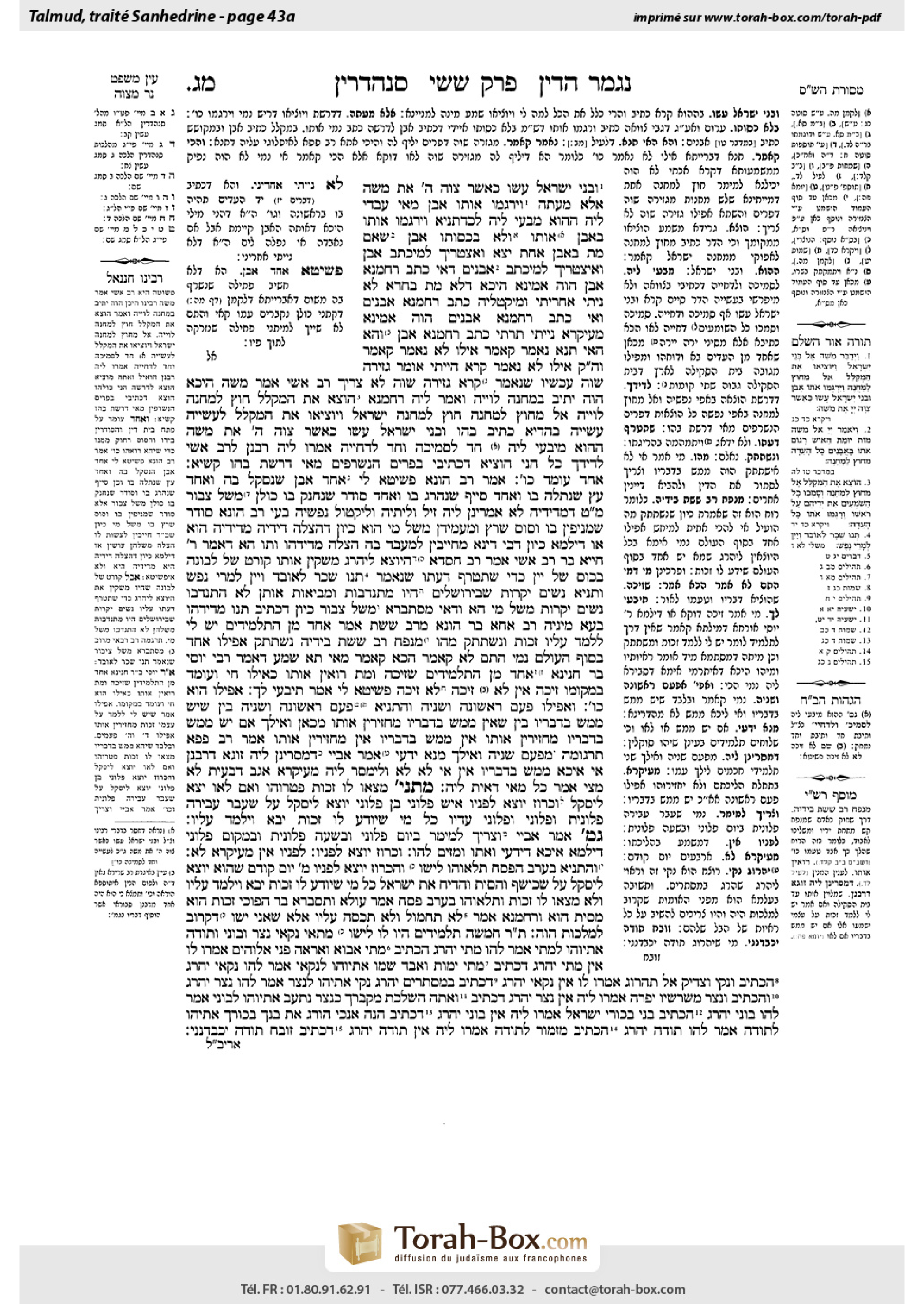
Sanhedrin 43a: Talmud study for Daf Yomi
Daf Yomi is the daily study of one Talmud folio. Explore 37 tractates with scans, Hebrew text, Sefaria English and AI-generated French translations where annotated.
Passage selection and English or AI-generated French translation are available where the scan has annotations. Daf Study is independent of Torah-Box and Sefaria.
Browse Sanhedrin · סנהדרין · All tractatesSanhedrin 43a text and translations
This page of Sanhedrin includes the Aramaic text, an English translation and an AI-generated French translation, alongside the scan above.
סנהדרין מ״ג א · Aramaic and Hebrew text
״וּבְנֵי יִשְׂרָאֵל עָשׂוּ כַּאֲשֶׁר צִוָּה ה׳ אֶת מֹשֶׁה״.
אֶלָּא מֵעַתָּה: ״וַיִּרְגְּמוּ אֹתוֹ אָבֶן״ מַאי עָבְדִי לֵיהּ? הָהוּא מִבְּעֵי לֵיהּ לְכִדְתַנְיָא: ״וַיִּרְגְּמוּ אֹתוֹ בָּאָבֶן״ – ״אֹתוֹ״ וְלֹא בִּכְסוּתוֹ, ״אָבֶן״ שֶׁאִם מֵת בְּאֶבֶן אַחַת יָצָא.
וְאִצְטְרִיךְ לְמִיכְתַּב ״אָבֶן״, וְאִיצְטְרִיךְ לְמִיכְתַּב ״אֲבָנִים״. דְּאִי כְּתַב רַחֲמָנָא ״אָבֶן״, הֲוָה אָמֵינָא: הֵיכָא דְּלָא מֵת בַּחֲדָא, לָא נַיְתֵי אַחֲרִיתִי וְנִיקְטְלֵיהּ. כְּתַב רַחֲמָנָא ״אֲבָנִים״. וְאִי כְּתַב רַחֲמָנָא ״אֲבָנִים״, הֲוָה אָמֵינָא: מֵעִיקָּרָא נַיְיתֵי תַּרְתֵּי. כְּתַב רַחֲמָנָא ״אָבֶן״.
וְהָא הַאי תַּנָּא ״נֶאֱמַר״ קָאָמַר? ״אִילּוּ לֹא נֶאֱמַר״ קָאָמַר, וְהָכִי קָאָמַר: אִילּוּ לֹא נֶאֱמַר קְרָא, הָיִיתִי אוֹמֵר גְּזֵירָה שָׁוָה. עַכְשָׁיו שֶׁנֶּאֱמַר קְרָא, גְּזֵירָה שָׁוָה לָא צְרִיךְ.
רַב אָשֵׁי אָמַר: מֹשֶׁה הֵיכָא הֲוָה יָתֵיב? בְּמַחֲנֵה לְוִיָּיה. וַאֲמַר לֵיהּ רַחֲמָנָא: ״הוֹצֵא אֶת הַמְקַלֵּל״ – חוּץ לְמַחֲנֵה לְוִיָּיה. ״אֶל מִחוּץ לַמַּחֲנֶה״ – חוּץ לְמַחֲנֵה יִשְׂרָאֵל. ״וַיּוֹצִיאוּ אֶת הַמְקַלֵּל״ – לַעֲשִׂיָּיה.
עֲשִׂיָּיה בְּהֶדְיָא כְּתִיב בְּהוּ: ״וּבְנֵי יִשְׂרָאֵל עָשׂוּ כַּאֲשֶׁר צִוָּה ה׳ אֶת מֹשֶׁה״. הָהוּא מִיבְּעֵי לֵיהּ, חַד לִסְמִיכָה וְחַד לִדְחִיָּיה.
אֲמַרוּ לֵיהּ רַבָּנַן לְרַב אָשֵׁי: לְדִידָךְ, כֹּל הָנֵי ״הוֹצִיא״ דִּכְתִיבִי בְּפָרִים הַנִּשְׂרָפִים, מַאי דָּרְשַׁתְּ בְּהוּ? קַשְׁיָא.
אֶחָד עוֹמֵד כּוּ׳. אָמַר רַב הוּנָא: פְּשִׁיטָא לִי, אֶחָד אֶבֶן שֶׁנִּסְקָל בָּהּ, וְאֶחָד עֵץ שֶׁנִּתְלֶה בּוֹ, וְאֶחָד סַיִיף שֶׁנֶּהֱרָג בּוֹ, וְאֶחָד סוּדָר שֶׁנֶּחְנָק בּוֹ – כּוּלָּן מִשֶּׁל צִבּוּר. מַאי טַעְמָא? דְּמִדִּידֵיהּ לָא אָמְרִינַן לֵיהּ: ״זִיל וְלֵיתֵיהּ וְלִיקְטוֹל נַפְשֵׁיהּ״.
בָּעֵי רַב הוּנָא: סוּדָר שֶׁמְּנִיפִין בּוֹ, וְסוּס שֶׁרָץ וּמַעֲמִידָן – מִשֶּׁל מִי הוּא? כֵּיוָן דְּהַצָּלָה דִּידֵיהּ, מִדִּידֵיהּ הוּא? אוֹ דִילְמָא, כֵּיוָן דְּבֵי דִּינָא מְחַיְּיבִין לְמֶעְבַּד לֵיהּ הַצָּלָה, מִדִּידְהוּ?
וְתוּ, הָא דְּאָמַר רַב חִיָּיא בַּר רַב אָשֵׁי אָמַר רַב חִסְדָּא: הַיּוֹצֵא לֵיהָרֵג מַשְׁקִין אוֹתוֹ קוֹרֶט שֶׁל לְבוֹנָה בְּכוֹס שֶׁל יַיִן כְּדֵי שֶׁתִּטָּרֵף דַּעְתּוֹ, שֶׁנֶּאֱמַר: ״תְּנוּ שֵׁכָר לְאוֹבֵד וְיַיִן לְמָרֵי נָפֶשׁ״. וְתַנְיָא: נָשִׁים יְקָרוֹת שֶׁבִּירוּשָׁלַיִם הָיוּ מִתְנַדְּבוֹת וּמְבִיאוֹת אוֹתָן. לֹא הִתְנַדְּבוּ נָשִׁים יְקָרוֹת, מִשֶּׁל מִי? הָא וַדַּאי מִסְתַּבְּרָא מִשֶּׁל צִבּוּר, כֵּיוָן דִּכְתִיב ״תְּנוּ״ – מִדִּידְהוּ.
בְּעָא מִינֵּיהּ רַב אַחָא בַּר הוּנָא מֵרַב שֵׁשֶׁת: אָמַר אֶחָד מִן הַתַּלְמִידִים ״יֵשׁ לִי לְלַמֵּד עָלָיו זְכוּת״, וְנִשְׁתַּתֵּק, מַהוּ? מְנַפַּח רַב שֵׁשֶׁת בִּידֵיהּ. נִשְׁתַּתֵּק? אֲפִילּוּ אֶחָד בְּסוֹף הָעוֹלָם נָמֵי! הָתָם לָא קָאָמַר, הָכָא קָאָמַר. מַאי?
תָּא שְׁמַע, דְּאָמַר רַבִּי יוֹסֵי בַּר חֲנִינָא: אֶחָד מִן הַתַּלְמִידִים שֶׁזִּיכָּה וָמֵת, רוֹאִין אוֹתוֹ כְּאִילּוּ חַי וְעוֹמֵד בִּמְקוֹמוֹ. זִיכָּה – אִין, לֹא זִיכָּה – לָא.
זִיכָּה – פְּשִׁיטָא לִי; אָמַר – תִּיבְּעֵי לָךְ.
אֲפִילּוּ הוּא כּוּ׳. וַאֲפִילּוּ פַּעַם רִאשׁוֹנָה וּשְׁנִיָּה? וְהָתַנְיָא: פַּעַם רִאשׁוֹנָה וּשְׁנִיָּה, בֵּין שֶׁיֵּשׁ מַמָּשׁ בִּדְבָרָיו בֵּין שֶׁאֵין מַמָּשׁ בִּדְבָרָיו – מַחְזִירִין אוֹתוֹ. מִכָּאן וָאֵילָךְ, אִם יֵשׁ מַמָּשׁ בִּדְבָרָיו – מַחְזִירִין אוֹתוֹ, אֵין מַמָּשׁ בִּדְבָרָיו – אֵין מַחְזִירִין אוֹתוֹ.
אָמַר רַב פָּפָּא: תַּרְגּוּמַהּ מִפַּעַם שְׁנִיָּה וְאֵילָךְ.
מְנָא יָדְעִי? אָמַר אַבָּיֵי: דְּמָסְרִינַן לֵיהּ זוּגָא דְּרַבָּנַן. אִי אִיכָּא מַמָּשׁ בִּדְבָרָיו – אִין, אִי לָא – לָא.
וְלִימְסַר לֵיהּ מֵעִיקָּרָא? אַגַּב דִּבְעִית, לָא מָצֵי אָמַר כֹּל מַאי דְּאִית לֵיהּ.
מַתְנִי׳ מָצְאוּ לוֹ זְכוּת – פְּטָרוּהוּ, וְאִם לָאו – יוֹצֵא לִיסָּקֵל. וְכָרוֹז יוֹצֵא לְפָנָיו: ״אִישׁ פְּלוֹנִי בֶּן פְּלוֹנִי יוֹצֵא לִיסָּקֵל עַל שֶׁעָבַר עֲבֵירָה פְּלוֹנִית, וּפְלוֹנִי וּפְלוֹנִי עֵדָיו. כׇּל מִי שֶׁיּוֹדֵעַ לוֹ זְכוּת יָבֹא וִילַמֵּד עָלָיו״.
גְּמָ׳ אָמַר אַבָּיֵי: וְצָרִיךְ לְמֵימַר בְּיוֹם פְּלוֹנִי, וּבְשָׁעָה פְּלוֹנִית, וּבְמָקוֹם פְּלוֹנִי. דִּילְמָא אִיכָּא דְּיָדַעי וְאָתֵי וּמַזֵּים לְהוּ.
וְכָרוֹז יוֹצֵא לְפָנָיו. לְפָנָיו – אִין, מֵעִיקָּרָא – לָא. וְהָתַנְיָא: בְּעֶרֶב הַפֶּסַח תְּלָאוּהוּ לְיֵשׁוּ הַנּוֹצְרִי, וְהַכָּרוֹז יוֹצֵא לְפָנָיו אַרְבָּעִים יוֹם: ״יֵשׁוּ הַנּוֹצְרִי יוֹצֵא לִיסָּקֵל עַל שֶׁכִּישֵּׁף וְהֵסִית וְהִדִּיחַ אֶת יִשְׂרָאֵל. כׇּל מִי שֶׁיּוֹדֵעַ לוֹ זְכוּת יָבוֹא וִילַמֵּד עָלָיו״. וְלֹא מָצְאוּ לוֹ זְכוּת, וּתְלָאוּהוּ בְּעֶרֶב הַפֶּסַח.
אָמַר עוּלָּא: וְתִסְבְּרָא? יֵשׁוּ הַנּוֹצְרִי בַּר הַפּוֹכֵי זְכוּת הוּא? מֵסִית הוּא, וְרַחֲמָנָא אָמַר: ״לֹא תַחְמֹל וְלֹא תְכַסֶּה עָלָיו!״ אֶלָּא שָׁאנֵי יֵשׁוּ, דְּקָרוֹב לְמַלְכוּת הֲוָה.
תָּנוּ רַבָּנַן: חֲמִשָּׁה תַּלְמִידִים הָיוּ לוֹ לְיֵשׁוּ הַנּוֹצְרִי – מַתַּאי, נַקַּאי, נֶצֶר, וּבוּנִי, וְתוֹדָה. אַתְיוּהּ לְמַתַּי. אֲמַר לְהוּ: מַתַּי יֵהָרֵג? הָכְתִיב ״מַתַּי אָבוֹא וְאֵרָאֶה פְּנֵי אֱלֹהִים״? אָמְרוּ לוֹ: אִין, מַתַּי יֵהָרֵג, דִּכְתִיב: ״מָתַי יָמוּת וְאָבַד שְׁמוֹ״.
אַתְיוּהּ לְנַקַּאי. אֲמַר לְהוּ: נַקַּאי יֵהָרֵג? הָכְתִיב ״וְנָקִי וְצַדִּיק אַל תַּהֲרֹג״? אָמְרוּ לוֹ: אִין, נַקַּאי יֵהָרֵג, דִּכְתִיב: ״בַּמִּסְתָּרִים יַהֲרֹג נָקִי״.
אַתְיוּהּ לְנֶצֶר. אָמַר: נֶצֶר יֵהָרֵג? הָכְתִיב ״וְנֵצֶר מִשׇּׁרָשָׁיו יִפְרֶה״? אָמְרוּ לוֹ: אִין, נֶצֶר יֵהָרֵג, דִּכְתִיב: ״וְאַתָּה הׇשְׁלַכְתָּ מִקִּבְרְךָ כְּנֵצֶר נִתְעָב״.
אַתְיוּהּ לְבוּנִי. אָמַר: בּוּנִי יֵהָרֵג? הָכְתִיב ״בְּנִי בְכֹרִי יִשְׂרָאֵל״! אָמְרוּ לוֹ: אִין, בּוּנִי יֵהָרֵג, דִּכְתִיב: ״הִנֵּה אָנֹכִי הוֹרֵג אֶת בִּנְךָ בְּכֹרֶךָ״.
אַתְיוּהּ לְתוֹדָה. אָמַר: תּוֹדָה יֵהָרֵג? הָכְתִיב ״מִזְמוֹר לְתוֹדָה״? אָמְרוּ לוֹ: אִין, תּוֹדָה יֵהָרֵג, דִּכְתִיב: ״זֹבֵחַ תּוֹדָה יְכַבְּדָנְנִי״.
Sanhedrin 43a · English translation
“And the children of Israel did as the Lord commanded Moses.”
The Gemara asks: If that is so, what do they do with the words in the verse: “And they stoned him with a stone”? These words appear to be superfluous, as even without them we would know that God’s instructions to stone the blasphemer were implemented. What then do they serve to teach? The Gemara answers: That phrase is necessary for that which is taught in a baraita: The verse states: “And they stoned him with a stone.” The word “him” teaches that they stoned him alone, while he was naked, but not while he was in his clothing. The verse uses the singular term “stone [aven]” rather than the plural term stones [avanim] to teach that if the condemned man died after being struck with one stone, the court has fulfilled its obligation.
The Gemara notes: And it was necessary to write with regard to the blasphemer that “they stoned him with a stone,” in the singular, and it was necessary to write with regard to the man who gathered sticks on Shabbat that “they stoned him with stones” (Numbers 15:36), in the plural. As, had the Merciful One written only “stone,” I would say that where the condemned man did not die after being struck with one stone, they do not bring other stones and kill him with them. Therefore, the Merciful One writes “stones.” And had the Merciful One written only “stones,” I would say that from the outset they should bring two or more stones. Therefore, the Merciful One writes “stone.”
The Gemara raises an objection to Rav Pappa’s derivation: But this tanna of the baraita cited above said: It is stated here and it is stated elsewhere, thereby basing his derivation on a verbal analogy between the verse concerning the blasphemer and the verse concerning the bulls brought as sin-offerings that are burned. How, then, can Rav Pappa, an amora, disagree and derive the halakha directly from the verse dealing with the blasphemer? The Gemara answers: According to Rav Pappa, the tanna of the baraita said: Had it not been stated, and this is what he is saying: Had a verse not been stated from which it can be directly derived that the condemned man is stoned outside all three camps, I would have said that this can be learned by way of a verbal analogy. But now that such a verse has been stated, the verbal analogy is not needed.
Rav Ashi said: The location of the place of stoning can be directly derived from the verse discussing the blasphemer but in a slightly different manner. Where was Moses sitting when the matter of the blasphemer was brought before him? In the Levite camp. And the Merciful One said to him: “Take out him who has cursed” (Leviticus 24:14), indicating that he should be taken outside the Levite camp into the Israelite camp. And God continued in that verse: “Outside the camp,” which is an additional command that he should be removed even further, to outside the Israelite camp. And the later verse, which says: “And they brought him that had cursed out of the camp…and the children of Israel did as the Lord commanded Moses” (Leviticus 24:23), teaches us about the implementation of God’s instructions, i.e., that the children of Israel did in fact carry out His command.
The Gemara raises an objection: The implementation of God’s instructions is written explicitly in this context, as it is stated in the continuation of the verse: “And the children of Israel did as the Lord commanded Moses.” The Gemara answers: That verse is necessary to teach us that not only was the condemned man taken outside the three camps and stoned, but the rest of God’s instructions were also fulfilled. These instructions relate to the placing of the witnesses’ hands upon the head of the condemned man, as it is stated: “And let all that heard him place their hands upon his head” (Leviticus 24:14), and to the witnesses’ pushing of the condemned man from a platform the height of two stories.
The Sages said to Rav Ashi: According to you, that the expression “take out” by itself means outside the camp, and “outside the camp” means outside an additional camp, what do you learn from all those instances of “take out” that are written with regard to the bulls brought as sin-offerings that are burned? According to your explanation, there are many superfluous phrases in the verses. The Gemara comments: Indeed, this is difficult with regard to the opinion of Rav Ashi.
§ The mishna teaches that one man stands at the entrance to the court, with cloths in his hand, ready to signal to the court agents leading the condemned man to his execution that some doubt has been raised with respect to the latter’s guilt. Rav Huna says: It is obvious to me that the stone with which the condemned man is stoned and the tree on which his corpse is hung after his execution, or the sword with which he is killed, or the scarf with which he is strangled, all of these come from the property of the community. What is the reason for this? We do not tell the condemned man to go and bring these items from his own property and effectively kill himself.
Rav Huna raised a dilemma: With regard to the cloth that is waved and the horse that races off after the court agents to stop the latter from carrying out the execution, from whose property do they come, that of the condemned man or that of the community? The Gemara explains the two sides of the dilemma: Since they are needed to save the man being led to his execution, these items should be taken from his property. Or perhaps, since the court is obligated to take all possible measures to save him from death, they should be taken from them, i.e., the community.
And furthermore, another question is raised along similar lines: With regard to that which Rav Ḥiyya bar Ashi says that Rav Ḥisda says: The court gives one who is being led out to be killed a grain [koret] of frankincense in a cup of wine in order to confuse his mind and thereby minimize his suffering from the fear of his impending death, as it is stated: “Give strong drink to him that is ready to perish, and wine to the bitter in soul” (Proverbs 31:6). And it is taught in a baraita: The prominent women of Jerusalem would donate this drink and bring it to those being led out to be killed. The question is: If these prominent women did not donate this drink, from whom is it taken? The Gemara answers: With regard to this question, it is certainly reasonable that this drink should be taken from the community, as it is written: “Give [tenu] strong drink,” in the plural, indicating that it should come from them, the community.
§ Rav Aḥa bar Huna asked Rav Sheshet: If one of the students sitting before the judges said: I can teach a reason to acquit him, and he became mute and cannot explain himself, what is the halakha in such a case? Does the court take heed of his words, or do they disregard him? Rav Sheshet waved his hands in scorn and said: If the student became mute, the court certainly does not pay attention to him, as were the court to concern themselves with what he said, they would have to be concerned even that perhaps there is someone at the end of the world who can propose an argument in the condemned man’s favor. The Gemara rejects this argument: The cases are not similar. There, no one said that he had a reason to acquit the condemned man. Here, the student already said that he had a reason to acquit the condemned man. The question, therefore, is appropriate. What is the halakha in such a case?
The Gemara suggests: Come and hear an answer: As Rabbi Yosei bar Ḥanina says: In a case where there was one of the students who argued to acquit the defendant and then died, the court views him as if he were alive and standing in his place and voting to acquit the defendant. The implication is that if he argued to acquit the defendant and explained his reasoning, yes, the court counts his vote as if he were still alive. But if he did not actually argue to acquit the defendant, but only said that he wished to propose such an argument, his vote is not counted as though he were still alive.
The Gemara rejects this proof: If the student argued to acquit the defendant, it is obvious to me that he should be counted among those favoring acquittal. But if he only says that he wishes to propose such an argument, let the dilemma be raised whether or not he should be regarded as having presented a convincing argument in favor of acquittal. The question is left unresolved.
The mishna teaches: And even if he, the condemned man himself, says: I can teach a reason to acquit myself, he is returned to the courthouse even four or five times, provided that there is substance to his words. The Gemara asks: And is the halakha that there must be substance to his words even the first and second time that the condemned man says that he can teach a reason to acquit himself? But isn’t it taught in a baraita: The first and second times that he says that he can teach a reason to acquit himself, they return him to the courthouse and consider whether there is substance to his statement or there is no substance to his statement. From this point forward, if there is substance to his statement they return him to the courthouse, but if there is no substance to his statement, they do not return him. This appears to contradict the mishna.
Rav Pappa said: Explain that the mishna’s ruling applies only from after the second time forward, that from that point on we examine whether there is substance to his words.
The Gemara asks: How do we know whether or not there is substance to his words? Abaye said: If the condemned man has already been returned twice to the courthouse, we send a pair of rabbis with him to evaluate his claim. If they find that there is substance to his statement, yes, he is returned once again to the courthouse; if not, he is not returned.
The Gemara asks: But why not send a pair of rabbis with him from the outset, even the first time, and have them make an initial assessment of his claim? The Gemara answers: Since a man facing execution is frightened by the thought of his impending death, he is not able to say all that he has to say, and perhaps out of fear he will be confused and not provide a substantial reason to overturn his verdict. Therefore, the first two times he is returned to the courthouse without an initial examination of his arguments. Once he has already been returned on two occasions, the court allows for no further delay, and they send two rabbis to evaluate his claim before returning him a third time.
MISHNA: If, after the condemned man is returned to the courthouse, the judges find a reason to acquit him, they acquit him and release him immediately. But if they do not find a reason to acquit him, he goes out to be stoned. And a crier goes out before him and publicly proclaims: So-and-so, son of so-and-so, is going out to be stoned because he committed such and such a transgression. And so-and-so and so-and-so are his witnesses. Anyone who knows of a reason to acquit him should come forward and teach it on his behalf.
GEMARA: Abaye says: And the crier must also publicly proclaim that the transgression was committed on such and such a day, at such and such an hour, and at such and such a place, as perhaps there are those who know that the witnesses could not have been in that place at that time, and they will come forward and render the witnesses conspiring witnesses.
The mishna teaches that a crier goes out before the condemned man. This indicates that it is only before him, i.e., while he is being led to his execution, that yes, the crier goes out, but from the outset, before the accused is convicted, he does not go out. The Gemara raises a difficulty: But isn’t it taught in a baraita: On Passover Eve they hung the corpse of Jesus the Nazarene after they killed him by way of stoning. And a crier went out before him for forty days, publicly proclaiming: Jesus the Nazarene is going out to be stoned because he practiced sorcery, incited people to idol worship, and led the Jewish people astray. Anyone who knows of a reason to acquit him should come forward and teach it on his behalf. And the court did not find a reason to acquit him, and so they stoned him and hung his corpse on Passover eve.
Ulla said: And how can you understand this proof? Was Jesus the Nazarene worthy of conducting a search for a reason to acquit him? He was an inciter to idol worship, and the Merciful One states with regard to an inciter to idol worship: “Neither shall you spare, neither shall you conceal him” (Deuteronomy 13:9). Rather, Jesus was different, as he had close ties with the government, and the gentile authorities were interested in his acquittal. Consequently, the court gave him every opportunity to clear himself, so that it could not be claimed that he was falsely convicted.
Apropos the trial of Jesus, the Gemara cites another baraita, where the Sages taught: Jesus the Nazarene had five disciples: Mattai, Nakai, Netzer, Buni, and Toda. They brought Mattai in to stand trial. Mattai said to the judges: Shall Mattai be executed? But isn’t it written: “When [matai] shall I come and appear before God?” (Psalms 42:3). Mattai claimed that this verse alludes to the fact he is righteous. They said to him: Yes, Mattai shall be executed, as it is written: “When [matai] shall he die, and his name perish?” (Psalms 41:6).
Then they brought Nakai in to stand trial. Nakai said to the judges: Shall Nakai be executed? But isn’t it written: “And the innocent [naki] and righteous you shall not slay” (Exodus 23:7)? They said to him: Yes, Nakai shall be executed, as it is written: “In secret places he kills the innocent [naki]” (Psalms 10:8).
Then they brought Netzer in to stand trial. He said to the judges: Shall Netzer be executed? But isn’t it written: “And a branch [netzer] shall grow out of his roots” (Isaiah 11:1)? They said to him: Yes, Netzer shall be executed, as it is written: “But you are cast out of your grave like an abhorred branch [netzer]” (Isaiah 14:19).
Then they brought Buni in to stand trial. Buni said to the judges: Shall Buni be executed? But isn’t it written: “My firstborn son [beni] is Israel” (Exodus 4:22)? They said to him: Yes, Buni shall be executed, as it is written: “Behold, I shall kill your firstborn son [binkha]” (Exodus 4:23).
Then they brought Toda in to stand trial. Toda said to the judges: Shall Toda be executed? But isn’t it written: “A psalm of thanksgiving [toda]” (Psalms 100:1)? They said to him: Yes, Toda shall be executed, as it is written: “Whoever slaughters a thanks-offering [toda] honors Me” (Psalms 50:23).
Sanhedrin 43a · Traduction française (IA)
« Et les enfants d’Israël firent comme l’Éternel l’avait ordonné à Moïse. »
La Guemara demande : Si tel est le cas, que font-ils des mots du verset : « Et ils le lapidèrent avec une pierre » ? Ces mots semblent superflus, car même sans eux, nous saurions que les instructions de Dieu visant à lapider le blasphémateur furent exécutées. Que viennent-ils donc enseigner ? La Guemara répond : Cette expression est nécessaire pour ce qui est enseigné dans une baraïta : le verset dit : « Et ils le lapidèrent avec une pierre. » Le mot « le » enseigne qu’ils le lapidèrent seul, alors qu’il était nu, et non alors qu’il était vêtu. Le verset emploie le singulier « pierre [aven] », et non le pluriel « pierres [avanim] », pour enseigner que si le condamné mourait après avoir été frappé par une seule pierre, le tribunal avait rempli son obligation.
La Guemara fait remarquer qu’il était nécessaire d’écrire, au sujet du blasphémateur, « ils le lapidèrent avec une pierre », au singulier, et d’écrire, au sujet de l’homme qui ramassait du bois le Chabbat, « ils le lapidèrent avec des pierres » (Nombres 15:36), au pluriel. En effet, si le Miséricordieux avait écrit seulement « pierre », j’aurais dit que si le condamné ne mourait pas après avoir été frappé par une pierre, ils n’en apporteraient pas d’autres pour le tuer avec. C’est pourquoi le Miséricordieux écrit « pierres ». Et si le Miséricordieux avait écrit seulement « pierres », j’aurais dit qu’ils devaient apporter dès le départ deux pierres ou davantage. C’est pourquoi le Miséricordieux écrit « pierre ».
La Guemara soulève une objection à la déduction de Rav Pappa : mais ce tanna de la baraïta citée plus haut a dit : « Il est dit ici et il est dit ailleurs », fondant ainsi sa déduction sur une analogie verbale entre le verset concernant le blasphémateur et celui concernant les taureaux apportés comme sacrifices expiatoires et brûlés. Comment Rav Pappa, un amora, peut-il alors être en désaccord et déduire la halakha directement du verset traitant du blasphémateur ? La Guemara répond : Selon Rav Pappa, le tanna de la baraïta a dit : « Si cela n’avait pas été dit » ; voici ce qu’il veut dire : si aucun verset n’avait été énoncé permettant de déduire directement que le condamné est lapidé à l’extérieur des trois camps, j’aurais dit qu’on peut l’apprendre au moyen d’une analogie verbale. Mais maintenant qu’un tel verset a été énoncé, l’analogie verbale n’est pas nécessaire.
Rav Ashi dit : L’emplacement du lieu de lapidation peut être déduit directement du verset qui parle du blasphémateur, mais d’une manière légèrement différente. Où Moïse était-il assis lorsque l’affaire du blasphémateur fut portée devant lui ? Dans le camp des Lévites. Le Miséricordieux lui dit alors : « Fais sortir celui qui a maudit » (Lévitique 24:14), indiquant qu’il devait être emmené hors du camp des Lévites, dans le camp d’Israël. Et Dieu poursuit dans ce verset : « Hors du camp », ce qui constitue un ordre supplémentaire de le déplacer encore plus loin, à l’extérieur du camp d’Israël. Quant au verset ultérieur, qui dit : « Ils firent sortir du camp celui qui avait maudit… et les enfants d’Israël firent comme l’Éternel l’avait ordonné à Moïse » (Lévitique 24:23), il nous enseigne que les instructions de Dieu furent exécutées, c’est-à-dire que les enfants d’Israël accomplirent effectivement Son ordre.
La Guemara soulève une objection : l’exécution des instructions de Dieu est explicitement mentionnée dans ce contexte, puisqu’il est dit dans la suite du verset : « Et les enfants d’Israël firent comme l’Éternel l’avait ordonné à Moïse. » La Guemara répond : ce verset est nécessaire pour nous enseigner que le condamné ne fut pas seulement emmené hors des trois camps et lapidé, mais que les autres instructions de Dieu furent également exécutées. Elles concernent le fait que les témoins posent leurs mains sur la tête du condamné, comme il est dit : « Que tous ceux qui l’ont entendu posent leurs mains sur sa tête » (Lévitique 24:14), ainsi que le fait que les témoins poussent le condamné d’une plateforme haute de deux étages.
Les Sages dirent à Rav Ashi : Selon toi, l’expression « fais sortir » signifie à elle seule « hors du camp », et « hors du camp » signifie hors d’un camp supplémentaire ; que déduis-tu alors de toutes les occurrences de « faire sortir » qui sont écrites au sujet des taureaux apportés comme sacrifices expiatoires et brûlés ? Selon ton explication, de nombreuses expressions des versets sont superflues. La Guemara fait remarquer : en effet, cela pose une difficulté concernant l’opinion de Rav Ashi.
§ La Michna enseigne qu’un homme se tient à l’entrée du tribunal, un tissu à la main, prêt à faire signe aux agents du tribunal qui conduisent le condamné à son exécution si un doute a été soulevé quant à sa culpabilité. Rav Huna dit : Il m’est évident que la pierre avec laquelle le condamné est lapidé, l’arbre auquel son cadavre est suspendu après son exécution, l’épée avec laquelle il est tué et le foulard avec lequel il est étranglé proviennent tous des biens de la communauté. Pourquoi ? Nous ne disons pas au condamné d’aller chercher ces objets dans ses propres biens et de se donner ainsi lui-même la mort.
Rav Huna soulève une question : le tissu que l’on agite et le cheval qui part au galop derrière les agents du tribunal pour les empêcher de procéder à l’exécution proviennent-ils des biens du condamné ou de ceux de la communauté ? D’un côté, puisqu’ils sont nécessaires pour sauver l’homme conduit à son exécution, ces objets devraient être pris sur ses biens. Ou peut-être que, puisque le tribunal est tenu de prendre toutes les mesures possibles pour le sauver de la mort, ils devraient être pris sur les biens de la communauté.
Une autre question du même ordre est également soulevée : Rav Ḥiyya bar Ashi dit au nom de Rav Ḥisda : le tribunal donne à celui qu’on conduit à la mort un grain [koret] d’encens dans une coupe de vin, afin de lui troubler l’esprit et de réduire ainsi ses souffrances dues à la crainte de sa mort imminente, comme il est dit : « Donnez des boissons fortes à celui qui va périr, et du vin à l’âme amère » (Proverbes 31:6). Et une baraïta enseigne : les femmes éminentes de Jérusalem offraient cette boisson et l’apportaient à ceux qu’on conduisait à la mort. La question est la suivante : si ces femmes éminentes n’offraient pas cette boisson, à qui la prend-on ? La Guemara répond : à cette question, il est certainement raisonnable que la boisson soit prise sur les biens de la communauté, car il est écrit : « Donnez [tenu] des boissons fortes », au pluriel, ce qui indique qu’elle doit provenir d’eux, c’est-à-dire de la communauté.
§ Rav Aḥa bar Huna demanda à Rav Sheshet : si l’un des étudiants assis devant les juges dit : « Je peux présenter un argument pour l’acquitter », puis devient muet et ne peut pas s’expliquer, quelle est la halakha dans un tel cas ? Le tribunal doit-il tenir compte de ses paroles ou les ignorer ? Rav Sheshet agita les mains avec mépris et dit : si l’étudiant est devenu muet, le tribunal ne tient certainement pas compte de lui, car s’il devait prendre en considération ce qu’il a dit, il lui faudrait aussi se préoccuper du fait qu’il existe peut-être quelqu’un à l’autre bout du monde capable de proposer un argument en faveur du condamné. La Guemara rejette cet argument : les cas ne sont pas comparables. Là-bas, personne n’a dit avoir un argument pour acquitter le condamné. Ici, l’étudiant a déjà dit qu’il avait un argument pour l’acquitter. La question se pose donc bien : quelle est la halakha dans un tel cas ?
La Guemara propose : viens et écoute une réponse. Rabbi Yosei bar Ḥanina dit : dans le cas où l’un des étudiants a argumenté en faveur de l’acquittement de l’accusé, puis est mort, le tribunal le considère comme s’il était vivant, se tenait à sa place et votait pour acquitter l’accusé. Cela implique que s’il a argumenté en faveur de l’acquittement et expliqué son raisonnement, oui, le tribunal compte son vote comme s’il était encore vivant. Mais s’il n’a pas effectivement argumenté en faveur de l’acquittement et a seulement dit qu’il souhaitait présenter un tel argument, son vote n’est pas compté comme s’il était encore vivant.
La Guemara rejette cette preuve : si l’étudiant a argumenté en faveur de l’acquittement de l’accusé, il m’est évident qu’il doit être compté parmi ceux qui sont favorables à l’acquittement. Mais s’il dit seulement qu’il souhaite présenter un tel argument, que l’on soulève la question de savoir s’il faut ou non le considérer comme ayant présenté un argument convaincant en faveur de l’acquittement. La question reste sans réponse.
La Michna enseigne : même si le condamné lui-même dit : « Je peux présenter un argument pour m’acquitter », on le ramène au tribunal jusqu’à quatre ou cinq fois, à condition que ses paroles aient du fondement. La Guemara demande : La halakha exige-t-elle qu’il y ait du fondement dans ses paroles dès la première et la deuxième fois que le condamné dit qu’il peut présenter un argument pour s’acquitter ? Pourtant, une baraïta n’enseigne-t-elle pas : les première et deuxième fois où il dit qu’il peut présenter un argument pour s’acquitter, on le ramène au tribunal et l’on examine si sa déclaration a du fondement ou non. À partir de ce moment, s’il y a du fondement dans sa déclaration, on le ramène au tribunal ; s’il n’y en a pas, on ne le ramène pas. Cela semble contredire la Michna.
Rav Pappa dit : explique que la décision de la Michna ne s’applique qu’à partir de la troisième fois, c’est-à-dire qu’à partir de là, on examine si ses paroles ont du fondement.
La Guemara demande : comment sait-on si ses paroles ont du fondement ou non ? Abaye dit : si le condamné a déjà été ramené deux fois au tribunal, nous envoyons avec lui deux rabbins pour évaluer son argument. S’ils trouvent que sa déclaration a du fondement, on le ramène une nouvelle fois au tribunal ; sinon, on ne le ramène pas.
La Guemara demande : mais pourquoi ne pas envoyer deux rabbins avec lui dès le départ, dès la première fois, afin qu’ils évaluent son argument ? La Guemara répond : comme un homme qui fait face à l’exécution est effrayé à l’idée de sa mort imminente, il ne parvient pas à dire tout ce qu’il a à dire ; peut-être que la peur le troublera et qu’il ne présentera pas d’argument solide pour renverser son verdict. C’est pourquoi, les deux premières fois, on le ramène au tribunal sans examiner préalablement ses arguments. Une fois qu’il y a déjà été ramené à deux reprises, le tribunal ne permet aucun délai supplémentaire et envoie deux rabbins évaluer son argument avant de le ramener une troisième fois.
MICHNA : Si, après que le condamné a été ramené au tribunal, les juges trouvent un motif pour l’acquitter, ils l’acquittent et le libèrent immédiatement. Mais s’ils ne trouvent pas de motif pour l’acquitter, il est conduit à la lapidation. Un crieur le précède et proclame publiquement : « Untel, fils d’untel, est conduit à la lapidation parce qu’il a commis telle et telle transgression. Untel et untel sont ses témoins. Que quiconque connaît un motif pour l’acquitter se présente et le fasse valoir en sa faveur. »
GUEMARA : Abaye dit : le crieur doit aussi proclamer publiquement que la transgression a été commise tel jour, à telle heure et en tel lieu, car certains savent peut-être que les témoins ne pouvaient pas se trouver à cet endroit à ce moment-là ; ils se présenteront alors et feront reconnaître les témoins comme des témoins comploteurs.
La Michna enseigne qu’un crieur précède le condamné. Cela indique que le crieur sort seulement lorsqu’il le précède, c’est-à-dire pendant qu’on le conduit à son exécution, mais qu’il ne sort pas dès le départ, avant que l’accusé soit condamné. La Guemara soulève une difficulté : pourtant, une baraïta n’enseigne-t-elle pas : la veille de Pessa’h, on pendit le cadavre de Jésus le Nazaréen, après l’avoir mis à mort par lapidation. Un crieur le précéda pendant quarante jours et proclama publiquement : « Jésus le Nazaréen est conduit à la lapidation parce qu’il a pratiqué la sorcellerie, incité des gens à l’idolâtrie et égaré le peuple juif. Que quiconque connaît un motif pour l’acquitter se présente et le fasse valoir en sa faveur. » Le tribunal ne trouva aucun motif pour l’acquitter ; on le lapida donc et l’on pendit son cadavre la veille de Pessa’h.
Ulla dit : comment pouvez-vous comprendre cette preuve ? Jésus le Nazaréen méritait-il qu’on cherche un motif pour l’acquitter ? Il était un incitateur à l’idolâtrie, et le Miséricordieux dit au sujet d’un tel incitateur : « Tu ne l’épargneras pas et tu ne le protégeras pas » (Deutéronome 13:9). Jésus était plutôt un cas particulier, car il avait des liens étroits avec le pouvoir et les autorités non juives souhaitaient son acquittement. Le tribunal lui donna donc toutes les possibilités de se disculper, afin que l’on ne puisse pas prétendre qu’il avait été condamné à tort.
À propos du procès de Jésus, la Guemara cite une autre baraïta, dans laquelle les Sages enseignent : Jésus le Nazaréen avait cinq disciples : Mattai, Nakai, Netzer, Buni et Toda. On fit comparaître Mattai. Mattai dit aux juges : « Mattai doit-il être exécuté ? Pourtant, n’est-il pas écrit : “Quand [matai] viendrai-je et paraîtrai-je devant Dieu ?” » (Psaumes 42:3). Mattai prétendait que ce verset faisait allusion à sa propre justice. Ils lui répondirent : « Oui, Mattai sera exécuté, car il est écrit : “Quand [matai] mourra-t-il, et quand son nom périra-t-il ?” » (Psaumes 41:6).
Puis on fit comparaître Nakai. Nakai dit aux juges : « Nakai doit-il être exécuté ? Pourtant, n’est-il pas écrit : “Tu ne tueras pas l’innocent [naki] ni le juste” » (Exode 23:7) ? Ils lui répondirent : « Oui, Nakai sera exécuté, car il est écrit : “Dans des lieux secrets, il tue l’innocent [naki]” » (Psaumes 10:8).
Puis on fit comparaître Netzer. Il dit aux juges : « Netzer doit-il être exécuté ? Pourtant, n’est-il pas écrit : “Un rameau [netzer] poussera de ses racines” » (Isaïe 11:1) ? Ils lui répondirent : « Oui, Netzer sera exécuté, car il est écrit : “Mais toi, tu es rejeté loin de ton tombeau, comme un rameau [netzer] abominable” » (Isaïe 14:19).
Puis on fit comparaître Buni. Buni dit aux juges : « Buni doit-il être exécuté ? Pourtant, n’est-il pas écrit : “Mon fils premier-né [beni], c’est Israël” » (Exode 4:22) ? Ils lui répondirent : « Oui, Buni sera exécuté, car il est écrit : “Voici, je vais tuer ton fils premier-né [binkha]” » (Exode 4:23).
Puis on fit comparaître Toda. Toda dit aux juges : « Toda doit-il être exécuté ? Pourtant, n’est-il pas écrit : “Psaume de reconnaissance [toda]” » (Psaumes 100:1) ? Ils lui répondirent : « Oui, Toda sera exécuté, car il est écrit : “Celui qui offre un sacrifice de reconnaissance [toda] m’honore” » (Psaumes 50:23).
Traduction française générée par IA à partir de l’édition anglaise de Sefaria. Vérifie toujours un passage avec le texte source.
Text from Sefaria: William Davidson Edition - Vocalized Aramaic (CC BY NC); William Davidson Edition - English (CC BY NC).