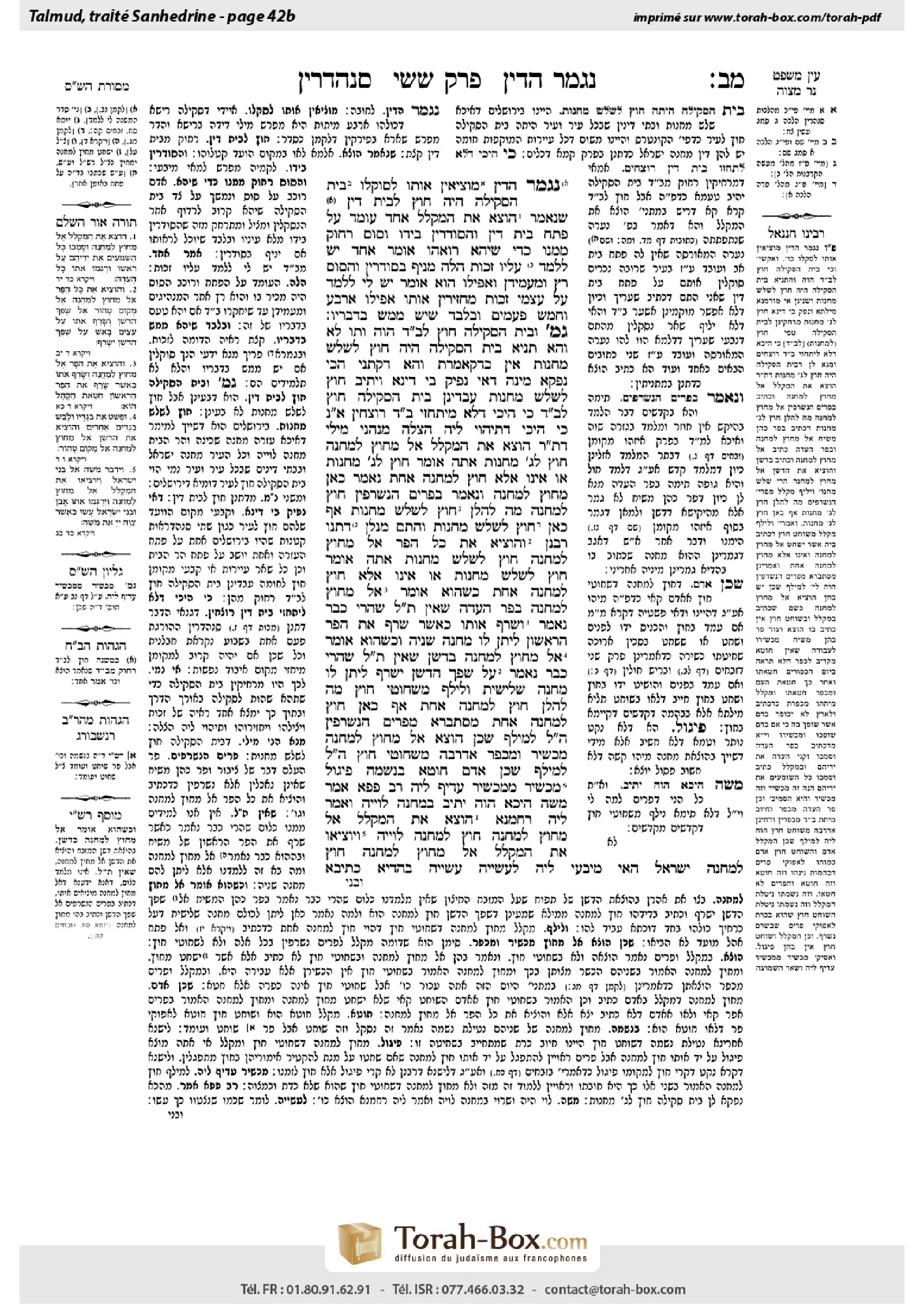
Sanhedrin 42b: Talmud study for Daf Yomi
Daf Yomi is the daily study of one Talmud folio. Explore 37 tractates with scans, Hebrew text, Sefaria English and AI-generated French translations where annotated.
Passage selection and English or AI-generated French translation are available where the scan has annotations. Daf Study is independent of Torah-Box and Sefaria.
Browse Sanhedrin · סנהדרין · All tractatesSanhedrin 42b text and translations
This page of Sanhedrin includes the Aramaic text, an English translation and an AI-generated French translation, alongside the scan above.
סנהדרין מ״ב ב · Aramaic and Hebrew text
מַתְנִי׳ נִגְמַר הַדִּין, מוֹצִיאִין אוֹתוֹ לְסוֹקְלוֹ. בֵּית הַסְּקִילָה הָיָה חוּץ לְבֵית דִּין, שֶׁנֶּאֱמַר: ״הוֹצֵא אֶת הַמְקַלֵּל״.
אֶחָד עוֹמֵד עַל פֶּתַח בֵּית דִּין, וְהַסּוּדָרִין בְּיָדוֹ, וְסוּס רָחוֹק מִמֶּנּוּ כְּדֵי שֶׁיְּהֵא רוֹאֵהוּ. אוֹמֵר אֶחָד: ״יֵשׁ לְלַמֵּד עָלָיו זְכוּת״, הַלָּה מֵנִיף בְּסוּדָרִין, וְהַסּוּס רָץ וּמַעֲמִידָן. וַאֲפִילּוּ הוּא אוֹמֵר: ״יֵשׁ לִי לְלַמֵּד עַל עַצְמִי זְכוּת״, מַחֲזִירִין אוֹתוֹ, אֲפִילּוּ אַרְבַּע וְחָמֵשׁ פְּעָמִים, וּבִלְבַד שֶׁיֵּשׁ מַמָּשׁ בִּדְבָרָיו.
גְּמָ׳ וּבֵית הַסְּקִילָה חוּץ לְבֵית דִּין הֲוָה, וְתוּ לָא? וְהָא תַּנְיָא: בֵּית הַסְּקִילָה הָיָה חוּץ לְשָׁלֹשׁ מַחֲנוֹת.
אִין, כִּדְקָאָמְרַתְּ. וְהָא דְּקָתָנֵי הָכִי, נָפְקָא מִינַּהּ דְּאִי נָפֵיק בֵּי דִינָא וְיָתֵיב חוּץ לְשָׁלֹשׁ מַחֲנוֹת, עָבְדִינַן בֵּית הַסְּקִילָה חוּץ לְבֵית דִּין, כִּי הֵיכִי דְּלָא מִיתְחֲזֵי בֵּית דִּין רוֹצְחִין. אִי נָמֵי, כִּי הֵיכִי דְּתִיהְוֵי לֵיהּ הַצָּלָה.
מְנָהָנֵי מִילֵּי? דְּתָנוּ רַבָּנַן: ״הוֹצֵא אֶת הַמְקַלֵּל אֶל מִחוּץ לַמַּחֲנֶה״ – חוּץ לְשָׁלֹשׁ מַחֲנוֹת. אַתָּה אוֹמֵר חוּץ לְשָׁלֹשׁ מַחֲנוֹת, אוֹ אֵינוֹ אֶלָּא חוּץ לְמַחֲנֶה אַחַת? נֶאֱמַר כָּאן ״מִחוּץ לַמַּחֲנֶה״, וְנֶאֱמַר בְּפָרִים הַנִּשְׂרָפִין ״חוּץ לְמַחֲנֶה״. מָה לְהַלָּן – חוּץ לְשָׁלֹשׁ מַחֲנוֹת, אַף כָּאן – חוּץ לְשָׁלֹשׁ מַחֲנוֹת.
וְהָתָם מְנָלַן? דְּתָנוּ רַבָּנַן: ״וְהוֹצִיא אֶת כׇּל הַפָּר אֶל מִחוּץ לַמַּחֲנֶה״ – חוּץ לְשָׁלֹשׁ מַחֲנוֹת. אַתָּה אוֹמֵר חוּץ לְשָׁלֹשׁ מַחֲנוֹת, אוֹ אֵינוֹ אֶלָּא חוּץ לְמַחֲנֶה אַחַת?
כְּשֶׁהוּא אוֹמֵר ״אֶל מִחוּץ לַמַּחֲנֶה״ בְּפַר הָעֵדָה, שֶׁאֵין תַּלְמוּד לוֹמַר, שֶׁהֲרֵי כְּבָר נֶאֱמַר ״וְשָׂרַף אֹתוֹ כַּאֲשֶׁר שָׂרַף אֵת הַפָּר הָרִאשׁוֹן״ – לִיתֵּן לוֹ מַחֲנֶה שְׁנִיָּה.
וּכְשֶׁהוּא אוֹמֵר ״אַל מִחוּץ לַמַּחֲנֶה״ בְּדֶשֶׁן, שֶׁאֵין תַּלְמוּד לוֹמַר, שֶׁהֲרֵי כְּבָר נֶאֱמַר ״עַל שֶׁפֶךְ הַדֶּשֶׁן יִשָּׂרֵף״ – לִיתֵּן לוֹ מַחֲנֶה שְׁלִישִׁית.
וְלֵילַף מִשְּׁחוּטֵי חוּץ? מָה לְהַלָּן חוּץ לְמַחֲנֶה אַחַת, אַף כָּאן חוּץ לְמַחֲנֶה אַחַת.
מִסְתַּבְּרָא, מִפָּרִים הַנִּשְׂרָפִין הֲוָה לֵיהּ לְמֵילַף,
שֶׁכֵּן ״הוֹצֵא אֶל מִחוּץ לַמַּחֲנֶה״, מַכְשִׁיר וּמְכַפֵּר.
אַדְּרַבָּה, מִשְּׁחוּטֵי חוּץ הֲוָה לֵיהּ לְמֵילַף,
שֶׁכֵּן אָדָם חוֹטֵא, בִּנְשָׁמָה, פִּיגּוּל.
מַכְשִׁיר מִמַּכְשִׁיר עֲדִיף לֵיהּ.
רַב פָּפָּא אָמַר: מֹשֶׁה הֵיכָא הֲוָה יָתֵיב? בְּמַחֲנֵה לְוִיָּיה. וַאֲמַר לֵיהּ רַחֲמָנָא: ״הוֹצֵא אֶת הַמְקַלֵּל אֶל מִחוּץ לַמַּחֲנֶה״ – חוּץ לְמַחֲנֵה לְוִיָּיה. ״וַיּוֹצִיאוּ אֶת הַמְקַלֵּל אֶל מִחוּץ לַמַּחֲנֶה״ – חוּץ לְמַחֲנֵה יִשְׂרָאֵל.
הַאי מִיבְּעֵי לֵיהּ לַעֲשִׂיָּיה? עֲשִׂיָּיה בְּהֶדְיָא כְּתִיבָא:
Sanhedrin 42b · English translation
MISHNA: When the trial has ended in a guilty verdict and the condemned man has been sentenced to be stoned, he is taken out to be stoned. The place of stoning was outside the court and a little beyond it, as it is stated with regard to a blasphemer: “Take out him who has cursed to outside the camp, and let all that heard him lay their hands upon his head, and let all the congregation stone him” (Leviticus 24:14).
One man stands at the entrance to the court, with cloths [vehasudarin] in his hand, and another man sits on a horse at a distance from him but where he can still see him. If one of the judges says: I can teach a reason to acquit him, the other, i.e., the man with the cloths, waves the cloths as a signal to the man on the horse, and the horse races off after the court agents who are leading the condemned man to his execution, and he stops them, and they wait until the court determines whether or not the argument has substance. And even if he, the condemned man himself, says: I can teach a reason to acquit myself, he is returned to the courthouse, even four or five times, provided that there is substance to his words.
GEMARA: The Gemara asks: And was the place of stoning just outside the court and nothing more? Does it suffice that the place of execution is only a short distance from the court and no further? But isn’t it taught in a baraita: The place of stoning was outside the distance that is equivalent to the length of the three camps in the wilderness: The camp of the Divine Presence, the camp of the Levites, and the camp of the Israelites. In Jerusalem there were three corresponding camps: The Temple with its courtyard, the Temple Mount, and the rest of the city. The distance in the wilderness outside of the three camps corresponds to a place outside the city walls and limits.
The Gemara answers: Yes, it is as you said, that the place of stoning was outside the three camps. And the practical difference from the fact that the mishna teaches the halakha in this manner is that if it happened that the court went out and convened outside the three camps, even then the place of stoning is set up at a certain distance from the court, and not immediately adjacent to it, so that the court should not appear to be a court of killers. Alternatively, the reason the place of stoning must be distanced from the court is so that the condemned man might have a chance to be saved, i.e., so that during the time it takes for him to be taken from the court to the place of stoning someone will devise a claim in his favor.
The Gemara asks: From where is this matter derived that the stoning is carried out outside the three camps? As the Sages taught a baraita with regard to the verse: “Take out him who has cursed to outside the camp” (Leviticus 24:14). This means: Outside the three camps, i.e., even outside the camp of the Israelites. Do you say that he is taken outside the three camps, or is he perhaps taken outside only one camp? Proof is brought that he must be taken outside the three camps: It is stated here that the condemned man is taken “outside the camp” and it is stated with regard to the bulls brought as sin-offerings that are burned that they must be burned “outside the camp” (Leviticus 4:12). Just as there, the bulls brought as sin-offerings are burned when outside the three camps, so too here, the condemned man is taken outside the three camps.
The Gemara asks: And there, with regard to the bulls brought as sin-offerings that are burned, from where do we derive that they must be burned when outside all three camps? As the Sages taught in a baraita: It is stated about the bull brought as a sin-offering of the High Priest: “Even the whole bull shall he carry outside the camp unto a clean place, where the ashes are poured out, and burn it” (Leviticus 4:12), meaning that he should take it outside the three camps. Do you say that he takes it outside the three camps, or is he required to take it outside only one camp?
When the verse states with regard to the bull brought as a communal sin-offering: “He shall carry the bull outside the camp, and burn it as he burned the first bull” (Leviticus 4:21), it requires explanation, as there is no need for the verse to state “outside the camp,” since it is already stated at the end of that same verse: “And burn it as he burned the first bull,” which indicates that all the halakhot of the bull brought as a sin-offering of a High Priest apply to the bull brought as a communal sin-offering. What then does the verse mean when it states “outside the camp”? To give it a second camp, i.e., it indicates that it must be removed not only from the camp of the Divine Presence, corresponding to the Temple, but also from the Levite camp, corresponding to the Temple Mount.
And when another verse states with regard to the removal of the ash: “And he shall put off his garments, and put on other garments, and carry forth the ashes outside the camp to a clean place” (Leviticus 6:4), that verse also requires an explanation, as there is no need for the verse to state this, since it is already stated with regard to the bull brought as a sin-offering of a High Priest: “Even the whole bull shall he carry outside the camp to a clean place, where the ashes are poured out, and burn it on wood with fire; where the ashes are poured out shall it be burned” (Leviticus 4:12). The repetition of “outside the camp” indicates that he is required to give it a third camp, i.e., teaching that it is burned when outside the Israelite camp, corresponding to the land outside Jerusalem’s walls.
The Gemara challenges this derivation of the halakha governing one who is sentenced to be stoned from the halakha governing the burning of bulls brought as sin-offerings. Perhaps the place of stoning should be learned from the halakha governing offerings slaughtered outside the Temple courtyard, about which the verse also uses the expression “outside the camp” (see Leviticus 17:3). Just as there, with regard to offerings slaughtered outside the Temple courtyard, these words mean: Outside only one camp, the camp of the Divine Presence, corresponding to the Temple, as the next verse states: “And he did not bring it to the door of the Tent of Meeting” (Leviticus 17:4), i.e., the camp of the Divine Presence, so too here, the condemned man should be stoned outside one camp.
The Gemara answers: For three reasons it is reasonable to derive the halakha governing one who is sentenced to be stoned from the halakha governing bulls brought as sin-offerings that are burned.
The Gemara explains: As with regard to the man to be stoned for blasphemy it states: “Take out [hotze] him who has cursed to outside the camp,” which is similar to what is stated about the sin bull-offerings: “Even the whole bull shall he carry [vehotzi] outside the camp,” whereas with regard to offerings slaughtered outside the Temple courtyard it merely says: “Outside the camp.” Additionally, both in the case of stoning and in the case of the bulls brought as sin-offerings, going outside the camp renders the act fit, as the blasphemer may not be stoned and the bulls may not be burned inside the camp, in contrast to the case of the offerings slaughtered outside the Temple courtyard, where slaughtering them outside the camp renders the act forbidden. And additionally, both in the case of stoning and in the case of the bulls brought as sin-offerings, being outside the camp achieves atonement, as both capital punishment and sin-offerings atone for sin.
The Gemara rejects this reasoning: On the contrary, the halakha governing one who is sentenced to be stoned should be derived from the halakha governing offerings slaughtered outside the Temple courtyard, for four reasons.
The Gemara explains the four reasons: As in both cases it is a person who is outside, either the one who is taken outside for stoning, or the one who slaughters the offerings outside the Temple courtyard, whereas in the case of the bulls brought as sin-offerings, it is the bulls that are carried outside the camp. Additionally, both the blasphemer and the one who slaughters offerings outside the Temple courtyard have committed a sin, while the bull has not. Additionally, both the blasphemer and the one who slaughters offerings outside the Temple courtyard pay with their souls, as slaughtering an offering outside the Temple is punishable with karet. And lastly, both in the case of the blasphemer and in the case of offerings slaughtered outside the Temple courtyard, the halakha of disqualification of an offering that was sacrificed with the intent to consume it after its designated time [piggul] is not applicable, whereas this halakha is applicable to the bulls brought as sin-offerings.
The Gemara explains: Nevertheless, the baraita prefers to compare one case requiring going outside the camp to render an act fit and another case requiring going outside the camp to render an act fit, rather than comparing one case requiring going outside the camp to render an act fit and another case of going outside the camp that renders the act forbidden, as this is the most notable of the factors mentioned.
Rav Pappa said: The matter of the location of the place of stoning can be derived from the verses themselves: Where was Moses sitting when the matter of the blasphemer was brought before him? In the Levite camp, as he was a Levite, and it was there that the blasphemer was brought for trial. And the Merciful One said to Moses: “Take out him who has cursed to outside the camp,” indicating that he should be taken outside the Levite camp into the Israelite camp. And later it says: “And Moses spoke to the children of Israel, and they brought him that had cursed out of the camp, and they stoned him with a stone. And the children of Israel did as the Lord commanded Moses” (Leviticus 24:23), teaching that he was taken outside the Israelite camp as well.
The Gemara raises an objection: This additional verse is necessary to teach us about the implementation of God’s instructions, i.e., that the Jewish people did in fact carry out God’s command, but this verse should not be understood as referring to an additional camp. The Gemara answers: The implementation of God’s instructions is written explicitly, as it is stated in the continuation of the verse:
Sanhedrin 42b · Traduction française (IA)
MICHNA : Lorsque le procès s’est achevé par un verdict de culpabilité et que le condamné a été condamné à la lapidation, on le conduit au lieu de la lapidation. Celui-ci se trouvait à l’extérieur du tribunal, à une certaine distance de celui-ci, comme il est dit au sujet du blasphémateur : « Fais sortir celui qui a maudit hors du camp, et que tous ceux qui l’ont entendu posent leurs mains sur sa tête ; puis que toute l’assemblée le lapide » (Lévitique 24:14).
Un homme se tient à l’entrée du tribunal, des étoffes [vehasudarin] à la main, et un autre homme est assis sur un cheval à une certaine distance de lui, mais de manière à pouvoir encore le voir. Si l’un des juges dit : « Je peux avancer un argument pour l’acquitter », l’autre, c’est-à-dire l’homme qui tient les étoffes, les agite pour faire signe à l’homme à cheval. Celui-ci part au galop à la poursuite des agents du tribunal qui conduisent le condamné à son exécution, les arrête, et ils attendent que le tribunal détermine si l’argument est fondé ou non. Même si le condamné lui-même dit : « Je peux avancer un argument pour m’acquitter », on le ramène au tribunal, même quatre ou cinq fois, à condition que ses propos soient fondés.
GUEMARA : La Guemara demande : Le lieu de la lapidation se trouvait-il simplement à l’extérieur du tribunal, sans être plus éloigné ? Suffit-il que le lieu d’exécution soit à faible distance du tribunal ? Pourtant, n’est-il pas enseigné dans une baraïta que le lieu de la lapidation se trouvait au-delà de la distance correspondant à l’étendue des trois camps dans le désert : le camp de la Présence divine, le camp des Lévites et le camp des Israélites. À Jérusalem, trois camps leur correspondaient : le Temple et sa cour, le mont du Temple et le reste de la ville. La distance qui, dans le désert, séparait le lieu des trois camps correspond à un lieu situé à l’extérieur des murailles et des limites de la ville.
La Guemara répond : Oui, comme tu l’as dit, le lieu de la lapidation se trouvait à l’extérieur des trois camps. La conséquence pratique de la manière dont la Michna enseigne cette halakha est que, si le tribunal sortait et siégeait à l’extérieur des trois camps, le lieu de la lapidation devait tout de même être établi à une certaine distance du tribunal, et non juste à côté, afin que le tribunal ne donne pas l’impression d’être une cour de meurtriers. Autre explication : le lieu de la lapidation devait être éloigné du tribunal afin que le condamné ait une chance d’être sauvé, c’est-à-dire que, pendant le temps nécessaire pour le conduire du tribunal au lieu de la lapidation, quelqu’un puisse trouver un argument en sa faveur.
La Guemara demande : D’où déduit-on que la lapidation doit être exécutée à l’extérieur des trois camps ? Les Sages enseignèrent dans une baraïta, au sujet du verset : « Fais sortir celui qui a maudit hors du camp » (Lévitique 24:14), que cela signifie : à l’extérieur des trois camps, c’est-à-dire même à l’extérieur du camp des Israélites. Faut-il comprendre qu’il est conduit à l’extérieur des trois camps, ou peut-être seulement à l’extérieur d’un camp ? On apporte une preuve qu’il doit être conduit à l’extérieur des trois camps : il est dit ici que le condamné est conduit « hors du camp », et il est dit au sujet des taureaux apportés comme sacrifices expiatoires et brûlés qu’ils doivent être brûlés « hors du camp » (Lévitique 4:12). De même que les taureaux apportés comme sacrifices expiatoires sont brûlés à l’extérieur des trois camps, de même, ici, le condamné est conduit à l’extérieur des trois camps.
La Guemara demande : Et là, au sujet des taureaux apportés comme sacrifices expiatoires et brûlés, d’où déduit-on qu’ils doivent être brûlés à l’extérieur des trois camps ? Les Sages enseignèrent dans une baraïta : il est dit au sujet du taureau apporté comme sacrifice expiatoire par le grand prêtre : « Le taureau entier, il le portera hors du camp, vers un lieu pur, où l’on déverse les cendres, et il le brûlera » (Lévitique 4:12). Cela signifie qu’il doit le conduire à l’extérieur des trois camps. Faut-il comprendre qu’il le conduit à l’extérieur des trois camps, ou doit-il seulement le conduire à l’extérieur d’un camp ?
Lorsque le verset dit, au sujet du taureau apporté comme sacrifice expiatoire par la communauté : « Il portera le taureau hors du camp et le brûlera comme il a brûlé le premier taureau » (Lévitique 4:21), cela demande une explication : le verset n’avait pas besoin de dire « hors du camp », puisqu’il est déjà dit à la fin de ce même verset : « et le brûlera comme il a brûlé le premier taureau », ce qui indique que toutes les halakhot relatives au taureau apporté comme sacrifice expiatoire par le grand prêtre s’appliquent au taureau apporté comme sacrifice expiatoire par la communauté. Que signifie donc l’expression « hors du camp » ? Elle lui ajoute un deuxième camp, c’est-à-dire qu’elle indique qu’il faut le faire sortir non seulement du camp de la Présence divine, correspondant au Temple, mais aussi du camp des Lévites, correspondant au mont du Temple.
Et lorsqu’un autre verset dit, au sujet de l’évacuation des cendres : « Il ôtera ses vêtements, en revêtira d’autres, et emportera les cendres hors du camp, vers un lieu pur » (Lévitique 6:4), cela demande également une explication : il n’était pas nécessaire de le dire, puisque le verset relatif au taureau apporté comme sacrifice expiatoire par le grand prêtre dit déjà : « Le taureau entier, il le portera hors du camp, vers un lieu pur, où l’on déverse les cendres, et il le brûlera sur du bois au feu ; là où l’on déverse les cendres, il sera brûlé » (Lévitique 4:12). La répétition de « hors du camp » indique qu’il faut lui ajouter un troisième camp, c’est-à-dire qu’il est brûlé à l’extérieur du camp des Israélites, ce qui correspond au territoire situé au-delà des murailles de Jérusalem.
La Guemara conteste cette déduction de la halakha concernant celui qui est condamné à la lapidation à partir de la halakha relative aux taureaux apportés comme sacrifices expiatoires et brûlés. Peut-être faut-il déduire le lieu de la lapidation de la halakha concernant les sacrifices égorgés à l’extérieur de la cour du Temple, à propos desquels le verset emploie également l’expression « hors du camp » (voir Lévitique 17:3). De même que là, au sujet des sacrifices égorgés à l’extérieur de la cour du Temple, ces mots signifient « à l’extérieur d’un seul camp », le camp de la Présence divine, correspondant au Temple, comme le verset suivant le dit : « et il ne l’a pas apporté à l’entrée de la Tente d’assignation » (Lévitique 17:4), c’est-à-dire au camp de la Présence divine, de même, ici, le condamné devrait être lapidé à l’extérieur d’un seul camp.
La Guemara répond : Il est raisonnable, pour trois raisons, de déduire la halakha concernant celui qui est condamné à la lapidation de celle qui concerne les taureaux apportés comme sacrifices expiatoires et brûlés.
La Guemara explique : au sujet de l’homme qui doit être lapidé pour blasphème, il est dit : « Fais sortir [hotze] celui qui a maudit hors du camp », ce qui ressemble à ce qui est dit au sujet des taureaux apportés comme sacrifices expiatoires : « Le taureau entier, il le portera [vehotzi] hors du camp », tandis qu’au sujet des sacrifices égorgés à l’extérieur de la cour du Temple, il est simplement dit : « hors du camp ». De plus, tant dans le cas de la lapidation que dans celui des taureaux apportés comme sacrifices expiatoires, le fait de sortir du camp rend l’acte permis : le blasphémateur ne peut pas être lapidé à l’intérieur du camp et les taureaux ne peuvent pas y être brûlés. Cela contraste avec le cas des sacrifices égorgés à l’extérieur de la cour du Temple, où le fait de les égorger hors du camp rend l’acte interdit. Enfin, tant dans le cas de la lapidation que dans celui des taureaux apportés comme sacrifices expiatoires, le fait d’être hors du camp permet l’expiation, car la peine capitale comme les sacrifices expiatoires expient le péché.
La Guemara rejette ce raisonnement : au contraire, la halakha concernant celui qui est condamné à la lapidation devrait être déduite de la halakha concernant les sacrifices égorgés à l’extérieur de la cour du Temple, et ce pour quatre raisons.
La Guemara expose les quatre raisons : dans les deux cas, c’est une personne qui se trouve à l’extérieur, soit celui qui est conduit dehors pour être lapidé, soit celui qui égorge les sacrifices à l’extérieur de la cour du Temple, tandis que, dans le cas des taureaux apportés comme sacrifices expiatoires, ce sont les taureaux qui sont emportés hors du camp. De plus, tant le blasphémateur que celui qui égorge des sacrifices à l’extérieur de la cour du Temple ont commis un péché, contrairement au taureau. En outre, tant le blasphémateur que celui qui égorge des sacrifices à l’extérieur de la cour du Temple paient de leur vie, car égorger un sacrifice à l’extérieur du Temple est passible de retranchement (karet). Enfin, tant dans le cas du blasphémateur que dans celui des sacrifices égorgés à l’extérieur de la cour du Temple, la halakha relative à l’invalidation d’un sacrifice offert avec l’intention d’en consommer après le temps qui lui est prescrit [piggul] ne s’applique pas, alors qu’elle s’applique aux taureaux apportés comme sacrifices expiatoires.
La Guemara explique : néanmoins, la baraïta préfère comparer un cas où il faut sortir du camp pour rendre l’acte permis à un autre cas où il faut sortir du camp pour rendre l’acte permis, plutôt que de comparer un cas où il faut sortir du camp pour rendre l’acte permis à un autre cas où sortir du camp rend l’acte interdit, car c’est le facteur le plus déterminant parmi ceux qui ont été mentionnés.
Rav Pappa dit : l’emplacement du lieu de la lapidation peut être déduit des versets eux-mêmes. Où Moïse était-il assis lorsque l’affaire du blasphémateur lui fut présentée ? Dans le camp des Lévites, puisqu’il était lévite, et c’est là que le blasphémateur fut amené pour être jugé. Le Miséricordieux dit alors à Moïse : « Fais sortir celui qui a maudit hors du camp », indiquant qu’il devait être conduit hors du camp des Lévites, dans le camp des Israélites. Puis il est dit : « Moïse parla aux enfants d’Israël, et ils firent sortir du camp celui qui avait maudit, et ils le lapidèrent avec une pierre. Les enfants d’Israël firent comme le Seigneur l’avait ordonné à Moïse » (Lévitique 24:23), ce qui enseigne qu’il fut également conduit hors du camp des Israélites.
La Guemara soulève une objection : ce verset supplémentaire est nécessaire pour nous enseigner que les instructions de Dieu ont été mises en œuvre, c’est-à-dire que le peuple juif a effectivement exécuté l’ordre de Dieu ; mais il ne faut pas comprendre ce verset comme faisant référence à un camp supplémentaire. La Guemara répond : la mise en œuvre des instructions de Dieu est déjà explicitement mentionnée, comme il est dit dans la suite du verset :
Traduction française générée par IA à partir de l’édition anglaise de Sefaria. Vérifie toujours un passage avec le texte source.
Text from Sefaria: William Davidson Edition - Vocalized Aramaic (CC BY NC); William Davidson Edition - English (CC BY NC).