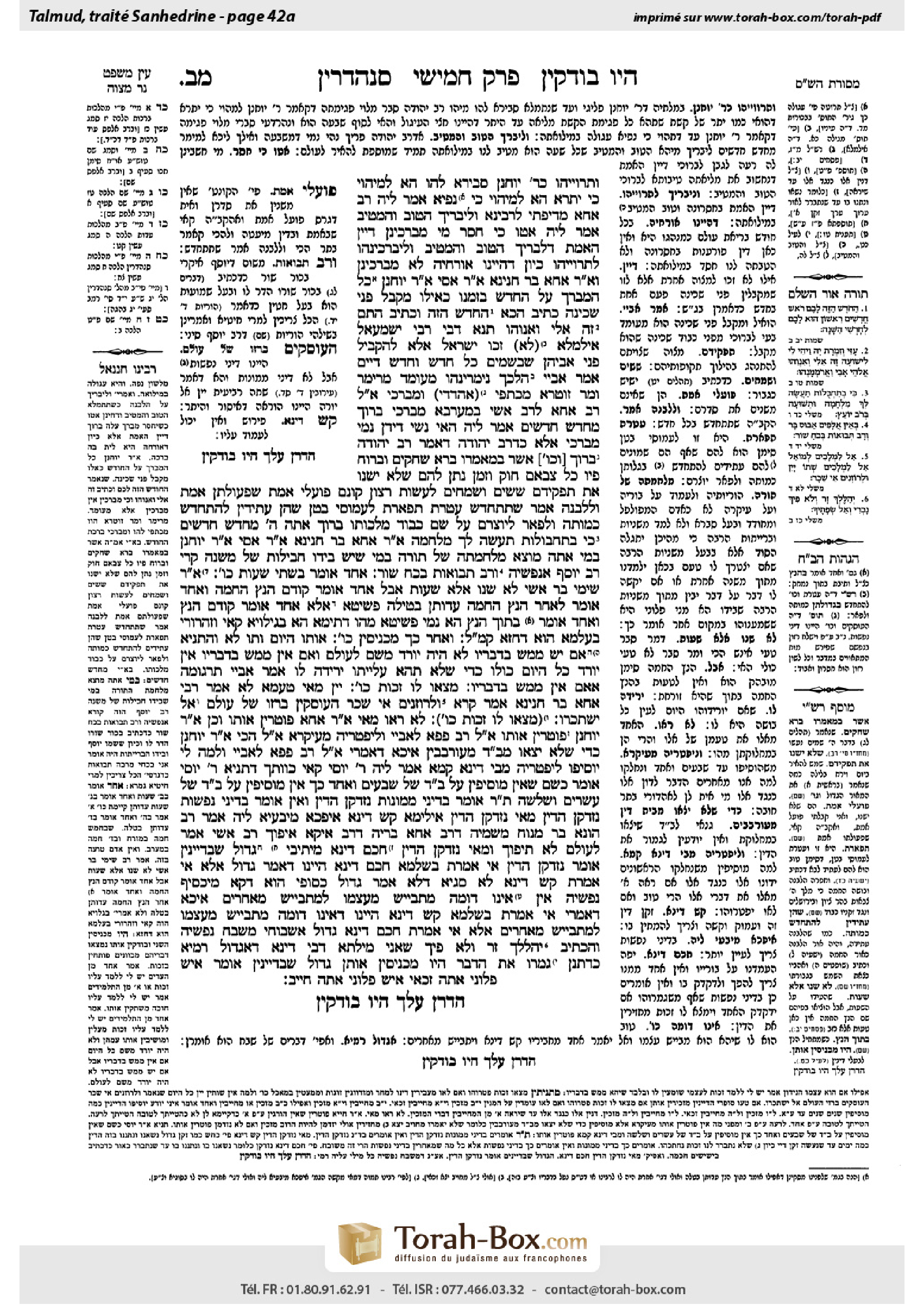
Sanhedrin 42a: Talmud study for Daf Yomi
Daf Yomi is the daily study of one Talmud folio. Explore 37 tractates with scans, Hebrew text, Sefaria English and AI-generated French translations where annotated.
Passage selection and English or AI-generated French translation are available where the scan has annotations. Daf Study is independent of Torah-Box and Sefaria.
Browse Sanhedrin · סנהדרין · All tractatesSanhedrin 42a text and translations
This page of Sanhedrin includes the Aramaic text, an English translation and an AI-generated French translation, alongside the scan above.
סנהדרין מ״ב א · Aramaic and Hebrew text
וְתַרְוַיְיהוּ כְּרַבִּי יוֹחָנָן סְבִירָא לְהוּ: הָא לְמִיהְוֵי כִּי יִתְרָא, הָא לְמִיהְוֵי כִּי נָפְיָא.
אֲמַר לֵיהּ רַב אַחָא מִדִּיפְתִּי לְרָבִינָא: וְלִיבָרֵיךְ ״הַטּוֹב וְהַמֵּטִיב״! אֲמַר לֵיהּ: אַטּוּ כִּי חָסַר מִי מְבָרְכִינַן ״דַּיַּין הָאֱמֶת״, דִּלְבָרֵיךְ ״הַטּוֹב וְהַמֵּטִיב״? וְלִיבָרְכִינְהוּ לְתַרְוַיְיהוּ? כֵּיוָן דְּהַיְינוּ אוֹרְחֵיהּ, לָא מְבָרְכִינַן.
וְאָמַר רַבִּי אַחָא בַּר חֲנִינָא אָמַר רַבִּי אַסִּי אָמַר רַבִּי יוֹחָנָן: כׇּל הַמְבָרֵךְ עַל הַחֹדֶשׁ בִּזְמַנּוֹ כְּאִילּוּ מְקַבֵּל פְּנֵי שְׁכִינָה. כְּתִיב הָכָא ״הַחֹדֶשׁ הַזֶּה״, וּכְתִיב הָתָם ״זֶה אֵלִי וְאַנְוֵהוּ״. תָּנָא דְּבֵי רַבִּי יִשְׁמָעֵאל: אִילְמָלֵא לֹא זָכוּ יִשְׂרָאֵל אֶלָּא לְהַקְבִּיל פְּנֵי אֲבִיהֶן שֶׁבַּשָּׁמַיִם כָּל חֹדֶשׁ וָחֹדֶשׁ, דַּיָּים. אָמַר אַבָּיֵי: הִלְכָּךְ נֵימְרִינְהוּ מְעוּמָּד.
מָרִימָר וּמָר זוּטְרָא מְכַתְּפִי אַהֲדָדֵי וּמְבָרְכִי. אֲמַר לֵיהּ רַב אַחָא לְרַב אָשֵׁי: בְּמַעְרְבָא מְבָרְכִי ״בָּרוּךְ מְחַדֵּשׁ חֳדָשִׁים״. אֲמַר לֵיהּ: הַאי נְשֵׁי דִּידַן נָמֵי מְבָרְכִי.
אֶלָּא כִּדְרַב יְהוּדָה, דְּאָמַר רַב יְהוּדָה: ״בָּרוּךְ [וְכוּ׳] אֲשֶׁר בְּמַאֲמָרוֹ בָּרָא שְׁחָקֵים, וּבְרוּחַ פִּיו כׇּל צְבָאָם. חֹק וּזְמַן נָתַן לָהֶם שֶׁלֹּא יְשַׁנּוּ אֶת תַּפְקִידָם, שָׂשִׂים וּשְׂמֵחִים לַעֲשׂוֹת רְצוֹן קוֹנָם. פּוֹעֲלֵי אֱמֶת שֶׁפְּעוּלָּתָן אֱמֶת. וְלַלְּבָנָה אָמַר שֶׁתִּתְחַדֵּשׁ עֲטֶרֶת תִּפְאֶרֶת לַעֲמוּסֵי בָטֶן, שֶׁהֵן עֲתִידִין לְהִתְחַדֵּשׁ כְּמוֹתָהּ וּלְפָאֵר לְיוֹצְרָם עַל שֵׁם כְּבוֹד מַלְכוּתוֹ. בָּרוּךְ אַתָּה ה׳ מְחַדֵּשׁ חֳדָשִׁים״.
כִּי בְתַחְבֻּלוֹת תַּעֲשֶׂה לְּךָ מִלְחָמָה. אָמַר רַבִּי אַחָא בַּר חֲנִינָא אָמַר רַבִּי אַסִּי אָמַר רַבִּי יוֹחָנָן: בְּמִי אַתָּה מוֹצֵא מִלְחַמְתָּהּ שֶׁל תּוֹרָה? בְּמִי שֶׁיֵּשׁ בְּיָדוֹ חֲבִילוֹת שֶׁל מִשְׁנָה. קָרֵי רַב יוֹסֵף אַנַּפְשֵׁיהּ: ״וְרׇב תְּבוּאוֹת בְּכֹחַ שׁוֹר״.
אֶחָד אוֹמֵר בִּשְׁתֵּי שָׁעוֹת כּוּ׳. אָמַר רַב שִׁימִי בַּר אָשֵׁי: לֹא שָׁנוּ אֶלָּא שָׁעוֹת, אֲבָל אֶחָד אוֹמֵר קוֹדֶם הָנֵץ הַחַמָּה וְאֶחָד אוֹמֵר לְאַחַר הָנֵץ הַחַמָּה – עֵדוּתָן בְּטֵילָה.
פְּשִׁיטָא! אֶלָּא: אֶחָד אוֹמֵר ״קוֹדֶם הָנֵץ״, וְאֶחָד אוֹמֵר ״בְּתוֹךְ הָנֵץ״. הָא נָמֵי פְּשִׁיטָא! מַהוּ דְּתֵימָא: הָא בְּגִילּוּיָא קָאֵי, וְזַהֲרוּרֵי בְּעָלְמָא הוּא דַּחֲזָא – קָא מַשְׁמַע לַן.
וְאַחַר כָּךְ מַכְנִיסִין כּוּ׳. אוֹתוֹ הַיּוֹם וְתוּ לָא? וְהָתַנְיָא: אִם יֵשׁ מַמָּשׁ בִּדְבָרָיו – לֹא הָיָה יוֹרֵד מִשָּׁם לְעוֹלָם, וְאִם אֵין מַמָּשׁ בִּדְבָרָיו – אֵין יוֹרֵד כׇּל הַיּוֹם כּוּלּוֹ, כְּדֵי שֶׁלֹּא תְּהֵא עֲלִיָּיתוֹ יְרִידָה לוֹ. אָמַר אַבָּיֵי: תַּרְגּוּמַהּ אַאִם אֵין מַמָּשׁ בִּדְבָרָיו.
מָצְאוּ לוֹ זְכוּת כּוּ׳. יַיִן מַאי טַעְמָא לָא? אָמַר רַבִּי אַחָא בַּר חֲנִינָא: אָמַר קְרָא ״וּלְרוֹזְנִים אֵי שֵׁכָר״ – הָעוֹסְקִין בְּרָזוֹ שֶׁל עוֹלָם אַל יִשְׁתַּכְּרוּ.
מָצְאוּ לוֹ זְכוּת כּוּ׳. לֹא רָאוּ, מַאי?
אָמַר רַבִּי אַחָא: פּוֹטְרִין אוֹתוֹ. וְכֵן אָמַר רַבִּי יוֹחָנָן: פּוֹטְרִין אוֹתוֹ. אֲמַר לֵיהּ רַב פָּפָּא לְאַבָּיֵי: וְלִיפְטְרֵיהּ מֵעִיקָּרָא! אָמַר לֵיהּ: הָכִי אָמַר רַבִּי יוֹחָנָן: כְּדֵי שֶׁלֹּא יֵצְאוּ מִבֵּית דִּין מְעוּרְבָּבִין.
אִיכָּא דְּאָמְרִי: אֲמַר לֵיהּ רַב פָּפָּא לְאַבָּיֵי, וּלְמָה לִי יוֹסִיפוּ? לִיפְטְרֵיהּ מִבֵּי דִּינָא קַמָּא! אֲמַר לֵיהּ: רַבִּי יוֹסֵי קָאֵי כְּוָותָךְ, דְּתַנְיָא: רַבִּי יוֹסֵי אוֹמֵר, כְּשֵׁם שֶׁאֵין מוֹסִיפִין עַל בֵּית דִּין שֶׁל שִׁבְעִים וְאֶחָד, כָּךְ אֵין מוֹסִיפִין עַל בֵּית דִּין שֶׁל עֶשְׂרִים וּשְׁלֹשָׁה.
תָּנוּ רַבָּנַן: אוֹמֵר בְּדִינֵי מָמוֹנוֹת ״נִזְדַּקֵּן הַדִּין״, וְאֵין אוֹמֵר בְּדִינֵי נְפָשׁוֹת ״נִזְדַּקֵּן הַדִּין״.
מַאי ״נִזְדַּקֵּן הַדִּין״? אִילֵּימָא קַשׁ דִּינָא, אִיפְּכָא מִיבַּעְיָא לֵיהּ! אָמַר רַב הוּנָא בַּר מָנוֹחַ מִשְּׁמֵיהּ דְּרַב אַחָא בְּרֵיהּ דְּרַב אִיקָא: אֵיפוֹךְ. רַב אָשֵׁי אָמַר: לְעוֹלָם לָא תֵּיפוֹךְ, וּמַאי ״נִזְדַּקֵּן הַדִּין״ – חֲכַם דִּינָא.
מֵיתִיבִי: גָּדוֹל שֶׁבַּדַּיָּינִין אוֹמֵר ״נִזְדַּקֵּן הַדִּין״. אִי אָמְרַתְּ בִּשְׁלָמָא חֲכַם דִּינָא, הַיְינוּ דְּאָמַר גָּדוֹל. אֶלָּא אִי אָמְרַתְּ קַשׁ דִּינָא, לָא סַגִּיא דְּלָא אָמַר גָּדוֹל? כַּסּוֹפֵי הוּא דְּקָא מְיכַסֵּיף נַפְשֵׁיהּ?
אִין. אֵינוֹ דּוֹמֶה מִתְבַּיֵּישׁ מֵעַצְמוֹ, לְמִתְבַּיֵּישׁ מֵאֲחֵרִים.
אִיכָּא דְּאָמְרִי: אִי אָמְרַתְּ בִּשְׁלָמָא קַשׁ דִּינָא, הַיְינוּ דְּאֵינוֹ דּוֹמֶה מִתְבַּיֵּישׁ מֵעַצְמוֹ לְמִתְבַּיֵּישׁ מֵאֲחֵרִים. אֶלָּא אִי אָמְרַתְּ חֲכַם דִּינָא, גָּדוֹל אַשְׁבּוֹחֵי מַשְׁבַּח נַפְשֵׁיהּ? וְהָכְתִיב: ״יְהַלֶּלְךָ זָר וְלֹא פִיךָ״!
שָׁאנֵי מִילְּתָא דְּבֵי דִינָא, דְּאַגָּדוֹל רַמְיָא. כְּדִתְנַן: גָּמְרוּ אֶת הַדָּבָר, הָיוּ מַכְנִיסִין אוֹתָן. גָּדוֹל שֶׁבַּדַּיָּינִין אוֹמֵר: ״אִישׁ פְּלוֹנִי אַתָּה זַכַּאי״, ״אִישׁ פְּלוֹנִי אַתָּה חַיָּיב״.
הֲדַרַן עֲלָיךְ הָיוּ בּוֹדְקִין
Sanhedrin 42a · English translation
The Gemara comments: And they both hold in accordance with the opinion of Rabbi Yoḥanan that one can recite the blessing until the flaw of the moon is filled. The dispute is that this one, i.e., Rav Ya’akov bar Idi, who holds one can recite the blessing until seven days have passed, understands Rabbi Yoḥanan to be referring to the day when the moon will be like the string of a bow. Before that point the moon appeared merely as a bow, and after seven days it appears like a half-circle, like a bow that has a string. That one, i.e., the Sages of Neharde’a, who holds one can recite the blessing until sixteen days have passed, understands Rabbi Yoḥanan to be referring to the day when the moon will be like a sieve, i.e., a full circle.
§ Rav Aḥa of Difti said to Ravina: And they should bless the blessing of: Blessed are You, Lord our God, King of the Universe, Who is good and Who does good, for the benefit that people derive from the light of moon. Ravina said to him: Is that to say that when the moon is shrinking we bless, as we do for other disasters: Blessed are You, Lord our God, King of the Universe, the true Judge, so that we should conversely bless: Blessed are You, Lord our God, King of the Universe, Who is good and Who does good, when the moon is growing? Rav Aḥa of Difti said to him: You are correct, and we should say them both: The blessing of the true Judge, when the moon is waning, and the blessing of Who is good and Who does good, when the moon is waxing. Ravina answered him: Since this is its nature, we do not bless the moon. The waxing and waning of the moon is not an unexpected occurrence that requires these blessings.
And Rabbi Aḥa bar Ḥanina says that Rabbi Asi says that Rabbi Yoḥanan says: With regard to anyone who blesses the new month in its proper time, it is as if he greets the Face of the Divine Presence. Alluding to this, it is written here concerning the sanctification of the new month: “This month shall be for you the beginning of months” (Exodus 12:2), and it is written there, where the Jewish people encountered the Divine Presence at the splitting of the sea: “This is my God and I will glorify Him” (Exodus 15:2). The term “this” is employed in both verses. The school of Rabbi Yishmael taught: If the Jewish people merited to greet the Face of their Father in Heaven only one time each and every month, it would suffice for them, since in the blessing of the moon there is an aspect of greeting the Divine Presence. Abaye said: Therefore, we will say the blessing while standing, in honor of the Divine Presence.
The Gemara relates: Mareimar and Mar Zutra would lean on one another’s shoulders and recite the blessing. Rav Aḥa said to Rav Ashi: In the West, Eretz Yisrael, they recite the following blessing on the moon: Blessed is He Who renews the months. Rav Ashi said to him: Our women also recite that blessing, meaning that this is an abridged version for the unlettered.
Rather, the full version of the blessing is the version of Rav Yehuda. As Rav Yehuda says: Blessed are You, Lord our God, King of the Universe, Who by His word created the heavens, and by the breath of his mouth all their hosts. He set for them a law and a time, that they should not deviate from their task. And they are joyous and glad to perform the will of their Owner; they are workers of truth whose work is truth. And to the moon He said that it should renew itself as a crown of beauty for those He carried from the womb, as they are destined to be renewed like it, and to praise their Creator for the name of His glorious kingdom. Blessed are You the Lord, Who renews the months.
The Gemara presents another statement, citing Rabbi Aḥa, citing Rabbi Asi, citing Rabbi Yoḥanan. The verse states: “For by wise advice you shall make your war” (Proverbs 24:6). Rabbi Aḥa bar Ḥanina says that Rabbi Asi says that Rabbi Yoḥanan says: In whom do you find the war, i.e., the ability to engage in disputes, of Torah? In one who has in his possession bundles, i.e., vast knowledge, of Mishna. One must first learn the primary sources before engaging in disputes of Torah. Rav Yosef would read concerning himself the verse: “And much produce comes by the strength of the ox” (Proverbs 14:4), i.e., one with great strength can bring a large yield. Rav Yosef was known to be particularly well-versed in tannaitic statements.
§ The mishna teaches that if one witness says that the event occurred at two hours, i.e., the second hour of the day from sunrise, and one witness says that the event occurred at three hours, their testimony stands. Rav Shimi bar Ashi says: This was taught only when there was a difference in the hours, but if one witness says that the event occurred before the sunrise, and one says that the event occurred after the sunrise, their testimony is void. Although this may be a smaller discrepancy in terms of time, the difference between before and after sunrise cannot be ascribed to an error.
The Gemara asks: Isn’t this obvious? There is a clear difference between darkness and light. Rather, Rav Shimi bar Ashi said as follows: If one witness says that the event occurred before the sunrise, and one says that the event occurred during the sunrise, their testimony is void. The Gemara asks: Isn’t this also obvious? The Gemara answers: Lest you say that this one who says: During the sunrise, was standing in an exposed place and saw a mere shine and thought he saw the sunrise, Rav Shimi bar Ashi teaches us the court does not assume this occurred, and deems the testimony incongruent.
§ The mishna teaches: And afterward they bring in the second witness and examine him. Later, the mishna states: But if one of the students said: I can teach a reason to acquit him, they raise him to the seat of the court and seat him among them, and he would not descend from there all day. The Gemara asks: That day and no more? But isn’t it taught in a baraita (Tosefta 9:3): If the statement of that student has substance he would never descend from there, as his statement demonstrates that he is capable of deliberating with the other judges. But if the statement of that student does not have substance, he would not descend from there the entire day, in order that his ascent should not be a descent for him, i.e., to avoid humiliating him. Abaye said: Interpret the mishna to be with regard to a case when the statement of that student does not have substance.
The mishna teaches that if the court found it fit to acquit the defendant during the deliberations, as all or a majority of them agree to acquit him, they excuse him. The mishna further teaches that the judges would not drink wine all day. The Gemara asks: What is the reason they did not drink wine? Rabbi Aḥa bar Ḥanina says that it is because the verse states: “It is not for kings to drink wine, nor for princes [rozenim] to say: Where is strong drink” (Proverbs 31:4). Rabbi Aḥa bar Ḥanina explains: This is a directive to those who deal with the secret of the world [berazo shel olam], i.e., such stringent matters: Do not become drunk.
§ The mishna teaches: If the court found it fit to acquit him during the deliberations, as all or a majority of them agree to acquit him, they release him. It was further taught in the mishna that when the court cannot arrive at a verdict they add judges in pairs of two and deliberate until there is a clear verdict. If they added the maximum number of judges and still cannot reach a clear verdict, they discuss the matter until one of those who deems him liable sees the validity of the statements of those who acquit, and changes his position. The Gemara asks: If the judges do not change their position, as they do not see the validity of the position of those who acquit him, what is done?
Rabbi Aḥa says: They release him, as he was not found liable. And likewise Rabbi Yoḥanan says: They release him. Rav Pappa said to Abaye: But if they ultimately release him if the court is deadlocked, why do they attempt to convince each other at all when they should release him from the outset? Abaye said to him: This is what Rabbi Yoḥanan said: The reason is so that they not leave the court confounded, without reaching some definite conclusion, as this would tarnish the reputation of the court.
Some say that this is what Rav Pappa said to Abaye: But why do I need them to add judges at all when they should release him from the first court? Once the first court did not find him liable, they should release him. Why add judges? Abaye said to him: Rabbi Yosei holds in accordance with your opinion, as it is taught in a baraita that Rabbi Yosei says: Just as the court does not add judges to a court of seventy-one, so too, the court does not add judges to a court of twenty-three. If the court of twenty-three cannot arrive at a verdict, they release him.
The Sages taught: In cases of monetary law one says: The judgment has grown aged, i.e., this matter is very difficult and requires scrutiny, but in cases of capital law one does not say: The judgment has grown aged.
The Gemara asks: What is the meaning of: The judgment has grown aged? If we say that the intention is: The judgment has aged, i.e., taken an extended amount of time but requires additional deliberations, if so, he should say the reverse, as it is more critical to extend deliberations in cases of capital law than in cases of monetary law. Rav Huna bar Manoaḥ said in the name of Rav Aḥa, son of Rav Ika: Reverse the statement, and say that in cases of monetary law one does not say: The judgment has grown aged, but in cases of capital law one does say it. Rav Ashi said: Actually, do not reverse it. And what is the meaning of: The judgment has grown aged? It means that the judgment has grown wise, like an elder who has acquired wisdom. In other words, the deliberations have been exhausted, and it is time to vote on a verdict.
The Gemara raises an objection to the first explanation from a baraita: In a situation where they did not reach a decision, the greatest among the judges says: The judgment has grown aged. The Gemara explains the objection: Granted, if you say this means: The judgment has grown wise, this would be why the baraita states that the greatest judge says this statement, as arriving at a verdict is an honor for the court, and consequently the greatest of the court should be the one to announce it. But if you say this means: The judgment has aged, is it not enough that the greatest among the judges in particular not say so? Must he humiliate himself by stating that they cannot reach a verdict?
The Gemara answers: Yes, the greatest of the judges must also announce that the court cannot reach a verdict. Being shamed by oneself is not comparable to being shamed by others. Therefore, it is preferable that the greatest of the judges state this conclusion, rather than having one of the more junior judges state it.
Some say they raised an objection to the second explanation: Granted, if you say this means: The judgment has aged, this would be the reason that the greatest one states it, because being shamed by oneself is not comparable to being shamed by others. But if you say this means: The judgment has grown wise, should the greatest judge praise himself? But isn’t it written: “Let another man praise you, and not your own mouth, a stranger and not your own lips” (Proverbs 27:2)?
The Gemara answers: A matter of the court is different, as its administration is incumbent upon the greatest judge. As we learned in a mishna (29a): When they finished deliberating the matter, they would bring in the litigants. The greatest of the judges would say: So-and-so, you are exempt from paying; or: So-and-so, you are liable to pay.
Sanhedrin 42a · Traduction française (IA)
La Guemara commente : Tous deux sont d’accord avec Rabbi Yoḥanan, selon qui on peut réciter la bénédiction jusqu’à ce que le défaut de la lune soit comblé. Leur désaccord porte sur le jour auquel Rabbi Yoḥanan faisait référence. Celui-ci, c’est-à-dire Rav Ya’akov bar Idi, qui estime qu’on peut réciter la bénédiction jusqu’à sept jours après la nouvelle lune, comprend qu’il s’agit du jour où la lune ressemble à la corde d’un arc. Avant ce moment, la lune avait seulement la forme d’un arc ; après sept jours, elle ressemble à un demi-cercle, comme un arc muni de sa corde. Celui-là, c’est-à-dire les Sages de Neharde’a, qui estime qu’on peut réciter la bénédiction jusqu’à seize jours après la nouvelle lune, comprend que Rabbi Yoḥanan fait référence au jour où la lune ressemble à un tamis, c’est-à-dire à un cercle complet.
§ Rav Aḥa de Difti dit à Ravina : Ne devrait-on pas réciter la bénédiction suivante : « Béni sois-Tu, Seigneur notre Dieu, Roi de l’Univers, qui es bon et qui fais le bien », pour le bien que les gens tirent de la lumière de la lune ? Ravina lui dit : Cela signifie-t-il que, lorsque la lune décroît, nous récitons la bénédiction que nous disons pour d’autres malheurs : « Béni sois-Tu, Seigneur notre Dieu, Roi de l’Univers, juge de vérité », et que, par conséquent, lorsque la lune croît, nous récitions à l’inverse : « Béni sois-Tu, Seigneur notre Dieu, Roi de l’Univers, qui es bon et qui fais le bien » ? Rav Aḥa de Difti lui répondit : Tu as raison, nous devrions réciter les deux bénédictions : celle du juge de vérité lorsque la lune décroît, et celle de Celui qui est bon et qui fait le bien lorsqu’elle croît. Ravina lui répondit : Puisque c’est sa nature, nous ne bénissons pas la lune. Sa croissance et son déclin ne sont pas des événements imprévus qui exigent ces bénédictions.
Et Rabbi Aḥa bar Ḥanina dit au nom de Rabbi Asi, qui dit au nom de Rabbi Yoḥanan : Quiconque bénit la nouvelle lune au moment approprié, c’est comme s’il saluait la Présence divine. À ce propos, il est écrit ici, au sujet de la sanctification de la nouvelle lune : « Ce mois-ci sera pour vous le commencement des mois » (Exode 12:2), et il est écrit là, lorsque le peuple juif rencontra la Présence divine lors de la traversée de la mer : « Voici mon Dieu, je le glorifierai » (Exode 15:2). Le terme « voici » apparaît dans les deux versets. L’école de Rabbi Yishmaël enseignait : Si le peuple juif avait le mérite de saluer le visage de son Père qui est dans les Cieux une seule fois chaque mois, cela lui suffirait, car la bénédiction de la lune comporte une dimension de salut de la Présence divine. Abaye dit : Par conséquent, nous réciterons la bénédiction debout, en l’honneur de la Présence divine.
La Guemara rapporte : Mareimar et Mar Zutra s’appuyaient l’un sur l’épaule de l’autre pour réciter la bénédiction. Rav Aḥa dit à Rav Ashi : En Occident, c’est-à-dire en Terre d’Israël, on récite sur la lune la bénédiction suivante : « Béni soit Celui qui renouvelle les mois. » Rav Ashi lui dit : Nos femmes récitent elles aussi cette bénédiction ; cela signifie qu’il s’agit d’une version abrégée destinée aux personnes peu instruites.
La version complète de la bénédiction est plutôt celle de Rav Yehuda. Rav Yehuda dit en effet : « Béni sois-Tu, Seigneur notre Dieu, Roi de l’Univers, qui as créé les cieux par Ta parole et toutes leurs armées par le souffle de Ta bouche. Tu leur as fixé une loi et un temps, afin qu’elles ne s’écartent pas de leur tâche. Elles se réjouissent et sont heureuses d’accomplir la volonté de leur Maître ; elles sont des ouvrières de vérité, et leur œuvre est vérité. À la lune, Il a dit de se renouveler comme une couronne de beauté pour ceux qu’Il a portés dès le sein maternel, car ils sont destinés à se renouveler comme elle et à louer leur Créateur pour le nom de Son glorieux royaume. Béni sois-Tu, Seigneur, qui renouvelles les mois. »
La Guemara présente un autre enseignement rapporté par Rabbi Aḥa, au nom de Rabbi Asi, qui le tient de Rabbi Yoḥanan. Le verset dit : « Car c’est par des conseils avisés que tu mèneras ta guerre » (Proverbes 24:6). Rabbi Aḥa bar Ḥanina dit au nom de Rabbi Asi, qui dit au nom de Rabbi Yoḥanan : Chez qui trouve-t-on la guerre de la Torah, c’est-à-dire la capacité de prendre part aux controverses de la Torah ? Chez celui qui possède des faisceaux, c’est-à-dire une vaste connaissance, de Michna. Il faut d’abord étudier les sources fondamentales avant de prendre part aux controverses de la Torah. Rav Yosef avait l’habitude de se citer le verset suivant : « Une grande récolte vient de la force du bœuf » (Proverbes 14:4), c’est-à-dire que celui qui possède une grande force peut obtenir un rendement abondant. Rav Yosef était réputé pour sa connaissance particulièrement étendue des enseignements des tannaïm.
§ La Michna enseigne que si un témoin dit que l’événement a eu lieu à la deuxième heure, c’est-à-dire à la deuxième heure du jour après le lever du soleil, et qu’un autre témoin dit qu’il a eu lieu à la troisième heure, leur témoignage est recevable. Rav Shimi bar Ashi dit : Cela n’a été enseigné que lorsqu’il y a un décalage d’une heure ; mais si un témoin dit que l’événement a eu lieu avant le lever du soleil et qu’un autre dit qu’il a eu lieu après le lever du soleil, leur témoignage est invalide. Même si l’écart de temps peut être moindre, la différence entre avant et après le lever du soleil ne peut pas être attribuée à une erreur.
La Guemara demande : N’est-ce pas évident ? Il existe une différence manifeste entre l’obscurité et la lumière. Rav Shimi bar Ashi dit plutôt ce qui suit : Si un témoin dit que l’événement a eu lieu avant le lever du soleil et qu’un autre dit qu’il a eu lieu pendant le lever du soleil, leur témoignage est invalide. La Guemara demande : Cela aussi n’est-il pas évident ? La Guemara répond : De peur que tu ne dises que celui qui affirme que l’événement a eu lieu pendant le lever du soleil se trouvait dans un lieu découvert, a vu une simple lueur et a cru voir le soleil se lever, Rav Shimi bar Ashi nous apprend que le tribunal ne présume pas que cela se soit produit et considère les témoignages comme contradictoires.
§ La Michna enseigne : Ensuite, on fait entrer le deuxième témoin et on l’interroge. Plus loin, la Michna dit : Mais si l’un des élèves déclare : « Je peux présenter un argument pour l’acquitter », on le fait monter sur le siège du tribunal et on le fait asseoir parmi les juges ; il ne redescend pas de là de toute la journée. La Guemara demande : Seulement ce jour-là, et pas au-delà ? N’est-il pas enseigné dans une baraïta (Tosefta 9:3) : Si l’argument de cet élève est fondé, il ne redescendra jamais de là, car son intervention montre qu’il est capable de délibérer avec les autres juges. Mais si son argument n’est pas fondé, il ne redescendra pas de là pendant toute la journée, afin que sa montée ne se transforme pas en humiliation pour lui, c’est-à-dire afin d’éviter de l’embarrasser. Abaye dit : Il faut interpréter la Michna comme portant sur le cas où l’argument de cet élève n’est pas fondé.
La Michna enseigne que si, au cours des délibérations, le tribunal estime devoir acquitter l’accusé, c’est-à-dire si tous les juges ou la majorité d’entre eux sont d’accord pour l’acquitter, on le libère. La Michna enseigne également que les juges ne buvaient pas de vin de toute la journée. La Guemara demande : Pourquoi ne buvaient-ils pas de vin ? Rabbi Aḥa bar Ḥanina dit que c’est parce que le verset dit : « Il n’appartient pas aux rois de boire du vin, ni aux princes [rozenim] de dire : Où est la boisson forte ? » (Proverbes 31:4). Rabbi Aḥa bar Ḥanina explique : C’est une directive adressée à ceux qui s’occupent du secret du monde [berazo shel olam], c’est-à-dire de questions aussi cruciales : ne vous enivrez pas.
§ La Michna enseigne : Si, au cours des délibérations, le tribunal estime devoir acquitter l’accusé, c’est-à-dire si tous les juges ou la majorité d’entre eux sont d’accord pour l’acquitter, on le libère. La Michna enseigne également que, lorsque le tribunal ne parvient pas à rendre un verdict, on ajoute des juges par groupes de deux et l’on délibère jusqu’à ce qu’un verdict clair se dégage. Si l’on a ajouté le nombre maximal de juges et que l’on ne parvient toujours pas à un verdict clair, on examine l’affaire jusqu’à ce que l’un de ceux qui le déclarent coupable reconnaisse la validité des arguments de ceux qui l’acquittent et change d’avis. La Guemara demande : Si les juges ne changent pas d’avis, parce qu’ils ne reconnaissent pas la validité de la position de ceux qui l’acquittent, que fait-on ?
Rabbi Aḥa dit : On le libère, car il n’a pas été déclaré coupable. Rabbi Yoḥanan dit de même : On le libère. Rav Pappa dit à Abaye : Mais si, en fin de compte, on le libère lorsque le tribunal est dans l’impasse, pourquoi les juges cherchent-ils à se convaincre les uns les autres ? Ils devraient le libérer d’emblée. Abaye lui dit : Voici ce que Rabbi Yoḥanan a dit : c’est afin qu’ils ne quittent pas le tribunal sans être parvenus à une conclusion précise, car cela ternirait la réputation du tribunal.
Selon une autre version, voici ce que Rav Pappa dit à Abaye : Mais pourquoi faudrait-il ajouter des juges ? On devrait le libérer à l’issue de la première délibération. Puisque le premier tribunal ne l’a pas déclaré coupable, on devrait le libérer. Pourquoi ajouter des juges ? Abaye lui dit : Rabbi Yosei est d’accord avec ton opinion, car il est enseigné dans une baraïta que Rabbi Yosei dit : De même que le tribunal n’ajoute pas de juges à un tribunal de soixante et onze juges, de même il n’ajoute pas de juges à un tribunal de vingt-trois juges. Si le tribunal de vingt-trois juges ne parvient pas à rendre un verdict, on le libère.
Les Sages enseignèrent : Dans les affaires civiles, on dit : « Le jugement a vieilli », c’est-à-dire que l’affaire est très difficile et nécessite un examen approfondi ; mais, dans les affaires passibles de la peine capitale, on ne dit pas : « Le jugement a vieilli ».
La Guemara demande : Que signifie « le jugement a vieilli » ? Si l’on entend par là que le jugement a pris de l’âge, c’est-à-dire qu’il a duré longtemps mais nécessite encore des délibérations supplémentaires, il faudrait alors dire l’inverse, car il est plus crucial de prolonger les délibérations dans les affaires passibles de la peine capitale que dans les affaires civiles. Rav Huna bar Manoaḥ dit au nom de Rav Aḥa, fils de Rav Ika : Inverse l’enseignement et dis que, dans les affaires civiles, on ne dit pas : « Le jugement a vieilli », tandis que, dans les affaires passibles de la peine capitale, on le dit. Rav Ashi dit : En réalité, n’inverse pas l’enseignement. Que signifie donc « le jugement a vieilli » ? Cela veut dire que le jugement a acquis de la sagesse, comme un ancien qui a acquis de la sagesse. Autrement dit, les délibérations sont arrivées à leur terme et il est temps de voter sur le verdict.
La Guemara soulève une objection contre la première explication à partir d’une baraïta : Lorsque les juges ne sont pas parvenus à une décision, le plus éminent d’entre eux dit : « Le jugement a vieilli. » La Guemara explique l’objection : Il est compréhensible que, si l’on entend par là que le jugement a acquis de la sagesse, la baraïta précise que c’est le juge le plus éminent qui prononce ces paroles, car parvenir à un verdict est un honneur pour le tribunal et il convient donc que le plus éminent du tribunal l’annonce. Mais si l’on entend par là que le jugement a pris de l’âge, ne suffirait-il pas que le plus éminent des juges, en particulier, ne le dise pas ? Doit-il s’humilier en déclarant qu’ils ne parviennent pas à un verdict ?
La Guemara répond : Oui, le plus éminent des juges doit lui aussi annoncer que le tribunal ne parvient pas à un verdict. Être humilié par soi-même n’est pas comparable au fait d’être humilié par autrui. Il est donc préférable que le plus éminent des juges énonce cette conclusion plutôt que de laisser l’un des juges moins éminents le faire.
Selon une autre version, ils soulèvent une objection contre la seconde explication : Il est compréhensible que, si l’on entend par là que le jugement a pris de l’âge, ce soit la raison pour laquelle le juge le plus éminent le dit, car être humilié par soi-même n’est pas comparable au fait d’être humilié par autrui. Mais si l’on entend par là que le jugement a acquis de la sagesse, le juge le plus éminent devrait-il se faire lui-même son éloge ? N’est-il pas écrit : « Qu’un autre te loue, et non ta propre bouche, un étranger, et non tes propres lèvres » (Proverbes 27:2) ?
La Guemara répond : Les affaires du tribunal sont différentes, car leur gestion incombe au juge le plus éminent. En effet, nous avons appris dans une Michna (29a) : Lorsqu’ils avaient terminé de délibérer sur l’affaire, ils faisaient entrer les plaideurs. Le juge le plus éminent disait : « Untel, tu es dispensé de payer », ou : « Untel, tu es tenu de payer. »
Traduction française générée par IA à partir de l’édition anglaise de Sefaria. Vérifie toujours un passage avec le texte source.
Text from Sefaria: William Davidson Edition - Vocalized Aramaic (CC BY NC); William Davidson Edition - English (CC BY NC).