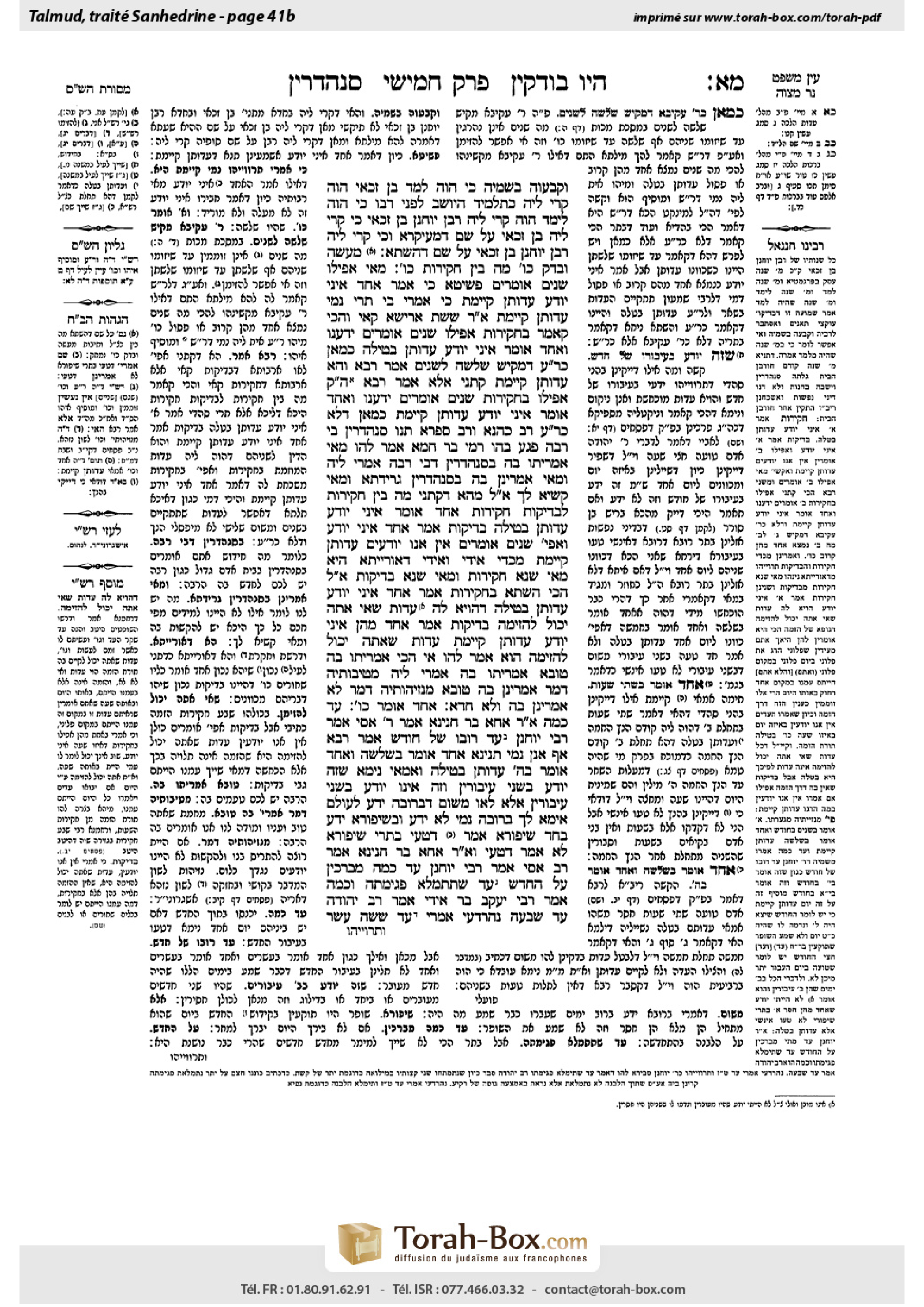
Sanhedrin 41b: Talmud study for Daf Yomi
Daf Yomi is the daily study of one Talmud folio. Explore 37 tractates with scans, Hebrew text, Sefaria English and AI-generated French translations where annotated.
Passage selection and English or AI-generated French translation are available where the scan has annotations. Daf Study is independent of Torah-Box and Sefaria.
Browse Sanhedrin · סנהדרין · All tractatesSanhedrin 41b text and translations
This page of Sanhedrin includes the Aramaic text, an English translation and an AI-generated French translation, alongside the scan above.
סנהדרין מ״א ב · Aramaic and Hebrew text
וְקַבְעוּהָ בִּשְׁמֵיהּ. כִּי הֲוָה לָמַד, ״בֶּן זַכַּאי״ הֲוָה קָרֵי לֵיהּ, כְּתַלְמִיד הַיּוֹשֵׁב לִפְנֵי רַבּוֹ. כִּי הֲוָה לִימֵּד, הֲוָה קָרֵי לֵיהּ ״רַבָּן יוֹחָנָן בֶּן זַכַּאי״. כִּי קָרֵי לֵיהּ ״בֶּן זַכַּאי״ – עַל שֵׁם דְּמֵעִיקָּרָא, וְכִי קָרֵי לֵיהּ ״רַבָּן יוֹחָנָן בֶּן זַכַּאי״ – עַל שֵׁם דְּהַשְׁתָּא.
מַעֲשֶׂה וּבָדַק כּוּ׳. מָה בֵּין חֲקִירוֹת כּוּ׳. מַאי ״אֲפִילּוּ שְׁנַיִם אוֹמְרִים״? פְּשִׁיטָא! כִּי אָמַר אֶחָד ״אֵינִי יוֹדֵעַ״ – עֵדוּתָן קַיֶּימֶת, כִּי אָמְרִי בֵּי תְרֵי נָמֵי עֵדוּתָן קַיֶּימֶת!
אָמַר רַב שֵׁשֶׁת: אַרֵישָׁא קָאֵי, וְהָכִי קָאָמַר: בַּחֲקִירוֹת, אֲפִילּוּ שְׁנַיִם אוֹמְרִים ״יָדַעְנוּ״ וְאֶחָד אוֹמֵר ״אֵינִי יוֹדֵעַ״ – עֵדוּתָן בְּטֵילָה. כְּמַאן? כְּרַבִּי עֲקִיבָא, דְּמַקֵּישׁ שְׁלֹשָׁה לִשְׁנַיִם.
אָמַר רָבָא: וְהָא ״עֵדוּתָן קַיֶּימֶת״ קָתָנֵי! אֶלָּא אָמַר רָבָא: הָכִי קָאָמַר: אֲפִילּוּ בַּחֲקִירוֹת, שְׁנַיִם אוֹמְרִים ״יָדַעְנוּ״ וְאֶחָד אוֹמֵר ״אֵינִי יוֹדֵעַ״ – עֵדוּתָן קַיֶּימֶת. כְּמַאן? דְּלָא כְּרַבִּי עֲקִיבָא.
רַב כָּהֲנָא וְרַב סָפְרָא תָּנוּ סַנְהֶדְרִין בֵּי רַבָּה. פְּגַע בְּהוּ רָמֵי בַּר חָמָא. אֲמַר לְהוּ: מַאי אָמְרִיתוּ בַּהּ בְּסַנְהֶדְרִין דְּבֵי רַבָּה? אָמְרִי לֵיהּ: וּמַאי אָמְרִינַן בַּהּ בְּסַנְהֶדְרִין גְּרֵידְתָּא? וּמַאי קַשְׁיָא לָךְ?
אֲמַר לְהוּ, מֵהָא דְּקָתָנֵי: מָה בֵּין חֲקִירוֹת לִבְדִיקוֹת? חֲקִירוֹת – אֶחָד אוֹמֵר ״אֵינִי יוֹדֵעַ״, עֵדוּתָן בְּטֵילָה, בְּדִיקוֹת – אָמַר אֶחָד ״אֵינִי יוֹדֵעַ״, וַאֲפִילּוּ שְׁנַיִם אוֹמְרִים ״אֵין אָנוּ יוֹדְעִים״, עֵדוּתָן קַיֶּימֶת. מִכְּדֵי, אִידֵּי וְאִידֵּי דְּאוֹרָיְיתָא הִיא, מַאי שְׁנָא חֲקִירוֹת וּמַאי שְׁנָא בְּדִיקוֹת?
אָמְרִי לֵיהּ: הָכִי הַשְׁתָּא? בַּחֲקִירוֹת, אָמַר אֶחָד ״אֵינִי יוֹדֵעַ״ – עֵדוּתָן בְּטֵילָה, דְּהָוְיָא לַהּ עֵדוּת שֶׁאִי אַתָּה יָכוֹל לַהֲזִימָּהּ. בְּדִיקוֹת, אָמַר אֶחָד מֵהֶן ״אֵינִי יוֹדֵעַ״ – עֵדוּתָן קַיֶּימֶת, עֵדוּת שֶׁאַתָּה יָכוֹל לַהֲזִימָּהּ הוּא.
אֲמַר לְהוּ: אִי הָכִי אָמְרִיתוּ בַּהּ, טוּבָא אָמְרִיתוּ בַּהּ. אָמְרִי לֵיהּ: מִטֵּיבוּתֵיהּ דְּמָר אָמְרִינַן בַּהּ טוּבָא, מִנְּזִיהוּתֵיהּ דְּמָר לָא אָמְרִינַן בַּהּ וְלָא חֲדָא.
אֶחָד אוֹמֵר כּוּ׳. עַד כַּמָּה? אָמַר רַבִּי אַחָא בַּר חֲנִינָא, אָמַר רַבִּי אַסִּי, אָמַר רַבִּי יוֹחָנָן: עַד רוּבּוֹ שֶׁל חוֹדֶשׁ.
אָמַר רָבָא: אַף אֲנַן נָמֵי תְּנֵינָא, אֶחָד אוֹמֵר ״בִּשְׁלֹשָׁה״ וְאֶחָד אוֹמֵר ״בַּחֲמִשָּׁה״ – עֵדוּתָן בְּטֵילָה. וְאַמַּאי? נֵימָא שֶׁזֶּה יוֹדֵעַ בִּשְׁנֵי עִיבּוּרִין וְזֶה אֵינוֹ יוֹדֵעַ בִּשְׁנֵי עִיבּוּרִין? אֶלָּא לָאו, מִשּׁוּם דִּבְרוּבָּה יָדַע!
לְעוֹלָם אֵימָא לָךְ: בְּרוּבָּה נָמֵי לָא יָדַע, וּבְשִׁיפּוּרָא יָדַע. בְּחַד שִׁיפּוּרָא אָמַר דְּטָעֵי, בִּתְרֵי שִׁיפּוּרֵי לָא אָמַר דְּטָעֵי.
וְאָמַר רַבִּי אַחָא בַּר חֲנִינָא אָמַר רַב אַסִּי אָמַר רַבִּי יוֹחָנָן: עַד כַּמָּה מְבָרְכִין עַל הַחֹדֶשׁ? עַד שֶׁתִּתְמַלֵּא פְּגִימָתָהּ. וְכַמָּה? אָמַר רַב יַעֲקֹב בַּר אִידִי אָמַר רַב יְהוּדָה: עַד שִׁבְעָה. נְהַרְדָּעֵי אָמְרִי: עַד שִׁשָּׁה עָשָׂר.
Sanhedrin 41b · English translation
and Rabbi Yehuda HaNasi established it in the mishna in his name. When he was studying, they called him ben Zakkai, in the manner that they would call a student sitting before his teacher, and when he was teaching others they called him Rabban Yoḥanan ben Zakkai. In terms of the baraita and the mishna, when they called him ben Zakkai in the Mishna, that was based on the name that he was called initially. And when they called him Rabban Yoḥanan ben Zakkai in the other baraita, that was based on the name that he was called now.
§ The mishna teaches: An incident occurred, and ben Zakkai examined the witnesses about the stems of figs. What is the difference between interrogations and examinations? In the case of interrogations, if one of the witnesses says: I do not know the answer, their testimony is void immediately. In the case of examinations, if one says: I do not know the answer, and even if two witnesses say: We do not know the answer, their testimony still stands. The Gemara asks: What is the meaning of: Even if two say? Isn’t it obvious? The mishna already stated that when one witness says: I do not know, their testimony stands, indicating that knowledge of the answers to these types of questions is not required. Accordingly, when two witnesses say that they do not know, their testimony stands as well. What is the novelty of this ruling?
Rav Sheshet said: This clause is referring to the first clause of the mishna, and this is what it is saying: With regard to the interrogations, even if two witnesses say: We know, and one additional witness says: I do not know, their testimony is void. In accordance with whose opinion is this mishna written? In accordance with the opinion of Rabbi Akiva, who compares in all court proceedings three witnesses to two, holding that just as two witnesses must testify a fully valid testimony, so it is with three. Therefore, if the third witness does not know the answer to an interrogation, the testimony of all three is void.
Rava says: But the mishna teaches: Their testimony stands, not: Their testimony is void. Rather, Rava said: This is what the mishna is saying: Even with regard to the interrogations, if two witnesses say: We know, and one witness says: I do not know, their testimony stands, as the court accepts the testimony of the two. In accordance with whose opinion is this mishna written? Not in accordance with the opinion of Rabbi Akiva.
The Gemara relates: Rav Kahana and Rav Safra studied tractate Sanhedrin in the school of Rabba. Rami bar Ḥama encountered them. Rami bar Ḥama said to them: What do you say concerning tractate Sanhedrin that you learned in the school of Rabba? Rav Kahana and Rav Safra said to him: And what do we say concerning the regular tractate Sanhedrin? And what is difficult for you? Do you have a specific difficulty you would like answered?
Rami bar Ḥama said to them: I have a difficulty from that which is taught in the mishna: What is the difference between interrogations and examinations? In the case of interrogations, if one of the witnesses says: I do not know the answer, their testimony is void immediately. In the case of examinations, if one says: I do not know the answer, and even if two say: We do not know the answer, their testimony still stands. Rami bar Ḥama asks: After all, this type of question and that type of question are required by Torah law; what is different about interrogations and what is different about examinations? Why is there a difference in halakha between the two?
Rav Kahana and Rav Safra said to him: How can these cases be compared? With regard to the interrogations, if one witness says: I do not know, their testimony is void, as it is testimony that you cannot render conspiratory testimony. If the witnesses do not state a specific time and place, there is no way for other witnesses to claim that the first witnesses had been with them elsewhere at the time they claim the event occurred. By contrast, with regard to the examinations, if one of the witnesses says: I do not know, their testimony stands, as it is testimony that you can render conspiratory testimony.
Rami bar Ḥama said to them: If you said an incisive statement like this about this tractate, you said much about it. Rav Kahana and Rav Safra said to him: Due to the Master’s goodness, that is, due to your good will and desire to accept our answer to your question, we said much about it. But with the Master’s rebuke and challenge we would not say even one answer about it, i.e., if you had wished to criticize this answer you could have refuted it, and it would be as if we did not say any answer.
§ The mishna teaches that if one witness says the event occurred on the second of the month and one witness says that the event occurred on the third of the month, their testimony stands, since it is possible to say that one witness knows of the addition of a day to the previous month, while the other witness does not know of it. Their testimony is considered congruent. The Gemara asks: Until how many days into the month does the court assume that one of the witnesses does not know when the month began? Rabbi Aḥa bar Ḥanina says that Rabbi Asi says that Rabbi Yoḥanan says: Until the majority of the month has passed.
Rava says: We learn this in the mishna as well, as it teaches: If one witness says the event occurred on the third of the month and one witness says the event occurred on the fifth of the month, their testimony is void. But why is it void? Let us say that it not a contradiction, as this witness knows of two additions, i.e., that a day was added to the two previous months, and that witness does not know of the two additions. Rather, is it not void because once the majority of the month passed a witness knows what day it is, so that an error of two days cannot occur?
The Gemara rejects this proof: Actually, I could say to you that a witness may not know the day even once the majority of the month has passed. The reason for the ruling of the mishna is that he knows about the shofar [ubeshipura], which the court would blow at the New Moon. It is possible that with regard to one blast of the shofar it could be said that he erred and was not aware of it. With regard to two blasts of the shofar it cannot be said that he erred. By contrast, in the case of the mishna here, perhaps as long as the witnesses are testifying about two consecutive days within one month, the error of one of them persisted throughout the month.
§ Having cited a statement of Rabbi Aḥa bar Ḥanina, citing Rabbi Asi, citing Rabbi Yoḥanan, the Gemara cites another statement in his name: Rabbi Aḥa bar Ḥanina says that Rav Asi says that Rabbi Yoḥanan says: Until how many days into a new month may one recite a blessing on the month, i.e., Birkat HaLevana? Until the flaw of the moon is filled, when it no longer appears deficient. And until how many days is that? Rav Ya’akov bar Idi says that Rav Yehuda says: Until seven days of the month have passed. The Sages of Neharde’a say: Until sixteen days of the month have passed.
Sanhedrin 41b · Traduction française (IA)
et Rabbi Yehuda HaNasi l’établit dans la Michna en son nom. Lorsqu’il étudiait, on l’appelait ben Zakkaï, comme on appelait un élève assis devant son maître ; lorsqu’il enseignait à d’autres, on l’appelait Rabban Yoḥanan ben Zakkaï. Ainsi, dans la baraïta et dans la Michna, lorsqu’on l’appelait ben Zakkaï dans la Michna, c’était d’après le nom qu’on lui donnait initialement. Et lorsqu’on l’appelait Rabban Yoḥanan ben Zakkaï dans l’autre baraïta, c’était d’après le nom qu’on lui donne à présent.
§ La Michna enseigne : Un incident eut lieu, et ben Zakkaï interrogea les témoins sur les tiges des figues. Quelle est la différence entre les interrogatoires et les vérifications ? Lors des interrogatoires, si l’un des témoins dit : « Je ne sais pas », leur témoignage est immédiatement invalidé. Lors des vérifications, si l’un dit : « Je ne sais pas », et même si deux témoins disent : « Nous ne savons pas », leur témoignage reste valable. La Guemara demande : Que signifie « même si deux disent » ? N’est-ce pas évident ? La Michna a déjà enseigné que si un témoin dit : « Je ne sais pas », leur témoignage reste valable, ce qui indique qu’il n’est pas nécessaire de connaître les réponses à ces questions. Par conséquent, si deux témoins disent qu’ils ne savent pas, leur témoignage reste également valable. Quelle est donc la nouveauté de cette règle ?
Rav Sheshet dit : Cette clause se rapporte à la première clause de la Michna, et voici ce qu’elle enseigne : lors des interrogatoires, même si deux témoins disent : « Nous savons », et qu’un troisième témoin dit : « Je ne sais pas », leur témoignage est invalidé. Selon l’opinion de qui cette Michna est-elle rédigée ? Selon l’opinion de Rabbi Akiva, qui assimile, dans toutes les procédures judiciaires, trois témoins à deux, considérant que, de même que deux témoins doivent fournir un témoignage pleinement valable, il en va de même pour trois. Par conséquent, si le troisième témoin ne connaît pas la réponse à une question d’interrogatoire, le témoignage des trois est invalidé.
Rava dit : Mais la Michna enseigne : « Leur témoignage reste valable », et non : « Leur témoignage est invalidé ». Rava dit plutôt : voici ce que la Michna enseigne : même lors des interrogatoires, si deux témoins disent : « Nous savons », et qu’un témoin dit : « Je ne sais pas », leur témoignage reste valable, car le tribunal accepte le témoignage des deux. Selon l’opinion de qui cette Michna est-elle rédigée ? Elle n’est pas conforme à l’opinion de Rabbi Akiva.
La Guemara rapporte : Rav Kahana et Rav Safra étudièrent le traité Sanhédrin à la maison d’étude de Rabba. Rami bar Ḥama les rencontra. Rami bar Ḥama leur dit : « Que dites-vous au sujet du traité Sanhédrin que vous avez étudié à la maison d’étude de Rabba ? » Rav Kahana et Rav Safra lui répondirent : « Et que disons-nous au sujet du traité Sanhédrin ordinaire ? Qu’est-ce qui te pose problème ? As-tu une difficulté précise à laquelle tu souhaites une réponse ? »
Rami bar Ḥama leur dit : « J’ai une difficulté fondée sur ce qui est enseigné dans la Michna : “Quelle est la différence entre les interrogatoires et les vérifications ? Lors des interrogatoires, si l’un des témoins dit : ‘Je ne sais pas’, leur témoignage est immédiatement invalidé. Lors des vérifications, si l’un dit : ‘Je ne sais pas’, et même si deux disent : ‘Nous ne savons pas’, leur témoignage reste valable.” » Rami bar Ḥama demande : « Après tout, ces deux types de questions sont requis par la Torah ; en quoi les interrogatoires diffèrent-ils des vérifications ? Pourquoi la halakha diffère-t-elle dans les deux cas ? »
Rav Kahana et Rav Safra lui dirent : « Comment peut-on comparer ces cas ? Lors des interrogatoires, si un témoin dit : “Je ne sais pas”, leur témoignage est invalidé, car il s’agit d’un témoignage qu’il est impossible de rendre conspiratoire. Si les témoins ne précisent ni l’heure ni le lieu, d’autres témoins ne peuvent pas affirmer que les premiers témoins se trouvaient avec eux ailleurs au moment où ils prétendent que l’événement s’est produit. En revanche, lors des vérifications, si l’un des témoins dit : “Je ne sais pas”, leur témoignage reste valable, car il s’agit d’un témoignage qu’il est possible de rendre conspiratoire. »
Rami bar Ḥama leur dit : « Si vous avez formulé une remarque aussi incisive sur ce traité, vous en avez dit beaucoup. » Rav Kahana et Rav Safra lui dirent : « Grâce à la bienveillance du Maître, c’est-à-dire à ta bonne volonté et à ton désir d’accepter notre réponse à ta question, nous en avons dit beaucoup. Mais si le Maître nous avait réprimandés et avait contesté notre réponse, nous n’en aurions pas donné une seule ; autrement dit, si tu avais voulu critiquer cette réponse, tu aurais pu la réfuter, et ce serait comme si nous n’avions donné aucune réponse. »
§ La Michna enseigne que si un témoin dit que l’événement s’est produit le deux du mois et qu’un autre témoin dit qu’il s’est produit le trois du mois, leur témoignage reste valable, puisqu’on peut dire que l’un des témoins sait qu’un jour a été ajouté au mois précédent, tandis que l’autre l’ignore. Leur témoignage est considéré comme concordant. La Guemara demande : Jusqu’à combien de jours après le début du mois le tribunal suppose-t-il que l’un des témoins ignore à quel moment le mois a commencé ? Rabbi Aḥa bar Ḥanina dit que Rabbi Asi dit que Rabbi Yoḥanan dit : jusqu’à ce que la majeure partie du mois se soit écoulée.
Rava dit : Nous l’apprenons également de la Michna, qui enseigne : si un témoin dit que l’événement s’est produit le trois du mois et qu’un autre dit qu’il s’est produit le cinq du mois, leur témoignage est invalidé. Mais pourquoi est-il invalidé ? Ne pourrait-on pas dire qu’il n’y a pas de contradiction, car l’un de ces témoins sait que deux jours ont été ajoutés, c’est-à-dire qu’un jour a été ajouté à chacun des deux mois précédents, tandis que l’autre ignore ces deux ajouts ? N’est-ce pas plutôt parce qu’une fois la majeure partie du mois écoulée, un témoin sait quel jour nous sommes, de sorte qu’une erreur de deux jours ne peut pas se produire ?
La Guemara rejette cette preuve : En réalité, je pourrais te dire qu’un témoin peut ignorer la date même après que la majeure partie du mois s’est écoulée. La raison de la règle de la Michna est qu’il connaît le chofar [ubeshipura], que le tribunal faisait retentir à la nouvelle lune. On peut dire qu’il a pu se tromper au sujet d’un son du chofar et ne pas en avoir connaissance ; mais on ne peut pas dire qu’il se soit trompé au sujet de deux sons du chofar. En revanche, dans le cas de la Michna ici, il se peut que, tant que les témoins témoignent au sujet de deux jours consécutifs au cours d’un même mois, l’erreur de l’un d’eux ait persisté pendant tout le mois.
§ Après avoir cité une déclaration de Rabbi Aḥa bar Ḥanina, au nom de Rabbi Asi, au nom de Rabbi Yoḥanan, la Guemara en cite une autre en son nom : Rabbi Aḥa bar Ḥanina dit que Rav Asi dit que Rabbi Yoḥanan dit : Jusqu’à combien de jours après le début d’un nouveau mois peut-on réciter une bénédiction sur le mois, c’est-à-dire Birkat HaLevana ? Jusqu’à ce que l’imperfection de la lune soit comblée, lorsqu’elle n’apparaît plus comme déficiente. Et jusqu’à quel jour est-ce ? Rav Ya’akov bar Idi dit que Rav Yehuda dit : jusqu’à ce que sept jours du mois se soient écoulés. Les Sages de Neharde’a disent : jusqu’à ce que seize jours du mois se soient écoulés.
Traduction française générée par IA à partir de l’édition anglaise de Sefaria. Vérifie toujours un passage avec le texte source.
Text from Sefaria: William Davidson Edition - Vocalized Aramaic (CC BY NC); William Davidson Edition - English (CC BY NC).