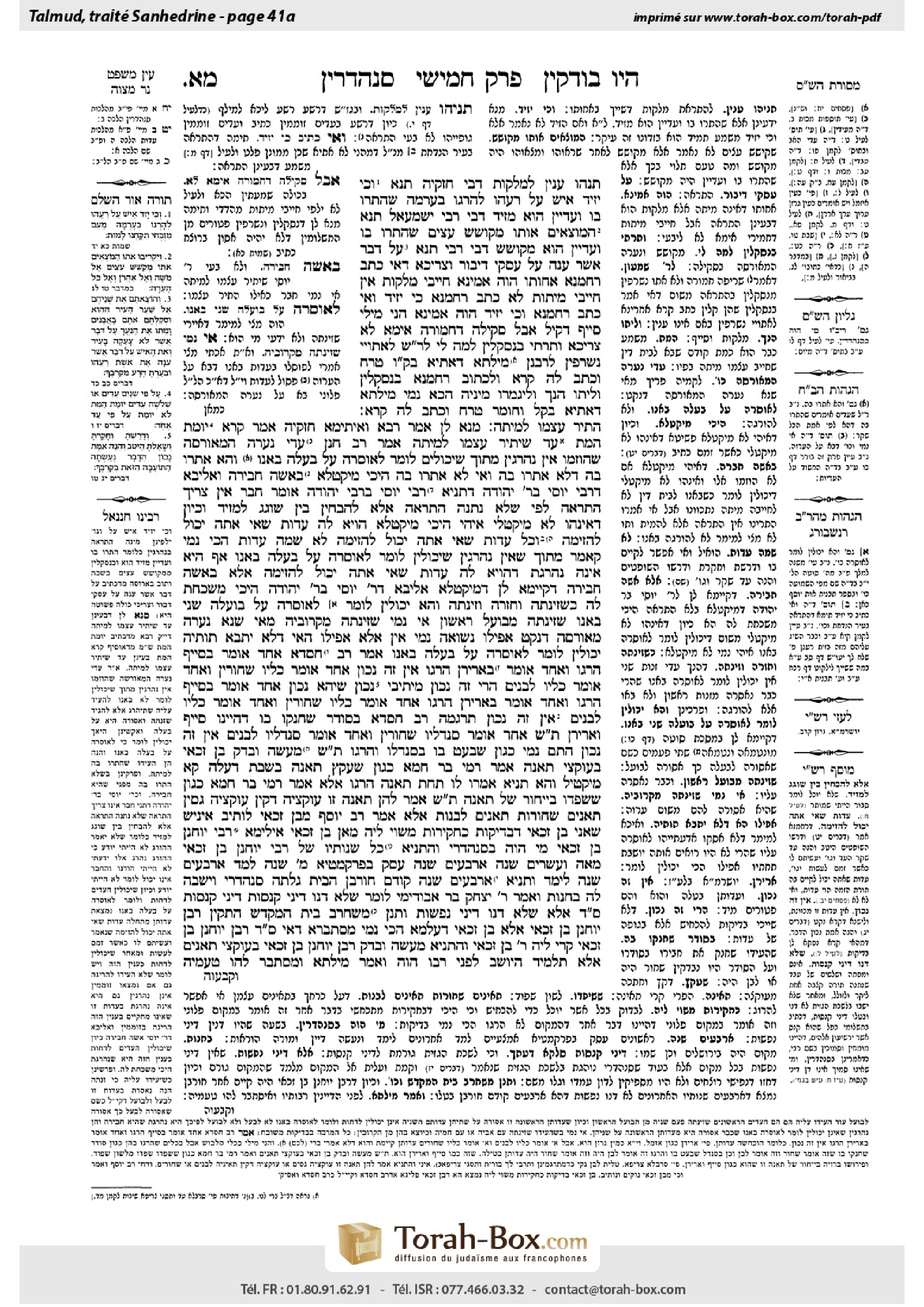
Sanhedrin 41a: Talmud study for Daf Yomi
Daf Yomi is the daily study of one Talmud folio. Explore 37 tractates with scans, Hebrew text, Sefaria English and AI-generated French translations where annotated.
Passage selection and English or AI-generated French translation are available where the scan has annotations. Daf Study is independent of Torah-Box and Sefaria.
Browse Sanhedrin · סנהדרין · All tractatesSanhedrin 41a text and translations
This page of Sanhedrin includes the Aramaic text, an English translation and an AI-generated French translation, alongside the scan above.
סנהדרין מ״א א · Aramaic and Hebrew text
תְּנֵהוּ עִנְיָן לְמַלְקוּת.
דְּבֵי חִזְקִיָּה תָּנָא: ״וְכִי יָזִד אִישׁ עַל רֵעֵהוּ לְהׇרְגוֹ בְעׇרְמָה״ – שֶׁהִתְרוּ בּוֹ, וַעֲדַיִין הוּא מֵזִיד.
דְּבֵי רַבִּי יִשְׁמָעֵאל תָּנָא: ״הַמֹּצְאִים אִתּוֹ מְקֹשֵׁשׁ עֵצִים״ – שֶׁהִתְרוּ בּוֹ, וַעֲדַיִין הוּא מְקוֹשֵׁשׁ.
דְּבֵי רַבִּי תָּנָא: ״עַל דְּבַר אֲשֶׁר עִנָּה״ – עַל עִסְקֵי דִּיבּוּר.
וּצְרִיכָא, דְּאִי כְּתַב רַחֲמָנָא ״אֲחֹתוֹ״ – הֲוָה אָמֵינָא: חַיָּיבֵי מַלְקוֹת – אִין, חַיָּיבֵי מִיתוֹת – לָא. כְּתַב רַחֲמָנָא ״כִּי יָזִד״.
וְאִי כְּתַב רַחֲמָנָא ״וְכִי יָזִד״, הֲוָה אָמֵינָא: הָנֵי מִילֵּי – סַיִיף דְּקִיל, אֲבָל סְקִילָה דַּחֲמוּרָה – אֵימָא לָא. צְרִיכָא.
וְתַרְתֵּי בְּנִסְקָלִין לְמָה לִי? לְרַבִּי שִׁמְעוֹן, לְאֵתוֹיֵי נִשְׂרָפִין.
לְרַבָּנַן, מִילְּתָא דְּאָתְיָא בְּקַל וָחוֹמֶר טָרַח וְכָתַב לַהּ קְרָא. וְלִכְתּוֹב רַחֲמָנָא בְּנִסְקָלִין, וְלֵיתוֹ הָנָךְ וְלִיגְמְרוּ מִינֵּיהּ? הָכָא נָמֵי, מִילְּתָא דְּאָתְיָא בְּקַל וָחוֹמֶר טָרַח וְכָתַב לַהּ קְרָא.
הִתִּיר עַצְמוֹ לְמִיתָה, מְנָא לַן? אָמַר רָבָא, וְאִיתֵּימָא חִזְקִיָּה, אָמַר קְרָא: ״יוּמַת הַמֵּת״ – עַד שֶׁיַּתִּיר עַצְמוֹ לְמִיתָה.
אָמַר רַב חָנָן: עֵדֵי נַעֲרָה הַמְאוֹרָסָה שֶׁהוּזַּמּוּ אֵין נֶהֱרָגִין, מִתּוֹךְ שֶׁיְּכוֹלִים לוֹמַר ״לְאוֹסְרָהּ עַל בַּעְלָהּ בָּאנוּ״.
וְהָא אַתְרוֹ בַּהּ? דְּלָא אַתְרוֹ בַּהּ. וְאִי לָא אַתְרוֹ בַּהּ, הֵיכִי מִיקַּטְלָא?
בְּאִשָּׁה חֲבֵירָה, וְאַלִּיבָּא דְּרַבִּי יוֹסֵי בְּרַבִּי יְהוּדָה. דְּתַנְיָא, רַבִּי יוֹסֵי בְּרַבִּי יְהוּדָה אוֹמֵר: חָבֵר אֵין צָרִיךְ הַתְרָאָה, לְפִי שֶׁלֹּא נִתְּנָה הַתְרָאָה אֶלָּא לְהַבְחִין בֵּין שׁוֹגֵג לְמֵזִיד.
וְכֵיוָן דְּאִינְהוּ לָא מִיקַּטְלִי, אִיהִי הֵיכִי מִיקַּטְלָא? הָוְיָא לַהּ עֵדוּת שֶׁאִי אַתָּה יָכוֹל לַהֲזִימָּהּ, וְכׇל עֵדוּת שֶׁאִי אַתָּה יָכוֹל לַהֲזִימָּהּ לֹא שְׁמָהּ עֵדוּת.
הָכִי נָמֵי קָאָמַר: מִתּוֹךְ שֶׁאֵין נֶהֱרָגִין, שֶׁיְּכוֹלִין לוֹמַר ״לְאוֹסְרָהּ עַל בַּעְלָהּ בָּאנוּ״, אַף הִיא אֵינָהּ נֶהֱרֶגֶת, דְּהָוְיָא לַהּ עֵדוּת שֶׁאִי אַתָּה יָכוֹל לַהֲזִימָּהּ.
אֶלָּא בְּאִשָּׁה חֲבֵירָה, דְּקַיְימָא לַן דְּמִיקַּטְלָא, אַלִּיבָּא דְּרַבִּי יוֹסֵי בְּרַבִּי יְהוּדָה הֵיכִי מַשְׁכַּחַתְּ לַהּ? כְּשֶׁזִּינְּתָה, וְחָזְרָה וְזִינְּתָה.
וְהָא יְכוֹלִין לוֹמַר: ״לְאוֹסְרָהּ עַל בּוֹעֲלָהּ שֵׁנִי בָּאנוּ״! שֶׁזִּינְּתָה מִבּוֹעֵל רִאשׁוֹן, אִי נָמֵי שֶׁזִּינְּתָה מִקְּרוֹבֶיהָ.
מַאי שְׁנָא נַעֲרָה מְאוֹרָסָה דְּנָקֵט? אֲפִילּוּ נְשׂוּאָה נָמֵי! אִין, אֶלָּא אֲפִילּוּ הַאי דְּלָא יָתְבָא תּוּתֵיהּ יְכוֹלִין לוֹמַר: ״לְאוֹסְרָהּ עַל בַּעְלָהּ בָּאנוּ״.
אָמַר רַב חִסְדָּא: אֶחָד אוֹמֵר ״בְּסַיִיף הֲרָגוֹ״, וְאֶחָד אוֹמֵר ״בַּאֲרִירָן הֲרָגוֹ״ – אֵין זֶה ״נָכוֹן״. אֶחָד אוֹמֵר ״כֵּלָיו שְׁחוֹרִין״, וְאֶחָד אוֹמֵר ״כֵּלָיו לְבָנִים״ – הֲרֵי זֶה ״נָכוֹן״.
מֵיתִיבִי: ״נָכוֹן״ – שֶׁיְּהֵא נָכוֹן. אֶחָד אוֹמֵר: ״בְּסַיִיף הֲרָגוֹ״, וְאֶחָד אוֹמֵר: ״בַּאֲרִירָן הֲרָגוֹ״. אֶחָד אוֹמֵר: ״כֵּלָיו שְׁחוֹרִין״, וְאֶחָד אוֹמֵר: ״כֵּלָיו לְבָנִים״ – אֵין זֶה ״נָכוֹן״. תַּרְגְּמַהּ רַב חִסְדָּא: בְּסוּדָר שֶׁחֲנָקוֹ בּוֹ, דְּהַיְינוּ סַיִיף וַאֲרִירָן.
תָּא שְׁמַע: אֶחָד אוֹמֵר ״סַנְדָּלָיו שְׁחוֹרִין״, וְאֶחָד אוֹמֵר ״סַנְדָּלָיו לְבָנִים״ – אֵין זֶה ״נָכוֹן״. הָתָם נָמֵי, כְּגוֹן שֶׁבָּעַט בּוֹ בְּסַנְדָּלוֹ וַהֲרָגוֹ.
תָּא שְׁמַע: מַעֲשֶׂה, וּבָדַק בֶּן זַכַּאי בְּעוּקְצֵי תְּאֵנָה. אָמַר רָמֵי בַּר חָמָא: כְּגוֹן שֶׁעָקַץ תְּאֵנָה בְּשַׁבָּת, דַּעֲלַהּ קָא מִיקְּטִיל.
וְהָא תַּנְיָא: אָמְרוּ לוֹ ״תַּחַת תְּאֵנָה הֲרָגוֹ״? אֶלָּא אָמַר רָמֵי בַּר חָמָא: כְּגוֹן שֶׁשִּׁפְּדוֹ בְּיִיחוּר שֶׁל תְּאֵנָה.
תָּא שְׁמַע, אָמַר לָהֶן: תְּאֵנָה זוֹ עֳקָצֶיהָ דַּקִּין? עֳקָצֶיהָ גַּסִּין? תְּאֵנִים שְׁחוֹרוֹת? תְּאֵנִים לְבָנוֹת? אֶלָּא, אָמַר רַב יוֹסֵף: מִבֶּן זַכַּאי לוֹתֵיב אִינִישׁ? שָׁאנֵי בֶּן זַכַּאי, דִּבְדִיקוֹת כַּחֲקִירוֹת מְשַׁוֵּי לֵיהּ.
מַאן בֶּן זַכַּאי? אִילֵּימָא רַבִּי יוֹחָנָן בֶּן זַכַּאי, מִי הֲוָה בְּסַנְהֶדְרִי? וְהָתַנְיָא: כׇּל שְׁנוֹתָיו שֶׁל רַבִּי יוֹחָנָן בֶּן זַכַּאי מֵאָה וְעֶשְׂרִים שָׁנָה. אַרְבָּעִים שָׁנָה עָסַק בִּפְרַקְמַטְיָא, אַרְבָּעִים שָׁנָה לָמַד, אַרְבָּעִים שָׁנָה לִימֵּד.
וְתַנְיָא: אַרְבָּעִים שָׁנָה קוֹדֶם חוּרְבַּן הַבַּיִת, גָּלְתָה סַנְהֶדְרִין וְיָשְׁבָה לָהּ בַּחֲנוּת. וְאָמַר רַבִּי יִצְחָק בַּר אֲבוּדִימִי: לוֹמַר שֶׁלֹּא דָּנוּ דִּינֵי קְנָסוֹת. דִּינֵי קְנָסוֹת סָלְקָא דַּעְתָּךְ? אֶלָּא שֶׁלֹּא דָּנוּ דִּינֵי נְפָשׁוֹת.
וּתְנַן: מִשֶּׁחָרַב בֵּית הַמִּקְדָּשׁ, הִתְקִין רַבָּן יוֹחָנָן בֶּן זַכַּאי.
אֶלָּא, בֶּן זַכַּאי דְּעָלְמָא. הָכִי נָמֵי מִסְתַּבְּרָא, דְּאִי סָלְקָא דַּעְתָּךְ רַבָּן יוֹחָנָן בֶּן זַכַּאי, קָרֵי לֵיהּ רַבִּי ״בֶּן זַכַּאי״?
וְהָתַנְיָא: מַעֲשֶׂה וּבָדַק רַבָּן יוֹחָנָן בֶּן זַכַּאי בְּעוּקְצֵי תְּאֵנִים! אֶלָּא, תַּלְמִיד הַיּוֹשֵׁב לִפְנֵי רַבּוֹ הֲוָה, וַאֲמַר מִילְּתָא וּמִסְתַּבַּר לְהוּ טַעְמֵיהּ,
Sanhedrin 41a · English translation
apply it to the matter of lashes, as forewarning is required for the court to be able to administer lashes.
The school of Ḥizkiyya taught a source for the requirement of forewarning from the verse concerning the court-imposed capital punishment meted out to a murderer, as it is states: “But if a man come intentionally upon his neighbor to slay him with guile” (Exodus 21:14). How do the witnesses know that he acted intentionally? It must be that they forewarned him, and still he acts intentionally.
The school of Rabbi Yishmael taught a source for the requirement to forewarn transgressors from the verse concerning the court-imposed capital punishment meted out to the wood-gatherer on Shabbat in the wilderness, as it is stated: “And they that found him gathering sticks brought him” (Numbers 15:33). By writing “gathering” in the present tense, the verse indicates that they forewarned him, but he is still gathering.
The school of Rabbi Yehuda HaNasi taught a source for the requirement to forewarn a transgressor from the verse concerning the court-imposed capital punishment meted out to one who commits adultery with a betrothed young woman, as it is stated: “For the matter [devar] that he has humbled his neighbor’s wife” (Deuteronomy 22:24). They make a verbal analogy: For matters involving speech [dibbur], the punishment is given only if the witnesses issued a verbal forewarning.
The Gemara comments: And it is necessary to have all of these sources, since if the Merciful One would write the requirement of forewarning in the context of “his sister” (Leviticus 20:17) alone, I would say: Those liable to receive lashes, yes, they do require forewarning, but those liable to receive court-imposed capital punishments, whose transgressions are severe, do not require forewarning. Therefore the Merciful One writes, with regard to a murderer: “If a man come intentionally.”
And if the Merciful One would write only: “If a man come intentionally,” I would say that this statement applies only when the penalty is death by the sword, as that is a lenient form of court-imposed capital punishment. But with regard to stoning, which is a severe form of court-imposed capital punishment, one could say that it does not require forewarning. Therefore, it is necessary to state the requirement of forewarning with regard to one who desecrates Shabbat.
The Gemara asks: And why do I need two verses that state the requirement for forewarning in the context of those liable to be stoned? Both the Shabbat violator and one who commits adultery with a betrothed young woman are punished with stoning. The Gemara answers: According to the opinion of Rabbi Shimon that death by burning is more severe than death by stoning, the additional verse serves to add the halakha that a forewarning must be issued to those liable to be burned for their transgressions, by way of the application of the principle: If this halakha is not needed for the matter in which it is written, apply it to a different matter.
According to the opinion of the Rabbis that death by stoning is more severe than death by burning, one can say that even with a matter that can be derived through an a fortiori inference, the verse nevertheless takes the trouble and writes it explicitly. The Gemara challenges: But let the Merciful One write this halakha only in the context of those liable to be stoned, and let these others be derived from it, as stoning is the most severe punishment. The Gemara answers: Here too, one can say that even with a matter that can be derived through an a fortiori inference, the verse nevertheless takes the trouble and writes it explicitly.
§ The baraita teaches that one of the questions the court asks of the witnesses is: Did he release himself to death, i.e., did he acknowledge that he is aware that the court imposes capital punishment for murder? The Gemara asks: From where do we derive that he must release himself to death? Rava said, and some say it was Ḥizkiyya who said, that the verse states: “By the mouth of two witnesses or three witnesses shall the dead be put to death” (Deuteronomy 17:6). By referring to the transgressor as dead even before he is executed, the verse indicates that he is not executed until he releases himself to death, by stating that he is aware that he will be executed for his transgression.
Rav Ḥanan says: Witnesses who testify to the adultery of a betrothed young woman who were rendered conspiring witnesses are not killed. Although conspiring witnesses are generally punished with the same punishment they attempted to impose on the purported transgressor (see Deuteronomy 19:19), this is an exception. This is because they can say: We did not come to testify in order to have her be executed; rather, we came to forbid her to her husband, as a betrothed or married woman who willingly engages in adulterous sexual intercourse is forbidden to her husband.
The Gemara challenges this ruling: But they must testify that they forewarned her before her transgression, and a forewarning includes apprising the transgressor of the punishment he or she will receive. How can the witnesses claim that they did not intend this result? The Gemara answers: Rav Ḥanan stated his halakha with regard to a case where they claim they did not forewarn her. The Gemara asks: But if they claim they did not forewarn her, how can she be killed? If she would not have been killed, there is no novelty to Rav Ḥanan’s statement that the witnesses are not killed.
The Gemara explains: Rav Ḥanan stated his halakha with regard to a woman who is a ḥavera, knowledgeable in Torah, and it is in accordance with the opinion of Rabbi Yosei, son of Rabbi Yehuda. As it is taught in a baraita: Rabbi Yosei, son of Rabbi Yehuda, says: A ḥaver does not require forewarning in order to be liable for a transgression, because forewarning is given only in order to distinguish between an intentional and an unintentional act.
The Gemara asks further: But since the witnesses are not killed for their conspiratory testimony in the case of a ḥavera, how can she be killed for her action? Their testimony is testimony that you cannot render conspiratory testimony, i.e., the witnesses cannot be punished for their testimony, and any testimony that you cannot potentially render conspiratory testimony is not categorized as testimony.
The Gemara answers: That is also what he is saying: Since the witnesses are not killed, as they can say: We came to forbid her to her husband, she is also not killed, since their testimony is testimony that you cannot potentially render conspiratory testimony.
The Gemara challenges: But with regard to a woman who is a ḥavera, since we maintain that she can be killed without being forewarned, how can you find this occurring according to the opinion of Rabbi Yosei, son of Rabbi Yehuda? As there was no forewarning, the witnesses can claim that their intention was to forbid her to her husband. The Gemara answers: It is found in a case where they testify that she committed adultery and then they testified that she again committed adultery. The witnesses cannot claim that their testimony was meant to forbid her to her husband, as she was already forbidden to him due to the first time she committed adultery.
The Gemara questions this: But the witnesses can say: We come to forbid her to her second paramour. The halakha is that in addition to becoming forbidden to her husband, an adulterous woman becomes forbidden to her paramour. The witnesses can claim that this was their intent in testifying. The Gemara answers: It is found in a case where they testify that she again committed adultery with the first paramour, i.e., the second act was with the same paramour, to whom she was already forbidden. Alternatively, it is found in a case where they testify that she committed adultery with one of her relatives, to whom she is forbidden regardless.
The Gemara clarifies: What is different that Rav Ḥanan chose to state his halakha with regard to a betrothed young woman? His halakha could be stated with regard to a married woman as well. The Gemara answers: Yes, that is correct. But the novelty of this element of his ruling is that even with regard to this betrothed young woman, who does not live under her husband, the witnesses can say: We came to forbid her to her husband.
§ Rav Ḥisda says: In a case where one of the witnesses says: The murderer killed the victim with a sword, and one of the witnesses says: The murderer killed the victim with an ariran, another weapon, this is not congruent testimony, as this is a clear contradiction. But if one of the witnesses says: The murderer’s garments were black, and one of the witnesses says: The murderer’s garments were white, this is congruent testimony, as this is not a meaningful discrepancy.
The Gemara raises an objection from a baraita: The verse states with regard to testimony: “And behold it be truth, the matter certain” (Deuteronomy 17:4). The meaning of “certain” is that the testimony of the two witnesses must be congruent. If one witness says: The murderer killed the victim with a sword, and one says: The murderer killed the victim with an ariran, or if one of the witnesses says: The murderer’s garments were black, and one of the witnesses says: The murderer’s garments were white, this is not congruent testimony. This contradicts the ruling of Rav Ḥisda. The Gemara answers: Rav Ḥisda interpreted that baraita as speaking about a scarf with which the murderer strangled the victim, as this is the same as a contradiction with regard to a sword and an ariran. As Rav Ḥisda himself ruled, a contradiction concerning details of the murder weapon renders the testimony incongruent.
The Gemara suggests: Come and hear proof from a baraita: If one of the witnesses says: The sandals of the murderer were black, and one of the witnesses says: The sandals of the murderer were white, this is not congruent testimony. This contradicts the ruling of Rav Ḥisda. The Gemara answers: Rav Ḥisda can explain that there also, it is speaking of a case where the murderer kicked the victim with his sandal and killed him.
The Gemara suggests: Come and hear proof from the mishna: An incident occurred, and ben Zakkai examined the witnesses about the stems of figs, indicating that even a contradiction concerning a minor point such as this would render the testimony incongruent. The Gemara answers: Rami bar Ḥama said: It is speaking there of a case where he picked a fig on Shabbat, as he is killed for that act itself. Picking a fruit from its source of growth is an example of the forbidden labor of reaping, so the testimony about the characteristics of the fig is significant.
The Gemara asks: But isn’t it taught in a baraita: When ben Zakkai asked the witnesses the question about the stems of figs, they said to him: The murderer killed the victim beneath a fig tree, indicating that it is speaking of a murder case? Rather, Rami bar Ḥama said: The mishna is speaking of a case where the murderer stabbed the victim with a branch of a fig tree. As Rav Ḥisda himself ruled, a contradiction concerning details of the murder weapon renders the testimony incongruent.
Come and hear a proof, as in that same examination ben Zakkai said to the witnesses: This fig tree about which you are testifying, were its stems thin or were its stems thick? Were the figs on it black or were the figs white? These questions concern the fruit itself, not the characteristics of a branch. Rather, Rav Yosef says: Should a person raise a difficulty from the conduct of ben Zakkai? Ben Zakkai is different, as he equated examinations with interrogations. According to ben Zakkai’s opinion, a contradiction in the witnesses’ answers to an examination is as significant as a contradiction in the witnesses’ answers to an interrogation, and it also renders the testimony incongruent.
§ The Gemara clarifies: Who is the ben Zakkai mentioned in the mishna? If we say it is Rabbi Yoḥanan ben Zakkai, was he a member in a Sanhedrin that judged capital cases? But isn’t it taught in a baraita: All the years of Rabbi Yoḥanan ben Zakkai were 120 years. For forty of those years he dealt in business [biferakmatya], for forty of those years he studied, and for forty of those years he taught and guided the Jewish people.
The Gemara continues its question: And it is taught in a baraita: Forty years before the destruction of the Second Temple, the Sanhedrin was exiled from the Chamber of Hewn Stone and sat in the store near the Temple Mount. And Rabbi Yitzḥak bar Avudimi says: The intent of the statement concerning the relocation of the Sanhedrin is to say that they no longer judged laws of fines. The Gemara asks: Does it enter your mind to say that they no longer judged laws of fines? It is known that the Sanhedrin would judge laws of fines for hundreds of years after the destruction of the Temple. Rather, he must have said that the Sanhedrin no longer judged cases of capital law. Once the Sanhedrin left the Chamber of Hewn Stone, the court’s power to judge capital cases was nullified.
The Gemara concludes its question: And since as we learned in a mishna (Sukka 41a): Once the Temple was destroyed, Rabban Yoḥanan ben Zakkai instituted an ordinance that the mitzva of lulav should be performed even in the rest of the country for seven days in commemoration of the Temple, it is clear that he was in a position of prominence after the destruction of the Temple. Since the Sanhedrin ceased judging cases of capital law forty years before the destruction of the Temple, and Rabban Yoḥanan ben Zakkai was in a position of prominence for only forty years, he could not have been a judge in a capital case.
The Gemara suggests: Rather, one can say that it was merely a different person named ben Zakkai, not the well-known Sage of that name. The Gemara comments: So too, it is reasonable to say this, as if it enters your mind that this was Rabban Yoḥanan ben Zakkai, would Rabbi Yehuda HaNasi call him ben Zakkai, without any title? He must have been referring to someone else.
The Gemara asks: But isn’t it taught in a baraita explicitly: An incident occurred, and Rabban Yoḥanan ben Zakkai examined the witnesses with regard to the stems of figs? This proves that the Sage in question is Rabban Yoḥanan ben Zakkai. Rather, one can say that at that time, when this incident occurred, Rabban Yoḥanan ben Zakkai was a student sitting before his teacher, and in those years the Sanhedrin was in its place and judged cases of capital law. And he said a matter in the course of examining the witnesses, and his reasoning was logical to them, and the judges asked his question,
Sanhedrin 41a · Traduction française (IA)
Applique-le à la question des coups de fouet, car un avertissement préalable est nécessaire pour que le tribunal puisse infliger cette peine.
L’école de Ḥizkiyya enseignait que l’exigence d’un avertissement préalable se déduit du verset relatif à la peine capitale infligée par le tribunal à un meurtrier, comme il est dit : « Mais si un homme s’en prend intentionnellement à son prochain pour le tuer par ruse » (Exode 21:14). Comment les témoins savent-ils qu’il a agi intentionnellement ? C’est nécessairement parce qu’ils l’ont averti au préalable, et qu’il a néanmoins agi intentionnellement.
L’école de Rabbi Yishmael enseignait que l’exigence d’un avertissement préalable aux transgresseurs se déduit du verset relatif à la peine capitale infligée par le tribunal à celui qui ramassait du bois le Chabbat dans le désert, comme il est dit : « Ceux qui le trouvèrent en train de ramasser du bois l’amenèrent » (Nombres 15:33). En employant le présent dans « en train de ramasser », le verset indique qu’ils l’avaient averti au préalable, mais qu’il continuait malgré tout à ramasser du bois.
L’école de Rabbi Yehuda HaNasi enseignait que l’exigence d’un avertissement préalable au transgresseur se déduit du verset relatif à la peine capitale infligée par le tribunal à celui qui commet l’adultère avec une jeune femme fiancée, comme il est dit : « Pour le fait [devar] qu’il a humilié la femme de son prochain » (Deutéronome 22:24). Ils établissent une analogie verbale : dans les cas désignés par le terme « parole » [dibbur], la peine n’est infligée que si les témoins ont donné un avertissement verbal.
La Guemara commente : Toutes ces sources sont nécessaires. En effet, si le Miséricordieux avait écrit l’exigence d’un avertissement préalable uniquement dans le contexte de « sa sœur » (Lévitique 20:17), j’aurais dit : ceux qui sont passibles de coups de fouet, oui, doivent recevoir un avertissement préalable, mais ceux qui sont passibles d’une peine capitale infligée par le tribunal, dont les transgressions sont graves, n’ont pas besoin d’un avertissement préalable. C’est pourquoi le Miséricordieux écrit, au sujet d’un meurtrier : « Si un homme s’en prend intentionnellement… ».
Et si le Miséricordieux avait écrit uniquement : « Si un homme s’en prend intentionnellement… », j’aurais dit que cela ne s’applique qu’au cas où la peine est la mort par l’épée, car il s’agit d’une forme relativement légère de peine capitale infligée par le tribunal. Mais, pour la lapidation, qui est une forme grave de peine capitale infligée par le tribunal, on aurait pu dire qu’un avertissement préalable n’est pas nécessaire. Il est donc nécessaire d’énoncer cette exigence à propos de celui qui profane le Chabbat.
La Guemara demande : Pourquoi ai-je besoin de deux versets qui énoncent l’exigence d’un avertissement préalable dans le contexte de ceux qui sont passibles de lapidation ? Le profanateur du Chabbat et celui qui commet l’adultère avec une jeune femme fiancée sont tous deux punis par lapidation. La Guemara répond : Selon l’opinion de Rabbi Shimon, pour qui la mort par le feu est plus grave que la mort par lapidation, le verset supplémentaire sert à ajouter la halakha selon laquelle ceux qui sont passibles de la mort par le feu pour leurs transgressions doivent recevoir un avertissement préalable, en appliquant le principe suivant : si cette halakha n’est pas nécessaire dans le contexte où elle est écrite, applique-la à un autre contexte.
Selon l’opinion des Rabbins, pour qui la mort par lapidation est plus grave que la mort par le feu, on peut dire que même lorsqu’une règle peut être déduite par raisonnement a fortiori, le verset prend néanmoins la peine de l’énoncer explicitement. La Guemara objecte : Mais que le Miséricordieux n’écrive cette halakha que dans le contexte de ceux qui sont passibles de lapidation, et que l’on en déduise le cas des autres, puisque la lapidation est la peine la plus grave. La Guemara répond : Ici aussi, on peut dire que même lorsqu’une règle peut être déduite par raisonnement a fortiori, le verset prend néanmoins la peine de l’énoncer explicitement.
§ La baraïta enseigne que l’une des questions que le tribunal pose aux témoins est : S’est-il reconnu passible de mort, c’est-à-dire a-t-il reconnu qu’il savait que le tribunal inflige la peine capitale pour meurtre ? La Guemara demande : D’où déduisons-nous qu’il doit se reconnaître passible de mort ? Rava dit — et certains disent que c’est Ḥizkiyya qui l’a dit — que le verset énonce : « C’est sur la déposition de deux ou trois témoins que le mort sera mis à mort » (Deutéronome 17:6). En qualifiant le transgresseur de « mort » avant même son exécution, le verset indique qu’il n’est exécuté qu’après s’être reconnu passible de mort, en déclarant qu’il sait qu’il sera exécuté pour sa transgression.
Rav Ḥanan dit : Les témoins qui déposent au sujet de l’adultère d’une jeune femme fiancée et qui sont ensuite reconnus comme témoins comploteurs ne sont pas mis à mort. Bien que les témoins comploteurs soient généralement punis de la peine qu’ils ont tenté de faire infliger au transgresseur présumé (voir Deutéronome 19:19), il s’agit ici d’une exception. En effet, ils peuvent dire : « Nous ne sommes pas venus témoigner pour qu’elle soit exécutée ; nous sommes venus pour qu’elle soit interdite à son mari », car une femme fiancée ou mariée qui a volontairement des relations sexuelles adultères est interdite à son mari.
La Guemara objecte à cette décision : Mais ils doivent témoigner qu’ils l’ont avertie avant sa transgression, et un avertissement préalable implique d’informer le transgresseur de la peine qu’il encourra. Comment les témoins peuvent-ils prétendre qu’ils n’avaient pas l’intention d’obtenir ce résultat ? La Guemara répond : Rav Ḥanan a énoncé sa halakha au sujet d’un cas où ils prétendent ne pas l’avoir avertie. La Guemara demande : Mais s’ils prétendent ne pas l’avoir avertie, comment peut-elle être mise à mort ? Si elle ne devait pas être mise à mort, la déclaration de Rav Ḥanan selon laquelle les témoins ne sont pas mis à mort ne présenterait rien de nouveau.
La Guemara explique : Rav Ḥanan a énoncé sa halakha au sujet d’une femme qui est une ḥavera, instruite dans la Torah, conformément à l’opinion de Rabbi Yosei, fils de Rabbi Yehuda. En effet, il est enseigné dans une baraïta : Rabbi Yosei, fils de Rabbi Yehuda, dit : Un ḥaver n’a pas besoin d’un avertissement préalable pour être passible de peine pour une transgression, car l’avertissement préalable ne sert qu’à distinguer un acte intentionnel d’un acte involontaire.
La Guemara demande encore : Mais puisque les témoins ne sont pas mis à mort pour leur témoignage comploteur dans le cas d’une ḥavera, comment peut-elle être mise à mort pour son acte ? Leur témoignage ne peut pas être réfuté par une accusation de complot, c’est-à-dire que les témoins ne peuvent pas être punis pour leur déposition ; or, tout témoignage qui ne peut pas être réfuté de cette manière n’est pas considéré comme un témoignage.
La Guemara répond : C’est également ce qu’il dit : puisque les témoins ne sont pas mis à mort, car ils peuvent dire : « Nous sommes venus pour qu’elle soit interdite à son mari », elle non plus n’est pas mise à mort, car leur témoignage ne peut pas être réfuté par une accusation de complot.
La Guemara objecte : Mais, dans le cas d’une femme qui est une ḥavera, puisque nous considérons qu’elle peut être mise à mort sans avoir été avertie au préalable, comment cela peut-il se produire selon l’opinion de Rabbi Yosei, fils de Rabbi Yehuda ? En l’absence d’avertissement préalable, les témoins peuvent prétendre que leur intention était de la rendre interdite à son mari. La Guemara répond : Cela se produit dans un cas où ils témoignent qu’elle a commis un adultère, puis qu’elle en a commis un autre. Les témoins ne peuvent pas prétendre que leur témoignage visait à la rendre interdite à son mari, puisqu’elle lui était déjà interdite à la suite de son premier adultère.
La Guemara met cette réponse en question : Mais les témoins peuvent dire : « Nous sommes venus pour la rendre interdite à son second amant. » Selon la halakha, outre le fait qu’elle devient interdite à son mari, une femme adultère devient également interdite à son amant. Les témoins peuvent prétendre que c’était là leur intention en témoignant. La Guemara répond : Cela se produit dans un cas où ils témoignent qu’elle a de nouveau commis un adultère avec son premier amant, c’est-à-dire que le second acte a eu lieu avec le même amant, auquel elle était déjà interdite. Ou bien, cela se produit dans un cas où ils témoignent qu’elle a commis un adultère avec l’un de ses proches parents, auquel elle est de toute façon interdite.
La Guemara précise : Qu’y a-t-il de particulier dans le cas de la jeune femme fiancée, pour que Rav Ḥanan ait choisi d’énoncer sa halakha à son sujet ? Il aurait aussi pu l’énoncer au sujet d’une femme mariée. La Guemara répond : Oui, c’est exact. Mais l’élément nouveau de sa décision est que, même dans le cas de cette jeune femme fiancée, qui ne vit pas avec son mari, les témoins peuvent dire : « Nous sommes venus pour la rendre interdite à son mari. »
§ Rav Ḥisda dit : Si l’un des témoins affirme que le meurtrier a tué la victime avec une épée et l’autre qu’il l’a tuée avec un ariran, une autre arme, leurs témoignages ne concordent pas, car il s’agit d’une contradiction manifeste. Mais si l’un des témoins affirme que les vêtements du meurtrier étaient noirs et l’autre qu’ils étaient blancs, leurs témoignages concordent, car cette divergence n’est pas significative.
La Guemara soulève une objection à partir d’une baraïta : À propos du témoignage, le verset énonce : « Et voici que la chose est vraie, certaine » (Deutéronome 17:4). Le terme « certaine » signifie que les témoignages des deux témoins doivent concorder. Si l’un des témoins affirme que le meurtrier a tué la victime avec une épée et l’autre qu’il l’a tuée avec un ariran, ou si l’un des témoins affirme que les vêtements du meurtrier étaient noirs et l’autre qu’ils étaient blancs, leurs témoignages ne concordent pas. Cela contredit la décision de Rav Ḥisda. La Guemara répond : Rav Ḥisda interprète cette baraïta comme parlant d’une écharpe avec laquelle le meurtrier a étranglé la victime, car cela équivaut à une contradiction entre les versions concernant l’usage d’une épée ou d’un ariran. En effet, Rav Ḥisda lui-même a statué qu’une contradiction concernant les détails de l’arme du meurtre rend les témoignages discordants.
La Guemara propose : Viens entendre une preuve tirée d’une baraïta : si l’un des témoins affirme que les sandales du meurtrier étaient noires et l’autre qu’elles étaient blanches, leurs témoignages ne concordent pas. Cela contredit la décision de Rav Ḥisda. La Guemara répond : Rav Ḥisda peut expliquer qu’ici aussi, il s’agit d’un cas où le meurtrier a tué la victime en lui donnant un coup avec sa sandale.
La Guemara propose : Viens entendre une preuve tirée de la Michna : un événement s’est produit et ben Zakkai a interrogé les témoins au sujet des pédoncules des figues, ce qui indique que même une contradiction sur un détail mineur de ce genre rendrait les témoignages discordants. La Guemara répond : Rami bar Ḥama a dit : Il s’agit d’un cas où il a cueilli une figue le Chabbat, acte pour lequel il est lui-même mis à mort. Cueillir un fruit de sa source de croissance est un exemple du travail interdit de la moisson ; le témoignage concernant les caractéristiques de la figue est donc significatif.
La Guemara demande : Mais n’est-il pas enseigné dans une baraïta que, lorsque ben Zakkai a posé aux témoins la question au sujet des pédoncules des figues, ils lui ont répondu : « Le meurtrier a tué la victime sous un figuier », ce qui indique qu’il s’agit d’un meurtre ? Rami bar Ḥama a donc plutôt dit : La Michna parle d’un cas où le meurtrier a poignardé la victime avec une branche de figuier. En effet, Rav Ḥisda lui-même a statué qu’une contradiction concernant les détails de l’arme du meurtre rend les témoignages discordants.
Viens entendre une preuve : au cours de ce même examen, ben Zakkai a dit aux témoins : « Ce figuier au sujet duquel vous témoignez, ses pédoncules étaient-ils fins ou épais ? Les figues qu’il portait étaient-elles noires ou blanches ? » Ces questions concernent le fruit lui-même, et non les caractéristiques d’une branche. Rav Yosef dit plutôt : Peut-on soulever une difficulté à partir de la conduite de ben Zakkai ? Le cas de ben Zakkai est particulier, car il mettait les examens sur le même plan que les interrogatoires. Selon son opinion, une contradiction dans les réponses des témoins à un examen est aussi significative qu’une contradiction dans leurs réponses à un interrogatoire, et elle rend également les témoignages discordants.
§ La Guemara précise : Qui est le ben Zakkai mentionné dans la Michna ? Si l’on dit qu’il s’agit de Rabbi Yoḥanan ben Zakkai, était-il membre d’un Sanhédrin qui jugeait des affaires passibles de la peine capitale ? Mais n’est-il pas enseigné dans une baraïta : Rabbi Yoḥanan ben Zakkai vécut cent vingt ans. Pendant quarante ans, il fit du commerce [biferakmatya] ; pendant quarante ans, il étudia ; et pendant quarante ans, il enseigna et guida le peuple juif.
La Guemara poursuit son objection : Il est enseigné dans une baraïta : Quarante ans avant la destruction du Second Temple, le Sanhédrin fut exilé de la Chambre des pierres de taille et siégea dans la boutique près du mont du Temple. Rabbi Yitzḥak bar Avudimi dit : La déclaration concernant le déplacement du Sanhédrin signifie qu’il ne jugeait plus les affaires passibles d’amendes. La Guemara demande : Peut-on penser qu’il ne jugeait plus les affaires passibles d’amendes ? On sait que le Sanhédrin en jugea pendant des centaines d’années après la destruction du Temple. Il a donc nécessairement voulu dire que le Sanhédrin ne jugeait plus les affaires passibles de la peine capitale. Dès que le Sanhédrin quitta la Chambre des pierres de taille, le tribunal perdit le pouvoir de juger les affaires passibles de la peine capitale.
La Guemara achève son objection : Et puisque, comme nous l’avons appris dans une Michna (Soukka 41a), après la destruction du Temple, Rabban Yoḥanan ben Zakkai institua une ordonnance prescrivant d’accomplir la mitsva du loulav pendant sept jours même dans le reste du pays, en souvenir du Temple, il est clair qu’il occupait une position éminente après la destruction du Temple. Puisque le Sanhédrin avait cessé de juger les affaires passibles de la peine capitale quarante ans avant la destruction du Temple, et que Rabban Yoḥanan ben Zakkai n’occupa une position éminente que pendant les quarante années suivantes, il ne pouvait pas avoir été juge dans une affaire passible de la peine capitale.
La Guemara propose : On peut plutôt dire qu’il s’agissait simplement d’une autre personne nommée ben Zakkai, et non du Sage bien connu portant ce nom. La Guemara commente : Il est également raisonnable de le dire, car si l’on pensait qu’il s’agissait de Rabban Yoḥanan ben Zakkai, Rabbi Yehuda HaNasi l’aurait-il appelé ben Zakkai, sans aucun titre ? Il devait faire référence à quelqu’un d’autre.
La Guemara demande : Mais n’est-il pas explicitement enseigné dans une baraïta : « Un événement s’est produit, et Rabban Yoḥanan ben Zakkai a interrogé les témoins au sujet des pédoncules des figues » ? Cela prouve que le Sage en question est Rabban Yoḥanan ben Zakkai. On peut donc plutôt dire qu’à l’époque de cet événement, Rabban Yoḥanan ben Zakkai était un élève assis devant son maître et que, durant ces années, le Sanhédrin siégeait encore à son emplacement et jugeait les affaires passibles de la peine capitale. Il formula une question au cours de l’examen des témoins ; son raisonnement leur parut juste, et les juges posèrent sa question,
Traduction française générée par IA à partir de l’édition anglaise de Sefaria. Vérifie toujours un passage avec le texte source.
Text from Sefaria: William Davidson Edition - Vocalized Aramaic (CC BY NC); William Davidson Edition - English (CC BY NC).