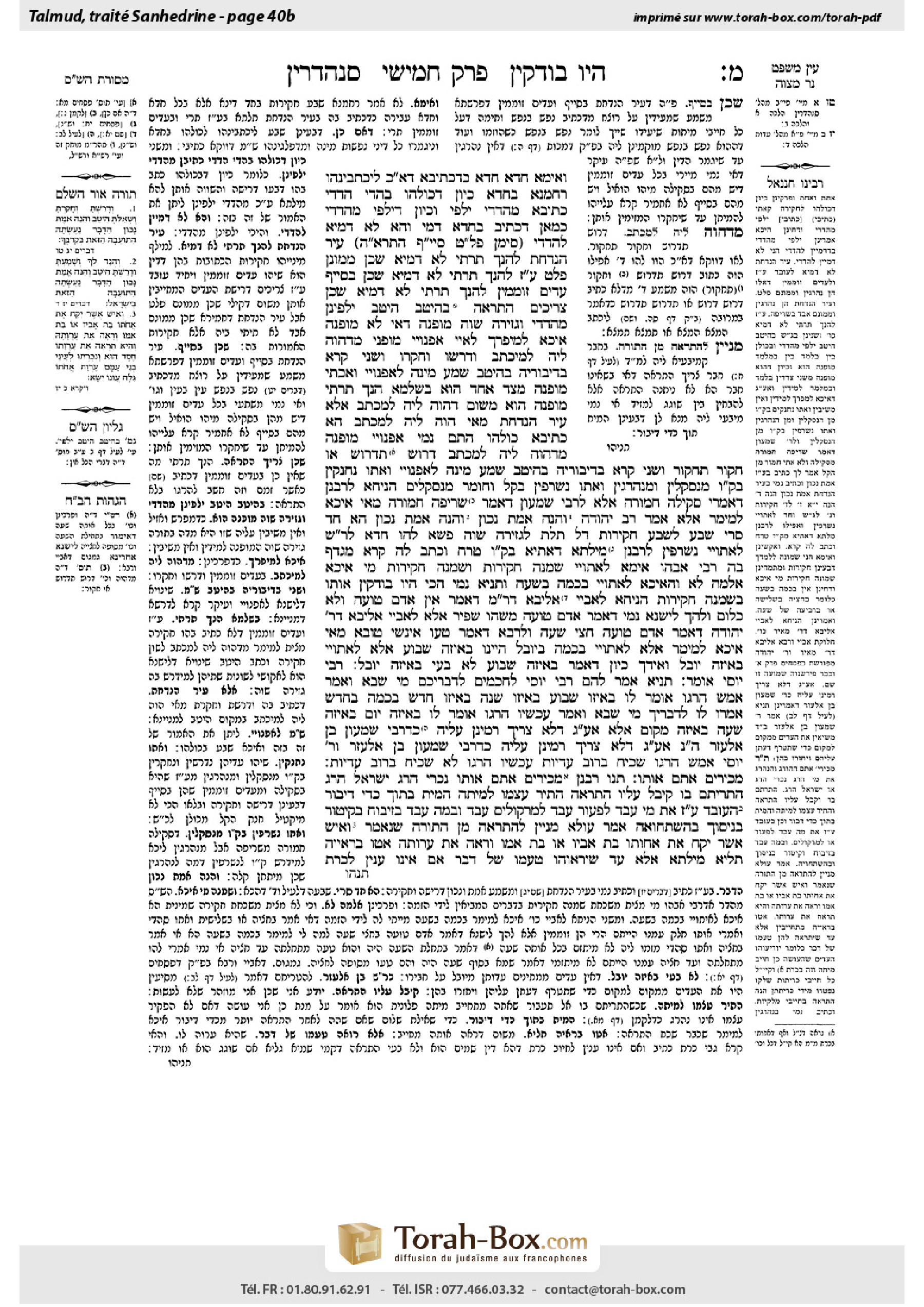
Sanhedrin 40b: Talmud study for Daf Yomi
Daf Yomi is the daily study of one Talmud folio. Explore 37 tractates with scans, Hebrew text, Sefaria English and AI-generated French translations where annotated.
Passage selection and English or AI-generated French translation are available where the scan has annotations. Daf Study is independent of Torah-Box and Sefaria.
Browse Sanhedrin · סנהדרין · All tractatesSanhedrin 40b text and translations
This page of Sanhedrin includes the Aramaic text, an English translation and an AI-generated French translation, alongside the scan above.
סנהדרין מ׳ ב · Aramaic and Hebrew text
וְאֵימָא: חֲדָא חֲדָא כְּדִכְתִיבָא? דְּאִם כֵּן, לִיכְתְּבִינְהוּ רַחֲמָנָא בַּחֲדָא! כֵּיוָן דְּכוּלְּהוּ בַּהֲדֵי הֲדָדֵי כְּתִיבָא, מֵהֲדָדֵי יָלְפִי, וְכֵיוָן דְּיָלְפִי מֵהֲדָדֵי, כְּמַאן דִּכְתִיב בַּחֲדָא דָּמֵי.
וְהָא לָא דָּמְיָאן לַהֲדָדֵי? (סִימָן: פָּלֵט, סַיִיף, הַתְרָאָה.)
עִיר הַנִּדַּחַת לְהָנָךְ תַּרְתֵּי לָא דָּמְיָא, שֶׁכֵּן מָמוֹנָן פָּלֵט. עֲבוֹדָה זָרָה לְהָנָךְ תַּרְתֵּי לָא דָּמְיָא, שֶׁכֵּן בְּסַיִיף. עֵדִים זוֹמְמִין לְהָנָךְ תַּרְתֵּי לָא דָּמְיָא, שֶׁכֵּן צְרִיכִים הַתְרָאָה.
בְּ״הֵיטֵב״ ״הֵיטֵב״ יָלְפִינַן מֵהֲדָדֵי, וּגְזֵירָה שָׁוָה מוּפְנָה. דְּאִי לָא מוּפְנָה, אִיכָּא לְמִיפְרַךְ. לָאיֵי, אַפְנוֹיֵי מוּפְנֵי. מִדַּהֲוָה לֵיהּ לְמִיכְתַּב ״וְדָרְשׁוּ וְחָקְרוּ״, וְשַׁנִּי קְרָא בְּדִיבּוּרֵיהּ בְּ״הֵיטֵב״, שְׁמַע מִינַּהּ לְאַפְנוֹיֵי.
וְאַכַּתִּי מוּפְנֶה מִצַּד אֶחָד הוּא! בִּשְׁלָמָא הָנָךְ תַּרְתֵּי מוּפְנֶה הוּא, מִשּׁוּם דַּהֲוָה לֵיהּ לְמִכְתַּב. אֶלָּא עִיר הַנִּדַּחַת, מַאי הֲוָה לֵיהּ לְמִכְתַּב? הָא כְּתִיבָא כּוּלְּהוּ!
הָתָם נָמֵי אַפְנוֹיֵי מוּפְנֵה, מִדַּהֲוָה לֵיהּ לְמִכְתַּב ״דָּרוֹשׁ תִּדְרֹשׁ״ אוֹ ״חָקוֹר תַּחְקֹר״, וְשַׁנִּי קְרָא בְּדִיבּוּרֵיהּ בְּ״הֵיטֵב״ – שְׁמַע מִינַּהּ לְאַפְנוֹיֵי.
וְאָתוּ נֶחְנָקִין בְּקַל וָחוֹמֶר מִנִּסְקָלִין וּמִנֶּהֱרָגִין, וְאָתוּ נִשְׂרָפִין בְּקַל וָחוֹמֶר מִנִּסְקָלִין.
הָנִיחָא לְרַבָּנַן דְּאָמְרִי סְקִילָה חֲמוּרָה, אֶלָּא לְרַבִּי שִׁמְעוֹן דְּאָמַר שְׂרֵיפָה חֲמוּרָה, מַאי אִיכָּא לְמֵימַר?
אֶלָּא אָמַר רַב יְהוּדָה: ״וְהִנֵּה אֱמֶת נָכוֹן״, ״וְהִנֵּה אֱמֶת נָכוֹן״ – הָא חַד סְרֵי. שֶׁבַע – לְשֶׁבַע חֲקִירוֹת, דַּל תְּלָת – לִגְזֵירָה שָׁוָה, פָּשָׁא לְהוּ חֲדָא.
לְרַבִּי שִׁמְעוֹן, לְאֵתוֹיֵי נִשְׂרָפִין. לְרַבָּנַן, מִילְּתָא דְּאָתְיָא בְּקַל וָחוֹמֶר – טָרַח וְכָתַב לַהּ קְרָא.
מְגַדֵּף בַּהּ רַבִּי אֲבָהוּ: אֵימָא לְאֵתוֹיֵי שְׁמֹנֶה חֲקִירוֹת! וּשְׁמֹנֶה חֲקִירוֹת מִי אִיכָּא?! אַלְּמָה לָא? וְהָאִיכָּא לְאֵתוֹיֵי בְּכַמָּה בְּשָׁעָה. וְתַנְיָא נָמֵי הָכִי: הָיוּ בּוֹדְקִין אוֹתוֹ בִּשְׁמֹנֶה חֲקִירוֹת.
הָנִיחָא לְאַבָּיֵי אַלִּיבָּא דְּרַבִּי מֵאִיר, דְּאָמַר: אֵין אָדָם טוֹעֶה וְלֹא כְּלוּם, וּלְהַךְ לִישָּׁנָא נָמֵי דְּאָמַר: אָדָם טוֹעֶה מַשֶּׁהוּ – שַׁפִּיר. אֶלָּא לְאַבָּיֵי אַלִּיבָּא דְּרַבִּי יְהוּדָה, דְּאָמַר: אָדָם טוֹעֶה חֲצִי שָׁעָה, וּלְרָבָא דְּאָמַר: טָעוּ אִינָשֵׁי טוּבָא – מַאי אִיכָּא לְמֵימַר?
אֶלָּא, לְאֵתוֹיֵי בְּכַמָּה בַּיּוֹבֵל.
הַיְינוּ בְּאֵיזֶה שָׁבוּעַ! אֶלָּא, לְאֵתוֹיֵי בְּאֵיזֶה יוֹבֵל. וְאִידַּךְ: כֵּיוָן דְּאָמַר בְּאֵיזֶה שָׁבוּעַ, לָא בָּעֵי בְּאֵיזֶה יוֹבֵל.
רַבִּי יוֹסֵי אוֹמֵר. תַּנְיָא, אָמַר לָהֶם רַבִּי יוֹסֵי לַחֲכָמִים: לְדִבְרֵיכֶם, מִי שֶׁבָּא וְאָמַר ״אֶמֶשׁ הֲרָגוֹ״, אוֹמֵר לוֹ ״בְּאֵיזוֹ שָׁבוּעַ?״, ״בְּאֵיזוֹ שָׁנָה?״, ״בְּאֵיזֶה חֹדֶשׁ?״, ״בְּכַמָּה בַּחֹדֶשׁ?״
אָמְרוּ לוֹ: לִדְבָרֶיךָ, מִי שֶׁבָּא וְאָמַר ״עַכְשָׁו הֲרָגוֹ״, אוֹמֵר לוֹ ״בְּאֵיזֶה יוֹם?״, ״בְּאֵיזֶה שָׁעָה?״, ״בְּאֵיזֶה מָקוֹם?״
אֶלָּא, אַף עַל גַּב דְּלָא צָרִיךְ, רָמֵינַן עֲלֵיהּ כִּדְרַבִּי שִׁמְעוֹן בֶּן אֶלְעָזָר. הָכָא נָמֵי, אַף עַל גַּב דְּלָא צָרִיךְ, רָמֵינַן עֲלֵיהּ כִּדְרַבִּי שִׁמְעוֹן בֶּן אֶלְעָזָר.
וְרַבִּי יוֹסֵי: ״אֶמֶשׁ הֲרָגוֹ״ – שְׁכִיחַ בְּרוֹב עֵדִיּוֹת, ״עַכְשָׁיו הֲרָגוֹ״ – לָא שְׁכִיחַ בְּרוֹב עֵדִיּוֹת.
מַכִּירִים אַתֶּם אוֹתוֹ. תָּנוּ רַבָּנַן: מַכִּירִים אַתֶּם אוֹתוֹ? נׇכְרִי הָרַג? יִשְׂרָאֵל הָרַג? הִתְרִיתֶם בּוֹ? קִיבֵּל עָלָיו הַתְרָאָה? הִתִּיר עַצְמוֹ לְמִיתָה? הֵמִית בְּתוֹךְ כְּדֵי דִיבּוּר?
הָעוֹבֵד עֲבוֹדָה זָרָה. אֶת מִי עָבַד: לִפְעוֹר עָבַד? לְמַרְקוּלִיס עָבַד? וּבַמָּה עָבַד: בְּזִיבּוּחַ? בְּקִיטּוּר? בְּנִיסּוּךְ? בְּהִשְׁתַּחֲוָאָה?
אָמַר עוּלָּא: מִנַּיִין לְהַתְרָאָה מִן הַתּוֹרָה? שֶׁנֶּאֱמַר: ״וְאִישׁ אֲשֶׁר יִקַּח אֶת אֲחֹתוֹ בַּת אָבִיו אוֹ בַת אִמּוֹ וְרָאָה אֶת עֶרְוָתָהּ״. אַטּוּ בִּרְאִיָּה תַּלְיָא מִילְּתָא? אֶלָּא עַד שֶׁיַּרְאוּהוּ טַעְמוֹ שֶׁל דָּבָר. אִם אֵינוֹ עִנְיָן לְכָרֵת –
Sanhedrin 40b · English translation
The Gemara asks: But why not say that each one is as it is written, and conclude that the Torah requires, respectively, three, two, and two interrogations in the three cases of idol worship, an idolatrous city, and conspiring witnesses, discussed in those verses? As, if it is so, i.e., if there is a requirement of seven interrogations in all cases of capital law, let the Merciful One write them in one place, and it would be derived from there to other cases. The Gemara answers: Since they are all written together, i.e., they all employ analogous terminology, one learns the halakhot of one from the other, and once one learns the halakhot of one from the other, they are considered as if they are written in one place.
The Gemara asks: But those three instances of idol worship, an idolatrous city, and conspiring witnesses are not similar to each other, so how can one derive the halakhot of one from the other? The Gemara records a mnemonic device for the following terms: Escapes, sword, forewarning.
What are the differences? The case of an idolatrous city is not similar to those two, i.e., idol worship and conspiring witnesses, because for the others their money escapes their fate. Although the court executes those transgressors, their money is not confiscated. By contrast, in the case of an idolatrous city, not only are the residents executed, all of their property is destroyed. Idol worship is not similar to those two, as the other two transgressions are judged by the sword, while the punishment for idol worship is death by stoning. The case of conspiring witnesses is not similar to those two, as those who transgress the two other transgressions require forewarning in order to be liable for the transgression, while conspiring witnesses are not forewarned before they testify.
The Gemara explains: This is not an association based on conceptual similarity alone; rather, we learn one from the other based on a verbal analogy employing the words “diligently” and “diligently.” “Diligently” is used in all three verses. The Gemara comments: And this verbal analogy must be free, i.e., these terms must be superfluous in their context. The Torah included them for the express purpose of establishing the verbal analogy. A verbal analogy that is based on otherwise extraneous terms cannot be logically refuted. This is because if these terms are not free, the verbal analogy can be refuted. The Gemara concludes: This is not so [la’ei], i.e., the verbal analogy cannot be refuted, as they are free. The Gemara explains: Since the Torah could have written: And they inquire and investigate, and the verse modified its statement by writing “diligently,” learn from it that this term’s function is to have it be free, to enable a verbal analogy.
The Gemara challenges this explanation: And yet it is free on only one side, as the term is superfluous in two of the verses but not in all three of them. The Gemara explains: Granted, with regard to these two, idol worship and conspiring witnesses, it is free, because it could have been written only: And you inquire and you investigate, but instead the word “diligently” also appears in the verse. But in the verses concerning an idolatrous city, what could it have written differently? They are all written.
The Gemara answers: There, it is also free, as the term is superfluous in that verse as well. Since the Torah could have written: You shall inquire, or: You shall investigate, in an emphatic form by doubling the verb, and the verse modified its statement by writing: “And you shall inquire and investigate diligently,” learn from it that this term’s function is to have it be free in order to enable a verbal analogy. By way of this verbal analogy, the Gemara has derived the requirement for seven interrogations in cases of capital law where the punishment is either death by stoning or death by the sword.
The Gemara continues: And one can learn that this applies to those transgressors who are strangled as well, by means of an a fortiori inference from those transgressors who are stoned and from those who are killed by the sword. Just as in these cases, where the transgression is severe as evidenced by their severe mode of execution, seven interrogations are required, the requirement should apply all the more so to those transgressors who are strangled, who committed a less severe transgression. And one can learn that this applies to those transgressors who are burned as well, by means of an a fortiori inference from those transgressors who are stoned.
The Gemara questions this last inference: This works out well according to the opinion of the Rabbis, who say that stoning is more severe than burning (see 49b). Consequently, it is possible to derive by means of an a fortiori inference the halakha of a transgression whose punishment is burning from the halakha of a transgression whose punishment is stoning. But according to the opinion of Rabbi Shimon, who says that burning is more severe than stoning, what is there to say?
Rather, Rav Yehuda said: There are an additional two phrases in the verses that are used to teach the halakha of the seven interrogations. The verse states with regard to the idolatrous city: “And you shall inquire, and investigate, and ask diligently and behold it be truth, the matter certain” (Deuteronomy 13:15). Additionally, the verse states with regard to idol worship: “You have inquired diligently and behold it be truth, the matter certain” (Deuteronomy 17:4). When one adds the two usages of “truth” and “certain” to the seven expressions stated earlier, consequently, there are eleven expressions; seven are used to teach the halakha of the seven interrogations, and of the four that remain, remove three, one for each verse, for the purpose of the verbal analogy, and one remains.
According to the opinion of Rabbi Shimon, this additional expression serves to include the halakha that the seven interrogations applies to those transgressors who are burned. According to the opinion of the Rabbis as well, who learned this from an a fortiori inference, the additional expression teaches this same halakha, as with regard to a matter that can be derived through an a fortiori inference, the verse nevertheless takes the trouble and writes it explicitly.
Rabbi Abbahu ridiculed this explanation: Say this additional expression serves to add that there are eight interrogations. The Gemara asks: And are there eight interrogations? What interrogation can be added? The Gemara suggests: And why not? But there is the possibility to add this question to the interrogation: When in the hour, i.e., at what time within the hour. And this is also taught in a baraita: They would examine him with eight interrogations.
The Gemara comments: This works out well according to the explanation of Abaye of the opinion of Rabbi Meir, who says, in explaining Rabbi Meir’s opinion: A person does not err at all, i.e., when witnesses state an hour in which an event occurred, it is assumed that they are completely accurate. And also according to the version of his statement that Abaye says: A person errs a bit; it is well. Consequently, there is a reason to ask at what time during the hour the event occurred. But according to the explanation of Abaye of the opinion of Rabbi Yehuda, who says, in explaining Rabbi Yehuda’s opinion: A person errs up to half an hour, and according to the opinion of Rava, who says: People err even more than that; what can be said? There is no reason to ask at what time during the hour the event occurred, as any inconsistency will be ascribed to an innocent error.
The Gemara suggests: Rather, there is the possibility to add the question: In how many years within the jubilee, i.e., in which of the fifty years, the event occurred.
The Gemara questions this explanation: This is exactly the same question as: In which seven-year period of the jubilee did the event occur, as one can calculate the year within the jubilee by knowing the seven-year period. The Gemara suggests: Rather, there is the possibility to add the question of: In which jubilee cycle did the event occur, in the current cycle or the previous cycle? And the other Sage, i.e., Rabbi Abbahu, who assumes that there cannot be an eighth interrogation, holds that once the witness said in which seven-year period of the jubilee the event occurred, there is no need to ask in which jubilee it occurred, as the court would have no reason to think that he is testifying about an event that occurred fifty years prior.
§ The mishna teaches that Rabbi Yosei says they ask only on which day, at which hour, and in which place the event occurred, but not more. It is taught in a baraita the reasoning behind this dispute: Rabbi Yosei said to the Rabbis: According to your statement that the court asks all seven interrogations, when there is a witness who came to court and said: The accused killed the victim last night, should the judge say to him in his examination: In which seven-year period of the jubilee, in which year, in which month, on which day of the month did the accused murder the victim? What would be the purpose of asking these questions? It suffices that they ask him about the day, the time, and the place.
The Rabbis said to him: According to your statement, when there is a witness who came to court and said: The accused killed the victim just now, should the judge say to him in his examination: On which day, at which hour, in what place did the accused murder the victim? The witness already stated that the murder had just occurred.
The Rabbis continue: Rather, even according to your opinion, although it is not necessary to ask these questions in this particular case, we impose the obligation to answer all the interrogations on the witnesses, in accordance with the explanation of Rabbi Shimon ben Elazar, that the court beleaguers the witnesses in attempt to confuse them (see 32b). Here too, although it is not necessary to ask these questions in this particular case, we impose the obligation to answer all the interrogations on the witnesses, in accordance with the explanation of Rabbi Shimon ben Elazar.
The Gemara asks: And what would Rabbi Yosei respond to this claim? The Gemara explains: He holds that the witness testifying: The accused killed the victim last night, is common in most testimonies. Therefore, this testimony is taken into account when deciding the content of the interrogations. By contrast, the witness testifying: The accused killed the victim just now, is not common in most testimonies, i.e., it is relatively rare. Therefore, this testimony is not taken into account when deciding the content of the interrogations.
§ The mishna teaches that after the interrogations the court asks several questions essential to the testimony, such as: Do you recognize him? The Sages taught in a baraita: In a trial for murder, the court asks the witness: Do you recognize the accused? Did he kill a gentile? Did he kill a Jew? Did you forewarn him? Did he accept the forewarning on himself, i.e., acknowledge the warning? Did he release himself to death, i.e., acknowledge that he is aware that the court imposes capital punishment for murder? Did he kill within the time required for speaking a short phrase, as if not, he could claim he forgot the warning?
In the case of one who is an accused idol worshipper, the court asks the witness: Whom among the idols did he worship? Did he worship Peor? Did he worship Markulis? And in what manner did he worship? Was it by sacrificing an offering, or by burning incense, by pouring wine as a libation, or by prostrating before the idol?
Ulla says: From where in the Torah is the obligation of forewarning derived? As it is stated: “And if a man shall take his sister, his father’s daughter, or his mother’s daughter, and see her nakedness and she see his nakedness, it is a disgraceful deed and they shall be cut off in the sight of their people” (Leviticus 20:17). One can ask: Is that to say that the matter is dependent on sight? The transgression is engaging in sexual intercourse, not seeing each other. Rather, the meaning of “and see” is: He is not liable until he sees the reason of the matter, that it should be clear to him that he is committing a transgression by having been forewarned. If this halakha is not needed for the matter of excision [karet], as this punishment is in the hands of Heaven, and God is aware whether or not he acted intentionally,
Sanhedrin 40b · Traduction française (IA)
La Guemara demande : Mais pourquoi ne pas dire que chacun s’applique tel qu’il est écrit, et conclure que la Torah exige respectivement trois, deux et deux interrogatoires dans les trois cas de l’idolâtrie, de la ville idolâtre et des témoins comploteurs évoqués dans ces versets ? En effet, s’il en était ainsi, c’est-à-dire s’il fallait sept interrogatoires dans toutes les affaires passibles de la peine capitale, que le Miséricordieux les écrive en un seul endroit, et l’on en déduirait leur application aux autres cas. La Guemara répond : Puisqu’ils sont tous écrits ensemble, c’est-à-dire qu’ils emploient tous une terminologie analogue, on apprend les halakhot de l’un à partir de l’autre ; dès lors qu’on apprend les halakhot de l’un à partir de l’autre, c’est comme s’ils étaient écrits en un seul endroit.
La Guemara demande : Mais ces trois cas — l’idolâtrie, la ville idolâtre et les témoins comploteurs — ne se ressemblent pas. Comment peut-on donc déduire les halakhot de l’un à partir de l’autre ? La Guemara donne un moyen mnémotechnique pour les termes qui suivent : échappent, épée, avertissement préalable.
Quelles sont les différences ? Le cas de la ville idolâtre ne ressemble pas à ces deux autres cas, c’est-à-dire l’idolâtrie et les témoins comploteurs, car, dans ces deux autres cas, les biens échappent à leur sort. Bien que le tribunal exécute les transgresseurs, leurs biens ne sont pas confisqués. En revanche, dans le cas d’une ville idolâtre, non seulement ses habitants sont exécutés, mais tous leurs biens sont détruits. L’idolâtrie ne ressemble pas à ces deux autres cas, car les deux autres transgressions sont punies par l’épée, tandis que l’idolâtrie est punie de mort par lapidation. Le cas des témoins comploteurs ne ressemble pas à ces deux autres cas, car les auteurs des deux autres transgressions doivent avoir été avertis au préalable pour en être passibles, alors que les témoins comploteurs ne sont pas avertis avant de témoigner.
La Guemara explique : Il ne s’agit pas d’une association fondée uniquement sur une similitude de fond ; on apprend plutôt un cas à partir d’un autre au moyen d’une analogie verbale reposant sur les termes « minutieusement » et « minutieusement ». Le terme « minutieusement » figure dans les trois versets. La Guemara fait remarquer : Cette analogie verbale doit être fondée sur des termes libres, c’est-à-dire superflus dans leur contexte. La Torah les a inclus expressément afin d’établir l’analogie verbale. Une analogie verbale fondée sur des termes par ailleurs superflus ne peut être réfutée par un raisonnement logique. En effet, si ces termes ne sont pas libres, l’analogie verbale peut être réfutée. La Guemara conclut : Ce n’est pas ainsi [la’ei], c’est-à-dire que l’analogie verbale ne peut pas être réfutée, car ces termes sont libres. La Guemara explique : Puisque la Torah aurait pu écrire « et ils interrogent et enquêtent », mais que le verset a modifié sa formulation en ajoutant le terme « minutieusement », on en déduit que ce terme a pour fonction d’être libre, afin de permettre une analogie verbale.
La Guemara conteste cette explication : Pourtant, le terme n’est libre que d’un côté, puisqu’il est superflu dans deux des versets, mais pas dans les trois. La Guemara explique : Il est vrai que, dans les deux cas de l’idolâtrie et des témoins comploteurs, le terme est libre, car il aurait suffi d’écrire : « Et tu interroges et tu enquêtes », mais le mot « minutieusement » apparaît aussi dans le verset. Mais, dans les versets concernant une ville idolâtre, qu’aurait-on pu écrire autrement ? Tout y est écrit.
La Guemara répond : Là aussi, le terme est libre, car il est également superflu dans ce verset. Puisque la Torah aurait pu écrire « tu interrogeras » ou « tu enquêteras » sous une forme emphatique, en redoublant le verbe, mais que le verset a modifié sa formulation en écrivant : « Et tu interrogeras et enquêteras minutieusement », on en déduit que ce terme a pour fonction d’être libre, afin de permettre une analogie verbale. Grâce à cette analogie verbale, la Guemara a établi que sept interrogatoires sont requis dans les affaires passibles de la peine capitale par lapidation ou par l’épée.
La Guemara poursuit : On peut aussi déduire que cela s’applique aux transgresseurs passibles d’étranglement, au moyen d’un raisonnement a fortiori à partir des transgresseurs passibles de lapidation et de ceux mis à mort par l’épée. De même que, dans ces cas, où la transgression est grave, comme l’atteste la sévérité du mode d’exécution, sept interrogatoires sont requis, cette exigence s’applique à plus forte raison aux transgresseurs passibles d’étranglement, qui ont commis une transgression moins grave. On peut aussi déduire que cela s’applique aux transgresseurs passibles du feu, au moyen d’un raisonnement a fortiori à partir des transgresseurs passibles de lapidation.
La Guemara met en question cette dernière déduction : Cela convient selon l’opinion des Rabbins, qui disent que la lapidation est plus sévère que le feu (voir 49b). Il est donc possible de déduire, au moyen d’un raisonnement a fortiori, la halakha applicable à une transgression punie par le feu à partir de celle applicable à une transgression punie par la lapidation. Mais, selon l’opinion de Rabbi Shimon, qui dit que le feu est plus sévère que la lapidation, que peut-on répondre ?
Rav Yehouda dit plutôt : Deux expressions supplémentaires figurent dans les versets et servent à enseigner la halakha des sept interrogatoires. À propos de la ville idolâtre, le verset dit : « Tu interrogeras, tu enquêteras, tu demanderas minutieusement, et voici que la chose est vraie et certaine » (Deutéronome 13, 15). En outre, à propos de l’idolâtrie, le verset dit : « Tu as enquêté minutieusement, et voici que la chose est vraie et certaine » (Deutéronome 17, 4). Si l’on ajoute les deux occurrences de « vraie » et de « certaine » aux sept expressions mentionnées plus tôt, on obtient onze expressions ; sept servent à enseigner la halakha des sept interrogatoires et, parmi les quatre restantes, on en écarte trois, une pour chaque verset, afin de permettre l’analogie verbale ; il en reste une.
Selon l’opinion de Rabbi Shimon, cette expression supplémentaire sert à inclure la halakha selon laquelle les sept interrogatoires s’appliquent aux transgresseurs passibles du feu. Selon l’opinion des Rabbins également, qui ont déduit cette règle au moyen d’un raisonnement a fortiori, l’expression supplémentaire enseigne la même halakha, car, même lorsqu’une règle peut être déduite au moyen d’un raisonnement a fortiori, le verset prend néanmoins la peine de l’énoncer explicitement.
Rabbi Abbahou tourna cette explication en dérision : Disons que cette expression supplémentaire sert à ajouter un huitième interrogatoire. La Guemara demande : Y a-t-il donc huit interrogatoires ? Quel interrogatoire peut-on ajouter ? La Guemara suggère : Pourquoi pas ? On peut ajouter à l’interrogatoire la question suivante : À quel moment de l’heure, c’est-à-dire à quelle heure exactement ? C’est aussi ce qu’enseigne une baraïta : Ils l’examinaient au moyen de huit interrogatoires.
La Guemara fait remarquer : Cela convient selon l’explication qu’Abayé donne de l’opinion de Rabbi Meïr : une personne ne se trompe pas du tout, c’est-à-dire que, lorsque des témoins indiquent l’heure à laquelle un événement s’est produit, on suppose qu’ils sont parfaitement exacts. Cela convient aussi selon l’autre version de ses propos, qu’Abayé rapporte : une personne se trompe un peu. On a donc une raison de demander à quel moment de l’heure l’événement s’est produit. Mais, selon l’explication qu’Abayé donne de l’opinion de Rabbi Yehouda : une personne peut se tromper jusqu’à une demi-heure, et selon l’opinion de Rava, qui dit que les gens peuvent se tromper davantage encore, que peut-on répondre ? Il n’y a aucune raison de demander à quel moment de l’heure l’événement s’est produit, puisque toute divergence sera attribuée à une erreur innocente.
La Guemara suggère plutôt d’ajouter la question suivante : Au cours de quelle année du cycle jubilaire, c’est-à-dire parmi les cinquante années, l’événement s’est-il produit ?
La Guemara conteste cette explication : C’est exactement la même question que celle-ci : Au cours de quelle période de sept ans du cycle jubilaire l’événement s’est-il produit ? En effet, on peut calculer l’année du cycle jubilaire en connaissant la période de sept ans. La Guemara suggère plutôt d’ajouter la question suivante : Au cours de quel cycle jubilaire l’événement s’est-il produit, dans le cycle actuel ou dans le précédent ? L’autre Sage, c’est-à-dire Rabbi Abbahou, qui estime qu’il ne peut y avoir de huitième interrogatoire, considère qu’une fois que le témoin a indiqué au cours de quelle période de sept ans du cycle jubilaire l’événement s’est produit, il n’est pas nécessaire de demander au cours de quel cycle jubilaire il s’est produit, car le tribunal n’aurait aucune raison de penser qu’il témoigne au sujet d’un événement remontant à cinquante ans.
§ La Michna enseigne que Rabbi Yossé dit qu’ils demandent seulement quel jour, à quelle heure et en quel lieu l’événement s’est produit, et rien de plus. Une baraïta enseigne le raisonnement qui sous-tend cette controverse : Rabbi Yossé dit aux Rabbins : Selon vous, puisque le tribunal pose les sept interrogatoires, si un témoin vient au tribunal et dit : « L’accusé a tué la victime la nuit dernière », le juge doit-il lui demander pendant son interrogatoire : « Au cours de quelle période de sept ans du cycle jubilaire, en quelle année, en quel mois et quel jour du mois l’accusé a-t-il tué la victime ? » À quoi bon poser ces questions ? Il suffit de lui demander le jour, l’heure et le lieu.
Les Rabbins lui répondirent : Selon vous, si un témoin vient au tribunal et dit : « L’accusé vient tout juste de tuer la victime », le juge doit-il lui demander pendant son interrogatoire : « Quel jour, à quelle heure et en quel lieu l’accusé a-t-il tué la victime ? » Le témoin a déjà déclaré que le meurtre venait de se produire.
Les Rabbins poursuivent : Pourtant, même selon votre opinion, bien qu’il ne soit pas nécessaire de poser ces questions dans ce cas précis, nous imposons aux témoins l’obligation de répondre à tous les interrogatoires, conformément à l’explication de Rabbi Shimon ben Elazar, selon laquelle le tribunal accable les témoins pour tenter de les troubler (voir 32b). Ici aussi, bien qu’il ne soit pas nécessaire de poser ces questions dans ce cas précis, nous imposons aux témoins l’obligation de répondre à tous les interrogatoires, conformément à l’explication de Rabbi Shimon ben Elazar.
La Guemara demande : Et que répondrait Rabbi Yossé à cet argument ? La Guemara explique : Il considère que, dans la plupart des témoignages, il est fréquent que le témoin déclare : « L’accusé a tué la victime la nuit dernière. » Ce témoignage est donc pris en compte lorsqu’on détermine le contenu des interrogatoires. En revanche, il est relativement rare que le témoin déclare : « L’accusé vient tout juste de tuer la victime. » Ce témoignage n’est donc pas pris en compte lorsqu’on détermine le contenu des interrogatoires.
§ La Michna enseigne qu’après les interrogatoires, le tribunal pose plusieurs questions essentielles au témoignage, telles que : « Le reconnaissez-vous ? » Les Sages ont enseigné dans une baraïta : Dans une affaire de meurtre, le tribunal demande au témoin : « Reconnaissez-vous l’accusé ? A-t-il tué un non-Juif ? A-t-il tué un Juif ? L’avez-vous averti au préalable ? A-t-il accepté l’avertissement, c’est-à-dire a-t-il reconnu qu’il avait été averti ? S’est-il livré à la mort, c’est-à-dire a-t-il reconnu savoir que le tribunal impose la peine capitale pour meurtre ? A-t-il tué dans le délai nécessaire pour prononcer une courte phrase ? » En effet, sinon, il pourrait prétendre avoir oublié l’avertissement.
Dans le cas d’un accusé d’idolâtrie, le tribunal demande au témoin : « Laquelle des idoles a-t-il adorée ? A-t-il adoré Péor ? A-t-il adoré Markoulis ? Et de quelle manière l’a-t-il adorée ? A-t-il offert un sacrifice, brûlé de l’encens, versé du vin en libation ou s’est-il prosterné devant l’idole ? »
Oulla dit : D’où tire-t-on de la Torah l’obligation d’avertir préalablement ? Car il est dit : « Si un homme prend sa sœur, fille de son père ou fille de sa mère, et voit sa nudité tandis qu’elle voit la sienne, c’est une infamie ; ils seront retranchés sous les yeux de leur peuple » (Lévitique 20, 17). On peut demander : Cela signifie-t-il que la question dépend du fait de voir ? La transgression consiste à avoir des relations sexuelles, et non à se voir l’un l’autre. Il faut donc comprendre « et voit » ainsi : il n’est passible que s’il comprend la raison de l’affaire, c’est-à-dire s’il lui est clairement établi qu’il commet une transgression après avoir été averti. Si cette halakha n’est pas nécessaire à propos du retranchement [karet], puisque cette peine relève du Ciel et que Dieu sait s’il a agi intentionnellement ou non,
Traduction française générée par IA à partir de l’édition anglaise de Sefaria. Vérifie toujours un passage avec le texte source.
Text from Sefaria: William Davidson Edition - Vocalized Aramaic (CC BY NC); William Davidson Edition - English (CC BY NC).