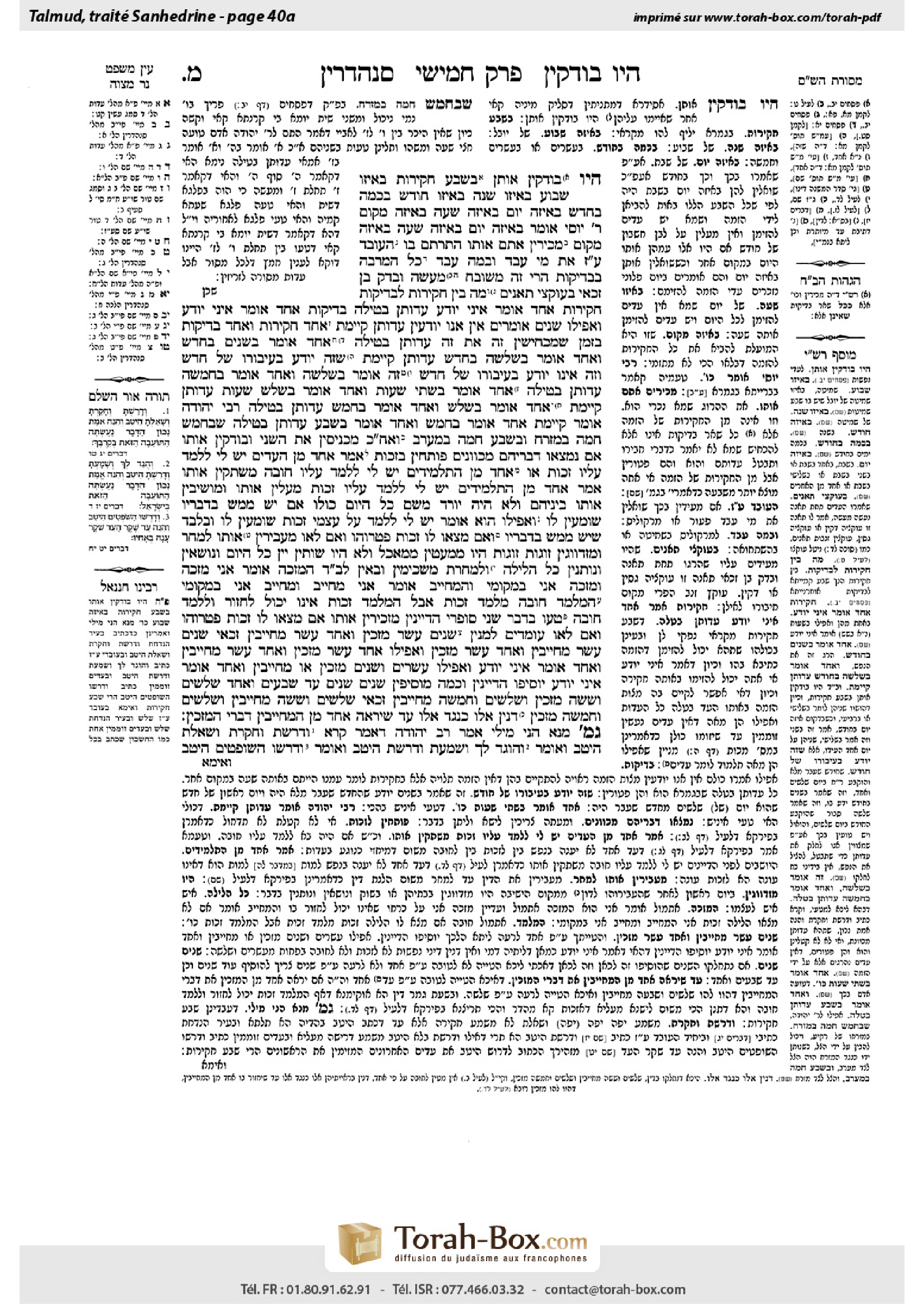
Sanhedrin 40a: Talmud study for Daf Yomi
Daf Yomi is the daily study of one Talmud folio. Explore 37 tractates with scans, Hebrew text, Sefaria English and AI-generated French translations where annotated.
Passage selection and English or AI-generated French translation are available where the scan has annotations. Daf Study is independent of Torah-Box and Sefaria.
Browse Sanhedrin · סנהדרין · All tractatesSanhedrin 40a text and translations
This page of Sanhedrin includes the Aramaic text, an English translation and an AI-generated French translation, alongside the scan above.
סנהדרין מ׳ א · Aramaic and Hebrew text
מַתְנִי׳ הָיוּ בּוֹדְקִין אוֹתָן בְּשֶׁבַע חֲקִירוֹת: בְּאֵיזוֹ שָׁבוּעַ, בְּאֵיזוֹ שָׁנָה, בְּאֵיזוֹ חוֹדֶשׁ, בְּכַמָּה בַּחֹדֶשׁ, בְּאֵיזֶה יוֹם, בְּאֵיזוֹ שָׁעָה, בְּאֵיזֶה מְקוֹם. רַבִּי יוֹסֵי אוֹמֵר: בְּאֵיזֶה יוֹם, בְּאֵיזוֹ שָׁעָה, בְּאֵיזֶה מָקוֹם.
מַכִּירִין אַתֶּם אוֹתוֹ? הִתְרֵתֶם בּוֹ? הָעוֹבֵד עֲבוֹדָה זָרָה: אֶת מִי עָבַד, וּבַמֶּה עָבַד?
כָּל הַמַּרְבֶּה בִּבְדִיקוֹת – הֲרֵי זֶה מְשׁוּבָּח. מַעֲשֶׂה וּבָדַק בֶּן זַכַּאי בְּעוּקְצֵי תְּאֵנִים.
מָה בֵּין חֲקִירוֹת לִבְדִיקוֹת? חֲקִירוֹת – אֶחָד אוֹמֵר ״אֵינִי יוֹדֵעַ״, עֵדוּתָן בְּטֵילָה. בְּדִיקוֹת – אֶחָד אוֹמֵר ״אֵינִי יוֹדֵעַ״, וַאֲפִילּוּ שְׁנַיִם אוֹמְרִים ״אֵין אָנוּ יוֹדְעִין״, עֵדוּתָן קַיֶּימֶת. אֶחָד חֲקִירוֹת וְאֶחָד בְּדִיקוֹת, בִּזְמַן שֶׁמַּכְחִישִׁין זֶה אֶת זֶה – עֵדוּתָן בְּטֵילָה.
אֶחָד אוֹמֵר: ״בִּשְׁנַיִם בְּחֹדֶשׁ״, וְאֶחָד אוֹמֵר: ״בִּשְׁלֹשָׁה בַּחֹדֶשׁ״ – עֵדוּתָן קַיֶּימֶת, שֶׁזֶּה יוֹדֵעַ בְּעִיבּוּרוֹ שֶׁל חֹדֶשׁ, וְזֶה אֵינוֹ יוֹדֵעַ בְּעִיבּוּרוֹ שֶׁל חֹדֶשׁ.
אֶחָד אוֹמֵר: ״בִּשְׁלֹשָׁה״, וְאֶחָד אוֹמֵר ״בַּחֲמִשָּׁה״ – עֵדוּתָן בְּטֵילָה.
אֶחָד אוֹמֵר: ״בִּשְׁתֵּי שָׁעוֹת״, וְאֶחָד אוֹמֵר: ״בְּשָׁלֹשׁ שָׁעוֹת״ – עֵדוּתָן קַיֶּימֶת. אֶחָד אוֹמֵר: ״בְּשָׁלֹשׁ״, וְאֶחָד אוֹמֵר: ״בְּחָמֵשׁ״ – עֵדוּתָן בְּטֵילָה.
רַבִּי יְהוּדָה אוֹמֵר: קַיֶּימֶת. אֶחָד אוֹמֵר ״בְּחָמֵשׁ״, וְאֶחָד אוֹמֵר ״בְּשֶׁבַע״ – עֵדוּתָן בְּטֵילָה, שֶׁבְּחָמֵשׁ חַמָּה בַּמִּזְרָח וּבְשֶׁבַע חַמָּה בַּמַּעֲרָב.
וְאַחַר כָּךְ מַכְנִיסִין אֶת הַשֵּׁנִי וּבוֹדְקִין אוֹתוֹ. אִם נִמְצְאוּ דִּבְרֵיהֶם מְכֻוָּונִים, פּוֹתְחִין בִּזְכוּת. אָמַר אֶחָד מִן הָעֵדִים: ״יֵשׁ לִי לְלַמֵּד עָלָיו זְכוּת״, אוֹ אֶחָד מִן הַתַּלְמִידִים: ״יֵשׁ לִי לְלַמֵּד עָלָיו חוֹבָה״ – מְשַׁתְּקִין אוֹתוֹ. אָמַר אֶחָד מִן הַתַּלְמִידִים: ״יֵשׁ לִי לְלַמֵּד עָלָיו זְכוּת״ – מַעֲלִין אוֹתוֹ וּמוֹשִׁיבִין אוֹתוֹ בֵּינֵיהֶם, וְלֹא הָיָה יוֹרֵד מִשָּׁם כׇּל הַיּוֹם כּוּלּוֹ.
אִם יֵשׁ מַמָּשׁ בִּדְבָרָיו, שׁוֹמְעִין לוֹ. וַאֲפִילּוּ הוּא אוֹמֵר: ״יֵשׁ לִי לְלַמֵּד עַל עַצְמִי זְכוּת״, שׁוֹמְעִין לוֹ, וּבִלְבַד שֶׁיֵּשׁ מַמָּשׁ בִּדְבָרָיו.
וְאִם מָצְאוּ לוֹ זְכוּת, פְּטָרוּהוּ. וְאִם לָאו, מַעֲבִירִין אוֹתוֹ לְמָחָר, וּמִזְדַּוְּוגִין זוּגוֹת זוּגוֹת. הָיוּ מְמַעֲטִין מִמַּאֲכָל, וְלֹא הָיוּ שׁוֹתִין יַיִן כׇּל הַיּוֹם, וְנוֹשְׂאִין וְנוֹתְנִין כׇּל הַלַּיְלָה. וְלַמׇּחֳרָת מַשְׁכִּימִין וּבָאִין לְבֵית דִּין.
הַמְזַכֶּה אוֹמֵר: ״אֲנִי מְזַכֶּה, וּמְזַכֶּה אֲנִי בִּמְקוֹמִי״. וְהַמְחַיֵּיב אוֹמֵר: ״אֲנִי מְחַיֵּיב, וּמְחַיֵּיב אֲנִי בִּמְקוֹמִי״. הַמְלַמֵּד חוֹבָה מְלַמֵּד זְכוּת, אֲבָל הַמְלַמֵּד זְכוּת אֵינוֹ יָכוֹל לַחְזוֹר וּלְלַמֵּד חוֹבָה. טָעוּ בַּדָּבָר – שְׁנֵי סוֹפְרֵי הַדַּיָּינִין מַזְכִּירִין אוֹתוֹ. אִם מָצְאוּ לוֹ זְכוּת – פְּטָרוּהוּ, וְאִם לָאו – עוֹמְדִים לַמִּנְיָן. שְׁנֵים עָשָׂר מְזַכִּין וְאַחַד עָשָׂר מְחַיְּיבִין – זַכַּאי.
שְׁנֵים עָשָׂר מְחַיְּיבִין וְאַחַד עָשָׂר מְזַכִּין, וַאֲפִילּוּ אַחַד עָשָׂר מְזַכִּין וְאַחַד עָשָׂר מְחַיְּיבִין וְאֶחָד אוֹמֵר ״אֵינִי יוֹדֵעַ״, וַאֲפִילּוּ עֶשְׂרִים וּשְׁנַיִם מְזַכִּין אוֹ מְחַיְּיבִין וְאֶחָד אוֹמֵר ״אֵינִי יוֹדֵעַ״ – יוֹסִיפוּ הַדַּיָּינִין. וְכַמָּה מוֹסִיפִין? שְׁנַיִם שְׁנַיִם, עַד שִׁבְעִים וְאֶחָד.
שְׁלֹשִׁים וְשִׁשָּׁה מְזַכִּין וּשְׁלֹשִׁים וַחֲמִשָּׁה מְחַיְּיבִין – זַכַּאי. שְׁלֹשִׁים וְשִׁשָּׁה מְחַיְּיבִין וּשְׁלֹשִׁים וַחֲמִשָּׁה מְזַכִּין – דָּנִין אֵלּוּ כְּנֶגֶד אֵלּוּ, עַד שֶׁיִּרְאֶה אֶחָד מִן הַמְחַיְּיבִין דִּבְרֵי הַמְזַכִּין.
גְּמָ׳ מְנָא הָנֵי מִילֵּי? אָמַר רַב יְהוּדָה: דְּאָמַר קְרָא ״וְדָרַשְׁתָּ וְחָקַרְתָּ וְשָׁאַלְתָּ הֵיטֵב״, וְאוֹמֵר ״וְהֻגַּד לְךָ וְשָׁמָעְתָּ וְדָרַשְׁתָּ הֵיטֵב״, וְאוֹמֵר ״וְדָרְשׁוּ הַשּׁוֹפְטִים הֵיטֵב״.
Sanhedrin 40a · English translation
MISHNA: The court would examine the witnesses in capital cases with seven interrogations, i.e., interrogatory questions, and they are: In which seven-year period, that is, in which cycle of seven years within a jubilee did the event occur; in which year of the Sabbatical cycle did the event occur; in which month did the event occur; on which day of the month did the event occur; on which day of the week did the event occur; at which hour did the event occur; and in what place did the event occur. Rabbi Yosei says: The court would examine the witnesses with only three interrogations: On which day did the event occur, at which hour, and in what place.
They would also ask: Do you recognize him as the man who committed the transgression? Did you warn him? They would then ask the witnesses about the particulars of the incident. For example, in the case of one who is an accused idol worshipper, they ask the witnesses: Whom, i.e., which idol, did he worship, and in what manner did he worship it, and so on.
With regard to all judges who increase the number of examinations, i.e., who add questions about the details of the event, this is praiseworthy, as this may clarify that the witnesses are lying. An incident occurred and ben Zakkai examined the witnesses by questioning them about the color and shape of the stems of figs in order to unearth a contradiction between the witnesses.
The mishna explains: What is the difference between interrogations and examinations? With regard to interrogations, if one of the witnesses says: I do not know the answer, their testimony is void immediately. With regard to examinations, if one says: I do not know the answer, and even if two say: We do not know the answer, their testimony still stands. Both with regard to interrogations and examinations, at a time when the witnesses contradict one another, their testimony is void.
The mishna clarifies: If one witness says the event occurred on the second of the month, and one witness says that the event occurred on the third of the month, this is not regarded as a contradiction and their testimony stands, since it is possible to say that this witness knows of the addition of a day to the previous month, and according to his tally the event occurred on the second of the month, and that witness does not know of the addition of a day to the previous month, and according to his tally the event occurred on the third of the month. Their testimony is not considered incongruent.
By contrast, if this witness says the event occurred on the third of the month and one witness says the event occurred on the fifth of the month, their testimony is void, as this disparity cannot be attributed to a mere error. Therefore, their testimony is not congruent.
Similarly, if one witness says that the event occurred at two hours, i.e., the second hour of the day from sunrise, and one witness says that the event occurred at three hours, their testimony stands, as one could reasonably err this amount in estimating the hour of the day. By contrast, if one says that the event occurred at three hours, and one says that the event occurred at five hours, their testimony is void.
Rabbi Yehuda says: Also in this case their testimony stands, as one could reasonably err concerning even this length of time. Rabbi Yehuda adds: But if one says that the event occurred at five hours, and one says that the event occurred at seven hours, their testimony is void. Here the difference is recognizable to all, since at five hours the sun is in the east and at seven the sun is in the west, and one could not err concerning this. Therefore, their testimony is not congruent.
The mishna continues: And afterward, after the court examines the first witness, they bring in the second witness and examine him. If the statements of the witnesses are found to be congruent, the court begins to deliberate the matter. They open the deliberations with an appeal to anyone who can find a reason to acquit the accused. If one of the witnesses said: I can teach a reason to acquit him, or if one of the students sitting before the judges said: I can teach a reason to deem him liable, the judges silence him, i.e., both the witness and the student. The reason is that these people are not allowed to offer information such as this. But if one of the students said: I can to teach a reason to acquit him, they raise him to the seat of the court and seat him among them, and he would not descend from there the entire day, but would sit and participate in their deliberations.
If the statement of that student has substance, the court listens to him. And if even the accused says: I can teach a reason to acquit me, the court listens to him and considers his statement, provided that his statement has substance.
And if the court found it fit to acquit him during the deliberations, as all or a majority of the judges agreed to acquit him, they excuse him. But if a majority does not find it fit to acquit him, they delay his verdict to the following day, and they then assign pairs of judges to discuss the matter with each other. They would minimize their food intake and they would not drink wine all day. And they would deliberate all night, and the following day they would arise early and come to court and then vote again and tally the votes of the judges.
One who yesterday was of the opinion to acquit the defendant says: I said to acquit, and I acquit in my place, i.e., I stand by my statement to acquit. And one who yesterday was of the opinion to deem him liable says: I said to deem him liable, and I deem him liable in my place. One who yesterday taught a reason to deem him liable may then teach a reason to acquit, but one who yesterday taught a reason to acquit may not then teach a reason to deem him liable. If they erred in the matter, as one of the judges forgot what he had said the previous day, two judges’ scribes, who recorded the statements of the judges, remind him. If the court then found it fit to acquit him unanimously, they excuse him, and if not all of the judges determine to acquit, they stand to count the vote. If twelve judges vote to acquit him and eleven judges deem him liable, he is acquitted.
The mishna continues: In a case where twelve judges deem him liable and eleven judges acquit; or even if eleven judges acquit and eleven deem him liable and one judge says: I do not know; or even if twenty-two judges acquit or deem him liable and one judge says: I do not know, the judge who said he does not know is disregarded, and the judges add additional judges to the court until they reach a definitive ruling. And how many judges do they add? They add pairs of two judges each time they do not reach a ruling until there are seventy-one judges, but no more than that.
At that point, if thirty-six judges acquit and thirty-five judges deem him liable, he is acquitted. If thirty-six judges deem him liable and thirty-five judges acquit, they continue to deliberate the matter, these judges against those judges, until one of those who deems him liable sees the validity of the statements of those who acquit and changes his position, as the court does not condemn a defendant to death by a majority of one judge.
GEMARA: The Gemara asks: From where are these matters derived? What is the source for these seven interrogations? Rav Yehuda says: It is as the verse states with regard to an idolatrous city: “And you shall inquire, and investigate, and ask diligently” (Deuteronomy 13:15); and it states with regard to one who worships idols: “If it be told to you and you have heard it and inquired diligently” (Deuteronomy 17:4); and it states with regard to conspiring witnesses: “And the judges shall inquire diligently” (Deuteronomy 19:18). Taken together, there are seven interrogations alluded to in these verses by each instance of the terms inquire, investigate, and diligently.
Sanhedrin 40a · Traduction française (IA)
MICHNA : Dans les affaires capitales, le tribunal interrogeait les témoins au moyen de sept interrogatoires, c’est-à-dire de questions précises : au cours de quelle période de sept ans — autrement dit, dans quel cycle de sept ans à l’intérieur d’un jubilé — l’événement s’est-il produit ? En quelle année du cycle sabbatique ? En quel mois ? Quel jour du mois ? Quel jour de la semaine ? À quelle heure ? Et en quel lieu ? Rabbi Yosei dit : Le tribunal n’interrogeait les témoins qu’au moyen de trois interrogatoires : quel jour l’événement s’est-il produit, à quelle heure et en quel lieu ?
On leur demandait également : « Le reconnaissez-vous comme l’homme qui a commis la transgression ? L’avez-vous averti ? » On interrogeait ensuite les témoins sur les détails de l’incident. Par exemple, dans le cas d’un accusé d’idolâtrie, on demandait aux témoins : « Qui — c’est-à-dire quelle idole — a-t-il adoré, et de quelle manière l’a-t-il adorée ? », et ainsi de suite.
Tous les juges qui multiplient les vérifications, c’est-à-dire qui ajoutent des questions sur les détails de l’événement, sont dignes d’éloges, car cela peut établir que les témoins mentent. Un incident se produisit : ben Zakkai interrogea les témoins sur la couleur et la forme des tiges de figues afin de faire apparaître une contradiction entre eux.
La Michna explique : quelle est la différence entre les interrogatoires et les vérifications ? Pour les interrogatoires, si l’un des témoins répond : « Je ne sais pas », leur témoignage est immédiatement invalidé. Pour les vérifications, si l’un répond : « Je ne sais pas », et même si deux répondent : « Nous ne savons pas », leur témoignage reste valable. Tant pour les interrogatoires que pour les vérifications, si les témoins se contredisent, leur témoignage est invalidé.
La Michna précise : si un témoin dit que l’événement a eu lieu le deux du mois et un autre qu’il a eu lieu le trois du mois, cela n’est pas considéré comme une contradiction et leur témoignage reste valable. En effet, il est possible que le premier sache qu’un jour a été ajouté au mois précédent et que, selon son décompte, l’événement ait eu lieu le deux du mois, tandis que l’autre ignore qu’un jour a été ajouté au mois précédent et que, selon son décompte, l’événement ait eu lieu le trois du mois. Leur témoignage n’est donc pas considéré comme discordant.
En revanche, si un témoin dit que l’événement a eu lieu le trois du mois et un autre qu’il a eu lieu le cinq du mois, leur témoignage est invalidé, car cet écart ne peut s’expliquer par une simple erreur. Leur témoignage n’est donc pas concordant.
De même, si un témoin dit que l’événement a eu lieu à la deuxième heure — c’est-à-dire à la deuxième heure du jour, à partir du lever du soleil — et un autre qu’il a eu lieu à la troisième heure, leur témoignage reste valable, car il est raisonnable qu’on se trompe de cette durée en estimant l’heure du jour. En revanche, si l’un dit que l’événement a eu lieu à la troisième heure et l’autre à la cinquième heure, leur témoignage est invalidé.
Rabbi Yehuda dit : Dans ce cas également, leur témoignage reste valable, car il est raisonnable de se tromper même sur une période aussi longue. Rabbi Yehuda ajoute : Mais si l’un dit que l’événement a eu lieu à la cinquième heure et l’autre à la septième heure, leur témoignage est invalidé. Ici, la différence est manifeste pour tous : à la cinquième heure, le soleil est à l’est, et à la septième heure, il est à l’ouest ; on ne peut pas se tromper à ce sujet. Leur témoignage n’est donc pas concordant.
La Michna poursuit : ensuite, après que le tribunal a interrogé le premier témoin, il fait entrer le second et l’interroge. Si les déclarations des témoins se révèlent concordantes, le tribunal commence à délibérer. Il ouvre les délibérations en invitant quiconque peut trouver un motif d’acquitter l’accusé à le faire connaître. Si l’un des témoins dit : « Je peux présenter un motif pour l’acquitter », ou si l’un des élèves assis devant les juges dit : « Je peux présenter un motif pour le déclarer coupable », les juges le font taire, qu’il s’agisse du témoin ou de l’élève, car ces personnes ne sont pas autorisées à présenter de tels éléments. Mais si l’un des élèves dit : « Je peux présenter un motif pour l’acquitter », on le fait monter au siège du tribunal et on le fait asseoir parmi les juges. Il n’en descend pas de toute la journée, mais reste assis et participe à leurs délibérations.
Si l’argument de cet élève est fondé, le tribunal l’écoute. Et si l’accusé lui-même dit : « Je peux présenter un motif pour m’acquitter », le tribunal l’écoute et examine sa déclaration, à condition qu’elle soit fondée.
Si, au cours des délibérations, le tribunal estime qu’il convient de l’acquitter, parce que tous les juges ou la majorité d’entre eux se sont prononcés en faveur de son acquittement, on le libère. Mais si la majorité ne juge pas qu’il convient de l’acquitter, le tribunal reporte le verdict au lendemain et désigne alors des paires de juges pour discuter de l’affaire entre elles. Les juges réduisaient leur consommation de nourriture et ne buvaient pas de vin de toute la journée. Ils délibéraient toute la nuit, puis, le lendemain, ils se levaient tôt, se rendaient au tribunal, votaient de nouveau et comptaient les voix des juges.
Celui qui, la veille, était d’avis d’acquitter l’accusé dit : « J’ai dit qu’il fallait l’acquitter, et je maintiens mon avis. » Celui qui, la veille, était d’avis de le déclarer coupable dit : « J’ai dit qu’il fallait le déclarer coupable, et je maintiens mon avis. » Celui qui, la veille, avait présenté un motif pour le déclarer coupable peut ensuite présenter un motif pour l’acquitter, mais celui qui avait présenté un motif pour l’acquitter ne peut ensuite présenter un motif pour le déclarer coupable. Si les juges se trompent — par exemple, si l’un d’eux a oublié ce qu’il avait dit la veille —, les deux scribes des juges, qui ont consigné leurs déclarations, le lui rappellent. Si le tribunal estime alors qu’il convient de l’acquitter à l’unanimité, on le libère ; si tous les juges ne décident pas de l’acquitter, ils se lèvent pour compter les voix. Si douze juges votent pour l’acquitter et onze juges le déclarent coupable, il est acquitté.
La Michna poursuit : dans le cas où douze juges le déclarent coupable et onze l’acquittent, ou même si onze juges l’acquittent et onze le déclarent coupable, tandis qu’un juge dit : « Je ne sais pas », ou encore si vingt-deux juges l’acquittent ou le déclarent coupable et qu’un juge dit : « Je ne sais pas », le juge qui a déclaré ne pas savoir n’est pas pris en compte, et les juges ajoutent des juges au tribunal jusqu’à parvenir à une décision définitive. Combien de juges en ajoutent-ils ? Chaque fois qu’ils ne parviennent pas à une décision, ils ajoutent deux juges, par paires, jusqu’à ce qu’il y ait soixante et onze juges, mais pas davantage.
À ce stade, si trente-six juges l’acquittent et trente-cinq le déclarent coupable, il est acquitté. Si trente-six juges le déclarent coupable et trente-cinq l’acquittent, ils poursuivent les délibérations, les uns face aux autres, jusqu’à ce que l’un de ceux qui le déclarent coupable reconnaisse la validité des arguments de ceux qui l’acquittent et change d’avis, car le tribunal ne condamne pas un accusé à mort à la majorité d’une seule voix.
GUEMARA : La Guemara demande : d’où tire-t-on ces règles ? Quelle est la source de ces sept interrogatoires ? Rav Yehuda dit : Cela découle du verset au sujet d’une ville idolâtre : « Tu rechercheras, tu enquêteras et tu t’informeras avec soin » (Deutéronome 13:15) ; il est également dit, au sujet de celui qui adore les idoles : « Si l’on te rapporte cela, que tu l’apprends et que tu enquêtes avec soin » (Deutéronome 17:4) ; et il est encore dit, au sujet des faux témoins conspirateurs : « Les juges enquêteront avec soin » (Deutéronome 19:18). Pris ensemble, ces versets font allusion à sept interrogatoires, à travers chacune des occurrences des termes « rechercher », « enquêter » et « avec soin ».
Traduction française générée par IA à partir de l’édition anglaise de Sefaria. Vérifie toujours un passage avec le texte source.
Text from Sefaria: William Davidson Edition - Vocalized Aramaic (CC BY NC); William Davidson Edition - English (CC BY NC).