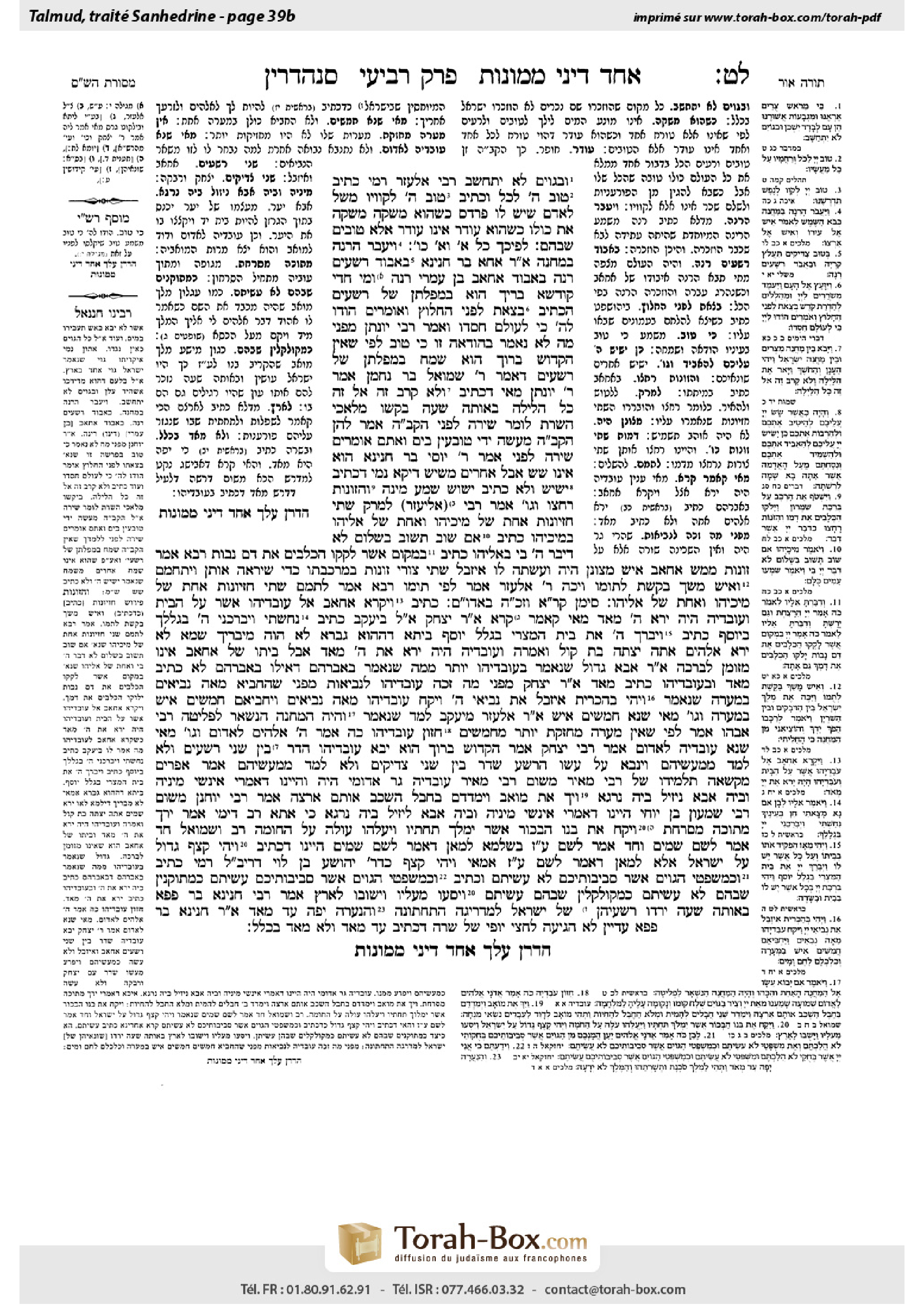
Sanhedrin 39b: Talmud study for Daf Yomi
Daf Yomi is the daily study of one Talmud folio. Explore 37 tractates with scans, Hebrew text, Sefaria English and AI-generated French translations where annotated.
Passage selection and English or AI-generated French translation are available where the scan has annotations. Daf Study is independent of Torah-Box and Sefaria.
Browse Sanhedrin · סנהדרין · All tractatesSanhedrin 39b text and translations
This page of Sanhedrin includes the Aramaic text, an English translation and an AI-generated French translation, alongside the scan above.
סנהדרין ל״ט ב · Aramaic and Hebrew text
״וּבַגּוֹיִם לֹא יִתְחַשָּׁב״.
רַבִּי אֶלְעָזָר רָמֵי: כְּתִיב ״טוֹב ה׳ לַכֹּל״, וּכְתִיב ״טוֹב ה׳ לְקֹוָויו״. מָשָׁל לְאָדָם שֶׁיֵּשׁ לוֹ פַּרְדֵּס: כְּשֶׁהוּא מַשְׁקֶה – מַשְׁקֶה אֶת כּוּלּוֹ, כְּשֶׁהוּא עוֹדֵר – אֵינוֹ עוֹדֵר אֶלָּא טוֹבִים שֶׁבָּהֶם.
לְפִיכָךְ כָּל אֶחָד וְאֶחָד כּוּ׳. ״וַיַּעֲבֹר הָרִנָּה בַּמַּחֲנֶה״. אָמַר רַבִּי אַחָא בַּר חֲנִינָא: ״בַּאֲבֹד רְשָׁעִים רִנָּה״ – בַּאֲבוֹד אַחְאָב בֶּן עָמְרִי רִנָּה.
וּמִי חָדֵי קוּדְשָׁא בְּרִיךְ הוּא בְּמַפַּלְתָּן שֶׁל רְשָׁעִים? הָכְתִיב: ״בְּצֵאת לִפְנֵי הֶחָלוּץ וְאֹמְרִים הוֹדוּ לַה׳ כִּי לְעוֹלָם חַסְדּוֹ״. וְאָמַר רַבִּי יוֹנָתָן: מִפְּנֵי מָה לֹא נֶאֱמַר בְּהוֹדָאָה זוֹ ״כִּי טוֹב״? לְפִי שֶׁאֵין הַקָּדוֹשׁ בָּרוּךְ הוּא שָׂמֵחַ בְּמַפַּלְתָּן שֶׁל רְשָׁעִים.
דְּאָמַר רַבִּי שְׁמוּאֵל בַּר נַחְמָן אָמַר רַבִּי יוֹנָתָן: מַאי דִּכְתִיב ״וְלֹא קָרַב זֶה אֶל זֶה כׇּל הַלָּיְלָה״? בְּאוֹתָהּ שָׁעָה בִּקְּשׁוּ מַלְאֲכֵי הַשָּׁרֵת לוֹמַר שִׁירָה לִפְנֵי הַקָּדוֹשׁ בָּרוּךְ הוּא. אָמַר לָהֶן הַקָּדוֹשׁ בָּרוּךְ הוּא: מַעֲשֵׂה יָדַי טוֹבְעִין בַּיָּם וְאַתֶּם אוֹמְרִים שִׁירָה לְפָנַי?
אָמַר רַבִּי יוֹסֵי בַּר חֲנִינָא: הוּא אֵינוֹ שָׂשׂ, אֲבָל אֲחֵרִים מֵשִׂישׂ. דַּיְקָא נָמֵי, דִּכְתִיב ״יָשִׂישׂ״ וְלָא כְּתִיב ״יָשׂוּשׂ״. שְׁמַע מִינַּהּ.
״וְהַזֹּנוֹת רָחָצוּ וְגוֹ׳״, אָמַר רַבִּי אֶלְעָזָר: לְמָרֵק שְׁתֵּי חֶזְיוֹנוֹת, אַחַת שֶׁל מִיכָיְהוּ וְאַחַת שֶׁל אֵלִיָּהוּ. בְּמִיכָיְהוּ כְּתִיב: ״אִם שׁוֹב תָּשׁוּב בְּשָׁלוֹם לֹא דִבֶּר ה׳ בִּי״; בְּאֵלִיָּהוּ כְּתִיב: ״בִּמְקוֹם אֲשֶׁר לָקְקוּ הַכְּלָבִים אֶת דַּם נָבוֹת״.
רָבָא אָמַר: זוֹנוֹת מַמָּשׁ. אַחְאָב אִישׁ מְצוּנָּן הָיָה, וְעָשְׂתָה לוֹ אִיזֶבֶל שְׁתֵּי צוּרֵי זוֹנוֹת בְּמֶרְכַּבְתּוֹ, כְּדֵי שֶׁיִּרְאֶה אוֹתָן וְיִתְחַמֵּם.
״וְאִישׁ מָשַׁךְ בַּקֶּשֶׁת לְתֻמּוֹ וַיַּכֶּה״. רַבִּי אֶלְעָזָר אָמַר: לְפִי תּוּמּוֹ. רָבָא אָמַר: לְתַמֵּם שְׁתֵּי חֶזְיוֹנוֹת, אַחַת שֶׁל מִיכָיְהוּ וְאַחַת שֶׁל אֵלִיָּהוּ.
(סִימָן: קָרָא, וְזָכָה, בֶּאֱדוֹם.) כְּתִיב: ״וַיִּקְרָא אַחְאָב אֶל עֹבַדְיָהוּ אֲשֶׁר עַל הַבָּיִת וְעֹבַדְיָהוּ הָיָה יָרֵא [אֶת] ה׳ מְאֹד״. מַאי קָאָמַר קְרָא?
אָמַר רַבִּי יִצְחָק: אָמַר לֵיהּ, בְּיַעֲקֹב כְּתִיב ״נִחַשְׁתִּי וַיְבָרְכֵנִי ה׳ בִּגְלָלֶךָ״, בְּיוֹסֵף כְּתִיב ״וַיְבָרֶךְ ה׳ אֶת בֵּית הַמִּצְרִי בִּגְלַל יוֹסֵף״. בֵּיתָא דְּהָהוּא גַּבְרָא לָא הֲוָה מִיבְּרִיךְ. שֶׁמָּא לֹא יְרֵא אֱלֹהִים אַתָּה? יָצְתָה בַּת קוֹל וְאָמְרָה: ״וְעֹבַדְיָהוּ הָיָה יָרֵא אֶת ה׳ מְאֹד״, אֲבָל בֵּיתוֹ שֶׁל אַחְאָב אֵינוֹ מְזוּמָּן לִבְרָכָה.
אָמַר רַבִּי אַבָּא: גָּדוֹל שֶׁנֶּאֱמַר בְּעוֹבַדְיָהוּ יוֹתֵר מִמַּה שֶּׁנֶּאֱמַר בְּאַבְרָהָם, דְּאִילּוּ בְּאַבְרָהָם לָא כְּתִיב ״מְאֹד״, וּבְעוֹבַדְיָהוּ כְּתִיב ״מְאֹד״.
אָמַר רַבִּי יִצְחָק: מִפְּנֵי מָה זָכָה עוֹבַדְיָהוּ לִנְבִיאוּת? מִפְּנֵי שֶׁהֶחְבִּיא מֵאָה נְבִיאִים בַּמְּעָרָה, שֶׁנֶּאֱמַר: ״וַיְהִי בְּהַכְרִית אִיזֶבֶל אֵת נְבִיאֵי ה׳ וַיִּקַּח עֹבַדְיָהוּ מֵאָה נְבִיאִים וַיַּחְבִּיאֵם חֲמִשִּׁים אִישׁ בַּמְּעָרָה וְגוֹ״. מַאי שְׁנָא חֲמִשִּׁים אִישׁ? אָמַר רַבִּי אֶלְעָזָר: מִיַּעֲקֹב לָמַד, שֶׁנֶּאֱמַר: ״וְהָיָה הַמַּחֲנֶה הַנִּשְׁאָר לִפְלֵיטָה״. רַבִּי אֲבָהוּ אָמַר: לְפִי שֶׁאֵין מְעָרָה מַחְזֶקֶת יוֹתֵר מֵחֲמִשִּׁים.
״חֲזוֹן עֹבַדְיָהוּ כֹּה אָמַר ה׳ אֱלֹהִים לֶאֱדוֹם וְגוֹ׳״. מַאי שְׁנָא עוֹבַדְיָה לֶאֱדוֹם?
אָמַר רַבִּי יִצְחָק: אָמַר הַקָּדוֹשׁ בָּרוּךְ הוּא, יָבֹא עוֹבַדְיָהוּ הַדָּר בֵּין שְׁנֵי רְשָׁעִים וְלֹא לָמַד מִמַּעֲשֵׂיהֶם, וְיִנָּבֵא עַל עֵשָׂו הָרָשָׁע שֶׁדָּר בֵּין שְׁנֵי צַדִּיקִים וְלֹא לָמַד מִמַּעֲשֵׂיהֶם. אָמַר אֶפְרַיִם מִקְשָׁאָה תַּלְמִידוֹ שֶׁל רַבִּי מֵאִיר מִשּׁוּם רַבִּי מֵאִיר: עוֹבַדְיָה גֵּר אֲדוֹמִי הָיָה. וְהַיְינוּ דְּאָמְרִי אִינָשֵׁי: מִנֵּיהּ וּבֵיהּ אִבָּא נֵיזִיל בֵּיהּ נַרְגָּא.
״וַיַּךְ אֶת מוֹאָב וַיְמַדְּדֵם בַּחֶבֶל הַשְׁכֵּב אוֹתָם אַרְצָה״. אָמַר רַבִּי יוֹחָנָן מִשּׁוּם רַבִּי שִׁמְעוֹן בֶּן יוֹחַי, הַיְינוּ דְּאָמְרִי אִינָשֵׁי: מִינֵּיהּ וּבֵיהּ אִבָּא לֵיזִיל בֵּיהּ נַרְגָּא. כִּי אֲתָא רַב דִּימִי אָמַר: יָרֵךְ מִתּוֹכָהּ מַסְרַחַת.
״וַיִּקַּח אֶת בְּנוֹ הַבְּכוֹר אֲשֶׁר יִמְלֹךְ תַּחְתָּיו וַיַּעֲלֵהוּ עֹלָה עַל הַחֹמָה״. רַב וּשְׁמוּאֵל, חַד אָמַר: לְשֵׁם שָׁמַיִם, וְחַד אָמַר: לְשֵׁם עֲבוֹדָה זָרָה.
בִּשְׁלָמָא לְמַאן דְּאָמַר לְשֵׁם שָׁמַיִם, הַיְינוּ דִּכְתִיב ״וַיְהִי קֶצֶף גָּדוֹל עַל יִשְׂרָאֵל״. אֶלָּא לְמַאן דְּאָמַר לְשֵׁם עֲבוֹדָה זָרָה, אַמַּאי ״וַיְהִי קֶצֶף״?
כִּדְרַבִּי יְהוֹשֻׁעַ בֶּן לֵוִי, דְּרַבִּי יְהוֹשֻׁעַ בֶּן לֵוִי רָמֵי: כְּתִיב ״וּכְמִשְׁפְּטֵי הַגּוֹיִם אֲשֶׁר סְבִיבוֹתֵיכֶם לֹא עֲשִׂיתֶם״, וּכְתִיב ״וּכְמִשְׁפְּטֵי הַגּוֹיִם אֲשֶׁר סְבִיבוֹתֵיכֶם עֲשִׂיתֶם״. כַּמְתוּקָּנִין שֶׁבָּהֶם – לֹא עֲשִׂיתֶם, כַּמְקוּלְקָלִין שֶׁבָּהֶם – עֲשִׂיתֶם.
״וַיִּסְעוּ מֵעָלָיו וַיָּשׁוּבוּ לָאָרֶץ״. אָמַר רַבִּי חֲנִינָא בַּר פָּפָּא: בְּאוֹתָהּ שָׁעָה יָרְדוּ שׂוֹנְאֵיהֶן שֶׁל יִשְׂרָאֵל לְמַדְרֵיגָה הַתַּחְתּוֹנָה.
״וְהַנַּעֲרָה יָפָה עַד מְאֹד״. אָמַר רַבִּי חֲנִינָא בַּר פָּפָּא: עֲדַיִין לֹא הִגִּיעָה לַחֲצִי יוֹפִי שֶׁל שָׂרָה, דִּכְתִיב ״עַד מְאֹד״ – וְלֹא מְאֹד בַּכְּלָל.
הֲדַרַן עֲלָךְ אֶחָד דִּינֵי מָמוֹנוֹת
Sanhedrin 39b · English translation
“It is a people that shall dwell alone, and shall not be reckoned among the nations” (Numbers 23:9), teaching that where the verse mentions “the nations,” the Jewish people are not included.
The Gemara cites a related statement: Rabbi Elazar raises a contradiction: It is written in one verse: “The Lord is good to all and His compassion is over all His works” (Psalms 145:9), and it is written in a different verse: “The Lord is good to those who wait for Him, to the soul that seeks Him” (Lamentations 3:25). He explains: This can be compared to a person who has an orchard. When he waters it, he waters all of it. Perforce, the water reaches all parts of the orchard, and he cannot discriminate between trees. This is the meaning of the verse: “The Lord is good to all.” By contrast, when he hoes around the trees, he hoes only around the good trees among them. Similarly, when God bestows goodness to the world, all receive it. When He protects people from harm, not all are protected.
§ The mishna teaches: Therefore, since all humanity descends from one person, each and every person is obligated to say: The world was created for me. The mishna then teaches that the court says to the witnesses: And perhaps you will say: Why would we want to be responsible for the blood of this person? But be aware, as is it not already stated: “When the wicked perish, there is song” (Proverbs 11:10)? The Gemara teaches: A separate verse relates that after the evil king Ahab was killed: “And the song went throughout the camp” (I Kings 22:36). Rabbi Aḥa bar Ḥanina says: The fact that the verse states “the song,” and not a song, indicates that it is referring to a song mentioned elsewhere. Accordingly, the verse: “When the wicked perish, there is song,” alludes to this episode: When Ahab ben Omri perished, there was song.
The Gemara asks: But is the Holy One, Blessed be He, gladdened by the downfall of the wicked? Isn’t it written in the verse describing the victory of the Jewish people in battle: “He appointed them that should sing unto the Lord, and praise in the beauty of holiness, as they went out before the army, and say: Give thanks to the Lord, for His mercy endures forever” (II Chronicles 20:21). And Rabbi Yonatan says: For what reason is it not stated in this praise: “Give thanks to the Lord for He is good, for His mercy endures forever,” as is stated elsewhere, e.g., Psalms 118:1? This is because the Holy One, Blessed be He, is not gladdened by the downfall of the wicked.
The Gemara comments: As Rabbi Shmuel bar Naḥman says that Rabbi Yonatan says: What is the meaning of that which is written in the passage describing the splitting of the Red Sea: “And the one came not near the other all the night” (Exodus 14:20)? At that time the ministering angels desired to recite a song before the Holy One, Blessed be He. The Holy One, Blessed be He, said to them: My handiwork, i.e., the Egyptians, are drowning in the sea, and you are reciting a song before Me? Apparently, God is not gladdened by the downfall of the wicked.
Rabbi Yosei bar Ḥanina says: He, i.e., God, does not rejoice in their downfall, but He does cause others to feel joy. The Gemara comments: Accordingly, the language of the verse is also precise, as it is written: “And it shall come to pass, that as the Lord rejoiced over you to do you good, and to multiply you; so the Lord will cause rejoicing [yasis] over you to cause you to perish” (Deuteronomy 28:63), and it is not written: Will have joy [yasus]. The term “yasis” connotes causing joy to others, not that God will experience joy Himself. The Gemara affirms: Conclude from this inference that it is so.
Apropos the death of Ahab, the Gemara cites another verse from that passage. The verse states: “And they washed the chariot by the pool of Samaria, and the dogs licked up his blood; and the harlots also washed themselves there, according to the word of the Lord that He spoke” (I Kings 22:38). Rabbi Elazar says: “The harlots [hazzonot]” can be read as visions [ḥezyonot], and the verse means: To cleanse, i.e., to fulfill, two visions, one of Micaiah and one of Elijah. This fulfills a vision of Micaiah, as it is written: “If you return at all in peace, the Lord has not spoken by me” (I Kings 22:28). Once Ahab died, Micaiah’s vision was fulfilled. This also fulfills a vision of Elijah, as it is written: “In the place where the dogs licked the blood of Naboth shall the dogs lick your blood, even yours” (I Kings 21:19).
Rava says: The verse is speaking of actual harlots. Ahab was a frigid man, who did not lust for women. And Jezebel, his wife, fashioned two forms of harlots for him in his chariot, in order that he see them while traveling and become aroused. Accordingly, one would understand the verse as stating that the harlots were washed, not that they washed themselves.
The verse describing the death of Ahab states: “And a certain man drew a bow offhandedly [letummo] and smote the king of Israel” (I Kings 22:34). Rabbi Elazar says: “Letummo” should be understood as offhandedly [lefi tummo], without aiming for Ahab. Rava says: This alludes to the fact that the killing of Ahab served to make whole [letammem] two visions, one of Micaiah and one of Elijah.
§ Before continuing its discussion of Ahab, the Gemara records a mnemonic for the forthcoming statements: Called; and merited; of Edom. It is written: “And Ahab called Obadiah, who was over the household; now Obadiah feared the Lord greatly” (I Kings 18:3). The Gemara asks: What is the verse saying? What is the connection between Obadiah’s fear of the Lord and the call of Ahab?
Rabbi Yitzḥak says that Ahab said to Obadiah: It is written with regard to Jacob: “And Laban said to him: If now I have found favor in your eyes, I have observed the signs, and the Lord has blessed me for your sake” (Genesis 30:27). It is written with regard to Joseph: “The Lord blessed the Egyptian’s house for Joseph’s sake” (Genesis 39:5). The house of that man, i.e., my house, was not blessed. Perhaps you do not fear God? Immediately, a Divine Voice emerged and said: “Now Obadiah feared the Lord greatly,” but the house of Ahab is not fit for blessing like the houses of those masters.
Rabbi Abba says: The praise that is stated with regard to Obadiah is greater than that which is stated with regard to Abraham. As with regard to Abraham the verse states: “For now I know that you fear God” (Genesis 22:12), and the term “greatly” is not written, and about Obadiah the term “greatly” is written.
Rabbi Yitzḥak says: For what reason did Obadiah merit prophecy? It is because he concealed one hundred prophets in a cave, as it is stated: “It was so, when Jezebel cut off the prophets of the Lord, that Obadiah took one hundred prophets, and hid them, fifty men in a cave, and fed them with bread and water” (I Kings 18:4). The Gemara asks: What is different, i.e., why did he decide, to conceal fifty men in each of two caves and not conceal them all together in one cave? Rabbi Elazar says: He learned from the behavior of Jacob to do so, as it is stated: “And he said: If Esau comes to the one camp and smites it, then the camp that is left shall escape” (Genesis 32:9). Obadiah learned from this to divide the prophets and thereby lessen the danger. Rabbi Abbahu says: It is because there is no cave big enough to contain more than fifty people.
The verse states: “The vision of Obadiah. So says the Lord God concerning Edom: We have heard a message from the Lord, and an ambassador is sent among the nations: Arise, and let us rise up against her in battle” (Obadiah 1:1). The Gemara asks: What is different, i.e., what is the reason, that specifically Obadiah prophesied concerning Edom?
Rabbi Yitzḥak says: The Holy One, Blessed be He, said: Let Obadiah come, who dwells among two wicked ones, Ahab and Jezebel, but did not learn from their actions; and he will prophesy concerning Esau the wicked, the progenitor of Edom, who dwelled among two righteous ones, Isaac and Rebekkah, but did not learn from their actions. Efrayim Miksha’a, a student of Rabbi Meir, said in the name of Rabbi Meir: Obadiah was an Edomite convert. Consequently, he prophesied with regard to Edom. And this is as people say: From and within the forest comes the ax to it, as the handle for the ax that chops the tree is from the forest itself.
The verse states concerning King David: “And he smote Moab and measured them with the line, making them lie down on the ground and he measured two lines to put to death” (II Samuel 8:2). Rabbi Yoḥanan says in the name of Rabbi Shimon ben Yoḥai: This is as people say: From and within the forest comes the ax to it, as King David was a descendant of Ruth the Moabite. When Rav Dimi came from Eretz Yisrael he stated something similar to this: A thigh rots from within, i.e., when a piece of meat rots, the rotting begins from the inner part of it. Here too, the punishment is administered by one descended from that very nation.
§ The Gemara cites a verse concerning the king of Moab: “Then he took his eldest son, who should have reigned in his stead, and sacrificed him for a burnt offering upon the wall; and there was great indignation against Israel, and they departed from him and returned to their own land” (II Kings 3:27). Rav and Shmuel engage in a dispute concerning this. One says: The king sacrificed his son for the sake of Heaven, and one says: The king sacrificed his son for the sake of idol worship.
The Gemara asks: Granted, according to the one who says that he sacrificed him for the sake of Heaven, this is as it is written: “And there was great indignation against Israel,” as the gentile attempted to honor God according to his understanding, while the Jewish people were straying from worshipping God, leading to God’s anger against them. But according to the one who says that he sacrificed him for the sake of idol worship, why would the verse state: “And there was…indignation”?
The Gemara answers: This can be understood in accordance with the statement of Rabbi Yehoshua ben Levi. As Rabbi Yehoshua ben Levi raises a contradiction: It is written concerning the Jewish people: “You have not walked in My statutes, neither have you kept My ordinances; nor have you done according to the statutes of the nations that are round about you” (Ezekiel 5:7), and it is also written: “You have done according to the statutes of the nations that are round about you” (Ezekiel 11:12). Rabbi Yehoshua ben Levi explains: You did not act like the proper ones among the nations, but you did act like the flawed ones among them. Here as well, the Jewish people learned from the king of Moab to engage in human sacrifice.
The Gemara discusses the end of that verse: “And they departed from him and returned to their own land [la’aretz]” (II Kings 3:27). Rabbi Ḥanina bar Pappa says: At that time the enemies of the Jewish people, a euphemism for the Jewish people themselves, descended to the lowest level. He interprets “la’aretz” to mean: To the earth, teaching that the Jewish people were as low as the dust of the earth.
The chapter closes with the explication of a verse stated with regard to Abishag, who attended King David before his death: “And the damsel was very fair [yafa ad me’od ]” (I Kings 1:4). Rabbi Ḥanina bar Pappa says: She still did not reach half the beauty of Sarah, as it is written: “Ad me’od,” which can be translated as “up to very fair,” but not including the praise of “very fair.” By contrast, it is written concerning Sarah: “She was very fair” (Genesis 12:14).
Sanhedrin 39b · Traduction française (IA)
« C’est un peuple qui demeurera à part et ne sera pas compté parmi les nations » (Nombres 23:9), ce qui enseigne que, lorsque le verset mentionne « les nations », le peuple juif n’est pas inclus.
La Guemara cite une déclaration apparentée. Rabbi Elazar soulève une contradiction : il est écrit dans un verset : « Le Seigneur est bon envers tous, et Sa compassion s’étend à toutes Ses œuvres » (Psaumes 145:9), et dans un autre : « Le Seigneur est bon envers ceux qui l’attendent, envers l’âme qui le cherche » (Lamentations 3:25). Il explique : On peut comparer cela à un homme qui possède un verger. Lorsqu’il l’arrose, il l’arrose tout entier. L’eau atteint nécessairement toutes les parties du verger, et il ne peut pas distinguer les arbres. Voilà le sens du verset : « Le Seigneur est bon envers tous. » En revanche, lorsqu’il bêche autour des arbres, il ne le fait qu’autour des bons arbres du verger. De même, lorsque Dieu répand Sa bonté sur le monde, tous en bénéficient. Mais lorsqu’Il protège les gens du mal, tous ne sont pas protégés.
§ La Michna enseigne : Par conséquent, puisque toute l’humanité descend d’un seul homme, chaque personne a l’obligation de dire : « Le monde a été créé pour moi. » La Michna enseigne ensuite que le tribunal dit aux témoins : « Et peut-être direz-vous : Pourquoi voudrions-nous être responsables du sang de cette personne ? » Mais sachez-le : n’est-il pas déjà écrit : « Quand les méchants périssent, il y a des chants » (Proverbes 11:10) ? La Guemara enseigne qu’un autre verset rapporte qu’après la mort du roi impie Achab : « Le chant retentit dans tout le camp » (I Rois 22:36). Rabbi Aḥa bar Ḥanina dit : Le fait que le verset dise « le chant », et non « un chant », indique qu’il s’agit d’un chant mentionné ailleurs. Ainsi, le verset « Quand les méchants périssent, il y a des chants » fait allusion à cet épisode : quand Achab ben Omri périt, il y eut un chant.
La Guemara demande : Le Saint, béni soit-Il, se réjouit-Il de la chute des méchants ? Le verset décrivant la victoire du peuple juif au combat ne dit-il pas : « Il établit ceux qui devaient chanter au Seigneur et louer la beauté de la sainteté, tandis qu’ils marchaient devant l’armée et disaient : Rendez grâce au Seigneur, car Sa miséricorde est éternelle » (II Chroniques 20:21) ? Et Rabbi Yonatan dit : Pour quelle raison cette louange ne dit-elle pas : « Rendez grâce au Seigneur, car Il est bon, car Sa miséricorde est éternelle », comme il est dit ailleurs, par exemple dans Psaumes 118:1 ? C’est parce que le Saint, béni soit-Il, ne se réjouit pas de la chute des méchants.
La Guemara fait remarquer : Rabbi Shmuel bar Naḥman dit au nom de Rabbi Yonatan : Quel est le sens de ce qui est écrit dans le passage décrivant la séparation de la mer Rouge : « L’un ne s’approcha pas de l’autre pendant toute la nuit » (Exode 14:20) ? À ce moment-là, les anges de service voulurent réciter un chant devant le Saint, béni soit-Il. Le Saint, béni soit-Il, leur dit : « Mes créatures, c’est-à-dire les Égyptiens, se noient dans la mer, et vous récitez un chant devant Moi ? » Il apparaît donc que Dieu ne se réjouit pas de la chute des méchants.
Rabbi Yosei bar Ḥanina dit : Lui, c’est-à-dire Dieu, ne se réjouit pas de leur chute, mais Il suscite la joie chez les autres. La Guemara fait remarquer que la formulation du verset est également précise : il est écrit « Et il arrivera que, comme le Seigneur s’est réjoui de vous en vous faisant du bien et en vous multipliant, ainsi le Seigneur suscitera la joie [yasis] à votre sujet en vous faisant périr » (Deutéronome 28:63), et non « Il se réjouira [yasus] ». Le terme « yasis » signifie qu’Il suscite la joie chez les autres, et non que Dieu éprouvera Lui-même de la joie. La Guemara conclut de cette déduction qu’il en est bien ainsi.
À propos de la mort d’Achab, la Guemara cite un autre verset de ce passage. Le verset dit : « On lava le char près de l’étang de Samarie, et les chiens léchèrent son sang ; les prostituées aussi s’y lavèrent, selon la parole que le Seigneur avait prononcée » (I Rois 22:38). Rabbi Elazar dit : « Les prostituées [hazzonot] » peut se lire « les visions [ḥezyonot] », et le verset signifie qu’il fallait réaliser deux visions, celle de Michée et celle d’Élie. La vision de Michée fut accomplie, car il est écrit : « Si tu reviens jamais en paix, le Seigneur n’a pas parlé par ma bouche » (I Rois 22:28). Après la mort d’Achab, la vision de Michée fut réalisée. La vision d’Élie fut également accomplie, car il est écrit : « À l’endroit où les chiens ont léché le sang de Naboth, les chiens lécheront aussi ton sang, le tien » (I Rois 21:19).
Rava dit : Le verset parle de prostituées au sens propre. Achab était un homme frigide, qui ne désirait pas les femmes. Sa femme Jézabel fit représenter deux prostituées dans son char afin qu’il les voie en voyageant et soit excité. Ainsi, on comprendrait que le verset dit que les prostituées furent lavées, et non qu’elles se lavèrent elles-mêmes.
Le verset décrivant la mort d’Achab dit : « Un homme tira son arc au hasard [letummo] et frappa le roi d’Israël » (I Rois 22:34). Rabbi Elazar dit : « Letummo » doit s’entendre comme « au hasard » [lefi tummo], sans viser Achab. Rava dit : Cela fait allusion au fait que la mort d’Achab permit de réaliser [letammem] deux visions, celle de Michée et celle d’Élie.
§ Avant de poursuivre la discussion sur Achab, la Guemara donne un moyen mnémotechnique pour les déclarations qui suivent : appela ; mérita ; d’Édom. Il est écrit : « Achab appela Obadiah, qui était à la tête de la maison ; or Obadiah craignait grandement le Seigneur » (I Rois 18:3). La Guemara demande : Que signifie ce verset ? Quel rapport y a-t-il entre la crainte du Seigneur d’Obadiah et l’appel d’Achab ?
Rabbi Yitzḥak dit qu’Achab adressa ces paroles à Obadiah : « Il est écrit au sujet de Jacob : “Laban lui dit : Si j’ai trouvé grâce à tes yeux, j’ai observé les signes, et le Seigneur m’a béni à cause de toi” » (Genèse 30:27). Il est écrit au sujet de Joseph : « Le Seigneur bénit la maison de l’Égyptien à cause de Joseph » (Genèse 39:5). « La maison de cet homme, c’est-à-dire la mienne, n’a pas été bénie. Peut-être ne crains-tu pas Dieu ? » Aussitôt, une voix divine se fit entendre et dit : « Or Obadiah craignait grandement le Seigneur », mais la maison d’Achab n’est pas digne d’être bénie comme celles de ces maîtres.
Rabbi Abba dit : L’éloge formulé au sujet d’Obadiah est plus grand que celui formulé au sujet d’Abraham. En effet, au sujet d’Abraham, le verset dit : « Maintenant, je sais que tu crains Dieu » (Genèse 22:12), sans employer le terme « grandement », tandis qu’au sujet d’Obadiah, le terme « grandement » est employé.
Rabbi Yitzḥak dit : Pour quelle raison Obadiah mérita-t-il la prophétie ? C’est parce qu’il cacha cent prophètes dans une grotte, comme il est dit : « Il arriva, lorsque Jézabel extermina les prophètes du Seigneur, qu’Obadiah prit cent prophètes, les cacha, cinquante hommes dans une grotte, et les nourrit de pain et d’eau » (I Rois 18:4). La Guemara demande : Pourquoi décida-t-il d’en cacher cinquante dans chacune de deux grottes, plutôt que de les cacher tous ensemble dans une seule grotte ? Rabbi Elazar dit : Il apprit à agir ainsi de Jacob, comme il est dit : « Il dit : Si Ésaü vient contre un camp et le frappe, le camp qui restera pourra s’échapper » (Genèse 32:9). Obadiah apprit de cela à répartir les prophètes et à réduire ainsi le danger. Rabbi Abbahu dit : C’est parce qu’il n’y a pas de grotte assez grande pour accueillir plus de cinquante personnes.
Le verset dit : « Vision d’Obadiah. Ainsi parle le Seigneur Dieu au sujet d’Édom : Nous avons entendu une nouvelle de la part du Seigneur, et un messager est envoyé parmi les nations : Levez-vous, et levons-nous contre elle pour le combat » (Obadiah 1:1). La Guemara demande : Quelle est la raison pour laquelle Obadiah prophétisa précisément au sujet d’Édom ?
Rabbi Yitzḥak dit : Le Saint, béni soit-Il, dit : « Qu’Obadiah vienne, lui qui vit parmi deux méchants, Achab et Jézabel, sans apprendre de leurs actes, et qu’il prophétise au sujet du méchant Ésaü, l’ancêtre d’Édom, qui vécut parmi deux justes, Isaac et Rebecca, sans apprendre de leurs actes. » Efrayim Miksha’a, un disciple de Rabbi Meir, dit au nom de Rabbi Meir : Obadiah était un prosélyte édomite. Par conséquent, il prophétisa au sujet d’Édom. Et c’est ce que les gens disent : La hache vient de la forêt et s’abat sur elle, car le manche de la hache qui abat l’arbre provient de la forêt elle-même.
Le verset dit au sujet du roi David : « Il frappa Moab et les mesura au cordeau, les faisant coucher à terre ; il mesura deux lignes pour les mettre à mort » (II Samuel 8:2). Rabbi Yoḥanan dit au nom de Rabbi Shimon ben Yoḥai : C’est ce que les gens disent : La hache vient de la forêt et s’abat sur elle, car le roi David descendait de Ruth la Moabite. Lorsque Rav Dimi vint d’Eretz Yisrael, il formula une idée semblable : Une cuisse pourrit de l’intérieur, c’est-à-dire que lorsqu’un morceau de viande pourrit, la putréfaction commence à l’intérieur. Ici aussi, le châtiment est infligé par un descendant de cette même nation.
§ La Guemara cite un verset au sujet du roi de Moab : « Il prit alors son fils aîné, qui devait régner à sa place, et l’offrit en holocauste sur la muraille ; une grande indignation s’abattit sur Israël, et ils s’éloignèrent de lui pour retourner dans leur pays » (II Rois 3:27). Rav et Shmuel sont en désaccord à ce sujet. L’un dit : Le roi sacrifia son fils pour le Ciel ; l’autre dit : Le roi sacrifia son fils pour le culte idolâtre.
La Guemara demande : On comprend, selon celui qui dit qu’il le sacrifia pour le Ciel, le sens de « une grande indignation s’abattit sur Israël », puisque le non-Juif tenta d’honorer Dieu selon sa propre conception, tandis que le peuple juif s’écartait du culte de Dieu, ce qui suscita Sa colère contre eux. Mais selon celui qui dit qu’il le sacrifia pour le culte idolâtre, pourquoi le verset dit-il qu’« une grande indignation » s’abattit sur Israël ?
La Guemara répond : On peut comprendre cela à la lumière de la déclaration de Rabbi Yehoshua ben Levi. Celui-ci soulève une contradiction : il est écrit au sujet du peuple juif : « Vous n’avez pas marché selon mes lois, ni observé mes ordonnances ; vous n’avez pas agi selon les lois des nations qui vous entourent » (Ézéchiel 5:7), et il est également écrit : « Vous avez agi selon les lois des nations qui vous entourent » (Ézéchiel 11:12). Rabbi Yehoshua ben Levi explique : Vous n’avez pas agi comme les meilleurs parmi les nations, mais vous avez agi comme les plus mauvais d’entre elles. Ici aussi, le peuple juif apprit du roi de Moab à pratiquer le sacrifice humain.
La Guemara examine la fin de ce verset : « Ils s’éloignèrent de lui pour retourner dans leur pays [la’aretz] » (II Rois 3:27). Rabbi Ḥanina bar Pappa dit : À ce moment-là, les ennemis du peuple juif — expression euphémistique désignant le peuple juif lui-même — descendirent au plus bas niveau. Il interprète « la’aretz » comme signifiant « vers la terre », ce qui enseigne que le peuple juif était aussi bas que la poussière de la terre.
Le chapitre se termine par l’explication d’un verset au sujet d’Abishag, qui servit le roi David avant sa mort : « La jeune fille était très belle [yafa ad me’od] » (I Rois 1:4). Rabbi Ḥanina bar Pappa dit : Elle n’atteignait même pas la moitié de la beauté de Sarah, car il est écrit « ad me’od », que l’on peut traduire par « jusqu’à très belle », sans toutefois lui attribuer l’éloge de « très belle ». En revanche, il est écrit au sujet de Sarah : « Elle était très belle » (Genèse 12:14).
Traduction française générée par IA à partir de l’édition anglaise de Sefaria. Vérifie toujours un passage avec le texte source.
Text from Sefaria: William Davidson Edition - Vocalized Aramaic (CC BY NC); William Davidson Edition - English (CC BY NC).