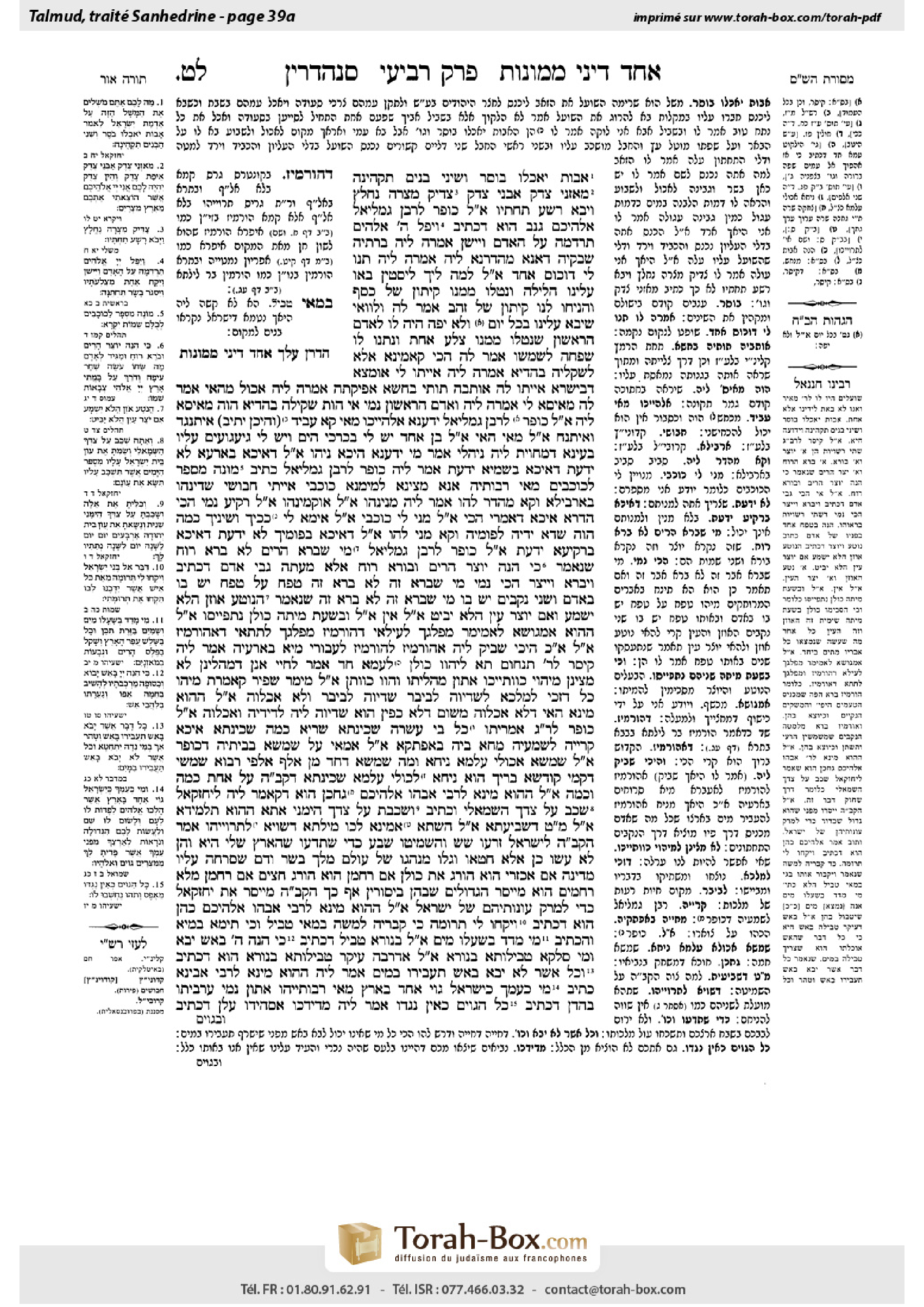
Sanhedrin 39a: Talmud study for Daf Yomi
Daf Yomi is the daily study of one Talmud folio. Explore 37 tractates with scans, Hebrew text, Sefaria English and AI-generated French translations where annotated.
Passage selection and English or AI-generated French translation are available where the scan has annotations. Daf Study is independent of Torah-Box and Sefaria.
Browse Sanhedrin · סנהדרין · All tractatesSanhedrin 39a text and translations
This page of Sanhedrin includes the Aramaic text, an English translation and an AI-generated French translation, alongside the scan above.
סנהדרין ל״ט א · Aramaic and Hebrew text
״אָבוֹת יֹאכְלוּ בֹסֶר וְשִׁנֵּי בָנִים תִּקְהֶינָה״, ״מֹאזְנֵי צֶדֶק אַבְנֵי צֶדֶק״, ״צַדִּיק מִצָּרָה נֶחֱלָץ וַיָּבֹא רָשָׁע תַּחְתָּיו״.
אֲמַר לֵיהּ קֵיסָר לְרַבָּן גַּמְלִיאֵל: אֱלֹהֵיכֶם גַּנָּב הוּא, דִּכְתִיב: ״וַיַּפֵּל ה׳ אֱלֹהִים תַּרְדֵּמָה עַל הָאָדָם וַיִּישָׁן״. אֲמַרָה לֵיהּ בְּרַתֵּיה: שִׁבְקֵיהּ, דַּאֲנָא מַהְדַּרְנָא לֵיהּ. אֲמַרָה לֵיהּ: תְּנוּ לִי דּוּכּוֹס אֶחָד. אֲמַר לַהּ: לְמָה לִיךְ? לִיסְטִין בָּאוּ עָלֵינוּ הַלַּיְלָה וְנָטְלוּ מִמֶּנּוּ קִיתוֹן שֶׁל כֶּסֶף וְהִנִּיחוּ לָנוּ קִיתוֹן שֶׁל זָהָב. אָמַר לָהּ: וּלְוַואי שֶׁיָּבֹאוּ עָלֵינוּ בְּכׇל יוֹם. וְלֹא יָפֶה הָיָה לוֹ לְאָדָם הָרִאשׁוֹן, שֶׁנָּטְלוּ מִמֶּנּוּ צֵלָע אַחַת וְנָתְנוּ לוֹ שִׁפְחָה לְשַׁמְּשׁוֹ?
אֲמַר לַהּ: הָכִי קָאָמֵינָא, אֶלָּא לִשְׁקְלַיהּ בְּהֶדְיָא? אֲמַרָה לֵיהּ: אַיְיתוֹ לִי אוּמְצָא דְּבִישְׂרָא. אַיְיתוֹ לַהּ. אוֹתְבַהּ תּוּתֵי בַּחְשָׁא, אַפִּיקְתַּהּ. אֲמַרָה לֵיהּ: אֱכוֹל (מֵהַאי). אֲמַר לַהּ: מְאִיסָא לִי. אֲמַרָה לֵיהּ: וְאָדָם הָרִאשׁוֹן נָמֵי, אִי הֲוָת שְׁקִילָה בְּהֶדְיָא, הֲוָה מְאִיסָא לֵיהּ.
אֲמַר לֵיהּ קֵיסָר לְרַבָּן גַּמְלִיאֵל: יָדַעְנָא אֱלָהַיְיכוּ מַאי קָא עָבֵיד וְהֵיכָן יָתֵיב. אִיתְנְגִיד וְאִיתְּנַח. אֲמַר לֵיהּ: מַאי הַאי? אֲמַר לֵיהּ: בֵּן אֶחָד יֵשׁ לִי בִּכְרַכֵּי הַיָּם וְיֵשׁ לִי גִּיעֲגוּעִים עָלָיו. בָּעֵינָא דְּמַחְוֵית לֵיהּ נִיהֲלִי. אָמַר: מִי יָדַעְנָא הֵיכָא נִיהוּ? אֲמַר לֵיהּ: דְּאִיכָּא בְּאַרְעָא לָא יָדְעַתְּ, דְּאִיכָּא בִּשְׁמַיָּא יָדְעַתְּ?
אֲמַר לֵיהּ קֵיסָר לְרַבָּן גַּמְלִיאֵל: כְּתִיב ״מוֹנֶה מִסְפָּר לַכּוֹכָבִים״, מַאי רְבוּתֵיהּ? אֲנָא מָצֵינָא לְמִימְנֵי כּוֹכְבֵי! אַיְיתִי חֲבוּשֵׁי, שְׁדִינְהוּ בְּאַרְבֵּילָא, וְקָא מְהַדַּר לְהוּ. אֲמַר לֵיהּ: מְנִינְהוּ. אֲמַר לֵיהּ: אוֹקְמִינְהוּ! אֲמַר לֵיהּ: רָקִיעַ נָמֵי הָכִי הָדְרָא.
אִיכָּא דְּאָמְרִי, הָכִי אֲמַר לֵיהּ: מְנִי לִי כּוֹכְבֵי. אֲמַר לֵיהּ: אֵימָא לִי כַּכָּיךְ וְשִׁינָּיךְ כַּמָּה הָוֵי? שְׁדָא יְדֵיהּ לְפוּמֵּיהּ וְקָא מָנֵי לְהוּ. אֲמַר לֵיהּ: דְּאִיכָּא בְּפוּמָּיךְ לָא יָדְעַתְּ, דְּאִיכָּא בִּרְקִיעָא יָדְעַתְּ?
אֲמַר לֵיהּ קֵיסָר לְרַבָּן גַּמְלִיאֵל: מִי שֶׁבָּרָא הָרִים לֹא בָּרָא רוּחַ, שֶׁנֶּאֱמַר ״כִּי הִנֵּה יוֹצֵר הָרִים וּבֹרֵא רוּחַ״. אֶלָּא מֵעַתָּה, גַּבֵּי אָדָם דִּכְתִיב ״וַיִּבְרָא״ ״וַיִּיצֶר״, הָכִי נָמֵי מִי שֶׁבָּרָא זֶה לֹא בָּרָא זֶה?
טֶפַח עַל טֶפַח יֵשׁ בּוֹ בָּאָדָם, וּשְׁנֵי נְקָבִים יֵשׁ בּוֹ. מִי שֶׁבָּרָא זֶה לֹא בָּרָא זֶה? שֶׁנֶּאֱמַר: ״הֲנֹטַע אֹזֶן הֲלֹא יִשְׁמָע וְאִם יֹצֵר עַיִן הֲלֹא יַבִּיט״. אֲמַר לֵיהּ: אִין. אֲמַר לֵיהּ: וּבִשְׁעַת מִיתָה כּוּלָּן נִתְפַּיְּיסוּ?
אֲמַר לֵיהּ הָהוּא אַמְגּוּשָׁא לְאַמֵּימָר: מִפַּלְגָךְ לְעִילַּאי דְּהוֹרְמִיז, מִפַּלְגָךְ לְתַתַּאי דְּאַהוֹרְמִיז. אֲמַר לֵיהּ: אִם כֵּן, הֵיכִי שָׁבֵיק לֵיהּ אַהוֹרְמִיז לְהוֹרְמִיז לְעַבּוֹרֵי מַיָּא בְּאַרְעֵיהּ?
אֲמַר לֵיהּ קֵיסָר לְרַבִּי תַּנְחוּם: תָּא לִיהְווֹ כּוּלָּן לְעַמָּא חַד. אֲמַר: לְחַיֵּי, אֲנַן דְּמָהֲלִינַן לָא מָצֵינַן מִיהְוֵי כְּוָותַיְיכוּ. אַתּוּן מָהֲלִיתוּ וֶהֱווֹ כְּוָותַן! אֲמַר לֵיהּ: מֵימָר שַׁפִּיר קָאָמְרַתְּ, מִיהוּ כֹּל דְּזָכֵי לְמַלְכָּא לִשְׁדְּיוּהּ לְבֵיבָר. שַׁדְיוּהּ לְבֵיבָר וְלָא אַכְלוּהּ. אֲמַר לֵיהּ הָהוּא מִינָא: הַאי דְּלָא אַכְלוּהּ מִשּׁוּם דְּלָא כְּפוּן הוּא. שַׁדְיוּהּ לֵיהּ לְדִידֵיהּ וְאַכְלוּהּ.
אֲמַר לֵיהּ קֵיסָר לְרַבָּן גַּמְלִיאֵל: אָמְרִיתוּ כֹּל בֵּי עַשְׂרָה שְׁכִינְתָּא שָׁרְיָא, כַּמָּה שְׁכִינְתָּא אִיכָּא? קַרְיֵיהּ לְשַׁמָּעֵיהּ, מְחָא בֵּיהּ בְּאַפָּתְקָא. אֲמַר לֵיהּ: אַמַּאי עָל שִׁמְשָׁא בְּבֵיתֵיהּ דְּקֵיסָר? אֲמַר לֵיהּ: שִׁמְשָׁא אַכּוּלֵּי עָלְמָא נָיְחָא. וּמָה שִׁמְשָׁא דְּחַד מִן אֶלֶף אַלְפֵי רִבּוֹא שַׁמָּשֵׁי דְּקַמֵּי קוּדְשָׁא בְּרִיךְ הוּא נָיְחָא אַכּוּלֵּי עָלְמָא, שְׁכִינְתָּא דְּקוּדְשָׁא בְּרִיךְ הוּא עַל אַחַת כַּמָּה וְכַמָּה.
אֲמַר לֵיהּ הָהוּא מִינָא לְרַבִּי אֲבָהוּ: אֱלֹהֵיכֶם גַּחֲכָן הוּא, דְּקָאָמַר לֵיהּ לִיחֶזְקֵאל ״שְׁכַב עַל צִדְּךָ הַשְּׂמָאלִי״, וּכְתִיב ״וְשָׁכַבְתָּ עַל צִדְּךָ הַיְמָנִי״! אֲתָא הָהוּא תַּלְמִידָא, אֲמַר לֵיהּ: מַאי טַעְמָא דִּשְׁבִיעֲתָא? אֲמַר לְהוּ: הַשְׁתָּא אָמֵינָא לְכוּ מִילְּתָא דְּשָׁוְיָא לְתַרְוַיְיכוּ.
אָמַר הַקָּדוֹשׁ בָּרוּךְ הוּא לְיִשְׂרָאֵל: זִרְעוּ שֵׁשׁ וְהַשְׁמִיטוּ שֶׁבַע, כְּדֵי שֶׁתֵּדְעוּ שֶׁהָאָרֶץ שֶׁלִּי הִיא. וְהֵן לֹא עָשׂוּ כֵּן, אֶלָּא חָטְאוּ וְגָלוּ. מִנְהָגוֹ שֶׁל עוֹלָם: מֶלֶךְ בָּשָׂר וָדָם שֶׁסָּרְחָה עָלָיו מְדִינָה – אִם אַכְזָרִי הוּא, הוֹרֵג אֶת כּוּלָּן; אִם רַחְמָן הוּא, הוֹרֵג חֶצְיָם; אִם רַחְמָן מָלֵא רַחֲמִים הוּא, מְיַיסֵּר הַגְּדוֹלִים שֶׁבָּהֶן בְּיִסּוּרִין. אַף כָּךְ הַקָּדוֹשׁ בָּרוּךְ הוּא מְיַיסֵּר אֶת יְחֶזְקֵאל כְּדֵי לְמָרֵק עֲוֹנוֹתֵיהֶם שֶׁל יִשְׂרָאֵל.
אֲמַר לֵיהּ הָהוּא מִינָא לְרַבִּי אֲבָהוּ: אֱלֹהֵיכֶם כֹּהֵן הוּא, דִּכְתִיב ״וְיִקְחוּ לִי תְּרוּמָה״. כִּי קַבְרֵיהּ לְמֹשֶׁה, בְּמַאי טְבֵיל? וְכִי תֵּימָא בְּמַיָּא, וְהָכְתִיב ״מִי מָדַד בְּשׇׁעֳלוֹ מַיִם״?
אֲמַר לֵיהּ: בְּנוּרָא טְבֵיל, דִּכְתִיב ״כִּי הִנֵּה ה׳ בָּאֵשׁ יָבוֹא״. וּמִי סָלְקָא טְבִילוּתָא בְּנוּרָא? אֲמַר לֵיהּ: אַדְּרַבָּה, עִיקַּר טְבִילוּתָא בְּנוּרָא הוּא, דִּכְתִיב ״וְכׇל אֲשֶׁר לֹא יָבֹא בָּאֵשׁ תַּעֲבִירוּ בַמָּיִם״.
אֲמַר לֵיהּ הָהוּא מִינָא לְרַבִּי אֲבִינָא: כְּתִיב ״וּמִי כְעַמְּךָ כְּיִשְׂרָאֵל גּוֹי אֶחָד בָּאָרֶץ״, מַאי רְבוּתַיְיהוּ? אַתּוּן נָמֵי עָרְבִיתוּ בַּהֲדַן, דִּכְתִיב ״כׇּל הַגּוֹיִם כְּאַיִן נֶגְדּוֹ״. אֲמַר לֵיהּ: מִדִּידְכוּ אַסְהִידוּ עֲלַן, דִּכְתִיב
Sanhedrin 39a · English translation
And they are the parables concerning the following verses: “The fathers have eaten sour grapes, and the children’s teeth are set on edge” (Ezekiel 18:2); “Just balances, just weights…shall you have” (Leviticus 19:36); and “The righteous is delivered out of trouble, and the wicked comes in his stead” (Proverbs 11:8).
§ The Roman emperor said to Rabban Gamliel: Your God is a thief, as it is written: “And the Lord God caused a deep sleep to fall upon the man and he slept; and He took one of his sides, and closed up the place with flesh instead” (Genesis 2:21). The daughter of the emperor said to Rabban Gamliel: Leave him, as I will respond to him. She said to her father: Provide one commander [dukhus] for me to avenge someone’s wrongdoing. The emperor said to her: Why do you need him? She said to him: Armed bandits came to us this past night, and took a silver jug [kiton] from us, and left a golden jug for us. The emperor said to her: If so, would it be that armed bandits such as these would come to us every day. She said to him: And was it not similarly good for Adam the first man that God took a side from him and gave him a maidservant to serve him?
The emperor said to her: This is what I was saying: But if it is good for Adam, let God take his side from him in the open, not during the time of his deep sleep, like a thief. She said to him: Bring me a slice of raw meat. They brought it to her. She placed it under the embers, and removed it after it was roasted. She said to him: Eat from this meat. The emperor said to her: It is repulsive to me. Although he knew that this is how meat is prepared, seeing the raw meat made it repulsive to him. She said to him: With regard to Adam the first man as well, had God taken her from him in the open, she would have been repulsive to him. Therefore God acted while Adam was asleep.
The emperor said to Rabban Gamliel: I know your God, what He does and where He sits. Meanwhile, the emperor was moaning and groaning. Rabban Gamliel said to him: What is this? Why are you in distress? The emperor said to him: I have one son in the cities overseas and I miss him. Rabban Gamliel said to him: I want you to show him to me. The emperor said: Do I know where he is? Rabban Gamliel said to him: If you do not know that which is on earth, is it possible that you do know that which is in the heavens?
The emperor said to Rabban Gamliel: It is written in praise of the Lord: “He counts the number of the stars; He gives them all their names” (Psalms 147:4). What is His greatness? I can also count the stars. Rabban Gamliel brought quinces, put them in a sieve, and spun them. He said to the emperor: Count them. The emperor said to him: Stand them still so that I can count them. Rabban Gamliel said to him: The firmament also revolves like this, therefore you cannot count the stars in it.
Some say that this is what the emperor said to him: I have counted the stars. Rabban Gamliel said to him: Tell me how many teeth and incisors you have. The emperor put his hand in his mouth and was counting them. Rabban Gamliel said to him: You do not know what is in your mouth, but you do know what is in the firmament?
The emperor said to Rabban Gamliel: He Who created mountains did not create wind, rather two separate gods created them, as it is stated: “For, lo, He forms mountains and creates wind” (Amos 4:13); one is described with the verb “forms,” and the other with the verb “creates.” Rabban Gamliel said to him: If that is so, then with regard to Adam, as it is written concerning him: “And God created” (Genesis 1:27), and also: “And the Lord God formed” (Genesis 2:7), so too should one say that He who created this did not create that?
If you will claim that different gods created different parts of Adam, that will not suffice. A person has one handbreadth by one handbreadth of facial countenance, with two types of orifices in it, eyes and ears. Should one say that He who created this did not create that; as it is stated: “He that planted the ear, shall He not hear? He that formed the eye, shall He not see?” (Psalms 94:9)? The verse employs two verbs for the eyes and ears alone. The emperor said to him: Yes, different gods created different parts of the face. Rabban Gamliel said to him: And at the moment of death, are they all appeased? Do all these gods agree as one that the time arrived for the person to die?
The Gemara relates: A certain magus said to Ameimar: From your midpoint and up is in the domain of Hurmiz, the god of good, who created the significant and important parts of the body, and from your midpoint and down is in the domain of Ahurmiz, the god of bad. Ameimar said to him: If so, how does Ahurmiz allow Hurmiz to urinate in his territory? A person drinks with his mouth, which is in his upper half, and urinates from below.
The Gemara relates: The emperor said to Rabbi Tanḥum: Come, let us all be one people. Rabbi Tanḥum said: Very well. But we, who are circumcised, cannot become uncircumcised as you are; you all circumcise yourselves and become like us. The emperor said to Rabbi Tanḥum: In terms of the logic of your statement, you are saying well, but anyone who bests the king in a debate is thrown to the enclosure [labeivar] of wild animals. They threw him to the enclosure but the animals did not eat him, as God protected him. A certain heretic said to the emperor: This incident, that they did not eat him, happened because they are not hungry. They then threw the heretic into the enclosure and the animals ate him.
The emperor said to Rabban Gamliel: You say that the Divine Presence dwells in any place where there are ten adult male Jews. He asked, sarcastically: How many Divine Presences are there? Rabban Gamliel summoned the servant of the emperor and hit him on his neck [be’appatka]. Rabban Gamliel said to him: Why did you allow the sun to enter the house of the emperor? The emperor said to him: The sun rests upon all the world; no one can prevent it from shining. Rabban Gamliel said to him: And if the sun, which is one of ten thousand attendants that are before the Holy One, Blessed be He, rests upon all the world, the Divine Presence of the Holy One, Blessed be He, all the more so rests upon the world.
A certain heretic said to Rabbi Abbahu: Your God is a jester, as He said to Ezekiel the prophet: “Lie on your left side” (Ezekiel 4:4), and it is also written: “Lie on your right side” (Ezekiel 4:6); God had Ezekiel turn from side to side, apparently for comic effect. In the meantime, a certain student came before Rabbi Abbahu and said to him: What is the reason for the mitzva of the Sabbatical Year? Rabbi Abbahu said to them: Now I will tell you something that is fit for the two of you.
Rabbi Abbahu continued: The Holy One, Blessed be He, said to the Jewish people: Sow for six years, and withhold sowing during the seventh year, so that that you will know that the land is Mine. But the Jewish people did not do so; rather, they sinned and were consequently exiled. The manner of the world is that in the case of a flesh-and-blood king whose province sinned against him, if he is cruel, he kills them all; if he is compassionate, he kills only half of them; and if he is compassionate and is full of compassion, he afflicts the leaders among them with suffering. Rabbi Abbahu continues: So too in this case, the Holy One, Blessed be He, afflicts Ezekiel in order to cleanse the sins of the Jewish people. God instructed him to lie down and suffer the same number of days as the number of years that the Jewish people did not observe the halakhot of the Sabbatical Year.
A certain heretic said to Rabbi Abbahu: Your God is a priest, as it is written: “That they take for Me an offering [teruma]” (Exodus 25:2), and teruma is given to the priests. He asked, sarcastically: When He buried Moses, in what ritual bath did He immerse? A priest who contracts impurity from a corpse must immerse in order to be able to partake of teruma. And if you would say that He immersed in water, but isn’t it written: “Who has measured the waters in the hollow of His hand” (Isaiah 40:12), that all waters of the world fit in the palm of God, so He could not immerse in them.
Rabbi Abbahu said to him: He immersed in fire, as it is written: “For, behold, the Lord will come in fire” (Isaiah 66:15). The heretic said to him: But is immersion in fire effective? Rabbi Abbahu said to him: On the contrary, the main form of immersion is in fire, as it is written with regard to the removal of non-kosher substances absorbed in a vessel: “And all that abides not the fire you shall make to go through the water” (Numbers 31:23), indicating that fire purifies more than water does.
A certain heretic said to Rabbi Avina: It is written: “And who is like Your people, Israel, one nation in the earth” (II Samuel 7:23). The heretic asked: What is your greatness? You are also mixed together with us, as it is written: “All nations before Him are as nothing; they are counted by Him less than nothing and vanity” (Isaiah 40:17). Rabbi Avina said to him: One of yours, the gentile prophet Balaam, has already testified for us, as it is written:
Sanhedrin 39a · Traduction française (IA)
Et ce sont les paraboles relatives aux versets suivants : « Les pères ont mangé des raisins verts, et les dents des enfants en ont été agacées » (Ézéchiel 18:2) ; « Vous aurez des balances justes, des poids justes… » (Lévitique 19:36) ; et « Le juste est délivré de la détresse, et le méchant prend sa place » (Proverbes 11:8).
§ L’empereur romain dit à Rabban Gamliel : « Votre Dieu est un voleur », comme il est écrit : « L’Éternel Dieu fit tomber un profond sommeil sur l’homme, et il s’endormit ; Il prit l’un de ses côtés et referma la chair à sa place » (Genèse 2:21). La fille de l’empereur dit à Rabban Gamliel : « Laissez-le, je vais lui répondre. » Elle dit à son père : « Fais venir un commandant [dukhus] pour moi, afin que je puisse venger une injustice. » L’empereur lui dit : « Pourquoi en as-tu besoin ? » Elle lui répondit : « Des brigands armés sont venus chez nous la nuit dernière ; ils nous ont pris une cruche d’argent [kiton] et nous ont laissé une cruche d’or. » L’empereur lui dit : « Dans ce cas, puisse-t-il nous arriver que de tels brigands armés viennent chez nous chaque jour ! » Elle lui dit : « Adam, le premier homme, n’a-t-il pas lui aussi tiré profit du fait que Dieu lui ait pris un côté et lui ait donné une servante pour le servir ? »
L’empereur lui dit : « C’est ce que je disais : si cela est bon pour Adam, que Dieu lui prenne son côté au grand jour, et non pendant son profond sommeil, comme un voleur. » Elle lui dit : « Apporte-moi une tranche de viande crue. » On la lui apporta. Elle la plaça sous les braises et la retira une fois rôtie. Elle lui dit : « Mange de cette viande. » L’empereur lui dit : « Elle me répugne. » Bien qu’il sût que c’est ainsi que l’on prépare la viande, la vue de la viande crue le répugnait. Elle lui dit : « De même, si Dieu avait pris la femme à Adam, le premier homme, au grand jour, elle l’aurait répugné. » C’est pourquoi Dieu agit pendant qu’Adam dormait.
L’empereur dit à Rabban Gamliel : « Je connais ton Dieu, ce qu’Il fait et où Il siège. » Entre-temps, l’empereur gémissait et se lamentait. Rabban Gamliel lui dit : « Qu’est-ce donc ? Pourquoi es-tu en détresse ? » L’empereur lui répondit : « J’ai un fils dans les villes d’outre-mer et il me manque. » Rabban Gamliel lui dit : « Je voudrais que tu me le montres. » L’empereur dit : « Est-ce que je sais où il se trouve ? » Rabban Gamliel lui dit : « Si tu ne sais pas ce qui se trouve sur terre, est-il possible que tu saches ce qui se trouve dans les cieux ? »
L’empereur dit à Rabban Gamliel : « Il est écrit à la louange de l’Éternel : “Il compte le nombre des étoiles ; Il leur donne à toutes un nom” » (Psaumes 147:4). « En quoi réside Sa grandeur ? Moi aussi, je peux compter les étoiles. » Rabban Gamliel apporta des coings, les mit dans un tamis et le fit tourner. Il dit à l’empereur : « Compte-les. » L’empereur lui dit : « Immobilise-les pour que je puisse les compter. » Rabban Gamliel lui dit : « Le firmament tourne lui aussi ainsi ; c’est pourquoi tu ne peux pas compter les étoiles qui s’y trouvent. »
Certains disent que voici ce que l’empereur lui répondit : « J’ai compté les étoiles. » Rabban Gamliel lui dit : « Dis-moi combien tu as de dents et d’incisives. » L’empereur mit la main dans sa bouche et les compta. Rabban Gamliel lui dit : « Tu ne sais pas ce qu’il y a dans ta bouche, mais tu sais ce qu’il y a dans le firmament ? »
L’empereur dit à Rabban Gamliel : « Celui qui a formé les montagnes n’a pas créé le vent ; ce sont plutôt deux dieux distincts qui les ont créés, comme il est dit : “Car voici, Il forme les montagnes et crée le vent” » (Amos 4:13) ; l’un est désigné par le verbe « former », et l’autre par le verbe « créer ». Rabban Gamliel lui dit : « Si tel était le cas, alors, au sujet d’Adam, dont il est écrit : “Dieu créa” (Genèse 1:27), et aussi : “L’Éternel Dieu forma” (Genèse 2:7), faudrait-il dire également que Celui qui a créé ceci n’a pas créé cela ? »
Si tu prétends que des dieux différents ont créé les différentes parties d’Adam, cela ne suffit pas. Le visage d’une personne mesure un empan sur un empan et comporte deux sortes d’orifices, les yeux et les oreilles. Faudrait-il dire que Celui qui a créé ceci n’a pas créé cela, comme il est dit : « Celui qui a planté l’oreille, n’entendrait-Il pas ? Celui qui a formé l’œil, ne verrait-Il pas ? » (Psaumes 94:9). Le verset emploie deux verbes pour les yeux et les oreilles seulement. L’empereur lui dit : « Oui, des dieux différents ont créé les différentes parties du visage. » Rabban Gamliel lui dit : « Et au moment de la mort, sont-ils tous apaisés ? Tous ces dieux conviennent-ils ensemble que le moment est venu pour cette personne de mourir ? »
La Guemara rapporte : Un certain mage dit à Ameimar : « À partir de ton milieu et vers le haut, tu es dans le domaine de Hurmiz, le dieu du bien, qui a créé les parties importantes et précieuses du corps ; à partir de ton milieu et vers le bas, tu es dans le domaine d’Ahurmiz, le dieu du mal. » Ameimar lui dit : « Dans ce cas, comment Ahurmiz permet-il à Hurmiz d’uriner sur son territoire ? L’homme boit par la bouche, qui se trouve dans la partie supérieure, et urine par le bas. »
La Guemara rapporte : L’empereur dit à Rabbi Tanḥum : « Viens, devenons tous un seul peuple. » Rabbi Tanḥum répondit : « Très bien. Mais nous, qui sommes circoncis, nous ne pouvons pas devenir incirconcis comme vous ; vous tous, faites-vous circoncire et devenez comme nous. » L’empereur dit à Rabbi Tanḥum : « Du point de vue de la logique de ton propos, tu as raison ; toutefois, quiconque l’emporte sur le roi dans un débat est jeté dans l’enclos [labeivar] des animaux sauvages. » On le jeta dans l’enclos, mais les animaux ne le dévorèrent pas, car Dieu le protégea. Un certain hérétique dit à l’empereur : « S’ils ne l’ont pas dévoré, c’est parce qu’ils n’ont pas faim. » Ils jetèrent alors l’hérétique dans l’enclos, et les animaux le dévorèrent.
L’empereur dit à Rabban Gamliel : « Vous dites que la Présence divine réside en tout lieu où se trouvent dix hommes juifs adultes. » Il demanda avec sarcasme : « Combien y a-t-il de Présences divines ? » Rabban Gamliel fit venir le serviteur de l’empereur et le frappa à la nuque [be’appatka]. Rabban Gamliel lui dit : « Pourquoi as-tu laissé le soleil entrer dans la maison de l’empereur ? » L’empereur lui dit : « Le soleil éclaire le monde entier ; personne ne peut l’empêcher de briller. » Rabban Gamliel lui dit : « Et si le soleil, qui n’est qu’un des dix mille serviteurs qui se tiennent devant le Saint, béni soit-Il, éclaire le monde entier, à plus forte raison la Présence divine du Saint, béni soit-Il, réside-t-elle dans le monde entier. »
Un certain hérétique dit à Rabbi Abbahu : « Votre Dieu est un plaisantin, puisqu’Il a dit au prophète Ézéchiel : “Couche-toi sur le côté gauche” (Ézéchiel 4:4), et qu’il est aussi écrit : “Couche-toi sur le côté droit” (Ézéchiel 4:6) ; Dieu a fait tourner Ézéchiel d’un côté à l’autre, apparemment pour s’amuser. » Entre-temps, un certain étudiant se présenta devant Rabbi Abbahu et lui dit : « Quelle est la raison de la mitsva de l’année sabbatique ? » Rabbi Abbahu leur dit : « Je vais maintenant vous dire quelque chose qui convient à vous deux. »
Rabbi Abbahu poursuivit : Le Saint, béni soit-Il, dit au peuple juif : « Semez pendant six ans et abstenez-vous de semer la septième année, afin que vous sachiez que la terre est à Moi. » Mais le peuple juif n’agit pas ainsi ; au contraire, il pécha et fut par conséquent exilé. Voici la manière d’agir des rois de chair et de sang lorsqu’une province a péché contre eux : si le roi est cruel, il les tue tous ; s’il est compatissant, il n’en tue que la moitié ; et s’il est compatissant et plein de compassion, il fait souffrir leurs dirigeants. Rabbi Abbahu poursuit : De même ici, le Saint, béni soit-Il, fait souffrir Ézéchiel afin de purifier les péchés du peuple juif. Dieu lui ordonna de se coucher et de souffrir pendant un nombre de jours égal au nombre d’années durant lesquelles le peuple juif n’avait pas observé les halakhot de l’année sabbatique.
Un certain hérétique dit à Rabbi Abbahu : « Votre Dieu est un prêtre, comme il est écrit : “Qu’ils prélèvent pour Moi une offrande [terouma]” » (Exode 25:2), et la terouma est donnée aux prêtres. Il demanda avec sarcasme : « Lorsqu’Il ensevelit Moïse, dans quel bain rituel s’est-Il immergé ? » Un prêtre qui contracte une impureté due à un cadavre doit s’immerger pour pouvoir consommer de la terouma. « Et si tu dis qu’Il s’est immergé dans l’eau, n’est-il pas écrit : “Qui a mesuré les eaux dans le creux de Sa main” » (Isaïe 40:12) ? Cela signifie que toutes les eaux du monde tiennent dans la paume de Dieu, de sorte qu’Il ne pouvait pas s’y immerger.
Rabbi Abbahu lui dit : « Il s’est immergé dans le feu, comme il est écrit : “Car voici, l’Éternel viendra dans le feu” » (Isaïe 66:15). L’hérétique lui dit : « Mais l’immersion dans le feu est-elle efficace ? » Rabbi Abbahu lui dit : « Au contraire, la forme essentielle de l’immersion se fait dans le feu, comme il est écrit au sujet de l’élimination des substances non cachères absorbées dans un ustensile : “Et tout ce qui ne supporte pas le feu, vous le ferez passer par l’eau” » (Nombres 31:23), ce qui indique que le feu purifie davantage que l’eau.
Un certain hérétique dit à Rabbi Avina : « Il est écrit : “Et qui est comme Ton peuple, Israël, une nation sur la terre” » (II Samuel 7:23). L’hérétique demanda : « Quelle est votre grandeur ? Vous êtes vous aussi mêlés à nous, comme il est écrit : “Toutes les nations sont devant Lui comme rien ; elles sont à Ses yeux moins que rien et que le vide” » (Isaïe 40:17). Rabbi Avina lui dit : « L’un des vôtres, le prophète non juif Balaam, a déjà témoigné en notre faveur, comme il est écrit : »
Traduction française générée par IA à partir de l’édition anglaise de Sefaria. Vérifie toujours un passage avec le texte source.
Text from Sefaria: William Davidson Edition - Vocalized Aramaic (CC BY NC); William Davidson Edition - English (CC BY NC).