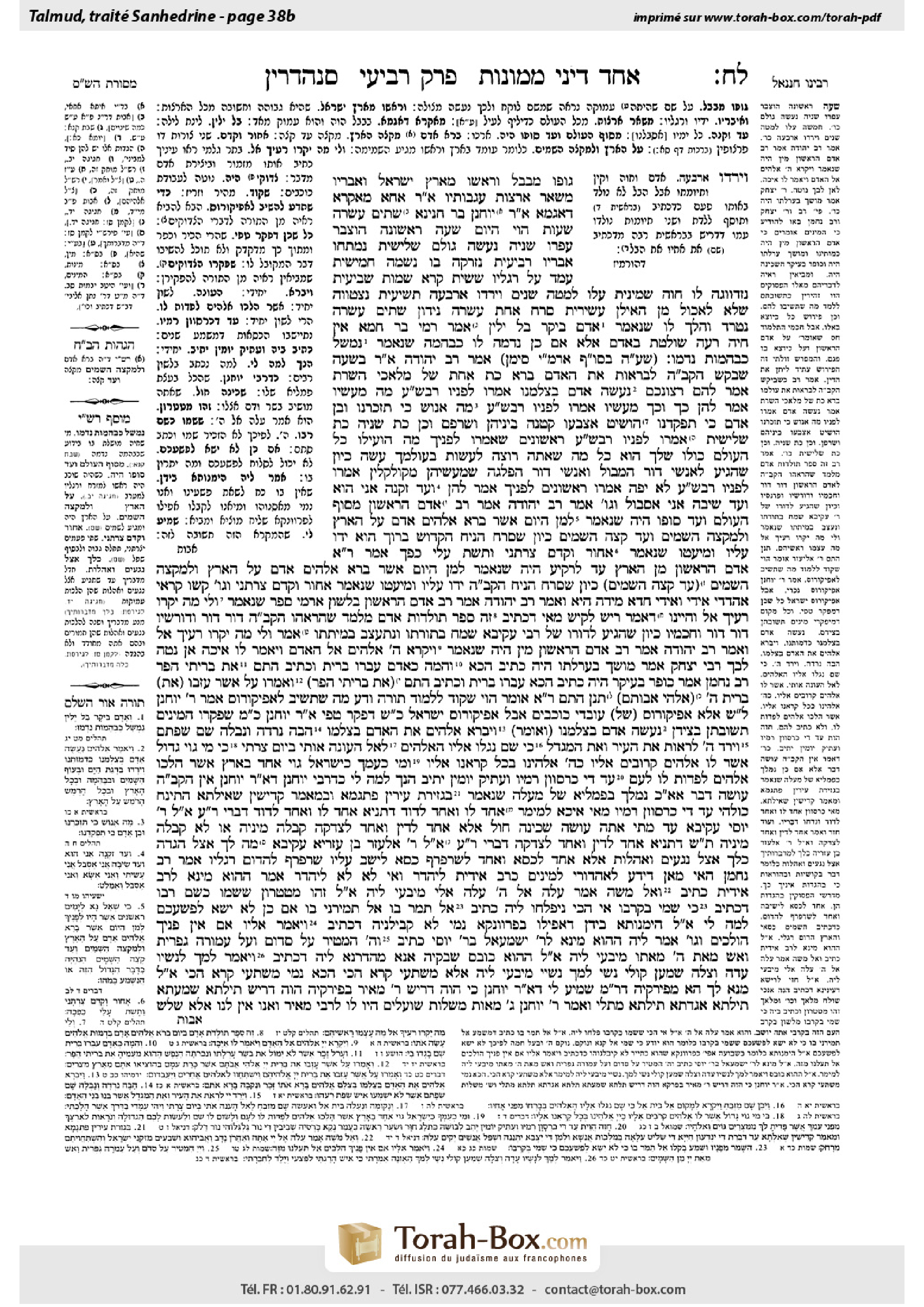
Sanhedrin 38b: Talmud study for Daf Yomi
Daf Yomi is the daily study of one Talmud folio. Explore 37 tractates with scans, Hebrew text, Sefaria English and AI-generated French translations where annotated.
Passage selection and English or AI-generated French translation are available where the scan has annotations. Daf Study is independent of Torah-Box and Sefaria.
Browse Sanhedrin · סנהדרין · All tractatesSanhedrin 38b text and translations
This page of Sanhedrin includes the Aramaic text, an English translation and an AI-generated French translation, alongside the scan above.
סנהדרין ל״ח ב · Aramaic and Hebrew text
גּוּפוֹ מִבָּבֶל, וְרֹאשׁוֹ מֵאֶרֶץ יִשְׂרָאֵל, וְאֵבָרָיו מִשְּׁאָר אֲרָצוֹת. עַגְבוֹתָיו, אָמַר רַב אַחָא: מֵאַקְרָא דְאַגְמָא.
אָמַר רַבִּי יוֹחָנָן בַּר חֲנִינָא: שְׁתֵּים עֶשְׂרֵה שָׁעוֹת הָוֵי הַיּוֹם. שָׁעָה רִאשׁוֹנָה – הוּצְבַּר עֲפָרוֹ, שְׁנִיָּה – נַעֲשָׂה גּוֹלֶם, שְׁלִישִׁית – נִמְתְּחוּ אֵבָרָיו, רְבִיעִית – נִזְרְקָה בּוֹ נְשָׁמָה, חֲמִישִׁית – עָמַד עַל רַגְלָיו, שִׁשִּׁית – קָרָא שֵׁמוֹת, שְׁבִיעִית – נִזְדַּוְּוגָה לוֹ חַוָּה, שְׁמִינִית – עָלוּ לַמִּטָּה שְׁנַיִם וְיָרְדוּ אַרְבָּעָה, תְּשִׁיעִית – נִצְטַוָּוה שֶׁלֹּא לֶאֱכוֹל מִן הָאִילָן, עֲשִׂירִית – סָרַח, אַחַת עֶשְׂרֵה – נִידּוֹן, שְׁתֵּים עֶשְׂרֵה – נִטְרַד וְהָלַךְ לוֹ, שֶׁנֶּאֱמַר: ״אָדָם בִּיקָר בַּל יָלִין״.
אָמַר רָמֵי בַּר חָמָא: אֵין חַיָּה רָעָה שׁוֹלֶטֶת בְּאָדָם אֶלָּא אִם כֵּן נִדְמָה לוֹ כִּבְהֵמָה, שֶׁנֶּאֱמַר: ״נִמְשַׁל כַּבְּהֵמוֹת נִדְמוּ״.
(שָׁעָה, בַּסּוֹף, אֲרַמִּי – סִימָן.) אָמַר רַב יְהוּדָה אָמַר רַב: בְּשָׁעָה שֶׁבִּקֵּשׁ הַקָּדוֹשׁ בָּרוּךְ הוּא לִבְראוֹת אֶת הָאָדָם, בָּרָא כַּת אַחַת שֶׁל מַלְאֲכֵי הַשָּׁרֵת. אָמַר לָהֶם: רְצוֹנְכֶם נַעֲשֶׂה אָדָם בְּצַלְמֵנוּ? אָמְרוּ לְפָנָיו: רִבּוֹנוֹ שֶׁל עוֹלָם, מָה מַעֲשָׂיו? אָמַר לָהֶן: כָּךְ וְכָךְ מַעֲשָׂיו.
אָמְרוּ לְפָנָיו: רִבּוֹנוֹ שֶׁל עוֹלָם, ״מָה אֱנוֹשׁ כִּי תִזְכְּרֶנּוּ וּבֶן אָדָם כִּי תִפְקְדֶנּוּ״? הוֹשִׁיט אֶצְבָּעוֹ קְטַנָּה בֵּינֵיהֶן וּשְׂרָפָם. וְכֵן כַּת שְׁנִיָּה. כַּת שְׁלִישִׁית אָמְרוּ לְפָנָיו: רִבּוֹנוֹ שֶׁל עוֹלָם, רִאשׁוֹנִים שֶׁאָמְרוּ לְפָנֶיךָ מָה הוֹעִילוּ? כָּל הָעוֹלָם כּוּלּוֹ שֶׁלְּךָ הוּא. כׇּל מָה שֶׁאַתָּה רוֹצֶה לַעֲשׂוֹת בְּעוֹלָמְךָ – עֲשֵׂה.
כֵּיוָן שֶׁהִגִּיעַ לְאַנְשֵׁי דּוֹר הַמַּבּוּל וְאַנְשֵׁי דּוֹר הַפְּלַגָּה שֶׁמַּעֲשֵׂיהֶן מְקוּלְקָלִין, אָמְרוּ לְפָנָיו: רִבּוֹנוֹ שֶׁל עוֹלָם, לֹא יָפֶה אָמְרוּ רִאשׁוֹנִים לְפָנֶיךָ? אָמַר לָהֶן: ״וְעַד זִקְנָה אֲנִי הוּא וְעַד שֵׂיבָה אֲנִי אֶסְבֹּל וְגוֹ׳״.
אָמַר רַב יְהוּדָה אָמַר רַב: אָדָם הָרִאשׁוֹן מִסּוֹף הָעוֹלָם וְעַד סוֹפוֹ הָיָה, שֶׁנֶּאֱמַר: ״לְמִן הַיּוֹם אֲשֶׁר בָּרָא אֱלֹהִים אָדָם עַל הָאָרֶץ וּלְמִקְצֵה הַשָּׁמַיִם וְעַד קְצֵה הַשָּׁמָיִם״. כֵּיוָן שֶׁסָּרַח, הִנִּיחַ הַקָּדוֹשׁ בָּרוּךְ הוּא יָדוֹ עָלָיו וּמִיעֲטוֹ, שֶׁנֶּאֱמַר: ״אָחוֹר וָקֶדֶם צַרְתָּנִי וַתָּשֶׁת עָלַי כַּפֶּכָה״.
אָמַר רַבִּי אֶלְעָזָר: אָדָם הָרִאשׁוֹן מִן הָאָרֶץ עַד לָרָקִיעַ הָיָה, שֶׁנֶּאֱמַר: ״לְמִן הַיּוֹם אֲשֶׁר בָּרָא אֱלֹהִים אָדָם עַל הָאָרֶץ וּלְמִקְצֵה הַשָּׁמַיִם עַד קְצֵה הַשָּׁמָיִם״. כֵּיוָן שֶׁסָּרַח, הִנִּיחַ הַקָּדוֹשׁ בָּרוּךְ הוּא יָדוֹ עָלָיו וּמִיעֲטוֹ, שֶׁנֶּאֱמַר: ״אָחוֹר וָקֶדֶם צַרְתָּנִי וְגוֹ׳״. קָשׁוּ קְרָאֵי אַהֲדָדֵי? אִידֵּי וְאִידֵּי חֲדָא מִידָּה הִיא.
וְאָמַר רַב יְהוּדָה אָמַר רַב: אָדָם הָרִאשׁוֹן בְּלָשׁוֹן אֲרַמִּי סִפֵּר, שֶׁנֶּאֱמַר: ״וְלִי מַה יָּקְרוּ רֵעֶיךָ אֵל״.
וְהַיְינוּ דְּאָמַר רֵישׁ לָקִישׁ: מַאי דִּכְתִיב ״זֶה סֵפֶר תּוֹלְדֹת אָדָם״? מְלַמֵּד שֶׁהֶרְאָהוּ הַקָּדוֹשׁ בָּרוּךְ הוּא דּוֹר דּוֹר וְדוֹרְשָׁיו, דּוֹר דּוֹר וַחֲכָמָיו. כֵּיוָן שֶׁהִגִּיעַ לְדוֹרוֹ שֶׁל רַבִּי עֲקִיבָא, שָׂמַח בְּתוֹרָתוֹ וְנִתְעַצֵּב בְּמִיתָתוֹ. אָמַר: ״וְלִי מַה יָּקְרוּ רֵעֶיךָ אֵל״.
וְאָמַר רַב יְהוּדָה אָמַר רַב: אָדָם הָרִאשׁוֹן מִין הָיָה, שֶׁנֶּאֱמַר: ״וַיִּקְרָא ה׳ אֱלֹהִים אֶל הָאָדָם וַיֹּאמֶר לוֹ אַיֶּכָּה״ – אָן נָטָה לִבֶּךָ? רַבִּי יִצְחָק אָמַר: מוֹשֵׁךְ בְּעׇרְלָתוֹ הָיָה. כְּתִיב הָכָא: ״וְהֵמָּה כְּאָדָם עָבְרוּ בְרִית״, וּכְתִיב הָתָם: ״אֶת בְּרִיתִי הֵפַר״.
רַב נַחְמָן אָמַר: כּוֹפֵר בָּעִיקָּר הָיָה. כְּתִיב הָכָא: ״עָבְרוּ בְרִית״, וּכְתִיב הָתָם: ״אֶת בְּרִיתִי הֵפַר״, וְאָמְרוּ: ״עַל אֲשֶׁר עָזְבוּ אֶת בְּרִית ה׳ אֱלֹהֵי אֲבוֹתָם״.
תְּנַן הָתָם, רַבִּי אֱלִיעֶזֶר אוֹמֵר: הֱוֵי שָׁקוּד לִלְמוֹד תּוֹרָה, וְדַע מָה שֶׁתָּשִׁיב לָאֶפִּיקוֹרוֹס. אָמַר רַבִּי יוֹחָנָן: לֹא שָׁנוּ אֶלָּא אֶפִּיקוֹרוֹס נׇכְרִי, אֲבָל אֶפִּיקוֹרוֹס יִשְׂרָאֵל – כׇּל שֶׁכֵּן דְּפָקַר טְפֵי.
אָמַר רַבִּי יוֹחָנָן: כׇּל מָקוֹם שֶׁפָּקְרוּ הַמִּינִים, תְּשׁוּבָתָן בְּצִידָּן. ״נַעֲשֶׂה אָדָם בְּצַלְמֵנוּ״, וְאוֹמֵר: ״וַיִּבְרָא אֱלֹהִים אֶת הָאָדָם בְּצַלְמוֹ״. ״הָבָה נֵרְדָה וְנָבְלָה שָׁם שְׂפָתָם״ – ״וַיֵּרֶד ה׳ לִרְאֹת אֶת הָעִיר וְאֶת הַמִּגְדָּל״. ״כִּי שָׁם נִגְלוּ אֵלָיו הָאֱלֹהִים״ – ״לָאֵל הָעֹנֶה אֹתִי בְּיוֹם צָרָתִי״.
״כִּי מִי גוֹי גָּדוֹל אֲשֶׁר לוֹ אֱלֹהִים קְרֹבִים אֵלָיו כַּה׳ אֱלֹהֵינוּ בְּכׇל קׇרְאֵנוּ אֵלָיו״. ״וּמִי כְעַמְּךָ כְּיִשְׂרָאֵל גּוֹי אֶחָד בָּאָרֶץ אֲשֶׁר הָלְכוּ אֱלֹהִים לִפְדּוֹת לוֹ לְעָם״. ״עַד דִּי כׇרְסָוָן רְמִיו, וְעַתִּיק יוֹמִין יְתִיב״.
הָנָךְ לְמָה לִי? כִּדְרַבִּי יוֹחָנָן, דְּאָמַר רַבִּי יוֹחָנָן: אֵין הַקָּדוֹשׁ בָּרוּךְ הוּא עוֹשֶׂה דָּבָר אֶלָּא אִם כֵּן נִמְלָךְ בְּפָמַלְיָא שֶׁל מַעְלָה, שֶׁנֶּאֱמַר ״בִּגְזֵרַת עִירִין פִּתְגָמָא וּבְמֵאמַר קַדִּישִׁין שְׁאֵלְתָא״.
הָתִינַח כּוּלְּהִי, ״עַד דִּי כׇרְסָוָן רְמִיו״ מַאי אִיכָּא לְמֵימַר? אֶחָד לוֹ וְאֶחָד לְדָוִד, דְּתַנְיָא: אֶחָד לוֹ וְאֶחָד לְדָוִד, דִּבְרֵי רַבִּי עֲקִיבָא. אָמַר לוֹ רַבִּי יוֹסֵי: עֲקִיבָא, עַד מָתַי אַתָּה עוֹשֶׂה שְׁכִינָה חוֹל? אֶלָּא אֶחָד לְדִין וְאֶחָד לִצְדָקָה.
קַבְּלַהּ מִינֵּיהּ אוֹ לָא קַבְּלַהּ מִינֵּיהּ? תָּא שְׁמַע, דְּתַנְיָא: אֶחָד לְדִין וְאֶחָד לִצְדָקָה, דִּבְרֵי רַבִּי עֲקִיבָא. אָמַר לוֹ רַבִּי אֶלְעָזָר בֶּן עֲזַרְיָה: עֲקִיבָא, מָה לְךָ אֵצֶל הַגָּדָה? כְּלָךְ אֵצֶל נְגָעִים וְאֹהָלוֹת! אֶלָּא, אֶחָד לְכִסֵּא וְאֶחָד לִשְׁרַפְרַף: כִּסֵּא לֵישֵׁב עָלָיו, שְׁרַפְרַף לַהֲדוֹם רַגְלָיו.
אָמַר רַב נַחְמָן: הַאי מַאן דְּיָדַע לְאַהְדּוֹרֵי לְמִינֵי כְּרַב אִידִית – לַיהְדַּר, וְאִי לָא – לָא לַיהְדַּר. אָמַר הָהוּא מִינָא לְרַב אִידִית, כְּתִיב: ״וְאֶל מֹשֶׁה אָמַר עֲלֵה אֶל ה׳״. ״עֲלֵה אֵלַי״ מִיבְּעֵי לֵיהּ! אֲמַר לֵיהּ: זֶהוּ מְטַטְרוֹן שֶׁשְּׁמוֹ כְּשֵׁם רַבּוֹ, דִּכְתִיב ״כִּי שְׁמִי בְּקִרְבּוֹ״.
אִי הָכִי, נִיפְלְחוּ לֵיהּ! כְּתִיב: ״אַל תַּמֵּר בּוֹ״ – אַל תְּמִירֵנִי בּוֹ. אִם כֵּן, ״לֹא יִשָּׂא לְפִשְׁעֲכֶם״ לְמָה לִּי? אֲמַר לֵיהּ: הֵימָנוּתָא בִּידַן, דַּאֲפִילּוּ בְּפַרְוָונְקָא נָמֵי לָא קַבֵּילְנֵיהּ, דִּכְתִיב: ״וַיֹּאמֶר אֵלָיו אִם אֵין פָּנֶיךָ הֹלְכִים וְגוֹ׳״.
אֲמַר לֵיהּ הָהוּא מִינָא לְרַבִּי יִשְׁמָעֵאל בְּרַבִּי יוֹסֵי: כְּתִיב ״וַה׳ הִמְטִיר עַל סְדֹם וְעַל עֲמֹרָה גׇּפְרִית וָאֵשׁ מֵאֵת ה׳״, ״מֵאִתּוֹ״ מִיבְּעֵי לֵיהּ! אֲמַר לֵיהּ הָהוּא כּוֹבֵס: שִׁבְקֵיהּ, אֲנָא מַהְדַּרְנָא לֵיהּ. דִּכְתִיב ״וַיֹּאמֶר לֶמֶךְ לְנָשָׁיו עָדָה וְצִלָּה שְׁמַעַן קוֹלִי נְשֵׁי לֶמֶךְ״, נָשַׁיי מִיבְּעֵי לֵיהּ! אֶלָּא מִשְׁתַּעֵי קְרָא הָכִי, הָכָא נָמֵי מִשְׁתַּעֵי קְרָא הָכִי. אֲמַר לֵיהּ: מְנָא לָךְ הָא? מִפִּירְקֵיהּ דְּרַבִּי מֵאִיר שְׁמִיעַ לִי.
דְּאָמַר רַבִּי יוֹחָנָן: כִּי הֲוָה דָּרֵישׁ רַבִּי מֵאִיר בְּפִירְקֵיהּ, הֲוָה דָּרֵישׁ תִּילְתָּא שְׁמַעְתָּא, תִּילְתָּא אַגָּדְתָּא, תִּילְתָּא מַתְלֵי. וְאָמַר רַבִּי יוֹחָנָן: שָׁלֹשׁ מֵאוֹת מִשְׁלוֹת שׁוּעָלִים הָיוּ לוֹ לְרַבִּי מֵאִיר, וְאָנוּ אֵין לָנוּ אֶלָּא שָׁלֹשׁ.
Sanhedrin 38b · English translation
his torso was fashioned from dust taken from Babylonia, and his head was fashioned from dust taken from Eretz Yisrael, the most important land, and his limbs were fashioned from dust taken from the rest of the lands in the world. With regard to his buttocks, Rav Aḥa says: They were fashioned from dust taken from Akra De’agma, on the outskirts of Babylonia.
Rabbi Yoḥanan bar Ḥanina says: Daytime is twelve hours long, and the day Adam the first man was created was divided as follows: In the first hour of the day, his dust was gathered. In the second, an undefined figure was fashioned. In the third, his limbs were extended. In the fourth, a soul was cast into him. In the fifth, he stood on his legs. In the sixth, he called the creatures by the names he gave them. In the seventh, Eve was paired with him. In the eighth, they arose to the bed two, and descended four, i.e., Cain and Abel were immediately born. In the ninth, he was commanded not to eat of the Tree of Knowledge. In the tenth, he sinned. In the eleventh, he was judged. In the twelfth, he was expelled and left the Garden of Eden, as it is stated: “But man abides not in honor; he is like the beasts that perish” (Psalms 49:13). Adam did not abide, i.e., sleep, in a place of honor for even one night.
Rami bar Ḥama says in explanation of the end of that verse: A wild animal does not have power over a person unless that person seems to the wild animal like an animal, as it is stated: “He is like the beasts that perish.”
The Gemara presents a mnemonic for the statements that follow: At the time, to the end, Aramaic. Rav Yehuda says that Rav says: At the time that the Holy One, Blessed be He, sought to create a person, He created one group of ministering angels. He said to them: If you agree, let us fashion a person in our image. The angels said before him: Master of the Universe, what are the actions of this person You suggest to create? God said to them: His actions are such and such, according to human nature.
The angels said before him: Master of the Universe: “What is man that You are mindful of him? And the son of man that You think of him?” (Psalms 8:5), i.e., a creature such as this is not worth creating. God outstretched His small finger among them and burned them with fire. And the same occurred with a second group of angels. The third group of angels that He asked said before Him: Master of the Universe, the first two groups who spoke their mind before You, what did they accomplish? The entire world is Yours; whatever You wish to do in Your world, do. God then created the first person.
When history arrived at the time of the people of the generation of the flood and the people of the generation of the dispersion, i.e., the Tower of Babel, whose actions were ruinous, the angels said before God: Master of the Universe, didn’t the first set of angels speak appropriately before You, that human beings are not worthy of having been created? God said to them concerning humanity: “Even to your old age I am the same; and even to hoar hairs will I suffer you; I have made and I will bear; and I will carry, and I will deliver you” (Isaiah 46:4), i.e., having created people, I will even suffer their flaws.
Rav Yehuda says that Rav says: Adam the first man spanned from one end of the world until the other, as it is stated: “Since the day that God created man upon the earth, and from the one end of heaven unto the other” (Deuteronomy 4:32), meaning that on the day Adam was created he spanned from one end of the heavens until the other. Once Adam sinned, the Holy One, Blessed be He, placed His hand on him and diminished him, as it is stated: “Behind and before You have created me and laid Your hand upon me” (Psalms 139:5), that at first Adam spanned “behind and before,” meaning everywhere, and then God laid His hand on him and diminished him.
Rabbi Elazar says: The height of Adam the first man was from the ground until the firmament, as it is stated: “Since the day that God created man upon the earth, and from the one end of heaven unto the other.” Adam stood “upon the earth” and rose to the end of the heavens. Once Adam sinned, the Holy One, Blessed be He, placed His hand on him and diminished him, as it is stated: “Behind and before You have created me and laid Your hand upon me.” The Gemara asks: The interpretations of the verses contradict each other. The first interpretation is that his size was from one end of the world to the other, and the second interpretation is that it was from the earth until the heavens. The Gemara answers: This and that, from one end of the world to another and from the earth until the heavens, are one measure, i.e., the same distance.
And Rav Yehuda says that Rav says: Adam the first man spoke in the language of Aramaic, as it is stated in the chapter of Psalms speaking in the voice of Adam: “How weighty also are Your thoughts to me, O God” (Psalms 139:17).
And this, i.e., that the verse in Psalms is stated by Adam, is what Reish Lakish says: What is the meaning of that which is written: “This is the book of the generations of Adam” (Genesis 5:1)? This verse teaches that the Holy One, Blessed be He, showed Adam every generation and its Torah interpreters, every generation and its wise ones. When he arrived at his vision of the generation of Rabbi Akiva, Adam was gladdened by his Torah, and saddened by his manner of death. He said: “How weighty also are Your thoughts to me, O God,” i.e., how it weighs upon me that a man as great as Rabbi Akiva should suffer.
And Rav Yehuda says that Rav says: Adam the first man was a heretic, as it is stated: “And the Lord called to the man and said to him: Where are you”? (Genesis 3:9), meaning, to where has your heart turned, indicating that Adam turned from the path of truth. Rabbi Yitzḥak says: He was one who drew his foreskin forward, so as to remove any indication that he was circumcised. It is written here: “And they like men [adam] have transgressed the covenant” (Hosea 6:7), and it is written there: “And the uncircumcised male who is not circumcised in the flesh of his foreskin, that soul shall be cut off from his people; he has broken My covenant” (Genesis 17:14).
Rav Naḥman says: He was a denier of the fundamental principle of belief in God. It is written here: “And they like men [adam] have transgressed the covenant,” and it is written there: “He has broken My covenant,” and it is written in a third verse: “And then they shall answer: Because they have forsaken the covenant of the Lord their God and worshipped other gods and served them” (Jeremiah 22:9).
§ We learned in a mishna there (Avot 2:14): Rabbi Eliezer says: Be persistent to learn Torah, and know what to respond to the heretic [la’apikoros]. Rabbi Yoḥanan says: This was taught only with regard to a gentile heretic, but not with regard to a Jewish heretic, as one should not respond to him. All the more so, if one does respond he will become more heretical. His heresy is assumed to be intentional, and any attempt to rebut it will only cause him to reinforce his position.
Rabbi Yoḥanan says: Any place in the Bible from where the heretics attempt to prove their heresy, i.e., that there is more than one god, the response to their claim is alongside them, i.e., in the immediate vicinity of the verses they cite. The verse states that God said: “Let us make man in our image” (Genesis 1:26), employing the plural, but it then states: “And God created man in His image” (Genesis 1:27), employing the singular. The verse states that God said: “Come, let us go down and there confound their language” (Genesis 11:7), but it also states: “And the Lord came down to see the city and the tower” (Genesis 11:5). The verse states in the plural: “There God was revealed [niglu] to him when he fled from the face of his brother” (Genesis 35:7), but it also states in the singular: “To God Who answers [haoneh] me in the day of my distress” (Genesis 35:3).
Rabbi Yoḥanan cites several examples where the counterclaim is in the same verse as the claim of the heretics. The verse states: “For what nation is there so great that has God so near to them as the Lord our God is whenever we call upon Him?” (Deuteronomy 4:7), where the term “near” is written in plural, kerovim, but the term “upon Him” is written in singular. Another verse states: “And who is like Your people, like Israel, a nation one in the earth, whom God went to redeem unto Himself for a people?” (II Samuel 7:23), where the term “went” is written in plural, halekhu, but the term “Himself” is written in singular. Another verse states: “I beheld till thrones were placed, and one that was ancient of days did sit” (Daniel 7:9); where the term “thrones” is written in plural, kharsavan, but the term “sit” is written in singular.
The Gemara asks: Why do I need these instances of plural words? Why does the verse employ the plural at all when referring to God? The Gemara explains: This is in accordance with the statement of Rabbi Yoḥanan, as Rabbi Yoḥanan says: The Holy One, Blessed be He, does not act unless He consults with the entourage of Above, i.e., the angels, as it is stated: “The matter is by the decree of the watchers, and the sentence by the word of the holy ones” (Daniel 4:14).
The Gemara clarifies: This works out well for almost all the verses, as they describe an action taken by God, but what is there to say concerning the verse: “I beheld till thrones were placed”? The Gemara answers: One throne is for Him and one throne is for David, i.e., the messiah, as it is taught in a baraita: One throne is for Him and one throne is for David; this is the statement of Rabbi Akiva. Rabbi Yosei said to him: Akiva! Until when will you desacralize the Divine Presence by equating God with a person? Rather, the correct interpretation is that both thrones are for God, as one throne is for judgment and one throne is for righteousness.
The Gemara asks: Did Rabbi Akiva accept this explanation from Rabbi Yosei or did he not accept it from him? The Gemara suggests: Come and hear a proof to the matter from what was taught in another baraita, as it is taught in a baraita: One throne is for judgment and one throne is for righteousness; this is the statement of Rabbi Akiva. Rabbi Elazar ben Azarya said to him: Akiva! What are you doing near, i.e., discussing, matters of aggada? Go near tractates Nega’im and Oholot, which examine the complex halakhot of ritual purity, where your knowledge is unparalleled. Rather, the correct interpretation is that while both thrones are for God, one is for a throne and one is for a stool. There is a throne for God to sit upon, and a stool that serves as His footstool.
Rav Naḥman says: This one, i.e., any person, who knows how to respond to the heretics as effectively as Rav Idit should respond to them, but if he does not know, he should not respond to them. The Gemara relates: A certain heretic said to Rav Idit: It is written in the verse concerning God: “And to Moses He said: Come up to the Lord” (Exodus 24:1). The heretic raised a question: It should have stated: Come up to Me. Rav Idit said to him: This term, “the Lord,” in that verse is referring to the angel Metatron, whose name is like the name of his Master, as it is written: “Behold I send an angel before you to keep you in the way and to bring you to the place that I have prepared. Take heed of him and obey his voice; do not defy him; for he will not pardon your transgression, for My name is in him” (Exodus 23:20–21).
The heretic said to him: If so, if this angel is equated with God, we should worship him as we worship God. Rav Idit said to him: It is written: “Do not defy [tammer] him,” which alludes to: Do not replace Me [temireni] with him. The heretic said to him: If so, why do I need the clause “For he will not pardon your transgression”? Rav Idit said to him: We believe that we did not accept the angel even as a guide [befarvanka] for the journey, as it is written: “And he said to him: If Your Presence go not with me raise us not up from here” (Exodus 33:15). Moses told God that if God Himself does not accompany the Jewish people they do not want to travel to Eretz Yisrael.
The Gemara relates: A certain heretic said to Rabbi Yishmael, son of Rabbi Yosei: It is written: “And the Lord rained upon Sodom and upon Gomorrah brimstone and fire from the Lord out of heaven” (Genesis 19:24). The heretic raised the question: It should have stated: From Him out of heaven. A certain launderer said to Rabbi Yishmael: Leave him be; I will respond to him. This is as it is written: “And Lemech said to his wives: Adah and Zillah, hear my voice; wives of Lemech, hearken to my speech” (Genesis 4:23). One can raise the question: It should have been written: My wives, and not: “Wives of Lemech.” Rather, it is the style of the verse to speak in this manner. Here too, it is the style of the verse to speak in this manner. Rabbi Yishmael said to the launderer: From where did you hear this interpretation? The launderer said to him: I heard it at the lecture of Rabbi Meir.
The Gemara comments: This is as Rabbi Yoḥanan said: When Rabbi Meir would teach his lecture he would expound one-third halakha, one-third aggada, and one-third parables. And Rabbi Yoḥanan says: Rabbi Meir had, i.e., taught, three hundred parables of foxes, and we have only three.
Sanhedrin 38b · Traduction française (IA)
Son torse fut façonné à partir de poussière prélevée en Babylonie, sa tête à partir de poussière prélevée en Eretz Israël, la terre la plus importante, et ses membres à partir de poussière prélevée dans les autres pays du monde. Quant à ses fesses, Rav Aḥa dit qu’elles furent façonnées à partir de poussière prélevée à Akra De’agma, dans la périphérie de Babylonie.
Rabbi Yoḥanan bar Ḥanina dit : Le jour dure douze heures, et le jour où Adam, le premier homme, fut créé se déroula ainsi : à la première heure, sa poussière fut rassemblée. À la deuxième, une forme indéfinie fut façonnée. À la troisième, ses membres furent étendus. À la quatrième, une âme lui fut insufflée. À la cinquième, il se tint debout. À la sixième, il donna aux créatures les noms qu’il leur attribua. À la septième, Ève lui fut associée. À la huitième, ils montèrent au lit à deux et en descendirent à quatre, c’est-à-dire que Caïn et Abel naquirent aussitôt. À la neuvième, il lui fut ordonné de ne pas manger de l’arbre de la connaissance. À la dixième, il pécha. À la onzième, il fut jugé. À la douzième, il fut expulsé et quitta le jardin d’Éden, comme il est dit : « Mais l’homme ne demeure pas dans l’honneur ; il est semblable aux bêtes qui périssent » (Psaumes 49:13). Adam ne demeura pas, c’est-à-dire ne dormit pas, en un lieu d’honneur, même une seule nuit.
Rami bar Ḥama dit, pour expliquer la fin de ce verset : Une bête sauvage n’a de pouvoir sur une personne que si celle-ci lui paraît semblable à une bête, comme il est dit : « Il est semblable aux bêtes qui périssent. »
La Guemara donne un moyen mnémotechnique pour les enseignements qui suivent : au moment, jusqu’à la fin, araméen. Rav Yehuda dit au nom de Rav : Au moment où le Saint, béni soit-Il, voulut créer un homme, Il créa un groupe d’anges de service. Il leur dit : « Si vous êtes d’accord, façonnons un homme à notre image. » Les anges lui dirent : « Maître de l’univers, quelles seront les actions de cet homme que Tu proposes de créer ? » Dieu leur répondit : « Ses actions seront telles et telles, conformément à la nature humaine. »
Les anges lui dirent : « Maître de l’univers, “Qu’est-ce que l’homme pour que Tu te souviennes de lui, et le fils de l’homme pour que Tu prennes garde à lui ?” (Psaumes 8:5) », c’est-à-dire qu’une créature de cette sorte ne mérite pas d’être créée. Dieu tendit son petit doigt au milieu d’eux et les brûla par le feu. La même chose arriva à un deuxième groupe d’anges. Les anges du troisième groupe qu’Il consulta lui dirent : « Maître de l’univers, qu’ont obtenu les deux premiers groupes en exprimant devant Toi ce qu’ils pensaient ? Le monde entier T’appartient ; fais dans Ton monde ce que Tu veux. » Dieu créa alors le premier homme.
Lorsque l’histoire arriva à l’époque de la génération du Déluge et de celle de la dispersion, c’est-à-dire de la tour de Babel, dont les actions étaient destructrices, les anges dirent devant Dieu : « Maître de l’univers, le premier groupe d’anges ne T’avait-il pas parlé à juste titre, en disant que les êtres humains ne méritaient pas d’avoir été créés ? » Dieu leur répondit au sujet de l’humanité : « Jusqu’à votre vieillesse, Je suis le même ; jusqu’à vos cheveux blancs, Je vous porterai. C’est Moi qui ai fait, et Moi qui porterai ; Je soutiendrai et Je délivrerai » (Isaïe 46:4), c’est-à-dire : après avoir créé les êtres humains, Je supporterai même leurs défauts.
Rav Yehuda dit au nom de Rav : Adam, le premier homme, s’étendait d’un bout du monde à l’autre, comme il est dit : « Depuis le jour où Dieu créa l’homme sur la terre, et d’un bout du ciel à l’autre » (Deutéronome 4:32), ce qui signifie que, le jour où Adam fut créé, il s’étendait d’un bout des cieux à l’autre. Après qu’Adam eut péché, le Saint, béni soit-Il, posa Sa main sur lui et le réduisit, comme il est dit : « Tu m’as créé par derrière et par devant, et Tu as posé Ta main sur moi » (Psaumes 139:5), ce qui signifie qu’au début Adam s’étendait « par derrière et par devant », c’est-à-dire partout ; puis Dieu posa Sa main sur lui et le réduisit.
Rabbi Elazar dit : Adam, le premier homme, avait une taille allant du sol jusqu’au firmament, comme il est dit : « Depuis le jour où Dieu créa l’homme sur la terre, et d’un bout du ciel à l’autre. » Adam se tenait « sur la terre » et s’élevait jusqu’à l’extrémité des cieux. Après qu’Adam eut péché, le Saint, béni soit-Il, posa Sa main sur lui et le réduisit, comme il est dit : « Tu m’as créé par derrière et par devant, et Tu as posé Ta main sur moi. » La Guemara demande : Les interprétations des versets se contredisent. Selon la première interprétation, sa taille allait d’un bout du monde à l’autre, et selon la seconde, elle allait de la terre jusqu’aux cieux. La Guemara répond : Ces deux mesures — d’un bout du monde à l’autre et de la terre jusqu’aux cieux — n’en font qu’une, c’est-à-dire qu’elles représentent la même distance.
Et Rav Yehuda dit au nom de Rav : Adam, le premier homme, parlait araméen, comme il est dit dans le chapitre des Psaumes qui rapporte les paroles d’Adam : « Que Tes pensées sont lourdes pour moi, ô Dieu » (Psaumes 139:17).
Et c’est à cela — au fait que le verset des Psaumes soit prononcé par Adam — que se rapporte ce que dit Reish Lakish : Quel est le sens de ce qui est écrit : « Voici le livre des générations d’Adam » (Genèse 5:1) ? Ce verset enseigne que le Saint, béni soit-Il, montra à Adam chaque génération et ses interprètes de la Torah, chaque génération et ses sages. Lorsqu’il arriva, dans sa vision, à la génération de Rabbi Akiva, Adam se réjouit de sa Torah, mais s’attrista de la manière dont il mourrait. Il dit : « Que Tes pensées sont lourdes pour moi, ô Dieu », c’est-à-dire : combien il m’est pénible qu’un homme aussi grand que Rabbi Akiva souffre.
Et Rav Yehuda dit au nom de Rav : Adam, le premier homme, était hérétique, comme il est dit : « Le Seigneur appela l’homme et lui dit : “Où es-tu ?” » (Genèse 3:9), c’est-à-dire : vers où ton cœur s’est-il tourné ? Cela indique qu’Adam s’était détourné du chemin de la vérité. Rabbi Yitzḥak dit : Il avait ramené son prépuce vers l’avant afin d’effacer tout signe de sa circoncision. Il est écrit ici : « Et eux, comme des hommes [adam], ont transgressé l’alliance » (Osée 6:7), et il est écrit là : « Le mâle incirconcis, qui n’aura pas été circoncis dans la chair de son prépuce, cette âme sera retranchée de son peuple ; il a rompu Mon alliance » (Genèse 17:14).
Rav Naḥman dit : Il niait le principe fondamental de la foi en Dieu. Il est écrit ici : « Et eux, comme des hommes [adam], ont transgressé l’alliance », et il est écrit là : « Il a rompu Mon alliance », et il est écrit dans un troisième verset : « Alors ils répondront : C’est parce qu’ils ont abandonné l’alliance du Seigneur, leur Dieu, et adoré d’autres dieux et les ont servis » (Jérémie 22:9).
§ Nous avons appris dans une Michna (Avot 2:14) : Rabbi Eliezer dit : « Sois assidu dans l’étude de la Torah et sache quoi répondre à l’hérétique [la’apikoros]. » Rabbi Yoḥanan dit : Cet enseignement ne concerne qu’un hérétique non juif, mais pas un hérétique juif, auquel il ne faut pas répondre. À plus forte raison, si l’on lui répond, il deviendra encore plus hérétique. On considère que son hérésie est délibérée, et toute tentative de la réfuter ne fera que le renforcer dans sa position.
Rabbi Yoḥanan dit : À tout endroit de la Bible dont les hérétiques tentent de tirer la preuve de leur hérésie, selon laquelle il y aurait plus d’un dieu, la réponse à leur argument se trouve à proximité, c’est-à-dire dans les versets qui suivent immédiatement ceux qu’ils citent. Le verset dit que Dieu a déclaré : « Faisons l’homme à notre image » (Genèse 1:26), au pluriel, mais il dit ensuite : « Dieu créa l’homme à Son image » (Genèse 1:27), au singulier. Le verset dit que Dieu a déclaré : « Allons, descendons et confondons là leur langue » (Genèse 11:7), mais il dit aussi : « Le Seigneur descendit pour voir la ville et la tour » (Genèse 11:5). Le verset dit au pluriel : « Là, ils se révélèrent [niglu] à lui lorsqu’il fuyait devant son frère » (Genèse 35:7), mais il dit aussi au singulier : « Dieu qui me répond [haoneh] au jour de ma détresse » (Genèse 35:3).
Rabbi Yoḥanan cite plusieurs exemples où la réfutation figure dans le même verset que l’argument des hérétiques. Le verset dit : « Quelle nation est assez grande pour avoir un Dieu aussi proche d’elle que le Seigneur notre Dieu l’est chaque fois que nous L’invoquons ? » (Deutéronome 4:7) ; le terme « proches » est au pluriel, kerovim, tandis que le terme « Lui » est au singulier. Un autre verset dit : « Et quelle nation est semblable à Ton peuple, à Israël, nation unique sur la terre, que Dieu est allé racheter pour en faire Son peuple ? » (II Samuel 7:23) ; le terme « est allé » est au pluriel, halekhu, tandis que le terme « Lui-même » est au singulier. Un autre verset dit : « Je regardais, jusqu’à ce que des trônes fussent placés, et un ancien des jours s’assit » (Daniel 7:9) ; le terme « trônes » est au pluriel, kharsavan, tandis que le terme « s’assit » est au singulier.
La Guemara demande : Pourquoi ces formes plurielles sont-elles nécessaires ? Pourquoi le verset emploie-t-il le pluriel en parlant de Dieu ? La Guemara explique : Cela est conforme à l’enseignement de Rabbi Yoḥanan, car Rabbi Yoḥanan dit : Le Saint, béni soit-Il, n’agit pas sans consulter la suite céleste, c’est-à-dire les anges, comme il est dit : « La chose est décrétée par les veilleurs, et la sentence par la parole des saints » (Daniel 4:14).
La Guemara précise : Cela convient pour presque tous les versets, puisqu’ils décrivent une action accomplie par Dieu ; mais que dire du verset : « Je regardais, jusqu’à ce que des trônes fussent placés » ? La Guemara répond : Un trône est pour Lui et un trône pour David, c’est-à-dire le Messie, comme il est enseigné dans une baraïta : Un trône est pour Lui et un trône pour David ; telle est l’opinion de Rabbi Akiva. Rabbi Yosei lui dit : « Akiva ! Jusqu’à quand profaneras-tu la Présence divine en mettant Dieu sur le même plan qu’un homme ? » La bonne interprétation est plutôt que les deux trônes sont pour Dieu : l’un est pour le jugement et l’autre pour la justice.
La Guemara demande : Rabbi Akiva a-t-il accepté cette explication de Rabbi Yosei, ou ne l’a-t-il pas acceptée ? La Guemara propose : Venez entendre une preuve à ce sujet, tirée de ce qui a été enseigné dans une autre baraïta, où il est enseigné : Un trône est pour le jugement et l’autre pour la justice ; telle est l’opinion de Rabbi Akiva. Rabbi Elazar ben Azarya lui dit : « Akiva ! Que fais-tu à t’occuper de questions d’aggada ? Va plutôt étudier les traités Nega’im et Oholot, qui examinent les halakhot complexes de pureté rituelle, domaines où ton savoir est sans égal. » La bonne interprétation est plutôt que, bien que les deux trônes soient pour Dieu, l’un est un trône et l’autre un tabouret. Dieu a un trône sur lequel s’asseoir, et un tabouret qui lui sert de marchepied.
Rav Naḥman dit : Toute personne qui sait répondre aux hérétiques aussi efficacement que Rav Idit doit leur répondre ; mais si elle ne le sait pas, elle ne doit pas leur répondre. La Guemara rapporte : Un hérétique dit à Rav Idit : Il est écrit au sujet de Dieu : « Et Il dit à Moïse : Monte vers le Seigneur » (Exode 24:1). L’hérétique souleva une objection : Il aurait fallu dire : « Monte vers Moi. » Rav Idit lui répondit : Dans ce verset, le terme « le Seigneur » désigne l’ange Metatron, dont le nom est semblable à celui de son Maître, comme il est écrit : « Voici, J’envoie un ange devant toi pour te garder en chemin et te conduire au lieu que J’ai préparé. Prends garde à lui et obéis à sa voix ; ne le défie pas, car il ne pardonnera pas votre transgression, puisque Mon nom est en lui » (Exode 23:20–21).
L’hérétique lui dit : « Dans ce cas, si cet ange est assimilé à Dieu, nous devrions l’adorer comme nous adorons Dieu. » Rav Idit lui répondit : Il est écrit : « Ne le défie pas [tammer] », ce qui évoque : « Ne Me remplace pas [temireni] par lui. » L’hérétique lui dit : « Dans ce cas, pourquoi faut-il préciser : “Car il ne pardonnera pas votre transgression” ? » Rav Idit lui répondit : Nous savons que nous n’avons pas accepté l’ange, pas même comme guide [befarvanka] pour le voyage, comme il est écrit : « Il lui dit : Si Ta Présence ne m’accompagne pas, ne nous fais pas monter d’ici » (Exode 33:15). Moïse dit à Dieu que si Dieu Lui-même n’accompagnait pas le peuple juif, celui-ci ne voulait pas partir pour Eretz Israël.
La Guemara rapporte : Un hérétique dit à Rabbi Yishmael, fils de Rabbi Yosei : Il est écrit : « Le Seigneur fit pleuvoir sur Sodome et Gomorrhe du soufre et du feu venant du Seigneur, depuis les cieux » (Genèse 19:24). L’hérétique souleva la question : Il aurait fallu dire : « De Lui, depuis les cieux. » Un certain blanchisseur dit à Rabbi Yishmael : « Laisse-le, je vais lui répondre. » C’est comme il est écrit : « Lamech dit à ses femmes : Adah et Tsillah, écoutez ma voix ; femmes de Lamech, prêtez l’oreille à mes paroles » (Genèse 4:23). On peut soulever la question : Il aurait fallu écrire « mes femmes », et non « femmes de Lamech ». C’est plutôt la manière dont le verset s’exprime. Ici aussi, le verset s’exprime de cette manière. Rabbi Yishmael dit au blanchisseur : « Où as-tu entendu cette interprétation ? » Le blanchisseur lui répondit : « Je l’ai entendue dans le cours de Rabbi Meir. »
La Guemara commente : Cela correspond à ce que Rabbi Yoḥanan a dit : lorsque Rabbi Meir donnait son cours, il développait un tiers de halakha, un tiers d’aggada et un tiers de paraboles. Et Rabbi Yoḥanan dit : Rabbi Meir avait enseigné trois cents paraboles de renards, mais nous n’en avons que trois.
Traduction française générée par IA à partir de l’édition anglaise de Sefaria. Vérifie toujours un passage avec le texte source.
Text from Sefaria: William Davidson Edition - Vocalized Aramaic (CC BY NC); William Davidson Edition - English (CC BY NC).