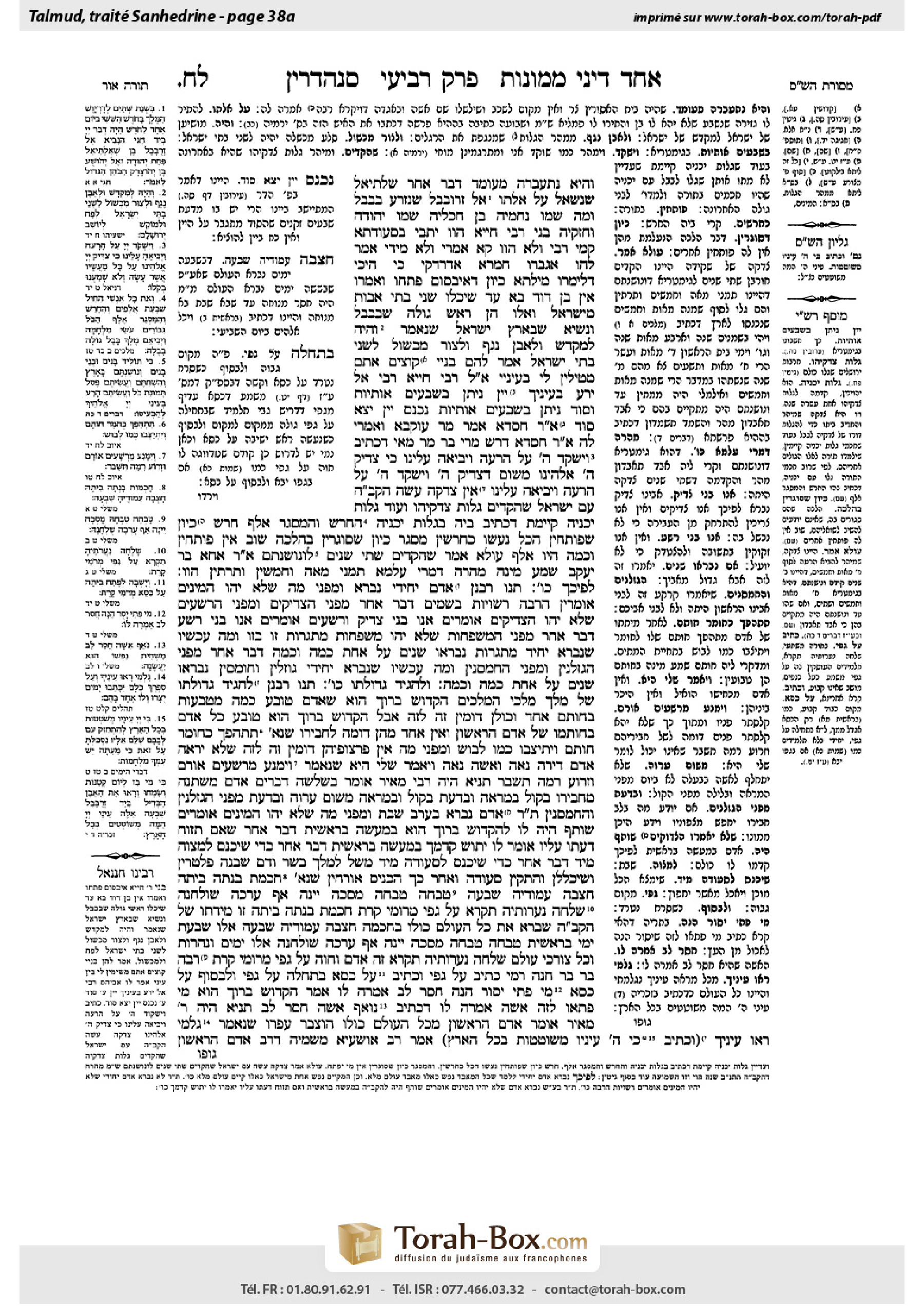
Sanhedrin 38a: Talmud study for Daf Yomi
Daf Yomi is the daily study of one Talmud folio. Explore 37 tractates with scans, Hebrew text, Sefaria English and AI-generated French translations where annotated.
Passage selection and English or AI-generated French translation are available where the scan has annotations. Daf Study is independent of Torah-Box and Sefaria.
Browse Sanhedrin · סנהדרין · All tractatesSanhedrin 38a text and translations
This page of Sanhedrin includes the Aramaic text, an English translation and an AI-generated French translation, alongside the scan above.
סנהדרין ל״ח א · Aramaic and Hebrew text
וְהִיא נִתְעַבְּרָה מְעוּמָּד. דָּבָר אַחֵר: שַׁלְתִּיאֵל – שֶׁנִּשְׁאַל עַל אָלָתוֹ אֵל. זְרוּבָּבֶל – שֶׁנִּזְרַע בְּבָבֶל. וּמָה שְׁמוֹ? נְחֶמְיָה בֶּן חֲכַלְיָה שְׁמוֹ.
יְהוּדָה וְחִזְקִיָּה בְּנֵי רַבִּי חִיָּיא הֲווֹ יָתְבִי בִּסְעוּדְתָּא קַמֵּי רַבִּי, וְלָא הֲווֹ קָא אָמְרִי וְלָא מִידֵּי. אֲמַר לְהוּ: אַגְבַּרוּ חַמְרָא אַדַּרְדְּקֵי כִּי הֵיכִי דְּלֵימְרוּ מִילְּתָא. כֵּיוָן דְּאִיבַּסּוּם, פָּתְחוּ וַאֲמַרוּ: אֵין בֶּן דָּוִד בָּא עַד שֶׁיִּכְלוּ שְׁנֵי בָּתֵּי אָבוֹת מִיִּשְׂרָאֵל, וְאֵלּוּ הֵן: רֹאשׁ גּוֹלָה שֶׁבְּבָבֶל וְנָשִׂיא שֶׁבְּאֶרֶץ יִשְׂרָאֵל, שֶׁנֶּאֱמַר: ״וְהָיָה לְמִקְדָּשׁ וּלְאֶבֶן נֶגֶף וּלְצוּר מִכְשׁוֹל לִשְׁנֵי בָתֵּי יִשְׂרָאֵל״.
אָמַר לָהֶם: בָּנַיי, קוֹצִים אַתֶּם מְטִילִין לִי בְּעֵינַיי? אָמַר לוֹ רַבִּי חִיָּיא: רַבִּי, אַל יֵרַע בְּעֵינֶיךָ. ״יַיִן״ נִיתַּן בְּשִׁבְעִים אוֹתִיּוֹת, וְ״סוֹד״ נִיתַּן בְּשִׁבְעִים אוֹתִיּוֹת. נִכְנַס יַיִן – יָצָא סוֹד.
אָמַר רַב חִסְדָּא אָמַר מָר עוּקְבָא, וְאָמְרִי לַהּ אָמַר רַב חִסְדָּא: דָּרֵשׁ מָרִי בַּר מָר, מַאי דִּכְתִיב: ״וַיִּשְׁקֹד ה׳ עַל הָרָעָה וַיְבִיאֶהָ עָלֵינוּ כִּי צַדִּיק ה׳ אֱלֹהֵינוּ״? מִשּׁוּם דְּצַדִּיק ה׳ – ״וַיִּשְׁקֹד ה׳ עַל הָרָעָה וַיְבִיאֶהָ עָלֵינוּ״? אִין, צְדָקָה עָשָׂה הַקָּדוֹשׁ בָּרוּךְ הוּא עִם יִשְׂרָאֵל שֶׁהִקְדִּים גָּלוּת צִדְקִיָּהוּ וְעוֹד גָּלוּת יְכׇנְיָה קַיֶּימֶת.
דִּכְתִיב בֵּיהּ בְּגָלוּת יְכׇנְיָה: ״הֶחָרָשׁ וְהַמַּסְגֵּר אֶלֶף״. חָרָשׁ – כֵּיוָן שֶׁפּוֹתְחִין, הַכֹּל נַעֲשׂוּ כְּחֵרְשִׁין. מַסְגֵּר – כֵּיוָן שֶׁסּוֹגְרִין בַּהֲלָכָה, שׁוּב אֵין פּוֹתְחִין. וְכַמָּה הָיוּ? אֶלֶף.
עוּלָּא אָמַר: שֶׁהִקְדִּים שְׁתֵּי שָׁנִים לִ״וְנוֹשַׁנְתֶּם״.
אָמַר רַב אַחָא בַּר יַעֲקֹב: שְׁמַע מִינַּהּ, ״מְהֵרָה״ דְּמָרֵי עָלְמָא תַּמְנֵי מְאָה וְחַמְשִׁין וְתַרְתֵּין הָווּ.
לְפִיכָךְ כּוּ׳. תָּנוּ רַבָּנַן: אָדָם יְחִידִי נִבְרָא, וּמִפְּנֵי מָה? שֶׁלֹּא יְהוּ מִינִים אוֹמְרִין ״הַרְבֵּה רְשׁוּיוֹת בַּשָּׁמַיִם״. דָּבָר אַחֵר: מִפְּנֵי הַצַּדִּיקִים וּמִפְּנֵי הָרְשָׁעִים, שֶׁלֹּא יְהוּ הַצַּדִּיקִים אוֹמְרִים ״אָנוּ בְּנֵי צַדִּיק״, וּרְשָׁעִים אוֹמְרִים ״אָנוּ בְּנֵי רָשָׁע״.
דָּבָר אַחֵר: מִפְּנֵי הַמִּשְׁפָּחוֹת, שֶׁלֹּא יְהוּ מִשְׁפָּחוֹת מִתְגָּרוֹת זוֹ בָּזוֹ. וּמָה עַכְשָׁיו שֶׁנִּבְרָא יָחִיד מִתְגָּרוֹת, נִבְרְאוּ שְׁנַיִם – עַל אַחַת כַּמָּה וְכַמָּה! דָּבָר אַחֵר: מִפְּנֵי הַגַּזְלָנִין וּמִפְּנֵי הַחַמְסָנִין. וּמָה עַכְשָׁו שֶׁנִּבְרָא יְחִידִי גּוֹזְלִין וְחוֹמְסִין, נִבְרְאוּ שְׁנַיִם – עַל אַחַת כַּמָּה וְכַמָּה!
וּלְהַגִּיד גְּדוּלָּתוֹ כּוּ׳. תָּנוּ רַבָּנַן, לְהַגִּיד גְּדוּלָּתוֹ שֶׁל מֶלֶךְ מַלְכֵי הַמְּלָכִים הַקָּדוֹשׁ בָּרוּךְ הוּא, שֶׁאָדָם טוֹבֵעַ כַּמָּה מַטְבְּעוֹת בְּחוֹתָם אֶחָד וְכוּלָּן דּוֹמִין זֶה לְזֶה, אֲבָל הַקָּדוֹשׁ בָּרוּךְ הוּא טוֹבֵעַ כׇּל אָדָם בְּחוֹתָמוֹ שֶׁל אָדָם הָרִאשׁוֹן וְאֵין אֶחָד מֵהֶן דּוֹמֶה לַחֲבֵירוֹ, שֶׁנֶּאֱמַר: ״תִּתְהַפֵּךְ כְּחֹמֶר חוֹתָם וְיִתְיַצְּבוּ כְּמוֹ לְבוּשׁ״.
וּמִפְּנֵי מָה אֵין פַּרְצוּפֵיהֶן דּוֹמִין זֶה לָזֶה? שֶׁלֹּא יִרְאֶה אָדָם דִּירָה נָאָה וְאִשָּׁה נָאָה וְיֹאמַר: ״שֶׁלִּי הִיא״. שֶׁנֶּאֱמַר: ״וְיִמָּנַע מֵרְשָׁעִים אוֹרָם וּזְרוֹעַ רָמָה תִּשָּׁבֵר״.
תַּנְיָא, הָיָה רַבִּי מֵאִיר אוֹמֵר: בִּשְׁלֹשָׁה דְּבָרִים אָדָם מִשְׁתַּנֶּה מֵחֲבֵירוֹ: בְּקוֹל, בְּמַרְאֶה, וּבְדַעַת. בְּקוֹל וּבְמַרְאֶה – מִשּׁוּם עֶרְוָה, וּבְדַעַת – מִפְּנֵי הַגַּזְלָנִין וְהַחַמְסָנִין.
תָּנוּ רַבָּנַן: אָדָם נִבְרָא בְּעֶרֶב שַׁבָּת, וּמִפְּנֵי מָה? שֶׁלֹּא יְהוּ מִינִים אוֹמְרִים: שׁוּתָּף הָיָה לוֹ לְהַקָּדוֹשׁ בָּרוּךְ הוּא בְּמַעֲשֵׂה בְרֵאשִׁית. דָּבָר אַחֵר: שֶׁאִם תָּזוּחַ דַּעְתּוֹ עָלָיו, אוֹמֵר לוֹ: יַתּוּשׁ קְדָמְךָ בְּמַעֲשֵׂה בְרֵאשִׁית. דָּבָר אַחֵר: כְּדֵי שֶׁיִּכָּנֵס לַמִּצְוָה מִיָּד.
דָּבָר אַחֵר: כְּדֵי שֶׁיִּכָּנֵס לַסְּעוּדָה מִיָּד. מָשָׁל לְמֶלֶךְ בָּשָׂר וָדָם שֶׁבְּנָהּ פַּלְטֵרִין וְשִׁיכְלְלָן, וְהִתְקִין סְעוּדָה, וְאַחַר כָּךְ הִכְנִיס אוֹרְחִין. שֶׁנֶּאֱמַר: ״חׇכְמוֹת בָּנְתָה בֵיתָהּ חָצְבָה עַמּוּדֶיהָ שִׁבְעָה. טָבְחָה טִבְחָהּ מָסְכָה יֵינָהּ אַף עָרְכָה שֻׁלְחָנָהּ. שָׁלְחָה נַעֲרֹתֶיהָ תִקְרָא עַל גַּפֵּי מְרֹמֵי קָרֶת.״
״חׇכְמוֹת בָּנְתָה בֵיתָהּ״ – זוֹ מִידָּתוֹ שֶׁל הַקָּדוֹשׁ בָּרוּךְ הוּא, שֶׁבָּרָא אֶת כָּל הָעוֹלָם כּוּלּוֹ בְּחׇכְמָה. ״חָצְבָה עַמּוּדֶיהָ שִׁבְעָה״ – אֵלּוּ שִׁבְעַת יְמֵי בְּרֵאשִׁית. ״טָבְחָה טִבְחָהּ מָסְכָה יֵינָהּ אַף עָרְכָה שֻׁלְחָנָהּ״ – אֵלּוּ יַמִּים וּנְהָרוֹת וְכׇל צוֹרְכֵי עוֹלָם. ״שָׁלְחָה נַעֲרֹתֶיהָ תִקְרָא״ – זֶה אָדָם וְחַוָּה.
״עַל גַּפֵּי מְרֹמֵי קָרֶת״ – רַבָּה בַּר בַּר חָנָה רָמֵי: כְּתִיב ״עַל גַּפֵּי״, וּכְתִיב ״עַל כִּסֵּא״. בַּתְּחִלָּה – עַל גַּפֵּי, וּלְבַסּוֹף – עַל כִּסֵּא.
״מִי פֶתִי יָסֻר הֵנָּה חֲסַר לֵב אָמְרָה לּוֹ״. אָמַר הַקָּדוֹשׁ בָּרוּךְ הוּא: מִי פִּיתָּהוּ לָזֶה? אִשָּׁה אָמְרָה לוֹ. דִּכְתִיב: ״נֹאֵף אִשָּׁה חֲסַר לֵב״.
תַּנְיָא, הָיָה רַבִּי מֵאִיר אוֹמֵר: אָדָם הָרִאשׁוֹן מִכׇּל הָעוֹלָם כּוּלּוֹ הוּצְבַּר עֲפָרוֹ, שֶׁנֶּאֱמַר: ״גׇּלְמִי רָאוּ עֵינֶיךָ״, וּכְתִיב: ״כִּי ה׳ עֵינָיו מְשֹׁטְטוֹת בְּכׇל הָאָרֶץ״. אָמַר רַב אוֹשַׁעְיָא מִשְּׁמֵיהּ דְּרַב: אָדָם הָרִאשׁוֹן
Sanhedrin 38a · English translation
and the mother of Shealtiel conceived while standing. Alternatively, “Shealtiel” is interpreted as meaning that God [El ] requested [nishal ] dissolution of His oath, as it were, and allowed Jeconiah to father a child. In the continuation of that passage in Chronicles, where the verse refers to the grandson of Jeconiah, Zerubbabel [Zerubavel ], the Gemara interprets that his name teaches that he was sown [nizra], i.e., conceived, in Babylonia [Bavel]. And what was his true name? Nehemiah, son of Hachaliah, was his true name.
Having mentioned the sons of Rabbi Ḥiyya, the Gemara relates: Yehuda and Ḥizkiyya, sons of Rabbi Ḥiyya, were sitting at a meal before Rabbi Yehuda HaNasi, and they were not saying anything. Rabbi Yehuda HaNasi said to his servants: Add more wine for the young men, so that they will say something. Once they were inebriated, they loosened their tongues and said: The son of David, i.e., the Messiah, will not come until two fathers’ houses are destroyed from Israel, as those two families are preventing the redemption. And they are the head of the exile who is in Babylonia, i.e., the family of the Exilarch, and the Nasi who is in Eretz Yisrael, i.e., the family of Rabbi Yehuda HaNasi (see 5a), as it is stated in reference to the Messiah: “And he shall be for a sanctuary; but for a stone of stumbling and for a rock of offense to both the houses of Israel” (Isaiah 8:14).
Rabbi Yehuda HaNasi said to them: My children, do you throw thorns in my eyes? How can you say this in the presence of the Nasi himself? Rabbi Ḥiyya said to him: My teacher, do not view their behavior in a negative light. Wine [yayin] is given in letters of seventy, i.e., the numerical value of the letters in the word yayin is seventy, and secret [sod ] is given in letters of seventy, i.e., the numerical value of the letters in the word sod is seventy. When wine enters, secrets emerge.
Apropos the discussion of exile, Rav Ḥisda says that Mar Ukva says, and some say that Rav Ḥisda says that Mari bar Mar taught: What is the meaning of that which is written: “And so the Lord has hastened the evil, and brought it upon us; for the Lord our God is righteous in all His works He has done” (Daniel 9:14)? Is it because “the Lord our God is righteous” that “the Lord has hastened the evil, and brought it upon us”? He explains: Yes, because it was a righteous act that the Holy One, Blessed be He, performed for the Jewish people by hastening the exile of Zedekiah while the Jews who had been exiled in the exile of Jeconiah, which preceded it, were still alive, as the wise people among those exiled with Jeconiah were able to instruct those exiled with Zedekiah.
This is as it is written concerning the exile of Jeconiah: “And all the men of might, seven thousand, and the craftsmen [heḥarash] and the smiths [vehammasger] one thousand” (II Kings 24:16). The Gemara interprets: The term “ḥarash,” which can be read as ḥeresh, deaf-mute, is referring to Torah scholars, as when they open their mouths to teach Torah, all the others become as though they were deaf-mutes, as they would listen quietly to the one teaching Torah. The term “masger,” which is related to saggur, meaning closed, teaches that when they close, i.e., finish, teaching the halakha, they do not reopen the discussion, as all has been clarified. And how many were these Torah scholars? One thousand.
Ulla says: The righteous act that the Lord performed, referred to in the verse in Daniel, was that He hastened the exile by two years of venoshantem. Moses taught: “When you shall have children, and children’s children, and you shall have remained long [venoshantem] in the land, and shall deal corruptly, and make a carved idol, the likeness of anything, and shall do evil in the sight of the Lord your God, to provoke him to anger, I call heaven and earth to witness against you this day, that you shall soon utterly perish from off the land into which you go over the Jorden to possess it; you shall not prolong your days upon it, but shall utterly be destroyed” (Deuteronomy 4:25–26). The numerical value of the letters of the word “venoshantem” is 852, and the Jewish people were exiled in the 850th year after entering Eretz Yisrael. Since they were exiled early, not all of the curses enumerated in the verse would be fulfilled.
Rav Aḥa bar Ya’akov says: Learn from it that for the Master of the World, the term soon is referring to 852 years, as the verse states: “You shall soon utterly perish,” and the intended time until the exile was 852 years.
§ The mishna teaches: Therefore, Adam the first man was created alone. The Sages taught in a baraita: Adam was created alone, and for what reason? So that the heretics will not say: There are many authorities in Heaven, and each created a different person. Alternatively, Adam was created alone due to the righteous and due to the wicked. It was so that the righteous will not say: We are the children of the righteous, and righteousness is natural for us, so there is no need for us to exert ourselves to be righteous, and so that the wicked will not say: We are the children of the wicked and cannot change our ways.
The baraita continues: Alternatively, he was created alone due to the families, so that the families will not quarrel with each other, each one boasting of the heritage of their progenitor. And if now that Adam was created alone, families still quarrel and each family claims superiority, if there were two people created initially, all the more so would they do this. Alternatively, he was created alone due to the robbers and due to those who take by force that which is not theirs, as the feeling of fraternity among all people, having descended from the same forefather, will limit crime. And if now that Adam was created alone, criminals still rob and take by force that which is not theirs, if there were two people created initially, all the more so would this be the case.
The mishna teaches: And this serves to tell of the greatness of the Holy One, Blessed be He, as when a person stamps several coins with one seal, they are all similar to each other. But the supreme King of kings, the Holy One, Blessed be He, stamped all people with the seal of Adam the first man, as all are his offspring, and not one of them is similar to another. The Sages taught in a baraita (Tosefta 8:5): The fact that Adam the first man was created alone serves to declare the greatness of the supreme King of kings, the Holy One, Blessed be He, as a person stamps several coins with one seal, and they are all similar to each other. But the Holy One, Blessed be He, stamps all people with the seal of Adam the first man, and not one of them is similar to another. As it is stated: “It is changed like clay under the seal and they stand as a garment” (Job 38:14). The verse describes people as being created “under the seal,” but their external appearance is different, just as garments can differ in appearance.
The baraita asks: And for what reason are their faces not similar to one another? The baraita answers: It is so that a man will not see a beautiful home or a beautiful woman and say: She is mine. If all people looked the same, no one could contradict him. As it is stated in the following verse: “And from the wicked their light is withheld and the high arm shall be broken” (Job 38:15), indicating that the reason people look different from one another is to prevent the wicked from succeeding in their plans.
It is taught in a baraita: Rabbi Meir would say: One person is different from another in three ways: In voice, in appearance, and in thought. The differences in voice and appearance are due to a woman forbidden to him, so that people will not exchange spouses one with another. And the differences in thought are due to the robbers and those who take by force that which is not theirs, as, if everyone thought in a similar way, criminals could take advantage of others because they would understand where they keep their valuables.
The Sages taught in a baraita (Tosefta 8:7): Adam the first man was created on Shabbat eve at the close of the six days of Creation. And for what reason was this so? So that the heretics will not be able to say that the Holy One, Blessed be He, had a partner, i.e., Adam, in the acts of Creation. Alternatively, he was created on Shabbat eve so that if a person becomes haughty, God can say to him: The mosquito preceded you in the acts of Creation, as you were created last. Alternatively, he was created on Shabbat eve in order that he enter into the mitzva of observing Shabbat immediately.
Alternatively, he was created on Shabbat eve, after all of the other creations, in order that he enter into a feast immediately, as the whole world was prepared for him. This is comparable to a king of flesh and blood, who first built palaces [palterin] and improved them, and prepared a feast and afterward brought in his guests. As it is stated: “Wisdom has built her house, and she has hewn out her seven pillars. She has killed her beasts; she has mingled her wine; she has also furnished her table. She has sent forth her maidens; she calls upon the top of the highest places of the city” (Proverbs 9:1–3).
The baraita explains: “Wisdom has built her house”; this is referring to the attribute of the Holy One, Blessed be He, Who created the entire world with wisdom. “She has hewn out her seven pillars”; these pillars are referring to the seven days of Creation, in which the world was established. “She has killed her beasts; she has mingled her wine; she has also furnished her table”; these are referring to the seas and rivers and all the necessities of the world that were created. “She has sent forth her maidens; she calls”; this is referring to Adam and Eve, who were created at the end of Creation.
The verses continue: “Upon the top of the highest places of the city.” Rabba bar bar Ḥana raises a contradiction: It is written: “Upon the top of the highest places,” and it is written afterward: “For she sits at the door of her house, on a seat in the high places of the city” (Proverbs 9:14). Is she at the top or on a seat? He explains: Initially, Adam was alone upon the top of a high place, and ultimately, Adam was on a seat that is set for a bridegroom, when Eve was paired with him.
The verse states in that passage: “Whoever is thoughtless, let him turn in here; as for him that lacks understanding, she tells him” (Proverbs 9:4). The Gemara explains: The Holy One, Blessed be He, said: Who lured this man to sin? The woman told him to sin. An allusion to the interpretation that one who is lured to sin by a woman is called one “that lacks understanding” is as it is written: “He who commits adultery with a woman lacks understanding” (Proverbs 6:32).
It is taught in a baraita that Rabbi Meir would say: The dust that served to form Adam the first man was gathered from the entire world, as it is stated: “When I was made in secret and wrought in the lowest places of the earth, Your eyes did see my unshaped flesh” (Psalms 139:15–16), and it is written: “For the eyes of the Lord run to and fro throughout the whole earth” (II Chronicles 16:9), indicating that this figure was formed from the whole earth, the place within the view of the Lord’s eyes. Rav Oshaya says in the name of Rav: With regard to Adam the first man,
Sanhedrin 38a · Traduction française (IA)
et la mère de Shealtiel conçut debout. Autre interprétation : « Shealtiel » signifie que Dieu [El] demanda [nishal] que son serment soit annulé, pour ainsi dire, et permit à Yekonia d’engendrer un enfant. Dans la suite de ce passage des Chroniques, où le verset mentionne le petit-fils de Yekonia, Zorobabel [Zerubavel], la Guemara interprète son nom comme signifiant qu’il fut semé [nizra], c’est-à-dire conçu, à Babylone [Bavel]. Et quel était son véritable nom ? Son véritable nom était Néhemia, fils de Hacalia.
Après avoir mentionné les fils de Rabbi Ḥiyya, la Guemara rapporte : Yehuda et Ḥizkiyya, fils de Rabbi Ḥiyya, étaient assis à table devant Rabbi Yehuda HaNassi et ne disaient rien. Rabbi Yehuda HaNassi dit à ses serviteurs : « Servez encore du vin aux jeunes gens, afin qu’ils disent quelque chose. » Une fois ivres, ils délièrent leur langue et dirent : « Le fils de David, c’est-à-dire le Messie, ne viendra pas avant que deux maisons ancestrales soient détruites en Israël », car ces deux familles empêchent la rédemption. Il s’agit du chef de l’exil qui se trouve en Babylonie, c’est-à-dire la famille de l’Exilarque, et du Nassi qui se trouve en Eretz Israël, c’est-à-dire la famille de Rabbi Yehuda HaNassi (voir 5a), comme il est dit au sujet du Messie : « Il sera un sanctuaire, mais une pierre d’achoppement et un rocher de scandale pour les deux maisons d’Israël » (Isaïe 8:14).
Rabbi Yehuda HaNassi leur dit : « Mes enfants, me jetez-vous des épines dans les yeux ? Comment pouvez-vous dire cela en présence du Nassi lui-même ? » Rabbi Ḥiyya lui répondit : « Mon maître, ne prenez pas leur conduite en mauvaise part. Le mot “vin” [yayin] s’écrit avec des lettres dont la valeur numérique est soixante-dix, et le mot “secret” [sod] s’écrit lui aussi avec des lettres dont la valeur numérique est soixante-dix. Quand le vin entre, les secrets sortent. »
À propos de l’exil, Rav Ḥisda rapporte au nom de Mar Ukva — certains disent que Rav Ḥisda rapporte ce que Mari bar Mar enseignait : Que signifie ce qui est écrit : « Ainsi le Seigneur a hâté le mal et l’a fait venir sur nous, car le Seigneur notre Dieu est juste dans toutes ses œuvres » (Daniel 9:14) ? Est-ce parce que « le Seigneur notre Dieu est juste » que « le Seigneur a hâté le mal et l’a fait venir sur nous » ? Il répond : Oui, car le Saint, béni soit-Il, accomplit un acte de justice envers le peuple juif en hâtant l’exil de Sédécias alors que les Juifs exilés lors de l’exil de Yekonia, qui l’avait précédé, étaient encore en vie. Ainsi, les sages parmi les exilés avec Yekonia purent instruire ceux qui furent exilés avec Sédécias.
C’est ce qui est écrit au sujet de l’exil de Yekonia : « Tous les hommes vaillants, au nombre de sept mille, ainsi que les artisans [heḥarash] et les serruriers [vehammasger], au nombre de mille » (II Rois 24:16). La Guemara interprète ainsi : Le terme « ḥarash », qui peut se lire ḥeresh, « sourd-muet », désigne les érudits de la Torah : lorsqu’ils ouvrent la bouche pour enseigner la Torah, tous les autres deviennent comme des sourds-muets, car ils écoutent en silence celui qui enseigne la Torah. Le terme « masger », apparenté à saggur, « fermé », enseigne que lorsqu’ils cessent, c’est-à-dire terminent, d’exposer la halakha, ils ne rouvrent pas la discussion, car tout a été éclairci. Et combien étaient-ils, ces érudits de la Torah ? Mille.
Ulla dit : L’acte de justice accompli par le Seigneur, auquel fait référence le verset de Daniel, fut d’avoir avancé l’exil de deux ans par rapport à l’échéance indiquée par le mot venoshantem. Moïse enseigna : « Lorsque tu auras engendré des enfants et des petits-enfants, que vous aurez longtemps demeuré [venoshantem] dans le pays et que vous vous corromprez, que vous ferez une idole sculptée, une représentation de quoi que ce soit, et que vous ferez le mal aux yeux du Seigneur ton Dieu pour l’irriter, je prends aujourd’hui à témoin contre vous le ciel et la terre : vous disparaîtrez bientôt entièrement du pays dont vous allez prendre possession en traversant le Jourdain ; vous n’y prolongerez pas vos jours, mais vous serez entièrement détruits » (Deutéronome 4:25–26). La valeur numérique des lettres du mot « venoshantem » est 852, et le peuple juif fut exilé la 850e année après son entrée en Eretz Israël. Puisqu’il fut exilé plus tôt, toutes les malédictions énumérées dans le verset ne s’accomplirent pas.
Rav Aḥa bar Ya’akov dit : Il faut en déduire que, pour le Maître du monde, le terme « bientôt » désigne 852 ans, puisque le verset dit : « Vous disparaîtrez bientôt entièrement », et que le délai visé avant l’exil était de 852 ans.
§ La Michna enseigne : C’est pourquoi le premier homme, Adam, fut créé seul. Les Sages enseignèrent dans une baraïta : Adam fut créé seul. Pour quelle raison ? Afin que les hérétiques ne disent pas : « Il y a plusieurs autorités au Ciel, chacune ayant créé une personne différente. » Autre raison : Adam fut créé seul en considération des justes et des méchants. Cela devait empêcher les justes de dire : « Nous sommes les enfants de justes, la justice nous est donc naturelle et nous n’avons pas besoin de nous efforcer d’être justes », et les méchants de dire : « Nous sommes les enfants de méchants et nous ne pouvons pas changer de conduite. »
La baraïta poursuit : Autre raison : il fut créé seul en considération des familles, afin qu’elles ne se querellent pas, chacune se vantant de l’héritage de son ancêtre. Et si, alors qu’Adam fut créé seul, les familles se querellent encore et que chacune revendique sa supériorité, à plus forte raison l’auraient-elles fait si deux personnes avaient été créées au commencement. Autre raison : il fut créé seul en considération des voleurs et de ceux qui s’emparent par la force de ce qui ne leur appartient pas, car le sentiment de fraternité entre tous les êtres humains, issus du même ancêtre, limite la criminalité. Et si, alors qu’Adam fut créé seul, les criminels volent encore et s’emparent par la force de ce qui ne leur appartient pas, à plus forte raison en aurait-il été ainsi si deux personnes avaient été créées au commencement.
La Michna enseigne : Cela vise à faire connaître la grandeur du Saint, béni soit-Il : lorsqu’un homme frappe plusieurs pièces avec un même sceau, elles sont toutes semblables. Mais le Roi suprême des rois, le Saint, béni soit-Il, a marqué tous les êtres humains du sceau du premier homme, Adam, puisqu’ils sont tous ses descendants, et pourtant aucun ne ressemble à un autre. Les Sages enseignèrent dans une baraïta (Tosefta 8:5) : Le fait que le premier homme, Adam, ait été créé seul vise à proclamer la grandeur du Roi suprême des rois, le Saint, béni soit-Il. Un homme frappe plusieurs pièces avec un même sceau, et elles sont toutes semblables. Mais le Saint, béni soit-Il, marque tous les êtres humains du sceau du premier homme, Adam, et aucun ne ressemble à un autre. Comme il est dit : « Elle change comme l’argile sous le sceau, et ils se dressent comme un vêtement » (Job 38:14). Le verset décrit les êtres humains comme étant créés « sous le sceau », mais leur apparence extérieure diffère, tout comme les vêtements peuvent avoir des apparences différentes.
La baraïta demande : Et pourquoi leurs visages ne se ressemblent-ils pas ? Elle répond : Afin qu’un homme ne voie pas une belle maison ou une belle femme et ne dise pas : « Elle est à moi. » Si tous les êtres humains se ressemblaient, personne ne pourrait le contredire. Comme il est dit dans le verset suivant : « La lumière est retirée aux méchants, et le bras élevé est brisé » (Job 38:15), ce qui indique que les êtres humains ont des apparences différentes afin d’empêcher les méchants de réussir leurs projets.
Il est enseigné dans une baraïta : Rabbi Meïr disait : « Une personne diffère d’une autre de trois façons : par la voix, l’apparence et la pensée. » Les différences de voix et d’apparence sont dues à la nécessité d’empêcher qu’un homme convoite une femme qui lui est interdite, afin que les gens n’échangent pas leurs épouses. Les différences de pensée sont dues aux voleurs et à ceux qui s’emparent par la force de ce qui ne leur appartient pas : si tout le monde pensait de la même manière, les criminels pourraient profiter des autres, car ils sauraient où ceux-ci gardent leurs objets de valeur.
Les Sages enseignèrent dans une baraïta (Tosefta 8:7) : Le premier homme, Adam, fut créé la veille du Chabbat, à la fin des six jours de la Création. Pourquoi en fut-il ainsi ? Afin que les hérétiques ne puissent pas dire que le Saint, béni soit-Il, avait un associé, c’est-à-dire Adam, dans les actes de la Création. Autre raison : il fut créé la veille du Chabbat afin que, si un homme devient arrogant, Dieu puisse lui dire : « Le moustique t’a précédé dans les actes de la Création, car tu as été créé en dernier. » Autre raison : il fut créé la veille du Chabbat pour qu’il entre immédiatement dans la mitsva d’observer le Chabbat.
Autre raison : il fut créé la veille du Chabbat, après toutes les autres créatures, afin qu’il entre immédiatement dans un festin, puisque le monde entier avait été préparé pour lui. Cela ressemble au cas d’un roi de chair et de sang qui, d’abord, construisit des palais [palterin], les aménagea et prépara un festin, puis fit entrer ses invités. Comme il est dit : « La Sagesse a bâti sa maison, elle a taillé ses sept colonnes. Elle a égorgé ses bêtes, mélangé son vin et dressé sa table. Elle a envoyé ses jeunes filles ; elle appelle du haut des hauteurs de la ville » (Proverbes 9:1–3).
La baraïta explique : « La Sagesse a bâti sa maison » fait référence à l’attribut du Saint, béni soit-Il, qui créa le monde entier avec sagesse. « Elle a taillé ses sept colonnes » : ces colonnes font référence aux sept jours de la Création, au cours desquels le monde fut établi. « Elle a égorgé ses bêtes, mélangé son vin et dressé sa table » fait référence aux mers, aux fleuves et à toutes les nécessités du monde qui furent créées. « Elle a envoyé ses jeunes filles ; elle appelle » fait référence à Adam et Ève, qui furent créés à la fin de la Création.
Les versets poursuivent : « Du haut des hauteurs de la ville. » Rabba bar bar Ḥana soulève une contradiction : il est écrit « du haut des hauteurs », puis il est écrit : « Car elle est assise à la porte de sa maison, sur un siège, dans les hauteurs de la ville » (Proverbes 9:14). Est-elle au sommet ou assise sur un siège ? Il explique : Au commencement, Adam était seul au sommet d’un lieu élevé ; finalement, il était assis sur un siège destiné au marié, lorsqu’Ève lui fut adjointe.
Le passage dit : « Que celui qui est simple entre ici ; et à celui qui manque de discernement, elle dit » (Proverbes 9:4). La Guemara explique : Le Saint, béni soit-Il, dit : « Qui a entraîné cet homme à pécher ? C’est la femme qui lui a dit de pécher. » Le fait que celui qui est entraîné au péché par une femme soit désigné comme « celui qui manque de discernement » est suggéré par ce qui est écrit : « Celui qui commet l’adultère avec une femme manque de discernement » (Proverbes 6:32).
Il est enseigné dans une baraïta que Rabbi Meïr disait : La poussière qui servit à façonner le premier homme, Adam, fut rassemblée de toute la terre, comme il est dit : « Lorsque je fus formé dans le secret et façonné dans les profondeurs de la terre, tes yeux virent ma substance informe » (Psaumes 139:15–16), et il est écrit : « Car les yeux du Seigneur parcourent toute la terre » (II Chroniques 16:9), ce qui indique que cette figure fut formée à partir de toute la terre, c’est-à-dire de l’endroit qui se trouve dans le champ de vision des yeux du Seigneur. Rav Oshaya dit au nom de Rav : Concernant le premier homme, Adam,
Traduction française générée par IA à partir de l’édition anglaise de Sefaria. Vérifie toujours un passage avec le texte source.
Text from Sefaria: William Davidson Edition - Vocalized Aramaic (CC BY NC); William Davidson Edition - English (CC BY NC).