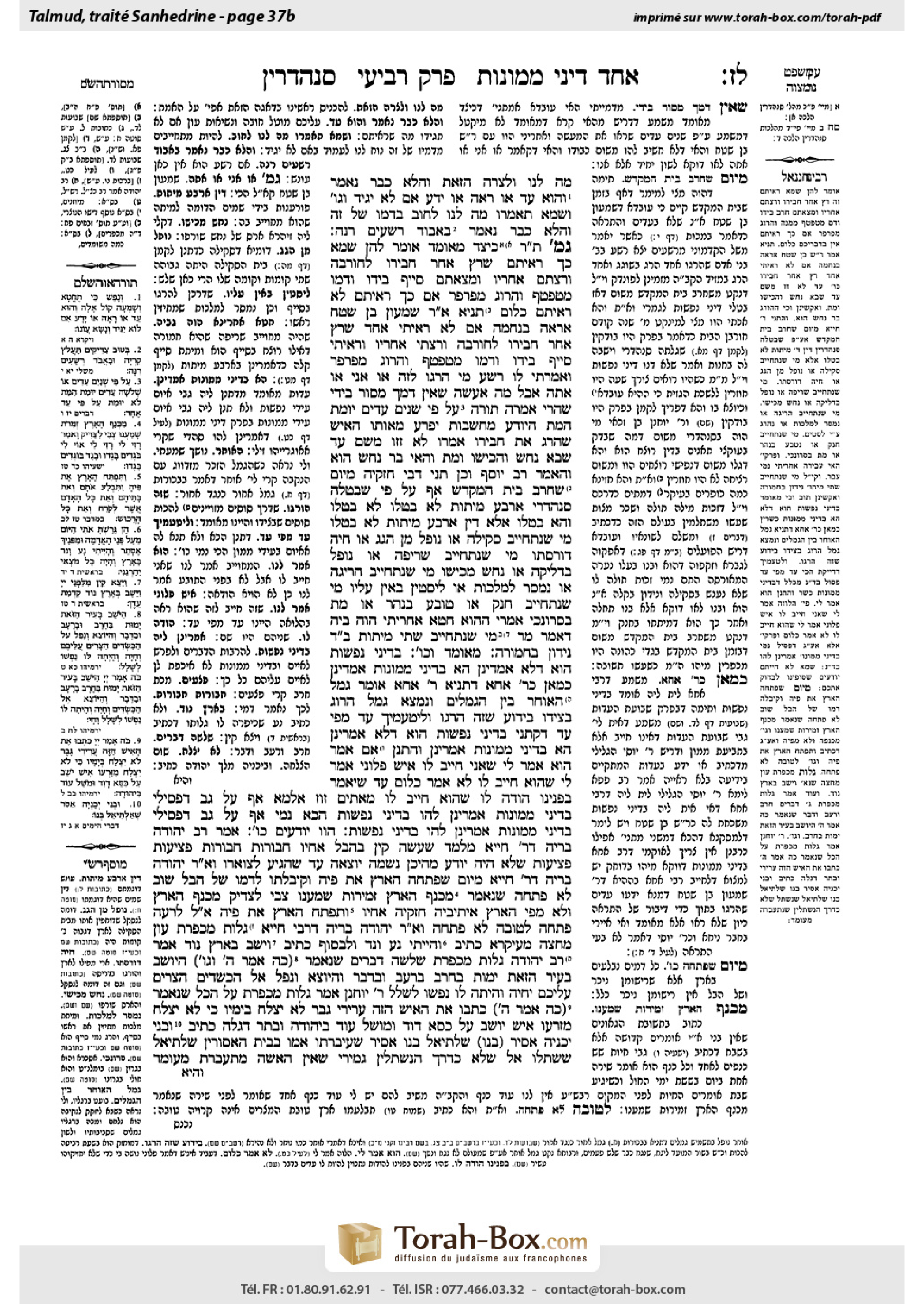
Sanhedrin 37b: Talmud study for Daf Yomi
Daf Yomi is the daily study of one Talmud folio. Explore 37 tractates with scans, Hebrew text, Sefaria English and AI-generated French translations where annotated.
Passage selection and English or AI-generated French translation are available where the scan has annotations. Daf Study is independent of Torah-Box and Sefaria.
Browse Sanhedrin · סנהדרין · All tractatesSanhedrin 37b text and translations
This page of Sanhedrin includes the Aramaic text, an English translation and an AI-generated French translation, alongside the scan above.
סנהדרין ל״ז ב · Aramaic and Hebrew text
מָה לָנוּ וְלַצָּרָה הַזֹּאת? וַהֲלֹא כְּבָר נֶאֱמַר: ״וְהוּא עֵד אוֹ רָאָה אוֹ יָדָע אִם לוֹא יַגִּיד וְגוֹ׳״. וְשֶׁמָּא תֹּאמְרוּ: מָה לָנוּ לָחוּב בְּדָמוֹ שֶׁל זֶה? וַהֲלֹא כְּבָר נֶאֱמַר: ״בַּאֲבֹד רְשָׁעִים רִנָּה״.
גְּמָ׳ תָּנוּ רַבָּנַן: כֵּיצַד מֵאוֹמֶד? אוֹמֵר לָהֶן: שֶׁמָּא כָּךְ רְאִיתֶם? שֶׁרָץ אַחַר חֲבֵירוֹ לְחוּרְבָּה, וְרַצְתֶּם אַחֲרָיו, וּמְצָאתֶם סַיִיף בְּיָדוֹ וְדָמוֹ מְטַפְטֵף, וְהָרוּג מְפַרְפֵּר. אִם כָּךְ רְאִיתֶם – לֹא רְאִיתֶם כְּלוּם.
תַּנְיָא, אָמַר רַבִּי שִׁמְעוֹן בֶּן שָׁטַח: אֶרְאֶה בְּנֶחָמָה אִם לֹא רָאִיתִי אֶחָד שֶׁרָץ אַחַר חֲבֵירוֹ לְחוּרְבָּה, וְרַצְתִּי אַחֲרָיו וְרָאִיתִי סַיִיף בְּיָדוֹ וְדָמוֹ מְטַפְטֵף וְהָרוּג מְפַרְפֵּר. וְאָמַרְתִּי לוֹ: רָשָׁע, מִי הֲרָגוֹ לָזֶה? אוֹ אֲנִי אוֹ אַתָּה. אֲבָל מָה אֶעֱשֶׂה שֶׁאֵין דָּמְךָ מָסוּר בְּיָדִי, שֶׁהֲרֵי אָמְרָה תּוֹרָה ״עַל פִּי שְׁנַיִם עֵדִים יוּמַת הַמֵּת״. הַיּוֹדֵעַ מַחְשָׁבוֹת יִפָּרַע מֵאוֹתוֹ הָאִישׁ שֶׁהָרַג אֶת חֲבֵירוֹ. אָמְרוּ: לֹא זָזוּ מִשָּׁם עַד שֶׁבָּא נָחָשׁ וְהִכִּישׁוֹ וָמֵת.
וְהַאי בַּר נָחָשׁ הוּא? וְהָאָמַר רַב יוֹסֵף, וְכֵן תָּנֵי דְּבֵי חִזְקִיָּה: מִיּוֹם שֶׁחָרַב בֵּית הַמִּקְדָּשׁ, אַף עַל פִּי שֶׁבָּטְלָה סַנְהֶדְרִי, אַרְבַּע מִיתוֹת לֹא בָּטְלוּ. לֹא בָּטְלוּ? וְהָא בָּטְלוּ! אֶלָּא, דִּין אַרְבַּע מִיתוֹת לֹא בָּטְלוּ.
מִי שֶׁנִּתְחַיֵּיב סְקִילָה – אוֹ נוֹפֵל מִן הַגָּג, אוֹ חַיָּה דּוֹרַסְתּוֹ. מִי שֶׁנִּתְחַיֵּיב שְׂרֵיפָה – אוֹ נוֹפֵל בִּדְלֵיקָה, אוֹ נָחָשׁ מַכִּישׁוֹ. מִי שֶׁנִּתְחַיֵּיב הֲרִיגָה – אוֹ נִמְסָר לַמַּלְכוּת, אוֹ לִיסְטִין בָּאִין עָלָיו. מִי שֶׁנִּתְחַיֵּיב חֶנֶק – אוֹ טוֹבֵעַ בַּנָּהָר, אוֹ מֵת בִּסְרוֹנְכֵי.
אָמְרִי: הָהוּא חֵטְא אַחֲרִיתִי הֲוָה בֵּיהּ, דְּאָמַר מָר: מִי שֶׁנִּתְחַיֵּיב שְׁתֵּי מִיתוֹת בֵּית דִּין – נִידּוֹן בַּחֲמוּרָה.
מֵאוֹמֶד וְכוּ׳. בְּדִינֵי נְפָשׁוֹת הוּא דְּלָא אָמְדִינַן, הָא בְּדִינֵי מָמוֹנוֹת אָמְדִינַן. כְּמַאן? כְּרַבִּי אַחָא, דְּתַנְיָא, רַבִּי אַחָא אוֹמֵר: גָּמָל הָאוֹחֵר בֵּין הַגְּמַלִּים וְנִמְצָא גָּמָל הָרוּג בְּצִידּוֹ – בְּיָדוּעַ שֶׁזֶּה הֲרָגוֹ.
וְלִיטַעְמָיךְ, עֵד מִפִּי עֵד דְּקָתָנֵי בְּדִינֵי נְפָשׁוֹת הוּא דְּלָא אָמְרִינַן, הָא בְּדִינֵי מָמוֹנוֹת אָמְרִינַן? וְהָתְנַן: אִם אָמַר ״הוּא אָמַר לִי שֶׁאֲנִי חַיָּיב לוֹ״, ״אִישׁ פְּלוֹנִי אָמַר לִי שֶׁהוּא חַיָּיב לוֹ״ – לֹא אָמַר כְּלוּם, עַד שֶׁיֹּאמַר ״בְּפָנֵינוּ הוֹדָה לוֹ שֶׁהוּא חַיָּיב לוֹ מָאתַיִם זוּז״.
אַלְמָא, אַף עַל גַּב דִּפְסִילִי בְּדִינֵי מָמוֹנוֹת, אָמְרִינַן לְהוּ בְּדִינֵי נְפָשׁוֹת. הָכָא נָמֵי, אַף עַל גַּב דִּפְסִילִי בְּדִינֵי מָמוֹנוֹת, אָמְרִינַן לְהוּ בְּדִינֵי נְפָשׁוֹת.
הֱווּ יוֹדְעִים כּוּ׳. אָמַר רַב יְהוּדָה בְּרֵיהּ דְּרַבִּי חִיָּיא: מְלַמֵּד שֶׁעָשָׂה קַיִן בְּהֶבֶל אָחִיו חַבּוּרוֹת חַבּוּרוֹת, פְּצִיעוֹת פְּצִיעוֹת, שֶׁלֹּא הָיָה יוֹדֵעַ מֵהֵיכָן נְשָׁמָה יוֹצְאָה, עַד שֶׁהִגִּיעַ לְצַוָּארוֹ.
וְאָמַר רַב יְהוּדָה בְּרֵיהּ דְּרַבִּי חִיָּיא: מִיּוֹם שֶׁפָּתְחָה הָאָרֶץ אֶת פִּיהָ וְקִיבְּלַתּוּ לְדָמוֹ שֶׁל הֶבֶל, שׁוּב לֹא פָּתְחָה, שֶׁנֶּאֱמַר: ״מִכְּנַף הָאָרֶץ זְמִרֹת שָׁמַעְנוּ צְבִי לַצַּדִּיק״ – מִכְּנַף הָאָרֶץ וְלֹא מִפִּי הָאָרֶץ. אֵיתִיבֵיהּ חִזְקִיָּה אָחִיו: ״וַתִּפְתַּח הָאָרֶץ אֶת פִּיהָ״! אֲמַר לֵיהּ: לְרָעָה פָּתְחָה, לְטוֹבָה לֹא פָּתְחָה.
וְאָמַר רַב יְהוּדָה בְּרֵיהּ דְּרַבִּי חִיָּיא: גָּלוּת מְכַפֶּרֶת עָוֹן מֶחֱצָה. מֵעִיקָּרָא כְּתִיב: ״וְהָיִיתִי נָע וְנָד״, וּלְבַסּוֹף כְּתִיב: ״וַיֵּשֶׁב בְּאֶרֶץ נוֹד״.
אָמַר רַב יְהוּדָה: גָּלוּת מְכַפֶּרֶת שְׁלֹשָׁה דְּבָרִים, שֶׁנֶּאֱמַר: ״כֹּה אָמַר ה׳ וְגוֹ׳ הַיֹּשֵׁב בָּעִיר הַזֹּאת יָמוּת בַּחֶרֶב בָּרָעָב וּבַדָּבֶר וְהַיּוֹצֵא וְנָפַל עַל הַכַּשְׂדִּים הַצָּרִים עֲלֵיכֶם וְחָיָה וְהָיְתָה לּוֹ נַפְשׁוֹ לְשָׁלָל״.
רַבִּי יוֹחָנָן אָמַר: גָּלוּת מְכַפֶּרֶת עַל הַכֹּל, שֶׁנֶּאֱמַר: ״כֹּה אָמַר ה׳ כִּתְבוּ אֶת הָאִישׁ הַזֶּה עֲרִירִי גֶּבֶר לֹא יִצְלַח בְּיָמָיו כִּי לֹא יִצְלַח מִזַּרְעוֹ אִישׁ יֹשֵׁב עַל כִּסֵּא דָוִד וּמֹשֵׁל עוֹד בִּיהוּדָה״. וּבָתַר דִּגְלָה כְּתִיב: ״וּבְנֵי יְכָנְיָה אַסִּר (בְּנוֹ) שַׁלְתִּיאֵל בְּנוֹ״. אַסִּר – שֶׁעִיבְּרַתּוּ אִמּוֹ בְּבֵית הָאֲסוּרִין. שַׁלְתִּיאֵל – שֶׁשְּׁתָלוֹ אֵל שֶׁלֹּא כְּדֶרֶךְ הַנִּשְׁתָּלִין: גְּמִירִי שֶׁאֵין הָאִשָּׁה מִתְעַבֶּרֶת מְעוּמָּד,
Sanhedrin 37b · English translation
Why would we want this trouble? Perhaps it would be better not to testify at all. But be aware, as is it not already stated: “And he being a witness, whether he has seen or known, if he does not utter it, then he shall bear his iniquity” (Leviticus 5:1)? It is a transgression not to testify when one can do so. And perhaps you will say: Why would we want to be responsible for the blood of this person? But be aware, as is it not already stated: “When the wicked perish, there is song” (Proverbs 11:10)?
GEMARA: The Sages taught in a baraita: How does the court describe testimony based on conjecture? The court says to the witnesses: Perhaps you saw this man about whom you are testifying pursuing another into a ruin, and you pursued him and found a sword in his hand, dripping with blood, and the one who was ultimately killed was convulsing. If you saw only this, it is as if you saw nothing, and you cannot testify to the murder.
It is taught in a baraita that Rabbi Shimon ben Shataḥ said as an oath: I will not see the consolation of Israel if I did not once see one person pursue another into a ruin, and I pursued him and saw a sword in his hand, dripping with blood, and the one who was ultimately killed was convulsing. And I said to him: Wicked person, who has killed this man? Either you or I. But what can I do, since your blood is not given over to me, as the Torah states: “At the mouth of two witnesses, or three witnesses, shall he that is to die be put to death” (Deuteronomy 17:6), and I did not witness you killing him. The One Who knows one’s thoughts shall punish this man who killed another. The Sages said: They did not move from there before a snake came and bit the murderer, and he died.
The Gemara questions this account: But was this murderer fit to die by being bitten by a snake? But doesn’t Rav Yosef say, and so the school of Ḥizkiyya also taught: From the day that the Temple was destroyed, although the Sanhedrin ceased to be extant, the four types of court-imposed capital punishment have not ceased. The Gemara asks: Have they really not ceased? But they have ceased, as court-imposed capital punishment is no longer given. Rather, the intention is that the halakha of the four types of court-imposed capital punishment has not ceased to be applicable.
The Gemara explains: How so? For one who would be liable to be executed by stoning, either he falls from a roof or an animal mauls him and breaks his bones. This death is similar to death by stoning, in which the one liable to be executed is pushed from a platform and his bones break from the impact of the fall. For one who would be liable to be executed by burning, either he falls into a fire and is burned or a snake bites him, as a snakebite causes a burning sensation. For one who would be liable to be executed by slaying through decapitation by the sword, either he is turned over to the authorities and they execute him with a sword, or robbers come upon him and murder him. One who would be liable to be executed by strangling either drowns in a river and is choked by the water or dies of diphtheria [bisronekhi], which causes his breathing to become constricted. According to this, a murderer, whose verdict in court would be death by slaying, should not be bitten by a snake.
The Sages say in explanation: That murderer had another sin for which he deserved execution by burning, and as the Master says: One who is found liable by the court to receive two types of court-imposed capital punishment is sentenced to the harsher of the two, and burning is considered a harsher death than slaying (see 50a).
§ The mishna teaches that in cases of capital law the court warns the witnesses not to testify based on conjecture. The Gemara comments: One can infer that it is only in cases of capital law that we do not rule based on conjecture, but in cases of monetary law, we do rule based on conjecture. In accordance with whose opinion is the mishna taught? It is in accordance with the opinion of Rabbi Aḥa. As it is taught in a baraita (Tosefta, Bava Kamma 3:6) that Rabbi Aḥa says: If there was a rutting male camel that was rampaging among other camels, and then a camel was found killed at its side, it is evident that this rampaging camel killed it, and the owner must pay for the damage caused. The baraita indicates that Rabbi Aḥa rules that cases of monetary law are decided based on conjecture.
The Gemara asks: But according to your reasoning, with regard to that which the mishna teaches, that the court warns the witnesses not to provide testimony based on hearsay, should one infer that it is in cases of capital law that we do not say that testimony based on hearsay is allowed, but in cases of monetary law, we do say that testimony based on hearsay is allowed? But didn’t we learn in a mishna (29a): If the witness said: The defendant said to me: It is true that I owe the plaintiff, or if he says: So-and-so said to me that the defendant owes the plaintiff, the witness has said nothing, i.e., his testimony is disregarded. These two statements by witnesses are examples of testimony based on hearsay, yet they are not valid in cases of monetary law. A witness’s testimony is not valid testimony unless he says, for example: The defendant admitted in our presence to the plaintiff that he owes him two hundred dinars, as by admitting the debt in the presence of witnesses he rendered himself liable to pay the amount that he mentioned.
Evidently, although testimony based on hearsay is invalid in cases of monetary law, we tell the witnesses to be aware of this in capital law. Here, too, with regard to testimony based on conjecture, one can say that although testimony based on conjecture is invalid in cases of monetary law, we tell the witnesses to be aware of this in cases of capital law.
§ The mishna teaches that the court would say: You should know that cases of capital law are not like cases of monetary law, and would reference the murder of Abel by Cain. Rav Yehuda, son of Rabbi Ḥiyya, says: By employing the plural term for blood, “The voice of your brother’s blood [demei] cries out to Me from the ground” (Genesis 4:10), the verse teaches that Cain caused multiple wounds and multiple injuries to his brother Abel. As Cain did not know from where the soul departs, he struck him multiple times. This continued until he came to his neck and struck him there, whereupon Abel died.
And Rav Yehuda, son of Rabbi Ḥiyya, says: From the day the earth opened its mouth and received the blood of Abel, its mouth has not opened again, as it is stated: “From the corner of the earth have we heard songs: Glory to the righteous” (Isaiah 24:16): One can infer that the songs are heard “from the corner of the earth,” but not from the mouth of the earth, as the earth never again opened its mouth. Ḥizkiyya, Rav Yehuda’s brother, raised an objection to Rav Yehuda, son of Rabbi Ḥiyya: The verse states concerning Korah and his assembly: “And the earth opened her mouth and swallowed them up, and their households, and all the men that appertained unto Korah, and all their goods” (Numbers 16:32). Rav Yehuda, son of Rabbi Ḥiyya, said to him: It opened again for a deleterious purpose; it did not open again for a constructive purpose.
And Rav Yehuda, son of Rabbi Ḥiyya, says: Exile atones for half of a sin. As initially it is written in the verse concerning Cain that he said: “And I shall be a fugitive [na] and a wanderer [vanad ] in the earth” (Genesis 4:14), and ultimately it is written: “And Cain went out from the presence of the Lord, and dwelt in the land of Nod” (Genesis 4:16). Rav Yehuda, son of Rabbi Ḥiyya, equates “Nod” with “nad,” and understands that Cain was given only the punishment of being a wanderer. Exile atoned for half his sin, thereby negating the punishment of being a fugitive.
Rav Yehuda says: Exile atones for three matters, i.e., three types of death, as it is stated: “So says the Lord: Behold, I set before you the way of life and the way of death. He that abides in this city shall die by the sword, and by the famine, and by the pestilence; but he that goes out, and falls away to the Chaldeans that besiege you, he shall survive, and his life shall be for him for a prey” (Jeremiah 21:8–9), indicating that exile from Jerusalem will save one from those three deaths.
Rabbi Yoḥanan says: Exile atones for all transgressions and renders a sinner like a new person, as it is stated concerning the king Jeconiah, a descendant of King David: “So says the Lord: Write you this man childless, a man that shall not prosper in his days; for no man of his seed shall prosper, sitting upon the throne of David, and ruling anymore in Judah” (Jeremiah 22:30). And after Jeconiah was exiled it is written: “And the sons of Jeconiah, the same is Assir, Shealtiel his son” (I Chronicles 3:17). The verse employs the plural “sons of” although he had only one son, Shealtiel. “Assir,” literally, prisoner, teaches that his mother conceived him in prison. “Shealtiel,” literally, planted by God, teaches that God planted him in a way atypical of most plants [hanishtalin], i.e., people. It is learned as a tradition that a woman does not conceive when she is standing during sexual intercourse,
Sanhedrin 37b · Traduction française (IA)
Pourquoi voudrions-nous nous attirer tous ces ennuis ? Peut-être vaudrait-il mieux ne pas témoigner du tout. Mais sachez-le : n’est-il pas déjà écrit : « S’il est témoin, qu’il ait vu ou appris quelque chose, et qu’il ne le déclare pas, il portera la faute de son iniquité » (Lévitique 5:1) ? Ne pas témoigner alors qu’on le peut est une transgression. Peut-être direz-vous : pourquoi voudrions-nous être responsables du sang de cet homme ? Mais sachez-le : n’est-il pas déjà écrit : « Quand les méchants périssent, il y a des chants de joie » (Proverbes 11:10) ?
GUEMARA : Les Sages ont enseigné dans une baraïta : Comment le tribunal décrit-il un témoignage fondé sur une conjecture ? Le tribunal dit aux témoins : Peut-être avez-vous vu cet homme au sujet duquel vous témoignez poursuivre un autre jusque dans une ruine, puis l’avez-vous poursuivi et avez-vous trouvé une épée dans sa main, dégoulinante de sang, tandis que celui qui a finalement été tué était en train de convulser. Si vous n’avez vu que cela, c’est comme si vous n’aviez rien vu, et vous ne pouvez pas témoigner du meurtre.
Il est enseigné dans une baraïta que Rabbi Shimon ben Shataḥ déclara sous serment : « Puissé-je ne pas voir la consolation d’Israël si je n’ai pas vu un jour un homme poursuivre un autre jusque dans une ruine ; je le poursuivis et vis une épée dans sa main, dégoulinante de sang, tandis que celui qui avait été tué convulsait. Je lui dis : “Méchant, qui a tué cet homme ? Toi ou moi. Mais que puis-je faire, puisque ton sang ne m’est pas confié, comme le dit la Torah : ‘C’est sur la déposition de deux témoins ou de trois témoins que celui qui doit mourir sera mis à mort’” (Deutéronome 17:6), et que je ne t’ai pas vu le tuer. Que Celui qui connaît les pensées punisse cet homme qui en a tué un autre.” » Les Sages dirent : ils ne s’étaient pas encore éloignés de là qu’un serpent vint mordre le meurtrier, qui mourut.
La Guemara met ce récit en question : ce meurtrier méritait-il vraiment de mourir mordu par un serpent ? Rav Yosef ne dit-il pas — et l’école de Ḥizkiyya n’a-t-elle pas également enseigné — que, depuis la destruction du Temple, bien que le Sanhédrin ait cessé d’exister, les quatre types de peines capitales imposées par le tribunal n’ont pas cessé ? La Guemara demande : n’ont-elles vraiment pas cessé ? Pourtant, elles ont cessé, puisque le tribunal n’impose plus de peine capitale. Il faut plutôt comprendre que la halakha relative aux quatre types de peines capitales imposées par le tribunal reste applicable.
La Guemara explique : Comment cela se passe-t-il ? Celui qui aurait été passible de lapidation tombe d’un toit ou est attaqué par un animal qui lui brise les os. Cette mort ressemble à la lapidation, où celui qui est passible de cette peine est poussé d’une plateforme et se brise les os sous l’effet de la chute. Celui qui aurait été passible d’être brûlé tombe dans un feu et brûle, ou est mordu par un serpent, car la morsure d’un serpent provoque une sensation de brûlure. Celui qui aurait été passible de la peine du glaive, c’est-à-dire d’être décapité par l’épée, est livré aux autorités, qui l’exécutent par l’épée, ou des brigands le surprennent et l’assassinent. Celui qui aurait été passible d’étranglement se noie dans un fleuve et est étouffé par l’eau, ou meurt de diphtérie [bisronekhi], qui provoque un rétrécissement des voies respiratoires. Selon cette explication, un meurtrier, qui aurait été condamné par le tribunal à la peine du glaive, ne devrait pas être mordu par un serpent.
Les Sages expliquent : ce meurtrier avait commis une autre faute qui le rendait passible d’être brûlé. En effet, comme le dit le Maître : celui que le tribunal reconnaît passible de deux types de peines capitales est condamné à la plus sévère des deux, et la peine du feu est considérée comme plus sévère que celle du glaive (voir 50a).
§ La Michna enseigne que, dans les affaires criminelles, le tribunal avertit les témoins de ne pas témoigner sur la base d’une conjecture. La Guemara fait remarquer : on peut en déduire que c’est seulement dans les affaires criminelles que nous ne statuons pas sur la base d’une conjecture, mais que, dans les affaires pécuniaires, nous statuons ainsi. Selon l’opinion de qui la Michna a-t-elle été enseignée ? Selon celle de Rabbi Aḥa. En effet, il est enseigné dans une baraïta (Tossefta, Baba Kama 3:6) que Rabbi Aḥa dit : si un chameau mâle en rut faisait rage parmi d’autres chameaux, puis qu’on trouvait un chameau tué à ses côtés, il est évident que ce chameau furieux l’a tué et que son propriétaire doit payer les dommages causés. La baraïta indique que, selon Rabbi Aḥa, les affaires pécuniaires sont tranchées sur la base d’une conjecture.
La Guemara demande : Mais si l’on suit votre raisonnement, à propos de ce que la Michna enseigne — le tribunal avertit les témoins de ne pas présenter un témoignage fondé sur des ouï-dire — faut-il en déduire que, dans les affaires criminelles, nous ne disons pas qu’un témoignage fondé sur des ouï-dire est recevable, mais que, dans les affaires pécuniaires, nous disons qu’il l’est ? N’avons-nous pas appris dans une Michna (29a) : si le témoin dit : « Le défendeur m’a dit : “Il est vrai que je dois de l’argent au demandeur” », ou s’il dit : « Untel m’a dit que le défendeur devait de l’argent au demandeur », le témoin n’a rien dit, c’est-à-dire que son témoignage est écarté. Ces deux déclarations de témoins sont des exemples de témoignages fondés sur des ouï-dire, et pourtant elles ne sont pas valables dans les affaires pécuniaires. Le témoignage d’un témoin n’est valable que s’il dit, par exemple : « Le défendeur a reconnu devant nous, en présence du demandeur, qu’il lui devait deux cents dinars », car en reconnaissant sa dette en présence de témoins, il s’est rendu redevable du montant qu’il a mentionné.
Il ressort donc que, bien qu’un témoignage fondé sur des ouï-dire soit invalide dans les affaires pécuniaires, nous avertissons les témoins de ne pas en produire dans les affaires criminelles. Ici aussi, à propos d’un témoignage fondé sur une conjecture, on peut dire que, bien qu’un tel témoignage soit invalide dans les affaires pécuniaires, nous avertissons les témoins de ne pas en produire dans les affaires criminelles.
§ La Michna enseigne que le tribunal disait : « Sachez que les affaires criminelles ne sont pas comme les affaires pécuniaires », et évoquait le meurtre d’Abel par Caïn. Rav Yehuda, fils de Rabbi Ḥiyya, dit : en employant le pluriel pour désigner le sang, « La voix du sang [demei] de ton frère crie vers Moi depuis la terre » (Genèse 4:10), le verset enseigne que Caïn infligea à son frère Abel de multiples blessures. Comme Caïn ne savait pas par où l’âme quitte le corps, il le frappa à plusieurs reprises. Il continua jusqu’à atteindre son cou et le frappa à cet endroit ; alors Abel mourut.
Rav Yehuda, fils de Rabbi Ḥiyya, dit aussi : depuis le jour où la terre ouvrit sa bouche et reçut le sang d’Abel, elle n’a plus jamais ouvert sa bouche, comme il est dit : « Du bout de la terre, nous avons entendu des chants : Gloire au juste » (Isaïe 24:16). On peut en déduire que les chants sont entendus « du bout de la terre », mais non de la bouche de la terre, car celle-ci n’a plus jamais ouvert la bouche. Ḥizkiyya, le frère de Rav Yehuda, souleva une objection à Rav Yehuda, fils de Rabbi Ḥiyya : le verset dit au sujet de Koré et de son assemblée : « La terre ouvrit sa bouche et les engloutit, eux, leurs familles, tous les hommes qui appartenaient à Koré et tous leurs biens » (Nombres 16:32). Rav Yehuda, fils de Rabbi Ḥiyya, lui répondit : elle s’ouvrit de nouveau à des fins nuisibles, mais ne s’ouvrit plus à des fins bénéfiques.
Rav Yehuda, fils de Rabbi Ḥiyya, dit aussi : l’exil expie la moitié d’une faute. Au début, le verset rapporte que Caïn dit : « Je serai fugitif [na] et errant [vanad ] sur la terre » (Genèse 4:14) ; puis il est écrit : « Caïn sortit de la présence du Seigneur et habita dans le pays de Nod » (Genèse 4:16). Rav Yehuda, fils de Rabbi Ḥiyya, établit une équivalence entre « Nod » et « nad » et comprend que Caïn ne reçut que la punition d’être errant. L’exil expia la moitié de sa faute et annula ainsi la punition d’être fugitif.
Rav Yehuda dit : l’exil expie trois choses, c’est-à-dire trois types de mort, comme il est dit : « Ainsi parle le Seigneur : Voici, je place devant vous le chemin de la vie et le chemin de la mort. Celui qui demeure dans cette ville mourra par l’épée, par la famine et par la peste ; mais celui qui sortira et se rendra aux Chaldéens qui vous assiègent survivra, et sa vie lui sera accordée comme butin » (Jérémie 21:8–9). Cela indique que l’exil hors de Jérusalem sauvera l’homme de ces trois types de mort.
Rabbi Yoḥanan dit : l’exil expie toutes les transgressions et rend le pécheur semblable à une personne nouvelle, comme il est dit au sujet du roi Yekhonia, descendant du roi David : « Ainsi parle le Seigneur : Inscrivez cet homme comme privé d’enfants, comme un homme qui ne réussira pas durant ses jours ; car aucun de ses descendants ne réussira à s’asseoir sur le trône de David ni à régner encore en Juda » (Jérémie 22:30). Or, après l’exil de Yekhonia, il est écrit : « Les fils de Yekhonia : Assir ; Shealtiel, son fils » (I Chroniques 3:17). Le verset emploie le pluriel « les fils de », alors qu’il n’avait qu’un seul fils, Shealtiel. « Assir », qui signifie littéralement « prisonnier », enseigne que sa mère le conçut en prison. « Shealtiel », qui signifie littéralement « planté par Dieu », enseigne que Dieu le planta d’une manière inhabituelle pour la plupart des plantes [hanishtalin], c’est-à-dire des êtres humains. On a reçu comme tradition qu’une femme ne conçoit pas lorsqu’elle est debout pendant le rapport sexuel,
Traduction française générée par IA à partir de l’édition anglaise de Sefaria. Vérifie toujours un passage avec le texte source.
Text from Sefaria: William Davidson Edition - Vocalized Aramaic (CC BY NC); William Davidson Edition - English (CC BY NC).