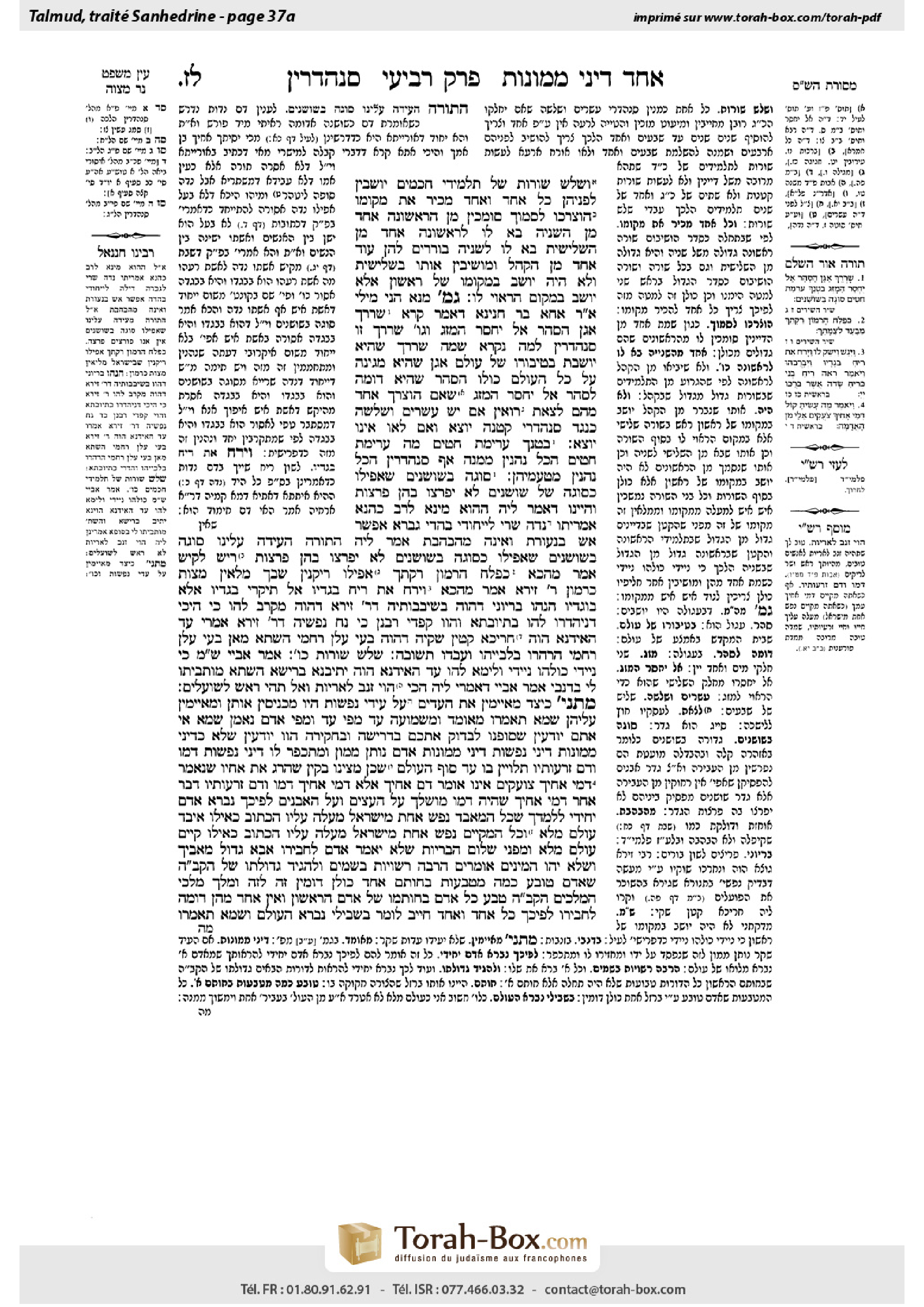
Sanhedrin 37a: Talmud study for Daf Yomi
Daf Yomi is the daily study of one Talmud folio. Explore 37 tractates with scans, Hebrew text, Sefaria English and AI-generated French translations where annotated.
Passage selection and English or AI-generated French translation are available where the scan has annotations. Daf Study is independent of Torah-Box and Sefaria.
Browse Sanhedrin · סנהדרין · All tractatesSanhedrin 37a text and translations
This page of Sanhedrin includes the Aramaic text, an English translation and an AI-generated French translation, alongside the scan above.
סנהדרין ל״ז א · Aramaic and Hebrew text
וְשָׁלֹשׁ שׁוּרוֹת שֶׁל תַּלְמִידֵי חֲכָמִים יוֹשְׁבִין לִפְנֵיהֶן, כׇּל אֶחָד וְאֶחָד מַכִּיר אֶת מְקוֹמוֹ. הוּצְרְכוּ לִסְמוֹךְ – סוֹמְכִין מִן הָרִאשׁוֹנָה. אֶחָד מִן הַשְּׁנִיָּה בָּא לוֹ לָרִאשׁוֹנָה, אֶחָד מִן הַשְּׁלִישִׁית בָּא לוֹ לַשְּׁנִיָּה. בּוֹרְרִים לָהֶן עוֹד אֶחָד מִן הַקָּהָל וּמוֹשִׁיבִין אוֹתוֹ בַּשְּׁלִישִׁית. וְלֹא הָיָה יוֹשֵׁב בִּמְקוֹמוֹ שֶׁל רִאשׁוֹן, אֶלָּא יוֹשֵׁב בְּמָקוֹם הָרָאוּי לוֹ.
גְּמָ׳ מְנָא הָנֵי מִילֵּי? אָמַר רַבִּי אַחָא בַּר חֲנִינָא: דְּאָמַר קְרָא ״שׇׁרְרֵךְ אַגַּן הַסַּהַר אַל יֶחְסַר הַמָּזֶג וְגוֹ׳״.
״שׇׁרְרֵךְ״ – זוֹ סַנְהֶדְרִין. לָמָּה נִקְרָא שְׁמָהּ ״שׇׁרְרֵךְ״? שֶׁהִיא יוֹשֶׁבֶת בְּטִיבּוּרוֹ שֶׁל עוֹלָם. ״אַגַּן״ – שֶׁהִיא מְגִינָּה עַל כׇּל הָעוֹלָם כּוּלּוֹ. ״הַסַּהַר״ – שֶׁהִיא דּוֹמָה לַסַּהַר.
״אַל יֶחְסַר הַמָּזֶג״ – שֶׁאִם הוּצְרַךְ אֶחָד מֵהֶם לָצֵאת, רוֹאִין: אִם יֵשׁ עֶשְׂרִים וּשְׁלֹשָׁה, כְּנֶגֶד סַנְהֶדְרִי קְטַנָּה – יוֹצֵא, וְאִם לָאו – אֵינוֹ יוֹצֵא.
״בִּטְנְךָ עֲרֵמַת חִטִּים״ – מָה עֲרֵימַת חִטִּים הַכֹּל נֶהֱנִין מִמֶּנָּה, אַף סַנְהֶדְרִין הַכֹּל נֶהֱנִין מִטַּעֲמֵיהֶן. ״סוּגָה בַּשּׁוֹשַׁנִּים״ – שֶׁאֲפִילּוּ כְּסוּגָה שֶׁל שׁוֹשַׁנִּים לֹא יִפְרְצוּ בָּהֶן פְּרָצוֹת.
וְהַיְינוּ דַּאֲמַר לֵיהּ הָהוּא מִינָא לְרַב כָּהֲנָא: אָמְרִיתוּ נִדָּה שְׁרֵי לְיַיחוֹדֵי בַּהֲדֵי גַּבְרָא. אֶפְשָׁר אֵשׁ בִּנְעוֹרֶת וְאֵינָהּ מְהַבְהֶבֶת? אֲמַר לֵיהּ: הַתּוֹרָה הֵעִידָה עָלֵינוּ ״סוּגָה בַּשּׁוֹשַׁנִּים״, שֶׁאֲפִילּוּ כְּסוּגָה בַּשּׁוֹשַׁנִּים לֹא יִפְרְצוּ בָּהֶן פְּרָצוֹת.
רֵישׁ לָקִישׁ אָמַר: מֵהָכָא, ״כְּפֶלַח הָרִמּוֹן רַקָּתֵךְ״ – אֲפִילּוּ רֵיקָנִין שֶׁבָּךְ מְלֵאִין מִצְוֹת כְּרִמּוֹן. רַבִּי זֵירָא אָמַר: מֵהָכָא, ״וַיָּרַח אֶת רֵיחַ בְּגָדָיו״. אַל תִּיקְרֵי ״בְּגָדָיו״ אֶלָּא ״בּוֹגְדָיו״.
הָנְהוּ בִּרְיוֹנֵי דַּהֲווֹ בְּשִׁיבָבוּתֵיהּ דְּרַבִּי זֵירָא, דַּהֲוָה מְקָרֵב לְהוּ כִּי הֵיכִי דְּנֶיהְדְּרוּ לְהוּ בִּתְיוּבְתָּא, וַהֲווֹ קָפְדִי רַבָּנַן. כִּי נָח נַפְשֵׁיהּ דְּרַבִּי זֵירָא, אָמְרִי: עַד הָאִידָּנָא הֲוָה חֲרִיכָא קַטִּין שָׁקֵיהּ דַּהֲוָה בָּעֵי עֲלַן רַחֲמֵי, הַשְׁתָּא מַאן בָּעֵי עֲלַן רַחֲמֵי? הַרְהֲרוּ בְּלִבַּיְיהוּ וַעֲבַדוּ תְּשׁוּבָה.
שָׁלֹשׁ שׁוּרוֹת כּוּ׳. אָמַר אַבָּיֵי: שְׁמַע מִינַּהּ כִּי נָיְידִי, כּוּלְּהוּ נָיְידִי. וְלֵימָא לְהוּ: עַד הָאִידָּנָא הֲוָה יָתֵיבְנָא בְּרֵישָׁא, הַשְׁתָּא מוֹתְבִיתוּ לִי בְּדַנְבֵי? אָמַר אַבָּיֵי: דְּאָמְרִי לֵיהּ הָכִי, ״הֱוֵי זָנָב לָאֲרָיוֹת וְאַל תְּהִי רֹאשׁ לַשּׁוּעָלִים״.
מַתְנִי׳ כֵּיצַד מְאַיְּימִין אֶת הָעֵדִים עַל עֵידֵי נְפָשׁוֹת? הָיוּ מַכְנִיסִין אוֹתָן וּמְאַיְּימִין עֲלֵיהֶן: שֶׁמָּא תֹּאמְרוּ מֵאוֹמֶד וּמִשְּׁמוּעָה, עֵד מִפִּי עֵד וּמִפִּי אָדָם נֶאֱמָן, שֶׁמָּא אִי אַתֶּם יוֹדְעִין שֶׁסּוֹפֵנוּ לִבְדּוֹק אֶתְכֶם בִּדְרִישָׁה וּבַחֲקִירָה.
הֱווּ יוֹדְעִין, שֶׁלֹּא כְּדִינֵי מָמוֹנוֹת דִּינֵי נְפָשׁוֹת. דִּינֵי מָמוֹנוֹת – אָדָם נוֹתֵן מָמוֹן וּמִתְכַּפֵּר לוֹ. דִּינֵי נְפָשׁוֹת – דָּמוֹ וְדַם זַרְעִיּוֹתָיו תְּלוּיִין בּוֹ עַד סוֹף הָעוֹלָם.
שֶׁכֵּן מָצִינוּ בְּקַיִן שֶׁהָרַג אֶת אָחִיו, שֶׁנֶּאֱמַר: ״דְּמֵי אָחִיךָ צֹעֲקִים״. אֵינוֹ אוֹמֵר ״דַּם אָחִיךָ״ אֶלָּא ״דְּמֵי אָחִיךָ״ – דָּמוֹ וְדַם זַרְעִיּוֹתָיו. דָּבָר אַחֵר: ״דְּמֵי אָחִיךָ״ – שֶׁהָיָה דָּמוֹ מוּשְׁלָךְ עַל הָעֵצִים וְעַל הָאֲבָנִים.
לְפִיכָךְ נִבְרָא אָדָם יְחִידִי, לְלַמֶּדְךָ שֶׁכׇּל הַמְאַבֵּד נֶפֶשׁ אַחַת מִיִּשְׂרָאֵל, מַעֲלֶה עָלָיו הַכָּתוּב כְּאִילּוּ אִיבֵּד עוֹלָם מָלֵא. וְכׇל הַמְקַיֵּים נֶפֶשׁ אַחַת מִיִּשְׂרָאֵל, מַעֲלֶה עָלָיו הַכָּתוּב כְּאִילּוּ קִיֵּים עוֹלָם מָלֵא.
וּמִפְּנֵי שְׁלוֹם הַבְּרִיּוֹת, שֶׁלֹּא יֹאמַר אָדָם לַחֲבֵירוֹ: ״אַבָּא גָּדוֹל מֵאָבִיךָ״, וְשֶׁלֹּא יְהוּ הַמִּינִים אוֹמְרִים: ״הַרְבֵּה רְשׁוּיוֹת בַּשָּׁמַיִם״.
וּלְהַגִּיד גְּדוּלָּתוֹ שֶׁל הַקָּדוֹשׁ בָּרוּךְ הוּא, שֶׁאָדָם טוֹבֵעַ כַּמָּה מַטְבְּעוֹת בְּחוֹתָם אֶחָד – כּוּלָּן דּוֹמִין זֶה לָזֶה, וּמֶלֶךְ מַלְכֵי הַמְּלָכִים הַקָּדוֹשׁ בָּרוּךְ הוּא טָבַע כׇּל אָדָם בְּחוֹתָמוֹ שֶׁל אָדָם הָרִאשׁוֹן, וְאֵין אֶחָד מֵהֶן דּוֹמֶה לַחֲבֵירוֹ. לְפִיכָךְ כָּל אֶחָד וְאֶחָד חַיָּיב לוֹמַר: בִּשְׁבִילִי נִבְרָא הָעוֹלָם.
וְשֶׁמָּא תֹּאמְרוּ:
Sanhedrin 37a · English translation
And three rows of Torah scholars sit before the judges, and each and every one among those sitting recognizes his place, i.e., they are seated in accordance with their stature. When the court must ordain an additional judge, e.g., if a judge dies during the proceedings or in the case of a court without a decisive majority (see 40a), the court ordains the greatest Torah scholar from the first row. As a seat in the first row is now vacant, one Torah scholar from the second row comes to the first row, and one Torah scholar from the third row comes to the second row, and the court selects another Torah scholar from among the assembled and they seat him in the third row. And this Torah scholar who moves from the second row to the first row would not sit in the place of the first Torah scholar, who joined the court, rather, he would sit in the place appropriate for him, i.e., at the end of that row, in accordance with his stature.
GEMARA: The mishna teaches that the Sanhedrin would sit in a semicircle. The Gemara asks: From where are these matters derived? Rabbi Aḥa bar Ḥanina says: As the verse states: “Your navel is like a round goblet, let no mingled wine be wanting; your belly is like a heap of wheat set about with lilies” (Song of Songs 7:3).
This verse is interpreted as referring to the members of the Sanhedrin, who sit in a semicircle. “Your navel”; this is an allusion to the Sanhedrin. And why is it called by way of allusion “your navel”? It is because it sits in the navel of the world, in the Temple. “Goblet [aggan]”; this teaches that the Sanhedrin protects [meginna] the entire world with its merit. “Round [hassahar]”; this teaches that the Sanhedrin is similar to the moon [sahar]. The court sits in a semicircle, like the shape of the moon.
“Let no mingled wine be wanting”; this compares the Sanhedrin to wine mixed with water, which typically involved mixing two parts water with one part wine. This teaches that if one member of the Great Sanhedrin needed to leave, they see: If there are still present in the Chamber of Hewn Stone twenty-three members, i.e., a third of the judges, corresponding to the number of a lesser Sanhedrin, he may leave, but if not, he may not leave.
The phrase “your belly is like a heap of wheat” teaches that just as with regard to a heap of wheat, all derive benefit from it, so too, with regard to the Sanhedrin, all derive benefit from their explanations of the Torah. The phrase “set about with lilies” is said in praise of the Jewish people, as they do not breach even a fence made of lilies, since the Jewish people observe both Torah law as well as rabbinic ordinances and decrees.
And this is like an incident involving Rav Kahana, as a certain heretic said to Rav Kahana: You say that it is permitted for a menstruating woman to seclude herself with a man, i.e., her husband. Is it possible to set fire to chips of kindling and not have them blaze and burn? How can the couple be relied upon not to engage in sexual intercourse? Rav Kahana said to him: The Torah testifies concerning us that we are “set about with lilies,” as the Jewish people do not breach even a fence made of lilies.
Reish Lakish says that the source to rely on them not to transgress is from here: “Your temples [rakkatekh] are like a pomegranate split open” (Song of Songs 6:7), which teaches that even the empty people [reikanin] among you are as full of mitzvot as the pomegranate is full of seeds. Rabbi Zeira says that the source is from here: The verse states concerning the occasion when Isaac blessed Jacob: “And he smelled the smell of his garments, and blessed him, and said: See, the smell of my son is as the smell of a field that the Lord has blessed” (Genesis 27:27). Do not read “his garments [begadav]”; rather, read: His traitors [bogedav], meaning that even traitors and sinners among the Jewish people have qualities “as the smell of a field that the Lord has blessed.”
The Gemara relates: There were certain hooligans [biryonei] who were living in the neighborhood of Rabbi Zeira. He brought them close, i.e., treated them with friendship, in order to cause them to repent of their sins, but the other Sages disapproved of his actions. When Rabbi Zeira died, those hooligans said: Until now, there was the short one with singed legs, i.e., Rabbi Zeira, who would pray for compassion for us. Who will pray for compassion for us now? They thought about this in their hearts and repented. Ultimately, Rabbi Zeira’s actions were proven correct, as they repented.
§ The mishna teaches that there are three rows of Torah scholars who sit before the court, and if one of the Torah scholars from the first row is elevated to a place on the court, the Torah scholar in the first position of the second row moves to the final position of the first row. Abaye says: Learn from the mishna that when they move, i.e., when the Torah scholars need to move as a result of one of them being elevated to the court, they all move. The Gemara inquires: But let the one being moved from the first position of the second row to the last position of the first row say to the court: Until now I was sitting at the head of the row, but now you are seating me at the tail, i.e., the end, of a row. Abaye says in explanation: That is not a valid claim, as the court can say this to him: Be a tail to the lions and do not be a head to the foxes (Avot 4:15), meaning that it is preferable to be the least among great people than the greatest among lesser people.
MISHNA: How does the court intimidate the witnesses in giving testimony for cases of capital law? They would bring the witnesses in and intimidate them by saying to them: Perhaps what you say in your testimony is based on conjecture, or perhaps it is based on a rumor, perhaps it is testimony based on hearsay, e.g., you heard a witness testify to this in a different court, or perhaps it is based on the statement of a trusted person. Perhaps you do not know that ultimately we examine you with inquiry and interrogation, and if you are lying, your lie will be discovered.
The court tells them: You should know that cases of capital law are not like cases of monetary law. In cases of monetary law, a person who testifies falsely, causing money to be given to the wrong party, can give the money to the proper owner and his sin is atoned for. In cases of capital law, if one testifies falsely, the blood of the accused and the blood of his offspring that he did not merit to produce are ascribed to the witness’s testimony until eternity.
The proof for this is as we found with Cain, who killed his brother, as it is stated concerning him: “The voice of your brother’s blood [demei] cries out to Me from the ground” (Genesis 4:10). The verse does not state: Your brother’s blood [dam], in the singular, but rather: “Your brother’s blood [demei],” in the plural. This serves to teach that the loss of both his brother’s blood and the blood of his brother’s offspring are ascribed to Cain. The mishna notes: Alternatively, the phrase “your brother’s blood [demei],” written in the plural, teaches that his blood was not gathered in one place but was splattered on the trees and on the stones.
The court tells the witnesses: Therefore, Adam the first man was created alone, to teach you that with regard to anyone who destroys one soul from the Jewish people, i.e., kills one Jew, the verse ascribes him blame as if he destroyed an entire world, as Adam was one person, from whom the population of an entire world came forth. And conversely, anyone who sustains one soul from the Jewish people, the verse ascribes him credit as if he sustained an entire world.
The mishna cites another reason Adam the first man was created alone: And this was done due to the importance of maintaining peace among people, so that one person will not say to another: My father, i.e., progenitor, is greater than your father. And it was also so that the heretics who believe in multiple gods will not say: There are many authorities in Heaven, and each created a different person.
And this serves to tell of the greatness of the Holy One, Blessed be He, as when a person stamps several coins with one seal, they are all similar to each other. But the supreme King of kings, the Holy One, Blessed be He, stamped all people with the seal of Adam the first man, as all of them are his offspring, and not one of them is similar to another. Therefore, since all humanity descends from one person, each and every person is obligated to say: The world was created for me, as one person can be the source of all humanity, and recognize the significance of his actions.
The court says to the witnesses: And perhaps you will say:
Sanhedrin 37a · Traduction française (IA)
Trois rangées de sages de la Torah siègent devant les juges, et chacun de ceux qui y siègent connaît sa place, c’est-à-dire qu’ils sont installés selon leur rang. Lorsque le tribunal doit nommer un juge supplémentaire, par exemple si un juge meurt au cours de la procédure ou si le tribunal ne dispose pas d’une majorité décisive (voir 40a), il nomme le plus grand sage de la Torah de la première rangée. Comme un siège de la première rangée est désormais vacant, un sage de la Torah de la deuxième rangée passe à la première rangée, et un sage de la Torah de la troisième rangée passe à la deuxième rangée ; le tribunal choisit alors un autre sage de la Torah parmi les personnes assemblées et l’installe dans la troisième rangée. Le sage de la Torah qui passe de la deuxième rangée à la première ne s’assied pas à la place du premier sage de la Torah, qui a rejoint le tribunal ; il s’assied plutôt à la place qui lui convient, c’est-à-dire à la fin de cette rangée, selon son rang.
GUEMARA : La Michna enseigne que le Sanhédrin siégeait en demi-cercle. La Guemara demande : D’où déduit-on cela ? Rabbi Aḥa bar Ḥanina dit : Le verset dit : « Ton nombril est comme une coupe ronde, où le vin mêlé ne manque pas ; ton ventre est comme un tas de blé entouré de lis » (Cantique des Cantiques 7, 3).
Ce verset est interprété comme faisant référence aux membres du Sanhédrin, qui siègent en demi-cercle. « Ton nombril » : c’est une allusion au Sanhédrin. Et pourquoi est-il désigné par l’allusion « ton nombril » ? Parce qu’il siège au nombril du monde, dans le Temple. « Coupe [aggan] » : cela enseigne que le Sanhédrin protège [meginna] le monde entier par son mérite. « Ronde [hassahar] » : cela enseigne que le Sanhédrin ressemble à la lune [sahar]. Le tribunal siège en demi-cercle, à l’image de la forme de la lune.
« Où le vin mêlé ne manque pas » : cette expression compare le Sanhédrin à du vin coupé d’eau, ce qui consistait généralement à mélanger deux parts d’eau à une part de vin. Cela enseigne que si un membre du Grand Sanhédrin doit sortir, on vérifie s’il reste vingt-trois membres dans la Chambre de la pierre taillée, c’est-à-dire un tiers des juges, correspondant au nombre de juges d’un petit Sanhédrin ; si c’est le cas, il peut sortir, mais sinon, il ne le peut pas.
L’expression « ton ventre est comme un tas de blé » enseigne que, de même que tous tirent profit d’un tas de blé, tous tirent également profit des explications de la Torah données par le Sanhédrin. L’expression « entouré de lis » est dite à la louange du peuple juif, car il ne transgresse même pas une clôture faite de lis : le peuple juif observe aussi bien la loi de la Torah que les dispositions et les décrets rabbiniques.
Cela ressemble à un épisode concernant Rav Kahana : un certain hérétique lui dit : « Vous dites qu’une femme en période de menstruation peut s’isoler avec un homme, c’est-à-dire son mari. Est-il possible d’allumer des copeaux de bois sans qu’ils s’embrasent et brûlent ? Comment peut-on compter sur le couple pour ne pas avoir de rapports sexuels ? » Rav Kahana lui répondit : « La Torah témoigne à notre sujet que nous sommes “entourés de lis”, car le peuple juif ne transgresse même pas une clôture faite de lis. »
Reish Lakish dit que la source permettant de compter sur eux pour ne pas transgresser se trouve ici : « Tes tempes [rakkatekh] sont comme une grenade fendue » (Cantique des Cantiques 6, 7). Cela enseigne que même les plus vides [reikanin] parmi vous sont aussi remplis de mitsvot que la grenade est remplie de grains. Rabbi Zeira dit que la source se trouve ici : le verset rapporte, à propos du moment où Isaac bénit Jacob : « Il sentit l’odeur de ses vêtements, le bénit et dit : Voici, l’odeur de mon fils est comme l’odeur d’un champ que l’Éternel a béni » (Genèse 27, 27). Ne lis pas « ses vêtements [begadav] », mais plutôt « ses traîtres [bogedav] », ce qui signifie que même les traîtres et les pécheurs du peuple juif ont des qualités « comme l’odeur d’un champ que l’Éternel a béni ».
La Guemara rapporte : Des voyous [biryonei] habitaient dans le voisinage de Rabbi Zeira. Il se rapprocha d’eux, c’est-à-dire qu’il les traita en amis, afin de les amener à se repentir de leurs péchés, mais les autres Sages désapprouvèrent son comportement. Lorsque Rabbi Zeira mourut, ces voyous dirent : « Jusqu’à présent, il y avait le petit homme aux jambes brûlées, c’est-à-dire Rabbi Zeira, qui priait pour que la miséricorde nous soit accordée. Qui priera désormais pour que la miséricorde nous soit accordée ? » Ils y réfléchirent intérieurement et se repentirent. En fin de compte, les actes de Rabbi Zeira se révélèrent justes, puisqu’ils se repentirent.
§ La Michna enseigne que trois rangées de sages de la Torah siègent devant le tribunal et que, si l’un des sages de la première rangée est élevé à un siège au tribunal, le sage qui occupe la première place de la deuxième rangée passe à la dernière place de la première rangée. Abaye dit : Déduis de la Michna que, lorsqu’ils se déplacent, c’est-à-dire lorsque les sages de la Torah doivent bouger parce que l’un d’eux a été élevé au tribunal, ils se déplacent tous. La Guemara demande : Mais celui qui passe de la première place de la deuxième rangée à la dernière place de la première rangée pourrait dire au tribunal : « Jusqu’à présent, je siégeais en tête de rangée, mais maintenant vous me placez à la queue, c’est-à-dire à la fin, d’une rangée. » Abaye explique : Cette revendication n’est pas valable, car le tribunal peut lui dire : « Sois une queue pour les lions plutôt qu’une tête pour les renards » (Avot 4, 15), ce qui signifie qu’il vaut mieux être le moindre parmi les grands que le plus grand parmi les petits.
MICHNA : Comment le tribunal intimide-t-il les témoins appelés à témoigner dans les affaires de droit pénal ? Il les faisait entrer et les intimidait en leur disant : « Peut-être ce que vous dites dans votre témoignage repose-t-il sur une supposition, ou peut-être sur une rumeur ; peut-être s’agit-il d’un témoignage par ouï-dire, par exemple si vous avez entendu un témoin déposer à ce sujet devant un autre tribunal ; ou peut-être cela repose-t-il sur la parole d’une personne digne de confiance. Peut-être ignorez-vous qu’en fin de compte nous vous soumettrons à des questions et à des interrogatoires, et que, si vous mentez, votre mensonge sera découvert. »
Le tribunal leur dit : « Vous devez savoir que les affaires de droit pénal ne sont pas comme les affaires pécuniaires. Dans les affaires pécuniaires, celui qui témoigne faussement et provoque la remise d’argent à la mauvaise partie peut restituer l’argent à son propriétaire légitime, et son péché est expié. Dans les affaires de droit pénal, si quelqu’un témoigne faussement, le sang de l’accusé et le sang de sa descendance qu’il n’a pas eu le mérite d’engendrer sont imputés au témoignage du témoin pour l’éternité. »
La preuve en est ce que nous trouvons à propos de Caïn, qui tua son frère. À son sujet, il est dit : « La voix du sang [demei] de ton frère crie vers moi depuis le sol » (Genèse 4, 10). Le verset ne dit pas « le sang [dam] de ton frère », au singulier, mais « le sang [demei] de ton frère », au pluriel. Cela enseigne que la perte du sang de son frère ainsi que celle du sang de la descendance de son frère sont imputées à Caïn. La Michna ajoute une autre explication : l’expression « le sang [demei] de ton frère », écrite au pluriel, enseigne que son sang n’a pas été recueilli en un seul endroit, mais éclaboussé sur les arbres et les pierres.
Le tribunal dit aux témoins : « C’est pourquoi Adam, le premier homme, a été créé seul, afin de vous enseigner que quiconque détruit une seule âme du peuple juif, c’est-à-dire tue un Juif, se voit imputer par le verset la faute comme s’il avait détruit un monde entier, puisque Adam était un seul homme dont est issue la population d’un monde entier. Et, inversement, quiconque préserve une seule âme du peuple juif se voit attribuer par le verset le mérite comme s’il avait préservé un monde entier. »
La Michna donne une autre raison pour laquelle Adam, le premier homme, a été créé seul : cela fut fait pour préserver la paix entre les hommes, afin que personne ne dise à un autre : « Mon père, c’est-à-dire mon ancêtre, est plus grand que le tien. » Ce fut également afin que les hérétiques qui croient en plusieurs dieux ne disent pas : « Il y a plusieurs autorités dans les cieux, et chacune a créé une personne différente. »
Cela sert aussi à faire connaître la grandeur du Saint, béni soit-Il : lorsqu’un homme frappe plusieurs pièces avec un même sceau, elles se ressemblent toutes. Mais le Roi suprême des rois, le Saint, béni soit-Il, a frappé tous les hommes avec le sceau d’Adam, le premier homme, puisqu’ils sont tous ses descendants, et pourtant aucun ne ressemble à un autre. Ainsi, puisque toute l’humanité descend d’un seul homme, chaque personne est tenue de dire : « Le monde a été créé pour moi », car une seule personne peut être à l’origine de toute l’humanité et reconnaître l’importance de ses actes.
Le tribunal dit aux témoins : « Et peut-être direz-vous : »
Traduction française générée par IA à partir de l’édition anglaise de Sefaria. Vérifie toujours un passage avec le texte source.
Text from Sefaria: William Davidson Edition - Vocalized Aramaic (CC BY NC); William Davidson Edition - English (CC BY NC).