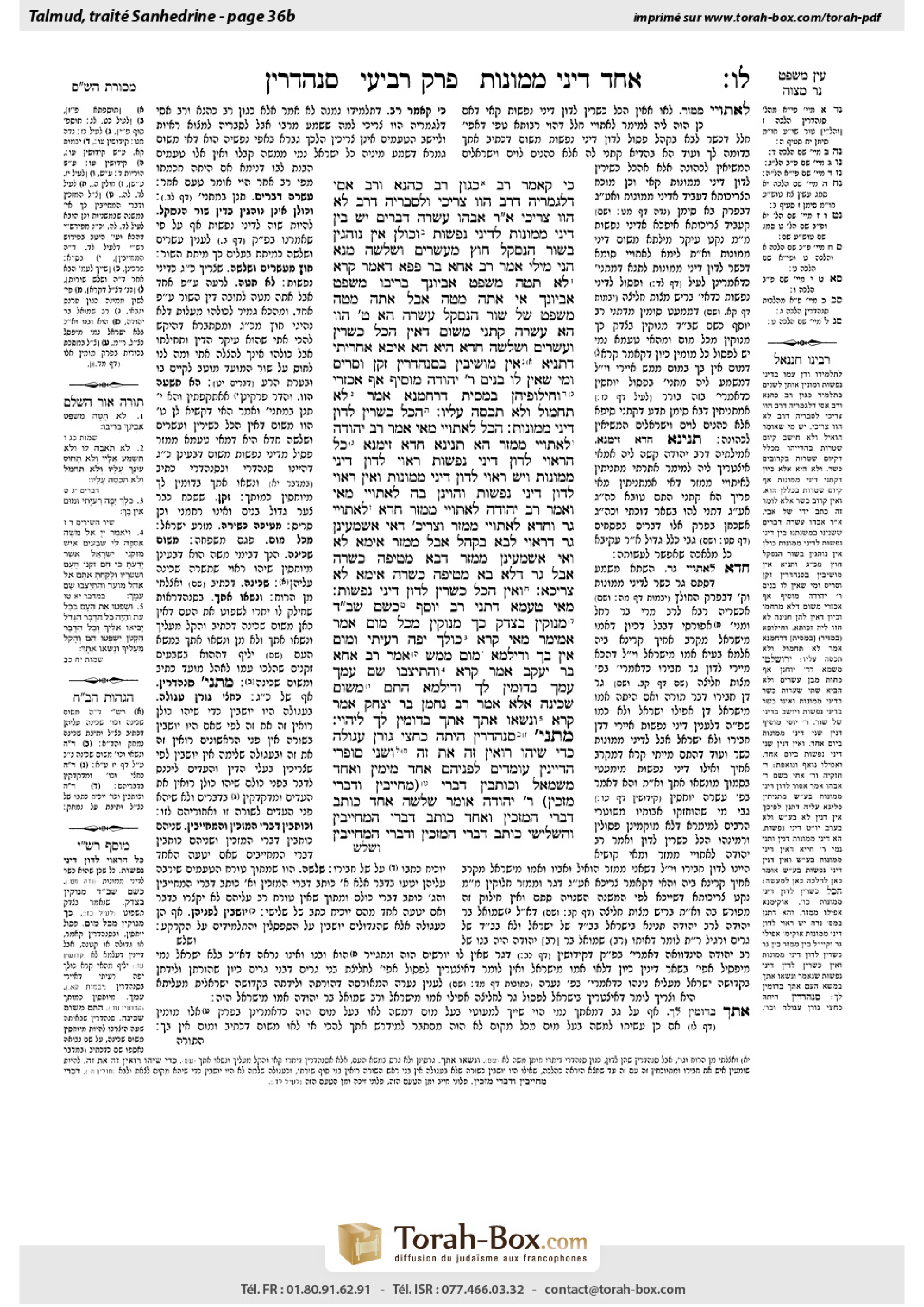
Sanhedrin 36b: Talmud study for Daf Yomi
Daf Yomi is the daily study of one Talmud folio. Explore 37 tractates with scans, Hebrew text, Sefaria English and AI-generated French translations where annotated.
Passage selection and English or AI-generated French translation are available where the scan has annotations. Daf Study is independent of Torah-Box and Sefaria.
Browse Sanhedrin · סנהדרין · All tractatesSanhedrin 36b text and translations
This page of Sanhedrin includes the Aramaic text, an English translation and an AI-generated French translation, alongside the scan above.
סנהדרין ל״ו ב · Aramaic and Hebrew text
כִּי קָאָמַר רַב, כְּגוֹן רַב כָּהֲנָא וְרַב אַסִּי, דְּלִגְמָרֵיהּ דְּרַב הֲווֹ צְרִיכִי, וְלִסְבָרֵיהּ דְּרַב לָא הֲווֹ צְרִיכִי.
אָמַר רַבִּי אֲבָהוּ: עֲשָׂרָה דְּבָרִים יֵשׁ בֵּין דִּינֵי מָמוֹנוֹת לְדִינֵי נְפָשׁוֹת, וְכוּלָּן אֵין נוֹהֲגִין בְּשׁוֹר הַנִּסְקָל, חוּץ מֵעֶשְׂרִים וּשְׁלֹשָׁה.
מְנָא הָנֵי מִילֵּי? אָמַר רַב אַחָא בַּר פָּפָּא: דְּאָמַר קְרָא ״לֹא תַטֶּה מִשְׁפַּט אֶבְיֹנְךָ בְּרִיבוֹ״. מִשְׁפַּט אֶבְיוֹנְךָ אִי אַתָּה מַטֶּה, אֲבָל אַתָּה מַטֶּה מִשְׁפָּט שֶׁל שׁוֹר הַנִּסְקָל.
עֲשָׂרָה? הָא תִּשְׁעָה הָווּ! הָא עֲשָׂרָה קָתָנֵי! מִשּׁוּם דְּאֵין הַכֹּל כְּשֵׁרִין, וְעֶשְׂרִים וּשְׁלֹשָׁה – חֲדָא הִיא.
הָא אִיכָּא אַחֲרִיתִי, דְּתַנְיָא: אֵין מוֹשִׁיבִין בְּסַנְהֶדְרִין זָקֵן וְסָרִיס וּמִי שֶׁאֵין לוֹ בָּנִים. רַבִּי יְהוּדָה מוֹסִיף: אַף אַכְזָרִי. וְחִילּוּפֵיהֶן בְּמֵסִית, דְּרַחֲמָנָא אָמַר: ״לֹא תַחְמֹל וְלֹא תְכַסֶּה עָלָיו״.
הַכֹּל כְּשֵׁרִין לָדוּן דִּינֵי מָמוֹנוֹת. הַכֹּל לְאֵתוֹיֵי מַאי? אָמַר רַב יְהוּדָה: לְאֵתוֹיֵי מַמְזֵר.
הָא תְּנֵינָא חֲדָא זִימְנָא: כׇּל הָרָאוּי לָדוּן דִּינֵי נְפָשׁוֹת רָאוּי לָדוּן דִּינֵי מָמוֹנוֹת, וְיֵשׁ רָאוּי לָדוּן דִּינֵי מָמוֹנוֹת וְאֵין רָאוּי לָדוּן דִּינֵי נְפָשׁוֹת. וְהָוֵינַן בַּהּ: לְאֵתוֹיֵי מַאי? וְאָמַר רַב יְהוּדָה: לְאֵתוֹיֵי מַמְזֵר. חֲדָא לְאֵתוֹיֵי גֵּר, וַחֲדָא לְאֵתוֹיֵי מַמְזֵר.
וּצְרִיכָא, דְּאִי אַשְׁמְעִינַן גֵּר – דְּרָאוּי לָבֹא בַּקָּהָל, אֲבָל מַמְזֵר אֵימָא לָא. וְאִי אַשְׁמְעִינַן מַמְזֵר – דְּבָא מִטִּיפָּה כְּשֵׁרָה, אֲבָל גֵּר דְּלֹא בָּא מִטִּיפָּה כְּשֵׁרָה אֵימָא לָא. צְרִיכָא.
וְאֵין הַכֹּל כְּשֵׁרִין לָדוּן דִּינֵי נְפָשׁוֹת. מַאי טַעְמָא? דְּתָנֵי רַב יוֹסֵף: כְּשֵׁם שֶׁבֵּית דִּין מְנוּקִּין בְּצֶדֶק, כָּךְ מְנוּקִּין מִכׇּל מוּם. אָמַר אַמֵּימָר, מַאי קְרָא: ״כֻּלָּךְ יָפָה רַעְיָתִי וּמוּם אֵין בָּךְ״.
וְדִילְמָא מוּם מַמָּשׁ? אָמַר רַב אַחָא בַּר יַעֲקֹב: אָמַר קְרָא, ״וְהִתְיַצְּבוּ שָׁם עִמָּךְ״ – עִמָּךְ בְּדוֹמִין לָךְ.
וְדִילְמָא הָתָם מִשּׁוּם שְׁכִינָה? אֶלָּא, אָמַר רַב נַחְמָן בַּר יִצְחָק: אָמַר קְרָא ״וְנָשְׂאוּ אִתָּךְ״ – אִתָּךְ בְּדוֹמִין לָךְ לֶיהֱוֵי.
מַתְנִי׳ סַנְהֶדְרִין הָיְתָה כַּחֲצִי גּוֹרֶן עֲגוּלָּה, כְּדֵי שֶׁיְּהוּ רוֹאִין זֶה אֶת זֶה. וּשְׁנֵי סוֹפְרֵי הַדַּיָּינִין עוֹמְדִים לִפְנֵיהֶם, אֶחָד מִיָּמִין וְאֶחָד מִשְּׂמֹאל, וְכוֹתְבִין דִּבְרֵי מְחַיְּיבִין וְדִבְרֵי מְזַכִּין. רַבִּי יְהוּדָה אוֹמֵר: שְׁלֹשָׁה, אֶחָד כּוֹתֵב דִּבְרֵי הַמְזַכִּין, וְאֶחָד כּוֹתֵב דִּבְרֵי הַמְחַיְּיבִין, וְהַשְּׁלִישִׁי כּוֹתֵב דִּבְרֵי הַמְזַכִּין וְדִבְרֵי הַמְחַיְּיבִין.
Sanhedrin 36b · English translation
The Gemara answers: When Rav says his statement, he is referring to not every student, but only those such as Rav Kahana and Rav Asi, who needed to learn the halakhic traditions of Rav, but they did not need to learn the reasoning of Rav, as they were capable of conducting their own analysis.
Rabbi Abbahu says: There are ten ways in which cases of monetary law are different from cases of capital law, as was taught in the beginning of the chapter, and none of them is practiced with regard to a court hearing concerning an ox that is to be stoned, as it is treated as a case of monetary law, except for the requirement that the animal be judged by twenty-three judges, like in cases of capital law.
The Gemara asks: From where are these matters derived? Rav Aḥa bar Pappa says: As the verse states: “You shall not incline the judgment of your poor in his cause” (Exodus 23:6). He explains: You may not incline the judgment of, i.e., exert effort to find liable, your poor, but you may incline the judgment of an ox that is to be stoned. The reason for the procedural differences between cases of monetary law and cases of capital law is to render it more likely that one accused of a capital transgression will be acquitted. This is not a factor when judging the ox.
The Gemara asks: Are there really ten ways in which cases of monetary law are different from cases of capital law? There are only nine differences recorded in the mishna. The Gemara questions this: But the mishna teaches ten differences, not nine. The Gemara clarifies: Although there appear to be ten, there are in fact nine, because the halakha that not all are fit to judge cases of capital law and the halakha that twenty-three judges are required for cases of capital law are one. The reason not all are fit to judge cases of capital law is that the court of twenty-three is derived from the command to Moses: “And they shall bear the burden of the people with you” (Numbers 11:17), which indicates that only those “with you,” i.e., similar in lineage to Moses, can serve on that court (see 17a).
The Gemara answers: But there is another difference, as it is taught in a baraita (Tosefta 7:3): The court does not seat on the Sanhedrin a very old person or one who is castrated or one who has no children, as those who did not recently raise children may lack compassion. Rabbi Yehuda adds: Even a cruel person is not eligible. The Gemara comments: And the opposite of this is the halakha with regard to one who entices others to engage in idol worship, as the Merciful One states concerning him: “Neither shall you spare, neither shall you conceal him” (Deuteronomy 13:9).
§ The mishna teaches that all are fit to judge cases of monetary law. The Gemara asks: What is added by the mishna’s employing the expansive term all? Rav Yehuda says: It serves to include a child born from an incestuous or adulterous relationship [mamzer] in the category of those qualified to judge cases of monetary law.
The Gemara questions this explanation: But we already learn this halakha one time, as it is taught in a baraita: All who are fit to judge cases of capital law are fit to judge cases of monetary law, but there are those who are fit to judge cases of monetary law and are not fit to judge cases of capital law. And we discussed it: What is included in the expansive term all employed by the baraita? And Rav Yehuda says: It serves to include a mamzer. The Gemara responds: One of the two sources serves to include a convert, who is qualified to judge only in cases of monetary law, and one of the two sources serves to include a mamzer.
The Gemara comments: And both the mishna and baraita are necessary, as the halakha taught by one source cannot be derived from the halakha taught by the other source. As, if the tanna taught us the fitness to judge cases of monetary law only with regard to a convert, one could say that a convert is like a born Jew concerning this, since he is fit to enter into the congregation, i.e., marry a Jew of fit lineage, but with regard to a mamzer, who is not fit to enter into the congregation, say that he cannot serve as a judge. And if the tanna taught us the fitness to judge cases of monetary law only with regard to a mamzer, one could say that a mamzer is fit to judge, as he came from seed of unflawed lineage, but with regard to a convert, who does not come from seed of unflawed lineage, say that he cannot serve as a judge. Therefore, both sources are necessary.
§ The mishna teaches: But not all are fit to judge cases of capital law; the judges may be only priests, Levites, or Israelites who are of sufficiently fit lineage to marry their daughters to members of the priesthood. The Gemara asks: What is the reason for this? The Gemara explains: As Rav Yosef taught: Just as the court is clean in justice, so too, it is clean of any blemish, i.e., it does not include anyone of flawed lineage. Ameimar says: What is the verse from which it is derived? It states: “You are all fair, my love; and there is no blemish in you” (Song of Songs 4:7).
The Gemara asks: But perhaps you should say that this is referring to an actual blemish, and is teaching that one who has a physical blemish cannot be appointed to the Sanhedrin. Rav Aḥa bar Ya’akov says: It is not necessary to learn from this verse the halakha that one who has a physical blemish cannot be appointed to the Sanhedrin, as the verse states in connection with the transfer of the Divine Spirit from Moses to the Elders: “That they may stand there with you” (Numbers 11:16). The term “with you” is explained to mean: With similarity to you, teaching that the members of the Sanhedrin must be whole in body, like Moses.
The Gemara rejects this proof: But perhaps there, those who were with Moses had to be free of any blemish due to the Divine Presence, which was going to rest upon them, but this is not a requirement for judges to serve on the Sanhedrin. Rather, Rav Naḥman bar Yitzḥak says: The verse states: “So shall they make it easier for you and bear the burden with you” (Exodus 18:22). The term “with you” is explained to mean: They shall be similar to you, without blemish. This verse is referring to the appointment of regular judges, upon whom the Divine Presence does not rest, and teaches that all members of the Sanhedrin must be whole in body, and the verse from Song of Songs teaches that they must have unflawed lineage as well.
MISHNA: A Sanhedrin of twenty-three was arranged in the same layout as half of a circular threshing floor, in order that all the judges will see one another and the witnesses. And two judges’ scribes stand before the court, one on the right and one on the left, and they write the statements of those who find the accused liable and the statements of those who acquit the accused. Rabbi Yehuda says: There were three scribes. One writes only the statements of those who acquit the accused, one writes only the statements of those who find him liable, and the third writes both the statements of those who acquit the accused and the statements of those who find him liable, so that if there is uncertainty concerning the precise wording that one of the scribes writes, it can be compared to the words of the third scribe.
Sanhedrin 36b · Traduction française (IA)
La Guemara répond : Lorsque Rav énonce sa déclaration, il ne fait pas référence à tous les élèves, mais seulement à des hommes comme Rav Kahana et Rav Asi. Ceux-ci devaient apprendre les traditions halakhiques de Rav, mais n’avaient pas besoin d’apprendre son raisonnement, car ils étaient capables de mener leur propre analyse.
Rabbi Abbahou dit : Il y a dix différences entre les affaires de droit civil et les affaires de droit pénal, comme cela a été enseigné au début du chapitre. Aucune d’entre elles ne s’applique lorsqu’un tribunal statue sur un bœuf qui doit être lapidé, car cette affaire est traitée comme une affaire de droit civil, à l’exception de l’obligation de faire juger l’animal par vingt-trois juges, comme dans les affaires de droit pénal.
La Guemara demande : De quoi déduit-on ces règles ? Rav Aḥa bar Pappa dit : Le verset dit : « Tu ne feras pas fléchir le droit de ton pauvre dans son procès » (Exode 23:6). Il explique : Tu ne dois pas faire fléchir le droit de ton pauvre, c’est-à-dire déployer des efforts pour le déclarer coupable ; mais tu peux faire fléchir le droit d’un bœuf qui doit être lapidé. Les différences de procédure entre les affaires de droit civil et celles de droit pénal ont pour but de rendre plus probable l’acquittement de celui qui est accusé d’une transgression passible de la peine capitale. Ce facteur n’intervient pas lorsqu’on juge le bœuf.
La Guemara demande : Y a-t-il vraiment dix différences entre les affaires de droit civil et les affaires de droit pénal ? La Michna n’en consigne que neuf. La Guemara objecte : Pourtant, la Michna enseigne dix différences, et non neuf. La Guemara précise : Bien qu’il semble y en avoir dix, il n’y en a en réalité que neuf, car la halakha selon laquelle tous ne sont pas aptes à juger les affaires de droit pénal et celle selon laquelle ces affaires doivent être jugées par vingt-trois juges n’en font qu’une. Si tous ne sont pas aptes à juger les affaires de droit pénal, c’est parce que le tribunal de vingt-trois juges est déduit de l’ordre donné à Moïse : « Ils porteront avec toi la charge du peuple » (Nombres 11:17), ce qui indique que seuls ceux qui sont « avec toi », c’est-à-dire de lignée semblable à celle de Moïse, peuvent siéger dans ce tribunal (voir 17a).
La Guemara répond : Mais il existe une autre différence, comme l’enseigne une baraïta (Tossefta 7:3) : Le tribunal ne fait pas siéger au Sanhédrin un homme très âgé, un eunuque ou un homme sans enfants, car ceux qui n’ont pas récemment élevé d’enfants peuvent manquer de compassion. Rabbi Yehouda ajoute : Même un homme cruel n’est pas apte. La Guemara fait remarquer : La halakha est inverse dans le cas de celui qui incite autrui à pratiquer le culte des idoles, car le Miséricordieux dit à son sujet : « Tu ne l’épargneras pas et tu ne le cacheras pas » (Deutéronome 13:9).
§ La Michna enseigne que tous sont aptes à juger les affaires de droit civil. La Guemara demande : Qu’ajoute l’emploi par la Michna du terme inclusif « tous » ? Rav Yehouda dit : Il sert à inclure parmi ceux qui sont aptes à juger les affaires de droit civil un enfant né d’une relation incestueuse ou adultère [mamzer].
La Guemara met en doute cette explication : Pourtant, nous apprenons déjà cette halakha une première fois, puisqu’une baraïta enseigne : Tous ceux qui sont aptes à juger les affaires de droit pénal sont aptes à juger les affaires de droit civil, mais certains sont aptes à juger les affaires de droit civil sans être aptes à juger les affaires de droit pénal. Et nous avons discuté de cette baraïta : Qu’inclut le terme inclusif « tous » qu’elle emploie ? Rav Yehouda dit : Il sert à inclure un mamzer. La Guemara répond : L’une des deux sources sert à inclure un converti, qui n’est apte à juger que les affaires de droit civil, et l’autre sert à inclure un mamzer.
La Guemara fait remarquer : La Michna et la baraïta sont toutes deux nécessaires, car la halakha enseignée par l’une ne peut être déduite de celle enseignée par l’autre. En effet, si le tanna nous avait enseigné l’aptitude à juger les affaires de droit civil uniquement à propos d’un converti, on aurait pu dire qu’à cet égard le converti est comme un Juif de naissance, puisqu’il est apte à entrer dans l’assemblée, c’est-à-dire à épouser un Juif de lignée convenable ; mais, pour ce qui est d’un mamzer, qui n’est pas apte à entrer dans l’assemblée, on aurait pu dire qu’il ne peut pas exercer la fonction de juge. Et si le tanna nous avait enseigné l’aptitude à juger les affaires de droit civil uniquement à propos d’un mamzer, on aurait pu dire qu’un mamzer est apte à juger, puisqu’il est issu d’une lignée sans défaut ; mais, pour ce qui est d’un converti, qui n’est pas issu d’une lignée sans défaut, on aurait pu dire qu’il ne peut pas exercer la fonction de juge. Les deux sources sont donc nécessaires.
§ La Michna enseigne : Mais tous ne sont pas aptes à juger les affaires de droit pénal ; les juges ne peuvent être que des prêtres, des Lévites ou des Israélites dont la lignée est suffisamment convenable pour qu’ils puissent marier leurs filles à des membres de la prêtrise. La Guemara demande : Quelle en est la raison ? La Guemara explique : Rav Yossef a enseigné : De même que le tribunal est pur en matière de justice, il doit aussi être exempt de toute tare, c’est-à-dire ne compter personne de lignée défectueuse. Ameimar dit : Quel est le verset dont on le déduit ? Il est dit : « Tu es toute belle, mon aimée, et il n’y a en toi aucune tare » (Cantique des Cantiques 4:7).
La Guemara demande : Mais peut-être faut-il dire que cela fait référence à une tare physique réelle et enseigne qu’une personne présentant une tare physique ne peut pas être nommée au Sanhédrin. Rav Aḥa bar Yaakov dit : Il n’est pas nécessaire de déduire de ce verset qu’une personne présentant une tare physique ne peut pas être nommée au Sanhédrin, car le verset dit, au sujet du transfert de l’Esprit divin de Moïse aux Anciens : « Afin qu’ils se tiennent là avec toi » (Nombres 11:16). L’expression « avec toi » s’explique ainsi : semblables à toi ; elle enseigne que les membres du Sanhédrin doivent être sans défaut physique, comme Moïse.
La Guemara rejette cette preuve : Mais peut-être que, dans ce cas, ceux qui étaient avec Moïse devaient être exempts de toute tare parce que la Présence divine allait reposer sur eux, tandis que cela n’est pas exigé des juges qui siègent au Sanhédrin. Rav Naḥman bar Yitzḥak dit plutôt : Le verset dit : « Ainsi, ils allégeront ta charge et la porteront avec toi » (Exode 18:22). L’expression « avec toi » s’explique ainsi : ils doivent être semblables à toi, sans tare. Ce verset concerne la nomination de juges ordinaires, sur lesquels la Présence divine ne repose pas, et enseigne que tous les membres du Sanhédrin doivent être sans défaut physique ; le verset du Cantique des Cantiques enseigne qu’ils doivent aussi être de lignée sans défaut.
Michna : Un Sanhédrin de vingt-trois juges était disposé comme la moitié d’une aire de battage circulaire, afin que tous les juges puissent se voir les uns les autres ainsi que les témoins. Deux scribes du tribunal se tenaient devant lui, l’un à droite et l’autre à gauche, et ils consignaient les paroles de ceux qui déclaraient l’accusé coupable et celles de ceux qui l’acquittaient. Rabbi Yehouda dit : Il y avait trois scribes. L’un consignait uniquement les paroles de ceux qui acquittaient l’accusé, un autre consignait uniquement celles de ceux qui le déclaraient coupable, et le troisième consignait à la fois les paroles de ceux qui l’acquittaient et celles de ceux qui le déclaraient coupable, afin que, si l’on avait un doute sur la formulation exacte notée par l’un des scribes, on puisse la comparer aux paroles du troisième scribe.
Traduction française générée par IA à partir de l’édition anglaise de Sefaria. Vérifie toujours un passage avec le texte source.
Text from Sefaria: William Davidson Edition - Vocalized Aramaic (CC BY NC); William Davidson Edition - English (CC BY NC).