Sanhedrin 36a: Talmud study for Daf Yomi
Daf Yomi is the daily study of one Talmud folio. Explore 37 tractates with scans, Hebrew text, Sefaria English and AI-generated French translations where annotated.
Passage selection and English or AI-generated French translation are available where the scan has annotations. Daf Study is independent of Torah-Box and Sefaria.
Browse Sanhedrin · סנהדרין · All tractatesSanhedrin 36a text and translations
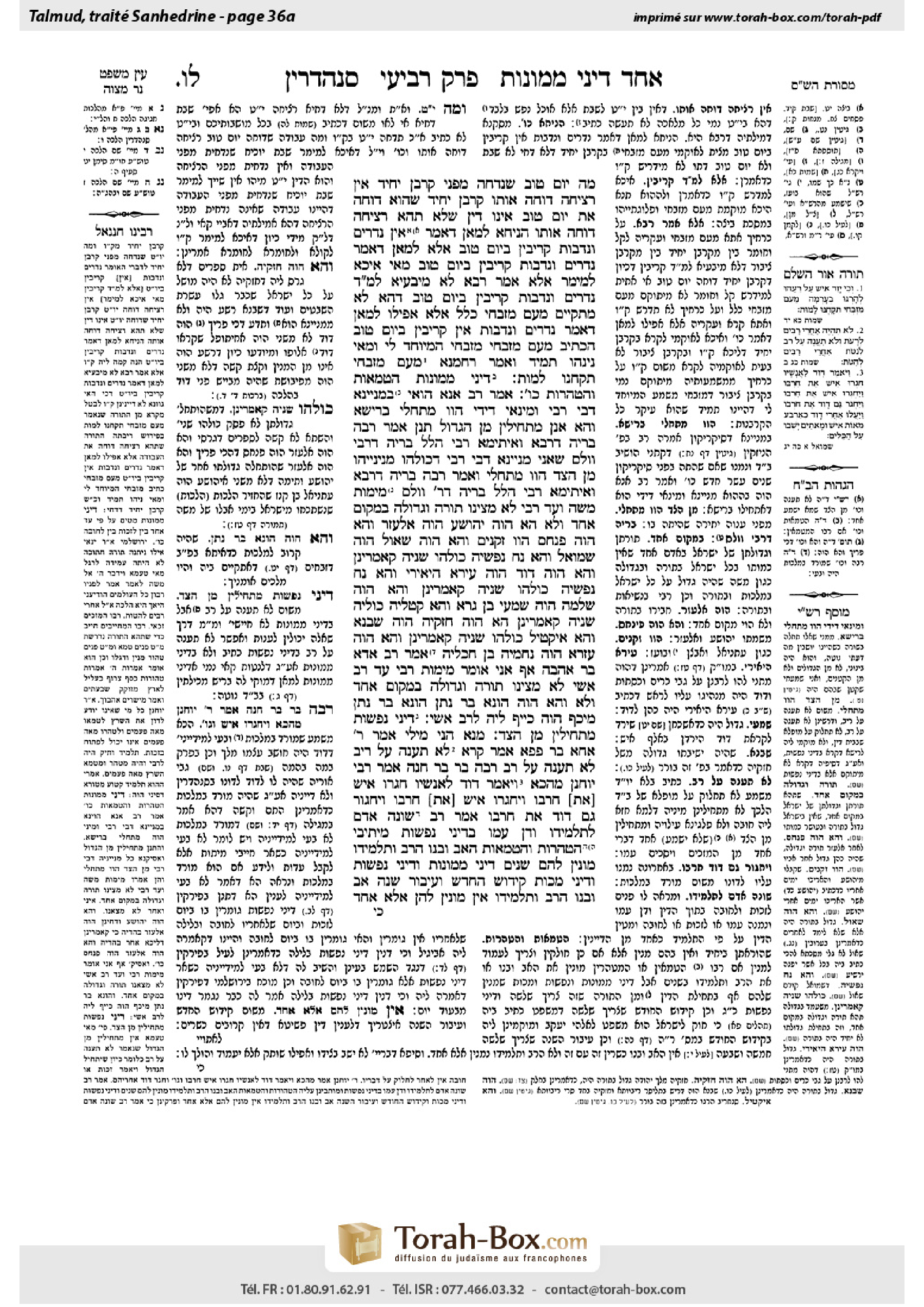
This page of Sanhedrin includes the Aramaic text, an English translation and an AI-generated French translation, alongside the scan above.
סנהדרין ל״ו א · Aramaic and Hebrew text
מָה יוֹם טוֹב שֶׁנִּדְחֶה מִפְּנֵי קׇרְבַּן יָחִיד, אֵין רְצִיחָה דּוֹחָה אוֹתוֹ. קׇרְבַּן יָחִיד שֶׁהוּא דּוֹחֶה אֶת יוֹם טוֹב, אֵינוֹ דִּין שֶׁלֹּא תְּהֵא רְצִיחָה דּוֹחָה אוֹתוֹ?
הָנִיחָא לְמַאן דְּאָמַר אֵין נְדָרִים וּנְדָבוֹת קְרֵיבִין בְּיוֹם טוֹב, אֶלָּא לְמַאן דְּאָמַר נְדָרִים וּנְדָבוֹת קְרֵיבִין בְּיוֹם טוֹב – מַאי אִיכָּא לְמֵימַר?
אֶלָּא אָמַר רָבָא: לָא מִיבַּעְיָא לְמַאן דְּאָמַר נְדָרִים וּנְדָבוֹת קְרֵיבִין בְּיוֹם טוֹב, דְּהָא לָא מִתְקַיֵּים ״מֵעִם מִזְבְּחִי״ כְּלָל.
אֶלָּא אֲפִילּוּ לְמַאן דְּאָמַר: נְדָרִים וּנְדָבוֹת אֵין קְרֵיבִין בְּיוֹם טוֹב, הָכְתִיב ״מֵעִם מִזְבְּחִי״ – מִזְבְּחִי הַמְיוּחָד לִי, וּמַאי נִינְהוּ? תָּמִיד. וְאָמַר רַחֲמָנָא: ״מֵעִם מִזְבְּחִי תִּקָּחֶנּוּ לָמוּת״.
דִּינֵי מָמוֹנוֹת, הַטְּמָאוֹת וְהַטְּהָרוֹת כּוּ׳. אָמַר רַב: אֲנָא הֲוַאי בְּמִנְיָנָא דְּבֵי רַבִּי, וּמִינַּאי דִּידִי הֲווֹ מַתְחֲלִי בְּרֵישָׁא. וְהָא אֲנַן ״מַתְחִילִין מִן הַגָּדוֹל״ תְּנַן!
אָמַר רַבָּה בְּרֵיהּ דְּרָבָא, וְאִיתֵּימָא רַבִּי הִלֵּל בְּרֵיהּ דְּרַבִּי וָולֶס: שָׁאנֵי מִנְיָינָא דְּבֵי רַבִּי, דְּכוּלְּהוּ מִנְיָנַיְיהוּ מִן הַצַּד הֲווֹ מַתְחֲלִי.
וְאָמַר רַבָּה בְּרֵיהּ דְּרָבָא, וְאִיתֵּימָא רַבִּי הִלֵּל בְּרֵיהּ דְּרַבִּי וָולֶס: מִימוֹת מֹשֶׁה וְעַד רַבִּי לֹא מָצִינוּ תּוֹרָה וּגְדוּלָּה בְּמָקוֹם אֶחָד.
וְלָא? הָא הֲוָה יְהוֹשֻׁעַ! הֲוָה אֶלְעָזָר. וְהָא הֲוָה פִּנְחָס! הֲווֹ זְקֵנִים.
וְהָא הֲוָה שָׁאוּל! הֲוָה שְׁמוּאֵל. וְהָא נָח נַפְשֵׁיהּ! כּוּלְּהוּ שְׁנֵיהּ קָאָמְרִינַן.
וְהָא הֲוָה דָּוִד! הֲוָה עִירָא הַיָּאִירִי. וְהָא נָח נַפְשֵׁיהּ! כּוּלְּהוּ שְׁנֵיהּ קָאָמְרִינַן.
וְהָא הֲוָה שְׁלֹמֹה! הֲוָה שִׁמְעִי בֶּן גֵּרָא. וְהָא קַטְלֵיהּ! כּוּלֵּיהּ שְׁנֵיהּ קָאָמְרִינַן.
הָא הֲוָה חִזְקִיָּה! הֲוָה שֶׁבְנָא. וְהָא אִיקְּטִיל! כּוּלְּהוּ שְׁנֵיהּ קָאָמְרִינַן. וְהָא הֲוָה עֶזְרָא! הֲוָה נְחֶמְיָה בֶּן חֲכַלְיָה.
אָמַר רַב אַדָּא בַּר אַהֲבָה: אַף אֲנִי אוֹמֵר, מִימוֹת רַבִּי עַד רַב אָשֵׁי לֹא מָצִינוּ תּוֹרָה וּגְדוּלָּה בְּמָקוֹם אֶחָד. וְלָא? וְהָא הֲוָה הוּנָא בַּר נָתָן! הוּנָא בַּר נָתָן מִיכָּף הֲוָה כַּיִיף לֵיהּ לְרַב אָשֵׁי.
דִּינֵי נְפָשׁוֹת מַתְחִילִין מִן הַצַּד. מְנָא הָנֵי מִילֵּי? אָמַר רַב אַחָא בַּר פָּפָּא: אָמַר קְרָא, ״לֹא תַעֲנֶה עַל רִב״. לֹא תַעֲנֶה עַל רַב.
רַבָּה בַּר בַּר חָנָה אָמַר רַבִּי יוֹחָנָן, מֵהָכָא: ״וַיֹּאמֶר דָּוִד לַאֲנָשָׁיו חִגְרוּ אִישׁ [אֶת] חַרְבּוֹ וַיַּחְגְּרוּ אִישׁ [אֶת] חַרְבּוֹ וַיַּחְגֹּר גַּם דָּוִד אֶת חַרְבּוֹ״.
אָמַר רַב: שׁוֹנֶה אָדָם לְתַלְמִידוֹ, וְדָן עִמּוֹ בְּדִינֵי נְפָשׁוֹת. מֵיתִיבִי: הַטְּהָרוֹת וְהַטְּמָאוֹת, הָאָב וּבְנוֹ, הָרַב וְתַלְמִידוֹ – מוֹנִין לָהֶם שְׁנַיִם. דִּינֵי מָמוֹנוֹת וְדִינֵי נְפָשׁוֹת וְדִינֵי מַכּוֹת, קִידּוּשׁ הַחֹדֶשׁ וְעִיבּוּר שָׁנָה – אָב וּבְנוֹ, הָרַב וְתַלְמִידוֹ, אֵין מוֹנִין לָהֶן אֶלָּא אֶחָד.
Sanhedrin 36a · English translation
Just as with regard to a Festival, which is overridden due to an offering of an individual, as voluntary offerings of individuals are sacrificed on Festivals, and nevertheless murder does not override it, as the court does not execute one liable to receive court-imposed capital punishment on a Festival, with regard to an offering of an individual, which overrides a Festival, is it not logical that murder should not override it? Therefore, unlike the explanation of Abaye, the court should not take a priest to execute him in the event he is liable to receive capital punishment if this will result in the offering of an individual not being sacrificed.
Rava clarifies: This works out well according to the one who says that vow offerings and gift offerings of individuals are not sacrificed on a Festival. Since the offerings of an individual do not override a Festival, there is no place for this a fortiori inference. But according to the one who says that vow offerings and gift offerings of individuals are sacrificed on a Festival, what is there to say? Why would one not make the above a fortiori inference?
Rather, Rava says that Abaye’s explanation of the verse is incorrect according to all opinions. It is not necessary to say that the inference is incorrect according to the one who says that vow offerings and gift offerings of individuals are sacrificed on a Festival, as according to that opinion one cannot justify the verse of “from My altar” at all, as there is no distinction between the offering of an individual and a communal offering, as both override a Festival. Accordingly, court-imposed capital punishment should not override either type of offering.
But even according to the one who says that vow offerings and gift offerings of individuals are not sacrificed on a Festival, in which case Abaye’s explanation is possible, this is difficult. But isn’t it written: “From My altar”? The term “My altar” indicates: My altar, the offering that is designated to Me. And what offering is this? It is the daily offering. And yet, the Merciful One states: “You shall take him from My altar, that he may die.” Accordingly, the verse is not stated specifically with regard to an offering of an individual.
§ The mishna teaches that in cases of monetary law, and likewise in the cases of ritual impurity and purity, the judges commence expressing their opinions from the greatest of the judges. Rav says: I was among the quorum of judges in the school of Rabbi Yehuda HaNasi, and they would commence from me, i.e., I was first when ascertaining the opinions of the judges. The Gemara questions this statement: But we learned in the mishna that the judges commence expressing their opinions from the greatest of the judges, and Rav was one of the junior judges of that court.
Rabba, son of Rava, says, and some say that it was Rabbi Hillel, son of Rabbi Valles, who says: The counting of the vote in the court in the school of Rabbi Yehuda HaNasi is different, as all of their deliberations and the counting of the vote would commence from the side benches, where the least significant judges sit. This was because Rabbi Yehuda HaNasi was held in such high esteem that once he expressed his opinion, no one would be so brazen as to contradict him.
And with regard to the greatness of Rabbi Yehuda HaNasi, Rabba, son of Rava, says, and some say that it was Rabbi Hillel, son of Rabbi Valles, who says: From the days of Moses and until the days of Rabbi Yehuda HaNasi we do not find unparalleled greatness in Torah knowledge and unparalleled greatness in secular matters, including wealth and high political office, combined in one place, i.e., in a single individual.
The Gemara asks: But was there not such a person? Wasn’t there Joshua, who was unparalleled in both domains? The Gemara answers: During his time there was Elazar, who was Joshua’s equal in Torah knowledge. The Gemara asks: But wasn’t there Pinehas, who outlived Elazar? The Gemara answers: There were the Elders, who were equal to Pinehas in Torah knowledge.
The Gemara further objects: But wasn’t there Saul, who was unparalleled in both domains? The Gemara answers: There was Samuel, who was Saul’s equal in Torah knowledge. The Gemara asks: But didn’t Samuel die in Saul’s lifetime, leaving Saul the leading figure in both domains? The Gemara answers: We meant to say that from the days of Moses until the days of Rabbi Yehuda HaNasi there was no other single individual who reigned supreme in Torah and greatness for all the years that he was the leader of the Jewish people.
The Gemara asks: But wasn’t there David, who was both the greatest Torah authority and the most powerful temporal authority of his day? The Gemara answers: There was Ira the Yairite, who was David’s equal in Torah knowledge. The Gemara objects: But didn’t Ira the Yairite die in David’s lifetime? The Gemara answers: We meant to say that there was no other single individual who reigned supreme in Torah and greatness for all the years that he was the leader of the Jewish people.
The Gemara asks: But wasn’t there Solomon, who was unparalleled in both domains? The Gemara answers: During his day there was Shimi ben Gera, who was Solomon’s master in Torah knowledge. The Gemara objects: But didn’t Solomon kill him at the beginning of his reign (see I Kings, chapter 2)? The Gemara answers: We meant to say that there was no other single individual who reigned supreme in Torah and greatness for all the years that he was the leader of the Jewish people.
The Gemara further objects: Wasn’t there Hezekiah, who was both the leading Torah scholar of his age and also the king of his people? The Gemara answers: There was Shebnah in that generation, who was Hezekiah’s equal in Torah knowledge. The Gemara asks: But wasn’t he killed in the war against Sennacherib? The Gemara answers: We meant to say that there was no other single individual who reigned supreme in Torah and greatness for all the years that he was the leader of the Jewish people. The Gemara asks: But wasn’t there Ezra, who was the greatest Torah Sage of his day and the leader of the Jewish people? The Gemara answers: There was Nehemiah, son of Hacaliah, who was his equal.
Rav Adda bar Ahava says: I also say a similar statement, that from the days of Rabbi Yehuda HaNasi and until the days of Rav Ashi we do not find unparalleled greatness in Torah knowledge and unparalleled greatness in secular matters, including wealth and high political office, combined in one place, i.e., in a single individual. The Gemara asks: But was there not such a person? But wasn’t there Huna bar Natan, who lived during the time of Rav Ashi and enjoyed both great Torah scholarship and great wealth? The Gemara answers: Huna bar Natan was subordinate to Rav Ashi, who was his superior in both domains.
§ The mishna teaches that in cases of capital law, the judges commence issuing their opinions from the side benches, where the least significant judges sit. The Gemara asks: From where are these matters derived? Rav Aḥa bar Pappa says: The verse states: “Neither shall you answer in a cause [al riv]” (Exodus 23:2), and the Sages interpret: Neither shall you answer after the Master [al rav], i.e., do not dispute the opinion of the greatest among the judges. Therefore, were the judges to commence issuing their opinions from the greatest of them, and he would say that the accused is liable, no judge would acquit him.
Rabba bar bar Ḥana says that Rabbi Yoḥanan says: The source of this practice is from here: When David decided to punish Nabal the Carmelite, the verse states: “And David said to his men: Every man gird his sword. And every man girded his sword, and David also girded his sword” (I Samuel 25:13). That was a case of capital law, and David, the greatest among them, was last.
Rav says: A person may teach his student the relevant material and then judge cases of capital law with him, and this student can participate in the deliberations and serve as one of the judges. The Gemara raises an objection from a baraita (Tosefta 7:2): In cases of ritual purity and impurity, if two of the judges are a father and his son, or a teacher and his student, the court counts them as two opinions. By inference, in cases of monetary law and cases of capital law, and cases of laws involving the punishment of lashes, as well as court proceedings concerning sanctification of the month and the intercalation of the year, if two of the judges are a father and his son, or a teacher and his student, the court counts them as only one opinion, as it is assumed the son or student will merely echo the opinion of his father or teacher. This contradicts the ruling of Rav.
Sanhedrin 36a · Traduction française (IA)
De même qu’en ce qui concerne une fête, qu’une offrande individuelle peut repousser, puisque les offrandes volontaires des particuliers sont sacrifiées les jours de fête, le meurtre ne la repousse pourtant pas, car le tribunal n’exécute pas, un jour de fête, une personne passible de la peine capitale ; en ce qui concerne une offrande individuelle, qui repousse une fête, n’est-il pas logique que le meurtre ne la repousse pas ? Ainsi, contrairement à l’explication d’Abayé, le tribunal ne devrait pas faire sortir un prêtre pour l’exécuter s’il est passible de la peine capitale, lorsque cela aurait pour conséquence que l’offrande individuelle ne soit pas sacrifiée.
Rava précise : Cela s’explique bien selon celui qui affirme que les offrandes votives et les offrandes de don des particuliers ne sont pas sacrifiées les jours de fête. Puisque les offrandes individuelles ne repoussent pas une fête, cette déduction a fortiori ne s’impose pas. Mais selon celui qui affirme que les offrandes votives et les offrandes de don des particuliers sont sacrifiées les jours de fête, que peut-on répondre ? Pourquoi ne ferait-on pas la déduction a fortiori évoquée plus haut ?
Rava dit plutôt que l’explication qu’Abayé donne du verset est erronée selon toutes les opinions. Il n’est pas nécessaire de dire que la déduction est erronée selon celui qui affirme que les offrandes votives et les offrandes de don des particuliers sont sacrifiées les jours de fête : selon cette opinion, on ne peut en aucune façon justifier le verset « de Mon autel », car il n’y a aucune différence entre une offrande individuelle et une offrande communautaire, puisque toutes deux repoussent une fête. Par conséquent, la peine capitale prononcée par le tribunal ne devrait repousser ni l’une ni l’autre de ces offrandes.
Mais même selon celui qui affirme que les offrandes votives et les offrandes de don des particuliers ne sont pas sacrifiées les jours de fête, auquel cas l’explication d’Abayé serait possible, cela pose difficulté. N’est-il pas écrit : « de Mon autel » ? L’expression « Mon autel » signifie : mon autel, l’offrande qui m’est destinée. Et quelle est cette offrande ? L’offrande quotidienne. Pourtant, le Miséricordieux déclare : « Tu le prendras de Mon autel, afin qu’il meure. » Par conséquent, le verset ne concerne pas spécifiquement une offrande individuelle.
§ La Michna enseigne qu’en matière de droit pécuniaire, ainsi que dans les questions de pureté et d’impureté rituelles, les juges commencent à exprimer leur avis par le plus éminent d’entre eux. Rav dit : « Je faisais partie du groupe de juges de l’académie de Rabbi Yehouda HaNassi, et ils commençaient par moi », c’est-à-dire que j’étais le premier à donner mon avis lorsque les juges étaient consultés. La Guemara conteste cette affirmation : Mais n’avons-nous pas appris dans la Michna que les juges commencent à exprimer leur avis par le plus éminent d’entre eux ? Or Rav était l’un des juges les moins éminents de ce tribunal.
Rabba, fils de Rava — et certains disent que c’est Rabbi Hillel, fils de Rabbi Valles, qui le dit —, explique : Le décompte des voix au tribunal de l’académie de Rabbi Yehouda HaNassi se déroulait différemment, car toutes les délibérations et le décompte des voix commençaient par les bancs latéraux, où siégeaient les juges les moins éminents. En effet, Rabbi Yehouda HaNassi était tenu en si haute estime qu’une fois qu’il avait exprimé son avis, personne n’aurait osé le contredire.
Et à propos de la grandeur de Rabbi Yehouda HaNassi, Rabba, fils de Rava — et certains disent que c’est Rabbi Hillel, fils de Rabbi Valles, qui le dit —, déclare : Depuis l’époque de Moïse jusqu’à celle de Rabbi Yehouda HaNassi, nous ne trouvons pas une excellence exceptionnelle dans la connaissance de la Torah conjuguée à une grandeur exceptionnelle dans les affaires profanes, notamment la richesse et une haute fonction politique, réunies chez un seul individu.
La Guemara demande : Mais n’y eut-il pas une telle personne ? Josué n’excellait-il pas dans les deux domaines ? La Guemara répond : De son vivant, Éléazar égalait Josué en connaissance de la Torah. La Guemara demande : Mais Pinhas ne survécut-il pas à Éléazar ? La Guemara répond : Les Anciens, qui égalaient Pinhas en connaissance de la Torah, étaient encore là.
La Guemara objecte encore : Mais Saül n’excellait-il pas dans les deux domaines ? La Guemara répond : Samuel égalait Saül en connaissance de la Torah. La Guemara demande : Mais Samuel ne mourut-il pas du vivant de Saül, laissant celui-ci comme la figure prééminente dans les deux domaines ? La Guemara répond : Nous voulions dire que, depuis l’époque de Moïse jusqu’à celle de Rabbi Yehouda HaNassi, aucun autre individu n’a régné sans rival dans la Torah et la grandeur pendant toutes les années où il dirigeait le peuple juif.
La Guemara demande : Mais David n’était-il pas à la fois la plus grande autorité en Torah et le dirigeant temporel le plus puissant de son époque ? La Guemara répond : Ira le Yairite égalait David en connaissance de la Torah. La Guemara objecte : Mais Ira le Yairite ne mourut-il pas du vivant de David ? La Guemara répond : Nous voulions dire qu’aucun autre individu n’a régné sans rival dans la Torah et la grandeur pendant toutes les années où il dirigeait le peuple juif.
La Guemara demande : Mais Salomon n’excellait-il pas dans les deux domaines ? La Guemara répond : De son vivant, Shimi ben Gera était supérieur à Salomon en connaissance de la Torah. La Guemara objecte : Mais Salomon ne le fit-il pas tuer au début de son règne (voir I Rois, chapitre 2) ? La Guemara répond : Nous voulions dire qu’aucun autre individu n’a régné sans rival dans la Torah et la grandeur pendant toutes les années où il dirigeait le peuple juif.
La Guemara objecte encore : Mais Ézéchias n’était-il pas à la fois le plus éminent érudit de la Torah de son époque et le roi de son peuple ? La Guemara répond : Shebna vivait à cette époque et égalait Ézéchias en connaissance de la Torah. La Guemara demande : Mais Shebna ne fut-il pas tué pendant la guerre contre Sennachérib ? La Guemara répond : Nous voulions dire qu’aucun autre individu n’a régné sans rival dans la Torah et la grandeur pendant toutes les années où il dirigeait le peuple juif. La Guemara demande : Mais Ezra n’était-il pas le plus grand Sage de la Torah de son époque et le dirigeant du peuple juif ? La Guemara répond : Nehemia, fils de Hacalia, l’égalait.
Rav Adda bar Ahava dit : Je formule moi aussi une déclaration semblable : depuis l’époque de Rabbi Yehouda HaNassi jusqu’à celle de Rav Ashi, nous ne trouvons pas une excellence exceptionnelle dans la connaissance de la Torah conjuguée à une grandeur exceptionnelle dans les affaires profanes, notamment la richesse et une haute fonction politique, réunies chez un seul individu. La Guemara demande : Mais n’y eut-il pas une telle personne ? Huna bar Natan, qui vivait à l’époque de Rav Ashi et possédait à la fois une grande érudition en Torah et une grande richesse, n’en était-il pas une ? La Guemara répond : Huna bar Natan était subordonné à Rav Ashi, qui lui était supérieur dans les deux domaines.
§ La Michna enseigne qu’en matière de droit pénal, les juges commencent à exprimer leur avis par ceux qui siègent sur les bancs latéraux, où prennent place les juges les moins éminents. D’où tire-t-on cette règle ? Rav Aḥa bar Pappa dit : Le verset déclare : « Tu ne répondras pas dans une affaire [al riv] » (Exode 23:2), et les Sages l’interprètent ainsi : « Tu ne répondras pas après le maître [al rav] », c’est-à-dire qu’il ne faut pas contredire l’avis du plus éminent des juges. Par conséquent, si les juges commençaient à exprimer leur avis par le plus éminent d’entre eux et que celui-ci déclarait l’accusé passible de la peine capitale, aucun juge ne l’acquitterait.
Rabba bar bar Ḥana dit au nom de Rabbi Yoḥanan : La source de cette pratique se trouve ici : lorsque David décida de punir Naval le Carmélite, le verset dit : « David dit à ses hommes : “Que chacun ceigne son épée.” Chacun ceignit son épée, et David aussi ceignit son épée » (I Samuel 25:13). Il s’agissait d’une affaire de droit pénal, et David, le plus éminent d’entre eux, fut le dernier.
Rav dit : Une personne peut enseigner à son élève la matière pertinente, puis juger avec lui des affaires de droit pénal ; cet élève peut participer aux délibérations et siéger comme l’un des juges. La Guemara soulève une objection tirée d’une baraïta (Tosefta 7:2) : en matière de pureté et d’impureté rituelles, si deux des juges sont père et fils, ou maître et élève, le tribunal compte leurs avis comme deux opinions. On en déduit qu’en matière de droit pécuniaire et de droit pénal, dans les affaires relatives aux lois prévoyant la peine de flagellation, ainsi que dans les procédures concernant la sanctification du mois et l’intercalation de l’année, si deux des juges sont père et fils, ou maître et élève, le tribunal ne compte leurs avis que comme une seule opinion, car on suppose que le fils ou l’élève ne fait que répéter l’avis de son père ou de son maître. Cela contredit la règle énoncée par Rav.
Traduction française générée par IA à partir de l’édition anglaise de Sefaria. Vérifie toujours un passage avec le texte source.
Text from Sefaria: William Davidson Edition - Vocalized Aramaic (CC BY NC); William Davidson Edition - English (CC BY NC).