Sanhedrin 35b: Talmud study for Daf Yomi
Daf Yomi is the daily study of one Talmud folio. Explore 37 tractates with scans, Hebrew text, Sefaria English and AI-generated French translations where annotated.
Passage selection and English or AI-generated French translation are available where the scan has annotations. Daf Study is independent of Torah-Box and Sefaria.
Browse Sanhedrin · סנהדרין · All tractatesSanhedrin 35b text and translations
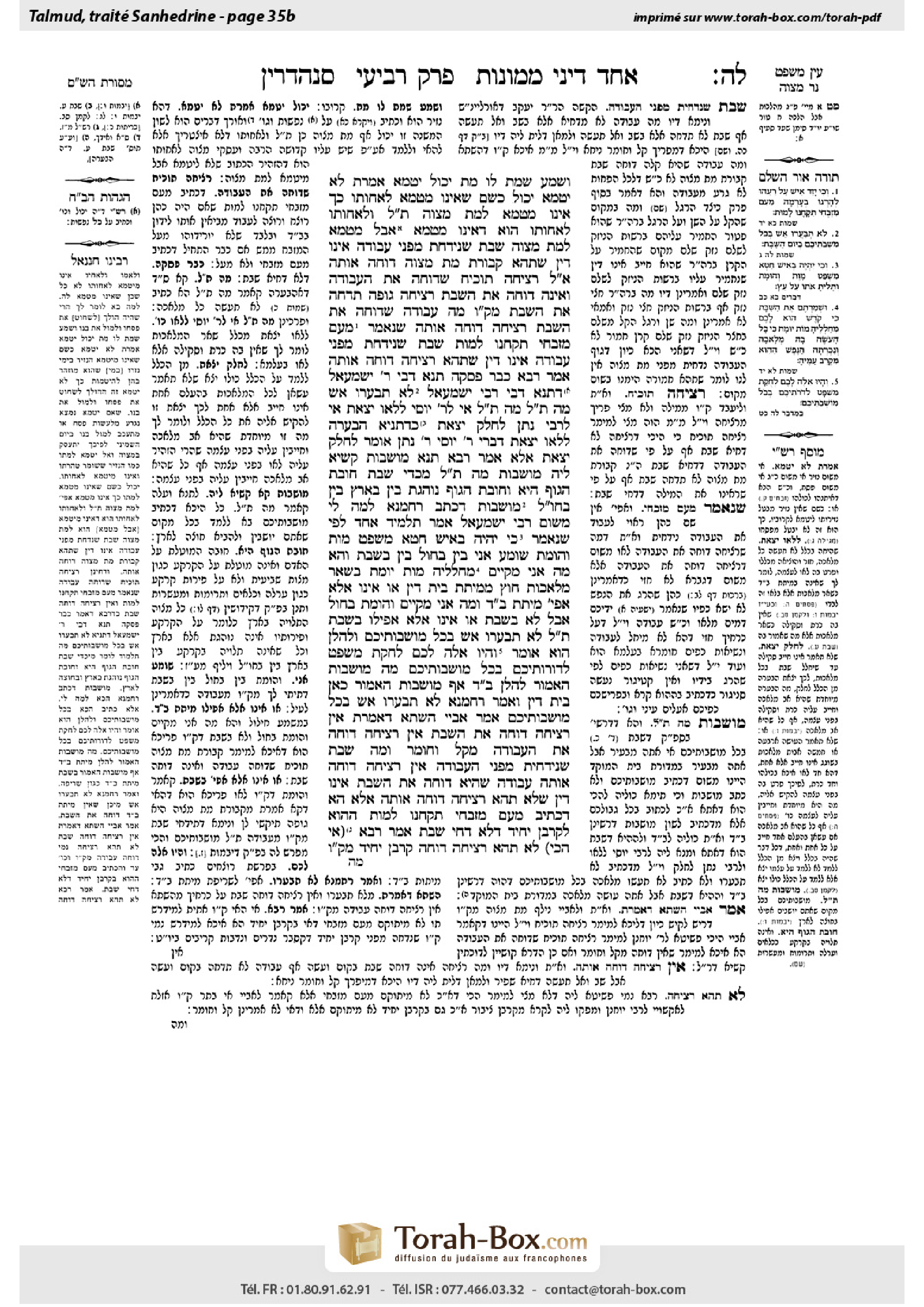
This page of Sanhedrin includes the Aramaic text, an English translation and an AI-generated French translation, alongside the scan above.
סנהדרין ל״ה ב · Aramaic and Hebrew text
וְשָׁמַע שֶׁמֵּת לוֹ מֵת, יָכוֹל יִטַּמֵּא? אָמַרְתָּ: ״לֹא יִטַּמֵּא״.
יָכוֹל, כְּשֵׁם שֶׁאֵינוֹ מִטַּמֵּא לַאֲחוֹתוֹ כָּךְ אֵינוֹ מִטַּמֵּא לְמֵת מִצְוָה? תַּלְמוּד לוֹמַר: ״וּלְאַחֹתוֹ״. לַאֲחוֹתוֹ הוּא דְּאֵינוֹ מִטַּמֵּא, אֲבָל מִטַּמֵּא לְמֵת מִצְוָה.
שַׁבָּת שֶׁנִּידְחֵת מִפְּנֵי עֲבוֹדָה, אֵינוֹ דִּין שֶׁתְּהֵא קְבוּרַת מֵת מִצְוָה דּוֹחָה אוֹתָהּ?
אֲמַר לֵיהּ: רְצִיחָה תּוֹכִיחַ, שֶׁדּוֹחָה אֶת הָעֲבוֹדָה וְאֵינָהּ דּוֹחָה אֶת הַשַּׁבָּת.
רְצִיחָה גּוּפָהּ תִּדְחֶה אֶת הַשַּׁבָּת מִקַּל וָחוֹמֶר: מָה עֲבוֹדָה שֶׁדּוֹחֶה אֶת הַשַּׁבָּת, רְצִיחָה דּוֹחָה אוֹתָהּ, שֶׁנֶּאֱמַר ״מֵעִם מִזְבְּחִי תִּקָּחֶנּוּ לָמוּת״; שַׁבָּת שֶׁנִּידְחֵת מִפְּנֵי עֲבוֹדָה, אֵינוֹ דִּין שֶׁתְּהֵא רְצִיחָה דּוֹחָה אוֹתָהּ?
אָמַר רָבָא: כְּבָר פַּסְקַהּ תָּנָא דְּבֵי רַבִּי יִשְׁמָעֵאל, דְּתָנָא דְּבֵי רַבִּי יִשְׁמָעֵאל: ״לֹא תְבַעֲרוּ אֵשׁ״ – מָה תַּלְמוּד לוֹמַר?
מָה תַּלְמוּד לוֹמַר? אִי לְרַבִּי יוֹסֵי – לְלָאו יָצָאת, אִי לְרַבִּי נָתָן – לְחַלֵּק יָצָאת. כִּדְתַנְיָא: הַבְעָרָה לְלָאו יָצָאת, דִּבְרֵי רַבִּי יוֹסֵי. רַבִּי נָתָן אוֹמֵר: לְחַלֵּק יָצָאת.
אֶלָּא אָמַר רָבָא: תְּנָא ״מוֹשָׁבוֹת״ קַשְׁיָא לֵיהּ. ״מוֹשָׁבוֹת״ – מָה תַּלְמוּד לוֹמַר? מִכְּדֵי שַׁבָּת חוֹבַת הַגּוּף הִיא, וְחוֹבַת הַגּוּף נוֹהֶגֶת בֵּין בְּאָרֶץ בֵּין בְּחוּץ לָאָרֶץ. ״מוֹשָׁבוֹת״ דִּכְתַב רַחֲמָנָא לְמָה לִי?
מִשּׁוּם רַבִּי יִשְׁמָעֵאל אָמַר תַּלְמִיד אֶחָד: לְפִי שֶׁנֶּאֱמַר ״כִּי יִהְיֶה בְאִישׁ חֵטְא מִשְׁפַּט מָוֶת וְהוּמָת״, שׁוֹמֵעַ אֲנִי בֵּין בַּחוֹל בֵּין בַּשַּׁבָּת. וְהָא מָה אֲנִי מְקַיֵּים ״מְחַלְּלֶיהָ מוֹת יוּמָת״? בִּשְׁאָר מְלָאכוֹת, חוּץ מִמִּיתַת בֵּית דִּין. אוֹ אֵינוֹ אֶלָּא אֲפִילּוּ מִיתַת בֵּית דִּין? וּמָה אֲנִי מְקַיֵּים ״וְהוּמָת״? בְּחוֹל אֲבָל לֹא בְּשַׁבָּת. אוֹ אֵינוֹ אֶלָּא אֲפִילּוּ בַּשַּׁבָּת?
תַּלְמוּד לוֹמַר: ״לֹא תְבַעֲרוּ אֵשׁ בְּכֹל מֹשְׁבֹתֵיכֶם״, וּלְהַלָּן הוּא אוֹמֵר: ״וְהָיוּ אֵלֶּה לָכֶם לְחֻקַּת מִשְׁפָּט לְדֹרֹתֵיכֶם בְּכֹל מוֹשְׁבֹתֵיכֶם״. מָה ״מוֹשָׁבוֹת״ הָאָמוּר לְהַלָּן – בֵּית דִּין, אַף ״מוֹשָׁבוֹת״ הָאָמוּר כָּאן – בֵּית דִּין. וְאָמַר רַחֲמָנָא: ״לֹא תְבַעֲרוּ אֵשׁ בְּכֹל מֹשְׁבֹתֵיכֶם״.
אָמַר אַבָּיֵי: הַשְׁתָּא דְּאָמְרַתְּ אֵין רְצִיחָה דּוֹחָה אֶת הַשַּׁבָּת, אֵין רְצִיחָה דּוֹחָה אֶת הָעֲבוֹדָה מִקַּל וָחוֹמֶר. וּמָה שַׁבָּת שֶׁנִּידְחֵית מִפְּנֵי הָעֲבוֹדָה – אֵין רְצִיחָה דּוֹחָה אוֹתָהּ, עֲבוֹדָה שֶׁהִיא דּוֹחָה אֶת הַשַּׁבָּת – אֵינוֹ דִּין שֶׁלֹּא תְּהֵא רְצִיחָה דּוֹחָה אוֹתָהּ?
אֶלָּא, הָא דִּכְתִיב: ״מֵעִם מִזְבְּחִי תִּקָּחֶנּוּ לָמוּת״? הָהוּא לְקׇרְבַּן יָחִיד, דְּלָא דָּחֵי שַׁבָּת.
אָמַר רָבָא: אִי הָכִי, לָא תְּהֵא רְצִיחָה דּוֹחָה קׇרְבַּן יָחִיד מִקַּל וָחוֹמֶר:
Sanhedrin 35b · English translation
and he heard that a relative of his died, one might have thought that he should return and become ritually impure with the impurity imparted by a corpse to bury his relative. You said: “He shall not make himself impure”; the death of his relative will not override so significant a mitzva from the Torah.
One might have thought: Just as he may not become impure to bury his sister, so he may not become impure to bury a met mitzva. Therefore, the verse states specifically: “Or for his sister”; teaching that he may not become impure only to bury his sister, as others can attend to her burial, but he may become impure to bury a met mitzva.
Having cited the baraita proving that the burial of a met mitzva overrides the Temple service, Reish Lakish continues his suggestion: With regard to Shabbat, which is overridden due to the Temple service, is it not logical that the burial of a met mitzva overrides it?
Rabbi Yoḥanan said to him: The halakha of murder, i.e., the obligation to kill one found liable to receive court-imposed capital punishment, proves that this is not the case, as it overrides the Temple service, e.g., if the only priest present is liable to receive court-imposed capital punishment, he is taken to be killed despite this resulting in the negation of the Temple service, but it does not override Shabbat.
The Gemara asks: Murder itself should override Shabbat based on this a fortiori inference: Just as with regard to the Temple service, which overrides Shabbat, nevertheless murder overrides it, and the source for this is as it is stated: “And if a man come presumptuously upon his neighbor, to slay him with guile; you shall take him from My altar, that he may die” (Exodus 21:14); then with regard to Shabbat, which is overridden due to the Temple service, is it not logical that murder should override it?
Rava said in response: It has already been ruled by a tanna of the school of Rabbi Yishmael, as the school of Rabbi Yishmael taught: What is the meaning when the verse states: “You shall kindle no fire throughout your habitations on Shabbat day” (Exodus 35:3)? All labor is forbidden on Shabbat, based on the verse: “In it you shall not do any manner of work” (Exodus 20:10). Why is kindling fire singled out?
The Gemara interjects: What is the meaning when the verse states this? If this question is in accordance with the opinion of Rabbi Yosei, this transgression was singled out to teach that one who lights a fire on Shabbat violates an ordinary prohibition, as opposed to the performance of other types of labor on Shabbat, for which one is liable to receive court-imposed capital punishment. If this question is in accordance with the opinion of Rabbi Natan, this transgression was singled out to divide the various labors and to establish liability to receive court-imposed capital punishment for performance of any one of them. The Gemara explains: As it is taught in a baraita: Kindling of fire was singled out to teach that one who lights a fire on Shabbat violates an ordinary prohibition, this is the statement of Rabbi Yosei. Rabbi Natan says: It was singled out to divide the various labors. Either way, it is clear what the meaning of the verse is.
The Gemara clarifies: Rather, Rava said: The term “habitations” in the verse poses a difficulty for the tanna: What is the meaning when the verse states: “You shall kindle no fire throughout your habitations on Shabbat day”? After all, Shabbat is an obligation on the person himself, not an obligation bound to any specific location. And the halakha is that an obligation on the person himself is practiced whether in Eretz Yisrael or outside of Eretz Yisrael. Why do I need the term “habitations” that the Merciful One writes in the Torah?
Rava continues: One student said in the name of Rabbi Yishmael that since it is stated: “And if there is in a man a sin deserving of death and he is put to death” (Deuteronomy 21:22), I would derive that the court administers capital punishment both during the week and on Shabbat. And accordingly, how do I realize the meaning of what the verse states concerning Shabbat: “Everyone that desecrates it shall be put to death” (Exodus 31:14)? One possibility is that the term: Desecration of Shabbat, applies only to other cases in which labor is performed, and excludes instances of the death penalty administered by a court, which is not a desecration of Shabbat. Or rather, derive that even the death penalty administered by a court is prohibited as desecration of Shabbat. And how do I realize the meaning of: “And he is put to death”? One possibility is that the mitzva of executing transgressors applies on weekdays, but not on Shabbat. Or rather, the other possibility is that it applies even on Shabbat.
As these verses can be interpreted in either manner, the verse states: “You shall kindle no fire throughout your habitations on Shabbat day,” and there, with regard to the punishment administered to a murderer, the verse states: “And these shall be for you a statute of judgment throughout your generations in all your habitations” (Numbers 35:29). Just as the term “habitations” that is stated there is referring to the act of a court, so too the term “habitations” that is stated here concerning Shabbat is referring to the act of a court. And the Merciful One states: “You shall kindle no fire throughout your habitations.” This teaches that the court does not administer capital punishment on Shabbat.
Abaye says: Now that you have said that murder of one condemned by the court does not override Shabbat, one should say that murder does not override the performance of the Temple service either, based on an a fortiori inference: And just as with regard to Shabbat, which is overridden for the performance of the Temple service, murder does not override it, then with regard to performance of the Temple service, which overrides Shabbat, is it not logical that murder should not override it?
The Gemara questions this inference: But if so, how would one explain that which is written in the verse concerning one liable to receive court-imposed capital punishment: “You shall take him from My altar, that he may die” (Exodus 21:14)? This verse indicates that the court administering capital punishment does override the performance of the Temple service. The Gemara explains: That verse serves to teach the halakha concerning an offering of an individual, which does not override Shabbat. The verse is teaching that the court takes the priest to execute him even if this will result in the offering of an individual not being sacrificed.
Rava says: If that is so, one should say that murder should not override even an offering of an individual based on an a fortiori inference:
Sanhedrin 35b · Traduction française (IA)
Et s’il apprenait qu’un de ses proches était mort, on aurait pu penser qu’il devait revenir et se rendre impur par contact avec un cadavre afin d’enterrer son proche. Le verset dit : « Il ne se rendra pas impur » ; la mort de son proche ne l’emportera pas sur une mitsva aussi importante de la Torah.
On aurait pu penser : de même qu’il ne peut pas se rendre impur pour enterrer sa sœur, il ne peut pas non plus se rendre impur pour enterrer un met mitsva. C’est pourquoi le verset précise : « Ou pour sa sœur », enseignant qu’il ne peut se rendre impur que pour enterrer sa sœur, puisque d’autres peuvent s’occuper de son enterrement, mais qu’il peut se rendre impur pour enterrer un met mitsva.
Après avoir cité la baraïta qui prouve que l’enterrement d’un met mitsva l’emporte sur le service du Temple, Reish Lakish poursuit son raisonnement : quant au Chabbat, auquel le service du Temple déroge, n’est-il pas logique que l’enterrement d’un met mitsva l’emporte sur lui ?
Rabbi Yoḥanan lui dit : La halakha relative au meurtre, c’est-à-dire l’obligation de mettre à mort celui qui a été reconnu passible de la peine capitale prononcée par le tribunal, prouve qu’il n’en est pas ainsi. En effet, elle l’emporte sur le service du Temple : par exemple, si le seul prêtre présent est passible de la peine capitale prononcée par le tribunal, on l’emmène pour le mettre à mort, même si cela entraîne l’interruption du service du Temple ; mais elle ne l’emporte pas sur le Chabbat.
La Guemara demande : Le meurtre lui-même ne devrait-il pas l’emporter sur le Chabbat, selon ce raisonnement a fortiori ? De même que le meurtre l’emporte sur le service du Temple, lequel l’emporte sur le Chabbat — et la source en est le verset : « Si un homme agit avec préméditation contre son prochain pour le tuer par ruse, tu le prendras même de mon autel pour qu’il meure » (Exode 21,14) —, alors, concernant le Chabbat, auquel le service du Temple déroge, n’est-il pas logique que le meurtre l’emporte sur lui ?
Rava répondit : Un tanna de l’école de Rabbi Yishmael a déjà tranché la question, car l’école de Rabbi Yishmael a enseigné : Que signifie le verset : « Vous n’allumerez aucun feu dans toutes vos demeures le jour du Chabbat » (Exode 35,3) ? Tout travail est interdit le Chabbat, d’après le verset : « Tu ne feras aucun travail » (Exode 20,10). Pourquoi l’allumage du feu est-il mentionné à part ?
La Guemara intervient : Que signifie ce verset ? Si la question est posée selon l’opinion de Rabbi Yosei, cette transgression a été mentionnée à part pour enseigner que celui qui allume un feu le Chabbat enfreint une simple interdiction, contrairement à celui qui accomplit d’autres types de travaux le Chabbat, qui est passible de la peine capitale prononcée par le tribunal. Si la question est posée selon l’opinion de Rabbi Natan, cette transgression a été mentionnée à part pour distinguer les différents travaux et établir qu’on est passible de la peine capitale prononcée par le tribunal pour l’accomplissement de chacun d’eux. La Guemara explique : ainsi qu’il est enseigné dans une baraïta : L’allumage du feu a été mentionné à part pour enseigner que celui qui allume un feu le Chabbat enfreint une simple interdiction ; telle est l’opinion de Rabbi Yosei. Rabbi Natan dit : Il a été mentionné à part pour distinguer les différents travaux. Dans les deux cas, le sens du verset est clair.
La Guemara précise : En réalité, Rava dit : Le terme « demeures » dans le verset pose une difficulté au tanna : Que signifie le verset : « Vous n’allumerez aucun feu dans toutes vos demeures le jour du Chabbat » ? Après tout, le Chabbat est une obligation qui incombe à la personne elle-même, et non une obligation liée à un lieu précis. Or, une obligation qui incombe à la personne elle-même s’applique aussi bien en Eretz Yisrael qu’en dehors d’Eretz Yisrael. Pourquoi donc la Torah a-t-elle employé le terme « demeures » ?
Rava poursuit : Un élève a dit au nom de Rabbi Yishmael que, puisqu’il est écrit : « Si un homme a commis un péché passible de mort et qu’il est mis à mort » (Deutéronome 21,22), j’en déduirais que le tribunal exécute les condamnés à mort aussi bien pendant la semaine que le Chabbat. Comment comprendre alors le sens du verset concernant le Chabbat : « Quiconque le profane sera mis à mort » (Exode 31,14) ? On pourrait dire que le terme « profanation du Chabbat » ne s’applique qu’aux autres cas où un travail est accompli, et exclut les cas où le tribunal exécute un condamné à mort, ce qui ne constitue pas une profanation du Chabbat. Ou bien faut-il en déduire que même l’exécution d’un condamné à mort par le tribunal est interdite, car elle constitue une profanation du Chabbat ? Comment comprendre alors le sens de « et qu’il est mis à mort » ? On pourrait dire que la mitsva d’exécuter les transgresseurs s’applique les jours de semaine, mais pas le Chabbat. Ou bien faut-il retenir l’autre possibilité : elle s’applique même le Chabbat.
Comme ces versets peuvent être interprétés dans les deux sens, le verset dit : « Vous n’allumerez aucun feu dans toutes vos demeures le jour du Chabbat », et, là-bas, au sujet de la peine infligée à un meurtrier, le verset dit : « Telles seront pour vous des règles de justice, dans toutes vos générations et dans toutes vos demeures » (Nombres 35,29). De même que le terme « demeures » employé là-bas se rapporte à l’action d’un tribunal, de même le terme « demeures » employé ici, au sujet du Chabbat, se rapporte à l’action d’un tribunal. Et le Miséricordieux dit : « Vous n’allumerez aucun feu dans toutes vos demeures. » Cela enseigne que le tribunal n’exécute pas de condamnés à mort le Chabbat.
Abaye dit : Puisqu’on a établi que l’exécution d’un condamné par le tribunal ne l’emporte pas sur le Chabbat, on devrait en déduire que l’exécution ne l’emporte pas non plus sur l’accomplissement du service du Temple, selon un raisonnement a fortiori : de même que, concernant le Chabbat, auquel on déroge afin d’accomplir le service du Temple, l’exécution ne l’emporte pas sur lui, alors, concernant l’accomplissement du service du Temple, qui l’emporte sur le Chabbat, n’est-il pas logique que l’exécution ne l’emporte pas sur lui ?
La Guemara met ce raisonnement en question : Mais alors, comment expliquer le verset concernant celui qui est passible de la peine capitale prononcée par le tribunal : « Tu le prendras même de mon autel pour qu’il meure » (Exode 21,14) ? Ce verset indique que l’exécution par le tribunal l’emporte sur l’accomplissement du service du Temple. La Guemara explique : Ce verset vient enseigner la halakha concernant une offrande individuelle, qui ne l’emporte pas sur le Chabbat. Il enseigne que le tribunal emmène le prêtre pour l’exécuter, même si cela entraîne qu’une offrande individuelle ne soit pas sacrifiée.
Rava dit : S’il en est ainsi, on devrait en déduire que l’exécution ne l’emporte même pas sur une offrande individuelle, selon un raisonnement a fortiori :
Traduction française générée par IA à partir de l’édition anglaise de Sefaria. Vérifie toujours un passage avec le texte source.
Text from Sefaria: William Davidson Edition - Vocalized Aramaic (CC BY NC); William Davidson Edition - English (CC BY NC).