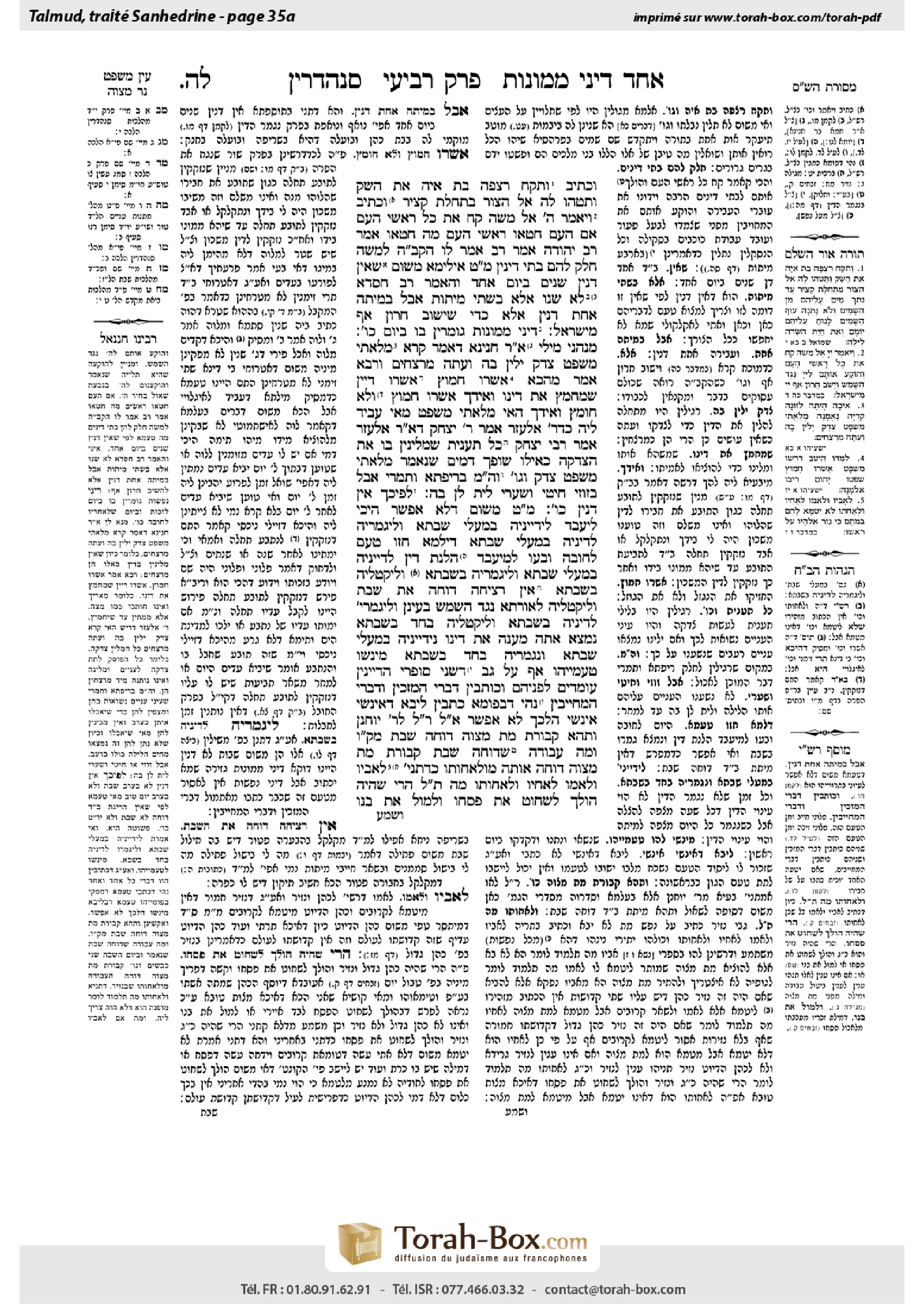
Sanhedrin 35a: Talmud study for Daf Yomi
Daf Yomi is the daily study of one Talmud folio. Explore 37 tractates with scans, Hebrew text, Sefaria English and AI-generated French translations where annotated.
Passage selection and English or AI-generated French translation are available where the scan has annotations. Daf Study is independent of Torah-Box and Sefaria.
Browse Sanhedrin · סנהדרין · All tractatesSanhedrin 35a text and translations
This page of Sanhedrin includes the Aramaic text, an English translation and an AI-generated French translation, alongside the scan above.
סנהדרין ל״ה א · Aramaic and Hebrew text
וּכְתִיב: ״וַתִּקַּח רִצְפָּה בַת אַיָּה אֶת הַשַּׂק וַתַּטֵּהוּ לָהּ אֶל הַצּוּר בִּתְחִלַּת קָצִיר״.
וּכְתִיב: ״וַיֹּאמֶר ה׳ אֶל מֹשֶׁה קַח אֶת כׇּל רָאשֵׁי הָעָם״. אִם הָעָם חָטְאוּ, רָאשֵׁי הָעָם מָה חָטְאוּ?
אָמַר רַב יְהוּדָה אָמַר רַב: אָמַר לוֹ הַקָּדוֹשׁ בָּרוּךְ הוּא לְמֹשֶׁה, חַלֵּק לָהֶם בָּתֵּי דִינִין. מַאי טַעְמָא? אִילֵּימָא מִשּׁוּם שֶׁאֵין דָּנִין שְׁנַיִם בְּיוֹם אֶחָד? וְהָאָמַר רַב חִסְדָּא: לֹא שָׁנוּ אֶלָּא בִּשְׁתֵּי מִיתוֹת, אֲבָל בְּמִיתָה אַחַת דָּנִין!
אֶלָּא, כְּדֵי שֶׁיָּשׁוּב חֲרוֹן אַף מִיִּשְׂרָאֵל.
דִּינֵי מָמוֹנוֹת גּוֹמְרִין בּוֹ בַּיּוֹם כּוּ׳. מְנָהָנֵי מִילֵּי?
אָמַר רַבִּי חֲנִינָא: דְּאָמַר קְרָא, ״מְלֵאֲתִי מִשְׁפָּט צֶדֶק יָלִין בָּהּ וְעַתָּה מְרַצְּחִים״. וְרָבָא אָמַר מֵהָכָא: ״אַשְּׁרוּ חָמוֹץ״ – אַשְּׁרוּ דַּיָּין שֶׁמְּחַמֵּץ אֶת דִּינוֹ.
וְאִידַּךְ: ״אַשְּׁרוּ חָמוֹץ״, וְלֹא חוֹמֵץ. וְאִידַּךְ, הַאי ״מְלֵאֲתִי מִשְׁפָּט״ מַאי עָבֵיד לֵיהּ?
כִּדְרַבִּי אֶלְעָזָר אָמַר רַבִּי יִצְחָק, דְּאָמַר רַבִּי אֶלְעָזָר אָמַר רַבִּי יִצְחָק: כׇּל תַּעֲנִית שֶׁמְּלִינִין בּוֹ אֶת הַצְּדָקָה – כְּאִילּוּ שׁוֹפֵךְ דָּמִים, שֶׁנֶּאֱמַר: ״מְלֵאֲתִי מִשְׁפָּט צֶדֶק וְגוֹ׳״. וְהָנֵי מִילֵּי – בְּרִיפְתָּא וְתַמְרֵי, אֲבָל בְּזוּזֵי, חִיטֵּי וּשְׂעָרֵי – לֵית לַן בַּהּ.
לְפִיכָךְ אֵין דָּנִין כּוּ׳. מַאי טַעְמָא?
מִשּׁוּם דְּלָא אֶפְשָׁר. הֵיכִי לֶיעְבַּד? לִידַיְּינֵיהּ בְּמַעֲלֵי שַׁבְּתָא וְלִיגְמְרֵיהּ לְדִינֵיהּ בְּמַעֲלֵי שַׁבְּתָא? דִּילְמָא חָזוּ טַעַם לְחוֹבָה, וּבָעוּ לְמִיעְבַּד הֲלָנַת דִּין. לְדַיְּינֵיהּ בְּמַעֲלֵי שַׁבְּתָא וְלִיגְמְרֵיהּ בְּשַׁבְּתָא, וְלִיקְטְלֵיהּ בְּשַׁבְּתָא? אֵין רְצִיחָה דּוֹחָה אֶת שַׁבָּת. וְלִיקְטְלֵיהּ לְאוּרְתָּא? נֶגֶד הַשֶּׁמֶשׁ בָּעֵינַן.
וְלִיגְמְרֵיהּ לְדִינֵיהּ בְּשַׁבְּתָא, וְלִיקְטְלֵיהּ בְּחַד בְּשַׁבְּתָא? נִמְצָא אַתָּה מְעַנֶּה אֶת דִּינוֹ. נִידַיְּינֵיהּ בְּמַעֲלֵי שַׁבְּתָא וְנִגְמְרֵיהּ בְּחַד בְּשַׁבְּתָא? מִינְּשׁוּ טַעְמַיְיהוּ. אַף עַל גַּב דִּשְׁנֵי סוֹפְרֵי הַדַּיָּינִין עוֹמְדִים לִפְנֵיהֶם, וְכוֹתְבִין דִּבְרֵי הַמְזַכִּין וְדִבְרֵי הַמְחַיְּיבִין, נְהִי דִּבְפוּמָּא כָּתְבִין, לִיבָּא דְּאִינְּשִׁי אִינְּשִׁי. הִלְכָּךְ לָא אֶפְשָׁר.
אֲמַר לֵיהּ רֵישׁ לָקִישׁ לְרַבִּי יוֹחָנָן: וּתְהֵא קְבוּרַת מֵת מִצְוָה דּוֹחָה שַׁבָּת מִקַּל וָחוֹמֶר: וּמָה עֲבוֹדָה שֶׁדּוֹחָה שַׁבָּת – קְבוּרַת מֵת מִצְוָה דּוֹחָה אוֹתָהּ, מִ״וּלְאַחֹתוֹ״.
כִּדְתַנְיָא: ״לְאָבִיו וּלְאִמּוֹ לְאָחִיו וּלְאַחֹתוֹ״ – מָה תַּלְמוּד לוֹמַר? הֲרֵי שֶׁהָיָה הוֹלֵךְ לִשְׁחוֹט אֶת פִּסְחוֹ וְלָמוּל אֶת בְּנוֹ
Sanhedrin 35a · English translation
And it is written: “And Rizpah, daughter of Aiah, took sackcloth and spread it for her upon the rock, from the beginning of harvest until water was poured upon them from heaven; and she suffered neither the birds of the air to rest on them by day, nor the beasts of the field by night” (II Samuel 21:10). It is clear from this verse that the bodies of the children of Saul remained exposed outdoors; presumably, they were hung.
The Gemara discusses the incident of the Israelites who worshipped the idol of Peor in the wilderness. And it is written: “And the Lord said unto Moses: Take all the chiefs of the people, and hang them unto the Lord facing the sun, that the fierce anger of the Lord may turn away from Israel” (Numbers 25:4). The Gemara asks: If the nation transgressed, in what manner did the chiefs of the people transgress? The verse does not record a transgression of the chiefs, so why were they punished?
Rav Yehuda says that Rav says: The reason for selecting the chiefs of the tribes was not to punish them. Rather, the Holy One, Blessed be He, said to Moses: Apportion courts for the chiefs of the tribes, and each court will judge and punish the transgressors of its tribe. The Gemara asks: What is the reason that multiple courts were needed for this? If we say that it is due to the principle that a court does not judge two cases of capital law in one day, and there were many cases to be judged, that cannot be the reason. But doesn’t Rav Ḥisda say: This principle was taught only with regard to two different types of death imposed by a court, as each case needs sufficient time to be fully investigated on its own merits. But the court does judge multiple cases of one type of death, i.e., one transgression, on the same day.
The Gemara explains: Rather, the reason for the appointment of multiple courts was in order that the fierce anger of the Lord may turn away from Israel. The fierce anger of God would remain until those who engaged in idol worship were punished. Therefore, it was necessary to try them in due haste.
§ The mishna teaches: In cases of monetary law, the court may conclude the deliberations and issue the ruling even on that same day, whether to exempt the accused or to find him liable. In cases of capital law, the court may conclude the deliberations and issue the ruling even on that same day to acquit the accused, but must wait until the following day to find him liable. The Gemara asks: From where are these matters derived?
Rabbi Ḥanina said: The verse states prophetically concerning Jerusalem after the destruction of the First Temple: “She that was full of justice, righteousness lodged in her, but now murderers” (Isaiah 1:21). The verse associates lodging, or waiting overnight, with justice. And Rava says that these matters are derived from here: “Learn to do well; seek judgment, relieve [ashru] the oppressed [ḥamotz]” (Isaiah 1:17). This is interpreted: Praise [ashru] the judge who delays [meḥametz] his verdict before he pronounces it.
And the other amora, Rabbi Ḥanina, who did not derive this halakha from this verse, interprets it as meaning: Relieve the robbery victim [ḥamotz], but not the robber [ḥometz], as do the wicked judges. The Gemara asks: And the other amora, Rava, what does he do with this verse: “She that was full of justice, righteousness lodged in her, but now murderers”?
The Gemara answers: Rava interprets it in accordance with the statement that Rabbi Elazar says that Rabbi Yitzḥak says, as Rabbi Elazar says that Rabbi Yitzḥak says: Every fast day on which the distribution of charity [tzedaka] is left overnight, this is considered as if one spilled the blood of the poor people, as they fasted all day in the expectation that they would receive charity before the day was over in order to purchase food with which to break their fasts. As it is stated: “She that was full of justice [tzedek], righteousness lodged in her, but now murderers.” The Gemara clarifies: And this statement applies with regard to the delaying of the distribution of bread and dates, which are ready to be consumed; but with regard to the delaying of the distribution of money, wheat, and barley, we have no problem with it.
§ After teaching that in cases of capital law, the verdict may not be issued on the same day as the deliberations, the mishna states: Therefore, the court does not judge cases of capital law on certain days, neither on the eve of Shabbat nor on the eve of a Festival. The Gemara asks: What is the reason for this? What does the halakha that the verdict may not be issued on the same day as the deliberations have to do with not judging cases on those days?
The Gemara explains: It is because it is not possible to conduct the trial on the eve of Shabbat or the eve of a Festival. As, how should we act? If we say that we should judge him on Shabbat eve and conclude his verdict on Shabbat eve, perhaps we would see a reason to find the accused liable, and in this situation the court is required to perform a suspension of the trial until the following day, as the court may not issue a verdict in cases of capital law on the same day as the deliberations. If we say: We should judge him on Shabbat eve and conclude the verdict on Shabbat, and, if he is found liable, kill him on Shabbat, that cannot be done, as the murder of one liable to receive court-imposed capital punishment does not override Shabbat. And if we say: We should kill him at night, after the conclusion of Shabbat, that cannot be done, as we require that the capital punishment be administered facing the sun, during the daytime.
And if we say: We should judge him on Shabbat eve, conclude his verdict on Shabbat, and kill him on Sunday, you are found to have caused a delay in his verdict, as the accused will have to wait overnight knowing he is condemned to death. And if we say: We should judge him on Shabbat eve and conclude his verdict on Sunday, the judges will forget their reasons for their positions in the interim. And even though two judges’ scribes are standing before them, and they write the statements of those who acquit the accused and the statements of those who find him liable, and they write that which emerged from the mouths of the judges, i.e., their tentative verdict, the hearts of people [enashei] are forgetful [inshei], and they will forget the reasons. Therefore, it is not possible to begin deliberations in cases of capital law on a Shabbat eve or a Festival eve.
§ The Gemara discusses a related matter: Reish Lakish said to Rabbi Yoḥanan: And the burial of a corpse with no one to bury it [met mitzva] should override Shabbat by means of an a fortiori inference: If with regard to the Temple service, which overrides Shabbat, yet the burial of a met mitzva overrides it, based on the interpretation of the term written with regard to a nazirite: “Or for his sister” (Numbers 6:7); the Gemara pauses its recounting of the question of Reish Lakish and cites a baraita that teaches this halakha.
As it is taught in a baraita: The verses state with regard to a nazirite: “All the days that he consecrates himself unto the Lord he shall not come near to a dead body. He shall not make himself impure for his father, or for his mother, for his brother, or for his sister, when they die” (Numbers 6:6–7). Why must the verse state all of these relatives? It teaches that if a nazirite was going to slaughter his Paschal offering or to circumcise his son
Sanhedrin 35a · Traduction française (IA)
Et il est écrit : « Rizpa, fille d’Aya, prit une étoffe de sac et l’étendit pour elle sur le rocher, depuis le début de la moisson jusqu’à ce que l’eau se déverse sur eux du ciel ; elle ne laissa ni les oiseaux du ciel se poser sur eux le jour, ni les bêtes des champs la nuit » (II Samuel 21,10). Ce verset montre clairement que les corps des fils de Saül demeurèrent exposés à l’extérieur ; vraisemblablement, ils avaient été pendus.
La Guemara évoque l’épisode des Israélites qui adorèrent l’idole de Péor dans le désert. Et il est écrit : « L’Éternel dit à Moïse : Prends tous les chefs du peuple et pends-les devant l’Éternel, face au soleil, afin que l’ardente colère de l’Éternel se détourne d’Israël » (Nombres 25,4). La Guemara demande : Si le peuple a transgressé, en quoi les chefs du peuple ont-ils transgressé ? Le verset ne rapporte aucune transgression des chefs ; pourquoi furent-ils donc punis ?
Rav Yehouda dit au nom de Rav : La raison pour laquelle les chefs des tribus furent désignés n’était pas de les punir. Le Saint, béni soit-Il, dit plutôt à Moïse : Établis des tribunaux pour les chefs des tribus, et chaque tribunal jugera et punira les transgresseurs de sa tribu. La Guemara demande : Pourquoi fallait-il plusieurs tribunaux ? Si l’on dit que c’est en vertu du principe selon lequel un tribunal ne juge pas deux affaires passibles de la peine capitale le même jour, et qu’il y avait de nombreuses affaires à juger, cela ne peut pas en être la raison. Mais Rav Ḥisda ne dit-il pas que ce principe ne s’applique qu’à deux types différents de peine capitale infligés par un tribunal, car chaque affaire doit être examinée à fond selon ses propres mérites ? En revanche, le tribunal juge le même jour plusieurs affaires entraînant le même type de peine capitale, c’est-à-dire portant sur une même transgression.
La Guemara explique : C’était plutôt afin que l’ardente colère de l’Éternel se détourne d’Israël. La colère ardente de Dieu persisterait jusqu’à ce que ceux qui s’étaient livrés à l’idolâtrie soient punis. Il fallait donc les juger dans les plus brefs délais.
§ La Michna enseigne : Dans les affaires de droit civil, le tribunal peut achever les délibérations et rendre son verdict le jour même, que ce soit pour acquitter l’accusé ou le déclarer coupable. Dans les affaires passibles de la peine capitale, le tribunal peut achever les délibérations et rendre son verdict le jour même pour acquitter l’accusé, mais il doit attendre le lendemain pour le déclarer coupable. La Guemara demande : De quelle source tire-t-on ces règles ?
Rabbi Ḥanina dit : Le verset prophétise au sujet de Jérusalem après la destruction du Premier Temple : « Elle qui était pleine de justice, où la droiture demeurait, est maintenant remplie de meurtriers » (Isaïe 1,21). Le verset associe le fait de demeurer — ou d’attendre toute une nuit — à la justice. Rava dit que ces règles sont déduites de ce verset : « Apprenez à faire le bien ; recherchez le jugement, secourez [ashru] l’opprimé [ḥamotz] » (Isaïe 1,17). On l’interprète ainsi : « Félicitez [ashru] le juge qui retarde [meḥametz] son verdict avant de le prononcer. »
Et l’autre amora, Rabbi Ḥanina, qui ne déduit pas cette halakha de ce verset, l’interprète ainsi : Secourez la victime du vol [ḥamotz], mais pas le voleur [ḥometz], comme le font les juges méchants. La Guemara demande : Et l’autre amora, Rava, que fait-il de ce verset : « Elle qui était pleine de justice, où la droiture demeurait, est maintenant remplie de meurtriers » ?
La Guemara répond : Rava l’interprète conformément à l’enseignement de Rabbi Elazar au nom de Rabbi Yitzḥak. Rabbi Elazar dit en effet au nom de Rabbi Yitzḥak : Lors de tout jour de jeûne où la distribution de la charité [tzedaka] est reportée au lendemain, c’est comme si l’on avait versé le sang des pauvres, car ils ont jeûné toute la journée dans l’espoir de recevoir la charité avant la fin du jour, afin d’acheter de quoi rompre leur jeûne. Comme il est dit : « Elle qui était pleine de justice [tzedek], où la droiture demeurait, est maintenant remplie de meurtriers. » La Guemara précise : Cette affirmation concerne le report de la distribution du pain et des dattes, qui sont prêts à être consommés ; mais le report de la distribution d’argent, de blé et d’orge ne pose pas de problème.
§ Après avoir enseigné que, dans les affaires passibles de la peine capitale, le verdict ne peut pas être rendu le jour même des délibérations, la Michna énonce : Le tribunal ne juge donc pas les affaires passibles de la peine capitale certains jours, ni la veille de Chabbat ni la veille d’une fête. La Guemara demande : Quelle en est la raison ? Quel rapport y a-t-il entre la halakha selon laquelle le verdict ne peut pas être rendu le jour même des délibérations et l’interdiction de juger ces jours-là ?
La Guemara explique : C’est parce qu’il n’est pas possible de tenir le procès la veille de Chabbat ou la veille d’une fête. En effet, comment procéder ? Si l’on dit qu’il faut le juger la veille de Chabbat et rendre le verdict ce même jour, peut-être trouvera-t-on une raison de déclarer l’accusé coupable ; dans ce cas, le tribunal devra suspendre le procès jusqu’au lendemain, puisqu’il ne peut pas rendre son verdict dans une affaire passible de la peine capitale le jour même des délibérations. Si l’on dit qu’il faut le juger la veille de Chabbat et rendre le verdict le Chabbat, puis, s’il est déclaré coupable, le mettre à mort le Chabbat, cela ne peut pas se faire, car l’exécution d’un condamné à mort par un tribunal ne repousse pas le Chabbat. Et si l’on dit qu’il faut le mettre à mort la nuit, après la fin du Chabbat, cela ne peut pas se faire, car la peine capitale doit être administrée face au soleil, pendant la journée.
Et si l’on dit qu’il faut le juger la veille de Chabbat, rendre le verdict le Chabbat et le mettre à mort le dimanche, on retarde alors son verdict, car l’accusé devra attendre toute la nuit en sachant qu’il est condamné à mort. Et si l’on dit qu’il faut le juger la veille de Chabbat et rendre le verdict le dimanche, les juges oublieront entre-temps les raisons qui fondent leurs opinions. Même si les scribes de deux juges se tiennent devant eux et consignent les déclarations de ceux qui acquittent l’accusé ainsi que celles de ceux qui le déclarent coupable, et qu’ils écrivent ce qui est sorti de la bouche des juges, c’est-à-dire leur verdict provisoire, le cœur des gens [enashei] est oublieux [inshei], et ils en oublieront les raisons. Il n’est donc pas possible d’entamer les délibérations dans les affaires passibles de la peine capitale la veille de Chabbat ou d’une fête.
§ La Guemara aborde une question connexe : Reish Lakish dit à Rabbi Yoḥanan : L’inhumation d’un mort sans personne pour l’enterrer [met mitsva] devrait elle aussi repousser le Chabbat, par raisonnement a fortiori. En effet, si, s’agissant du service du Temple, qui repousse le Chabbat, l’inhumation d’un met mitsva le repousse néanmoins, conformément à l’interprétation du terme écrit à propos du nazir : « ou pour sa sœur » (Nombres 6,7). La Guemara interrompt le récit de la question de Reish Lakish et cite une baraïta qui enseigne cette halakha.
Comme il est enseigné dans une baraïta : Les versets disent au sujet du nazir : « Pendant tous les jours où il se consacre à l’Éternel, il ne s’approchera pas d’un mort. Il ne se rendra pas impur pour son père, ni pour sa mère, ni pour son frère, ni pour sa sœur, lorsqu’ils meurent » (Nombres 6,6-7). Pourquoi le verset doit-il mentionner tous ces proches ? Cela enseigne que si un nazir s’apprêtait à égorger son offrande pascale ou à faire circoncire son fils
Traduction française générée par IA à partir de l’édition anglaise de Sefaria. Vérifie toujours un passage avec le texte source.
Text from Sefaria: William Davidson Edition - Vocalized Aramaic (CC BY NC); William Davidson Edition - English (CC BY NC).