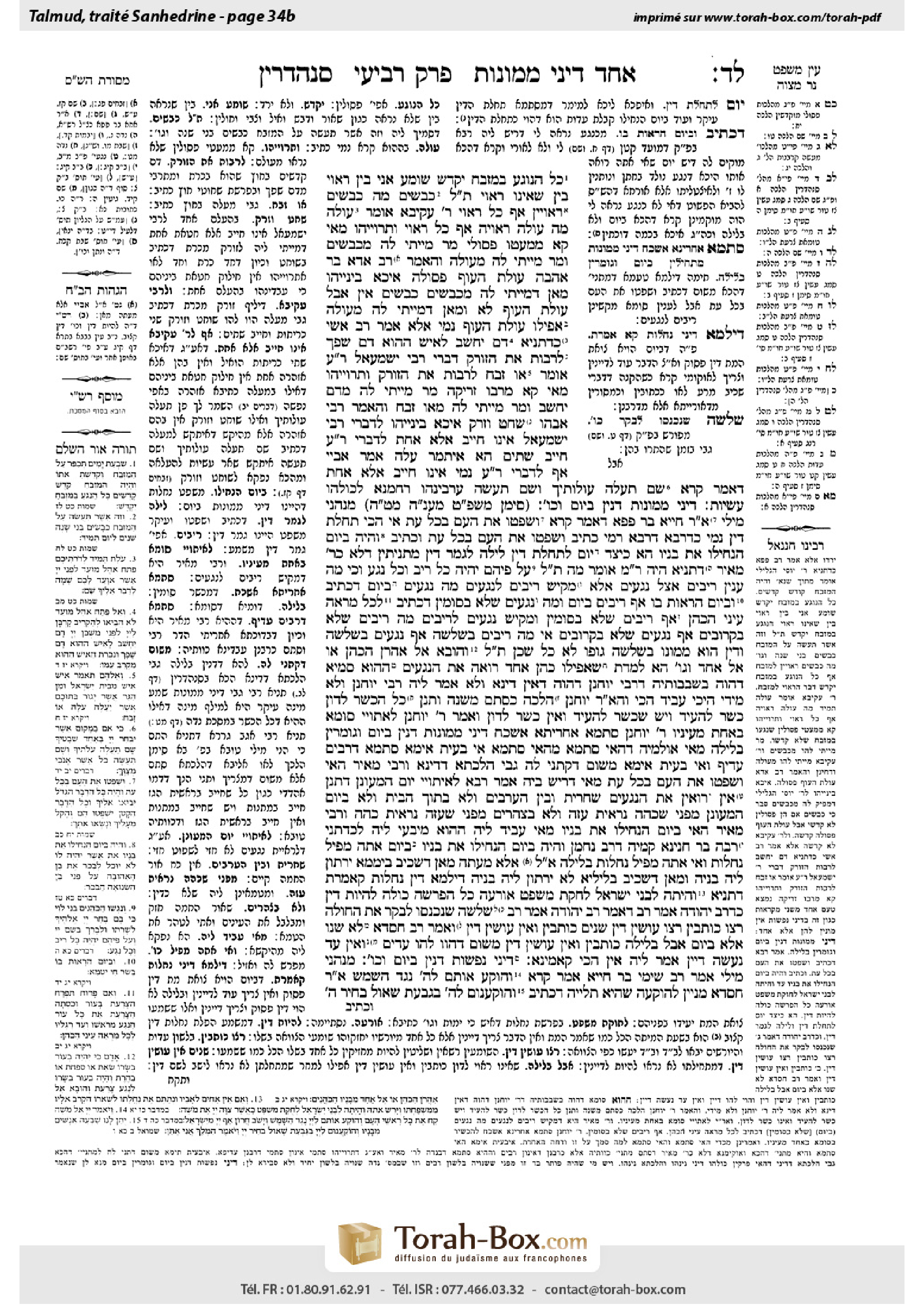
Sanhedrin 34b: Talmud study for Daf Yomi
Daf Yomi is the daily study of one Talmud folio. Explore 37 tractates with scans, Hebrew text, Sefaria English and AI-generated French translations where annotated.
Passage selection and English or AI-generated French translation are available where the scan has annotations. Daf Study is independent of Torah-Box and Sefaria.
Browse Sanhedrin · סנהדרין · All tractatesSanhedrin 34b text and translations
This page of Sanhedrin includes the Aramaic text, an English translation and an AI-generated French translation, alongside the scan above.
סנהדרין ל״ד ב · Aramaic and Hebrew text
״כָּל הַנּוֹגֵעַ בַּמִּזְבֵּחַ יִקְדָּשׁ״ – שׁוֹמֵעַ אֲנִי, בֵּין רָאוּי בֵּין שֶׁאֵינוֹ רָאוּי? תַּלְמוּד לוֹמַר: ״כְּבָשִׂים״ – מָה כְּבָשִׂים רְאוּיִין, אַף כֹּל רָאוּי. רַבִּי עֲקִיבָא אוֹמֵר: ״עוֹלָה״ – מָה עוֹלָה רְאוּיָה, אַף כֹּל רָאוּי.
וְתַרְוַיְיהוּ מַאי קָא מְמַעֲטוּ? פְּסוּלֵי. מָר מַיְיתֵי לַהּ מִ״כְּבָשִׂים״, וּמָר מַיְיתֵי לַהּ מֵ״עוֹלָה״.
וְהָאָמַר רַב אַדָּא בַּר אַהֲבָה: עוֹלַת הָעוֹף פְּסוּלָה אִיכָּא בֵּינַיְיהוּ. מַאן דְּמַיְיתֵי לַהּ מִ״כְּבָשִׂים״ – כְּבָשִׂים אִין, אֲבָל עוֹלַת הָעוֹף לָא. וּמַאן דְּמַיְיתֵי לַהּ מֵ״עוֹלָה״ – אֲפִילּוּ עוֹלַת הָעוֹף נָמֵי.
אֶלָּא אָמַר רַב אָשֵׁי: כִּדְתַנְיָא, ״דָּם יֵחָשֵׁב לָאִישׁ הַהוּא דָּם שָׁפָךְ״ – לְרַבּוֹת אֶת הַזּוֹרֵק, דִּבְרֵי רַבִּי יִשְׁמָעֵאל.
רַבִּי עֲקִיבָא אוֹמֵר: ״אוֹ זָבַח״ – לְרַבּוֹת אֶת הַזּוֹרֵק. וְתַרְוַיְיהוּ מַאי קָא מְרַבּוּ? זְרִיקָה. מָר מַיְיתֵי לַהּ מִ״דָּם יֵחָשֵׁב״, וּמָר מַיְיתֵי לַהּ מֵ״אוֹ זָבַח״.
וְהָאָמַר רַבִּי אֲבָהוּ: שָׁחַט וְזָרַק אִיכָּא בֵּינַיְיהוּ. לְדִבְרֵי רַבִּי יִשְׁמָעֵאל, אֵינוֹ חַיָּיב אֶלָּא אַחַת; לְדִבְרֵי רַבִּי עֲקִיבָא, חַיָּיב שְׁתַּיִם.
הָא אִיתְּמַר עֲלַהּ, אָמַר אַבָּיֵי: אַף לְדִבְרֵי רַבִּי עֲקִיבָא נָמֵי אֵינוֹ חַיָּיב אֶלָּא אַחַת, דְּאָמַר קְרָא ״שָׁם תַּעֲלֶה עֹלוֹתֶיךָ וְשָׁם תַּעֲשֶׂה״. עָרְבִינְהוּ רַחֲמָנָא לְכוּלְּהוּ עֲשִׂיּוֹת.
דִּינֵי מָמוֹנוֹת דָּנִין בַּיּוֹם וְכוּ׳. (סִימָן: מִשְׁפָּט, מַעֲנֶה, מַטֶּה.) מְנָהָנֵי מִילֵּי? אָמַר רַבִּי חִיָּיא בַּר פָּפָּא: דְּאָמַר קְרָא ״וְשָׁפְטוּ אֶת הָעָם בְּכׇל עֵת״.
אִי הָכִי, תְּחִלַּת דִּין נָמֵי? כִּדְרָבָא, דְּרָבָא רָמֵי: כְּתִיב ״וְשָׁפְטוּ אֶת הָעָם בְּכׇל עֵת״, וּכְתִיב ״וְהָיָה בְּיוֹם הַנְחִילוֹ אֶת בָּנָיו״. הָא כֵּיצַד? יוֹם לִתְחִלַּת דִּין, לַיְלָה לִגְמַר דִּין.
מַתְנִיתִין דְּלָא כְּרַבִּי מֵאִיר, דְּתַנְיָא: הָיָה רַבִּי מֵאִיר אוֹמֵר, מָה תַּלְמוּד לוֹמַר ״עַל פִּיהֶם יִהְיֶה כׇּל רִיב וְכׇל נָגַע״? וְכִי מָה עִנְיַן רִיבִים אֵצֶל נְגָעִים?
אֶלָּא מַקִּישׁ רִיבִים לִנְגָעִים: מָה נְגָעִים בַּיּוֹם, דִּכְתִיב ״וּבְיוֹם הֵרָאוֹת בּוֹ״, אַף רִיבִים בַּיּוֹם. וּמָה נְגָעִים שֶׁלֹּא בְּסוֹמִין, דִּכְתִיב ״לְכׇל מַרְאֵה עֵינֵי הַכֹּהֵן״, אַף רִיבִים שֶׁלֹּא בְּסוֹמִין. וּמַקִּישׁ נְגָעִים לְרִיבִים: מָה רִיבִים שֶׁלֹּא בִּקְרוֹבִים, אַף נְגָעִים שֶׁלֹּא בִּקְרוֹבִים.
אִי מָה רִיבִים בִּשְׁלֹשָׁה – אַף נְגָעִים בִּשְׁלֹשָׁה? וְדִין הוּא: מָמוֹנוֹ בִּשְׁלֹשָׁה, גּוּפוֹ לָא כׇּל שֶׁכֵּן? תַּלְמוּד לוֹמַר: ״וְהוּבָא אֶל אַהֲרֹן הַכֹּהֵן אוֹ אֶל אֶחָד וְגוֹ׳״. הָא לָמַדְתָּ שֶׁאֲפִילּוּ כֹּהֵן אֶחָד רוֹאֶה אֶת הַנְּגָעִים.
הָהוּא סַמְיָא דַּהֲוָה בְּשִׁבְבוּתֵיהּ דְּרַבִּי יוֹחָנָן, דַּהֲוָה דָּאֵין דִּינָא, וְלָא אֲמַר לֵיהּ רַבִּי יוֹחָנָן וְלָא מִידֵּי. הֵיכִי עָבֵיד הָכִי? וְהָא אָמַר רַבִּי יוֹחָנָן: הֲלָכָה כִּסְתַם מִשְׁנָה, וּתְנַן: כׇּל הַכָּשֵׁר לָדוּן כָּשֵׁר לְהָעִיד, וְיֵשׁ שֶׁכָּשֵׁר לְהָעִיד וְאֵין כָּשֵׁר לָדוּן. וְאָמַר רַבִּי יוֹחָנָן: לְאֵתוֹיֵי סוֹמֵא בְּאַחַת מֵעֵינָיו.
רַבִּי יוֹחָנָן סְתָמָא אַחְרִיתָא אַשְׁכַּח: דִּינֵי מָמוֹנוֹת דָּנִין בַּיּוֹם, וְגוֹמְרִין בַּלַּיְלָה.
מַאי אוּלְמֵיהּ דְּהַאי סְתָמָא מֵהַאי סְתָמָא? אִי בָּעֵית אֵימָא: סְתָמָא דְּרַבִּים עֲדִיף, וְאִי בָּעֵית אֵימָא: מִשּׁוּם דְּקָתָנֵי לַהּ גַּבֵּי הִלְכְתָא דְּדִינָא.
וְרַבִּי מֵאִיר, הַאי ״וְשָׁפְטוּ אֶת הָעָם בְּכׇל עֵת״ מַאי דָּרֵישׁ בֵּיהּ? אָמַר רָבָא: לְאֵיתוֹיֵי יוֹם הַמְעוּנָּן. דִּתְנַן: אֵין רוֹאִין אֶת הַנְּגָעִים שַׁחֲרִית, וּבֵין הָעַרְבַּיִם, וְלֹא בְּתוֹךְ הַבַּיִת, וְלֹא בְּיוֹם הַמְעוּנָּן, מִפְּנֵי שֶׁכֵּהָה נִרְאֵית עַזָּה. וְלֹא בַּצׇּהֳרַיִם, מִפְּנֵי שֶׁעַזָּה נִרְאֵית כֵּהָה.
וְרַבִּי מֵאִיר, הַאי ״בְּיוֹם הַנְחִילוֹ אֶת בָּנָיו״ מַאי עָבֵיד לֵיהּ? הַהוּא מִיבְּעֵי לֵיהּ לְכִדְתָנֵי רַבָּה בַּר חֲנִינָא קַמֵּיהּ דְּרַב נַחְמָן: ״וְהָיָה בְּיוֹם הַנְחִילוֹ אֶת בָּנָיו״ – בַּיּוֹם אַתָּה מַפִּיל נַחֲלוֹת, וְאִי אַתָּה מַפִּיל נַחֲלוֹת בַּלַּיְלָה. אֲמַר לֵיהּ: אֶלָּא מֵעַתָּה, מַאן דְּשָׁכֵיב בִּימָמָא יִרְתוּן לֵיהּ בְּנֵיהּ, וּמַאן דְּשָׁכֵיב בְּלֵילְיָא לָא יִרְתוּן לֵיהּ בְּנֵיהּ?
דִּילְמָא דִּין נַחֲלוֹת קָאָמְרַתְּ? דְּתַנְיָא: ״וְהָיְתָה לִבְנֵי יִשְׂרָאֵל לְחֻקַּת מִשְׁפָּט״ – אוֹרְעָה כָּל הַפָּרָשָׁה כֻּולָּהּ לִהְיוֹת דִּין.
כִּדְרַב יְהוּדָה אָמַר רַב, דְּאָמַר רַב יְהוּדָה אָמַר רַב: שְׁלֹשָׁה שֶׁנִּכְנְסוּ לְבַקֵּר אֶת הַחוֹלֶה, רָצוּ – כּוֹתְבִין, רָצוּ – עוֹשִׂין דִּין. שְׁנַיִם – כּוֹתְבִין וְאֵין עוֹשִׂין דִּין.
וְאָמַר רַב חִסְדָּא: לֹא שָׁנוּ אֶלָּא בַּיּוֹם, אֲבָל בַּלַּיְלָה כּוֹתְבִין וְאֵין עוֹשִׂין דִּין, מִשּׁוּם דְּהָווּ לְהוּ עֵדִים, וְאֵין עֵד נַעֲשֶׂה דַּיָּין. אֲמַר לֵיהּ: אִין, הָכִי קָאָמֵינָא.
דִּינֵי נְפָשׁוֹת דָּנִין בַּיּוֹם וְכוּ׳. מְנָהָנֵי מִילֵּי? אָמַר רַב שִׁימִי בַּר חִיָּיא: אָמַר קְרָא, ״וְהוֹקַע אוֹתָם לַה׳ נֶגֶד הַשָּׁמֶשׁ״. אָמַר רַב חִסְדָּא: מִנַּיִין לְהוֹקָעָה שֶׁהִיא תְּלִיָּיה? דִּכְתִיב: ״וְהוֹקַעֲנוּם לַה׳ בְּגִבְעַת שָׁאוּל בְּחִיר ה׳״.
Sanhedrin 34b · English translation
“Whatsoever touches the altar shall be sanctified” (Exodus 29:37), I would derive that this applies to every item, whether it is suited to be an offering, or unsuited to be an offering. The following verse states: “Now this is that which you shall offer upon the altar: Two lambs of the first year day by day continually” (Exodus 29:38); from this I derive: Just as lambs are suited to be offerings, so too, everything that is suited to be an offering is included in this halakha. The baraita continues: Rabbi Akiva says: The offerings discussed in this passage are each referred to as a burnt-offering (see Exodus 29:42). Therefore, I derive: Just as a burnt-offering is suited for the altar, so too, everything that is suited for the altar is included in this halakha.
Rav Pappa explains: And what do the two of them exclude by means of these explanations? Disqualified offerings, teaching that they do not become sanctified if they touch the altar. One Sage, Rabbi Yosei HaGelili, brings proof for this halakha from the term “lambs,” and one Sage, Rabbi Akiva, brings proof for this halakha from the term “burnt-offering.” This is an example of one explanation from two different verses.
The Gemara questions this example: But doesn’t Rav Adda bar Ahava say that the difference between them is with regard to a disqualified bird burnt-offering? The one who brings proof for this halakha from the term “lambs” holds that: Lambs, yes, they are included in this halakha, but a bird burnt-offering is not. And the one who brings proof for this halakha from the term “burnt-offering” holds that a bird burnt-offering is also included in this halakha.
Rather, Rav Ashi said: An example of one explanation from two different verses is as it is taught in a baraita: With regard to one who violates the prohibition against slaughtering an offering outside the Tent of Meeting, the verse states: “Whatever man there be of the house of Israel, that kills an ox, or lamb, or goat, in the camp, or that kills it outside the camp; and to the opening of the Tent of Meeting he did not bring it, to sacrifice an offering to the Lord before the Tabernacle of the Lord, blood shall be imputed unto that man; he shed blood; and this man shall be cut off from among his people” (Leviticus 17:3–4). This verse serves to include one who sprinkles the blood of consecrated offerings outside the Tent of Meeting; this is the statement of Rabbi Yishmael.
The baraita continues: Rabbi Akiva says that when the verse states: “Whatever man there be of the house of Israel, or of the strangers that sojourn among them, that offers a burnt-offering or sacrifice” (Leviticus 17:8), it serves to include one who sprinkles blood of consecrated offerings outside the Tent of Meeting. Rav Ashi explains: What do the two tanna’im include by means of these explanations? One who performs sprinkling of the blood outside the Tent of Meeting. One Sage, Rabbi Yishmael, brings proof for this halakha from the phrase “blood shall be imputed,” and one Sage, Rabbi Akiva, brings proof for this halakha from the term “or sacrifice.” This is an example of one explanation from two different verses.
The Gemara questions this example: But doesn’t Rabbi Abbahu say that the difference between them is with regard to one who slaughtered the offering and sprinkled the blood, as according to the statement of Rabbi Yishmael he is liable for only one transgression, and according to the statement of Rabbi Akiva he is liable for two transgressions?
The Gemara responds: Wasn’t it stated with regard to that baraita that Abaye says: Even according to the statement of Rabbi Akiva, he is liable for only one transgression, as the verse states: “But in the place that the Lord shall choose in one of your tribes, there you shall offer your burnt-offerings, and there you shall do all that I command you” (Deuteronomy 12:14). The Merciful One combined all the actions with regard to offerings as one transgression. According to the explanation of Abaye, there is in fact no practical dispute between Rabbi Yishmael and Rabbi Akiva with regard to this matter, and it serves as an example of one explanation from two different verses.
§ The mishna teaches: In cases of monetary law, the court judges during the daytime, and may conclude the deliberations and issue their ruling even at night. Before discussing this ruling, the Gemara cites a mnemonic for three of the forthcoming discussions: Judgment, answer, incline. The Gemara asks: From where are these matters concerning the time of the deliberations derived? Rabbi Ḥiyya bar Pappa says: As the verse states: “And let them judge the people at all times” (Exodus 18:22), indicating that the judgment can be during the day or at night.
The Gemara challenges this explanation: If that is so that this is the source of the halakha, the court should be able to conduct the initial stage of the trial at night, as well. The Gemara explains: It is possible to resolve the matter in accordance with the statement of Rava, as Rava raises a contradiction between two verses: It is written in one verse: “And let them judge the people at all times,” indicating that the judgment can be during the day or at night, and it is written in another verse: “Then it shall be on the day that he causes his sons to inherit that which he has” (Deuteronomy 21:16), indicating that cases of inheritance are judged only during the day. Rava explains: How can these texts be reconciled? The verse referring to the day is stated with regard to the initial stage of the trial, and the verse that includes the night is stated with regard to the verdict.
The Gemara comments: The mishna is not in accordance with the opinion of Rabbi Meir. As it is taught in a baraita that Rabbi Meir would say: What is the meaning when the verse states with regard to the priests: “According to their word shall every dispute and every leprous sore be” (Deuteronomy 21:5)? And what do disputes have to do with leprous sores?
The baraita continues: Rather, the verse juxtaposes disputes to leprous sores, teaching that just as leprous sores are viewed by a priest only in the daytime, as it is written: “And on the day when raw flesh appears in him he shall be impure” (Leviticus 13:14), so too disputes are judged only in the daytime. And just as leprous sores are viewed by a priest who can see, but not by blind priests, as it is written: “As far as appears to the priest” (Leviticus 13:12), so too disputes are judged by sighted judges, not by blind judges. And the verse juxtaposes leprous sores to disputes, teaching that just as disputes are judged by independent judges, not by judges who are relatives of the litigants, so too leprous sores are viewed by a priest who is not a relative of the afflicted person.
The baraita continues: If these two matters are juxtaposed, why not say that just as disputes are judged specifically by three judges, so too leprous sores are viewed by three priests? And this would be supported by a logical inference: If a case involving one’s money is judged by three judges, is it not clear all the more so that the person himself should be viewed by three priests? To counter this, the verse states: “And he shall be brought to Aaron the priest or to one of his sons, the priests” (Leviticus 13:2). From this you have learned that even one priest views leprous sores. In any event, as opposed to the mishna, Rabbi Meir holds that disputes are judged only during the day.
The Gemara relates: There was a certain blind man who was living in the neighborhood of Rabbi Yoḥanan who would serve as a judge, and Rabbi Yoḥanan did not say anything to him. The Gemara asks: How did he do this, i.e., allow the blind man to judge? But didn’t Rabbi Yoḥanan himself say: The halakha is in accordance with the ruling of an unattributed mishna, and we learned in an unattributed mishna (Nidda 49b): Anyone who is fit to judge is fit to testify, but there are those who are fit to testify but not fit to judge. And Rabbi Yoḥanan says: The latter clause serves to include one who is blind in one of his eyes, who is fit to testify but is not fit to judge. All the more so Rabbi Yoḥanan would agree that the unattributed mishna holds that one blind in both eyes is disqualified from serving as a judge.
The Gemara answers: Rabbi Yoḥanan found another unattributed mishna, i.e., the mishna here, which indicates that a blind man can serve as a judge: In cases of monetary law, the court judges during the daytime and may conclude the deliberations and issue the ruling even at night. Accordingly, judging cases of monetary law is not compared to viewing leprous sores, which is the source for disqualifying a blind judge.
The Gemara asks: In what way is the strength of this unattributed mishna greater than the strength of that unattributed mishna? Why would Rabbi Yoḥanan rule in accordance with this one and not that one? The Gemara explains: If you wish, say that an unattributed mishna that records the opinion of many Sages is preferable, as the mishna in tractate Nidda is written in accordance with the individual opinion of Rabbi Meir of the baraita. And if you wish, say it is because this unattributed mishna teaches this halakha in the context of the halakhot of judgment. Since this chapter is the primary source for all halakhot of judgments, the ruling written here carries greater weight.
The Gemara continues its discussion of these opinions. And what does Rabbi Meir interpret from this verse: “And let them judge the people at all times”? Rava said: He interprets that it serves to include a cloudy day, teaching that although a priest does not view a leprous sore on a cloudy day, the court may judge a case on a cloudy day. As we learned in a mishna (Nega’im 2:2): A priest does not view leprous sores during the early morning when the sun is not in full force, and not during the late afternoon, and not in a house, and not on a cloudy day. This is because a dull white sore appears bright, and a bright white sore is deemed ritually impure. And a priest does not view leprous sores at midday, because a bright white spot appears dull and the priest will mistakenly deem it ritually pure. The priest views the leprous sores during the late morning or early afternoon.
And what does Rabbi Meir interpret from this verse: “On the day that he causes his sons to inherit”? He already derived from the juxtaposition to leprous sores that the court cannot issue a verdict at night. The Gemara answers: He requires that verse to teach the halakha that Rabba bar Ḥanina taught in the presence of Rav Naḥman: The verse states: “Then it shall be on the day that he causes his sons to inherit that which he has” (Deuteronomy 21:16). The addition of the term “on the day” teaches that it is specifically during the day that you can distribute inheritances, but you cannot distribute inheritances at night. Rav Naḥman said to him: That cannot be the halakha, as, if that is so, then it ought to be that it is only in the case of one who dies during the day that his children inherit from him but that with regard to one who dies at night, his children do not inherit from him, and this is not the case.
Rav Naḥman suggests: Perhaps you are stating a distinction between day and night with regard to the adjudication of inheritances. A proof for this distinction is as it is taught in a baraita: A verse in the passage concerning inheritance states: “And it shall be for the children of Israel a statute of judgment” (Numbers 27:11), teaching that the entire portion is placed [ure’a] together to be considered a matter of judgment, subject to the procedural rules that apply to a matter of the court.
And this is in accordance with the statement that Rav Yehuda says that Rav says, as Rav Yehuda says that Rav says: In a case where there were three people who entered a room to visit an ill person, and the ill person desires to write a will in order to distribute his property following his death, if the visitors wish to do so, they can write his will and sign it as witnesses, and if they wish, they can act in judgment, i.e., they can act as a court in the matter, since they are three. Therefore, they can determine that the will has the validity of an act of the court and transfer the property to the heirs in their capacity as a court. But if only two came to visit the ill person, they can write the will and sign it as witnesses, but they cannot act in judgment, since three are required to form a court.
And Rav Ḥisda says: This halakha was taught only in a case where the three came to visit him during the day; but if the three of them came at night, they can write the will and sign it as witnesses, but they cannot act in judgment. What is the reason that they cannot act in judgment on the next day? It is because they are already witnesses to the will of the deceased, and there is a principle that a witness cannot become a judge, i.e., one who acts as a witness in a particular matter cannot become a judge with regard to that same matter. Rabba bar Ḥanina said to Rav Naḥman: Yes, it is indeed so that this is what I was saying.
§ The mishna teaches: In cases of capital law, the court judges during the daytime, and concludes the deliberations and issues the ruling in the daytime. The Gemara asks: From where are these matters derived? Rav Shimi bar Ḥiyya says: The verse states with regard to Israelites who worshipped the idol of Peor in the wilderness: “And hang [hoka] them unto the Lord, facing the sun” (Numbers 25:4), indicating that capital cases are judged in the face of the sun, i.e., during the day. Rav Ḥisda says: From where is it derived that hoka’a is hanging? Where the Gibeonites requested to be given Saul’s sons, as it is written: “Vehoka’anum unto the Lord in Gibeah of Saul, the chosen of the Lord” (II Samuel 21:6).
Sanhedrin 34b · Traduction française (IA)
« Tout ce qui touche l’autel sera sanctifié » (Exode 29,37) : j’en déduirais que cela s’applique à tout objet, qu’il soit apte ou non à être offert. Le verset suivant dit : « Voici ce que tu offriras sur l’autel : deux agneaux d’un an, chaque jour, continuellement » (Exode 29,38). J’en déduis que, de même que les agneaux sont aptes à être offerts, tout ce qui est apte à être offert est également inclus dans cette halakha. La baraïta poursuit : Rabbi Akiva dit : Les offrandes dont parle ce passage sont chacune désignées comme un holocauste (voir Exode 29,42). J’en déduis donc que, de même qu’un holocauste est apte à être offert sur l’autel, tout ce qui est apte à être offert sur l’autel est également inclus dans cette halakha.
Rav Pappa explique : Qu’excluent les deux tannaïm par ces explications ? Les offrandes disqualifiées, ce qui enseigne qu’elles ne sont pas sanctifiées lorsqu’elles touchent l’autel. Un Sage, Rabbi Yosei HaGelili, apporte la preuve de cette halakha à partir du terme « agneaux », et l’autre, Rabbi Akiva, à partir du terme « holocauste ». C’est là un exemple d’une même explication tirée de deux versets différents.
La Guemara remet en question cet exemple : Mais Rav Adda bar Ahava ne dit-il pas que leur désaccord porte sur un holocauste d’oiseau disqualifié ? Celui qui apporte la preuve de cette halakha à partir du terme « agneaux » estime que les agneaux, oui, sont inclus dans cette halakha, mais pas un holocauste d’oiseau. Celui qui apporte la preuve à partir du terme « holocauste » estime, lui, qu’un holocauste d’oiseau est également inclus dans cette halakha.
Rav Ashi dit plutôt : Un exemple d’une même explication tirée de deux versets différents est celui qu’enseigne une baraïta : À propos de celui qui transgresse l’interdiction d’abattre une offrande hors de la Tente d’assignation, le verset dit : « Quelqu’un de la maison d’Israël qui égorge un bœuf, un agneau ou une chèvre dans le camp, ou qui l’égorge hors du camp, et ne l’amène pas à l’entrée de la Tente d’assignation pour en faire une offrande à l’Éternel devant le Tabernacle de l’Éternel, cet homme sera tenu pour coupable de sang ; il a répandu le sang, et cet homme sera retranché du milieu de son peuple » (Lévitique 17,3-4). Ce verset inclut celui qui asperge le sang d’offrandes consacrées hors de la Tente d’assignation. Telle est la déclaration de Rabbi Yishmael.
La baraïta poursuit : Rabbi Akiva dit que lorsque le verset dit : « Quelqu’un de la maison d’Israël ou des étrangers qui séjournent parmi eux, qui offre un holocauste ou un sacrifice » (Lévitique 17,8), il inclut celui qui asperge le sang d’offrandes consacrées hors de la Tente d’assignation. Rav Ashi explique : Qu’incluent les deux tannaïm par ces explications ? Celui qui asperge le sang hors de la Tente d’assignation. Un Sage, Rabbi Yishmael, apporte la preuve de cette halakha à partir de l’expression « sera tenu pour coupable de sang », et l’autre, Rabbi Akiva, à partir des mots « ou un sacrifice ». C’est là un exemple d’une même explication tirée de deux versets différents.
La Guemara remet en question cet exemple : Mais Rabbi Abbahu ne dit-il pas que leur désaccord porte sur celui qui a abattu l’offrande puis aspergé le sang : selon Rabbi Yishmael, il n’est coupable que d’une seule transgression, tandis que selon Rabbi Akiva, il est coupable de deux transgressions ?
La Guemara répond : N’a-t-il pas été dit à propos de cette baraïta qu’Abaye affirme que, même selon Rabbi Akiva, il n’est coupable que d’une seule transgression, car le verset dit : « Mais c’est au lieu que l’Éternel choisira dans l’une de tes tribus que tu offriras tes holocaustes, et c’est là que tu feras tout ce que je t’ordonne » (Deutéronome 12,14). Le Miséricordieux a regroupé toutes les actions relatives aux offrandes en une seule transgression. Selon l’explication d’Abaye, il n’existe donc en réalité aucun désaccord pratique entre Rabbi Yishmael et Rabbi Akiva sur ce point, et cet exemple illustre une même explication tirée de deux versets différents.
§ La Michna enseigne : Dans les affaires pécuniaires, le tribunal juge pendant la journée, mais peut achever les délibérations et rendre son verdict même la nuit. Avant d’examiner cette règle, la Guemara cite un moyen mnémotechnique pour trois des discussions qui suivent : jugement, réponse, incliner. La Guemara demande : De quoi déduit-on ces règles concernant le moment des délibérations ? Rabbi Ḥiyya bar Pappa dit : Le verset dit : « Qu’ils jugent le peuple en tout temps » (Exode 18,22), ce qui indique que le jugement peut avoir lieu le jour ou la nuit.
La Guemara conteste cette explication : Si telle est la source de cette halakha, le tribunal devrait aussi pouvoir tenir la première étape du procès la nuit. La Guemara explique : Il est possible de résoudre la difficulté conformément à la déclaration de Rava, qui relève une contradiction entre deux versets. L’un dit : « Qu’ils jugent le peuple en tout temps », ce qui indique que le jugement peut avoir lieu le jour ou la nuit ; l’autre dit : « Alors, le jour où il fera hériter à ses fils ce qu’il possède » (Deutéronome 21,16), ce qui indique que les affaires de succession ne sont jugées que le jour. Rava explique : Comment concilier ces textes ? Le verset qui mentionne le jour concerne la première étape du procès, tandis que celui qui inclut la nuit concerne le verdict.
La Guemara remarque : La Michna n’est pas conforme à l’opinion de Rabbi Meïr. En effet, il est enseigné dans une baraïta que Rabbi Meïr disait : Que signifie, à propos des prêtres, le verset : « Selon leur parole se décidera toute contestation et toute plaie de lèpre » (Deutéronome 21,5) ? Et quel rapport y a-t-il entre les contestations et les plaies de lèpre ?
La baraïta poursuit : Le verset rapproche plutôt les contestations des plaies de lèpre pour enseigner que, de même que le prêtre n’examine les plaies de lèpre que le jour, comme il est écrit : « Le jour où de la chair vive apparaîtra en lui, il sera impur » (Lévitique 13,14), de même les contestations ne sont jugées que le jour. Et de même que les plaies de lèpre sont examinées par un prêtre qui voit, mais pas par un prêtre aveugle, comme il est écrit : « Selon ce qui apparaîtra au prêtre » (Lévitique 13,12), de même les contestations sont jugées par des juges voyants, et non par des juges aveugles. Le verset rapproche également les plaies de lèpre des contestations pour enseigner que, de même que les contestations sont jugées par des juges qui ne sont pas parents des parties, de même les plaies de lèpre sont examinées par un prêtre qui n’est pas parent de la personne atteinte.
La baraïta poursuit : Si ces deux sujets sont rapprochés, pourquoi ne pas dire que, de même que les contestations sont jugées précisément par trois juges, les plaies de lèpre sont également examinées par trois prêtres ? Cela serait étayé par un raisonnement a fortiori : si une affaire portant sur les biens d’une personne est jugée par trois juges, à plus forte raison la personne elle-même ne devrait-elle pas être examinée par trois prêtres ? Pour écarter cette déduction, le verset dit : « Il sera amené devant Aaron le prêtre ou devant l’un de ses fils, les prêtres » (Lévitique 13,2). Tu as ainsi appris qu’un seul prêtre suffit pour examiner les plaies de lèpre. Quoi qu’il en soit, contrairement à la Michna, Rabbi Meïr estime que les contestations ne sont jugées que le jour.
La Guemara rapporte : Un certain aveugle vivait dans le voisinage de Rabbi Yoḥanan et siégeait comme juge, et Rabbi Yoḥanan ne lui disait rien. La Guemara demande : Comment a-t-il pu faire cela, c’est-à-dire laisser l’aveugle juger ? Rabbi Yoḥanan n’a-t-il pas lui-même dit : La halakha est conforme à la règle d’une Michna anonyme ? Or, nous avons appris dans une Michna anonyme (Nidda 49b) : Quiconque est apte à juger est apte à témoigner, mais certains sont aptes à témoigner sans être aptes à juger. Et Rabbi Yoḥanan dit que la dernière proposition inclut celui qui est aveugle d’un œil : il est apte à témoigner, mais pas à juger. À plus forte raison, Rabbi Yoḥanan conviendrait que, selon la Michna anonyme, celui qui est aveugle des deux yeux est inapte à siéger comme juge.
La Guemara répond : Rabbi Yoḥanan avait trouvé une autre Michna anonyme, à savoir la Michna ici, qui indique qu’un aveugle peut siéger comme juge : Dans les affaires pécuniaires, le tribunal juge pendant la journée, mais peut achever les délibérations et rendre son verdict même la nuit. Par conséquent, le jugement des affaires pécuniaires n’est pas assimilé à l’examen des plaies de lèpre, qui est la source de l’exclusion du juge aveugle.
La Guemara demande : En quoi cette Michna anonyme a-t-elle plus de poids que l’autre Michna anonyme ? Pourquoi Rabbi Yoḥanan statuerait-il conformément à celle-ci plutôt qu’à celle-là ? La Guemara explique : Si tu veux, dis qu’une Michna anonyme qui consigne l’opinion de plusieurs Sages est préférable, car la Michna du traité Nidda suit l’opinion individuelle de Rabbi Meïr, exprimée dans la baraïta. Ou, si tu veux, dis que c’est parce que cette Michna anonyme enseigne cette halakha dans le cadre des lois du jugement. Puisque ce chapitre est la source principale de toutes les halakhot du jugement, la règle qui y est consignée a davantage de poids.
La Guemara poursuit l’examen de ces opinions. Et qu’interprète Rabbi Meïr à partir du verset : « Qu’ils jugent le peuple en tout temps » ? Rava dit : Il l’interprète comme incluant un jour nuageux, ce qui enseigne que, bien qu’un prêtre n’examine pas une plaie de lèpre par temps nuageux, le tribunal peut juger une affaire par temps nuageux. En effet, nous avons appris dans une Michna (Negaïm 2,2) : Le prêtre n’examine pas les plaies de lèpre tôt le matin, lorsque le soleil n’est pas encore à pleine puissance, ni en fin d’après-midi, ni dans une maison, ni par temps nuageux. C’est parce qu’une plaie d’un blanc terne paraît éclatante, et qu’une plaie d’un blanc éclatant est déclarée rituellement impure. Le prêtre n’examine pas non plus les plaies de lèpre à midi, car une tache d’un blanc éclatant paraît terne et le prêtre risque alors de la déclarer par erreur rituellement pure. Le prêtre examine les plaies de lèpre en fin de matinée ou au début de l’après-midi.
Et qu’interprète Rabbi Meïr à partir du verset : « Le jour où il fera hériter à ses fils » ? Il a déjà déduit du rapprochement avec les plaies de lèpre que le tribunal ne peut rendre un verdict la nuit. La Guemara répond : Il a besoin de ce verset pour enseigner la halakha que Rabba bar Ḥanina a enseignée en présence de Rav Naḥman : Le verset dit : « Alors, le jour où il fera hériter à ses fils ce qu’il possède » (Deutéronome 21,16). L’ajout des mots « le jour » enseigne que l’on ne peut répartir les héritages que le jour, et non la nuit. Rav Naḥman lui dit : Cela ne peut pas être la halakha, car, si c’était le cas, seuls les enfants d’une personne morte le jour hériteraient d’elle, tandis que les enfants d’une personne morte la nuit n’hériteraient pas d’elle ; or, ce n’est pas le cas.
Rav Naḥman suggère : Peut-être fais-tu une distinction entre le jour et la nuit concernant le jugement des successions. Une baraïta enseigne à l’appui de cette distinction : Un verset du passage sur les successions dit : « Et elle sera pour les enfants d’Israël une règle de jugement » (Nombres 27,11), enseignant que toute cette section est réunie [ure’a] pour être considérée comme une question de jugement, soumise aux règles de procédure applicables à une affaire portée devant un tribunal.
Et cela est conforme à la déclaration de Rav Yehouda au nom de Rav, car Rav Yehouda dit au nom de Rav : Lorsque trois personnes entrent dans la chambre pour rendre visite à un malade, et que celui-ci souhaite rédiger un testament afin de répartir ses biens après sa mort, les visiteurs peuvent, s’ils le souhaitent, rédiger son testament et le signer comme témoins ; s’ils le souhaitent, ils peuvent aussi statuer sur cette affaire en tant que tribunal, puisqu’ils sont trois. Ils peuvent donc conférer au testament la validité d’un acte judiciaire et transférer les biens aux héritiers en leur qualité de tribunal. Mais si seulement deux personnes sont venues rendre visite au malade, elles peuvent rédiger le testament et le signer comme témoins, mais elles ne peuvent pas statuer en tant que tribunal, car il en faut trois pour constituer un tribunal.
Rav Ḥisda dit : Cette halakha n’a été enseignée que dans le cas où les trois personnes sont venues lui rendre visite le jour ; mais si elles sont toutes trois venues la nuit, elles peuvent rédiger le testament et le signer comme témoins, mais elles ne peuvent pas statuer en tant que tribunal. Pourquoi ne peuvent-elles pas statuer en tant que tribunal le lendemain ? Parce qu’elles sont déjà témoins du testament du défunt, et un principe veut qu’un témoin ne puisse pas devenir juge : celui qui a témoigné dans une affaire donnée ne peut pas devenir juge dans cette même affaire. Rabba bar Ḥanina dit à Rav Naḥman : Oui, c’est bien ce que je disais.
§ La Michna enseigne : Dans les affaires criminelles passibles de la peine capitale, le tribunal juge pendant la journée et achève les délibérations et rend son verdict pendant la journée. La Guemara demande : De quoi déduit-on ces règles ? Rav Shimi bar Ḥiyya dit : À propos des Israélites qui adorèrent l’idole de Peor dans le désert, le verset dit : « Suspends-les [hoka] devant l’Éternel, face au soleil » (Nombres 25,4), ce qui indique que les affaires capitales sont jugées face au soleil, c’est-à-dire pendant la journée. Rav Ḥisda dit : D’où déduit-on que hoka’a signifie la pendaison ? C’est établi par le passage où les Gabaonites demandèrent qu’on leur livre les fils de Saül, comme il est écrit : « Nous les suspendrons [vehoka’anum] devant l’Éternel à Guibéa de Saül, l’élu de l’Éternel » (II Samuel 21,6).
Traduction française générée par IA à partir de l’édition anglaise de Sefaria. Vérifie toujours un passage avec le texte source.
Text from Sefaria: William Davidson Edition - Vocalized Aramaic (CC BY NC); William Davidson Edition - English (CC BY NC).