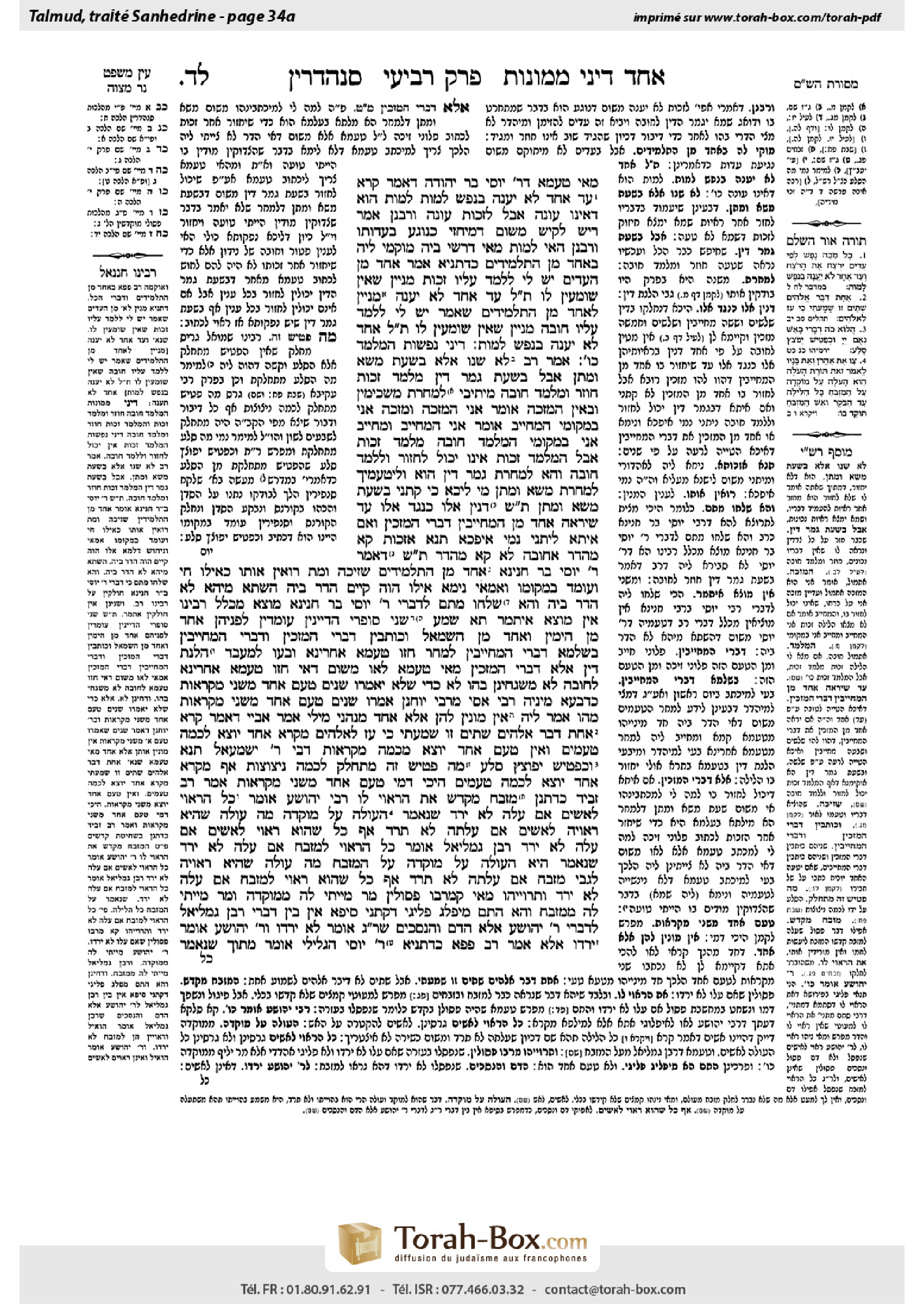
Sanhedrin 34a: Talmud study for Daf Yomi
Daf Yomi is the daily study of one Talmud folio. Explore 37 tractates with scans, Hebrew text, Sefaria English and AI-generated French translations where annotated.
Passage selection and English or AI-generated French translation are available where the scan has annotations. Daf Study is independent of Torah-Box and Sefaria.
Browse Sanhedrin · סנהדרין · All tractatesSanhedrin 34a text and translations
This page of Sanhedrin includes the Aramaic text, an English translation and an AI-generated French translation, alongside the scan above.
סנהדרין ל״ד א · Aramaic and Hebrew text
מַאי טַעְמָא דְּרַבִּי יוֹסֵי בַּר יְהוּדָה? דְּאָמַר קְרָא: ״עֵד אֶחָד לֹא יַעֲנֶה בְנֶפֶשׁ לָמוּת״. לָמוּת הוּא דְּאֵינוֹ עוֹנֶה, אֲבָל לִזְכוּת עוֹנֶה. וְרַבָּנַן? אָמַר רֵישׁ לָקִישׁ: מִשּׁוּם דְּמִיחֲזֵי כְּנוֹגֵעַ בְּעֵדוּתוֹ.
וְרַבָּנַן, הַאי ״לָמוּת״ מַאי דָּרְשִׁי בֵּיהּ? מוֹקְמִי לֵיהּ בְּאֶחָד מִן הַתַּלְמִידִים. כִּדְתַנְיָא: אָמַר אֶחָד מִן הָעֵדִים ״יֵשׁ לִי לְלַמֵּד עָלָיו זְכוּת״, מִנַּיִין שֶׁאֵין שׁוֹמְעִין לוֹ? תַּלְמוּד לוֹמַר: ״עֵד אֶחָד לֹא יַעֲנֶה״. מִנַּיִין לְאֶחָד מִן הַתַּלְמִידִים שֶׁאָמַר ״יֵשׁ לִי לְלַמֵּד עָלָיו חוֹבָה״, מִנַּיִין שֶׁאֵין שׁוֹמְעִין לוֹ? תַּלְמוּד לוֹמַר: ״אֶחָד לֹא יַעֲנֶה בְנֶפֶשׁ לָמוּת״.
דִּינֵי נְפָשׁוֹת: הַמְלַמֵּד כּוּ׳. אָמַר רַב: לֹא שָׁנוּ אֶלָּא בִּשְׁעַת מַשָּׂא וּמַתָּן, אֲבָל בִּשְׁעַת גְּמַר דִּין – מְלַמֵּד זְכוּת חוֹזֵר וּמְלַמֵּד חוֹבָה.
מֵיתִיבִי: לְמׇחֳרָת מַשְׁכִּימִין וּבָאִין. הַמְזַכֶּה אוֹמֵר: ״אֲנִי הַמְזַכֶּה, וּמְזַכֶּה אֲנִי בִּמְקוֹמִי״. הַמְחַיֵּיב אוֹמֵר: ״אֲנִי הַמְחַיֵּיב, וּמְחַיֵּיב אֲנִי בִּמְקוֹמִי״. הַמְלַמֵּד חוֹבָה מְלַמֵּד זְכוּת, אֲבָל הַמְלַמֵּד זְכוּת אֵינוֹ יָכוֹל לַחֲזוֹר וּלְלַמֵּד חוֹבָה.
וְהָא לַמׇּחֳרָת גְּמַר דִּין הוּא, וְלִיטַעְמָיךְ, לַמׇּחֳרָת מַשָּׂא וּמַתָּן מִי לֵיכָּא? כִּי קָתָנֵי בִּשְׁעַת מַשָּׂא וּמַתָּן.
תָּא שְׁמַע: דָּנִין אֵלּוּ כְּנֶגֶד אֵלּוּ, עַד שֶׁיִּרְאֶה אֶחָד מִן הַמְחַיְּיבִין דִּבְרֵי הַמְזַכִּין. וְאִם אִיתַהּ, לִיתְנֵי נָמֵי אִיפְּכָא! תַּנָּא אַזְּכוּת קָא מְהַדַּר, אַחוֹבָה לָא קָא מְהַדַּר.
תָּא שְׁמַע, דְּאָמַר רַבִּי יוֹסֵי בַּר חֲנִינָא: אֶחָד מִן הַתַּלְמִידִים שֶׁזִּיכָּה וָמֵת – רוֹאִין אוֹתוֹ כְּאִילּוּ חַי וְעוֹמֵד בִּמְקוֹמוֹ. וְאַמַּאי? נֵימָא: אִילּוּ הֲוָה קַיָּים, [הֲוָה] הָדַר בֵּיהּ! הַשְׁתָּא מִיהָא לָא הֲדַר בֵּיהּ.
וְהָא שְׁלַחוּ מִתָּם: לְדִבְרֵי רַבִּי יוֹסֵי בַּר חֲנִינָא, מוּצָא מִכְּלַל רַבֵּינוּ! ״אֵין מוּצָא״ אִיתְּמַר.
תָּא שְׁמַע: שְׁנֵי סוֹפְרֵי הַדַּיָּינִין עוֹמְדִין לִפְנֵיהֶן, אֶחָד מִן הַיָּמִין וְאֶחָד מִן הַשְּׂמֹאל, וְכוֹתְבִין דִּבְרֵי הַמְזַכִּין וְדִבְרֵי הַמְחַיְּיבִין.
בִּשְׁלָמָא דִּבְרֵי הַמְחַיְּיבִין, לִמְחַר חָזוּ טַעְמָא אַחֲרִינָא וּבָעוּ לְמֶעְבַּד הֲלָנַת דִּין. אֶלָּא דִּבְרֵי הַמְזַכִּין, מַאי טַעְמָא? לָאו מִשּׁוּם דְּאִי חָזוּ טַעְמָא אַחֲרִינָא לְחוֹבָה, לָא מַשְׁגְּחִינַן בְּהוּ?
לֹא, כְּדֵי שֶׁלֹּא יֹאמְרוּ שְׁנַיִם טַעַם אֶחָד מִשְּׁנֵי מִקְרָאוֹת. כְּדִבְעָא מִינֵּיהּ רַבִּי אַסִּי מֵרַבִּי יוֹחָנָן: אָמְרוּ שְׁנַיִם טַעַם אֶחָד מִשְּׁנֵי מִקְרָאוֹת, מַהוּ? אֲמַר לֵיהּ: אֵין מוֹנִין לָהֶן אֶלָּא אֶחָד.
מְנָהָנֵי מִילֵּי? אָמַר אַבָּיֵי: דְּאָמַר קְרָא ״אַחַת דִּבֶּר אֱלֹהִים שְׁתַּיִם זוּ שָׁמָעְתִּי כִּי עֹז לֵאלֹהִים״. מִקְרָא אֶחָד יוֹצֵא לְכַמָּה טְעָמִים, וְאֵין טַעַם אֶחָד יוֹצֵא מִכַּמָּה מִקְרָאוֹת. דְּבֵי רַבִּי יִשְׁמָעֵאל תָּנָא: ״וּכְפַטִּישׁ יְפֹצֵץ סָלַע״ – מָה פַּטִּישׁ זֶה מִתְחַלֵּק לְכַמָּה נִיצוֹצוֹת, אַף מִקְרָא אֶחָד יוֹצֵא לְכַמָּה טְעָמִים.
הֵיכִי דָּמֵי טַעַם אֶחָד מִשְּׁנֵי מִקְרָאוֹת? אָמַר רַב זְבִיד, כְּדִתְנַן: מִזְבֵּחַ מְקַדֵּשׁ אֶת הָרָאוּי לוֹ.
רַבִּי יְהוֹשֻׁעַ אוֹמֵר: כׇּל הָרָאוּי לָאִשִּׁים, אִם עָלָה – לֹא יֵרֵד, שֶׁנֶּאֱמַר: ״הָעֹלָה עַל מוֹקְדָה״. מָה עוֹלָה שֶׁהִיא רְאוּיָה לָאִשִּׁים, אִם עָלְתָה – לֹא תֵּרֵד, אַף כֹּל שֶׁהוּא רָאוּי לָאִשִּׁים, אִם עָלָה – לֹא יֵרֵד.
רַבָּן גַּמְלִיאֵל אוֹמֵר: כׇּל הָרָאוּי לַמִּזְבֵּחַ, אִם עָלָה – לֹא יֵרֵד, שֶׁנֶּאֱמַר: ״הִיא הָעֹלָה עַל מוֹקְדָה עַל הַמִּזְבֵּחַ״. מָה עוֹלָה שֶׁהִיא רְאוּיָה לְגַבֵּי מִזְבֵּחַ – אִם עָלְתָה לֹא תֵּרֵד, אַף כֹּל שֶׁהוּא רָאוּי לְמִזְבֵּחַ – אִם עָלָה לֹא יֵרֵד.
וְתַרְוַיְיהוּ מַאי קָמְרַבּוּ? פְּסוּלִין. מָר מַיְיתֵי לַהּ מִ״מּוֹקְדָה״, וּמָר מַיְיתֵי לַהּ מִ״מִּזְבֵּחַ״.
וְהָא הָתָם מִיפְלָג פְּלִיגִי, דְּקָתָנֵי סֵיפָא: אֵין בֵּין דִּבְרֵי רַבָּן גַּמְלִיאֵל לְדִבְרֵי רַבִּי יְהוֹשֻׁעַ אֶלָּא הַדָּם וְהַנְּסָכִים, שֶׁרַבָּן גַּמְלִיאֵל אוֹמֵר: לֹא יֵרְדוּ, וְרַבִּי יְהוֹשֻׁעַ אוֹמֵר: יֵרְדוּ.
אֶלָּא אָמַר רַב פָּפָּא: כִּדְתַנְיָא, רַבִּי יוֹסֵי הַגְּלִילִי אוֹמֵר: מִתּוֹךְ שֶׁנֶּאֱמַר
Sanhedrin 34a · English translation
The Gemara explains: What is the reason of Rabbi Yosei, son of Rabbi Yehuda? As the verse states: “But one witness shall not testify against any person that he die.” One can infer: That he die is the matter concerning which he does not testify, but he does testify to acquit. The Gemara asks: And what is the reasoning of the Rabbis? Reish Lakish says: A witness cannot offer any statements beyond his testimony because it appears as though he is biased in his testimony. If the court finds the accused liable based on the witness’s testimony, the witness could later be accused of being a conspiring witness. Therefore, it is to his advantage to have the court acquit the accused.
The Gemara asks: And as for the Rabbis, in what manner do they interpret this term: “That he die”? The Gemara answers: They establish it as teaching the halakha with regard to one of the students. As it is taught in a baraita: If one of the witnesses said: I have the ability to teach a reason to acquit him, from where is it derived that the court does not listen to him? The verse states: “One witness shall not testify.” From where is it derived that if there is one of the students who said: I have the ability to teach a reason to deem him liable, from where is it derived that the court does not listen to him? The verse states: “But one witness shall not testify against any person that he die.”
§ The mishna teaches: In cases of capital law, one who initially teaches a reason to deem the accused liable may then teach a reason to acquit, but one who initially teaches a reason to acquit him may not return and teach a reason to deem him liable. Rav says: They taught this halakha only with regard to the time of the deliberations of the court, but at the time of the verdict, one who initially teaches a reason to acquit may return and teach a reason to deem him liable.
The Gemara raises an objection from a mishna (40a): The following day, i.e., the day after the initial deliberations, the judges would arise early and come to court. One who yesterday was of the opinion to acquit says: I said to acquit, and I acquit in my place, i.e., I stand by my statement to acquit. And one who yesterday was of the opinion to deem him liable says: I said to deem him liable, and I deem him liable in my place. One who yesterday taught a reason to deem him liable may then teach a reason to acquit, but one who yesterday taught a reason to acquit may not then teach a reason to deem him liable.
The Gemara explains the objection: But the following day is at the time of the verdict, and the mishna rules that a judge who had said to acquit may not change his opinion. The Gemara questions this reading of the mishna: And according to your reasoning, are there no deliberations on the following day? The deliberations may resume on the next day. Therefore, one can say that when the mishna teaches that the judge may not change his opinion, it is with regard to the time of the deliberations.
The Gemara suggests: Come and hear a proof from the continuation of that mishna, which teaches that if the number of judges who deem him liable is one more than the number of judges who acquit, they continue to deliberate the matter, these judges against those judges, until one of those who deems him liable sees the validity of the statements of those who acquit and changes his position, as the court does not condemn someone to death by a majority of one judge. The Gemara states its proof: And if it is so that one who initially teaches a reason to acquit may return and teach a reason to deem him liable, let the mishna also teach the opposite possibility. The Gemara explains: The tanna is searching for scenarios of acquittal, he is not searching for scenarios of liability. It may be that the halakha is the same in the opposite case, but the tanna prefers to employ an example of acquittal.
The Gemara suggests: Come and hear a proof from a baraita: As Rabbi Yosei bar Ḥanina says: In a case where there was one of the students who argued to acquit and then died, the court views him as if he were alive and standing in his place and voting to acquit. The Gemara asks: But why? According to the opinion of Rav, that a judge may change his opinion at the time of the verdict, let us say: Perhaps if that student were alive, he would retract his opinion and find the accused liable. The Gemara explains: Now, in any event, he did not retract from his opinion. The assumption is that he would not have changed his opinion, although one can do so.
The Gemara questions this explanation: But the Sages sent a statement from there, Eretz Yisrael: According to this version of the statement of Rabbi Yosei bar Ḥanina, he engages in a dispute with our teacher, i.e., Rav. Apparently, the previous explanation, which reconciles their opinions, is incorrect. The Gemara answers: That tradition was not accurate, and it was stated that he does not engage in a dispute with Rav.
The Gemara suggests: Come and hear a proof from a baraita: After the initial deliberations, two judges’ scribes stand before the court, one on the right, and one on the left, and they write the statements of those who acquit the accused and the statements of those who find him liable.
The Gemara explains the proof: Granted, they write the statements of those who find the accused liable even though they may not change their opinions, as on the following day they may see another reason to find the accused liable, not the reason they gave the day before. And once this new reason is given, the court is required to perform a suspension of the trial until the following day, as they may not issue a verdict in cases of capital law on the same day as the deliberations. But what is the reason the scribes write the statements of those who acquit the accused? Is it not because the halakha is that if the judges would see another reason to find the accused liable, we do not pay heed to them, and in order to ensure that the judges do not change their opinions, the scribes write their statements?
The Gemara answers: No, the reason they write their statements is so that two of the judges should not say one explanation to acquit from two different verses. If two judges each say the same reason to acquit, but derive their reason from different verses, they are not counted as two votes. As Rabbi Asi asked of Rabbi Yoḥanan: If two of the judges say one explanation to acquit from two different verses, what is the halakha? Rabbi Yoḥanan said to him: We count them only as one, as it is clear that one of the derivations is in error.
§ The Gemara discusses the ruling of Rabbi Yoḥanan: From where is this matter derived? Abaye says: As the verse states: “God has spoken once, twice I have heard this; that strength belongs to God” (Psalms 62:12). Abaye explains: One verse is stated by God and from it emerge several explanations, but one explanation does not emerge from several verses. Alternatively, the school of Rabbi Yishmael taught that the verse states: “Is not My word like as fire? says the Lord; and like a hammer that breaks the rock in pieces” (Jeremiah 23:29). Just as this hammer breaks a stone into several fragments, so too, one verse is stated by God and from it emerge several explanations.
The Gemara clarifies: What is considered one explanation from two different verses? Rav Zevid says: As we learned in a mishna (Zevaḥim 83a): With regard to certain items that are disqualified from being sacrificed ab initio, once they have been placed on the altar they are nevertheless sacrificed, but the altar sanctifies only items that are suited for it, as the Gemara will explain. The tanna’im disagree as to what is considered suited for the altar.
Rabbi Yehoshua says: Any item that is suited to be consumed by the fire on the altar, e.g., burnt-offerings and the portions of other offerings burned on the altar, if it ascended upon the altar, even if it is disqualified from being sacrificed ab initio, it shall not descend. Since it was sanctified by its ascent upon the altar, it is sacrificed upon it, as it is stated: “It is the burnt-offering on the pyre upon the altar” (Leviticus 6:2), from which it is derived: Just as with regard to a burnt-offering that is suited to be consumed by the fire on the altar, if it ascended, it shall not descend, so too with regard to any item that is suited to be consumed by the fire on the altar, if it ascended, it shall not descend.
Rabban Gamliel says: With regard to any item that is suited to ascend upon the altar, even if it is not typically consumed, if it ascended, it shall not descend, even if it is disqualified from being sacrificed ab initio, as it is stated: “It is the burnt-offering on the pyre upon the altar,” from which it is derived: Just as a burnt-offering that is fit for the altar, if it ascended, it shall not descend, so too any item that is fit for the altar, if it ascended, it shall not descend.
Rav Zevid explains: And what do the two of them include by means of these explanations? Disqualified offerings, teaching that if they ascend they do not descend. One Sage, Rabbi Yehoshua, brings proof for this halakha from the term “on the pyre,” and one Sage, Rabban Gamliel, brings proof to this halakha from the term “upon the altar.” This is an example of one explanation from two different verses.
The Gemara questions this example: But there, Rabbi Yehoshua and Rabban Gamliel disagree, and their explanations cannot therefore be identical. As the latter clause of that mishna teaches: The difference between the statement of Rabban Gamliel and the statement of Rabbi Yehoshua is only with regard to disqualified blood and libations, which are not consumed by the fire, but do ascend onto the altar, as Rabban Gamliel says: They shall not descend, as they are fit to ascend on the altar, and Rabbi Yehoshua says: They shall descend, as they are not burned on the altar.
Rather, Rav Pappa says: An example of one explanation from two different verses is as it is taught in a baraita: Rabbi Yosei HaGelili says: From the fact that it is stated:
Sanhedrin 34a · Traduction française (IA)
La Guemara explique : Quelle est la raison de Rabbi Yosei, fils de Rabbi Yehuda ? Le verset dit : « Un seul témoin ne témoignera pas contre une personne pour la faire mourir. » On peut en déduire que le témoin ne témoigne pas pour la faire mourir, mais qu’il témoigne pour l’acquitter. La Guemara demande : Et quel est le raisonnement des Sages ? Reish Lakish dit : Un témoin ne peut rien ajouter à son témoignage, car cela donnerait l’impression qu’il est partial. Si le tribunal déclare l’accusé coupable sur la base de son témoignage, le témoin pourrait ensuite être accusé d’être un témoin comploteur. Il a donc intérêt à ce que le tribunal acquitte l’accusé.
La Guemara demande : Et comment les Sages interprètent-ils l’expression « pour le faire mourir » ? La Guemara répond : Ils y voient un enseignement concernant l’un des élèves. En effet, il est enseigné dans une baraïta : Si l’un des témoins dit : « Je peux avancer un argument pour l’acquitter », d’où apprend-on que le tribunal ne l’écoute pas ? Le verset dit : « Un seul témoin ne témoignera pas. » D’où apprend-on que, si l’un des élèves dit : « Je peux avancer un argument pour le déclarer coupable », le tribunal ne l’écoute pas ? Le verset dit : « Un seul témoin ne témoignera pas contre une personne pour la faire mourir. »
§ La Michna enseigne : Dans les affaires de droit pénal, celui qui avance d’abord un argument pour déclarer l’accusé coupable peut ensuite en avancer un pour l’acquitter, mais celui qui avance d’abord un argument pour l’acquitter ne peut pas ensuite en avancer un pour le déclarer coupable. Rav dit : Cette halakha n’a été enseignée qu’au sujet du temps des délibérations du tribunal ; au moment du verdict, celui qui avance d’abord un argument pour acquitter peut ensuite en avancer un pour déclarer l’accusé coupable.
La Guemara soulève une objection à partir d’une Michna (40a) : Le lendemain, c’est-à-dire le jour suivant les délibérations initiales, les juges se levaient tôt et se rendaient au tribunal. Celui qui, la veille, était d’avis d’acquitter dit : « J’ai dit qu’il fallait acquitter, et je maintiens mon avis. » Celui qui, la veille, était d’avis de le déclarer coupable dit : « J’ai dit qu’il fallait le déclarer coupable, et je maintiens mon avis. » Celui qui avait avancé la veille un argument pour le déclarer coupable peut ensuite en avancer un pour l’acquitter, mais celui qui avait avancé la veille un argument pour l’acquitter ne peut pas ensuite en avancer un pour le déclarer coupable.
La Guemara explique l’objection : Or, le lendemain correspond au moment du verdict, et la Michna statue qu’un juge qui avait dit qu’il fallait acquitter ne peut pas changer d’avis. La Guemara conteste cette lecture de la Michna : Et, selon votre raisonnement, n’y a-t-il pas de délibérations le lendemain ? Les délibérations peuvent reprendre le jour suivant. On peut donc dire que, lorsque la Michna enseigne que le juge ne peut pas changer d’avis, elle parle du temps des délibérations.
La Guemara propose : Viens entendre une preuve tirée de la suite de cette Michna, qui enseigne que, si les juges qui le déclarent coupable sont plus nombreux d’une voix que ceux qui l’acquittent, ils poursuivent les délibérations, les uns face aux autres, jusqu’à ce que l’un des juges qui le déclarent coupable reconnaisse la validité des arguments de ceux qui l’acquittent et change de position, car le tribunal ne condamne pas quelqu’un à mort à la majorité d’une seule voix. La Guemara formule sa preuve : S’il en est ainsi, si celui qui avance d’abord un argument pour acquitter peut ensuite en avancer un pour déclarer l’accusé coupable, que la Michna enseigne aussi la possibilité inverse. La Guemara explique : Le tanna cherche des situations d’acquittement, et non des situations de condamnation. Il se peut que la halakha soit la même dans le cas inverse, mais le tanna préfère donner un exemple d’acquittement.
La Guemara propose : Viens entendre une preuve tirée d’une baraïta. Rabbi Yosei bar Ḥanina dit : Si l’un des élèves a plaidé pour l’acquittement puis est mort, le tribunal le considère comme s’il était vivant, debout à sa place et votant pour l’acquittement. La Guemara demande : Mais pourquoi ? Selon l’opinion de Rav, d’après laquelle un juge peut changer d’avis au moment du verdict, disons que, si cet élève était vivant, il reviendrait peut-être sur son opinion et déclarerait l’accusé coupable. La Guemara explique : En tout état de cause, jusqu’à présent, il n’est pas revenu sur son opinion. On suppose donc qu’il ne l’aurait pas changée, même s’il en avait eu la possibilité.
La Guemara conteste cette explication : Mais les Sages ont envoyé de là-bas, d’Eretz Israël, un enseignement selon lequel, d’après cette version de la déclaration de Rabbi Yosei bar Ḥanina, celui-ci est en désaccord avec notre maître, c’est-à-dire Rav. Apparemment, l’explication précédente, qui concilie leurs opinions, est incorrecte. La Guemara répond : Cette tradition n’était pas exacte ; il a été enseigné qu’il n’est pas en désaccord avec Rav.
La Guemara propose : Viens entendre une preuve tirée d’une baraïta : Après les délibérations initiales, les scribes de deux juges se tiennent devant le tribunal, l’un à droite et l’autre à gauche, et consignent les arguments de ceux qui acquittent l’accusé ainsi que ceux de ceux qui le déclarent coupable.
La Guemara explique la preuve : Il est compréhensible qu’ils consignent les arguments de ceux qui déclarent l’accusé coupable, même s’ils ne peuvent pas changer d’avis, car le lendemain, ils peuvent trouver un autre argument pour le déclarer coupable, différent de celui qu’ils ont avancé la veille. Dès lors qu’un nouvel argument est avancé, le tribunal doit suspendre le procès jusqu’au lendemain, car il ne peut pas rendre de verdict dans une affaire de droit pénal le jour même des délibérations. Mais pourquoi les scribes consignent-ils les arguments de ceux qui acquittent l’accusé ? N’est-ce pas parce que, selon la halakha, si les juges trouvaient un autre argument pour déclarer l’accusé coupable, nous n’en tiendrions pas compte, et que les scribes consignent leurs arguments afin de s’assurer qu’ils ne changent pas d’avis ?
La Guemara répond : Non, ils consignent leurs arguments afin que deux juges ne donnent pas la même explication en faveur de l’acquittement à partir de deux versets différents. Si deux juges avancent le même motif d’acquittement, mais le déduisent de versets différents, ils ne comptent pas comme deux voix. Rabbi Asi demanda à Rabbi Yoḥanan : Si deux juges donnent la même explication en faveur de l’acquittement à partir de deux versets différents, quelle est la halakha ? Rabbi Yoḥanan lui répondit : Nous ne les comptons que comme une seule voix, car il est clair que l’une des déductions est erronée.
§ La Guemara examine la décision de Rabbi Yoḥanan : De quoi cette règle est-elle déduite ? Abaye dit : Le verset dit : « Dieu a parlé une fois, deux fois je l’ai entendu : la force appartient à Dieu » (Psaumes 62:12). Abaye explique : Dieu énonce un verset dont découlent plusieurs explications, mais une seule explication ne découle pas de plusieurs versets. Autrement, l’école de Rabbi Yishmael enseigne que le verset dit : « Ma parole n’est-elle pas comme un feu, dit l’Éternel, et comme un marteau qui fait éclater le rocher ? » (Jérémie 23:29). De même que ce marteau brise une pierre en plusieurs fragments, de même Dieu énonce un verset dont découlent plusieurs explications.
La Guemara précise : Qu’entend-on par une même explication tirée de deux versets différents ? Rav Zevid dit : Comme nous l’avons appris dans une Michna (Zevaḥim 83a) : Certains éléments, invalides pour être offerts a priori, sont néanmoins offerts une fois placés sur l’autel ; toutefois, l’autel ne sanctifie que les éléments qui lui sont aptes, comme la Guemara va l’expliquer. Les tannaïm sont en désaccord sur ce qui est considéré comme apte pour l’autel.
Rabbi Yehoshua dit : Tout élément destiné à être consumé par le feu sur l’autel, par exemple les holocaustes et les parties d’autres offrandes brûlées sur l’autel, s’il est monté sur l’autel, ne doit pas en être descendu, même s’il est invalide pour être offert a priori. Puisqu’il a été sanctifié en montant sur l’autel, il y est offert, comme il est dit : « C’est l’holocauste, sur le foyer, sur l’autel » (Lévitique 6:2). On en déduit que, de même qu’un holocauste destiné à être consumé par le feu sur l’autel, s’il y est monté, ne doit pas en être descendu, de même tout élément destiné à être consumé par le feu sur l’autel, s’il y est monté, ne doit pas en être descendu.
Rabban Gamliel dit : Tout élément apte à monter sur l’autel, même s’il n’est généralement pas consumé, s’il y est monté, ne doit pas en être descendu, même s’il est invalide pour être offert a priori. Le verset dit : « C’est l’holocauste, sur le foyer, sur l’autel », d’où l’on déduit que, de même qu’un holocauste apte pour l’autel, s’il y est monté, ne doit pas en être descendu, de même tout élément apte pour l’autel, s’il y est monté, ne doit pas en être descendu.
Rav Zevid explique : Et qu’incluent-ils tous deux au moyen de ces explications ? Les offrandes invalides, pour enseigner que, si elles montent sur l’autel, elles n’en descendent pas. Un Sage, Rabbi Yehoshua, tire la preuve de cette halakha de l’expression « sur le foyer », et l’autre Sage, Rabban Gamliel, la tire de l’expression « sur l’autel ». C’est un exemple d’une même explication tirée de deux versets différents.
La Guemara conteste cet exemple : Mais, dans ce cas, Rabbi Yehoshua et Rabban Gamliel sont en désaccord ; leurs explications ne peuvent donc pas être identiques. En effet, la fin de cette Michna enseigne : La différence entre l’opinion de Rabban Gamliel et celle de Rabbi Yehoshua ne concerne que le sang invalidé et les libations, qui ne sont pas consumés par le feu mais montent néanmoins sur l’autel. Rabban Gamliel dit : Ils ne doivent pas en être descendus, car ils sont aptes à monter sur l’autel ; Rabbi Yehoshua dit : Ils doivent en être descendus, car ils ne sont pas brûlés sur l’autel.
Mais Rav Pappa dit plutôt : Un exemple d’une même explication tirée de deux versets différents se trouve dans cette baraïta : Rabbi Yosei HaGelili dit : Du fait qu’il est dit :
Traduction française générée par IA à partir de l’édition anglaise de Sefaria. Vérifie toujours un passage avec le texte source.
Text from Sefaria: William Davidson Edition - Vocalized Aramaic (CC BY NC); William Davidson Edition - English (CC BY NC).