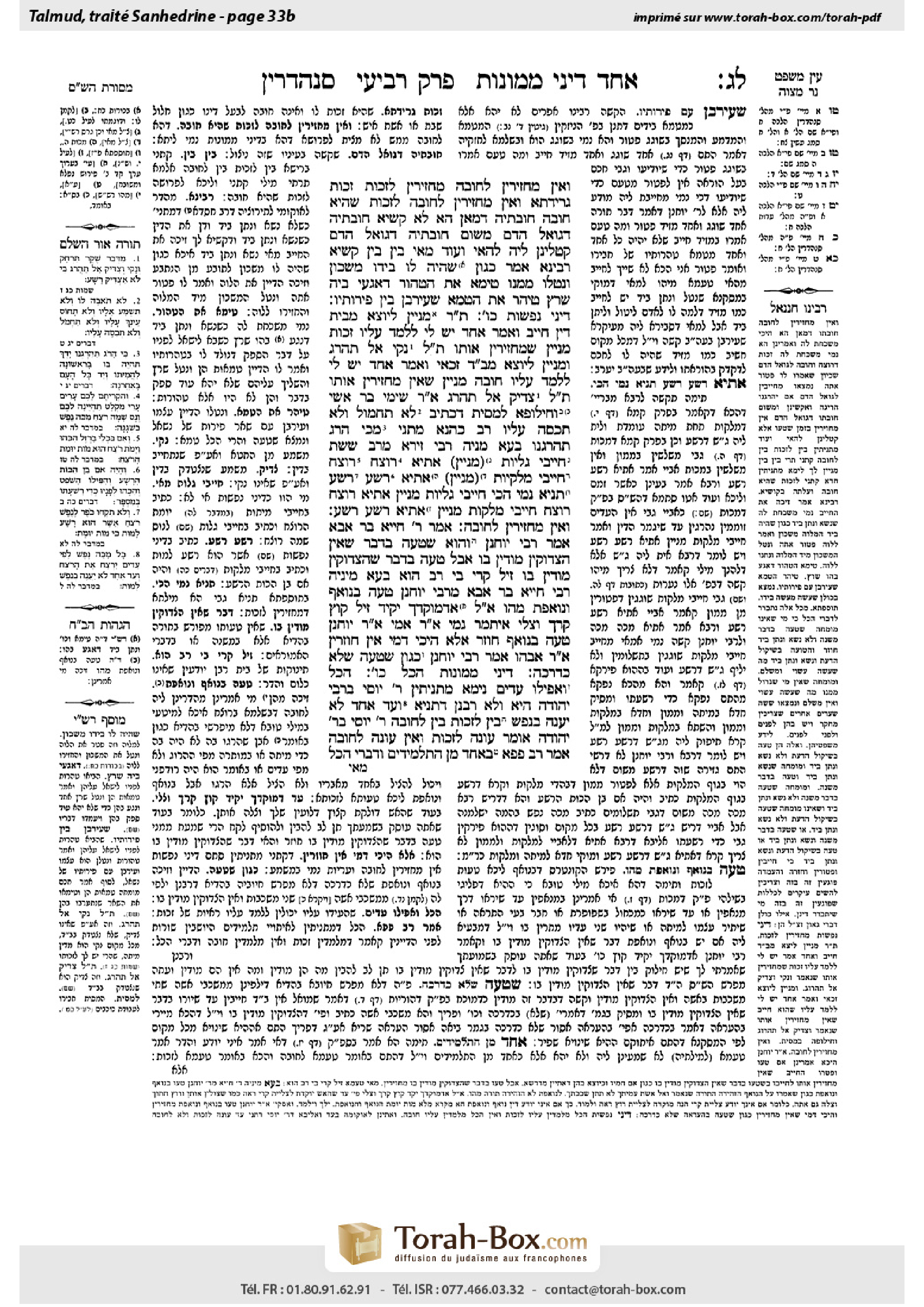
Sanhedrin 33b: Talmud study for Daf Yomi
Daf Yomi is the daily study of one Talmud folio. Explore 37 tractates with scans, Hebrew text, Sefaria English and AI-generated French translations where annotated.
Passage selection and English or AI-generated French translation are available where the scan has annotations. Daf Study is independent of Torah-Box and Sefaria.
Browse Sanhedrin · סנהדרין · All tractatesSanhedrin 33b text and translations
This page of Sanhedrin includes the Aramaic text, an English translation and an AI-generated French translation, alongside the scan above.
סנהדרין ל״ג ב · Aramaic and Hebrew text
וְאֵין מַחְזִירִין לְחוֹבָה. מַחְזִירִין לִזְכוּת – זְכוּת גְּרֵידְתָּא, וְאֵין מַחְזִירִין לְחוֹבָה – לִזְכוּת שֶׁהִיא חוֹבָה.
חוֹבְתֵיהּ דְּמַאן? הָא לָא קַשְׁיָא, חוֹבְתֵיהּ דְּגוֹאֵל הַדָּם. מִשּׁוּם חוֹבְתֵיהּ דְּגוֹאֵל הַדָּם קָטְלִינַן לֵיהּ לְהַאי? וְעוֹד, מַאי ״בֵּין״ ״בֵּין״? קַשְׁיָא.
רָבִינָא אָמַר: כְּגוֹן שֶׁהָיָה לוֹ בְּיָדוֹ מַשְׁכּוֹן, וּנְטָלוֹ מִמֶּנּוּ.
טִימֵּא אֶת הַטָּהוֹר, דְּאַגַּע בֵּיהּ שֶׁרֶץ. טִיהֵר אֶת הַטָּמֵא, שֶׁעֵירְבָן בֵּין פֵּירוֹתָיו.
דִּינֵי נְפָשׁוֹת כּוּ׳. תָּנוּ רַבָּנַן: מִנַּיִין לְיוֹצֵא מִבֵּית דִּין חַיָּיב, וְאָמַר אֶחָד ״יֵשׁ לִי לְלַמֵּד עָלָיו זְכוּת״, מִנַּיִין שֶׁמַּחְזִירִין אוֹתוֹ? תַּלְמוּד לוֹמַר ״נָקִי אַל תַּהֲרֹג״.
וּמִנַּיִין לְיוֹצֵא מִבֵּית דִּין זַכַּאי, וְאָמַר אֶחָד: ״יֵשׁ לִי לְלַמֵּד עָלָיו חוֹבָה״, מִנַּיִין שֶׁאֵין מַחְזִירִין אוֹתוֹ? תַּלְמוּד לוֹמַר: ״צַדִּיק אַל תַּהֲרֹג״.
אָמַר רַב שִׁימִי בַּר אָשֵׁי: וְחִילּוּפָא לְמֵסִית, דִּכְתִיב ״לֹא תַחְמֹל וְלֹא תְכַסֶּה עָלָיו״. רַב כָּהֲנָא מַתְנֵי מִ״כִּי הָרֹג תַּהַרְגֶנּוּ״.
בְּעָא מִנֵּיהּ רַבִּי זֵירָא מֵרַב שֵׁשֶׁת: חַיָּיבֵי גָּלִיּוֹת מִנַּיִין? אָתְיָא ״רֹצֵחַ״ ״רֹצֵחַ״.
חַיָּיבֵי מַלְקִיּוֹת מִנַּיִין? אָתְיָא ״רָשָׁע״ ״רָשָׁע״.
תַּנְיָא נָמֵי הָכִי: חַיָּיבֵי גָּלִיּוֹת מִנַּיִין? אַתְיָא ״רֹצֵחַ״ ״רֹצֵחַ״. חַיָּיבֵי מַלְקוֹת מִנַּיִין? אָתְיָא ״רָשָׁע״ ״רָשָׁע״.
וְאֵין מַחְזִירִין לְחוֹבָה. אָמַר רַבִּי חִיָּיא בַּר אַבָּא אָמַר רַבִּי יוֹחָנָן: וְהוּא שֶׁטָּעָה בְּדָבָר שֶׁאֵין הַצַּדּוּקִין מוֹדִין בּוֹ, אֲבָל טָעָה בִּדְבַר שֶׁהַצַּדּוּקִין מוֹדִין בּוֹ – זִיל קְרִי בֵּי רַב הוּא.
בְּעָא מִינֵּיהּ רַבִּי חִיָּיא בַּר אַבָּא מֵרַבִּי יוֹחָנָן: טָעָה בְּנוֹאֵף וְנוֹאֶפֶת מַהוּ? אֲמַר לֵיהּ: אַדְּמוֹקְדָךְ יְקִיד, זִיל קוּץ קָרָךְ וּצְלִי. אִיתְּמַר נָמֵי, אָמַר רַבִּי אַמֵּי אָמַר רַבִּי יוֹחָנָן: טָעָה בְּנוֹאֵף – חוֹזֵר.
אֶלָּא הֵיכִי דָּמֵי אֵין חוֹזְרִין? אָמַר רַבִּי אֲבָהוּ אָמַר רַבִּי יוֹחָנָן: כְּגוֹן שֶׁטָּעָה שֶׁלֹּא כְּדַרְכָּהּ.
דִּינֵי מָמוֹנוֹת הַכֹּל כּוּ׳. הַכֹּל, וַאֲפִילּוּ עֵדִים? נֵימָא מַתְנִיתִין רַבִּי יוֹסֵי בְּרַבִּי יְהוּדָה הִיא, וְלָא רַבָּנַן?
דְּתַנְיָא: ״וְעֵד אֶחָד לֹא יַעֲנֶה בְנֶפֶשׁ״ – בֵּין לִזְכוּת בֵּין לְחוֹבָה. רַבִּי יוֹסֵי בְּרַבִּי יְהוּדָה אוֹמֵר: עוֹנֶה לִזְכוּת, וְאֵין עוֹנֶה לְחוֹבָה.
אָמַר רַב פָּפָּא: בְּאֶחָד מִן הַתַּלְמִידִים, וְדִבְרֵי הַכֹּל.
Sanhedrin 33b · English translation
but they do not bring him back to be judged with a claim to find him liable. When the mishna says: The court brings the accused back to acquit him, this is an acquittal alone and is not to anyone’s liability. When it says: But they do not bring him back to be judged with a claim to find him liable, this is an acquittal that is also a liability. The court does not bring the accused back to acquit him if this entails a liability to another.
The Gemara clarifies: A liability for whom? There is no other litigant in cases of capital law. The Gemara answers: This is not difficult, this is to the liability, i.e., the detriment, of the blood redeemer, as he desires that the murderer be killed, and he will no longer be allowed to kill him. The Gemara questions this explanation: Is it reasonable that due to the liability of the blood redeemer, we kill this one and do not reverse the verdict to acquit him even when there is a reason to do so? And further, what is the meaning of the term: Whether with a claim to exempt the accused, or whether with a claim to find him liable? It is clear that this is referring to two separate matters, not to two types of acquittal. The Gemara comments: This is difficult.
The Gemara cites another explanation of how one can find a judge giving the item from one to another with regard to the clause of: He exempts a liable party. Ravina said: It is possible in a case where the one who lodged the claim had in his possession an item belonging to the other litigant that functioned as collateral for a debt, and when the judge issued a verdict in favor of the other he took the collateral from him, thereby physically transferring it to the wrong party.
In the case from the mishna in tractate Bekhorot: He ruled that a pure item is impure, how could he cause a loss with his own hands? It is where he had the litigant’s ritually pure item touch a creeping animal to emphasize that he believes it was already impure, and he thereby imparted impurity to it. In that mishna’s case of: He ruled that an impure item is pure, how could he cause a loss with his own hands? It is where he mixed this impure produce of the litigant’s with the litigant’s ritually pure produce, and he thereby caused all of the produce to be considered impure.
§ The mishna teaches that in cases of capital law, the court brings the accused back to be judged again with a claim to acquit him, but does not bring him back to be judged with a claim to find him liable. To explain the terms “innocent” and “righteous” in the verse: “And the innocent and the righteous you shall not slay” (Exodus 23:7), the Sages taught: From where is it derived that with regard to one who is leaving the court having been found liable, and someone said: I have the ability to teach a reason to acquit him, from where is it derived that the court brings the accused back to be judged again? The verse states: The innocent you shall not slay, and the accused may in fact be innocent.
And from where is it derived that with regard to one who is leaving the court, having been acquitted, and someone says: I have the ability to teach a reason to find him liable, from where is it derived that the court does not bring the accused back to be judged again? The verse states: “The righteous you shall not slay,” and the accused was found righteous in his trial.
Rav Shimi bar Ashi says: And the opposite of this is the halakha with regard to one who entices others to engage in idol worship, as it is written concerning him: “Neither shall you spare, neither shall you conceal him” (Deuteronomy 13:9). He is brought back to court to find him liable, but not to acquit him. Rav Kahana teaches this last halakha citing a different verse concerning the enticer: “But you shall kill him [harog tahargennu]” (Deuteronomy 13:10). The repetition of the verb indicates that he is killed even in circumstances where transgressors of other prohibitions would not be.
Rabbi Zeira asked Rav Sheshet: From where is it derived that the halakha concerning those liable to be exiled to a city of refuge for killing unintentionally is the same with regard to retrying a court case as the halakha concerning one who killed intentionally, who is found liable to receive court-imposed capital punishment? Rav Sheshet answered: It is derived from a verbal analogy employing the term “murderer” stated with regard to one who kills intentionally (see Numbers 35:16) and the term “murderer” stated with regard to one who kills unintentionally (see Numbers 35:19).
Rabbi Zeira asked Rav Sheshet: From where is it derived that the halakha concerning those liable to receive forty lashes is the same with regard to retrying a court case as the halakha concerning one who killed intentionally, who is found liable to receive court-imposed capital punishment? Rav Sheshet answered: It is derived from a verbal analogy employing the term “wicked” stated with regard to one who kills intentionally (see Numbers 35:31) and the term “wicked” stated with regard to those liable to receive lashes (see Deuteronomy 25:2).
The Gemara comments: This is also taught in a baraita (Tosefta 7:3): From where is it derived that the halakha concerning those liable to be exiled for killing unintentionally is the same with regard to retrying a court case as the halakha concerning one who killed intentionally, who is found liable to receive court-imposed capital punishment? It is derived from a verbal analogy employing the term “murderer” stated with regard to one who kills intentionally and the term “murderer” stated with regard to one who kills unintentionally. From where is it derived that the halakha concerning those liable to receive forty lashes is the same with regard to retrying a court case as the halakha concerning one who killed intentionally, who is found liable to receive court-imposed capital punishment? It is derived from a verbal analogy employing the term “wicked” stated with regard to one who kills intentionally and the term “wicked” stated with regard to those liable to receive lashes.
§ The mishna teaches concerning cases of capital law: But the court does not bring him back to be judged with a claim to find him liable. Rabbi Ḥiyya bar Abba says that Rabbi Yoḥanan says: And this is the halakha only in a case where the judge erred with regard to a matter for which the Sadducees do not admit to its validity, i.e., he erred in a matter learned from tradition or established by the Sages. But if the judge erred in a matter for which the Sadducees admit to its validity, i.e., a matter that is written explicitly in the Torah, it is a topic that you could go learn in a children’s school, and such an error negates the verdict and is reversed.
Rabbi Ḥiyya bar Abba asked of Rabbi Yoḥanan: What is the halakha in the case of a judge who erred with regard to the judgment of an adulterer and adulteress, by ruling that only the man is liable but not the woman? Rabbi Yoḥanan said to him: While your fire is burning, cut your squash and roast it, i.e., seize the opportunity to add this case to the principle I taught you earlier. It was also stated: Rabbi Ami says that Rabbi Yoḥanan says: Concerning a judge who erred with regard to an adulterer, the court revokes the verdict.
The Gemara asks: Rather, what are the circumstances where the court does not revoke the acquittal? Rabbi Abbahu says that Rabbi Yoḥanan says: In a case where he erred and acquitted the adulterer who engaged in sexual intercourse in an atypical manner, i.e., anal intercourse. The halakha that this is considered sexual intercourse is not explicit in a verse. Therefore, if a court acquits one so accused, the verdict is not revoked.
§ The mishna teaches that in cases of monetary law, all those present at the trial may teach a reason to exempt a litigant or to find him liable. In cases of capital law, all those present at the trial may teach a reason to acquit the accused, but not all present may teach a reason to find him liable. The Gemara asks: In capital cases, may all those present teach a reason to acquit, and even witnesses? The Gemara suggests: Let us say that the mishna is in accordance with the opinion of Rabbi Yosei, son of Rabbi Yehuda, and not in accordance with the opinion of the Rabbis.
The Gemara explains: As it is taught in a baraita: The verse states: “But one witness shall not testify against any person that he die” (Numbers 35:30). A witness cannot state anything other than his testimony, whether to provide a reason to acquit the accused or to provide a reason to find him liable; this is the opinion of the Rabbis. Rabbi Yosei, son of Rabbi Yehuda, says: A witness may answer to provide a reason to acquit, but a witness may not answer to provide a reason to find the accused liable. The mishna here seems to be in accordance with the minority opinion of Rabbi Yosei, son of Rabbi Yehuda.
Rav Pappa says: When the mishna refers to all those present at the trial, it is not referring to the witnesses but to one of the students sitting before the court, and therefore all agree with the ruling of the mishna.
Sanhedrin 33b · Traduction française (IA)
mais on ne le fait pas revenir pour qu’il soit jugé de nouveau dans le but de le déclarer coupable. Lorsque la Michna dit : « Le tribunal fait revenir l’accusé pour l’acquitter », il s’agit d’un acquittement qui, à lui seul, ne porte préjudice à personne. Lorsqu’elle dit : « Mais on ne le fait pas revenir pour le juger dans le but de le déclarer coupable », il s’agit d’un acquittement qui entraîne aussi un préjudice. Le tribunal ne fait pas revenir l’accusé pour l’acquitter si cela porte préjudice à autrui.
La Guemara précise : Un préjudice pour qui ? Dans les affaires de droit pénal, il n’y a pas d’autre partie au litige. La Guemara répond : Il s’agit ici du préjudice causé au vengeur du sang, qui souhaite que le meurtrier soit mis à mort et ne pourra alors plus le tuer lui-même. La Guemara conteste cette explication : Est-il raisonnable que, pour ne pas porter préjudice au vengeur du sang, on tue cet homme et qu’on ne revienne pas sur le verdict pour l’acquitter, même lorsqu’il y a une raison de le faire ? De plus, que signifie l’expression : « Que ce soit pour acquitter l’accusé ou pour le déclarer coupable » ? Il est clair qu’il s’agit de deux questions distinctes, et non de deux sortes d’acquittement. La Guemara relève une difficulté.
La Guemara cite une autre explication de la manière dont un juge peut transférer matériellement un objet d’une partie au litige à l’autre, à propos de la clause : « Il acquitte une partie qui est en fait responsable ». Ravina dit : C’est possible dans le cas où le demandeur détenait un objet appartenant à l’autre partie au litige, en garantie d’une dette. Lorsque le juge rendit un verdict en faveur de l’autre partie, il lui prit l’objet donné en garantie et le transféra ainsi matériellement à la mauvaise partie.
Dans le cas de la Michna du traité Bekhorot, où le juge a déclaré impur un objet pur, comment a-t-il pu causer une perte de ses propres mains ? C’est le cas où il fit toucher l’objet rituellement pur de la partie au litige par un animal rampant, pour montrer qu’à son avis l’objet était déjà impur, et le rendit ainsi impur. Dans le cas de cette Michna où le juge a déclaré pur un objet impur, comment a-t-il pu causer une perte de ses propres mains ? C’est le cas où il mélangea les produits impurs de la partie au litige à ses produits rituellement purs, rendant ainsi l’ensemble impur.
§ La Michna enseigne que, dans les affaires de droit pénal, le tribunal fait revenir l’accusé pour le juger de nouveau si un argument permet de l’acquitter, mais ne le fait pas revenir pour le juger de nouveau si un argument permet de le déclarer coupable. Pour expliquer les termes « innocent » et « juste » dans le verset : « Tu ne feras pas mourir l’innocent et le juste » (Exode 23:7), les Sages ont enseigné : D’où apprend-on que, lorsqu’un homme quitte le tribunal après avoir été déclaré coupable et que quelqu’un dit : « Je peux présenter un argument pour l’acquitter », le tribunal le fait revenir pour le juger de nouveau ? Le verset dit : « Tu ne feras pas mourir l’innocent », car l’accusé peut en fait être innocent.
Et d’où apprend-on que, lorsqu’un homme quitte le tribunal après avoir été acquitté et que quelqu’un dit : « Je peux présenter un argument pour le déclarer coupable », le tribunal ne le fait pas revenir pour le juger de nouveau ? Le verset dit : « Tu ne feras pas mourir le juste », car l’accusé a été reconnu juste lors de son procès.
Rav Shimi bar Ashi dit : La halakha est inverse dans le cas de celui qui incite autrui à pratiquer l’idolâtrie, comme il est écrit à son sujet : « Tu ne l’épargneras pas et tu ne le couvriras pas » (Deutéronome 13:9). On le fait revenir devant le tribunal pour le déclarer coupable, mais non pour l’acquitter. Rav Kahana enseigne cette dernière halakha en citant un autre verset concernant l’incitateur : « Mais tu le tueras [harog tahargennu] » (Deutéronome 13:10). La répétition du verbe indique qu’il est mis à mort même dans des circonstances où les transgresseurs d’autres interdictions ne le seraient pas.
Rabbi Zeira demanda à Rav Sheshet : D’où apprend-on que la halakha concernant ceux qui encourent l’exil dans une ville de refuge pour avoir tué involontairement est identique, quant à la possibilité de faire rejuger l’affaire, à celle concernant celui qui a tué volontairement et a été reconnu passible de la peine capitale imposée par le tribunal ? Rav Sheshet répondit : On l’apprend par une analogie verbale entre le terme « meurtrier », employé à propos de celui qui tue volontairement (voir Nombres 35:16), et le terme « meurtrier », employé à propos de celui qui tue involontairement (voir Nombres 35:19).
Rabbi Zeira demanda à Rav Sheshet : D’où apprend-on que la halakha concernant ceux qui encourent quarante coups est identique, quant à la possibilité de faire rejuger l’affaire, à celle concernant celui qui a tué volontairement et a été reconnu passible de la peine capitale imposée par le tribunal ? Rav Sheshet répondit : On l’apprend par une analogie verbale entre le terme « méchant », employé à propos de celui qui tue volontairement (voir Nombres 35:31), et le terme « méchant », employé à propos de ceux qui encourent les coups (voir Deutéronome 25:2).
La Guemara fait remarquer que cela est également enseigné dans une baraïta (Tosefta 7:3) : D’où apprend-on que la halakha concernant ceux qui encourent l’exil pour avoir tué involontairement est identique, quant à la possibilité de faire rejuger l’affaire, à celle concernant celui qui a tué volontairement et a été reconnu passible de la peine capitale imposée par le tribunal ? On l’apprend par une analogie verbale entre le terme « meurtrier », employé à propos de celui qui tue volontairement, et le terme « meurtrier », employé à propos de celui qui tue involontairement. D’où apprend-on que la halakha concernant ceux qui encourent quarante coups est identique, quant à la possibilité de faire rejuger l’affaire, à celle concernant celui qui a tué volontairement et a été reconnu passible de la peine capitale imposée par le tribunal ? On l’apprend par une analogie verbale entre le terme « méchant », employé à propos de celui qui tue volontairement, et le terme « méchant », employé à propos de ceux qui encourent les coups.
§ La Michna enseigne, à propos des affaires de droit pénal : « Mais le tribunal ne le fait pas revenir pour le juger dans le but de le déclarer coupable. » Rabbi Ḥiyya bar Abba dit au nom de Rabbi Yoḥanan : Cette halakha ne s’applique que lorsque le juge s’est trompé sur une question dont les Sadducéens ne reconnaissent pas la validité, c’est-à-dire une question apprise par tradition ou établie par les Sages. Mais si le juge s’est trompé sur une question dont les Sadducéens reconnaissent la validité, c’est-à-dire un point explicitement écrit dans la Torah, c’est quelque chose qu’on peut aller apprendre à l’école des enfants ; une telle erreur annule le verdict, qui est alors révisé.
Rabbi Ḥiyya bar Abba demanda à Rabbi Yoḥanan : Quelle est la halakha dans le cas d’un juge qui s’est trompé au sujet du jugement d’un adultère et d’une femme adultère, en statuant que seul l’homme est passible, mais pas la femme ? Rabbi Yoḥanan lui dit : « Pendant que ton feu brûle, coupe tes courges et fais-les rôtir », c’est-à-dire saisis l’occasion d’ajouter ce cas au principe que je t’ai enseigné précédemment. Il a également été dit : Rabbi Ami dit au nom de Rabbi Yoḥanan : Si un juge s’est trompé au sujet d’un adultère, le tribunal révoque le verdict.
La Guemara demande : Dans quelles circonstances, alors, le tribunal ne révoque-t-il pas l’acquittement ? Rabbi Abbahu dit au nom de Rabbi Yoḥanan : Dans le cas où le juge s’est trompé et a acquitté l’adultère qui a eu une relation sexuelle d’une manière atypique, c’est-à-dire par rapport anal. La halakha selon laquelle cela est considéré comme une relation sexuelle n’est pas explicite dans un verset. Par conséquent, si un tribunal acquitte une personne accusée d’un tel acte, le verdict n’est pas révoqué.
§ La Michna enseigne que, dans les affaires pécuniaires, toutes les personnes présentes au procès peuvent présenter un argument pour exonérer une partie au litige ou pour la déclarer responsable. Dans les affaires de droit pénal, toutes les personnes présentes au procès peuvent présenter un argument pour acquitter l’accusé, mais pas toutes pour le déclarer coupable. La Guemara demande : Dans les affaires de droit pénal, toutes les personnes présentes peuvent-elles présenter un argument pour acquitter, même les témoins ? La Guemara suggère : Disons que la Michna suit l’opinion de Rabbi Yosei, fils de Rabbi Yehuda, et non celle des Rabbins.
La Guemara explique : Comme il est enseigné dans une baraïta : Le verset dit : « Un seul témoin ne pourra témoigner contre une personne pour la faire mourir » (Nombres 35:30). Un témoin ne peut rien dire d’autre que son témoignage, que ce soit pour avancer un argument en faveur de l’acquittement de l’accusé ou pour le déclarer coupable ; telle est l’opinion des Rabbins. Rabbi Yosei, fils de Rabbi Yehuda, dit : Un témoin peut intervenir en faveur de l’acquittement, mais ne peut pas intervenir pour déclarer l’accusé coupable. La Michna semble ici suivre l’opinion minoritaire de Rabbi Yosei, fils de Rabbi Yehuda.
Rav Pappa dit : Lorsque la Michna parle de toutes les personnes présentes au procès, elle ne parle pas des témoins, mais de l’un des élèves assis devant le tribunal ; tous s’accordent donc avec la règle énoncée par la Michna.
Traduction française générée par IA à partir de l’édition anglaise de Sefaria. Vérifie toujours un passage avec le texte source.
Text from Sefaria: William Davidson Edition - Vocalized Aramaic (CC BY NC); William Davidson Edition - English (CC BY NC).