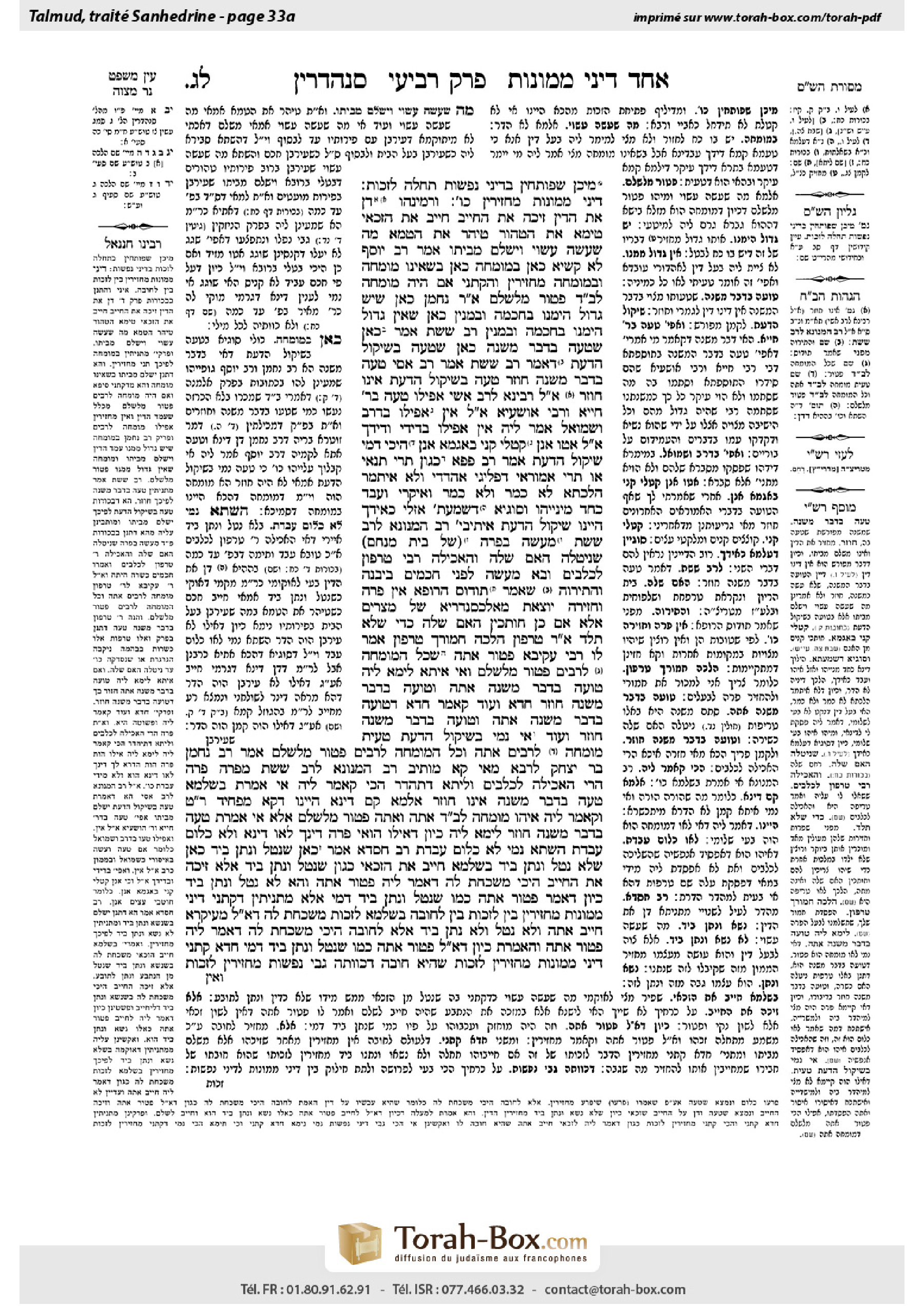
Sanhedrin 33a: Talmud study for Daf Yomi
Daf Yomi is the daily study of one Talmud folio. Explore 37 tractates with scans, Hebrew text, Sefaria English and AI-generated French translations where annotated.
Passage selection and English or AI-generated French translation are available where the scan has annotations. Daf Study is independent of Torah-Box and Sefaria.
Browse Sanhedrin · סנהדרין · All tractatesSanhedrin 33a text and translations
This page of Sanhedrin includes the Aramaic text, an English translation and an AI-generated French translation, alongside the scan above.
סנהדרין ל״ג א · Aramaic and Hebrew text
מִיכָּן שֶׁפּוֹתְחִין בְּדִינֵי נְפָשׁוֹת תְּחִלָּה לִזְכוּת.
דִּינֵי מָמוֹנוֹת מַחֲזִירִין כּוּ׳. וּרְמִינְהוּ: דָּן אֶת הַדִּין, זִיכָּה אֶת הַחַיָּיב, חִיֵּיב אֶת הַזַּכַּאי, טִימֵּא אֶת הַטָּהוֹר, טִיהֵר אֶת הַטָּמֵא – מַה שֶּׁעָשָׂה עָשׂוּי, וִישַׁלֵּם מִבֵּיתוֹ.
אָמַר רַב יוֹסֵף: לָא קַשְׁיָא, כָּאן בְּמוּמְחֶה, כָּאן בְּשֶׁאֵינוֹ מוּמְחֶה. וּבְמוּמְחֶה מַחְזִירִין? וְהָקָתָנֵי: אִם הָיָה מוּמְחֶה לְבֵית דִּין – פָּטוּר מִלְּשַׁלֵּם!
אָמַר רַב נַחְמָן: כָּאן שֶׁיֵּשׁ גָּדוֹל הֵימֶנּוּ בְּחָכְמָה וּבְמִנְיָן, כָּאן שֶׁאֵין גָּדוֹל הֵימֶנּוּ בְּחָכְמָה וּבְמִנְיָן.
רַב שֵׁשֶׁת אָמַר: כָּאן שֶׁטָּעָה בִּדְבַר מִשְׁנָה, כָּאן שֶׁטָּעָה בְּשִׁיקּוּל הַדַּעַת. דְּאָמַר רַב שֵׁשֶׁת אָמַר רַב אַסִּי: טָעָה בִּדְבַר מִשְׁנָה – חוֹזֵר, טָעָה בְּשִׁיקּוּל הַדַּעַת – אֵינוֹ חוֹזֵר.
אֲמַר לֵיהּ רָבִינָא לְרַב אָשֵׁי: אֲפִילּוּ טָעָה בְּרַבִּי חִיָּיא וְרַבִּי אוֹשַׁעְיָא? אֲמַר לֵיהּ: אִין. אֲפִילּוּ בִּדְרַב וּשְׁמוּאֵל? אֲמַר לֵיהּ: אִין. אֲפִילּוּ בְּדִידִי וְדִידָךְ? אֲמַר לֵיהּ: אַטּוּ אֲנַן קָטְלֵי קְנֵי בְּאַגְמָא אֲנַן?
הֵיכִי דָּמֵי שִׁיקּוּל הַדַּעַת? אָמַר רַב פָּפָּא: כְּגוֹן תְּרֵי תַּנָּאֵי אוֹ תְּרֵי אָמוֹרָאֵי דִּפְלִיגִי אַהֲדָדֵי, וְלָא אִיתְּמַר הִלְכְתָא לָא כְּמָר וְלָא כְּמָר, וְאִיקְּרִי וַעֲבַד כְּחַד מִינַּיְיהוּ, וְסוּגְיָא דִּשְׁמַעְתָּא אָזְלִי כְּאִידַּךְ – הַיְינוּ שִׁיקּוּל הַדַּעַת.
אֵיתִיבֵיהּ רַב הַמְנוּנָא לְרַב שֵׁשֶׁת: מַעֲשֶׂה בְּפָרָה שֶׁל בֵּית מְנַחֵם שֶׁנִּיטְּלָה הָאֵם שֶׁלָּהּ, וְהֶאֱכִילָהּ רַבִּי טַרְפוֹן לִכְלָבִים.
וּבָא מַעֲשֶׂה לִפְנֵי חֲכָמִים בְּיַבְנֶה, וְהִתִּירוּהָ. שֶׁאָמַר תּוֹדוֹס הָרוֹפֵא: אֵין פָּרָה וַחֲזִירָה יוֹצֵאת מֵאֲלֶכְּסַנְדְּרִיָּא שֶׁל מִצְרַיִם אֶלָּא אִם כֵּן חוֹתְכִין הָאֵם שֶׁלָּהּ, כְּדֵי שֶׁלֹּא תֵּלֵד. אָמַר רַבִּי טַרְפוֹן: הָלְכָה חֲמוֹרְךָ, טַרְפוֹן! אָמַר לוֹ רַבִּי עֲקִיבָא: פָּטוּר אַתָּה, שֶׁכׇּל הַמּוּמְחֶה לָרַבִּים פָּטוּר מִלְּשַׁלֵּם.
וְאִי אִיתָא, לֵימָא לֵיהּ: טוֹעֶה בִּדְבַר מִשְׁנָה אַתָּה, וְטוֹעֶה בִּדְבַר מִשְׁנָה חוֹזֵר.
חֲדָא וְעוֹד קָאָמַר: חֲדָא, דְּטוֹעֶה בִּדְבַר מִשְׁנָה אַתָּה, וְטוֹעֶה בִּדְבַר מִשְׁנָה חוֹזֵר. וְעוֹד: אִי נָמֵי בְּשִׁיקּוּל הַדַּעַת טָעִיתָ – מוּמְחֶה לָרַבִּים אַתָּה, וְכׇל הַמּוּמְחֶה לָרַבִּים פָּטוּר מִלְּשַׁלֵּם.
אָמַר רַב נַחְמָן בַּר יִצְחָק לְרָבָא: מַאי קָא מוֹתֵיב רַב הַמְנוּנָא לְרַב שֵׁשֶׁת מִפָּרָה? פָּרָה הֲרֵי הֶאֱכִילָהּ לִכְלָבִים, וְלֵיתָא דְּתֶהְדַּר.
הָכִי קָאָמַר לֵיהּ: אִי אָמְרַתְּ בִּשְׁלָמָא טָעָה בִּדְבַר מִשְׁנָה אֵינוֹ חוֹזֵר, אַלְמָא קָם דִּינָא – הַיְינוּ דְּקָא מְפַחֵיד רַבִּי טַרְפוֹן, וְקָאָמַר לֵיהּ אִיהוּ: מוּמְחֶה לְבֵית דִּין אַתָּה וְאַתָּה פָּטוּר מִלְּשַׁלֵּם. אֶלָּא אִי אָמְרַתְּ טָעָה בִּדְבַר מִשְׁנָה חוֹזֵר, לֵימָא לֵיהּ: כֵּיוָן דְּאִילּוּ הֲוַאי פָּרָה, דִּינָךְ לָאו דִּינָא וְלָא כְּלוּם עֲבַדְתְּ, הַשְׁתָּא נָמֵי לָא כְּלוּם עֲבַדְתְּ.
רַב חִסְדָּא אָמַר: כָּאן – שֶׁנָּטַל וְנָתַן בַּיָּד, כָּאן – שֶׁלֹּא נָטַל וְנָתַן בַּיָּד.
בִּשְׁלָמָא חִיֵּיב אֶת הַזַּכַּאי, כְּגוֹן שֶׁנָּטַל וְנָתַן בַּיָּד. אֶלָּא זִיכָּה אֶת הַחַיָּיב, הֵיכִי מַשְׁכַּחַתְּ לַהּ? דַּאֲמַר לֵיהּ: ״פָּטוּר אַתָּה״, וְהָא לֹא נָטַל וְנָתַן בַּיָּד! כֵּיוָן דְּאָמַר ״פָּטוּר אַתָּה״, כְּמוֹ שֶׁנָּטַל וְנָתַן בַּיָּד דָּמֵי.
אֶלָּא מַתְנִיתִין דְּקָתָנֵי: דִּינֵי מָמוֹנוֹת מַחְזִירִין בֵּין לִזְכוּת בֵּין לְחוֹבָה, בִּשְׁלָמָא לִזְכוּת מַשְׁכַּחַתְּ לַהּ, דַּאֲמַר לֵיהּ מֵעִיקָּרָא: ״חַיָּיב אַתָּה״, וְלֹא נָטַל וְלֹא נָתַן בַּיָּד. אֶלָּא לְחוֹבָה הֵיכִי מַשְׁכַּחַתְּ לַהּ? דְּאָמַר לֵיהּ: ״פָּטוּר אַתָּה״? וְהָאָמְרַתְּ: כֵּיוָן דְּאָמַר לֵיהּ ״פָּטוּר אַתָּה״, כְּמוֹ שֶׁנָּטַל וְנָתַן בַּיָּד דָּמֵי!
חֲדָא קָתָנֵי: דִּינֵי מָמוֹנוֹת מַחְזִירִין לִזְכוּת, שֶׁהִיא חוֹבָה. דִּכְוָותַהּ גַּבֵּי נְפָשׁוֹת: מַחְזִירִין לִזְכוּת,
Sanhedrin 33a · English translation
From here it is derived that in cases of capital law, the court opens the deliberations by first raising a claim to acquit the accused. This baraita corresponds to the explanation of Abaya and Rava that the court notifies the accused that he has nothing to fear if he is innocent.
§ The mishna teaches that in cases of monetary law, the court brings the accused back to be judged again if new evidence arises, whether with a claim to exempt him or with a claim to find him liable. In cases of capital law, the court brings the accused back to be judged again with a claim to acquit him, but does not bring him back to be judged with a claim to find him liable. And the Gemara raises a contradiction from a mishna (Bekhorot 28b): If a judge issued a judgment and erred, so that he exempts a liable party or finds an innocent party liable, or if he ruled that a pure item is impure or ruled that an impure item is pure, and by doing so he caused a litigant a monetary loss; what he did is done, i.e., the judgment stands, and the judge must pay damages from his home, i.e., from his personal funds. This indicates that the court does not bring the accused back to be judged again if new evidence arises.
Rav Yosef says: This is not difficult. The mishna here, which teaches that the court does bring the accused back to be judged again if new evidence arises, is stated with regard to a judge who was an expert, whereas the mishna there in tractate Bekhorot, which teaches that what he did is done, is stated with regard to a judge who was not an expert. The Gemara asks: And does one bring the accused back in the case of a judge who was an expert? But that mishna in tractate Bekhorot teaches: If he was an expert accepted by the court he is exempt from liability to pay. This indicates that the court does not bring the accused back to be judged again if new evidence arises, even if the judge is an expert; otherwise there would be no need to state that the judge is exempt from liability to pay.
Rav Naḥman says a different explanation: The mishna here, which teaches that the court does bring the accused back to be judged again if new evidence arises, is stated with regard to a case where there is a court greater than this one in wisdom and number of students that can judge the case again. The mishna there, which teaches that what he did is done, is stated with regard to a case where there is no court greater than his in wisdom and number of students that can judge the case again. If this judge erred, the error will not be corrected.
Rav Sheshet says a different explanation: The mishna here, which teaches that the court does bring the accused back to be judged again if new evidence arises, is stated with regard to a case where the judge erred in a matter that appears in the Mishna, i.e., he forgot an explicit mishnaic ruling, in which case the verdict is void. The mishna there, which teaches that what he did is done, is stated with regard to a case where the judge erred in his deliberation. As Rav Sheshet says that Rav Asi says: In the case of a judge who erred in a matter that appears in the Mishna, the decision is revoked, but in the case of a judge who erred in his deliberation, the decision is not revoked.
Ravina said to Rav Ashi: Does the category of: Erred in a matter that appears in the Mishna, include even one who erred concerning a statement of Rabbi Ḥiyya and Rabbi Oshaya, who were among the last of the tanna’im? Rav Ashi said to him: Yes. Ravina asked him: Does it include even one who erred concerning a statement of the first-generation amora’im Rav and Shmuel? Rav Ashi said to him: Yes. Ravina asked him: Does it include even one who erred concerning statements of mine and yours, as we are of the final generation of amora’im? Rav Ashi said to him: Is that to say that we are reed cutters in the pond? That is, our statements are in this category as well.
The Gemara clarifies: What is considered an error in a deliberation? Rav Pappa says: For example, two tanna’im or two amora’im who disagree with each other, and the halakha was not stated in accordance with this Sage or in accordance with that Sage, and it occurred that the judge acted in accordance with one of them, and the discussion of the halakha goes in accordance with the other opinion, i.e., most judges rule in accordance with the opposing opinion; this is an error in a deliberation.
Rav Hamnuna raised an objection to Rav Sheshet from the continuation of the mishna cited earlier (Bekhorot 28b): There was an incident involving a cow of the household of Menaḥem whose womb was removed, and when Rabbi Tarfon was consulted he ruled that it is an animal with a wound that will cause it to die within twelve months [tereifa], which is forbidden for consumption. And based on the ruling of Rabbi Tarfon, the questioner fed it to the dogs.
The mishna continues: And the incident came before the Sages of the court in Yavne, and they ruled that such an animal is permitted and is not a tereifa. As Theodosius [Todos] the doctor said: A cow or pig does not emerge from Alexandria of Egypt unless the residents sever its womb so that it will not give birth in the future. The breeds of cows and pigs in Alexandria were of exceptional quality and the people of Alexandria did not want them reproduced elsewhere. The fact that these animals lived long lives after their wombs were removed proves that the hysterectomy did not render them tereifot. Upon hearing this, Rabbi Tarfon said: Your donkey is gone, Tarfon, as he believed he was required to compensate the owner for the cow that he ruled to be a tereifa. Rabbi Akiva said to him: You are exempt, as any judge accepted as an expert for the public is exempt from liability to pay.
Rav Hamnuna states his objection to Rav Sheshet: And if it is so that there is a distinction between the two types of judicial errors, let Rabbi Akiva say to Rabbi Tarfon: You err in a matter that appears in the Mishna, as the ruling that an animal whose womb has been removed is permitted is recorded in a mishna (see Ḥullin 54a), and in the case of one who errs in a matter that appears in the Mishna, the decision is revoked.
The Gemara answers: Rabbi Akiva states one reason and adds another reason. One: As you err in a matter that appears in the Mishna, and in the case of one who errs in a matter that appears in the Mishna, the decision is revoked. Another: Even if you erred in a deliberation, you are a judge accepted as an expert for the public, and any judge accepted as an expert for the public is exempt from liability to pay.
Rav Naḥman bar Yitzḥak said to Rava: What was the objection raised by Rav Hamnuna to Rav Sheshet from the incident of the cow? After all, the owner had already fed the cow to the dogs, and it is not possible to revoke the ruling and judge the case again.
Rava answered: This is what Rav Hamnuna was saying to Rav Sheshet: Granted, if you say that in the case of a judge who errs in a matter that appears in the Mishna, the decision is not revoked, which evidently indicates that the verdict stands as it is, that is why Rabbi Tarfon feared that he would have to pay, and Rabbi Akiva said to him: You are an expert accepted by the court, and are exempt from liability to pay. But if you say that in the case of a judge who erred in a matter that appears in the Mishna, the decision is revoked, let Rabbi Akiva say to Rabbi Tarfon: Since if the cow were to be here, your verdict is not a verdict and you did nothing, now as well, you did nothing and you are not liable to pay. It was the action of the owner that caused the loss, as he fed the cow to the dogs.
Rav Ḥisda says that the contradiction between the mishna here and the mishna in tractate Bekhorot as to whether or not the court brings the accused back to be judged again if new evidence arises can be answered as follows: The mishna there in tractate Bekhorot is stated with regard to a case where a judge took the item in question from one litigant and gave it to the other litigant with his hand. In this case, the judge is liable to pay. The mishna here is stated with regard to a case where a judge of the court did not take the item in question from one litigant and give it to the other litigant with his hand. The court merely issued a ruling, and the litigants executed the verdict on their own. Therefore, the court is not liable to pay, and the judges retry the case.
The Gemara asks: Granted, one can explain the clause from the mishna in tractate Bekhorot: He finds an innocent party liable, in a case where the judge took the item in question from the innocent party and gave it to the other litigant with his hand. But how can you find him giving the item from one to another with regard to the clause of: He exempts a liable party? As, the judge said to the litigant only: You are exempt from liability to pay, but the judge did not take the item in question from one litigant and give it to the other litigant with his hand. The Gemara explains: Once he says: You are exempt from liability to pay, it is considered as if he took the item in question from the innocent party and gave it to the other litigant with his hand, as there is no need for any further action.
The Gemara asks: But what of the mishna, which teaches: In cases of monetary law, the court brings the accused back to be judged again if new evidence arises, either with a claim to exempt the accused, or with a claim to find him liable? Granted, you can find the example of: To exempt, where the court says at the outset to one litigant: You are liable to pay, and a judge did not take the item in question from one litigant and give it to the other litigant with his hand, as Rav Ḥisda holds that the verdict is revoked and the court does not pay. But how can you find the example of judging the case again to find him liable? As once the court says to the litigant: You are exempt, the case cannot be judged again. But you said that once a judge says: You are exempt from liability to pay, it is considered as if he took the item in question from the innocent party and gave it to the other litigant with his hand. If so, the court must pay and the judgment will not be revoked.
The Gemara answers: The mishna teaches only that one statement, and it should be understood as follows: In cases of monetary law, the court brings the litigant back to be judged again to exempt that litigant, which is to the liability of the other litigant, while in the corresponding situation with regard to cases of capital law, the court brings the accused back to acquit him,
Sanhedrin 33a · Traduction française (IA)
On déduit de là que, dans les affaires capitales, le tribunal ouvre les délibérations en avançant d’abord un argument en faveur de l’acquittement de l’accusé. Cette baraïta correspond à l’explication d’Abayé et de Rava, selon laquelle le tribunal informe l’accusé qu’il n’a rien à craindre s’il est innocent.
§ La Michna enseigne que, dans les affaires pécuniaires, le tribunal fait revenir l’accusé pour qu’il soit jugé de nouveau si de nouveaux éléments apparaissent, qu’ils tendent à l’exonérer ou à le déclarer responsable. Dans les affaires capitales, le tribunal le fait revenir pour qu’il soit jugé de nouveau si de nouveaux éléments tendent à l’acquitter, mais ne le fait pas revenir si ceux-ci tendent à le déclarer coupable. La Guemara soulève une contradiction à partir d’une Michna (Bekhorot 28b) : si un juge a rendu un jugement et s’est trompé, en exonérant une partie responsable ou en déclarant responsable une partie innocente, ou s’il a statué qu’un objet pur est impur ou qu’un objet impur est pur, et qu’il a ainsi causé une perte financière à l’un des plaideurs, sa décision est maintenue, c’est-à-dire que le jugement reste valable, et le juge doit indemniser la partie lésée sur ses propres biens, c’est-à-dire avec ses fonds personnels. Cela indique que le tribunal ne fait pas revenir l’accusé pour qu’il soit jugé de nouveau si de nouveaux éléments apparaissent.
Rav Yossef dit : Il n’y a pas de difficulté. La Michna ici, qui enseigne que le tribunal fait revenir l’accusé pour qu’il soit jugé de nouveau si de nouveaux éléments apparaissent, concerne un juge expert ; tandis que la Michna du traité Bekhorot, qui enseigne que sa décision est maintenue, concerne un juge qui n’était pas expert. La Guemara demande : Et fait-on revenir l’accusé dans le cas d’un juge expert ? Pourtant, cette Michna du traité Bekhorot enseigne : S’il était un expert agréé par le tribunal, il est exonéré de l’obligation de payer. Cela indique que le tribunal ne fait pas revenir l’accusé pour qu’il soit jugé de nouveau si de nouveaux éléments apparaissent, même si le juge est expert ; autrement, il ne serait pas nécessaire de préciser que le juge est exonéré de l’obligation de payer.
Rav Naḥman donne une autre explication : La Michna ici, qui enseigne que le tribunal fait revenir l’accusé pour qu’il soit jugé de nouveau si de nouveaux éléments apparaissent, concerne un cas où il existe un tribunal supérieur à celui-ci en sagesse et en nombre d’élèves, qui peut réexaminer l’affaire. La Michna de là-bas, qui enseigne que sa décision est maintenue, concerne un cas où il n’existe pas de tribunal supérieur au sien en sagesse et en nombre d’élèves qui puisse réexaminer l’affaire. Si ce juge s’est trompé, son erreur ne sera pas corrigée.
Rav Sheshet donne une autre explication : La Michna ici, qui enseigne que le tribunal fait revenir l’accusé pour qu’il soit jugé de nouveau si de nouveaux éléments apparaissent, concerne un juge qui s’est trompé sur un point mentionné dans la Michna, c’est-à-dire qu’il a oublié une décision explicite de la Michna ; dans ce cas, le verdict est annulé. La Michna de là-bas, qui enseigne que sa décision est maintenue, concerne un juge qui s’est trompé dans son raisonnement. En effet, Rav Sheshet dit au nom de Rav Assi : lorsqu’un juge s’est trompé sur un point mentionné dans la Michna, sa décision est annulée ; mais lorsqu’il s’est trompé dans son raisonnement, sa décision n’est pas annulée.
Ravina dit à Rav Ashi : La catégorie de celui qui s’est trompé sur un point mentionné dans la Michna comprend-elle aussi celui qui s’est trompé au sujet d’un enseignement de Rabbi Ḥiyya et de Rabbi Oshaya, qui comptaient parmi les derniers tannaïm ? Rav Ashi lui répondit : Oui. Ravina lui demanda : Comprend-elle aussi celui qui s’est trompé au sujet d’un enseignement des amoraïm de la première génération, Rav et Shmuel ? Rav Ashi lui répondit : Oui. Ravina lui demanda : Comprend-elle aussi celui qui s’est trompé au sujet de nos enseignements, à toi et à moi, puisque nous appartenons à la dernière génération des amoraïm ? Rav Ashi lui répondit : Quoi, nous ne serions que des coupeurs de roseaux dans l’étang ? Autrement dit, nos enseignements relèvent eux aussi de cette catégorie.
La Guemara précise : Qu’est-ce qui est considéré comme une erreur de raisonnement ? Rav Pappa dit : Par exemple, deux tannaïm ou deux amoraïm qui sont en désaccord, sans que la halakha ait été établie selon l’un ou l’autre, et le juge a statué conformément à l’un d’eux, alors que la discussion de la halakha suit l’opinion de l’autre, c’est-à-dire que la plupart des juges statuent conformément à l’opinion opposée ; il s’agit là d’une erreur de raisonnement.
Rav Hamnouna soulève une objection devant Rav Sheshet à partir de la suite de la Michna citée précédemment (Bekhorot 28b) : Il y eut un incident concernant une vache appartenant à la maison de Menaḥem, dont l’utérus avait été retiré. Consulté à son sujet, Rabbi Tarfon statua qu’il s’agissait d’un animal atteint d’une lésion qui entraînerait sa mort dans les douze mois [tereifa], et donc interdit à la consommation. Sur la base de la décision de Rabbi Tarfon, celui qui l’avait consulté la donna à manger aux chiens.
La Michna poursuit : L’affaire fut portée devant les Sages du tribunal de Yavné, qui statuèrent qu’un tel animal est permis et n’est pas une tereifa. En effet, le médecin Théodose [Todos] disait : Aucune vache ni aucun porc ne quitte Alexandrie d’Égypte sans que ses habitants lui aient sectionné l’utérus, afin qu’il ne puisse plus avoir de petits. Les races de vaches et de porcs d’Alexandrie étaient d’une qualité exceptionnelle, et les habitants d’Alexandrie ne voulaient pas qu’elles se reproduisent ailleurs. Le fait que ces animaux aient vécu longtemps après le retrait de leur utérus prouve que l’hystérectomie ne les rendait pas tereifot. En l’apprenant, Rabbi Tarfon dit : Ton âne est perdu, Tarfon, car il croyait devoir indemniser le propriétaire de la vache qu’il avait déclarée tereifa. Rabbi Akiva lui dit : Tu es exonéré, car tout juge agréé comme expert par le public est exonéré de l’obligation de payer.
Rav Hamnouna formule son objection à Rav Sheshet : S’il existe bien une distinction entre ces deux types d’erreurs judiciaires, que Rabbi Akiva dise à Rabbi Tarfon : « Tu t’es trompé sur un point mentionné dans la Michna », puisque la décision selon laquelle un animal dont l’utérus a été retiré est permis figure dans une Michna (voir Ḥullin 54a), et que, lorsqu’on se trompe sur un point mentionné dans la Michna, la décision est annulée.
La Guemara répond : Rabbi Akiva donne une raison, puis en ajoute une autre. Premièrement : « Tu t’es trompé sur un point mentionné dans la Michna », et, lorsqu’on se trompe sur un point mentionné dans la Michna, la décision est annulée. Deuxièmement : Même si tu t’es trompé dans ton raisonnement, tu es un juge agréé comme expert par le public, et tout juge agréé comme expert par le public est exonéré de l’obligation de payer.
Rav Naḥman bar Yitzḥak dit à Rava : Quelle objection Rav Hamnouna a-t-il soulevée devant Rav Sheshet à partir de l’incident de la vache ? Après tout, le propriétaire avait déjà donné la vache à manger aux chiens, et il n’est pas possible d’annuler la décision et de juger de nouveau l’affaire.
Rava répondit : Voici ce que Rav Hamnouna disait à Rav Sheshet : Certes, si tu dis que, lorsqu’un juge se trompe sur un point mentionné dans la Michna, la décision n’est pas annulée, ce qui indique manifestement que le verdict reste tel quel, Rabbi Tarfon avait alors raison de craindre de devoir payer, et Rabbi Akiva lui dit : « Tu es un expert agréé par le tribunal et tu es exonéré de l’obligation de payer. » Mais si tu dis que, lorsqu’un juge s’est trompé sur un point mentionné dans la Michna, la décision est annulée, que Rabbi Akiva dise à Rabbi Tarfon : « Puisque, si la vache était ici, ton verdict ne serait pas un verdict et tu n’aurais rien fait, à présent également, tu n’as rien fait et tu n’es pas tenu de payer. » C’est l’acte du propriétaire qui a causé la perte, puisqu’il a donné la vache à manger aux chiens.
Rav Ḥisda dit que la contradiction entre la Michna ici et la Michna du traité Bekhorot, sur la question de savoir si le tribunal fait revenir l’accusé pour qu’il soit jugé de nouveau lorsque de nouveaux éléments apparaissent, peut être résolue ainsi : La Michna de là-bas, dans le traité Bekhorot, concerne un cas où le juge a pris de sa main l’objet en question à l’un des plaideurs pour le remettre à l’autre. Dans ce cas, le juge est tenu de payer. La Michna ici concerne un cas où un juge du tribunal n’a pas pris de sa main l’objet en question à l’un des plaideurs pour le remettre à l’autre. Le tribunal s’est contenté de rendre une décision, et les plaideurs ont exécuté le verdict eux-mêmes. Le tribunal n’est donc pas tenu de payer, et les juges rejugent l’affaire.
La Guemara demande : On peut certes expliquer le passage de la Michna du traité Bekhorot : « Il déclare responsable une partie innocente », en supposant que le juge a pris l’objet en question à la partie innocente pour le remettre de sa main à l’autre plaideur. Mais comment peut-on comprendre qu’il remette ainsi l’objet de l’un à l’autre dans le passage : « Il exonère une partie responsable » ? En effet, le juge a seulement dit au plaideur : « Tu es exonéré de l’obligation de payer » ; mais il n’a pas pris de sa main l’objet en question à l’un des plaideurs pour le remettre à l’autre. La Guemara explique : Dès lors qu’il dit : « Tu es exonéré de l’obligation de payer », cela est considéré comme s’il avait pris l’objet en question à la partie innocente pour le remettre de sa main à l’autre plaideur, car aucune autre action n’est nécessaire.
La Guemara demande : Mais qu’en est-il de la Michna, qui enseigne que, dans les affaires pécuniaires, le tribunal fait revenir l’accusé pour qu’il soit jugé de nouveau si de nouveaux éléments apparaissent, qu’ils tendent à l’exonérer ou à le déclarer responsable ? On peut certes trouver un exemple du cas où l’on cherche à l’exonérer : au départ, le tribunal dit à l’un des plaideurs : « Tu es responsable de payer », sans qu’un juge ait pris de sa main l’objet en question à l’un des plaideurs pour le remettre à l’autre, puisque, selon Rav Ḥisda, le verdict est annulé et le tribunal n’est pas tenu de payer. Mais comment peut-on trouver un exemple où l’on rejugera l’affaire pour le déclarer responsable ? Dès lors que le tribunal dit au plaideur : « Tu es exonéré », l’affaire ne peut plus être jugée de nouveau. Or, tu as dit que, dès qu’un juge dit : « Tu es exonéré de l’obligation de payer », cela est considéré comme s’il avait pris l’objet en question à la partie innocente pour le remettre à l’autre plaideur. Dans ce cas, le tribunal doit payer et le jugement ne sera pas annulé.
La Guemara répond : La Michna n’enseigne qu’une seule de ces formulations, et il faut la comprendre ainsi : dans les affaires pécuniaires, le tribunal fait revenir le plaideur pour qu’il soit jugé de nouveau afin d’exonérer ce plaideur, ce qui revient à déclarer responsable l’autre plaideur ; et, dans la situation correspondante concernant les affaires capitales, le tribunal fait revenir l’accusé pour l’acquitter,
Traduction française générée par IA à partir de l’édition anglaise de Sefaria. Vérifie toujours un passage avec le texte source.
Text from Sefaria: William Davidson Edition - Vocalized Aramaic (CC BY NC); William Davidson Edition - English (CC BY NC).