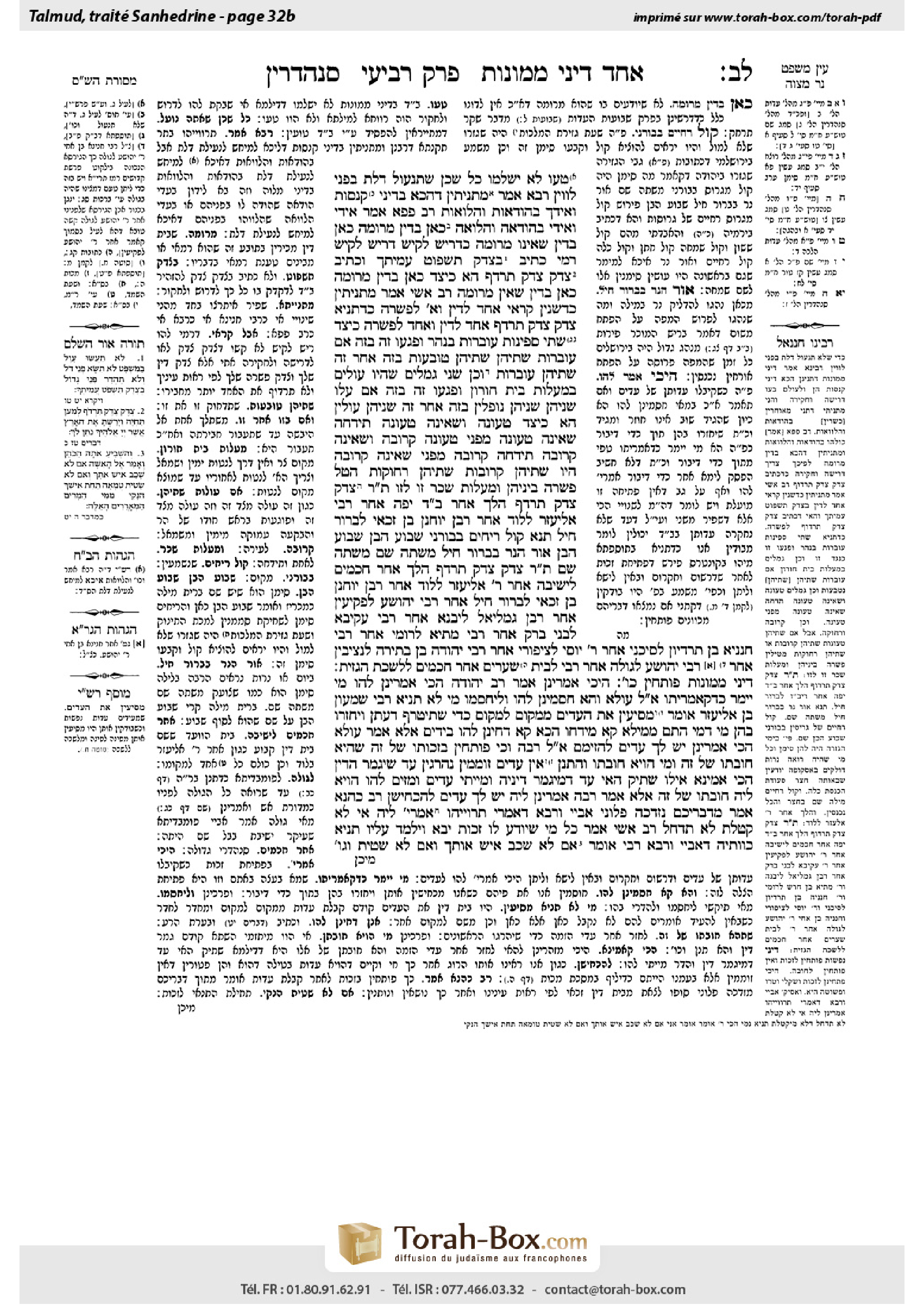
Sanhedrin 32b: Talmud study for Daf Yomi
Daf Yomi is the daily study of one Talmud folio. Explore 37 tractates with scans, Hebrew text, Sefaria English and AI-generated French translations where annotated.
Passage selection and English or AI-generated French translation are available where the scan has annotations. Daf Study is independent of Torah-Box and Sefaria.
Browse Sanhedrin · סנהדרין · All tractatesSanhedrin 32b text and translations
This page of Sanhedrin includes the Aramaic text, an English translation and an AI-generated French translation, alongside the scan above.
סנהדרין ל״ב ב · Aramaic and Hebrew text
טָעוּ – לֹא יְשַׁלְּמוּ? כׇּל שֶׁכֵּן שֶׁתִּנְעוֹל דֶּלֶת בִּפְנֵי לוֹוִין!
רָבָא אָמַר: מַתְנִיתִין דְּהָכָא בְּדִינֵי קְנָסוֹת, וְאִידַּךְ בְּהוֹדָאוֹת וְהַלְוָאוֹת.
רַב פָּפָּא אָמַר: אִידֵּי וְאִידֵּי בְּהוֹדָאָה וְהַלְוָאָה. כָּאן – בְּדִין מְרוּמֶּה, כָּאן – בְּדִין שֶׁאֵינוֹ מְרוּמֶּה.
כִּדְרֵישׁ לָקִישׁ, דְּרֵישׁ לָקִישׁ רָמֵי: כְּתִיב ״בְּצֶדֶק תִּשְׁפֹּט עֲמִיתֶךָ״, וּכְתִיב ״צֶדֶק צֶדֶק תִּרְדֹּף״. הָא כֵּיצַד? כָּאן – בְּדִין מְרוּמֶּה, כָּאן – בְּדִין שֶׁאֵין מְרוּמֶּה.
רַב אָשֵׁי אָמַר: מַתְנִיתִין כִּדְשַׁנִּין, קְרָאֵי אֶחָד לְדִין וְאֶחָד לִפְשָׁרָה.
כִּדְתַנְיָא: ״צֶדֶק צֶדֶק תִּרְדֹּף״ – אֶחָד לְדִין וְאֶחָד לִפְשָׁרָה. כֵּיצַד? שְׁתֵּי סְפִינוֹת עוֹבְרוֹת בַּנָּהָר וּפָגְעוּ זֶה בָּזֶה, אִם עוֹבְרוֹת שְׁתֵּיהֶן – שְׁתֵּיהֶן טוֹבְעוֹת, בְּזֶה אַחַר זֶה – שְׁתֵּיהֶן עוֹבְרוֹת. וְכֵן שְׁנֵי גְּמַלִּים שֶׁהָיוּ עוֹלִים בְּמַעֲלוֹת בֵּית חוֹרוֹן וּפָגְעוּ זֶה בָּזֶה, אִם עָלוּ שְׁנֵיהֶן – שְׁנֵיהֶן נוֹפְלִין, בְּזֶה אַחַר זֶה – שְׁנֵיהֶן עוֹלִין.
הָא כֵּיצַד? טְעוּנָה וְשֶׁאֵינָהּ טְעוּנָה – תִּידָּחֶה שֶׁאֵינָהּ טְעוּנָה מִפְּנֵי טְעוּנָה. קְרוֹבָה וְשֶׁאֵינָהּ קְרוֹבָה – תִּידָּחֶה קְרוֹבָה מִפְּנֵי שֶׁאֵינָהּ קְרוֹבָה. הָיוּ שְׁתֵּיהֶן קְרוֹבוֹת, שְׁתֵּיהֶן רְחוֹקוֹת – הָטֵל פְּשָׁרָה בֵּינֵיהֶן, וּמֵעֲלוֹת שָׂכָר זוֹ לָזוֹ.
תָּנוּ רַבָּנַן: ״צֶדֶק צֶדֶק תִּרְדֹּף״ – הַלֵּךְ אַחַר בֵּית דִּין יָפֶה, אַחַר רַבִּי אֱלִיעֶזֶר לְלוֹד, אַחַר רַבָּן יוֹחָנָן בֶּן זַכַּאי לִבְרוּר חַיִל.
תָּנָא: קוֹל רֵיחַיִם בְּבוּרְנִי – שְׁבוּעַ הַבֵּן, שְׁבוּעַ הַבֵּן. אוֹר הַנֵּר בִּבְרוּר חַיִל – מִשְׁתֶּה שָׁם, מִשְׁתֶּה שָׁם.
תָּנוּ רַבָּנַן: ״צֶדֶק צֶדֶק תִּרְדֹּף״ – הַלֵּךְ אַחַר חֲכָמִים לִישִׁיבָה. אַחַר רַבִּי אֱלִיעֶזֶר לְלוֹד, אַחַר רַבָּן יוֹחָנָן בֶּן זַכַּאי לִבְרוּר חַיִל, אַחַר רַבִּי יְהוֹשֻׁעַ לִפְקִיעִין, אַחַר רַבָּן גַּמְלִיאֵל לְיַבְנֶה, אַחַר רַבִּי עֲקִיבָא לִבְנֵי בְרָק, אַחַר רַבִּי מַתְיָא לְרוֹמִי, אַחַר רַבִּי חֲנַנְיָה בֶּן תְּרַדְיוֹן לְסִיכְנִי, אַחַר רַבִּי יוֹסֵי לְצִיפּוֹרִי, אַחַר רַבִּי יְהוּדָה בֶּן בְּתִירָה לִנְצִיבִין, אַחַר רַבִּי יְהוֹשֻׁעַ לַגּוֹלָה, אַחַר רַבִּי לְבֵית שְׁעָרִים, אַחַר חֲכָמִים לְלִשְׁכַּת הַגָּזִית.
דִּינֵי מָמוֹנוֹת פּוֹתְחִין כּוּ׳. הֵיכִי אָמְרִינַן? אָמַר רַב יְהוּדָה: הָכִי אָמְרִינַן לְהוּ: מִי יֵימַר כִּדְקָאָמְרִיתוּ?
אֲמַר לֵיהּ עוּלָּא: וְהָא חָסְמִינַן לְהוּ? וְלִיחַסְמוּ! מִי לָא תַּנְיָא: רַבִּי שִׁמְעוֹן בֶּן אֱלִיעֶזֶר אוֹמֵר, מַסִּיעִין אֶת הָעֵדִים מִמָּקוֹם לְמָקוֹם כְּדֵי שֶׁתִּיטָּרֵף דַּעְתָּן וְיַחְזְרוּ בָּהֶן?
מִי דָּמֵי? הָתָם מִמֵּילָא קָא מִידְּחוּ, הָכָא קָא דָחֵינַן לְהוּ בְּיָדַיִם.
אֶלָּא אָמַר עוּלָּא: הָכִי אָמְרִינַן, ״יֵשׁ לְךָ עֵדִים לַהֲזִימָּם?״ אֲמַר לֵיהּ רַבָּה: וְכִי פּוֹתְחִין בִּזְכוּתוֹ שֶׁל זֶה שֶׁהִיא חוֹבָתוֹ שֶׁל זֶה?
וּמִי הָוְיָא חוֹבָתוֹ? וְהָתְנַן: אֵין עֵדִים זוֹמְמִין נֶהֱרָגִין עַד שֶׁיִּגָּמֵר הַדִּין.
הָכִי אָמֵינָא: אִילּוּ שָׁתֵיק הַאי עַד דְּמִיגְמָר דִּינֵיהּ, וּמַיְיתִי עֵדִים וּמַזֵּים לְהוּ, הָוְיָא לֵיהּ חוֹבָתוֹ שֶׁל זֶה. אֶלָּא אָמַר רַבָּה: אָמְרִינַן לֵיהּ, ״יֵשׁ לְךָ עֵדִים לְהַכְחִישָׁן?״
רַב כָּהֲנָא אָמַר: ״מִדִּבְרֵיכֶם נִזְדַּכָּה פְּלוֹנִי״. אַבָּיֵי וְרָבָא דְּאָמְרִי תַּרְוַיְיהוּ: אָמְרִינַן לֵיהּ, ״אִי לָא קְטַלְתְּ לָא תִּדְחַל״. רַב אָשֵׁי אָמַר: ״כׇּל מִי שֶׁיּוֹדֵעַ לוֹ זְכוּת יָבֹא וִילַמֵּד עָלָיו״.
תַּנְיָא כְּוָותֵיהּ דְּאַבָּיֵי וְרָבָא. רַבִּי אוֹמֵר: ״אִם לֹא שָׁכַב אִישׁ אוֹתָךְ וְאִם לֹא שָׂטִית וְגוֹ׳״ –
Sanhedrin 32b · English translation
then if the judges erred they should not need to pay the party they wronged, as they can claim that they were prevented from examining the witnesses effectively. The Gemara answers: If that were to be the halakha, all the more so that this would lock the door in the face of potential borrowers. If people know that the courts are not responsible for an error in judgment, they will not be willing to lend money.
Rava says: The ruling of the mishna here, that cases of monetary law require inquiry and interrogation, is stated with regard to laws of fines, not standard cases of monetary law. And the other sources, i.e., the mishna in tractate Shevi’it and the baraita, which do not require inquiry and interrogation, are stated with regard to cases of admissions and loans, in which there is cause to relax the procedures of deliberation, as explained.
Rav Pappa says: This and that, i.e., both the mishna here and the other sources, are stated with regard to cases of an admission and a loan. The distinction between them is that the mishna here, which rules that cases of monetary law require inquiry and interrogation, is stated with regard to a possibly fraudulent trial, where the court suspects that one party is attempting to defraud the other party and have witnesses offer false testimony on his own behalf. There, in the baraita and in the mishna in tractate Shevi’it, which do not require inquiry and interrogation, the ruling is stated with regard to a trial that does not appear fraudulent.
This distinction is in accordance with the statement of Reish Lakish, as Reish Lakish raises a contradiction between two verses: It is written in one verse: “In justice shall you judge your neighbor” (Leviticus 19:15), and it is written in another verse: “Justice, justice, shall you follow” (Deuteronomy 16:20), with the repetition indicating that it is not enough to merely judge with justice. He continues: How can these texts be reconciled? Here, this latter verse is stated with regard to a possibly fraudulent trial, where the court must take extra care to judge with justice; and there, that former verse is stated with regard to a trial that does not appear fraudulent.
Rav Ashi says: The ruling of the mishna here, that cases of monetary law require inquiry and interrogation, is as we answered, i.e., in accordance with any one of the answers offered by the other amora’im. And those verses were not stated with regard to fraudulent trials; rather, one is stated with regard to judgment, in which the court must pursue justice extensively, and one is stated with regard to compromise.
As it is taught in a baraita: When the verse states: “Justice, justice, shall you follow,” one mention of “justice” is stated with regard to judgment and one is stated with regard to compromise. How so? Where there are two boats traveling on the river and they encounter each other, if both of them attempt to pass, both of them sink, as the river is not wide enough for both to pass. If they pass one after the other, both of them pass. And similarly, where there are two camels who were ascending the ascent of Beit Ḥoron, where there is a narrow steep path, and they encounter each other, if both of them attempt to ascend, both of them fall. If they ascend one after the other, both of them ascend.
How does one decide which of them should go first? If there is one boat that is laden and one boat that is not laden, the needs of the one that is not laden should be overridden due to the needs of the one that is laden. If there is one boat that is close to its destination and one boat that is not close to its destination, the needs of the one that is close should be overridden due to the needs of the one that is not close. If both of them were close to their destinations, or both of them were far from their destinations, impose a compromise between them to decide which goes first, and the owners of the boats pay a fee to one other, i.e., the owners of the first boat compensate the owner of the boat that waits, for any loss incurred.
§ The Sages taught: The verse states: “Justice, justice, shall you follow.” This teaches that one should follow the best, most prestigious, court of the generation. For example, follow after Rabbi Eliezer to Lod, after Rabban Yoḥanan ben Zakkai to Beror Ḥayil.
The Sages taught: When the gentile authorities issued decrees outlawing observance of the mitzvot, members of Jewish communities devised clandestine ways of indicating observance of mitzvot to each other. For example: If one produces the sound of a millstone in the city called Burni, this is tantamount to announcing: Week of the son, week of the son, i.e., there will be a circumcision. If one displays the light of a lamp in the city called Beror Ḥayil, this is tantamount to announcing: There is a wedding feast there, there is a wedding feast there.
The Sages taught: The verse states: “Justice, justice, shall you follow.” This teaches that one should follow the Sages to the academy where they are found. For example, follow after Rabbi Eliezer to Lod, after Rabban Yoḥanan ben Zakkai to Beror Ḥayil, after Rabbi Yehoshua to Peki’in, after Rabban Gamliel to Yavne, after Rabbi Akiva to Bnei Brak, after Rabbi Matya to Rome [Romi], after Rabbi Ḥananya ben Teradyon to Sikhnei, after Rabbi Yosei to Tzippori, after Rabbi Yehuda ben Beteira to Netzivin, after Rabbi Yehoshua to the exile [gola], i.e., Babylonia, after Rabbi Yehuda HaNasi to Beit She’arim, and after the Sages in the time of the Temple to the Chamber of Hewn Stone.
§ The mishna teaches that in cases of monetary law, the court opens the deliberations either with a claim to exempt the accused, or with a claim to find him liable. In cases of capital law, the court opens the deliberations with a claim to acquit the accused, but does not open the deliberations with a claim to find him liable. The Gemara asks: How do we say this opening stage of the deliberations? In other words, with what claim does the court begin deliberating? Rav Yehuda said: We say this to the witnesses: Who says that the event occurred as you said? Perhaps you erred?
Ulla said to him: But by confronting the witnesses in this manner, we silence them. The witnesses will think that the court suspects them of lying, and they will not testify. Rav Yehuda said to him: And let them be silenced. Isn’t it taught in a baraita (Tosefta 9:1): Rabbi Shimon ben Eliezer says: In cases of capital law, the court brings the witnesses from one place to another place in order to confuse them so that they will retract their testimony if they are lying.
The Gemara rejects this argument: Are the halakhot comparable? There, where Rabbi Shimon ben Eliezer says to bring the witnesses from place to place, the witnesses are repressed by themselves, whereas here, we repress them by direct action, and that the court should not do.
Rather, Ulla says: We say this to the accused: Do you have witnesses to determine that the witnesses who testified against you are conspiring witnesses? Rabba said to him: But do we open the deliberations with a claim to acquit the accused that is to the liability of this one, i.e., the witnesses? This claim can lead to the witnesses incurring liability for their testimony.
The Gemara questions Rabba’s assumption: But is this to the liability of the witnesses? But didn’t we learn in a mishna (Makkot 5b): Conspiring witnesses are not killed for their testimony until the verdict of the one concerning whom they testified is issued? Therefore, if they will be shown to be conspiring witnesses at this early stage of the proceedings, they will not be liable.
The Gemara restates Rabba’s objection: This is what I say: If the accused would be silent until his verdict is issued and then brings witnesses and the court determines them to be conspiring witnesses, it will be found that the statement of the court is to the liability of this one, i.e., the witnesses. Rather, Rabba says: We say to the accused: Do you have witnesses to contradict them? If the first witnesses are contradicted as to the facts of the case, no one is liable.
Rav Kahana said: We say to the witnesses: Based on your statements, so-and-so is acquitted. The court issues a pro forma declaration that it is possible to find a reason to acquit based on the testimony of the witnesses, and then they begin the deliberations. Abaye and Rava both say: We say to the accused: For example, if you did not kill anyone, do not fear the consequences of these proceedings, as you will be acquitted. Rav Ashi says: The court announces: Whoever knows of a reason to acquit the accused should come and teach this reason concerning him.
The Gemara comments: It is taught in a baraita in accordance with the explanation of Abaye and Rava. Rabbi Yehuda HaNasi says: The priest administering the sota rite to the sota says to her: “If no man has lain with you and if you have not gone astray to impurity while under your husband, you shall be free from this water of bitterness that causes the curse. But if you have gone astray while under your husband…” (Numbers 5:19–20). The priest first states the scenario in which the woman is innocent of adultery.
Sanhedrin 32b · Traduction française (IA)
Alors, si les juges s’étaient trompés, ils n’auraient pas à indemniser la partie qu’ils ont lésée, puisqu’ils pourraient prétendre qu’on les a empêchés d’interroger efficacement les témoins. La Guemara répond : si telle était la halakha, cela fermerait d’autant plus la porte aux prêteurs potentiels. Si les gens savaient que les tribunaux ne sont pas responsables d’une erreur judiciaire, ils ne seraient pas disposés à prêter de l’argent.
Rava dit : La décision de la Michna ici, selon laquelle les affaires de droit pécuniaire exigent une enquête et un interrogatoire, concerne les lois relatives aux amendes, et non les affaires ordinaires de droit pécuniaire. Quant aux autres sources, c’est-à-dire la Michna du traité Shevi’it et la baraïta, qui n’exigent pas d’enquête et d’interrogatoire, elles concernent les affaires d’aveu et de prêt, dans lesquelles il y a lieu d’assouplir les procédures de délibération, comme cela a été expliqué.
Rav Pappa dit : Les deux sources, c’est-à-dire la Michna ici et les autres sources, concernent les affaires d’aveu et de prêt. La différence entre elles est que la Michna ici, qui statue que les affaires de droit pécuniaire exigent une enquête et un interrogatoire, concerne un procès possiblement frauduleux, où le tribunal soupçonne qu’une partie tente de tromper l’autre et de faire déposer de faux témoins en sa faveur. Là-bas, dans la baraïta et dans la Michna du traité Shevi’it, qui n’exigent pas d’enquête et d’interrogatoire, la décision concerne un procès qui ne semble pas frauduleux.
Cette distinction est conforme à l’enseignement de Reish Lakish, car celui-ci soulève une contradiction entre deux versets : il est écrit dans un verset : « Tu jugeras ton prochain avec justice » (Lévitique 19,15), et dans un autre : « C’est la justice, la justice que tu poursuivras » (Deutéronome 16,20), la répétition indiquant qu’il ne suffit pas de juger avec justice. Il poursuit : Comment concilier ces textes ? Le second verset concerne un procès possiblement frauduleux, où le tribunal doit prendre des précautions supplémentaires pour juger avec justice ; le premier, lui, concerne un procès qui ne semble pas frauduleux.
Rav Ashi dit : La décision de la Michna ici, selon laquelle les affaires de droit pécuniaire exigent une enquête et un interrogatoire, s’explique comme nous l’avons répondu, c’est-à-dire conformément à l’une ou l’autre des réponses proposées par les autres amoraïm. Ces versets ne concernent pas des procès frauduleux ; l’un concerne le jugement, dans lequel le tribunal doit rechercher la justice avec diligence, et l’autre le compromis.
Comme il est enseigné dans une baraïta : lorsque le verset dit : « C’est la justice, la justice que tu poursuivras », une occurrence du mot « justice » concerne le jugement et l’autre le compromis. Comment cela s’applique-t-il ? Lorsque deux bateaux naviguent sur le fleuve et se rencontrent, si chacun tente de passer, ils coulent tous les deux, car le fleuve n’est pas assez large pour qu’ils passent ensemble. S’ils passent l’un après l’autre, ils passent tous les deux. De même, lorsque deux chameaux gravissent la pente de Beit Ḥoron, où le chemin est étroit et escarpé, et qu’ils se rencontrent, si chacun tente de monter, ils tombent tous les deux. S’ils montent l’un après l’autre, ils arrivent tous les deux en haut.
Comment décide-t-on lequel doit passer en premier ? Si l’un des bateaux est chargé et l’autre ne l’est pas, les besoins du bateau non chargé doivent céder devant ceux du bateau chargé. Si l’un des bateaux est proche de sa destination et l’autre en est éloigné, les besoins de celui qui en est proche doivent céder devant ceux de celui qui en est éloigné. Si les deux sont proches de leur destination, ou si les deux en sont éloignés, on leur impose un compromis pour décider lequel passe en premier, et les propriétaires des bateaux se versent une indemnité, c’est-à-dire que les propriétaires du premier bateau dédommagent le propriétaire du bateau qui attend pour toute perte subie.
§ Les Sages ont enseigné : le verset dit : « C’est la justice, la justice que tu poursuivras. » Cela enseigne qu’il faut rechercher le tribunal le meilleur et le plus prestigieux de la génération. Par exemple, il faut se rendre auprès de Rabbi Eliezer à Lod et de Rabban Yoḥanan ben Zakkai à Beror Ḥayil.
Les Sages ont enseigné : lorsque les autorités non juives promulguèrent des décrets interdisant l’observance des mitsvot, les membres des communautés juives inventèrent des moyens clandestins de s’indiquer mutuellement qu’ils observaient les mitsvot. Par exemple, si quelqu’un fait entendre le bruit d’une meule dans la ville appelée Burni, cela équivaut à annoncer : « Semaine du fils, semaine du fils », c’est-à-dire qu’il y aura une circoncision. Si quelqu’un fait voir la lumière d’une lampe dans la ville appelée Beror Ḥayil, cela équivaut à annoncer : « Il y a là un festin de mariage, il y a là un festin de mariage. »
Les Sages ont enseigné : le verset dit : « C’est la justice, la justice que tu poursuivras. » Cela enseigne qu’il faut suivre les Sages jusqu’à l’académie où ils se trouvent. Par exemple, il faut se rendre auprès de Rabbi Eliezer à Lod, de Rabban Yoḥanan ben Zakkai à Beror Ḥayil, de Rabbi Yehoshua à Peki’in, de Rabban Gamliel à Yavne, de Rabbi Akiva à Bnei Brak, de Rabbi Matya à Rome [Romi], de Rabbi Ḥananya ben Teradyon à Sikhnei, de Rabbi Yosei à Tzippori, de Rabbi Yehuda ben Beteira à Netzivin, de Rabbi Yehoshua en exil [gola], c’est-à-dire en Babylonie, de Rabbi Yehuda HaNasi à Beit She’arim, et des Sages à l’époque du Temple à la Chambre de pierre de taille.
§ La Michna enseigne que, dans les affaires de droit pécuniaire, le tribunal ouvre les délibérations soit par un argument en faveur de l’exemption de l’accusé, soit par un argument en faveur de sa condamnation. Dans les affaires de droit pénal, le tribunal ouvre les délibérations par un argument en faveur de l’acquittement de l’accusé, mais ne les ouvre pas par un argument en faveur de sa condamnation. La Guemara demande : Comment formulons-nous cette étape initiale des délibérations ? Autrement dit, par quel argument le tribunal commence-t-il à délibérer ? Rav Yehuda dit : Nous disons aux témoins : Qui affirme que les faits se sont déroulés comme vous l’avez dit ? Peut-être vous êtes-vous trompés ?
Ulla lui dit : Mais en confrontant ainsi les témoins, nous les réduisons au silence. Les témoins penseront que le tribunal les soupçonne de mentir et ne témoigneront pas. Rav Yehuda lui dit : Qu’ils se taisent donc. N’est-il pas enseigné dans une baraïta (Tosefta 9:1) : Rabbi Shimon ben Eliezer dit : Dans les affaires de droit pénal, le tribunal fait passer les témoins d’un endroit à un autre afin de les troubler, pour qu’ils se rétractent s’ils mentent.
La Guemara rejette cet argument : Les halakhot sont-elles comparables ? Là-bas, lorsque Rabbi Shimon ben Eliezer dit de faire passer les témoins d’un endroit à un autre, ils sont troublés par eux-mêmes ; ici, nous les troublons par une action directe, et le tribunal ne doit pas le faire.
Ulla dit plutôt : Nous disons à l’accusé : As-tu des témoins qui puissent établir que les témoins ayant déposé contre toi sont des témoins comploteurs ? Rabba lui dit : Mais ouvrons-nous les délibérations par un argument en faveur de l’acquittement de l’accusé qui entraîne la condamnation de celui-ci, c’est-à-dire des témoins ? Cet argument peut conduire à ce que les témoins soient tenus responsables de leur témoignage.
La Guemara remet en question l’hypothèse de Rabba : Mais cela entraîne-t-il la condamnation des témoins ? N’avons-nous pas appris dans une Michna (Makkot 5b) : Les témoins comploteurs ne sont pas mis à mort pour leur témoignage tant que le verdict de la personne contre laquelle ils ont témoigné n’a pas été rendu ? Par conséquent, si l’on établissait à ce stade précoce de la procédure qu’ils sont des témoins comploteurs, ils ne seraient pas tenus responsables.
La Guemara reformule l’objection de Rabba : Voici ce que je veux dire : si l’accusé gardait le silence jusqu’au prononcé de son verdict, puis faisait venir des témoins et que le tribunal établissait qu’il s’agissait de témoins comploteurs, il s’avérerait que la décision du tribunal entraîne la condamnation de ceux-ci, c’est-à-dire des témoins. Rabba dit plutôt : Nous disons à l’accusé : As-tu des témoins capables de les contredire ? Si les premiers témoins sont contredits sur les faits de l’affaire, personne n’est tenu responsable.
Rav Kahana dit : Nous disons aux témoins : Sur la base de vos déclarations, untel est acquitté. Le tribunal fait une déclaration de pure forme, indiquant qu’il est possible de trouver un motif d’acquittement à partir du témoignage des témoins, puis il commence les délibérations. Abaye et Rava disent tous deux : Nous disons à l’accusé : Par exemple, si tu n’as tué personne, ne crains pas l’issue de cette procédure, car tu seras acquitté. Rav Ashi dit : Le tribunal annonce : Que quiconque connaît un motif d’acquittement de l’accusé vienne exposer ce motif à son sujet.
La Guemara fait remarquer qu’une baraïta est enseignée conformément à l’explication d’Abaye et de Rava. Rabbi Yehuda HaNasi dit : Le prêtre qui accomplit le rite de la sota dit à la sota : « Si aucun homme n’a couché avec toi et si tu ne t’es pas détournée vers l’impureté alors que tu étais sous l’autorité de ton mari, tu seras à l’abri de cette eau amère qui provoque la malédiction. Mais si tu t’es détournée alors que tu étais sous l’autorité de ton mari… » (Nombres 5,19-20). Le prêtre commence par énoncer le cas où la femme est innocente d’adultère.
Traduction française générée par IA à partir de l’édition anglaise de Sefaria. Vérifie toujours un passage avec le texte source.
Text from Sefaria: William Davidson Edition - Vocalized Aramaic (CC BY NC); William Davidson Edition - English (CC BY NC).