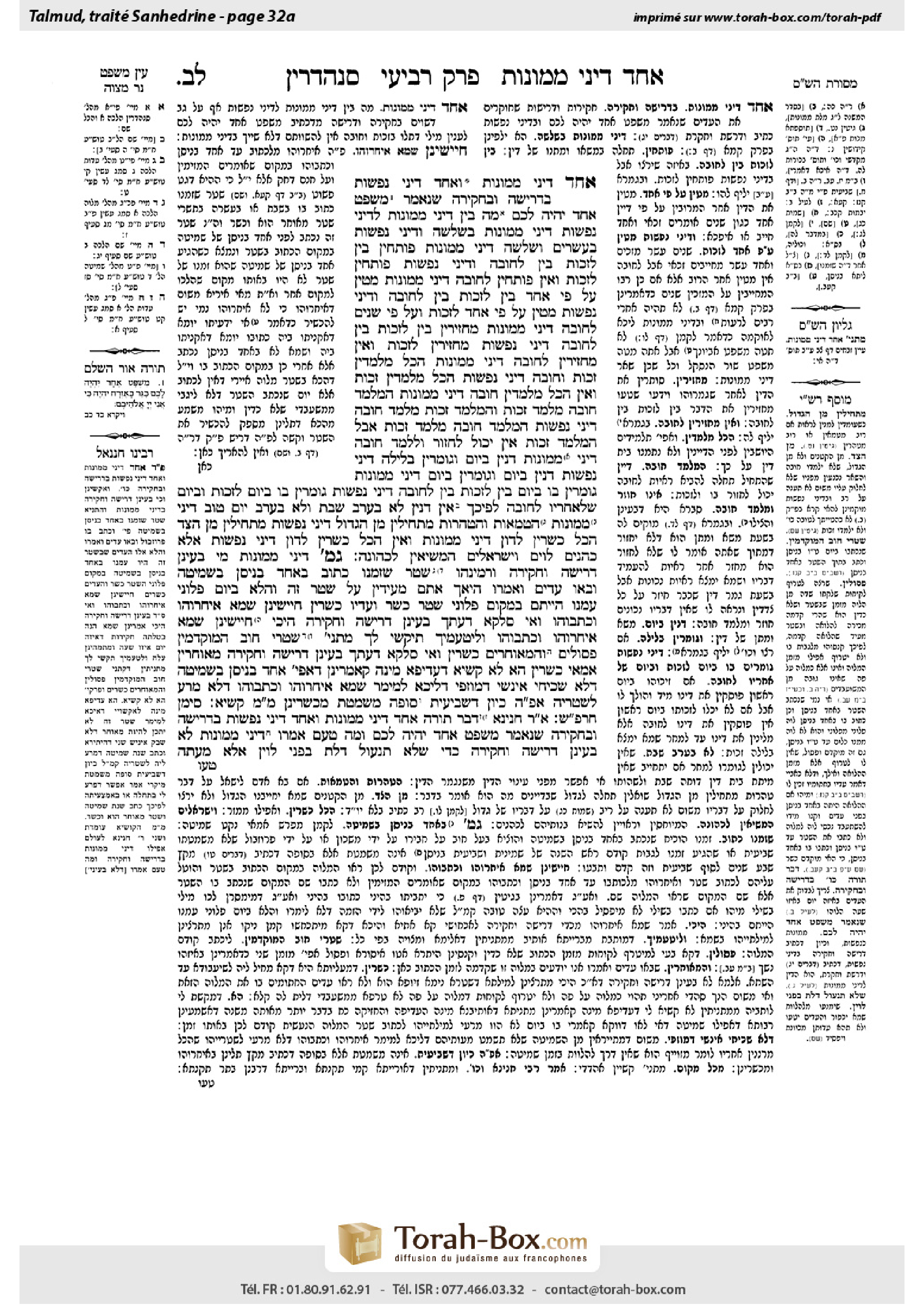
Sanhedrin 32a: Talmud study for Daf Yomi
Daf Yomi is the daily study of one Talmud folio. Explore 37 tractates with scans, Hebrew text, Sefaria English and AI-generated French translations where annotated.
Passage selection and English or AI-generated French translation are available where the scan has annotations. Daf Study is independent of Torah-Box and Sefaria.
Browse Sanhedrin · סנהדרין · All tractatesSanhedrin 32a text and translations
This page of Sanhedrin includes the Aramaic text, an English translation and an AI-generated French translation, alongside the scan above.
סנהדרין ל״ב א · Aramaic and Hebrew text
מַתְנִי׳ אֶחָד דִּינֵי מָמוֹנוֹת וְאֶחָד דִּינֵי נְפָשׁוֹת בִּדְרִישָׁה וּבַחֲקִירָה, שֶׁנֶּאֱמַר: ״מִשְׁפַּט אֶחָד יִהְיֶה לָכֶם״.
מָה בֵּין דִּינֵי מָמוֹנוֹת לְדִינֵי נְפָשׁוֹת? דִּינֵי מָמוֹנוֹת – בִּשְׁלֹשָׁה, וְדִינֵי נְפָשׁוֹת – בְּעֶשְׂרִים וּשְׁלֹשָׁה. דִּינֵי מָמוֹנוֹת – פּוֹתְחִין בֵּין לִזְכוּת בֵּין לְחוֹבָה, וְדִינֵי נְפָשׁוֹת – פּוֹתְחִין לִזְכוּת וְאֵין פּוֹתְחִין לְחוֹבָה.
דִּינֵי מָמוֹנוֹת – מַטִּין עַל פִּי אֶחָד, בֵּין לִזְכוּת בֵּין לְחוֹבָה, וְדִינֵי נְפָשׁוֹת – מַטִּין עַל פִּי אֶחָד לִזְכוּת, וְעַל פִּי שְׁנַיִם לְחוֹבָה.
דִּינֵי מָמוֹנוֹת – מַחְזִירִין בֵּין לִזְכוּת בֵּין לְחוֹבָה, דִּינֵי נְפָשׁוֹת – מַחְזִירִין לִזְכוּת וְאֵין מַחְזִירִין לְחוֹבָה.
דִּינֵי מָמוֹנוֹת – הַכֹּל מְלַמְּדִין זְכוּת וְחוֹבָה, דִּינֵי נְפָשׁוֹת – הַכֹּל מְלַמְּדִין זְכוּת, וְאֵין הַכֹּל מְלַמְּדִין חוֹבָה.
דִּינֵי מָמוֹנוֹת – הַמְלַמֵּד חוֹבָה מְלַמֵּד זְכוּת, וְהַמְלַמֵּד זְכוּת מְלַמֵּד חוֹבָה. דִּינֵי נְפָשׁוֹת – הַמְלַמֵּד חוֹבָה מְלַמֵּד זְכוּת, אֲבָל הַמְלַמֵּד זְכוּת אֵין יָכוֹל לַחְזוֹר וּלְלַמֵּד חוֹבָה.
דִּינֵי מָמוֹנוֹת – דָּנִין בַּיּוֹם, וְגוֹמְרִין בַּלַּיְלָה. דִּינֵי נְפָשׁוֹת – דָּנִין בַּיּוֹם, וְגוֹמְרִין בַּיּוֹם.
דִּינֵי מָמוֹנוֹת – גּוֹמְרִין בּוֹ בַּיּוֹם, בֵּין לִזְכוּת בֵּין לְחוֹבָה. דִּינֵי נְפָשׁוֹת – גּוֹמְרִין בּוֹ בַּיּוֹם לִזְכוּת, וּבַיּוֹם שֶׁלְּאַחֲרָיו לְחוֹבָה. לְפִיכָךְ, אֵין דָּנִין לֹא בְּעֶרֶב שַׁבָּת וְלֹא בְּעֶרֶב יוֹם טוֹב.
דִּינֵי מָמוֹנוֹת, הַטְּמָאוֹת וְהַטְּהָרוֹת – מַתְחִילִין מִן הַגָּדוֹל. דִּינֵי נְפָשׁוֹת – מַתְחִילִין מִן הַצַּד.
הַכֹּל כְּשֵׁרִין לָדוּן דִּינֵי מָמוֹנוֹת, וְאֵין הַכֹּל כְּשֵׁרִין לָדוּן דִּינֵי נְפָשׁוֹת, אֶלָּא כֹּהֲנִים לְוִיִּם וְיִשְׂרְאֵלִים הַמַּשִּׂיאִין לַכְּהוּנָּה.
גְּמָ׳ דִּינֵי מָמוֹנוֹת מִי בָּעֵינַן דְּרִישָׁה וַחֲקִירָה? וּרְמִינְהוּ: שְׁטָר שֶׁזְּמַנּוֹ כָּתוּב בְּאֶחָד בְּנִיסָן בַּשְּׁמִיטָּה, וּבָאוּ עֵדִים וְאָמְרוּ: ״הֵיאַךְ אַתֶּם מְעִידִין עַל שְׁטָר זֶה? וַהֲלֹא בְּיוֹם פְּלוֹנִי עִמָּנוּ הֱיִיתֶם בְּמָקוֹם פְּלוֹנִי!״ שְׁטָר כָּשֵׁר וְעֵדָיו כְּשֵׁרִין. חָיְישִׁינַן שֶׁמָּא אִיחֲרוּהוּ וּכְתָבוּהוּ.
וְאִי סָלְקָא דַעְתָּךְ בָּעֵינַן דְּרִישָׁה וַחֲקִירָה, הֵיכִי חָיְישִׁינַן שֶׁמָּא אִיחֲרוּהוּ וּכְתָבוּהוּ?
וְלִיטַעְמָיךְ, תִּיקְשֵׁי לָךְ מַתְנִיתִין: שִׁטְרֵי חוֹב הַמּוּקְדָּמִין פְּסוּלִים, וְהַמְאוּחָרִים כְּשֵׁרִין. וְאִי סָלְקָא דַעְתָּךְ בָּעֵינַן דְּרִישָׁה וַחֲקִירָה, מְאוּחָרִין אַמַּאי כְּשֵׁרִין?
הָא לָא קַשְׁיָא, דַּעֲדִיפָא מִינַּהּ קָאָמְרִינַן. דַּאֲפִילּוּ אֶחָד בְּנִיסָן בִּשְׁמִיטָּה, דְּלָא שְׁכִיחִי אִינָשֵׁי דְּמוֹזְפִי, דְּלֵיכָּא לְמֵימַר שֶׁמָּא אִיחֲרוּהוּ וּכְתָבוּהוּ דְּלָא מַרַע לִשְׁטָרֵיהּ, אֲפִילּוּ הָכִי, כֵּיוָן דִּשְׁבִיעִית סוֹפָהּ מְשַׁמֶּטֶת – מַכְשְׁרִינַן.
מִכׇּל מָקוֹם, קַשְׁיָא. סִימָן: חרפ״ש.
אָמַר רַבִּי חֲנִינָא: דְּבַר תּוֹרָה, אֶחָד דִּינֵי מָמוֹנוֹת וְאֶחָד דִּינֵי נְפָשׁוֹת בִּדְרִישָׁה וּבַחֲקִירָה, שֶׁנֶּאֱמַר: ״מִשְׁפַּט אֶחָד יִהְיֶה לָכֶם״. וּמָה טַעַם אָמְרוּ דִּינֵי מָמוֹנוֹת לָא בָּעֵינַן דְּרִישָׁה וַחֲקִירָה? כְּדֵי שֶׁלֹּא תִּנְעוֹל דֶּלֶת בִּפְנֵי לֹוִין.
אֶלָּא מֵעַתָּה
Sanhedrin 32a · English translation
MISHNA: Both cases of monetary law and cases of capital law are equal with regard to the requirement for inquiry and interrogation of the witnesses, as it is stated: “You shall have one manner of law” (Leviticus 24:22), meaning that all legal procedures must be uniform.
Having stated the essential similarity between the two, the mishna enumerates the differences between them. What are the differences between cases of monetary law and cases of capital law? Cases of monetary law are judged by a court of three judges, and cases of capital law are judged by a court of twenty-three judges. In cases of monetary law, the court opens the deliberations either with a claim to exempt the accused, or with a claim to find him liable. And in cases of capital law, the court opens the deliberations with a claim to acquit the accused, but it does not open the deliberations with a claim to find him liable.
In cases of monetary law, the court directs, i.e., issues, the ruling based on a majority of one judge, either to exempt, or to find liable. But in cases of capital law, the court directs the judgment based on a majority of one judge to acquit and based on a majority of two judges to find liable.
In cases of monetary law, the court brings the accused back to be judged again if new evidence arises, either with a claim to exempt the accused, or with a claim to find him liable. In cases of capital law, the court brings the accused back to be judged again with a claim to acquit him, but the court does not bring him back to be judged with a claim to find him liable.
In cases of monetary law, all those present at the trial may teach a reason to exempt a litigant or to find him liable. In cases of capital law, all those present at the trial may teach a reason to acquit the accused, but not all present may teach a reason to find him liable. Only the judges can teach a reason to find him liable.
In cases of monetary law, one who initially teaches a reason to find the accused liable may then teach a reason to exempt him, and one who initially teaches a reason to exempt him may then teach a reason to find him liable. In cases of capital law, one who initially teaches a reason to find him liable may then teach a reason to acquit, but one who initially teaches a reason to acquit may not return and teach a reason to find him liable.
In cases of monetary law, the court judges during the daytime, and may conclude the deliberations and issue the ruling even at night. In cases of capital law, the court judges during the daytime, and concludes the deliberations and issues the ruling only in the daytime.
In cases of monetary law, the court may conclude the deliberations and issue the ruling even on that same day, whether to exempt the accused or to find him liable. In cases of capital law, the court may conclude the deliberations and issue the ruling even on that same day to acquit the accused, but must wait until the following day to find him liable. Therefore, since capital cases might continue for two days, the court does not judge cases of capital law on certain days, neither on the eve of Shabbat nor the eve of a Festival.
In cases of monetary law, and likewise in the cases of ritual impurity and purity, the judges commence expressing their opinions from the greatest of the judges. In cases of capital law, the judges commence issuing their opinions from the side, where the least significant judges sit.
All are fit to judge cases of monetary law. But not all are fit to judge cases of capital law; only priests, Levites, and Israelites who are of sufficiently fit lineage to marry their daughters to members of the priesthood are fit to judge cases of capital law.
GEMARA: The mishna teaches that cases of monetary law require inquiry and interrogation of the witnesses. The Gemara asks: Do we require inquiry and interrogation in cases of monetary law? And the Gemara raises a contradiction from a baraita (Tosefta, Makkot 1:2): With regard to a promissory note whose date is written on the first of Nisan of the Sabbatical Year, and witnesses came and said to the signatory witnesses: How is it that you are testifying concerning this promissory note? But is it not so that on such and such day on which the promissory note was written you were with us in such and such place? The promissory note is nevertheless valid, and its witnesses remain fit to bear witness. The reason they are not proven to have signed the promissory note falsely is that we are concerned that perhaps they delayed and wrote it, i.e., the loan was given on an earlier date, and the promissory note was postdated.
The Gemara explains the contradiction: And if it enters your mind to say that we require inquiry and interrogation in cases of monetary law, how are we concerned that perhaps they delayed and wrote it? The signatory witnesses would be asked on which day they signed the promissory note, and when that does not accord with what is written in the promissory note, their testimony would be disregarded.
The Gemara counters: And according to your reasoning that we do not require inquiry and interrogation in cases of monetary law, the mishna elsewhere should pose a difficulty for you as well. As mishnayot are more authoritative than baraitot, it is preferable to raise a contradiction between two mishnayot than to raise a contradiction from a baraita to a mishna. The mishna teaches (Shevi’it 10:5): Antedated promissory notes are not valid, but postdated promissory notes are valid. And if it enters your mind to say we require inquiry and interrogation in cases of monetary law and that if there is a contradiction the testimony is not accepted, why are postdated promissory notes valid? The witnesses’ testimony does not accord with what is written in the document.
The Gemara explains: This is not difficult. There is a reason why the contradiction was raised from the baraita, not from the mishna. We are saying a better, i.e., stronger, contradiction than the one from the mishna. As one sees in the baraita that even with regard to a promissory note written on the first of Nisan in the Sabbatical Year, when it is not common to find people to lend money, as all debts are canceled at the close of the Sabbatical Year, where it is not as reasonable to say that perhaps they delayed and wrote the promissory note, as one would not damage his promissory note by postdating it so close to the end of the Sabbatical Year; even so, since the Sabbatical Year cancels debts only at its close, we are concerned that the promissory note is postdated and we deem it valid. This is why the contradiction was raised from the baraita, not from the mishna.
The Gemara returns to its question: In any case, the contradiction between the mishna and the baraita is difficult. The Gemara presents a mnemonic device for the following discussion, with each letter representing the name of a Sage who suggests an answer: Ḥet, reish, peh, shin.
The Gemara cites the first answer. Rabbi Ḥanina says: By Torah law, both cases of monetary law and cases of capital law are equal with regard to inquiry and interrogation of witnesses, as it is stated: “You shall have one manner of law” (Leviticus 24:22). And what is the reason the Sages said that in cases of monetary law we do not need inquiry and interrogation? It is an ordinance instituted by the Sages so as not to lock the door in the face of potential borrowers. The Sages were concerned that intensive examination of the witnesses would often result in contradictory testimony and render it difficult for lenders to collect their debts. This could lead to people refraining from lending money.
The Gemara asks: If that is so that the Sages removed the requirement for inquiry and interrogation in cases of monetary law,
Sanhedrin 32a · Traduction française (IA)
MICHNA : Les affaires pécuniaires et les affaires criminelles sont soumises aux mêmes exigences d’enquête et d’interrogatoire des témoins, comme il est dit : « Vous aurez une seule règle de droit » (Lévitique 24, 22), ce qui signifie que toutes les procédures judiciaires doivent être uniformes.
Après avoir énoncé la similitude fondamentale entre les deux, la Michna énumère leurs différences. Quelles sont les différences entre les affaires pécuniaires et les affaires criminelles ? Les affaires pécuniaires sont jugées par un tribunal de trois juges, tandis que les affaires criminelles sont jugées par un tribunal de vingt-trois juges. Dans les affaires pécuniaires, le tribunal ouvre les délibérations en avançant soit un argument en faveur de l’exonération de l’accusé, soit un argument en faveur de sa condamnation. Dans les affaires criminelles, le tribunal ouvre les délibérations en avançant un argument en faveur de l’acquittement de l’accusé, mais n’ouvre pas les délibérations en avançant un argument en faveur de sa condamnation.
Dans les affaires pécuniaires, le tribunal rend sa décision à la majorité d’une voix, qu’il s’agisse d’exonérer l’accusé ou de le déclarer coupable. Dans les affaires criminelles, le tribunal rend sa décision à la majorité d’une voix pour acquitter l’accusé, et à la majorité de deux voix pour le déclarer coupable.
Dans les affaires pécuniaires, le tribunal fait revenir l’accusé pour un nouveau jugement si de nouveaux éléments apparaissent, qu’ils plaident en faveur de son exonération ou de sa culpabilité. Dans les affaires criminelles, le tribunal le fait revenir pour un nouveau jugement si ces éléments plaident en faveur de son acquittement, mais ne le fait pas revenir pour le juger à nouveau s’ils plaident en faveur de sa culpabilité.
Dans les affaires pécuniaires, toutes les personnes présentes au procès peuvent avancer un argument en faveur de l’exonération ou de la condamnation d’une partie. Dans les affaires criminelles, toutes les personnes présentes au procès peuvent avancer un argument en faveur de l’acquittement de l’accusé, mais seules certaines peuvent avancer un argument en faveur de sa condamnation : les juges.
Dans les affaires pécuniaires, celui qui avance d’abord un argument en faveur de la condamnation de l’accusé peut ensuite avancer un argument en faveur de son exonération, et celui qui avance d’abord un argument en faveur de son exonération peut ensuite avancer un argument en faveur de sa condamnation. Dans les affaires criminelles, celui qui avance d’abord un argument en faveur de sa culpabilité peut ensuite avancer un argument en faveur de son acquittement, mais celui qui avance d’abord un argument en faveur de son acquittement ne peut pas ensuite avancer un argument en faveur de sa culpabilité.
Dans les affaires pécuniaires, le tribunal siège le jour et peut achever ses délibérations et rendre sa décision même la nuit. Dans les affaires criminelles, le tribunal siège le jour et n’achève ses délibérations et ne rend sa décision que le jour.
Dans les affaires pécuniaires, le tribunal peut achever ses délibérations et rendre sa décision le jour même, qu’il s’agisse d’exonérer l’accusé ou de le déclarer coupable. Dans les affaires criminelles, le tribunal peut achever ses délibérations et rendre sa décision le jour même pour acquitter l’accusé, mais doit attendre le lendemain pour le déclarer coupable. Par conséquent, puisque les affaires criminelles peuvent se prolonger sur deux jours, le tribunal ne juge pas ces affaires certains jours : ni la veille du Chabbat ni la veille d’une fête.
Dans les affaires pécuniaires, ainsi que dans les questions de pureté et d’impureté rituelles, les juges commencent à exprimer leur opinion par le plus éminent d’entre eux. Dans les affaires criminelles, les juges commencent à exprimer leur opinion par ceux qui siègent sur le côté, où prennent place les juges de moindre rang.
Tous sont aptes à juger les affaires pécuniaires. Mais tous ne sont pas aptes à juger les affaires criminelles : seuls les prêtres, les Lévites et les Israélites dont l’ascendance est suffisamment irréprochable pour qu’ils puissent marier leurs filles à des membres de la prêtrise sont aptes à juger ces affaires.
GUEMARA : La Michna enseigne que les affaires pécuniaires exigent l’enquête et l’interrogatoire des témoins. La Guemara demande : Exige-t-on une enquête et un interrogatoire dans les affaires pécuniaires ? La Guemara soulève une contradiction à partir d’une baraïta (Tosefta, Makot 1, 2) : à propos d’un acte de prêt portant la date du premier Nissan de l’année chabbatique, des témoins se présentent et disent aux témoins signataires : « Comment pouvez-vous témoigner au sujet de cet acte de prêt ? N’étiez-vous pas avec nous tel jour, en tel endroit, alors que cet acte de prêt a été rédigé ? » Malgré cela, l’acte de prêt est valide et ses témoins restent aptes à témoigner. La raison pour laquelle il n’est pas établi qu’ils ont signé l’acte de prêt de manière mensongère est que l’on craint qu’ils l’aient peut-être rédigé tardivement, c’est-à-dire que le prêt ait été accordé à une date antérieure et que l’acte de prêt ait été postdaté.
La Guemara explique la contradiction : si tu envisages de dire que nous exigeons une enquête et un interrogatoire dans les affaires pécuniaires, comment peut-on craindre qu’ils aient peut-être rédigé l’acte tardivement ? On demanderait aux témoins signataires quel jour ils ont signé l’acte de prêt et, si leur réponse ne correspond pas à la date qui y est inscrite, leur témoignage serait écarté.
La Guemara objecte : selon ton raisonnement, si nous n’exigeons pas d’enquête ni d’interrogatoire dans les affaires pécuniaires, la Michna enseignée ailleurs devrait également te poser une difficulté. En effet, les michnayot faisant davantage autorité que les baraïtot, il est préférable de soulever une contradiction entre deux michnayot plutôt qu’entre une baraïta et une Michna. La Michna enseigne (Cheviit 10, 5) : les actes de prêt antidatés ne sont pas valides, mais les actes de prêt postdatés le sont. Et si tu envisages de dire que nous exigeons une enquête et un interrogatoire dans les affaires pécuniaires et que, lorsqu’il y a contradiction, le témoignage n’est pas accepté, pourquoi les actes de prêt postdatés sont-ils valides ? Le témoignage des témoins ne correspond pas à ce qui est écrit dans le document.
La Guemara explique : il n’y a pas de difficulté. Il y a une raison pour laquelle la contradiction a été soulevée à partir de la baraïta plutôt que de la Michna. Nous présentons une contradiction meilleure, c’est-à-dire plus forte, que celle tirée de la Michna. Comme on le voit dans la baraïta, même à propos d’un acte de prêt rédigé le premier Nissan de l’année chabbatique, période où il est rare de trouver des prêteurs, puisque toutes les dettes sont annulées à la fin de l’année chabbatique, il est moins plausible de dire qu’ils ont peut-être rédigé l’acte tardivement : en effet, personne ne nuirait à son acte de prêt en le postdatant si près de la fin de l’année chabbatique. Malgré cela, puisque l’année chabbatique n’annule les dettes qu’à sa fin, on craint que l’acte de prêt ait été postdaté et on le considère comme valide. Voilà pourquoi la contradiction a été soulevée à partir de la baraïta et non de la Michna.
La Guemara revient à sa question : quoi qu’il en soit, la contradiction entre la Michna et la baraïta pose difficulté. La Guemara donne un moyen mnémotechnique pour la discussion qui suit, chaque lettre représentant le nom d’un Sage qui propose une réponse : Ḥet, reish, peh, shin.
La Guemara présente la première réponse. Rabbi Ḥanina dit : selon la Torah, les affaires pécuniaires et les affaires criminelles sont soumises aux mêmes exigences d’enquête et d’interrogatoire des témoins, comme il est dit : « Vous aurez une seule règle de droit » (Lévitique 24, 22). Pourquoi les Sages ont-ils dit que, dans les affaires pécuniaires, l’enquête et l’interrogatoire ne sont pas nécessaires ? C’est une ordonnance instituée par les Sages afin de ne pas fermer la porte aux emprunteurs potentiels. Les Sages craignaient qu’un examen approfondi des témoins ne conduise souvent à des témoignages contradictoires et ne rende difficile, pour les prêteurs, le recouvrement de leurs créances. Cela pourrait amener les gens à s’abstenir de prêter de l’argent.
La Guemara demande : si tel est le cas, si les Sages ont supprimé l’exigence d’enquête et d’interrogatoire dans les affaires pécuniaires,
Traduction française générée par IA à partir de l’édition anglaise de Sefaria. Vérifie toujours un passage avec le texte source.
Text from Sefaria: William Davidson Edition - Vocalized Aramaic (CC BY NC); William Davidson Edition - English (CC BY NC).