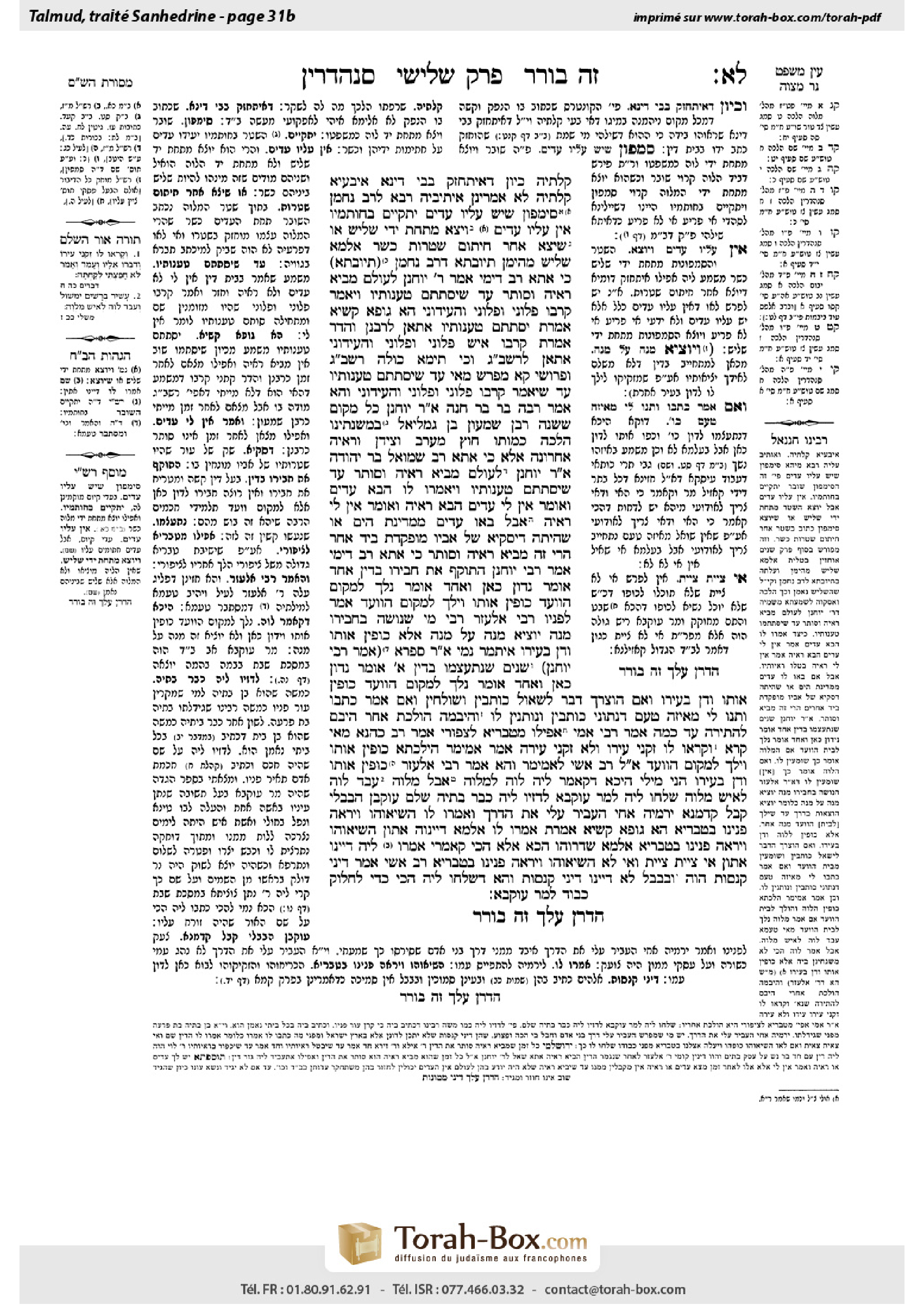
Sanhedrin 31b: Talmud study for Daf Yomi
Daf Yomi is the daily study of one Talmud folio. Explore 37 tractates with scans, Hebrew text, Sefaria English and AI-generated French translations where annotated.
Passage selection and English or AI-generated French translation are available where the scan has annotations. Daf Study is independent of Torah-Box and Sefaria.
Browse Sanhedrin · סנהדרין · All tractatesSanhedrin 31b text and translations
This page of Sanhedrin includes the Aramaic text, an English translation and an AI-generated French translation, alongside the scan above.
סנהדרין ל״א ב · Aramaic and Hebrew text
קְלָתֵיהּ!
כֵּיוָן דְּאִיתַּחְזַק בְּבֵי דִינָא, ״אִיבַּעְיָא קְלָתֵיהּ״ לָא אָמְרִינַן.
אֵיתִיבֵיהּ רָבָא לְרַב נַחְמָן: סִימְפּוֹן שֶׁיֵּשׁ עָלָיו עֵדִים – יִתְקַיֵּים בְּחוֹתְמָיו. אֵין עָלָיו עֵדִים, וְיָצָא מִתַּחַת יְדֵי שָׁלִישׁ, אוֹ שֶׁיָּצָא אַחַר חִיתּוּם שְׁטָרוֹת – כָּשֵׁר. אַלְמָא שָׁלִישׁ מְהֵימַן!
תְּיוּבְתָּא דְּרַב נַחְמָן, תְּיוּבְתָּא.
כִּי אֲתָא רַב דִּימִי, אָמַר רַבִּי יוֹחָנָן: לְעוֹלָם מֵבִיא רְאָיָה וְסוֹתֵר, עַד שֶׁיִּסְתַּתֵּם טַעֲנוֹתָיו וְיֹאמַר: קִרְבוּ פְּלוֹנִי וּפְלוֹנִי וְהַעִידוּנִי.
הָא גוּפַאּ קַשְׁיָא: אָמְרַתְּ ״יִסְתַּתֵּם טַעֲנוֹתָיו״ – אֲתָאן לְרַבָּנַן, וַהֲדַר אָמְרַתְּ ״קִרְבוּ אִישׁ פְּלוֹנִי וּפְלוֹנִי וְהַעִידוּנִי״ – אֲתָאן לְרַבָּן שִׁמְעוֹן בֶּן גַּמְלִיאֵל.
וְכִי תֵּימָא: כּוּלַּהּ רַבָּן שִׁמְעוֹן בֶּן גַּמְלִיאֵל, וּפָרוֹשֵׁי קָא מְפָרֵשׁ? מַאי ״עַד שֶׁיִּסְתַּתֵּם טַעֲנוֹתָיו״? עַד שֶׁיֹּאמַר: קִרְבוּ פְּלוֹנִי וּפְלוֹנִי וְהַעִידוּנִי. וְהָא אָמַר רַבָּה בַּר בַּר חָנָה אָמַר רַבִּי יוֹחָנָן: כׇּל מָקוֹם שֶׁשָּׁנָה רַבָּן שִׁמְעוֹן בֶּן גַּמְלִיאֵל בְּמִשְׁנָתֵינוּ הֲלָכָה כְּמוֹתוֹ, חוּץ מֵעָרֵב וְצַיְדָן וּרְאָיָה אַחֲרוֹנָה?
אֶלָּא, כִּי אֲתָא רַב שְׁמוּאֵל בַּר יְהוּדָה, אָמַר רַבִּי יוֹחָנָן: לְעוֹלָם מֵבִיא רְאָיָה וְסוֹתֵר, עַד שֶׁיִּסְתַּתֵּם טַעֲנוֹתָיו וְיֹאמְרוּ לוֹ: ״הָבֵא עֵדִים״, וְאוֹמֵר: ״אֵין לִי עֵדִים״. ״הָבֵא רְאָיָה״, וְאוֹמֵר: ״אֵין לִי רְאָיָה״. אֲבָל בָּאוּ עֵדִים מִמְּדִינַת הַיָּם, אוֹ שֶׁהָיְתָה דִּיסַקַּיָּא שֶׁל אָבִיו מוּפְקֶדֶת בְּיַד אַחֵר – הֲרֵי זֶה מֵבִיא רְאָיָה וְסוֹתֵר.
כִּי אֲתָא רַב דִּימִי, אָמַר רַבִּי יוֹחָנָן: הַתּוֹקֵף אֶת חֲבֵירוֹ בַּדִּין, אֶחָד אוֹמֵר ״נִדּוֹן כָּאן״, וְאֶחָד אוֹמֵר ״נֵלֵךְ לִמְקוֹם הַוַּועַד״ – כּוֹפִין אוֹתוֹ וְיֵלֵךְ לִמְקוֹם הַוַּועַד.
אָמַר לְפָנָיו רַבִּי אֶלְעָזָר: רַבִּי, מִי שֶׁנּוֹשֶׁה בַּחֲבֵירוֹ מָנֶה, יוֹצִיא מָנֶה עַל מָנֶה? אֶלָּא, כּוֹפִין אוֹתוֹ וְדָן בְּעִירוֹ.
אִיתְּמַר נָמֵי: אָמַר רַב סָפְרָא אָמַר רַבִּי יוֹחָנָן: שְׁנֵים שֶׁנִּתְעַצְּמוּ בַּדִּין, אֶחָד אוֹמֵר: ״נִדּוֹן כָּאן״, וְאֶחָד אוֹמֵר: ״נֵלֵךְ לִמְקוֹם הַוַּועַד״ – כּוֹפִין אוֹתוֹ וְדָן בְּעִירוֹ. וְאִם הוּצְרַךְ דָּבָר לִשְׁאוֹל – כּוֹתְבִין וְשׁוֹלְחִין.
וְאִם אָמַר: ״כִּתְבוּ וּתְנוּ לִי מֵאֵיזֶה טַעַם דַּנְתּוּנִי״ – כּוֹתְבִין וְנוֹתְנִין לוֹ.
וְהַיְּבָמָה, הוֹלֶכֶת אַחַר הַיָּבָם לְהַתִּירָהּ.
עַד כַּמָּה? אָמַר רַבִּי אַמֵּי: אֲפִילּוּ מִטְּבֶרְיָא לְצִפּוֹרִי.
אָמַר רַב כָּהֲנָא: מַאי קְרָא? ״וְקָרְאוּ לוֹ זִקְנֵי עִירוֹ״, וְלֹא זִקְנֵי עִירָהּ.
אָמַר אַמֵּימָר: הִילְכְתָא, כּוֹפִין אוֹתוֹ וְיֵלֵךְ לִמְקוֹם הַוַּועַד. אֲמַר לֵיהּ רַב אָשֵׁי לְאַמֵּימָר: וְהָא אָמַר רַבִּי אֶלְעָזָר: כּוֹפִין אוֹתוֹ וְדָן בְּעִירוֹ! הָנֵי מִילֵּי הֵיכָא דְּקָאָמַר לֵיהּ לֹוֶה לְמַלְוֶה, אֲבָל מַלְוֶה – ״עֶבֶד לֹוֶה לְאִישׁ מַלְוֶה״.
שְׁלַחוּ לֵיהּ לְמָר עוּקְבָא: לִדְזִיו לֵיהּ כְּבַר בִּתְיָה, שְׁלָם. עוּקְבָן הַבַּבְלִי קְבַל קֳדָמַנָא: יִרְמְיָה אָחִי הֶעֱבִיר עָלַי אֶת הַדֶּרֶךְ. אִמְרוּ לוֹ: הַשִּׂיאוּהוּ וְיִרְאֶה פָּנֵינוּ בִּטְבֶרְיָא.
הָא גוּפָא קַשְׁיָא: אָמְרַתְּ ״אִמְרוּ לוֹ״, אַלְמָא דַּיְּינוּהּ אַתּוּן. ״הַשִּׂיאוּהוּ וְיִרְאֶה פָּנֵינוּ בִּטְבֶרְיָא״, אַלְמָא שַׁדְּרוּהּ הָכָא.
(אֶלָּא), הָכִי קָאָמְרִי: אֱמַרוּ לֵיהּ, דַּיְּינוּהּ אַתּוּן. אִי צָיֵית – צָיֵית, וְאִי לָא – הַשִּׂיאוּהוּ וְיִרְאֶה פָּנֵינוּ בִּטְבֶרְיָא.
רַב אָשֵׁי אָמַר: דִּינֵי קְנָסוֹת הֲוָה, וּבְבָבֶל לָא דָּיְינִי דִּינֵי קְנָסוֹת. וְהָא דִּשְׁלַחוּ לֵיהּ הָכִי – כְּדֵי לַחֲלוֹק כָּבוֹד לְמָר עוּקְבָא.
הֲדַרַן עֲלָךְ זֶה בּוֹרֵר.
Sanhedrin 31b · English translation
she could have burned it. Why did you not accept her testimony?
Rav Naḥman answered him: Since the promissory note was ratified in court, we do not say that she is deemed credible to nullify its validity because if she had wanted to, she could have burned it. The validity of a ratified document is not nullified without evidence.
Rava raised an objection to the ruling of Rav Naḥman from a baraita: A receipt [simfon] of repayment of a debt upon which witnesses are signed is ratified by means of its signatories. The witnesses testify that these are their signatures, and it is thereby ratified. If there are no witnesses signed on it, but the receipt emerged from the possession of a third party serving as a trustee, or if it emerged after the signing of the documents, i.e., the receipt was written on the promissory note beneath the content of the note and the witnesses’ signatures, it is valid. Rava states his objection: Apparently, the testimony of a third party serving as a trustee is deemed credible, as he can testify that the receipt is valid even if it was not signed by witnesses.
The Gemara concludes: The refutation of the opinion of Rav Naḥman is indeed a conclusive refutation.
§ When Rav Dimi came from Eretz Yisrael to Babylonia, he said that Rabbi Yoḥanan said: One can always bring a proof for his claim and overturn the previous verdict, until his claims are stopped up, i.e., until he has no more claims, and he says: Come, so-and-so and so-and-so, and testify on my behalf, in which case those witnesses are not allowed to testify.
The Gemara asks: This matter itself is difficult. When you say: Until his claims are stopped up, we arrive at, i.e., this represents, the opinion of the Rabbis, who hold in the mishna that once a litigant stops presenting his claims, he cannot present additional claims later. And when you then say: Until he says come, so-and-so and so-and-so, and testify on my behalf, we arrive at the opinion of Rabban Shimon ben Gamliel that it is only in that case that the testimony is not accepted.
And if you would say that the entire statement is in accordance with the opinion of Rabban Shimon ben Gamliel, and Rabbi Yoḥanan is explaining his own statement, saying: What is the meaning of the phrase: Until his claims are stopped up? Until he says: Come, so-and-so and so-and-so, and testify on my behalf, this is difficult. But doesn’t Rabba bar bar Ḥana say that Rabbi Yoḥanan says that anywhere that Rabban Shimon ben Gamliel taught a ruling in our Mishna, the halakha is in accordance with his opinion, except for the following three cases: The responsibility of the guarantor, and the incident that occurred in the city of Tzaidan, and the dispute with regard to evidence in the final disagreement? Evidently, the halakha is in accordance with the opinion of the Rabbis in this case.
Rather, the Gemara presents another version of Rabbi Yoḥanan’s statement. When Rav Shmuel bar Yehuda came from Eretz Yisrael to Babylonia, he said that Rabbi Yoḥanan says: One can always bring a proof and overturn the previous verdict until his claims are stopped up, and the judges say to him: Bring witnesses, and he says: I have no witnesses, and they say to him: Bring evidence, and he says: I have no evidence. This is in accordance with the statement of the Rabbis in the mishna. But if witnesses came from overseas, or if there was a saddlebag [disakkaya] of his father’s documents deposited by another individual, which are cases where he did not know of the evidence, he can bring this evidence and overturn the previous verdict, as there is no concern of artifice.
§ When Rav Dimi came from Eretz Yisrael to Babylonia, he said that Rabbi Yoḥanan says: With regard to one who attacks another in judgment, i.e., tenaciously raises legal claims against another, and one of the litigants says: Let us go to court here in our locale, and the other one says: Let us go to the place of the Assembly, i.e., the Sanhedrin, or another High Court, the former litigant is compelled to go to the place of the Assembly.
Rabbi Elazar said before him: My teacher, if so, must one who claims a debt of one hundred dinars from another spend one hundred dinars of travel and lodging expenses for the one hundred dinars he wants to collect? Rather, one is compelled to appear and be judged in a court that presides in his own city.
It was also stated that Rav Safra says that Rabbi Yoḥanan says: With regard to two who were struggling in judgment, one of whom says: Let us go to court here, and one of whom says: Let us go to the place of the Assembly, the latter litigant is compelled to appear and be judged in a court that presides in his own city. And if the local court needs to ask a higher court about a certain matter, the judges write to the Assembly, and the higher court sends its response.
And if one of the litigants says to a court: Write for what reason you judged me in this manner and give it to me, as I do not trust your decision without explanation, the judges write it and give it to him.
Another halakha was stated with regard to the location of the judgment: And with regard to a woman whose husband had a brother, and he died childless [vehayevama], she follows her brother-in-law [hayavam] for him to free her of the levirate bond through ḥalitza. The yavam does not have to go to her.
The Gemara asks: How far does she have to go? Rabbi Ami says: Even from Tiberias to Tzippori. This is the halakha even though the court in Tiberias is more prestigious than the one in Tzippori.
Rav Kahana says: What is the verse that alludes to this halakha? It is the verse that states: “Then the elders of his city shall call him, and speak to him, and if he stands and says: I do not wish to take her” (Deuteronomy 25:8). The fact that the elders of his city, and not the elders of her city, are mentioned indicates that ḥalitza is performed in his city and not in hers.
Ameimar says: The halakha is that if one litigant wants to go to the place of the Assembly and the other does not, the latter is compelled to go to the place of the Assembly. Rav Ashi said to Ameimar: But doesn’t Rabbi Elazar say that he is compelled to appear and be judged in a court that presides in his own city? Ameimar answered: This statement applies in a case where the borrower said to the lender: Let us go to the place of the Assembly; in that case, the debtor is compelled to be judged in his city. But if the lender requests to go to the place of the Assembly, his request is accepted, as it is stated: “The borrower is servant to the lender” (Proverbs 22:7).
The Sages sent a letter to Mar Ukva, the Exilarch in Babylonia, which stated: To he who has light upon him, like Moses, who is called the son of Bithiah, Shalom. The letter continued: Ukvan the Babylonian complained before us as follows: Yirmeya, my brother, came past me, i.e., did me a great evil. And therefore tell Yirmeya; induce him [hassiuhu] to see our face in Tiberias, where we will judge his case.
The Gemara asks: This matter itself is difficult to understand. You said: Tell him. Apparently the intention was: Judge him yourselves in Babylonia. But then the letter states: Induce him to see our face in Tiberias. Apparently the intention was: Send him here.
Rather, this is what the Sages were saying: Tell him, i.e., judge him yourselves. If he listens to the court, he listens, and the issue is resolved. But if he does not listen, induce him to see our face in Tiberias.
Rav Ashi said: That is not the correct understanding of the letter. Rather, it was a case pertaining to the halakhot of fines, and in Babylonia the courts do not adjudicate in cases pertaining to the halakhot of fines, as there are no ordained judges there; such Sages are found only in Eretz Yisrael. Consequently, it was necessary to send the case to Eretz Yisrael. And the fact that they sent the letter to Mar Ukva using this wording, as though he were capable of adjudicating the case himself, was in order to give honor to Mar Ukva, who was a Sage and a leader. They hinted to him that he could not judge this case and that he therefore had to send the defendant to Eretz Yisrael.
Sanhedrin 31b · Traduction française (IA)
Elle aurait pu le brûler. Pourquoi n’avez-vous pas accepté son témoignage ?
Rav Naḥman lui répondit : Puisque le billet à ordre a été authentifié au tribunal, nous ne considérons pas qu’elle soit crédible au point d’en annuler la validité sous prétexte que, si elle l’avait voulu, elle aurait pu le brûler. La validité d’un acte authentifié n’est pas annulée sans preuve.
Rava objecta à la décision de Rav Naḥman en citant une baraïta : Un reçu [simfon] attestant le remboursement d’une dette et portant la signature de témoins est authentifié par ses signataires. Les témoins attestent qu’il s’agit bien de leurs signatures, et le reçu est ainsi authentifié. S’il n’y a pas de témoins signataires, mais que le reçu a été trouvé en possession d’un tiers qui en était le dépositaire, ou qu’il est apparu après la signature des actes, c’est-à-dire que le reçu a été inscrit sur le billet à ordre, sous son texte et sous les signatures des témoins, il est valide. Rava formule son objection : il semble que le témoignage d’un tiers dépositaire soit jugé crédible, puisqu’il peut attester la validité du reçu même s’il n’est pas signé par des témoins.
La Guemara conclut : La réfutation de l’opinion de Rav Naḥman est bien définitive.
§ Lorsque Rav Dimi vint d’Eretz Israël en Babylonie, il rapporta que Rabbi Yoḥanan avait dit : On peut toujours apporter une preuve à l’appui de sa prétention et faire annuler le jugement précédent, jusqu’à ce que ses prétentions soient épuisées, c’est-à-dire jusqu’à ce qu’il n’ait plus rien à faire valoir et qu’il dise : « Faites venir Untel et Untel pour témoigner en ma faveur. » Dans ce cas, ces témoins ne sont pas autorisés à témoigner.
La Guemara demande : Cette déclaration elle-même est difficile. Lorsque tu dis : « Jusqu’à ce que ses prétentions soient épuisées », tu rejoins l’opinion des rabbins, qui soutiennent dans la Michna qu’une fois qu’un plaideur a cessé de présenter ses prétentions, il ne peut plus en présenter d’autres par la suite. Mais lorsque tu ajoutes : « Jusqu’à ce qu’il dise : “Faites venir Untel et Untel pour témoigner en ma faveur” », tu rejoins l’opinion de Rabban Shimon ben Gamliel, selon laquelle le témoignage n’est pas accepté uniquement dans ce cas.
Et si tu disais que toute la déclaration est conforme à l’opinion de Rabban Shimon ben Gamliel, et que Rabbi Yoḥanan explique sa propre déclaration en disant que l’expression « jusqu’à ce que ses prétentions soient épuisées » signifie « jusqu’à ce qu’il dise : “Faites venir Untel et Untel pour témoigner en ma faveur” », cela poserait une difficulté. En effet, Rabba bar bar Ḥana ne rapporte-t-il pas que Rabbi Yoḥanan dit que partout où Rabban Shimon ben Gamliel formule une décision dans notre Michna, la halakha suit son opinion, à l’exception des trois cas suivants : la responsabilité de la caution, l’incident survenu dans la ville de Tzaidan et le différend concernant les preuves dans le dernier désaccord ? Il ressort de là que, dans ce cas, la halakha suit l’opinion des rabbins.
La Guemara présente plutôt une autre version de la déclaration de Rabbi Yoḥanan. Lorsque Rav Shmuel bar Yehuda vint d’Eretz Israël en Babylonie, il rapporta que Rabbi Yoḥanan avait dit : On peut toujours apporter une preuve et faire annuler le jugement précédent, jusqu’à ce que ses prétentions soient épuisées : les juges lui disent alors « Amène des témoins », et il répond « Je n’ai pas de témoins » ; ils lui disent ensuite « Amène une preuve », et il répond « Je n’ai pas de preuve ». Cela correspond à l’opinion des rabbins dans la Michna. Mais si des témoins arrivent de l’étranger, ou si l’on retrouve une sacoche [disakkaya] contenant les documents de son père, déposés chez une autre personne, il peut produire ces éléments et faire annuler le jugement précédent, puisqu’il n’y a alors aucun risque de manœuvre.
§ Lorsque Rav Dimi vint d’Eretz Israël en Babylonie, il rapporta que Rabbi Yoḥanan avait dit : Si quelqu’un s’acharne contre un autre dans un procès, c’est-à-dire qu’il fait valoir avec insistance des prétentions juridiques contre lui, et que l’un des plaideurs propose : « Allons au tribunal d’ici, dans notre localité », tandis que l’autre dit : « Allons au lieu de l’Assemblée », c’est-à-dire au Sanhédrin ou à une autre haute cour, le premier plaideur est contraint de se rendre au lieu de l’Assemblée.
Rabbi Elazar lui dit : Mon maître, dans ce cas, celui qui réclame à un autre une dette de cent dinars doit-il dépenser cent dinars en frais de voyage et de logement pour recouvrer les cent dinars qu’il veut percevoir ? Il faut plutôt contraindre les parties à comparaître et à être jugées devant un tribunal siégeant dans la ville du débiteur.
Il a également été enseigné que Rav Safra rapporte au nom de Rabbi Yoḥanan : Lorsque deux personnes sont en litige, que l’une dit : « Allons au tribunal d’ici », et que l’autre dit : « Allons au lieu de l’Assemblée », ce dernier est contraint de comparaître et d’être jugé devant un tribunal siégeant dans sa propre ville. Si le tribunal local doit consulter une cour supérieure sur une question donnée, les juges écrivent à l’Assemblée, et la cour supérieure leur envoie sa réponse.
Et si l’un des plaideurs dit au tribunal : « Écrivez la raison pour laquelle vous m’avez jugé de cette manière et remettez-moi le document, car je ne me fie pas à votre décision sans explication », les juges la mettent par écrit et la lui remettent.
Une autre halakha a été énoncée concernant le lieu où se tient le jugement : lorsqu’une femme devient veuve sans enfant [vehayevama] et que son mari avait un frère, elle se rend auprès de son beau-frère lévir [hayavam] afin qu’il la libère du lien léviratique par la ḥalitsa. Le yavam n’a pas à se rendre auprès d’elle.
La Guemara demande : Jusqu’où doit-elle aller ? Rabbi Ami répond : Même de Tibériade à Tzippori. Telle est la halakha, bien que le tribunal de Tibériade soit plus prestigieux que celui de Tzippori.
Rav Kahana dit : Quel verset fait allusion à cette halakha ? Le verset qui dit : « Les anciens de sa ville l’appelleront et lui parleront ; s’il se tient là et dit : “Je ne veux pas la prendre” » (Deutéronome 25:8). Le fait que le verset mentionne les anciens de sa ville, et non ceux de la ville de la femme, indique que la ḥalitsa a lieu dans sa ville, et non dans la sienne.
Ameimar dit : La halakha est que si un plaideur veut se rendre au lieu de l’Assemblée et que l’autre ne le veut pas, ce dernier est contraint de s’y rendre. Rav Ashi dit à Ameimar : Rabbi Elazar ne dit-il pas que le plaideur est contraint de comparaître et d’être jugé devant un tribunal siégeant dans sa propre ville ? Ameimar lui répondit : Cette déclaration s’applique lorsque l’emprunteur dit au prêteur : « Allons au lieu de l’Assemblée » ; dans ce cas, le débiteur est contraint d’être jugé dans sa ville. Mais si c’est le prêteur qui demande à se rendre au lieu de l’Assemblée, sa demande est acceptée, comme il est dit : « L’emprunteur est l’esclave du prêteur » (Proverbes 22:7).
Les Sages envoyèrent une lettre à Mar Ukva, l’exilarque de Babylonie, ainsi rédigée : « À celui sur qui repose la lumière, comme sur Moïse, appelé fils de Bithiah : Shalom. » La lettre poursuivait : « Ukvan le Babylonien s’est plaint auprès de nous en ces termes : Yirmeya, mon frère, est passé par moi, c’est-à-dire qu’il m’a fait un grand tort. Dis donc à Yirmeya de venir nous voir [hassiuhu] à Tibériade, afin que nous jugions son affaire. »
La Guemara demande : Cette déclaration elle-même est difficile à comprendre. Vous avez dit : « Dis-lui. » Cela semble signifier : « Jugez-le vous-mêmes en Babylonie. » Mais la lettre ajoute : « Fais-le venir nous voir à Tibériade. » Cela semble signifier : « Envoyez-le ici. »
Les Sages voulaient plutôt dire ceci : « Dis-lui », c’est-à-dire : « Jugez-le vous-mêmes. » S’il écoute le tribunal, l’affaire est réglée. Mais s’il ne l’écoute pas, fais-le venir nous voir à Tibériade.
Rav Ashi dit : Ce n’est pas ainsi qu’il faut comprendre la lettre. Il s’agissait plutôt d’une affaire relevant des lois relatives aux amendes. En Babylonie, les tribunaux ne statuent pas sur les affaires relevant de ces lois, car il n’y a pas de juges ordonnés ; de tels Sages ne se trouvent qu’en Eretz Israël. Il fallait donc envoyer l’affaire en Eretz Israël. Si les Sages ont adressé à Mar Ukva une lettre formulée comme s’il pouvait statuer lui-même sur l’affaire, c’était pour l’honorer, puisqu’il était un Sage et un dirigeant. Ils lui ont fait comprendre qu’il ne pouvait pas juger cette affaire et qu’il devait donc envoyer le défendeur en Eretz Israël.
Traduction française générée par IA à partir de l’édition anglaise de Sefaria. Vérifie toujours un passage avec le texte source.
Text from Sefaria: William Davidson Edition - Vocalized Aramaic (CC BY NC); William Davidson Edition - English (CC BY NC).