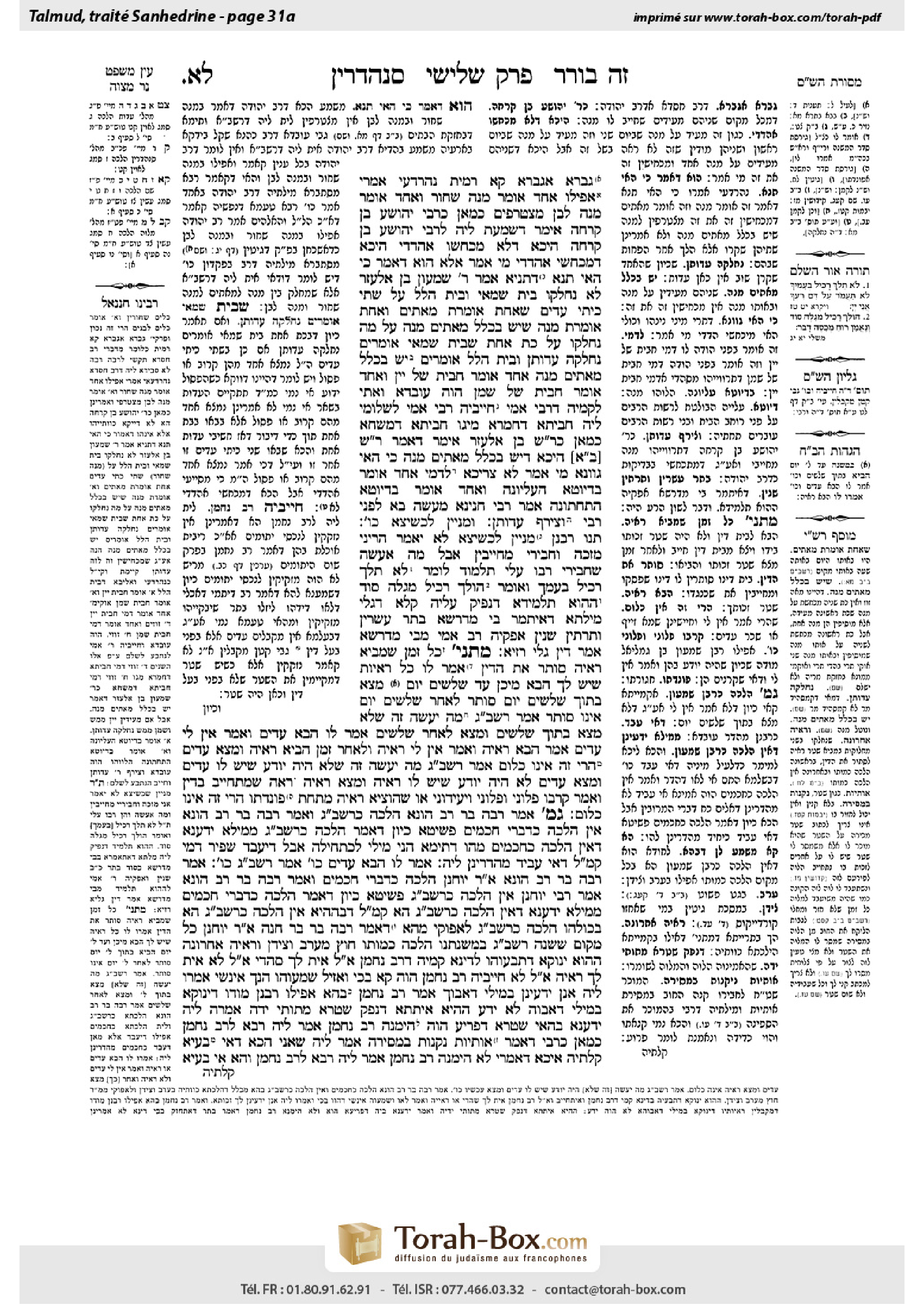
Sanhedrin 31a: Talmud study for Daf Yomi
Daf Yomi is the daily study of one Talmud folio. Explore 37 tractates with scans, Hebrew text, Sefaria English and AI-generated French translations where annotated.
Passage selection and English or AI-generated French translation are available where the scan has annotations. Daf Study is independent of Torah-Box and Sefaria.
Browse Sanhedrin · סנהדרין · All tractatesSanhedrin 31a text and translations
This page of Sanhedrin includes the Aramaic text, an English translation and an AI-generated French translation, alongside the scan above.
סנהדרין ל״א א · Aramaic and Hebrew text
גַּבְרָא אַגַּבְרָא קָא רָמֵית?
נְהַרְדָּעֵי אָמְרִי: אֲפִילּוּ אֶחָד אוֹמֵר ״מָנֶה שָׁחוֹר״, וְאֶחָד אוֹמֵר ״מָנֶה לָבָן״ – מִצְטָרְפִים.
כְּמַאן? כְּרַבִּי יְהוֹשֻׁעַ בֶּן קׇרְחָה? אֵימַר דְּשָׁמְעַתְּ לֵיהּ לְרַבִּי יְהוֹשֻׁעַ בֶּן קׇרְחָה הֵיכָא דְּלָא מַכְחֲשִׁי אַהֲדָדֵי, הֵיכָא דְּמַכְחֲשִׁי אַהֲדָדֵי מִי אָמַר?
אֶלָּא הוּא דְּאָמַר כִּי הַאי תַּנָּא, דְּתַנְיָא: אָמַר רַבִּי שִׁמְעוֹן בֶּן אֶלְעָזָר: לֹא נֶחְלְקוּ בֵּית שַׁמַּאי וּבֵית הִלֵּל עַל שְׁתֵּי כִּיתֵּי עֵדִים, שֶׁאַחַת אוֹמֶרֶת מָאתַיִם וְאַחַת אוֹמֶרֶת מָנֶה, שֶׁיֵּשׁ בִּכְלַל מָאתַיִם מָנֶה.
עַל מָה נֶחְלְקוּ? עַל כַּת אַחַת, שֶׁבֵּית שַׁמַּאי אוֹמְרִים: נֶחְלְקָה עֵדוּתָן, וּבֵית הִלֵּל אוֹמְרִים: יֵשׁ בִּכְלַל מָאתַיִם מָנֶה.
אֶחָד אוֹמֵר: ״חָבִית שֶׁל יַיִן״, וְאֶחָד אוֹמֵר: ״חָבִית שֶׁל שֶׁמֶן״. הֲוָה עוֹבָדָא, וְאָתֵי לְקַמֵּיהּ דְּרַבִּי אַמֵּי. חַיְּיבֵיהּ רַבִּי אַמֵּי לְשַׁלּוֹמֵי לֵיהּ חָבִיתָא דְחַמְרָא מִיגּוֹ חָבִיתָא דְמִשְׁחָא.
כְּמַאן? כְּרַבִּי שִׁמְעוֹן בֶּן אֶלְעָזָר? אֵימַר דְּאָמַר רַבִּי שִׁמְעוֹן בֶּן אֶלְעָזָר הֵיכָא דְּיֵשׁ בִּכְלַל מָאתַיִם מָנֶה, כִּי הַאי גַּוְונָא מִי אָמַר?
לָא צְרִיכָא, לִדְמֵי.
אֶחָד אוֹמֵר: ״בִּדְיוֹטָא הָעֶלְיוֹנָה״, וְאֶחָד אוֹמֵר: ״בִּדְיוֹטָא הַתַּחְתּוֹנָה״. אָמַר רַבִּי חֲנִינָא: מַעֲשֶׂה בָּא לִפְנֵי רַבִּי, וְצֵירַף עֵדוּתָן.
וּמִנַּיִין לִכְשֶׁיֵּצֵא כּוּ׳. תָּנוּ רַבָּנַן, מִנַּיִין לִכְשֶׁיֵּצֵא לֹא יֹאמַר: הֲרֵינִי מְזַכֶּה וַחֲבֵירַי מְחַיְּיבִין, אֲבָל מָה אֶעֱשֶׂה שֶׁחֲבֵירַי רַבּוּ עָלַי? תַּלְמוּד לוֹמַר ״לֹא תֵלֵךְ רָכִיל בְּעַמֶּיךָ״, וְאוֹמֵר ״הוֹלֵךְ רָכִיל מְגַלֶּה סוֹד״.
הָהוּא תַּלְמִידָא דִּנְפַק עֲלֵיהּ קָלָא דְּגַלִּי מִילְּתָא דְּאִיתְּמַר בֵּי מִדְרְשָׁא בָּתַר עֶשְׂרִין וְתַרְתֵּין שְׁנִין, אַפְּקֵיהּ רַב אַמֵּי מִבֵּי מִדְרְשָׁא. אֲמַר: ״דֵּין גָּלֵי רָזַיָּא.״
מַתְנִי׳ כׇּל זְמַן שֶׁמֵּבִיא רְאָיָה – סוֹתֵר אֶת הַדִּין. אָמַר לוֹ: ״כׇּל רְאָיוֹת שֶׁיֵּשׁ לְךָ הָבֵא מִיכָּן עַד שְׁלֹשִׁים יוֹם״. מָצָא בְּתוֹךְ שְׁלֹשִׁים יוֹם – סוֹתֵר, לְאַחַר שְׁלֹשִׁים יוֹם – אֵינוֹ סוֹתֵר.
אָמַר רַבָּן שִׁמְעוֹן בֶּן גַּמְלִיאֵל: מָה יַעֲשֶׂה זֶה שֶׁלֹּא מָצָא בְּתוֹךְ שְׁלֹשִׁים, וּמָצָא לְאַחַר שְׁלֹשִׁים?
אָמַר לוֹ: ״הָבֵא עֵדִים״, וְאָמַר: ״אֵין לִי עֵדִים״. אָמַר: ״הָבֵא רְאָיָה״, וְאָמַר: ״אֵין לִי רְאָיָה״. וּלְאַחַר זְמַן הֵבִיא רְאָיָה וּמָצָא עֵדִים – הֲרֵי זֶה אֵינוֹ כְּלוּם.
אָמַר רַבָּן שִׁמְעוֹן בֶּן גַּמְלִיאֵל: מָה יַעֲשֶׂה זֶה שֶׁלֹּא הָיָה יוֹדֵעַ שֶׁיֵּשׁ לוֹ עֵדִים, וּמָצָא עֵדִים? לֹא הָיָה יוֹדֵעַ שֶׁיֵּשׁ לוֹ רְאָיָה, וּמָצָא רְאָיָה?
רָאָה שֶׁמִּתְחַיֵּיב בַּדִּין, וְאָמַר: ״קָרְבוּ פְּלוֹנִי וּפְלוֹנִי וִיעִידוּנִי״, אוֹ שֶׁהוֹצִיא רְאָיָה מִתַּחַת פּוּנְדָּתוֹ – הֲרֵי זֶה אֵינוֹ כְּלוּם.
גְּמָ׳ אָמַר רַבָּה בַּר רַב הוּנָא: הֲלָכָה כְּרַבָּן שִׁמְעוֹן בֶּן גַּמְלִיאֵל. וְאָמַר רַבָּה בַּר רַב הוּנָא: אֵין הֲלָכָה כְּדִבְרֵי חֲכָמִים.
פְּשִׁיטָא! כֵּיוָן דְּאָמַר הֲלָכָה כְּרַבָּן שִׁמְעוֹן בֶּן גַּמְלִיאֵל, מִמֵּילָא יָדַעְנָא דְּאֵין הֲלָכָה כַּחֲכָמִים.
מַהוּ דְּתֵימָא: הָנֵי מִילֵּי לְכַתְּחִילָּה, אֲבָל דִּיעֲבַד שַׁפִּיר דָּמֵי, קָא מַשְׁמַע לַן, דְּאִי עָבֵיד – מַהְדְּרִינַן לֵיהּ.
אָמַר לוֹ: הָבֵא עֵדִים כּוּ׳, אָמַר רַבָּן שִׁמְעוֹן בֶּן גַּמְלִיאֵל כּוּ׳. אָמַר רַבָּה בַּר רַב הוּנָא אָמַר רַבִּי יוֹחָנָן: הֲלָכָה כְּדִבְרֵי חֲכָמִים. וְאָמַר רַבָּה בַּר רַב הוּנָא אָמַר רַבִּי יוֹחָנָן: אֵין הֲלָכָה כְּרַבָּן שִׁמְעוֹן בֶּן גַּמְלִיאֵל.
פְּשִׁיטָא! כֵּיוָן דְּאָמַר הֲלָכָה כְּדִבְרֵי חֲכָמִים, מִמֵּילָא יָדַעְנָא דְּאֵין הֲלָכָה כְּרַבָּן שִׁמְעוֹן בֶּן גַּמְלִיאֵל.
הָא קָא מַשְׁמַע לַן, דִּבְהָהִיא אֵין הֲלָכָה כְּרַבָּן שִׁמְעוֹן בֶּן גַּמְלִיאֵל; הָא בְּכוּלְּהוּ – הֲלָכָה כְּרַבָּן שִׁמְעוֹן בֶּן גַּמְלִיאֵל.
לְאַפּוֹקֵי מֵהָא דְּאָמַר רַבָּה בַּר בַּר חָנָה אָמַר רַבִּי יוֹחָנָן: כׇּל מָקוֹם שֶׁשָּׁנָה רַבָּן שִׁמְעוֹן בֶּן גַּמְלִיאֵל בְּמִשְׁנָתֵנוּ, הֲלָכָה כְּמוֹתוֹ, חוּץ מֵעָרֵב וְצַיְדָן וּרְאָיָה אַחֲרוֹנָה.
הָהוּא יָנוֹקָא דְּתַבְעוּהּ לְדִינָא קַמֵּיהּ דְּרַב נַחְמָן. אֲמַרוּ לֵיהּ: אִית לְךָ סָהֲדֵי? אֲמַר לְהוּ: לָא. אִית לָךְ רְאָיָה? אֲמַר לְהוּ: לָא. חַיְּיבֵיהּ רַב נַחְמָן.
הֲוָה קָא בָכֵי וְאָזֵיל. שַׁמְעוּהּ הָנָךְ אִינָשֵׁי, אֲמַרוּ לֵיהּ: אֲנַן יָדְעִינַן בְּמִילֵּי דַּאֲבוּךְ. אָמַר רַב נַחְמָן: בְּהָא אֲפִילּוּ רַבָּנַן מוֹדוּ, דְּיָנוֹקָא בְּמִילֵּי דַּאֲבוּהּ לָא יָדַע.
הָהִיא אִיתְּתָא דִּנְפַק שְׁטָרָא מִתּוּתֵי יְדַהּ, אֲמַרָה (לֵיהּ): יָדַעְנָא בְּהַאי שְׁטָרָא דִּפְרִיעַ הֲוָה. הֵימְנַהּ רַב נַחְמָן.
אֲמַר לֵיהּ רָבָא לְרַב נַחְמָן: כְּמַאן? כְּרַבִּי, דְּאָמַר אוֹתִיּוֹת נִקְנוֹת בִּמְסִירָה.
אֲמַר לֵיהּ: שָׁאנֵי הָכָא, דְּאִי בָּעֲיָא – קְלָתֵיהּ.
אִיכָּא דְאָמְרִי: לָא הֵימְנַהּ רַב נַחְמָן. אֲמַר לֵיהּ רָבָא לְרַב נַחְמָן: וְהָא אִי בָּעֲיָא —
Sanhedrin 31a · English translation
The Gemara answers: Are you setting the statement of one man against the statement of another man? Rav Ḥisda holds that a contradiction with regard to secondary details does not disqualify the testimony even in capital law, and Rav Yehuda holds that it does disqualify the testimony. Neither Sage is bound by the statement of the other.
The Sages of Neharde’a say: Even if one says that it was a black coin and the other one says that it was a white coin their testimonies are combined.
The Gemara asks: In accordance with whose opinion is this? Is it in accordance with the opinion of Rabbi Yehoshua ben Korḥa, that as long as both witnesses testify that the defendant owes the plaintiff the same sum, the testimonies are combined? Say that you heard Rabbi Yehoshua ben Korḥa saying that two testimonies are combined in a case where they do not contradict each other; but in a case where they contradict each other, did he say that they are combined?
Rather, the Sages of Neharde’a stated their opinion in accordance with the opinion of that tanna, as it is taught in a baraita that Rabbi Shimon ben Elazar says: Beit Shammai and Beit Hillel do not disagree with regard to a case of two sets of witnesses, where one set says that the plaintiff lent the defendant two hundred dinars, and the other one says that he lent him one hundred dinars. Both Beit Hillel and Beit Shammai agree that this is not considered a contradiction, and the testimony is accepted concerning the amount of one hundred dinars, as one hundred dinars is subsumed within two hundred, i.e., testimony concerning a large amount includes testimony concerning a smaller amount.
With regard to what case do they disagree? They disagree over the case of one set of two witnesses, where one witness testifies that the defendant owes the plaintiff two hundred dinars, and the other witness says that he owes him one hundred. As Beit Shammai say that their testimony is divided. Since they are not testifying about the same amount, the entire testimony is disqualified. And Beit Hillel say: One hundred dinars is subsumed within two hundred. Apparently, according to Beit Hillel’s opinion, as transmitted by Rabbi Shimon ben Elazar, although the testimonies are not identical, since both attest to the defendant’s liability to pay a certain amount of money, they are combined and accepted to that effect. This is the source for the opinion of the Sages of Neharde’a.
With regard to a case where one witness says that the plaintiff gave the defendant a barrel of wine, and the other one says that he gave him a barrel of oil, there was actually such an incident, and it came before Rabbi Ami. Since wine was cheaper than oil, Rabbi Ami deemed the defendant liable to pay the plaintiff only the value of a barrel of wine out of the value of a barrel of oil, an amount both witnesses agreed that he owed.
The Gemara asks: In accordance with whose opinion is this ruling? Is it in accordance with the opinion transmitted by Rabbi Shimon ben Elazar? Say that Rabbi Shimon ben Elazar said that two contradicting testimonies can be combined in a case where one hundred dinars is subsumed within two hundred; perhaps one of the witnesses saw only half the loan, and the other one saw it all. But in a case like this, where the testimonies are about completely different items, did he say that they can be combined?
The Gemara answers: No, this is not a case of a direct contradiction. This ruling is necessary only with regard to monetary value, i.e., where one witness says that the defendant owes the value of a barrel of wine, and the second one says that he owes the value of a barrel of oil. Therefore, it is comparable to a case of one hundred dinars and two hundred dinars.
With regard to a case where one witness says that the incident took place on the upper floor [badeyota] and the other one says that it occurred on the lower floor, Rabbi Ḥanina says that an incident like this came before Rabbi Yehuda HaNasi and he combined their testimonies. This was in accordance with the opinion of Rabbi Yehoshua ben Korḥa, that since they agree with regard to the matter itself, the secondary details are insignificant.
§ The mishna teaches: And from where is it derived that when the judge leaves the courtroom, he should not say: I deemed you exempt and my colleagues deemed you liable, but what can I do, as my colleagues outnumbered me and consequently you were deemed liable? About this it is stated: “You shall not go as a talebearer among your people” (Leviticus 19:16), and it says: “One who goes about as a talebearer reveals secrets, but one who is of a faithful spirit conceals a matter” (Proverbs 11:13). The Sages taught in a baraita: From where is it derived that when the judge leaves he should not say: I deemed you exempt and my colleagues deemed you liable, but what can I do, as my colleagues outnumbered me and consequently you were deemed liable? The verse states: “You shall not go as a talebearer among your people” (Leviticus 19:16), and it says: “One who goes about as a talebearer reveals secrets” (Proverbs 11:13).
The Gemara relates: There was a certain student, about whom a rumor emerged that he revealed a statement that was stated in the study hall and should have been kept secret, and the rumor emerged twenty-two years after the time the statement was revealed. Rav Ami removed him from the study hall as a punishment. Rav Ami said: This is a revealer of secrets and he cannot be trusted.
MISHNA: Any time one of the litigants brings additional proof, he can overturn the verdict that was decided according to previous proofs. If one litigant said to the other: Bring all the proofs that you have from now until thirty days from now, if he found additional proof within thirty days, he can overturn the verdict. If he found it after thirty days, he cannot overturn the verdict anymore.
Rabban Shimon ben Gamliel said: He can still overturn the verdict, as what should this litigant, who sought and did not find additional proof within thirty days but found it after thirty days, have done?
In a case where one litigant said to the other: Bring witnesses, and the latter said: I have no witnesses, and the former said to him: Bring a proof, and he said: I have no proof, and he later brought a proof or found witnesses, in this case, this proof or these witnesses are worth nothing. It is apparently a false proof or false testimony.
Rabban Shimon ben Gamliel said: What should this litigant, who did not know that he has witnesses and ultimately found witnesses, or who did not know that he has a proof and ultimately found proof, have done? Therefore, he can still overturn the verdict.
If at the beginning of the discussion in the court one did not bring witnesses or other evidence for his claims, but then he saw that he was about to be deemed liable to pay in the judgment, and said: Bring so-and-so and so-and-so, and they will testify on my behalf, or he pulled out a proof from under his belt [pundato], even Rabban Shimon ben Gamliel holds that this is worth nothing. If there was truth in the testimony of these witnesses or in this proof, he would not have hidden it until now.
GEMARA: With regard to the first halakha in the mishna, Rabba bar Rav Huna says: The halakha is in accordance with the statement of Rabban Shimon ben Gamliel. And Rabba bar Rav Huna also says: The halakha is not in accordance with the statement of the Rabbis.
The Gemara asks: Isn’t it obvious? Since he says that the halakha is in accordance with the statement of Rabban Shimon ben Gamliel, we know by ourselves that the halakha is not in accordance with the statement of the Rabbis.
The Gemara answers: Lest you say that this statement, that the halakha is not in accordance with the opinion of the Rabbis, applies ab initio, but after the fact, even if the court ruled in accordance with the opinion of the Rabbis, the ruling is valid, as their opinion was not entirely rejected, Rabba bar Rav Huna therefore teaches us that if the court acts in accordance with the opinion of the Rabbis, we send the case back to court.
§ The mishna teaches that in a case where one litigant said to the other: Bring witnesses, and he admitted that he had none, and he subsequently found witnesses, Rabban Shimon ben Gamliel said that their testimony is valid. Rabba bar Rav Huna says that Rabbi Yoḥanan says: The halakha is in accordance with the statement of the Rabbis. And Rabba bar Rav Huna also says that Rabbi Yoḥanan says: The halakha is not in accordance with the statement of Rabban Shimon ben Gamliel.
The Gemara asks: Isn’t it obvious? Since he says that the halakha is in accordance with the statement of the Rabbis, we know by ourselves that the halakha is not in accordance with the statement of Rabban Shimon ben Gamliel.
The Gemara answers: This statement of Rabba bar Rav Huna teaches us that specifically with regard to that halakha, the halakha is not in accordance with the statement of Rabban Shimon ben Gamliel; but with regard to all other statements of Rabban Shimon ben Gamliel in the corpus of the Mishna, the halakha is in accordance with the statement of Rabban Shimon ben Gamliel.
This is to the exclusion of that which Rabba bar bar Ḥanna says that Rabbi Yoḥanan says: Anywhere that Rabban Shimon ben Gamliel taught a ruling in our Mishna, the halakha is in accordance with his opinion, except for the following three cases: The responsibility of the guarantor, and the incident that occurred in the city of Tzaidan, and the dispute with regard to evidence in the final disagreement. Whereas in the former dispute in the mishna here, the halakha is in accordance with the opinion of Rabban Shimon ben Gamliel, in the latter dispute in the mishna here, the halakha is in accordance with the opinion of the Rabbis. Rabba bar Rav Huna, by contrast, maintains that in the case of a guarantor and in the case in Tzaidan, the halakha is in accordance with the opinion of Rabban Shimon ben Gamliel.
The Gemara relates: There was a certain child who was taken to court before Rav Naḥman. They said to him: Do you have witnesses on your behalf? The child said to them: No. They continued to ask: Do you have evidence? The child said to them: No. Rav Naḥman deemed him liable, in accordance with the claim of the other litigant.
The child was walking and crying. These people heard him, and said to him: We know about the monetary matters of your father and can testify on your behalf. When he brought them before Rav Naḥman, Rav Naḥman said: In a case like this, even the Rabbis concede that the testimony is accepted, as a child does not know about the monetary matters of his father. Clearly, when he said that he has no witnesses or proof, he said so out of ignorance and was mistaken; there is no concern about artifice.
The Gemara relates: There was a certain woman from whose possession a promissory note emerged, i.e., she was appointed to hold it. She said to the judge: I know that this promissory note was repaid. The creditor should not use it to collect. Rav Naḥman deemed her testimony credible and did not allow the creditor to collect the debt.
Rava said to Rav Naḥman: In accordance with whose opinion is your ruling? Is it in accordance with the opinion of Rabbi Yehuda HaNasi, who says that letters, i.e., the content of a promissory note, are acquired by merely transferring the document? In other words, there is no need to write a deed for the transfer of a monetary document from one individual’s ownership to another. By giving it to the recipient, he becomes the owner of the document. Therefore, since the promissory note is in this woman’s possession, she is considered its legal owner, and her claim that it was repaid is consequently accepted.
Rav Naḥman said to him: That is not the reason for my ruling; rather, here it is different. Here the woman’s claim is accepted in any event, as, since the promissory note was in her possession, if she had wanted to, she could have burned it. Therefore, she is presumably telling the truth.
Some say that there is another version of the story, according to which Rav Naḥman did not deem her testimony credible. Rava said to Rav Naḥman: But if she had wanted to,
Sanhedrin 31a · Traduction française (IA)
La Guemara répond : Opposes-tu la déclaration d’un homme à celle d’un autre ? Rav Ḥisda estime qu’une contradiction portant sur des détails secondaires n’invalide pas le témoignage, même en matière pénale, tandis que Rav Yehuda estime qu’elle l’invalide. Aucun des deux Sages n’est lié par la déclaration de l’autre.
Les Sages de Neharde’a disent : Même si l’un dit qu’il s’agissait d’une pièce noire et l’autre d’une pièce blanche, leurs témoignages sont réunis.
La Guemara demande : De l’avis de qui cette opinion relève-t-elle ? Est-ce de l’avis de Rabbi Yehoshua ben Korḥa, selon lequel les témoignages sont réunis tant que les deux témoins attestent que le défendeur doit la même somme au demandeur ? Tu as entendu Rabbi Yehoshua ben Korḥa dire que deux témoignages sont réunis lorsqu’ils ne se contredisent pas ; mais a-t-il dit qu’ils le sont lorsqu’ils se contredisent ?
Il faut plutôt dire que les Sages de Neharde’a ont énoncé leur opinion conformément à celle de ce tanna, comme il est enseigné dans une baraïta : Rabbi Shimon ben Elazar dit : Beit Shammaï et Beit Hillel ne sont pas en désaccord dans le cas de deux groupes de témoins, lorsque l’un affirme que le demandeur a prêté deux cents dinars au défendeur et que l’autre affirme qu’il lui en a prêté cent. Beit Hillel et Beit Shammaï conviennent tous deux qu’il ne s’agit pas d’une contradiction et que le témoignage est accepté pour la somme de cent dinars, car cent dinars sont compris dans deux cents, c’est-à-dire qu’un témoignage portant sur une somme importante inclut un témoignage portant sur une somme moindre.
Sur quel cas sont-ils en désaccord ? Ils le sont au sujet d’un seul groupe de deux témoins, dont l’un témoigne que le défendeur doit deux cents dinars au demandeur, tandis que l’autre dit qu’il lui en doit cent. Beit Shammaï disent que leur témoignage est scindé : puisqu’ils ne témoignent pas de la même somme, l’ensemble du témoignage est invalidé. Beit Hillel disent : Cent dinars sont compris dans deux cents. Il ressort donc de l’opinion de Beit Hillel, telle que la rapporte Rabbi Shimon ben Elazar, que même si les témoignages ne sont pas identiques, dès lors que tous deux attestent que le défendeur est tenu de payer une certaine somme, ils sont réunis et acceptés à cette fin. Telle est la source de l’opinion des Sages de Neharde’a.
Dans le cas où l’un des témoins affirme que le demandeur a donné au défendeur un tonneau de vin et l’autre qu’il lui a donné un tonneau d’huile, un tel incident s’est effectivement produit et a été soumis à Rabbi Ami. Comme le vin coûtait moins cher que l’huile, Rabbi Ami a condamné le défendeur à payer au demandeur, sur la valeur d’un tonneau d’huile, seulement la valeur d’un tonneau de vin, somme dont les deux témoins convenaient qu’il était redevable.
La Guemara demande : De l’avis de qui cette décision relève-t-elle ? Est-ce de l’avis rapporté par Rabbi Shimon ben Elazar ? Tu as entendu Rabbi Shimon ben Elazar dire que deux témoignages contradictoires peuvent être réunis lorsque cent dinars sont compris dans deux cents ; peut-être l’un des témoins n’a-t-il vu que la moitié du prêt, tandis que l’autre l’a vu en entier. Mais a-t-il dit qu’ils peuvent être réunis dans un cas comme celui-ci, où les témoignages portent sur des objets complètement différents ?
La Guemara répond : Non, il ne s’agit pas d’une contradiction directe. Cette décision est nécessaire uniquement en ce qui concerne la valeur monétaire, c’est-à-dire lorsque l’un des témoins dit que le défendeur doit la valeur d’un tonneau de vin et que le second dit qu’il doit la valeur d’un tonneau d’huile. Le cas est donc comparable à celui de cent et de deux cents dinars.
Dans le cas où l’un des témoins dit que l’incident s’est produit à l’étage supérieur [badeyota] et l’autre qu’il s’est produit à l’étage inférieur, Rabbi Ḥanina dit qu’un cas semblable a été soumis à Rabbi Yehuda HaNasi, qui a réuni leurs témoignages. Il a suivi l’opinion de Rabbi Yehoshua ben Korḥa : puisqu’ils sont d’accord sur le fond de l’affaire, les détails secondaires sont sans importance.
§ La Michna enseigne : Et d’où déduit-on que, lorsqu’un juge quitte le tribunal, il ne doit pas dire : « Je vous ai déclarés quittes, mais mes collègues vous ont déclarés responsables ; que puis-je faire, puisque mes collègues étaient plus nombreux que moi et que, par conséquent, vous avez été déclarés responsables » ? À ce sujet, il est dit : « Tu n’iras pas colportant des propos parmi ton peuple » (Lévitique 19,16), et il est dit : « Celui qui colporte des propos révèle des secrets, mais celui qui a un esprit fidèle garde une chose secrète » (Proverbes 11,13). Les Sages ont enseigné dans une baraïta : D’où déduit-on que, lorsqu’un juge quitte le tribunal, il ne doit pas dire : « Je vous ai déclarés quittes, mais mes collègues vous ont déclarés responsables ; que puis-je faire, puisque mes collègues étaient plus nombreux que moi et que, par conséquent, vous avez été déclarés responsables » ? Le verset dit : « Tu n’iras pas colportant des propos parmi ton peuple » (Lévitique 19,16), et il est dit : « Celui qui colporte des propos révèle des secrets » (Proverbes 11,13).
La Guemara rapporte : Un certain étudiant faisait l’objet d’une rumeur selon laquelle il avait divulgué une déclaration faite à la maison d’étude et qui aurait dû rester secrète. Cette rumeur a circulé vingt-deux ans après la divulgation de la déclaration. Rav Ami l’a exclu de la maison d’étude à titre de punition. Rav Ami dit : C’est quelqu’un qui révèle des secrets et à qui l’on ne peut pas faire confiance.
MICHNA : Chaque fois que l’un des plaideurs apporte une preuve supplémentaire, il peut faire révoquer le verdict rendu sur la base des preuves précédentes. Si l’un des plaideurs dit à l’autre : « Apporte toutes les preuves que tu as d’ici trente jours », et que celui-ci trouve une preuve supplémentaire dans les trente jours, il peut faire révoquer le verdict. S’il la trouve après trente jours, il ne peut plus faire révoquer le verdict.
Rabban Shimon ben Gamliel dit : Il peut encore faire révoquer le verdict, car qu’aurait dû faire ce plaideur, qui a cherché sans trouver de preuve supplémentaire dans les trente jours, mais en a trouvé une après trente jours ?
Dans le cas où l’un des plaideurs dit à l’autre : « Amène des témoins », et que l’autre répond : « Je n’ai pas de témoins », puis que le premier lui dit : « Apporte une preuve », et qu’il répond : « Je n’ai pas de preuve », si, par la suite, il apporte une preuve ou trouve des témoins, cette preuve ou ces témoins ne valent rien. Il s’agit apparemment d’une fausse preuve ou d’un faux témoignage.
Rabban Shimon ben Gamliel dit : Qu’aurait dû faire ce plaideur, qui ignorait qu’il avait des témoins et les a finalement trouvés, ou qui ignorait qu’il avait une preuve et en a finalement trouvé une ? Il peut donc encore faire révoquer le verdict.
Si, au début de la procédure devant le tribunal, l’un des plaideurs n’a pas présenté de témoins ni d’autres éléments de preuve à l’appui de ses prétentions, puis qu’il voit qu’il est sur le point d’être condamné à payer et dit : « Faites venir Untel et Untel, ils témoigneront en ma faveur », ou qu’il tire une preuve de sous sa ceinture [pundato], même Rabban Shimon ben Gamliel considère que cela ne vaut rien. Si le témoignage de ces témoins ou cette preuve était véridique, il ne l’aurait pas dissimulé jusque-là.
GUEMARA : À propos de la première halakha de la Michna, Rabba bar Rav Huna dit : La halakha suit l’opinion de Rabban Shimon ben Gamliel. Rabba bar Rav Huna dit également : La halakha ne suit pas l’opinion des Rabbins.
La Guemara demande : N’est-ce pas évident ? Puisqu’il dit que la halakha suit l’opinion de Rabban Shimon ben Gamliel, nous savons de nous-mêmes qu’elle ne suit pas l’opinion des Rabbins.
La Guemara répond : De peur que tu ne dises que cette déclaration — selon laquelle la halakha ne suit pas l’opinion des Rabbins — s’applique a priori, mais qu’a posteriori, même si le tribunal a statué conformément à l’opinion des Rabbins, le jugement est valide, puisque leur opinion n’a pas été entièrement rejetée, Rabba bar Rav Huna nous enseigne donc que si le tribunal agit conformément à l’opinion des Rabbins, l’affaire est renvoyée devant le tribunal.
§ La Michna enseigne que, lorsqu’un plaideur dit à l’autre : « Amène des témoins », que celui-ci reconnaît ne pas en avoir, puis qu’il trouve des témoins, Rabban Shimon ben Gamliel dit que leur témoignage est valide. Rabba bar Rav Huna dit au nom de Rabbi Yoḥanan : La halakha suit l’opinion des Rabbins. Rabba bar Rav Huna dit également au nom de Rabbi Yoḥanan : La halakha ne suit pas l’opinion de Rabban Shimon ben Gamliel.
La Guemara demande : N’est-ce pas évident ? Puisqu’il dit que la halakha suit l’opinion des Rabbins, nous savons de nous-mêmes qu’elle ne suit pas l’opinion de Rabban Shimon ben Gamliel.
La Guemara répond : Cette déclaration de Rabba bar Rav Huna nous enseigne que la halakha ne suit pas l’opinion de Rabban Shimon ben Gamliel précisément pour cette halakha ; mais, pour toutes ses autres déclarations dans le corpus de la Michna, la halakha suit son opinion.
Cela exclut ce que Rabba bar bar Ḥanna dit au nom de Rabbi Yoḥanan : Chaque fois que Rabban Shimon ben Gamliel énonce une décision dans notre Michna, la halakha suit son opinion, à l’exception des trois cas suivants : la responsabilité du garant, l’incident survenu dans la ville de Tzaidan et le désaccord relatif aux preuves dans le dernier différend. Alors que, dans le premier différend de la Michna ici, la halakha suit l’opinion de Rabban Shimon ben Gamliel, dans le dernier différend de la Michna ici, elle suit l’opinion des Rabbins. Rabba bar Rav Huna, en revanche, soutient que, dans le cas du garant et dans celui de Tzaidan, la halakha suit l’opinion de Rabban Shimon ben Gamliel.
La Guemara rapporte : Un certain enfant fut amené devant Rav Naḥman au tribunal. On lui demanda : « As-tu des témoins en ta faveur ? » L’enfant répondit : « Non. » On continua à lui demander : « As-tu une preuve ? » L’enfant répondit : « Non. » Rav Naḥman le déclara redevable, conformément à la prétention de l’autre plaideur.
L’enfant marchait en pleurant. Ces personnes l’entendirent et lui dirent : « Nous connaissons les affaires financières de ton père et pouvons témoigner en ta faveur. » Lorsqu’il les amena devant Rav Naḥman, celui-ci dit : Dans un cas comme celui-ci, même les Rabbins reconnaissent que le témoignage est recevable, car un enfant ne connaît pas les affaires financières de son père. De toute évidence, lorsqu’il a dit qu’il n’avait ni témoins ni preuve, il l’a dit par ignorance et s’est trompé ; il n’y a pas lieu de soupçonner une manœuvre.
La Guemara rapporte : Un billet à ordre se trouvait en la possession d’une certaine femme, à qui l’on en avait confié la garde. Elle dit au juge : « Je sais que ce billet à ordre a été remboursé. Le créancier ne doit pas s’en servir pour recouvrer sa créance. » Rav Naḥman jugea son témoignage digne de foi et n’autorisa pas le créancier à recouvrer la dette.
Rava dit à Rav Naḥman : De l’avis de qui ta décision relève-t-elle ? Est-ce de l’avis de Rabbi Yehuda HaNasi, qui dit que les documents, c’est-à-dire les créances qu’ils constatent, sont acquis par la simple remise du document ? Autrement dit, il n’est pas nécessaire de rédiger un acte pour transférer un document constatant une créance de la propriété d’une personne à celle d’une autre. En le lui remettant, le destinataire devient propriétaire du document. Par conséquent, puisque le billet à ordre est en possession de cette femme, elle en est considérée comme la propriétaire légale, et sa déclaration selon laquelle il a été remboursé est donc acceptée.
Rav Naḥman lui dit : Ce n’est pas la raison de ma décision ; le cas présent est différent. La déclaration de cette femme est acceptée de toute façon, car, puisque le billet à ordre était en sa possession, elle aurait pu le brûler si elle l’avait voulu. On présume donc qu’elle dit la vérité.
Certains disent qu’il existe une autre version de l’histoire, selon laquelle Rav Naḥman ne jugea pas son témoignage digne de foi. Rava dit à Rav Naḥman : « Mais si elle avait voulu, »
Traduction française générée par IA à partir de l’édition anglaise de Sefaria. Vérifie toujours un passage avec le texte source.
Text from Sefaria: William Davidson Edition - Vocalized Aramaic (CC BY NC); William Davidson Edition - English (CC BY NC).