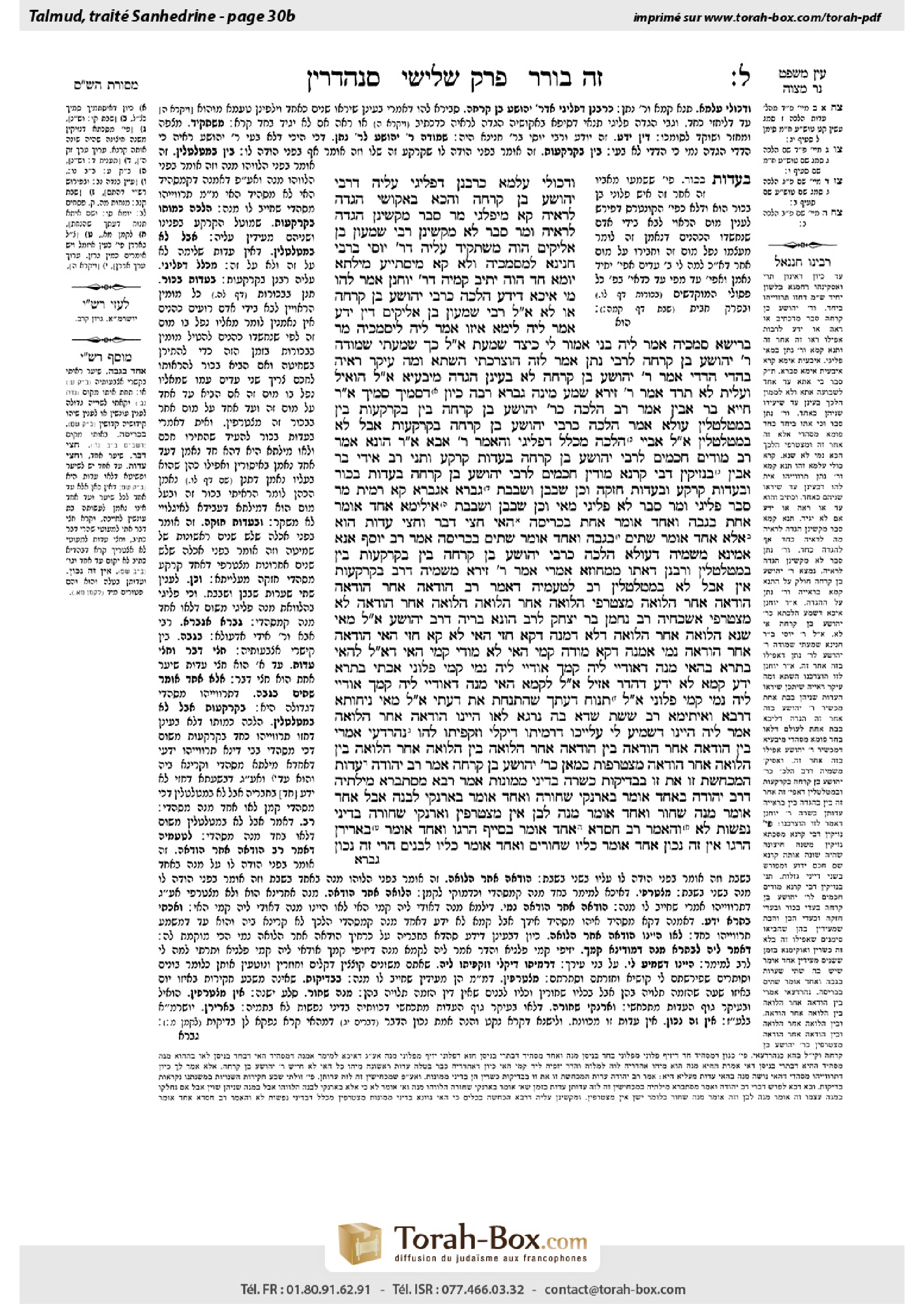
Sanhedrin 30b: Talmud study for Daf Yomi
Daf Yomi is the daily study of one Talmud folio. Explore 37 tractates with scans, Hebrew text, Sefaria English and AI-generated French translations where annotated.
Passage selection and English or AI-generated French translation are available where the scan has annotations. Daf Study is independent of Torah-Box and Sefaria.
Browse Sanhedrin · סנהדרין · All tractatesSanhedrin 30b text and translations
This page of Sanhedrin includes the Aramaic text, an English translation and an AI-generated French translation, alongside the scan above.
סנהדרין ל׳ ב · Aramaic and Hebrew text
וּדְכוּלֵּי עָלְמָא כְּרַבָּנַן דִּפְלִיגִי עֲלֵיהּ דְּרַבִּי יְהוֹשֻׁעַ בֶּן קׇרְחָה, וְהָכָא בְּאַקּוֹשֵׁי הַגָּדָה לִרְאִיָּה קָא מִיפַּלְגִי. מָר סָבַר: מַקְּשִׁינַן הַגָּדָה לִרְאִיָּה, וּמָר סָבַר: לָא מַקְּשִׁינַן.
רַבִּי שִׁמְעוֹן בֶּן אֶלְיָקִים הֲוָה מִשְׁתְּקִיד עֲלֵיהּ דְּרַבִּי יוֹסֵי בְּרַבִּי חֲנִינָא לְמִסְמְכֵיהּ, וְלָא קָא מִיסְתַּיַּיע מִילְּתָא. יוֹמָא חַד הֲוָה יָתֵיב קַמֵּיהּ דְּרַבִּי יוֹחָנָן,
אֲמַר לְהוּ: מִי אִיכָּא דְּיָדַע הֲלָכָה כְּרַבִּי יְהוֹשֻׁעַ בֶּן קׇרְחָה, אוֹ לָא? אֲמַר לֵיהּ רַבִּי שִׁמְעוֹן בֶּן אֶלְיָקִים: דֵּין יָדַע. אֲמַר לֵיהּ: לֵימָא אֵיזוֹ. אֲמַר לֵיהּ: לִיסְמְכֵיהּ מָר בְּרֵישָׁא. סַמְכֵיהּ.
אֲמַר לֵיהּ: בְּנִי, אֱמוֹר לִי כֵּיצַד שָׁמַעְתָּ? אֲמַר לֵיהּ: כָּךְ שָׁמַעְתִּי, שֶׁמּוֹדֶה רַבִּי יְהוֹשֻׁעַ בֶּן קׇרְחָה לְרַבִּי נָתָן.
אָמַר: לָזֶה הוּצְרַכְתִּי?! הַשְׁתָּא, וּמָה עִיקַּר רְאִיָּה בַּהֲדֵי הֲדָדֵי אָמַר רַבִּי יְהוֹשֻׁעַ בֶּן קׇרְחָה ״לָא בָּעֵינַן״, הַגָּדָה מִיבַּעְיָא?
אֲמַר לֵיהּ: הוֹאִיל וְעָלִיתָ, לֹא תֵּרֵד. אָמַר רַבִּי זֵירָא: שְׁמַע מִינַּהּ, גַּבְרָא רַבָּה, כֵּיוָן דְּאִיסְתְּמִיךְ – אִיסְתְּמִיךְ.
אָמַר רַבִּי חִיָּיא בַּר אָבִין אָמַר רַב: הֲלָכָה כְּרַבִּי יְהוֹשֻׁעַ בֶּן קׇרְחָה, בֵּין בְּקַרְקָעוֹת בֵּין בְּמִטַּלְטְלִין.
עוּלָּא אָמַר: הֲלָכָה כְּרַבִּי יְהוֹשֻׁעַ בֶּן קׇרְחָה בְּקַרְקָעוֹת, אֲבָל לֹא בְּמִטַּלְטְלִין.
אֲמַר לֵיהּ אַבָּיֵי: הֲלָכָה, מִכְּלָל דִּפְלִיגִי? וְהָאָמַר רַבִּי אַבָּא אָמַר רַב הוּנָא אָמַר רַב: מוֹדִים חֲכָמִים לְרַבִּי יְהוֹשֻׁעַ בֶּן קׇרְחָה בְּעֵדוּת קַרְקַע!
וְתָנֵי רַב אִידִי בַּר אָבִין בִּנְזִיקִין דְּבֵי קַרְנָא: מוֹדִין חֲכָמִים לְרַבִּי יְהוֹשֻׁעַ בֶּן קׇרְחָה בְּעֵדוּת בְּכוֹר, וּבְעֵדוּת קַרְקַע, וּבְעֵדוּת חֲזָקָה, וְכֵן שֶׁבַּבֵּן וְשֶׁבַּבַּת.
גַּבְרָא אַגַּבְרָא קָא רָמֵית? מָר סָבַר פְּלִיגִי, וּמָר סָבַר לָא פְּלִיגִי.
מַאי ״וְכֵן שֶׁבַּבֵּן וְשֶׁבַּבַּת״? אִילֵּימָא: אֶחָד אוֹמֵר אַחַת בְּגַבָּהּ, וְאֶחָד אוֹמֵר אַחַת בִּכְרֵיסָהּ? הַאי חֲצִי דָבָר וַחֲצִי עֵדוּת הוּא!
אֶלָּא, אֶחָד אוֹמֵר: שְׁתַּיִם בְּגַבָּהּ, וְאֶחָד אוֹמֵר: שְׁתַּיִם בִּכְרֵיסָהּ.
אָמַר רַב יוֹסֵף: אֲנָא אָמֵינָא מִשְּׁמֵיהּ דְּעוּלָּא: הֲלָכָה כְּרַבִּי יְהוֹשֻׁעַ בֶּן קׇרְחָה, בֵּין בְּקַרְקָעוֹת בֵּין בְּמִטַּלְטְלִין. וְרַבָּנַן דְּאָתוּ מִמָּחוֹזָא אָמְרִי: אָמַר רַבִּי זֵירָא מִשְּׁמֵיהּ דְּרַב: בַּקַּרְקָעוֹת – אִין, אֲבָל לָא בְּמִטַּלְטְלִין.
רַב לְטַעְמֵיהּ, דְּאָמַר רַב: הוֹדָאָה אַחַר הוֹדָאָה, הוֹדָאָה אַחַר הַלְוָאָה – מִצְטָרְפִי.
הַלְוָאָה אַחַר הַלְוָאָה, הַלְוָאָה אַחַר הוֹדָאָה – לָא מִצְטָרְפִי.
אַשְׁכְּחֵיהּ רַב נַחְמָן בַּר יִצְחָק לְרַב הוּנָא בְּרֵיהּ דְּרַב יְהוֹשֻׁעַ. אֲמַר לֵיהּ: מַאי שְׁנָא הַלְוָאָה אַחַר הַלְוָאָה דְּלָא? דְּמָנֶה דְּקָא חָזֵי הַאי, לָא קָא חָזֵי הַאי. הוֹדָאָה אַחַר הוֹדָאָה נָמֵי – אַמָּנֶה דְּקָא מוֹדֵי קַמֵּי הַאי, לָא מוֹדֵי קַמֵּי הַאי?
דְּאָמַר לֵיהּ לְהַאי בָּתְרָא: בְּהַאי מָנֶה דְּאוֹדַיי לֵיהּ קַמָּךְ, אוֹדַיי לֵיהּ נָמֵי קַמֵּי פְּלוֹנִי.
אַכַּתִּי, בָּתְרָא יָדַע, קַמָּא לָא יָדַע.
דַּהֲדַר אָזֵיל, אָמַר לֵיהּ לְקַמָּא: הַאי מָנֶה דְּאוֹדַיי לֵיהּ קַמָּךְ, אוֹדַיי לֵיהּ נָמֵי קַמֵּי פְּלוֹנִי. אֲמַר לֵיהּ: תָּנוּחַ דַּעְתְּךָ שֶׁהִתְנַחְתָּ אֶת דַּעְתִּי.
אֲמַר לֵיהּ: מַאי נִיחוּתָא? דְּרָבָא, וְאִיתֵּימָא רַב שֵׁשֶׁת, שְׁדָא בַּהּ נַרְגָּא – לָאו הַיְינוּ הוֹדָאָה אַחַר הַלְוָאָה?
אֲמַר לֵיהּ: הַיְינוּ דִּשְׁמִיעַ לִי עֲלַיְיכוּ, דְּרָמֵיתוּ דִּיקְלֵי וְזָקְפִיתוּ לְהוּ.
נְהַרְדָּעֵי אָמְרִי: בֵּין הוֹדָאָה אַחַר הוֹדָאָה, בֵּין הוֹדָאָה אַחַר הַלְוָאָה, בֵּין הַלְוָאָה אַחַר הַלְוָאָה, בֵּין הַלְוָאָה אַחַר הוֹדָאָה – מִצְטָרְפוֹת. כְּמַאן? כְּרַבִּי יְהוֹשֻׁעַ בֶּן קׇרְחָה.
אָמַר רַב יְהוּדָה: עֵדוּת הַמַּכְחֶשֶׁת זוֹ אֶת זוֹ בִּבְדִיקוֹת, כְּשֵׁרָה בְּדִינֵי מָמוֹנוֹת.
אָמַר רָבָא: מִסְתַּבְּרָא מִילְּתֵיהּ דְּרַב יְהוּדָה בְּאֶחָד אוֹמֵר ״בְּאַרְנָקִי שְׁחוֹרָה״, וְאֶחָד אוֹמֵר ״בְּאַרְנָקִי לְבָנָה״. אֲבָל אֶחָד אוֹמֵר ״מָנֶה שָׁחוֹר״, וְאֶחָד אוֹמֵר ״מָנֶה לָבָן״ – אֵין מִצְטָרְפִין.
וְאַרְנָקִי שְׁחוֹרָה בְּדִינֵי נְפָשׁוֹת לָא? וְהָאָמַר רַב חִסְדָּא: אֶחָד אוֹמֵר ״בְּסַיִיף הֲרָגוֹ״ וְאֶחָד אוֹמֵר ״בַּאֲרִירָן הֲרָגוֹ״ – אֵין זֶה ״נָכוֹן״; אֶחָד אוֹמֵר ״כֵּלָיו שְׁחוֹרִים״ וְאֶחָד אוֹמֵר ״כֵּלָיו לְבָנִים״ – הֲרֵי זֶה ״נָכוֹן״.
Sanhedrin 30b · English translation
and everyone, both the first tanna and Rabbi Natan, holds in accordance with the opinion of the Rabbis who disagree with Rabbi Yehoshua ben Korḥa, and derive from this verse that it is necessary that the witnesses see the incident together, i.e., they were both present and observed the incident at the same time. And here, with regard to whether or not the witnesses must testify in court together, they disagree with regard to whether or not the statement of the witnesses, i.e., their testimony in court, is compared to their observation of the incident. One Sage, the first tanna, holds that we compare their statement to their observation. Therefore, just as they must see the incident together, so too, they must testify together in court. And one Sage, Rabbi Natan, holds that we do not compare their statement to their observation.
The Gemara relates: Rabbi Shimon ben Elyakim was striving to ordain Rabbi Yosei, son of Rabbi Ḥanina, and was not successful in his attempts. One day, Rabbi Shimon ben Elyakim was sitting before Rabbi Yoḥanan among Rabbi Yoḥanan’s other students.
Rabbi Yoḥanan said to his students: Is there anyone who knows whether the halakha is in accordance with the opinion of Rabbi Yehoshua ben Korḥa, or not? Rabbi Shimon ben Elyakim said to him: This one, Rabbi Yosei, son of Rabbi Ḥanina, knows. Rabbi Yoḥanan said to him: If so, let him say. Rabbi Shimon ben Elyakim said to him: Let the Master ordain him first; since we are all in need of his wisdom, he is fit for ordination. Rabbi Yoḥanan then ordained Rabbi Yosei, son of Rabbi Ḥanina.
Rabbi Yoḥanan said to him: My son, tell me what you heard. Rabbi Yosei, son of Rabbi Ḥanina, said to him: This is what I heard: That Rabbi Yehoshua ben Korḥa concedes to the opinion of Rabbi Natan that it is unnecessary for the witnesses to testify together.
Rabbi Yoḥanan was disappointed, and said: For this I needed to ordain him? Now that with regard to the main element of testimony, i.e., observing the incident, Rabbi Yehoshua ben Korḥa says we do not need both witnesses to see it together, with regard to their statement in court, is it necessary to explicate that there is no requirement that they testify together?
Although the statement of Rabbi Yosei, son of Rabbi Ḥanina, was unnecessary, Rabbi Yoḥanan said to him: Since you ascended, i.e., you were ordained, you will not descend, even though it was in error. Rabbi Zeira said: Conclude from it that with regard to a great man, once he is ordained, even if it was due to mistaken judgment, he is ordained. The ordination is not canceled.
As for the halakha in this matter, Rabbi Ḥiyya bar Avin says that Rav says: The halakha is in accordance with the opinion of Rabbi Yehoshua ben Korḥa that it is unnecessary for the two witnesses to observe the incident together, both with regard to cases of land and with regard to cases of movable property.
Ulla says: The halakha is in accordance with the opinion of Rabbi Yehoshua ben Korḥa with regard to land, which is unmovable, and therefore both testimonies are certainly about the same piece of land; but not with regard to movable property, as there is a concern that they are not testifying about the same item.
Abaye said to Ulla: If you say that the halakha is in accordance with the opinion of Rabbi Yehoshua ben Korḥa with regard to land, by inference you hold that they disagree with regard to this matter. But doesn’t Rabbi Abba say that Rav Huna says that Rav says: The Rabbis concede to the opinion of Rabbi Yehoshua ben Korḥa with regard to testimony concerning land?
And Rav Idi bar Avin teaches in the halakhot of damages that were taught at the school of the Sage Karna: The Rabbis concede to the opinion of Rabbi Yehoshua ben Korḥa that the witnesses do not need to see the incident together with regard to testimony concerning a blemish in a male firstborn kosher animal, which renders it permitted to derive benefit from it, and with regard to testimony concerning ownership of land, and with regard to testimony concerning presumptive ownership of land. Since it is clear that they are testifying about the same land, it is unnecessary for them to see it together. And so they concede with regard to testimony over the two pubic hairs of a boy or of a girl, which are a sign of adulthood.
The Gemara rejects Abaye’s question: Are you setting the statement of one man against the statement of another man? One Sage, Ulla, holds that the Rabbis disagree with Rabbi Yehoshua ben Korḥa even with regard to land, and one Sage, i.e., Rav and Rav Idi, holds that they do not disagree.
The Gemara asks tangentially about the statement: And so they concede with regard to testimony over the two pubic hairs of a boy or of a girl: What is this referring to? If we say it is referring to testimony that a girl has reached majority, in which one witness says that he saw one hair on the her lower back and one witness says that he saw one hair on her lower abdomen, that is difficult. A girl is considered to have reached maturity when she has two pubic hairs. In this case, two witnesses separately testify that they have each seen one hair. In this case each testimony is obviously invalid, as it is half a matter and also half a testimony. Not only does each testimony refer to one hair, which is half a matter, it is submitted by one witness, which is half a testimony. Consequently, it is obvious that the girl is not considered to have reached majority in this case.
Rather, it must be referring to a case where one says that he saw two hairs on her lower back, and the other one says he saw two hairs on her lower abdomen. Since they each testify that she has reached adulthood, it is unnecessary for them to see the same hairs.
Rav Yosef said: I say in the name of Ulla that the halakha is in accordance with the opinion of Rabbi Yehoshua ben Korḥa both with regard to land and with regard to movable property. But the Sages who came from Meḥoza say that Rabbi Zeira says in the name of Rav: With regard to land the halakha is in accordance with the opinion of Rabbi Yehoshua ben Korḥa, but not with regard to movable property.
The Gemara comments: Rav conforms to his standard line of reasoning, as Rav says: Testimonies of an admission following an admission are combined into one; if one witness testifies that the respondent admitted in his presence that he owes the claimant, and the other witness testifies that the respondent admitted in his presence that he owes the claimant in a separate incident, their testimonies are combined. Likewise, testimonies of an admission following a loan are combined into one; where one witness testifies that the respondent admitted in his presence that he owes the claimant, and the other one testifies that on a previous date the respondent borrowed money from the claimant in his presence, their testimonies are combined.
Rav continues: But testimonies of a loan following a loan are not combined. If one testifies that the claimant lent the respondent one hundred dinars in his presence, and the other testifies that he lent him one hundred dinars in a separate incident in his presence, their testimonies are not combined, as they are clearly testifying about two separate loans. Similarly, testimonies of a loan following an admission are not combined. If one testifies that the claimant lent money to the respondent, and the other one testifies that on an earlier date the respondent admitted to owing the claimant, their testimonies are not combined.
Rav Naḥman bar Yitzḥak encountered Rav Huna, son of Rav Yehoshua. He said to him: What is different about a loan following a loan, in which case the testimonies are not combined, as the one hundred dinars that this witness saw, that witness did not see? In the case of an admission following an admission as well, perhaps the one hundred dinars about which the respondent admitted in the presence of this witness, he did not admit in the presence of that witness. Perhaps his admissions were in reference to two separate loans, and therefore the testimonies should not be combined.
Rav Huna, son of Rav Yehoshua, answered him: The reference is to a case where the respondent said to this last witness: With regard to the one hundred dinars that I admitted to owing in your presence, I admitted to owing them in the presence of so-and-so, the first witness, as well.
Rav Naḥman bar Yitzḥak asked: Still, the last witness knows that he is testifying about the same loan as the first witness, but the first witness does not know this. Since only one witness testifies that it is the same loan, the testimonies still cannot be combined.
Rav Huna, son of Rav Yehoshua, answered: It is a case where, after his admission to the second witness, the respondent went back and said to the first witness: With regard to those one hundred dinars that I admitted to owing in your presence, I admitted owing them in the presence of so-and-so as well. Therefore, both witnesses know that they are testifying about the same loan. Rav Naḥman bar Yitzḥak said to him: May your mind be settled, as you have settled my mind and put it at ease by answering this question that was troubling me.
Rav Huna, son of Rav Yehoshua, said to him: What is settling about this explanation? As Rava, and some say Rav Sheshet, threw an ax at my answer, i.e., he rejected my explanation, as follows: According to this interpretation of the case of an admission following an admission, isn’t this the same as an admission following a loan? The case of an admission following an admission is now rendered superfluous, as it adds no new insight on the matter.
Rav Naḥman bar Yitzḥak said to him: This is what I heard about you Sages of Meḥoza, that you knock down palm trees and erect them, i.e., you build and then destroy what you built. After you came up with such an excellent explanation, you ruined it yourselves.
The Sages of Neharde’a say: Whether it is a case of an admission following an admission, or an admission following a loan, or a loan following a loan, or a loan following an admission, in all these cases the testimonies are combined. In accordance with whose opinion is this? It is in accordance with the opinion of Rabbi Yehoshua ben Korḥa, who teaches that since both witnesses testify about a debt of one hundred dinars, it is considered like one testimony.
§ Rav Yehuda says: Testimony of two witnesses who contradict the testimony of each other in response to the judges’ examination of the details of the story is valid in cases of monetary law, although a contradiction of this type disqualifies testimony in cases of capital law.
Rava says: The statement of Rav Yehuda is reasonable in a case where one witness says: The money was in a black purse [be’arnaki], and the other one says: It was in a white purse. Since this is a secondary detail, they may not remember it accurately. But if one says: He lent him a black coin, i.e., the coin was dark, and the other one says: He lent him a white coin, the testimonies are not combined. Since they contradict each other with regard to a characteristic of the money itself, one is probably lying.
The Gemara challenges Rabbi Yehuda’s ruling: And if witnesses contradict each other with regard to secondary details such as a black purse in cases of capital law, is it the case that their testimony is not accepted? But doesn’t Rav Ḥisda say: In a case where one of the witnesses says: The murderer killed the victim with a sword, and one of the witnesses says: The murderer killed the victim with an ariran, another type of weapon, this is not congruent testimony, as this is a clear contradiction. But if one of the witnesses says: The murderer’s garments were black, and one of the witnesses says: The murderer’s garments were white, this is congruent testimony, as this is not a meaningful discrepancy.
Sanhedrin 30b · Traduction française (IA)
Et tous deux, tant le premier tanna que Rabbi Natan, sont d’accord avec l’opinion des Rabbins qui sont en désaccord avec Rabbi Yehoshua ben Korḥa et déduisent de ce verset que les témoins doivent voir l’événement ensemble, c’est-à-dire qu’ils doivent être tous deux présents et l’observer au même moment. Ici, en revanche, au sujet de la question de savoir si les témoins doivent ou non témoigner ensemble au tribunal, ils sont en désaccord sur le point de savoir si leur déclaration, c’est-à-dire leur témoignage au tribunal, est assimilée à leur observation de l’événement. Un Sage, le premier tanna, considère que leur déclaration est assimilée à leur observation. Par conséquent, de même qu’ils doivent voir l’événement ensemble, ils doivent aussi témoigner ensemble au tribunal. L’autre Sage, Rabbi Natan, considère que leur déclaration n’est pas assimilée à leur observation.
La Guemara rapporte : Rabbi Shimon ben Elyakim s’efforçait de faire ordonner Rabbi Yosei, fils de Rabbi Ḥanina, mais n’y parvenait pas. Un jour, Rabbi Shimon ben Elyakim était assis devant Rabbi Yoḥanan, parmi les autres élèves de celui-ci.
Rabbi Yoḥanan dit à ses élèves : Y en a-t-il un parmi vous qui sache si la halakha suit l’opinion de Rabbi Yehoshua ben Korḥa ou non ? Rabbi Shimon ben Elyakim lui dit : Celui-ci, Rabbi Yosei, fils de Rabbi Ḥanina, le sait. Rabbi Yoḥanan lui dit : Dans ce cas, qu’il le dise. Rabbi Shimon ben Elyakim lui dit : Que le Maître l’ordonne d’abord ; puisque nous avons tous besoin de sa sagesse, il est digne d’être ordonné. Rabbi Yoḥanan ordonna alors Rabbi Yosei, fils de Rabbi Ḥanina.
Rabbi Yoḥanan lui dit : Mon fils, dis-moi ce que tu as entendu. Rabbi Yosei, fils de Rabbi Ḥanina, lui dit : Voici ce que j’ai entendu : Rabbi Yehoshua ben Korḥa se rallie à l’opinion de Rabbi Natan, selon laquelle il n’est pas nécessaire que les témoins témoignent ensemble.
Rabbi Yoḥanan fut déçu et dit : Est-ce pour cela que je devais l’ordonner ? Puisque, concernant l’élément essentiel du témoignage, à savoir l’observation de l’événement, Rabbi Yehoshua ben Korḥa dit qu’il n’est pas nécessaire que les deux témoins le voient ensemble, faut-il préciser que, pour leur déclaration au tribunal, il n’est pas nécessaire qu’ils témoignent ensemble ?
Bien que la déclaration de Rabbi Yosei, fils de Rabbi Ḥanina, fût inutile, Rabbi Yoḥanan lui dit : Puisque tu es monté, c’est-à-dire que tu as été ordonné, tu ne redescendras pas, même si l’ordination a été accordée par erreur. Rabbi Zeira dit : On peut en déduire que, pour un grand homme, une fois ordonné, il le reste, même si son ordination résulte d’une décision erronée. L’ordination n’est pas annulée.
Quant à la halakha sur cette question, Rabbi Ḥiyya bar Avin dit au nom de Rav : La halakha suit l’opinion de Rabbi Yehoshua ben Korḥa, selon laquelle il n’est pas nécessaire que les deux témoins observent l’événement ensemble, aussi bien dans les litiges portant sur des biens-fonds que dans ceux portant sur des biens meubles.
Ulla dit : La halakha suit l’opinion de Rabbi Yehoshua ben Korḥa concernant les biens-fonds, qui sont immeubles et au sujet desquels les deux témoignages portent donc nécessairement sur la même parcelle, mais pas concernant les biens meubles, car on peut craindre que les témoins ne déposent pas au sujet du même objet.
Abaye dit à Ulla : Si tu dis que la halakha suit l’opinion de Rabbi Yehoshua ben Korḥa concernant les biens-fonds, tu laisses entendre qu’ils sont en désaccord sur cette question. Mais Rabbi Abba ne dit-il pas que Rav Huna dit au nom de Rav : Les Rabbins se rallient à l’opinion de Rabbi Yehoshua ben Korḥa concernant les témoignages portant sur des biens-fonds ?
Et Rav Idi bar Avin enseigne, dans les lois des dommages étudiées à l’école du Sage Karna : Les Rabbins se rallient à l’opinion de Rabbi Yehoshua ben Korḥa selon laquelle les témoins n’ont pas besoin de voir l’événement ensemble lorsqu’il s’agit d’un témoignage concernant un défaut chez un animal mâle premier-né d’une espèce pure, défaut qui permet d’en tirer profit, d’un témoignage concernant la propriété d’un bien-fonds ou d’un témoignage concernant la possession présumée d’un bien-fonds. Puisqu’il est clair que les témoins déposent au sujet du même bien-fonds, il n’est pas nécessaire qu’ils le voient ensemble. Ils se rallient également à son opinion concernant les témoignages relatifs aux deux poils pubiens d’un garçon ou d’une fille, qui sont un signe de maturité.
La Guemara rejette la question d’Abaye : Opposes-tu la déclaration d’un homme à celle d’un autre ? Un Sage, Ulla, considère que les Rabbins sont en désaccord avec Rabbi Yehoshua ben Korḥa même concernant les biens-fonds ; l’autre Sage, c’est-à-dire Rav et Rav Idi, considère qu’ils ne sont pas en désaccord.
La Guemara pose incidemment une question sur la déclaration : « Ils se rallient également à son opinion concernant les témoignages relatifs aux deux poils pubiens d’un garçon ou d’une fille. » À quoi cela fait-il référence ? Si l’on dit qu’il s’agit du témoignage établissant qu’une fille a atteint la majorité, où un témoin dit avoir vu un poil dans le bas du dos de la fille et l’autre affirme en avoir vu un dans le bas de son ventre, cela pose difficulté. Une fille est considérée comme ayant atteint la maturité lorsqu’elle a deux poils pubiens. Dans ce cas, deux témoins déposent séparément, chacun ayant vu un poil. Or chacun de ces témoignages est manifestement invalide, car il ne porte que sur une partie de la chose et constitue aussi une partie d’un témoignage. Chacun ne porte pas seulement sur un poil, soit une partie de la chose : il est en outre présenté par un seul témoin, soit une partie d’un témoignage. Il est donc évident que, dans ce cas, la fille n’est pas considérée comme ayant atteint la majorité.
Il faut plutôt parler d’un cas où l’un dit avoir vu deux poils dans le bas du dos de la fille et l’autre dit avoir vu deux poils dans le bas de son ventre. Puisque chacun témoigne qu’elle a atteint la maturité, il n’est pas nécessaire qu’ils aient vu les mêmes poils.
Rav Yosef dit : Je rapporte au nom d’Ulla que la halakha suit l’opinion de Rabbi Yehoshua ben Korḥa aussi bien concernant les biens-fonds que les biens meubles. Mais les Sages venus de Meḥoza disent que Rabbi Zeira rapporte au nom de Rav : Concernant les biens-fonds, la halakha suit l’opinion de Rabbi Yehoshua ben Korḥa, mais pas concernant les biens meubles.
La Guemara fait remarquer : Rav reste fidèle à sa ligne habituelle, car Rav dit : Les témoignages relatifs à un aveu après un autre aveu se combinent en un seul témoignage. Si un témoin dépose que le défendeur a reconnu devant lui devoir de l’argent au demandeur, et qu’un autre témoin dépose que, lors d’un épisode distinct, le défendeur a reconnu devant lui devoir de l’argent au demandeur, leurs témoignages se combinent. De même, les témoignages relatifs à un aveu après un prêt se combinent en un seul témoignage : si un témoin dépose que le défendeur a reconnu devant lui devoir de l’argent au demandeur et qu’un autre dépose que, à une date antérieure, le défendeur avait emprunté de l’argent au demandeur en sa présence, leurs témoignages se combinent.
Rav poursuit : Mais les témoignages relatifs à un prêt après un autre prêt ne se combinent pas. Si un témoin dépose que le demandeur a prêté cent dinars au défendeur en sa présence et qu’un autre dépose que le demandeur lui a prêté cent dinars en sa présence lors d’un épisode distinct, leurs témoignages ne se combinent pas, car ils portent manifestement sur deux prêts distincts. De même, les témoignages relatifs à un prêt après un aveu ne se combinent pas. Si un témoin dépose que le demandeur a prêté de l’argent au défendeur et qu’un autre dépose que, à une date antérieure, le défendeur avait reconnu devoir de l’argent au demandeur, leurs témoignages ne se combinent pas.
Rav Naḥman bar Yitzḥak rencontra Rav Huna, fils de Rav Yehoshua. Il lui dit : En quoi un prêt après un prêt diffère-t-il, de sorte que les témoignages ne se combinent pas ? Les cent dinars que ce témoin a vus, l’autre témoin ne les a pas vus. Mais, dans le cas d’un aveu après un aveu également, peut-être le défendeur n’a-t-il pas reconnu devant l’autre témoin devoir les cent dinars dont il a reconnu la dette devant celui-ci. Peut-être ses aveux concernaient-ils deux prêts distincts ; les témoignages ne devraient donc pas se combiner.
Rav Huna, fils de Rav Yehoshua, lui répondit : Il s’agit d’un cas où le défendeur a dit à ce dernier témoin : « Quant aux cent dinars que j’ai reconnu devoir en ta présence, j’ai aussi reconnu les devoir en présence d’Untel, le premier témoin. »
Rav Naḥman bar Yitzḥak demanda : Malgré cela, le dernier témoin sait qu’il dépose au sujet du même prêt que le premier témoin, mais le premier témoin ne le sait pas. Puisqu’un seul témoin atteste qu’il s’agit du même prêt, les témoignages ne peuvent toujours pas se combiner.
Rav Huna, fils de Rav Yehoshua, répondit : Il s’agit d’un cas où, après avoir fait son aveu au second témoin, le défendeur est retourné voir le premier témoin et lui a dit : « Quant à ces cent dinars que j’ai reconnu devoir en ta présence, j’ai également reconnu les devoir en présence d’Untel. » Ainsi, les deux témoins savent qu’ils déposent au sujet du même prêt. Rav Naḥman bar Yitzḥak lui dit : Que ton esprit soit apaisé, car tu as apaisé mon esprit et dissipé l’inquiétude que me causait cette question en y répondant.
Rav Huna, fils de Rav Yehoshua, lui dit : Qu’y a-t-il d’apaisant dans cette explication ? Rava — et certains disent Rav Sheshet — a rejeté ma réponse comme suit : selon cette interprétation du cas d’un aveu après un aveu, n’est-ce pas la même chose qu’un aveu après un prêt ? Le cas d’un aveu après un aveu devient alors superflu, puisqu’il n’apporte aucun éclairage nouveau sur la question.
Rav Naḥman bar Yitzḥak lui dit : Voilà ce que j’ai entendu dire de vous, Sages de Meḥoza : vous abattez des palmiers puis les redressez, c’est-à-dire que vous bâtissez pour ensuite détruire ce que vous avez bâti. Après avoir trouvé une explication si excellente, vous l’avez vous-mêmes ruinée.
Les Sages de Neharde’a disent : Qu’il s’agisse d’un aveu après un aveu, d’un aveu après un prêt, d’un prêt après un prêt ou d’un prêt après un aveu, dans tous ces cas les témoignages se combinent. Selon quelle opinion ? Selon celle de Rabbi Yehoshua ben Korḥa, qui enseigne que, puisque les deux témoins déposent au sujet d’une dette de cent dinars, leurs déclarations sont considérées comme un seul témoignage.
§ Rav Yehuda dit : Le témoignage de deux témoins qui se contredisent en réponse aux questions des juges sur les détails de l’affaire est valable dans les litiges pécuniaires, bien qu’une contradiction de ce type invalide le témoignage dans les affaires passibles de la peine capitale.
Rava dit : La déclaration de Rav Yehuda est raisonnable dans un cas où l’un des témoins dit : « L’argent était dans une bourse noire [be’arnaki] », et l’autre dit : « Il était dans une bourse blanche. » Puisqu’il s’agit d’un détail secondaire, il se peut qu’ils ne s’en souviennent pas correctement. Mais si l’un dit : « Il lui a prêté une pièce noire », c’est-à-dire une pièce de couleur sombre, et que l’autre dit : « Il lui a prêté une pièce blanche », leurs témoignages ne se combinent pas. Puisqu’ils se contredisent au sujet d’une caractéristique de l’argent lui-même, l’un d’eux ment probablement.
La Guemara conteste la décision de Rabbi Yehuda : si des témoins se contredisent sur des détails secondaires, tels que la couleur d’une bourse, dans les affaires passibles de la peine capitale, leur témoignage n’est-il donc pas accepté ? Mais Rav Ḥisda ne dit-il pas : lorsqu’un témoin dit que le meurtrier a tué la victime avec une épée et qu’un autre témoin dit qu’il l’a tuée avec un ariran, une autre sorte d’arme, les témoignages ne concordent pas, car il s’agit d’une contradiction manifeste ; mais si un témoin dit que les vêtements du meurtrier étaient noirs et qu’un autre dit qu’ils étaient blancs, les témoignages concordent, car cette différence n’est pas significative ?
Traduction française générée par IA à partir de l’édition anglaise de Sefaria. Vérifie toujours un passage avec le texte source.
Text from Sefaria: William Davidson Edition - Vocalized Aramaic (CC BY NC); William Davidson Edition - English (CC BY NC).