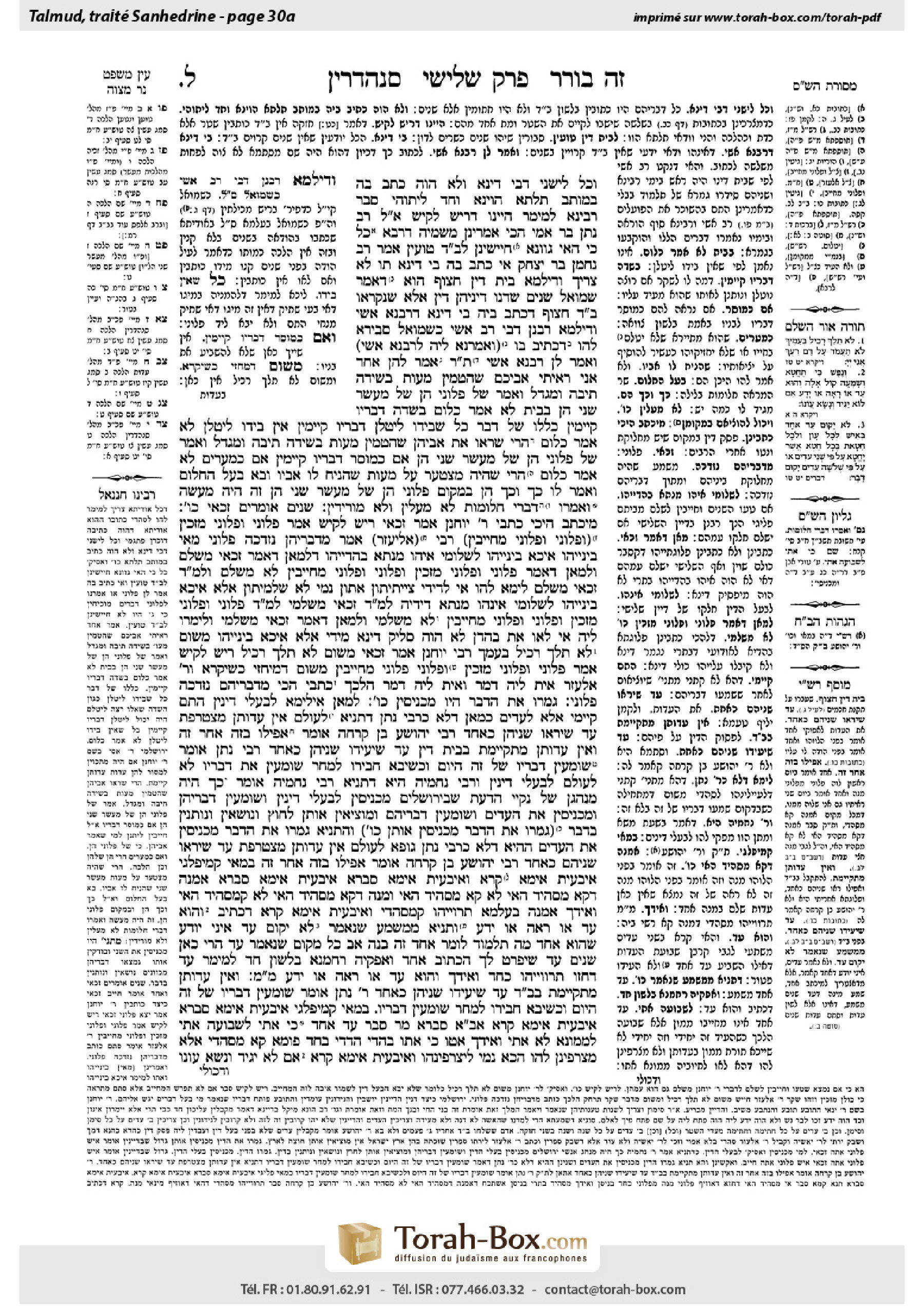
Sanhedrin 30a: Talmud study for Daf Yomi
Daf Yomi is the daily study of one Talmud folio. Explore 37 tractates with scans, Hebrew text, Sefaria English and AI-generated French translations where annotated.
Passage selection and English or AI-generated French translation are available where the scan has annotations. Daf Study is independent of Torah-Box and Sefaria.
Browse Sanhedrin · סנהדרין · All tractatesSanhedrin 30a text and translations
This page of Sanhedrin includes the Aramaic text, an English translation and an AI-generated French translation, alongside the scan above.
סנהדרין ל׳ א · Aramaic and Hebrew text
וְכֹל לִישָּׁנֵי דְּבֵי דִינָא, וְלָא הֲוָה כְּתִב בַּהּ ״בְּמוֹתַב תְּלָתָא הֲוֵינָא וְחַד לֵיתוֹהִי״.
סְבַר רָבִינָא לְמֵימַר: הַיְינוּ דְּרֵישׁ לָקִישׁ. אֲמַר לֵיהּ רַב נָתָן בַּר אַמֵּי: הָכִי אָמְרִינַן מִשְּׁמֵיהּ דְּרָבָא, כֹּל כִּי הַאי גַוְונָא חָיְישִׁינַן לְבֵית דִּין טוֹעִין.
אָמַר רַב נַחְמָן בַּר יִצְחָק: אִי כְּתִב בַּהּ ״בֵּי דִינָא״, תּוּ לָא צְרִיךְ.
וְדִילְמָא בֵּית דִּין חָצוּף הוּא? דְּאָמַר שְׁמוּאֵל: שְׁנַיִם שֶׁדָּנוּ, דִּינֵיהֶן דִּין, אֶלָּא שֶׁנִּקְרְאוּ בֵּית דִּין חָצוּף. דִּכְתִב בַּיהּ: ״בֵּי דִינָא דְּרַבְנָא אָשֵׁי״.
וְדִילְמָא רַבָּנַן דְּבֵי רַב אָשֵׁי כִּשְׁמוּאֵל סְבִירָא לְהוּ? דִּכְתִיב בַּהּ: ״וַאֲמַרְנָא לֵיהּ לְרַבַּנָא אָשֵׁי״, ״וַאֲמַר לַן רַבַּנָא אָשֵׁי.״
תָּנוּ רַבָּנַן, אָמַר לָהֶן אֶחָד: אֲנִי רָאִיתִי אֲבִיכֶם שֶׁהִטְמִין מָעוֹת בְּשִׁידָּה, תֵּיבָה, וּמִגְדָּל, וְאָמַר ״שֶׁל פְּלוֹנִי הֵן״, ״שֶׁל מַעֲשֵׂר שֵׁנִי הֵן״ – בַּבַּיִת לֹא אָמַר כְּלוּם, בַּשָּׂדֶה דְּבָרָיו קַיָּימִין.
כְּלָלוֹ שֶׁל דָּבָר: כֹּל שֶׁבְּיָדוֹ לִיטְּלָן – דְּבָרָיו קַיָּימִין; אֵין בְּיָדוֹ לִיטְּלָן – לֹא אָמַר כְּלוּם.
הֲרֵי שֶׁרָאוּ אֶת אֲבִיהֶן שֶׁהִטְמִין מָעוֹת בְּשִׁידָּה תֵּיבָה וּמִגְדָּל, וְאָמַר: ״שֶׁל פְּלוֹנִי הֵן״, ״שֶׁל מַעֲשֵׂר שֵׁנִי הֵן״ – אִם כְּמוֹסֵר, דְּבָרָיו קַיָּימִין; אִם כְּמַעֲרִים, לֹא אָמַר כְּלוּם.
הֲרֵי שֶׁהָיָה מִצְטַעֵר עַל מָעוֹת שֶׁהִנִּיחַ לוֹ אָבִיו, וּבָא בַּעַל הַחֲלוֹם וְאָמַר לוֹ: ״כָּךְ וְכָךְ הֵן״, ״בְּמָקוֹם פְּלוֹנִי הֵן״, ״שֶׁל מַעֲשֵׂר שֵׁנִי הֵן״. זֶה הָיָה מַעֲשֶׂה, וְאָמְרוּ: דִּבְרֵי חֲלוֹמוֹת לֹא מַעֲלִין וְלֹא מוֹרִידִין.
שְׁנַיִם אוֹמְרִים זַכַּאי כּוּ׳. מִיכְתָּב הֵיכִי כָּתְבִי?
רַבִּי יוֹחָנָן אָמַר: ״זַכַּאי״. רֵישׁ לָקִישׁ אָמַר: ״פְּלוֹנִי וּפְלוֹנִי מְזַכִּין, וּפְלוֹנִי וּפְלוֹנִי מְחַיְּיבִין״. רַבִּי אֱלִיעֶזֶר אָמַר: ״מִדִּבְרֵיהֶן נִזְדַּכָּה פְּלוֹנִי״.
מַאי בֵּינַיְיהוּ? אִיכָּא בֵּינַיְיהוּ לְשַׁלּוֹמֵי אִיהוּ מְנָתָא בַּהֲדַיְיהוּ, דִּלְמַאן דְּאָמַר ״זַכַּאי״ – מְשַׁלֵּם, וּלְמַאן דְּאָמַר ״פְּלוֹנִי וּפְלוֹנִי מְזַכִּין וּפְלוֹנִי וּפְלוֹנִי מְחַיְּיבִין״ – לָא מְשַׁלֵּם.
וּלְמַאן דְּאָמַר ״זַכַּאי״, מְשַׁלֵּם?! לֵימָא לְהוּ: אִי לְדִידִי צָיְיתִיתוּן, אַתּוּן נָמֵי לָא מְשַׁלְּמִיתוּן!
אֶלָּא, אִיכָּא בֵּינַיְיהוּ לְשַׁלּוֹמֵי אִינְהוּ מְנָתָא דִּידֵיהּ: לְמַאן דְּאָמַר ״זַכַּאי״ – מְשַׁלְּמִי, לְמַאן דְּאָמַר ״פְּלוֹנִי וּפְלוֹנִי מְזַכִּין וּפְלוֹנִי וּפְלוֹנִי מְחַיְּיבִין״ – לָא מְשַׁלְּמִי.
וּלְמַאן דְּאָמַר זַכַּאי, מְשַׁלְּמִי? וְלֵימְרוּ לֵיהּ: אִי לָאו אַתְּ בַּהֲדַן, לָא הֲוָה סָלֵיק דִּינָא מִידֵּי!
אֶלָּא, אִיכָּא בֵּינַיְיהוּ מִשּׁוּם ״לֹא תֵלֵךְ רָכִיל בְּעַמֶּיךָ״. רַבִּי יוֹחָנָן אָמַר: ״זַכַּאי״ – מִשּׁוּם ״לֹא תֵלֵךְ רָכִיל״.
רֵישׁ לָקִישׁ אָמַר: ״פְּלוֹנִי וּפְלוֹנִי מְזַכִּין, וּפְלוֹנִי וּפְלוֹנִי מְחַיְּיבִין״ – מִשּׁוּם דְּמִיחֲזֵי כְּשִׁיקְרָא.
וְרַבִּי אֶלְעָזָר אִית לֵיהּ דְּמָר, וְאִית לֵיהּ דְּמָר. הִלְכָּךְ, כָּתְבִי הָכִי: ״מִדִּבְרֵיהֶם נִזְדַּכָּה פְּלוֹנִי״.
גָּמְרוּ אֶת הַדָּבָר, הָיוּ מַכְנִיסִין כּוּ׳. לְמַאן? אִילֵימָא לְבַעֲלֵי דִינִין – הָתָם קָיְימִי! אֶלָּא לְעֵדִים.
כְּמַאן? דְּלָא כְּרַבִּי נָתָן, דְּתַנְיָא: לְעוֹלָם אֵין עֵדוּתָן מִצְטָרֶפֶת עַד שֶׁיִּרְאוּ שְׁנֵיהֶן כְּאֶחָד. רַבִּי יְהוֹשֻׁעַ בֶּן קָרְחָה אוֹמֵר: אֲפִילּוּ בָּזֶה אַחַר זֶה.
וְאֵין עֵדוּתָן מִתְקַיֶּימֶת בְּבֵית דִּין עַד שֶׁיָּעִידוּ שְׁנֵיהֶן כְּאֶחָד. רַבִּי נָתָן אוֹמֵר: שׁוֹמְעִין דְּבָרָיו שֶׁל זֶה הַיּוֹם, וּכְשֶׁיָּבֹא חֲבֵירוֹ לְמָחָר שׁוֹמְעִין אֶת דְּבָרָיו.
לָא, לְעוֹלָם לְבַעֲלֵי דִינִין. וְרַבִּי נְחֶמְיָה הִיא, דְּתַנְיָא: רַבִּי נְחֶמְיָה אוֹמֵר, כָּךְ הָיָה מִנְהָגָן שֶׁל נְקִיֵּי הַדַּעַת שֶׁבִּירוּשָׁלַיִם: מַכְנִיסִין לְבַעֲלֵי דִינִין וְשׁוֹמְעִין דִּבְרֵיהֶן, וּמַכְנִיסִין אֶת הָעֵדִים וְשׁוֹמְעִין דִּבְרֵיהֶם, וּמוֹצִיאִין אוֹתָן לַחוּץ וְנוֹשְׂאִין וְנוֹתְנִין בְּדָבָר. גָּמְרוּ אֶת הַדָּבָר, מַכְנִיסִין אוֹתָן כּוּ׳.
וְהָתַנְיָא: גָּמְרוּ אֶת הַדָּבָר, מַכְנִיסִין אֶת הָעֵדִים! הָהִיא דְּלָא כְּרַבִּי נָתָן.
גּוּפָא: לְעוֹלָם אֵין עֵדוּתָן מִצְטָרֶפֶת עַד שֶׁיִּרְאוּ שְׁנֵיהֶם כְּאֶחָד. רַבִּי יְהוֹשֻׁעַ בֶּן קָרְחָה אוֹמֵר: אֲפִילּוּ בָּזֶה אַחַר זֶה. בְּמַאי קָמִיפַּלְגִי? אִיבָּעֵית אֵימָא קְרָא, וְאִיבָּעֵית אֵימָא סְבָרָא.
אִיבָּעֵית אֵימָא סְבָרָא: אַמָּנֶה דְּקָא מַסְהֵיד הַאי, לָא קָא מַסְהֵיד הַאי, וּמָנֶה דְּקָא מַסְהֵיד הַאי, לָא קָמַסְהֵיד הַאי. וְאִידַּךְ: אַמָּנֶה בְּעָלְמָא תַּרְוַיְיהוּ קָמַסְהֲדִי.
וְאִיבָּעֵית אֵימָא קְרָא, דִּכְתִיב: ״וְהוּא עֵד אוֹ רָאָה אוֹ יָדָע״.
וְתַנְיָא: מִמַּשְׁמַע שֶׁנֶּאֱמַר: ״לֹא יָקוּם עֵד״ – אֵינִי יוֹדֵעַ שֶׁהוּא אֶחָד? מָה תַּלְמוּד לוֹמַר ״אֶחָד״?
זֶה בָּנָה אָב: כׇּל מָקוֹם שֶׁנֶּאֱמַר: ״עֵד״ – הֲרֵי כָּאן שְׁנַיִם, עַד שֶׁיִּפְרֹט לְךָ הַכָּתוּב ״אֶחָד״.
וְאַפְּקֵיהּ רַחֲמָנָא בִּלְשׁוֹן חַד, לְמֵימַר: עַד דְּחָזוּ תַּרְוַויְיהוּ כְּחַד. וְאִידַּךְ, ״וְהוּא עֵד אוֹ רָאָה אוֹ יָדָע״ – מִכׇּל מָקוֹם.
וְאֵין עֵדוּתָן מִתְקַיֶּימֶת בְּבֵית דִּין עַד שֶׁיָּעִידוּ שְׁנֵיהֶן כְּאֶחָד. רַבִּי נָתָן אוֹמֵר: שׁוֹמְעִין דְּבָרָיו שֶׁל זֶה הַיּוֹם, וּכְשֶׁיָּבֹא חֲבֵירוֹ לְמָחָר שׁוֹמְעִין דְּבָרָיו. בְּמַאי קָמִיפַּלְגִי? אִיבָּעֵית אֵימָא סְבָרָא, אִיבָּעֵית אֵימָא קְרָא.
אִיבָּעֵית אֵימָא סְבָרָא: מָר סָבַר, עֵד אֶחָד כִּי אָתֵי – לִשְׁבוּעָה אָתֵי, לְמָמוֹנָא לָא אָתֵי.
וְאִידַּךְ: אַטּוּ כִּי אָתוּ בַּהֲדֵי הֲדָדֵי, בְּחַד פּוּמָּא קָא מַסְהֲדִי? אֶלָּא מְצָרְפִינַן לְהוּ. הָכָא נָמֵי לִיצָרְפִינְהוּ.
וְאִיבָּעֵית אֵימָא קְרָא: ״אִם לוֹא יַגִּיד וְנָשָׂא עֲוֹנוֹ״,
Sanhedrin 30a · English translation
and all of the formulations of an enactment of the court were written in it. But only two were signed on it, and the following statement was not written in it: We were convened in a session of three judges, and one of the judges is no longer here, as he died or left for another reason. There was therefore room for concern that perhaps there were only two witnesses, and they wrote the document of admission improperly.
Ravina thought to say that this is a case in which the principle of Reish Lakish, that witnesses do not sign a document unless the action was performed appropriately, applies. Rav Natan bar Ami said to him: This is what we say in the name of Rava: In any cases like this, we are concerned for the possibility of an erroneous court that thinks that two constitute a court.
Rav Naḥman bar Yitzḥak says: If it was written in the document: We, the members of the court, convened, it is unnecessary for the deed to further state that one of the judges is no longer there, as a standard court consists of three judges.
The Gemara asks: But perhaps it was an impudent court, as Shmuel says: With regard to two judges who convened a tribunal and judged, their verdict is a binding verdict; but because they contravened the rabbinic ordinance mandating that a court must be composed of three judges, they are called an impudent court. The Gemara answers: It was a document in which it was written: We, the members of the court of Rabbana Ashi, convened. Rav Ashi’s court presumably conformed to rabbinic protocol.
The Gemara asks: But perhaps the Sages of the court of Rav Ashi hold like Shmuel, that the verdict of two judges is binding, and they convened an impudent court. The Gemara answers: It is a document in which it is written: And we said to Rabbana Ashi, and Rabbana Ashi said to us. Rav Ashi himself certainly would not have participated in the discussions of an impudent court.
§ The Gemara continues its discussion of when an admission is deemed credible. The Sages taught in a baraita: In a case where one said to the children of another: I saw that your father hid money in a chest, box, or cabinet, saying: This money belongs to so-and-so, or: This money is second tithe, and the money was found where he said, the halakha depends on the circumstances. If the chest, box, or cabinet was in the house, the witness has said nothing. His testimony about the status of the money is not accepted, as he is only one witness, and he could not have taken the money for himself had he wanted to. But if it was in the field, his statement stands, i.e., is accepted.
The principle of the matter is as follows: In any case where it is in the power of the witness to take the money, his statement stands; if it is not in his power to take the money, he has said nothing.
In a case where the children themselves saw that their father hid money in a chest, box, or cabinet, and the father said: This money belongs to so-and-so, or: This money is second tithe, if he said so as one who relays information to his own children, his statement stands. But if he said so as one who employs artifice, i.e., he appears to have told them that the money was not his only so that they would not take it, he has said nothing, and they may spend the money.
In a case where one was distressed about money that his father left him as an inheritance, because he could not find it, and the master of the dream, i.e., someone in his dream, came and said to him: It is such and such an amount of money and it is in such and such a place, but the money is second tithe, and he found this amount in the place of which he dreamed; and this was an actual incident that was brought before the Sages, and they said that he can spend the money, as matters appearing in dreams do not make a difference in determining the practical halakha.
§ The mishna teaches that if two judges say the defendant is exempt and one says he is liable, he is exempt. The Gemara asks: When there is a dispute between the judges, how do they write the verdict?
Rabbi Yoḥanan says: They write that he is exempt, without mentioning the dispute. Reish Lakish says that they specify: So-and-so and so-and-so deem him exempt, and so-and-so and so-and-so deem him liable; they must mention that there was a dispute. Rabbi Eliezer says that they do not specify the names of the judges, but rather they add the phrase: From the statement of the judges so-and-so was deemed exempt, to the wording of the verdict. This indicates that not all the judges agreed that he is exempt, but does not specify which judges came to which conclusion.
The Gemara asks: What is the difference between these opinions, besides the wording of the verdict? The Gemara answers: The practical difference between them is with regard to whether or not, in a case where it is discovered that the verdict was erroneous, the judge who was in the minority must pay his portion of restitution along with the judges of the majority. As according to the one who says that they write that he is exempt, the minority judge pays as well, and according to the one who says that they specify: So-and-so and so-and-so deem him exempt, and so-and-so and so-and-so deem him liable, he does not pay.
The Gemara asks: But according to the one who says that they write that he is exempt, why does he pay? Let him say to the other judges: If you would have listened to me you would not have paid either. Why should I have to pay for your mistake?
Rather, he does not pay, and the practical difference between the opinions is with regard to whether or not those other judges must pay his portion of the restitution. According to the one who says that they write that he is exempt, they pay the full sum, as they did not mention that there was a dispute over the matter. But according to the one who says that they specify: So-and-so and so-and-so deem him exempt, and so-and-so and so-and-so deem him liable, they do not pay the portion of the overruled judge, and he does not pay it either.
The Gemara asks: But according to the one who says that they write that he is exempt, why do they pay his portion? Let them say to him: If you had not been with us the judgment would have had no verdict at all, as two judges cannot issue a verdict. Therefore, you share the responsibility with us and should participate in the payment.
Rather, the difference between the opinions is only with regard to the wording of the verdict, and is due to the prohibition of: “You shall not go as a talebearer among your people” (Leviticus 19:16). Rabbi Yoḥanan says that they write that he is exempt due to the prohibition of gossip, as derived from the verse: “You shall not go as a talebearer.”
Reish Lakish says they specify: So-and-so and so-and-so deem him exempt, and so-and-so and so-and-so deem him liable, because otherwise the document would have the appearance of falsehood, as not all the judges deemed him exempt.
And Rabbi Elazar accepts the opinion of this Sage, Rabbi Yoḥanan, and accepts the opinion of that Sage, Reish Lakish. Therefore, this is what they write: From the statement of the judges, so-and-so was deemed exempt. This wording indicates that the ruling was not based on a consensus among the judges, so that it will not have the appearance of falsehood, but it also does not specify what each judge said, to avoid gossip.
§ The mishna teaches that after the judges finished the matter and reached a decision, they would bring them in. The Gemara asks: Whom would they bring in? If we say they would bring in the litigants, this cannot be, as they were there the whole time; they never left the room. Rather, they would bring in the witnesses.
If so, in accordance with whose opinion is the mishna? It is not in accordance with the opinion of Rabbi Natan; as it is taught in a baraita: The testimonies of individual witnesses are never combined into a testimony of two witnesses unless the two of them saw the incident transpire together as one. Rabbi Yehoshua ben Korḥa says: Their testimonies are combined even in a case where they saw the incident one after the other.
The baraita continues: And furthermore, their testimony does not stand in court unless the two of them testify together as one. Rabbi Natan says: They need not testify together. Rather, their testimonies are combined even if the judges hear the statement of this witness today, and when the other witness comes tomorrow the judges hear his statement. The mishna, by contrast, indicates that the verdict must be given with the two witnesses present together.
The Gemara reverses its interpretation of the mishna: No, actually it can be explained that the judges would bring in the litigants; and it is in accordance with the opinion of Rabbi Neḥemya. As it is taught in a baraita that Rabbi Neḥemya says: This was the custom of the scrupulous people of Jerusalem: When they would judge, they would bring in the litigants and hear their statements, and then they would bring in the witnesses and hear their statements in the presence of the litigants, and then they would take them all outside of the courtroom and discuss the matter in their absence. Once they finished the matter they would bring them, i.e., the litigants, in, to hear their verdict.
The Gemara asks: But isn’t it taught in a baraita explicitly: When they finished the matter they would bring in the witnesses? The Gemara answers: That baraita is certainly not in accordance with the opinion of Rabbi Natan.
§ The Gemara discusses the matter itself: The testimonies of individual witnesses are never combined into a testimony of two witnesses unless the two of them saw the incident transpire together as one. Rabbi Yehoshua ben Korḥa says: Their testimonies are combined even in a case where they saw the incident one after the other. The Gemara asks: With regard to what do they disagree? The Gemara answers: If you wish, say that they disagree with regard to the interpretation of a verse, and if you wish, say that they disagree with regard to logical reasoning.
The Gemara elaborates: If you wish, say that they disagree with regard to logical reasoning: The first tanna holds that the witnesses must see the incident transpire together, as otherwise, about the one hundred dinars of debt that this one is testifying, that one is not testifying, and about the one hundred dinars that that one is testifying, this one is not testifying. There is only one witness of each incident, which is not sufficient. And the other tanna, Rabbi Yehoshua ben Korḥa, holds that since both witnesses are testifying about one hundred dinars in general, the defendant is liable to pay the plaintiff one hundred dinars.
And if you wish, say that they disagree with regard to the interpretation of a verse, as it is written: “And if anyone sins, hearing the voice of adjuration, and he is a witness, whether he has seen or known, if he does not utter it, then he shall bear his iniquity” (Leviticus 5:1).
The Gemara explains: And it is taught in a baraita with regard to the verse: “One witness shall not rise up against a man for any iniquity, or for any sin, in any sin that he sins; at the mouth of two witnesses, or at the mouth of three witnesses, shall a matter be established” (Deuteronomy 19:15); by inference, from that which is stated in the verse: A witness shall not rise up against a man, even without the word “one,” do I not know that it is referring to one witness? After all, the verse is written in the singular. Therefore, what is the meaning when the verse states explicitly: “One witness”?
This established a paradigm, a basis for the principle that in every place in the Torah where the word “witness” is stated, it means that there are two witnesses, unless the verse specifies for you that it is referring to only one witness.
And according to the first tanna, the Merciful One expresses it in the singular form, i.e., “witness” and not “witnesses,” to say that they are not combined into a testimony of two witnesses unless the two of them saw the incident transpire together as one. And the other tanna, Rabbi Yehoshua ben Korḥa, derives from the phrase: “And he is a witness, whether he has seen or known,” that in any case where one testifies about what he sees and knows, his testimony is valid.
The baraita cited above teaches: And furthermore, their testimony does not stand in court unless the two of them testify together as one. Rabbi Natan says: They need not testify together; rather, their testimonies are combined even if the judges hear the statement of this witness today, and when the other witness comes tomorrow the judges hear his statement. The Gemara asks: With regard to what do they disagree? The Gemara answers: If you wish, say that they disagree with regard to logical reasoning, and if you wish, say that they disagree with regard to the interpretation of a verse.
The Gemara elaborates: If you wish, say that they disagree with regard to logical reasoning, as one Sage, the first tanna, holds that when one witness comes to testify, he comes to render the defendant liable to take an oath. This is the halakha when there is one witness against the defendant in a case of monetary law. He does not come to render the defendant liable to pay money, because for this two witnesses are necessary.
And the other tanna, Rabbi Natan, responds: Is that to say that when they come together, they render the defendant financially liable because they testify with one mouth? Obviously they testify one after the other. Rather, clearly it is the judges who combine their two testimonies into one. Here too, when the witnesses come to court at different times, let the judges combine their testimonies.
And if you wish, say that they disagree with regard to the interpretation of a verse: “If he does not utter it, then he shall bear his iniquity” (Leviticus 5:1),
Sanhedrin 30a · Traduction française (IA)
et toutes les formulations d’une décision du tribunal y étaient consignées. Mais seuls deux juges l’avaient signée, et la mention suivante n’y figurait pas : « Nous nous sommes réunis en séance à trois juges, et l’un des juges n’est plus parmi nous », parce qu’il était mort ou était parti pour une autre raison. Il y avait donc lieu de craindre qu’il n’y ait eu que deux témoins et qu’ils aient rédigé l’acte de reconnaissance de manière irrégulière.
Ravina pensait dire qu’il s’agissait d’un cas auquel s’applique le principe de Reish Lakish, selon lequel les témoins ne signent un document que si l’acte a été accompli correctement. Rav Natan bar Ami lui dit : « Voici ce que nous disons au nom de Rava : dans tous les cas de ce genre, nous craignons qu’il ne s’agisse d’un tribunal qui se serait trompé en pensant que deux personnes constituent un tribunal. »
Rav Naḥman bar Yitzḥak dit : Si le document porte la mention « Nous, membres du tribunal, nous sommes réunis », il n’est pas nécessaire d’y ajouter que l’un des juges n’est plus parmi nous, car un tribunal ordinaire se compose de trois juges.
La Guemara demande : Mais peut-être s’agissait-il d’un tribunal impudent, comme le dit Shmuel : lorsque deux juges constituent un tribunal et rendent un jugement, leur verdict est contraignant ; mais, parce qu’ils ont enfreint l’ordonnance rabbinique exigeant qu’un tribunal soit composé de trois juges, on les qualifie de tribunal impudent. La Guemara répond : Il s’agissait d’un document où il était écrit : « Nous, membres du tribunal de Rabbana Ashi, nous sommes réunis. » Le tribunal de Rav Ashi était vraisemblablement conforme au protocole rabbinique.
La Guemara demande : Mais peut-être les Sages du tribunal de Rav Ashi suivent-ils l’opinion de Shmuel, selon laquelle le verdict de deux juges est contraignant, et ont-ils constitué un tribunal impudent. La Guemara répond : Il s’agissait d’un document où il était écrit : « Nous avons parlé à Rabbana Ashi, et Rabbana Ashi nous a répondu. » Rav Ashi lui-même n’aurait certainement pas pris part aux discussions d’un tribunal impudent.
§ La Guemara poursuit son examen des cas où une reconnaissance est considérée comme digne de foi. Les Sages ont enseigné dans une baraïta : si quelqu’un dit aux enfants d’un autre : « J’ai vu votre père cacher de l’argent dans un coffre, une boîte ou une armoire, en disant : “Cet argent appartient à untel”, ou : “Cet argent est de la seconde dîme” », et que l’argent est trouvé à l’endroit indiqué, la halakha dépend des circonstances. Si le coffre, la boîte ou l’armoire se trouvait dans la maison, le témoin n’a rien dit. Son témoignage sur le statut de l’argent n’est pas accepté, puisqu’il n’est qu’un seul témoin et qu’il aurait pu prendre l’argent pour lui-même s’il l’avait voulu. Mais si l’objet se trouvait dans un champ, sa déclaration fait foi, c’est-à-dire qu’elle est acceptée.
Voici le principe général : dans tous les cas où le témoin a la possibilité de prendre l’argent, sa déclaration fait foi ; s’il n’a pas la possibilité de prendre l’argent, il n’a rien dit.
Si les enfants eux-mêmes ont vu leur père cacher de l’argent dans un coffre, une boîte ou une armoire, et que leur père a dit : « Cet argent appartient à untel », ou : « Cet argent est de la seconde dîme », sa déclaration fait foi s’il l’a dit à ses enfants pour les informer. Mais s’il l’a dit par ruse, c’est-à-dire qu’il semble leur avoir dit que l’argent ne lui appartenait pas uniquement pour qu’ils ne le prennent pas, il n’a rien dit et ils peuvent dépenser l’argent.
Dans le cas d’un homme inquiet au sujet de l’argent que son père lui avait laissé en héritage, parce qu’il ne le trouvait pas, le maître du rêve, c’est-à-dire quelqu’un apparu dans son rêve, vint lui dire : « Il y a telle somme d’argent à tel endroit. » Or, cet argent était de la seconde dîme, et il trouva cette somme à l’endroit indiqué dans son rêve. Il s’agissait d’un fait qui fut effectivement soumis aux Sages, lesquels déclarèrent qu’il pouvait dépenser l’argent, car ce qui apparaît en rêve ne change rien à la détermination de la halakha pratique.
§ La Michna enseigne que si deux juges déclarent le défendeur quitte et qu’un juge le déclare redevable, il est quitte. La Guemara demande : En cas de désaccord entre les juges, comment rédigent-ils le verdict ?
Rabbi Yoḥanan dit : Ils écrivent qu’il est quitte, sans mentionner le désaccord. Reish Lakish dit qu’ils précisent : « Untel et untel le déclarent quitte, et untel et untel le déclarent redevable » ; ils doivent mentionner qu’il y a eu désaccord. Rabbi Eliezer dit qu’ils ne précisent pas les noms des juges, mais qu’ils ajoutent au texte du verdict la formule : « D’après l’avis des juges, untel a été déclaré quitte. » Cela indique que tous les juges n’étaient pas d’accord pour le déclarer quitte, sans préciser quels juges sont parvenus à quelle conclusion.
La Guemara demande : Quelle est la différence entre ces opinions, outre la formulation du verdict ? La Guemara répond : La différence pratique entre elles concerne la question de savoir si, lorsqu’on découvre que le verdict était erroné, le juge qui était minoritaire doit verser sa part de l’indemnisation avec les juges majoritaires. En effet, selon celui qui dit qu’ils écrivent qu’il est quitte, le juge minoritaire paie lui aussi ; et selon celui qui dit qu’ils précisent : « Untel et untel le déclarent quitte, et untel et untel le déclarent redevable », il ne paie pas.
La Guemara demande : Mais selon celui qui dit qu’ils écrivent qu’il est quitte, pourquoi paie-t-il ? Qu’il dise aux autres juges : « Si vous m’aviez écouté, vous n’auriez pas eu à payer non plus. » Pourquoi devrait-il payer pour votre erreur ?
En réalité, il ne paie pas, et la différence pratique entre les opinions concerne la question de savoir si les autres juges doivent payer sa part de l’indemnisation. Selon celui qui dit qu’ils écrivent qu’il est quitte, ils paient la somme entière, puisqu’ils n’ont pas mentionné qu’il y avait eu désaccord. Mais selon celui qui dit qu’ils précisent : « Untel et untel le déclarent quitte, et untel et untel le déclarent redevable », ils ne paient pas la part du juge dont l’avis a été rejeté, et lui non plus ne la paie pas.
La Guemara demande : Mais selon celui qui dit qu’ils écrivent qu’il est quitte, pourquoi paient-ils sa part ? Qu’ils lui disent : « Si tu n’avais pas été avec nous, le jugement n’aurait donné lieu à aucun verdict, car deux juges ne peuvent pas rendre de verdict. Tu partages donc la responsabilité avec nous et tu dois participer au paiement. »
En réalité, la différence entre les opinions porte uniquement sur la formulation du verdict, et tient à l’interdiction : « Tu n’iras pas colportant des médisances parmi ton peuple » (Lévitique 19,16). Rabbi Yoḥanan dit qu’ils écrivent qu’il est quitte en raison de l’interdiction de la médisance, déduite du verset : « Tu n’iras pas colportant des médisances. »
Reish Lakish dit qu’ils précisent : « Untel et untel le déclarent quitte, et untel et untel le déclarent redevable », car autrement le document donnerait l’impression d’être mensonger, puisque tous les juges ne l’ont pas déclaré quitte.
Rabbi Elazar adopte l’opinion de ce Sage, Rabbi Yoḥanan, et celle de cet autre Sage, Reish Lakish. C’est pourquoi ils écrivent : « D’après l’avis des juges, untel a été déclaré quitte. » Cette formulation indique que la décision n’a pas fait l’unanimité parmi les juges, afin que le document ne paraisse pas mensonger ; mais elle ne précise pas non plus ce que chaque juge a dit, afin d’éviter la médisance.
§ La Michna enseigne qu’une fois que les juges avaient terminé l’affaire et pris une décision, ils les faisaient entrer. La Guemara demande : Qui faisaient-ils entrer ? Si l’on dit qu’ils faisaient entrer les plaideurs, cela ne peut pas être, puisqu’ils étaient présents tout le temps ; ils n’avaient jamais quitté la salle. Il faut donc dire qu’ils faisaient entrer les témoins.
Si tel est le cas, quelle opinion la Michna suit-elle ? Elle ne suit pas l’opinion de Rabbi Natan, car il est enseigné dans une baraïta : les témoignages de témoins pris individuellement ne sont jamais réunis pour constituer le témoignage de deux témoins, à moins que les deux témoins n’aient vu ensemble l’incident se produire. Rabbi Yehoshua ben Korḥa dit : leurs témoignages sont réunis même s’ils ont vu l’incident l’un après l’autre.
La baraïta poursuit : De plus, leur témoignage n’est pas recevable au tribunal à moins qu’ils ne témoignent ensemble. Rabbi Natan dit : Il n’est pas nécessaire qu’ils témoignent ensemble. Leurs témoignages sont réunis même si les juges entendent aujourd’hui la déposition de ce témoin, puis entendent celle de l’autre témoin lorsque celui-ci se présente le lendemain. En revanche, la Michna indique que le verdict doit être rendu en présence des deux témoins réunis.
La Guemara revient sur son interprétation de la Michna : Non, en réalité, on peut expliquer que les juges faisaient entrer les plaideurs et que la Michna suit l’opinion de Rabbi Neḥemya. En effet, il est enseigné dans une baraïta que Rabbi Neḥemya dit : Telle était la coutume des gens scrupuleux de Jérusalem : lorsqu’ils jugeaient, ils faisaient entrer les plaideurs et entendaient leurs déclarations, puis faisaient entrer les témoins et entendaient leurs déclarations en présence des plaideurs ; ensuite, ils les faisaient tous sortir de la salle du tribunal et discutaient de l’affaire en leur absence. Une fois l’affaire terminée, ils les faisaient entrer, c’est-à-dire les plaideurs, pour qu’ils entendent leur verdict.
La Guemara demande : Mais n’est-il pas explicitement enseigné dans une baraïta : « Lorsqu’ils avaient terminé l’affaire, ils faisaient entrer les témoins » ? La Guemara répond : Cette baraïta ne suit certainement pas l’opinion de Rabbi Natan.
§ La Guemara examine le sujet lui-même : les témoignages de témoins pris individuellement ne sont jamais réunis pour constituer le témoignage de deux témoins, à moins que les deux témoins n’aient vu ensemble l’incident se produire. Rabbi Yehoshua ben Korḥa dit : leurs témoignages sont réunis même s’ils ont vu l’incident l’un après l’autre. La Guemara demande : Sur quoi portent leurs divergences ? La Guemara répond : Si tu le souhaites, dis qu’ils divergent sur l’interprétation d’un verset ; et si tu le souhaites, dis qu’ils divergent sur un raisonnement logique.
La Guemara développe : Si tu le souhaites, dis qu’ils divergent sur un raisonnement logique : le premier tanna estime que les témoins doivent voir ensemble l’incident se produire, car autrement, pour les cent dinars de dette au sujet desquels celui-ci témoigne, celui-là ne témoigne pas ; et pour les cent dinars au sujet desquels celui-là témoigne, celui-ci ne témoigne pas. Il n’y a qu’un seul témoin pour chaque incident, ce qui ne suffit pas. L’autre tanna, Rabbi Yehoshua ben Korḥa, estime que puisque les deux témoins témoignent au sujet d’une somme globale de cent dinars, le défendeur est tenu de verser cent dinars au demandeur.
Et si tu le souhaites, dis qu’ils divergent sur l’interprétation d’un verset, comme il est écrit : « Si quelqu’un pèche en entendant une formule d’adjuration et qu’il est témoin, qu’il ait vu ou appris l’affaire, s’il ne la déclare pas, il portera sa faute » (Lévitique 5,1).
La Guemara explique : Et il est enseigné dans une baraïta au sujet du verset : « Un seul témoin ne se dressera pas contre un homme pour quelque faute ou quelque péché que ce soit, quel que soit le péché qu’il ait commis ; sur la déposition de deux témoins ou sur la déposition de trois témoins, une affaire sera établie » (Deutéronome 19,15) : par déduction, à partir de ce qui est dit dans le verset, « un témoin ne se dressera pas contre un homme », même sans le mot « seul », ne sais-je pas qu’il s’agit d’un seul témoin ? Après tout, le verset est formulé au singulier. Pourquoi donc le verset précise-t-il explicitement : « Un seul témoin » ?
Cela établit un modèle, un fondement du principe selon lequel, partout dans la Torah où figure le mot « témoin », il désigne deux témoins, à moins que le verset ne précise qu’il s’agit d’un seul témoin.
Et selon le premier tanna, le Miséricordieux, c’est-à-dire Dieu, emploie le singulier, « témoin » et non « témoins », pour enseigner que leurs témoignages ne sont pas réunis pour constituer le témoignage de deux témoins à moins qu’ils n’aient vu ensemble l’incident se produire. Quant à l’autre tanna, Rabbi Yehoshua ben Korḥa, il déduit de la formule « et qu’il est témoin, qu’il ait vu ou appris l’affaire » que, dans tout cas où quelqu’un témoigne de ce qu’il voit et sait, son témoignage est valable.
La baraïta citée plus haut enseigne : De plus, leur témoignage n’est pas recevable au tribunal à moins qu’ils ne témoignent ensemble. Rabbi Natan dit : Il n’est pas nécessaire qu’ils témoignent ensemble ; leurs témoignages sont réunis même si les juges entendent aujourd’hui la déposition de ce témoin, puis entendent celle de l’autre témoin lorsque celui-ci se présente le lendemain. La Guemara demande : Sur quoi portent leurs divergences ? La Guemara répond : Si tu le souhaites, dis qu’ils divergent sur un raisonnement logique ; et si tu le souhaites, dis qu’ils divergent sur l’interprétation d’un verset.
La Guemara développe : Si tu le souhaites, dis qu’ils divergent sur un raisonnement logique : un Sage, le premier tanna, estime que lorsqu’un témoin vient déposer, il vient rendre le défendeur passible d’un serment. Telle est la halakha lorsqu’il n’y a qu’un témoin contre le défendeur dans une affaire pécuniaire. Il ne vient pas rendre le défendeur redevable d’une somme d’argent, car deux témoins sont nécessaires pour cela.
Et l’autre tanna, Rabbi Natan, répond : Cela signifie-t-il que lorsqu’ils viennent ensemble, ils rendent le défendeur redevable d’une somme d’argent parce qu’ils témoignent d’une seule voix ? Il est évident qu’ils témoignent l’un après l’autre. En réalité, ce sont les juges qui réunissent leurs deux témoignages en un seul. De même ici, lorsque les témoins se présentent au tribunal à des moments différents, que les juges réunissent leurs témoignages.
Et si tu le souhaites, dis qu’ils divergent sur l’interprétation d’un verset : « S’il ne la déclare pas, il portera sa faute » (Lévitique 5,1),
Traduction française générée par IA à partir de l’édition anglaise de Sefaria. Vérifie toujours un passage avec le texte source.
Text from Sefaria: William Davidson Edition - Vocalized Aramaic (CC BY NC); William Davidson Edition - English (CC BY NC).