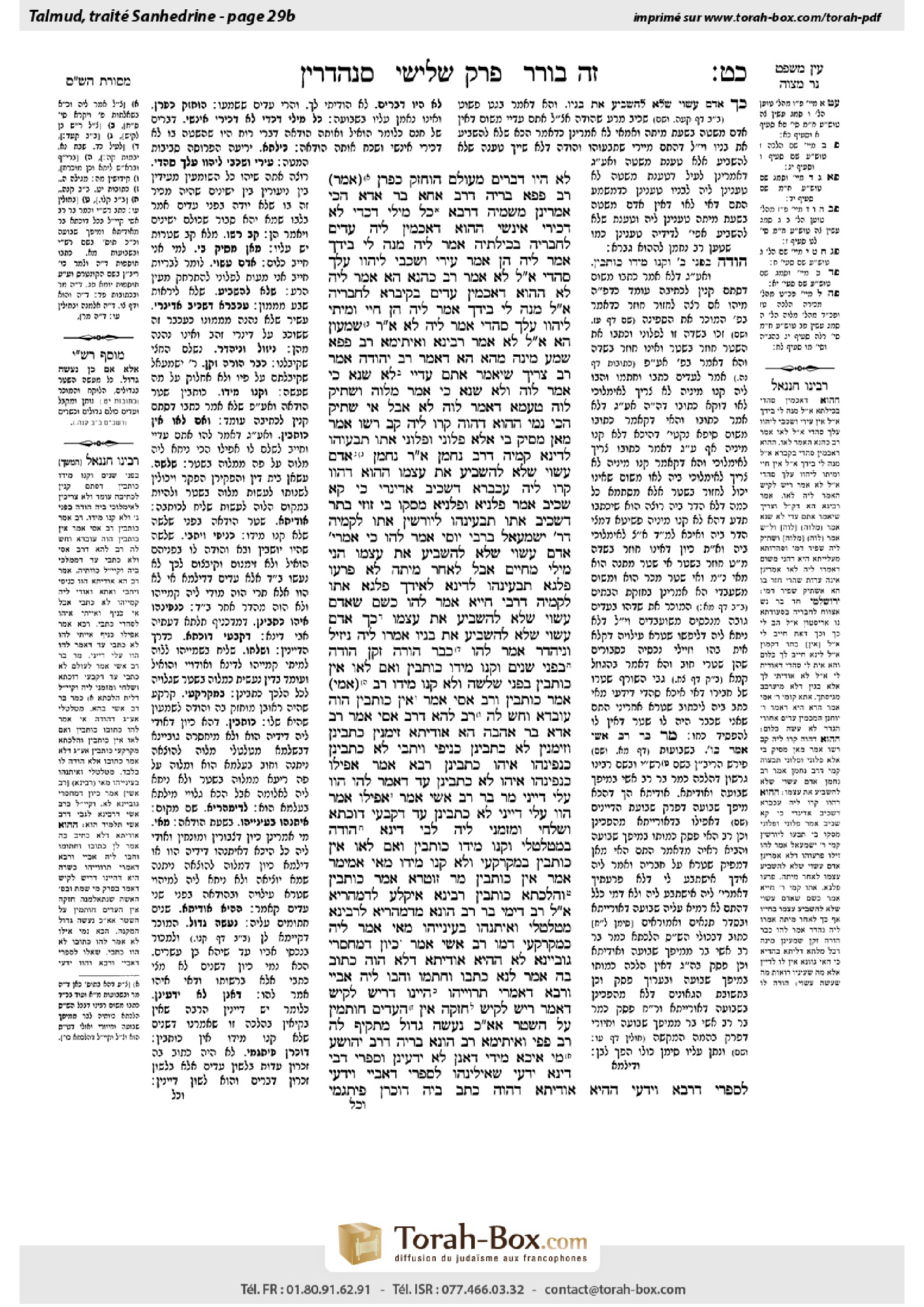
Sanhedrin 29b: Talmud study for Daf Yomi
Daf Yomi is the daily study of one Talmud folio. Explore 37 tractates with scans, Hebrew text, Sefaria English and AI-generated French translations where annotated.
Passage selection and English or AI-generated French translation are available where the scan has annotations. Daf Study is independent of Torah-Box and Sefaria.
Browse Sanhedrin · סנהדרין · All tractatesSanhedrin 29b text and translations
This page of Sanhedrin includes the Aramaic text, an English translation and an AI-generated French translation, alongside the scan above.
סנהדרין כ״ט ב · Aramaic and Hebrew text
״לֹא הָיוּ דְבָרִים מֵעוֹלָם״ – הוּחְזַק כַּפְרָן.
אָמַר רַב פָּפָּא בְּרֵיהּ דְּרַב אַחָא בַּר אַדָּא, הָכִי אָמְרִינַן מִשְּׁמֵיהּ דְּרָבָא: כֹּל מִילֵּי דִּכְדִי לָא דְּכִירִי אִינָשֵׁי.
הָהוּא דְּאַכְמֵין לֵיהּ עֵדִים לְחַבְרֵיהּ בְּכִילְּתֵיהּ. אֲמַר לֵיהּ: ״מָנֶה לִי בִּידָךְ״. אָמַר לֵיהּ: ״הֵן״. אָמַר: ״עֵירֵי וְשָׁכְבֵי לֶיהֱווֹ עֲלָךְ סָהֲדֵי״. אֲמַר לֵיהּ: ״לָא״. אֲמַר רַב כָּהֲנָא: הָא אֲמַר לֵיהּ ״לָא״.
הָהוּא דְּאַכְמֵין עֵדִים בְּקִיבְרָא לְחַבְרֵיהּ, אֲמַר לֵיהּ: ״מָנֶה לִי בִּידָךְ״. אָמַר לֵיהּ: ״הֵן״. חַיֵּי וּמִיתֵי לֶיהֱווֹ עֲלָךְ סָהֲדִי, אָמַר לֵיהּ: ״לָא״. אֲמַר רַבִּי שִׁמְעוֹן [בֶּן לָקִישׁ]: הָא אֲמַר לֵיהּ ״לָא״.
אָמַר רָבִינָא, וְאִיתֵּימָא רַב פָּפָּא: שְׁמַע מִינַּהּ מֵהָא, הָא דְּאָמַר רַב יְהוּדָה אָמַר רַב: צָרִיךְ שֶׁיֹּאמַר ״אַתֶּם עֵדַיי״, לָא שְׁנָא כִּי אָמַר לֹוֶה, וְלָא שְׁנָא כִּי אָמַר מַלְוֶה וְשָׁתֵיק לֹוֶה. טַעְמָא דְּאָמַר לֹוֶה ״לָא״, אֲבָל אִי שָׁתֵיק – הָכִי נָמֵי.
הָהוּא דַּהֲוָה קָרוּ לֵיהּ ״קַב רָשׁוּ״, אֲמַר: מַאן מַסֵּיק בִּי אֶלָּא פְּלוֹנִי וּפְלוֹנִי? אֲתוֹ, תַּבְעוּהּו לְדִינָא קַמֵּיהּ דְּרַב נַחְמָן.
אָמַר רַב נַחְמָן: אָדָם עָשׂוּי שֶׁלֹּא לְהַשְׂבִּיעַ אֶת עַצְמוֹ.
הָהוּא דַּהֲווֹ קָרוּ לֵיהּ ״עַכְבְּרָא דְּשָׁכֵיב אַדִּינָרֵי״. כִּי קָא שָׁכֵיב, אֲמַר: ״פְּלָנְיָא וּפְלָנְיָא מַסְּקוּ בִּי זוּזֵי״. בָּתַר דִּשְׁכֵיב, אֲתוֹ תַּבְעִינְהוּ לְיוֹרְשִׁין.
אֲתוֹ לְקַמֵּיהּ דְּרַבִּי יִשְׁמָעֵאל בְּרַבִּי יוֹסֵי. אֲמַר לְהוּ: כִּי אָמְרִינַן ״אָדָם עָשׂוּי שֶׁלֹּא לְהַשְׂבִּיעַ אֶת עַצְמוֹ״, הָנֵי מִילֵּי מֵחַיִּים, אֲבָל לְאַחַר מִיתָה – לָא.
פְּרַעוּ פַּלְגָא, תַּבְעִינְהוּ לְדִינָא לְאִידַּךְ פַּלְגָא. אֲתוֹ לְקַמֵּיהּ דְּרַבִּי חִיָּיא. אֲמַר לְהוּ: כְּשֵׁם שֶׁאָדָם עָשׂוּי שֶׁלֹּא לְהַשְׂבִּיעַ אֶת עַצְמוֹ, כָּךְ אָדָם עָשׂוּי שֶׁלֹּא לְהַשְׂבִּיעַ אֶת בָּנָיו. אֲמַרוּ לֵיהּ: נֵיזִיל וְנַיהְדַּר? אֲמַר לְהוּ: כְּבָר הוֹרָה זָקֵן.
הוֹדָה בִּפְנֵי שְׁנַיִם, וְקָנוּ מִיָּדוֹ – כּוֹתְבִין, וְאִם לָאו – אֵין כּוֹתְבִין.
בִּפְנֵי שְׁלֹשָׁה, וְלֹא קָנוּ מִיָּדוֹ. רַב אַמֵּי אָמַר: כּוֹתְבִין, וְרַב אַסִּי אָמַר: אֵין כּוֹתְבִין. הֲוָה עוֹבָדָא, וְחַשׁ לַהּ רַב לְהָא דְּרַב אַסִּי.
אָמַר רַב אַדָּא בַּר אַהֲבָה: הָא אוֹדִיתָא, זִימְנִין כָּתְבִינַן וְזִימְנִין לָא כָּתְבִינַן. כְּנִיפִי וְיָתְבִי – לָא כָּתְבִינַן, כַּנְפִינְהוּ אִיהוּ – כָּתְבִינַן.
רָבָא אָמַר: אֲפִילּוּ כַּנְפִינְהוּ אִיהוּ – לָא כָּתְבִינַן, עַד דְּאָמַר לְהוּ: ״הֱווֹ עֲלַי דַּיָּינֵי״.
מָר בַּר רַב אָשֵׁי אָמַר: אֲפִילּוּ אָמַר ״הֱווֹ עֲלַי דַּיָּינֵי״, לָא כָּתְבִינַן עַד דְּקָבְעִי דּוּכְתָּא, וְשָׁלְחִי, וּמַזְמְנִי לֵיהּ לְבֵי דִינָא.
הוֹדָה בְּמִטַּלְטְלֵי, וְקָנוּ מִיָּדוֹ – כּוֹתְבִין, וְאִם לָאו – אֵין כּוֹתְבִין. בִּמְקַרְקְעֵי, וְלֹא קָנוּ מִיָּדוֹ, מַאי? אַמֵּימָר אָמַר: אֵין כּוֹתְבִין. מָר זוּטְרָא אָמַר: כּוֹתְבִין. וְהִלְכְתָא: כּוֹתְבִין.
רָבִינָא אִיקְּלַע לְדִמְהַרְיָא. אֲמַר לֵיהּ רַב דִּימִי בַּר רַב הוּנָא מִדִּמְהַרְיָא לְרָבִינָא: מִטַּלְטְלִי וְאִיתַנְהוּ בְּעֵינַיְיהוּ, מַאי? אֲמַר לֵיהּ: כִּמְקַרְקְעֵי דָּמוּ. רַב אָשֵׁי אָמַר: כֵּיוָן דִּמְחַסְּרִי גּוּבְיָינָא, לָא.
הָהִיא אוֹדִיתָא דְּלָא הֲוָה כְּתִב בַּהּ ״אֲמַר לַנָא, כְּתֻבוּ וַחֲתֻמוּ וְהַבוּ לֵיהּ״, אַבָּיֵי וְרָבָא דְּאָמְרִי תַּרְוַיְיהוּ: הַיְינוּ דְּרֵישׁ לָקִישׁ.
דְּאָמַר רֵישׁ לָקִישׁ: חֲזָקָה אֵין הָעֵדִים חוֹתְמִין עַל הַשְּׁטָר, אֶלָּא אִם כֵּן נַעֲשָׂה גָּדוֹל.
מַתְקֵיף לַהּ רַב פַּפֵּי, וְאִיתֵּימָא רַב הוּנָא בְּרֵיהּ דְּרַב יְהוֹשֻׁעַ: מִי אִיכָּא מִידֵּי דַּאֲנַן לָא יָדְעִינַן, וְסָפְרֵי דְּבֵי דִינָא יָדְעִי?
שְׁאֵילִינְהוּ לְסָפְרֵי דְאַבָּיֵי, וְיָדְעִי. לְסָפְרֵי דְרָבָא, וְיָדְעִי.
הָהִיא אוֹדִיתָא דַּהֲוָה כְּתִב בַּיהּ ״דּוּכְרַן פִּיתְגָמֵי״,
Sanhedrin 29b · English translation
These matters never occurred, i.e., I never admitted to this, the defendant assumes the presumptive status of one who falsely denies his debts, as the witnesses heard his admission. Consequently, he is not trusted to take an oath that he is exempt.
Rav Pappa, son of Rav Aḥa bar Adda, says: This is what we say in the name of Rava: The defendant is not rendered a liar, because people do not remember all frivolous matters. Since the admission was not made seriously, perhaps the defendant forgot the incident. Therefore, his denial of its having occurred was not necessarily an outright lie.
The Gemara relates: There was a certain man who hid witnesses in the canopy above his bed to hear the statement of another. That certain man said to him: I have one hundred dinars in your possession. The latter said to him: Yes. The claimant then said: Let those awake and those asleep bear witness about you, hoping to induce him to agree to this testimony, as the respondent might assume that everyone was asleep. The latter said to him: No. When the matter came to court Rav Kahana said: Since he said no to him, his admission did not render him liable.
The Gemara relates another incident: There was a certain man who hid witnesses in a grave to hear the statement of another. That certain man said to him: I have one hundred dinars in your possession. The latter said to him: Yes. The claimant then said: Let the living and the dead bear witness about you. The respondent said to him: No. Rabbi Shimon said: Since he said no to him, his admission did not render him liable.
Ravina said, and some say Rav Pappa said it: Conclude from it that with regard to that which Rav Yehuda says that Rav says, that one needs to say to the witnesses of the admission: You are my witnesses, there is no difference whether the debtor said it, and there is no difference whether the creditor said it and the debtor remained silent. The inference is that the reason the Sages deemed the purported debtor exempt in the above cases is that the debtor explicitly said no, i.e., that he does not accept the witnesses, but had he remained silent his admission would have indeed rendered him liable.
The Gemara relates: There was a certain man whom people called: A kav of debts, as everyone claimed debts from him, who once said: Who can claim debts from me, other than so-and-so and so-and-so? I do not owe money to as many as assumed. Those whom he admitted that he owed came and took him to judgment before Rav Naḥman to claim what he owed them, and he responded in court that his admittance was in jest.
Rav Naḥman said: A person is prone to make false statements so as not to make himself appear sated, i.e., it is possible that he might say falsely in public that he owes money in order that he should not be considered wealthy. Therefore, as long as he has not made a proper admission that he owes a specific sum to a specific individual, he is not liable.
The Gemara relates: There was a certain man whom people called: A mouse that lies on dinars, as he was a miser who did not benefit from his money, like a mouse that sits and safeguards gold dinars. This man said on his deathbed: So-and-so and so-and-so claim dinars from me. After he died, they came and sued the heirs.
They came to judgment before Rabbi Yishmael, son of Rabbi Yosei. He said to them: When we say a person is prone to make false statements so as not to make himself appear sated, this statement applies to an admission during his lifetime. But after death, i.e., on his deathbed, this does not apply; rather, we presume he told the truth.
The heirs paid half the amount of the claim. The claimants then sued them for the other half. They came to judgment before Rabbi Ḥiyya. Rabbi Ḥiyya said to them: Just as a person is prone to make false statements so as not to make himself appear sated, so too, a person is prone to make false statements so as not to make his sons appear sated. One might claim falsely on his deathbed that he owes money so that his children will not be considered wealthy. Therefore, there is no room for a claim against the heirs. The heirs then said to him: If so, let us go and overturn the former verdict, and retrieve the amount we paid the claimants. Rabbi Ḥiyya said to them: The elder, i.e., Rabbi Yishmael, son of Rabbi Yosei, has already issued a ruling in this case, and it is not in my power to overturn his ruling.
§ If one made an admission in the presence of two witnesses that he owes money and they performed a formal act of acquisition with him to verify the admission, the witnesses can write a record of the admission in a document and sign it, thereby granting the creditor more rights. But if they did not perform a formal act of acquisition they may not write a record of the admission in a document, as the debtor presumably wants the loan to retain its status as a loan by oral agreement, which grants fewer rights to the creditor than a loan with a promissory note.
If he made an admission in the presence of three witnesses and they did not perform a formal act of acquisition with him, Rav Ami says: They can write a record of the admission in a document. Since the admission was made in the presence of three individuals, who are considered a court, it is permitted for a court to write its verdicts. And Rav Asi says: They may not write it in a document; perhaps the debtor intended for them to serve only as witnesses, not as a court. There was an incident in which a person admitted his debt before three witnesses, and Rav was concerned for this opinion of Rav Asi, and ruled that they may not write a record of the admission.
Rav Adda bar Ahava says: With regard to this document of admission, sometimes we write it and sometimes we do not write it. If the three witnesses were gathered and sitting when the debtor made his admission before them, we do not write it, as perhaps he did not intend for them to serve as a court. But if the debtor gathered them, we write the document of admission, as the fact that he took care to bring three people and not just two proves that he intended for them to serve as a court.
Rava says: Even if he gathered them we do not write it, unless he says to them: Be my judges.
Mar bar Rav Ashi says: Even if he says: Be my judges, we do not write it unless they establish a place for judgment and send messengers and summon him to court. Unless the entire procedure of an admission in court is implemented, the debtor may not have intended that they serve as a court with regard to this matter.
If he made an admission with regard to movable property that he owes, and the witnesses performed a formal act of acquisition with him, they can write a record of the admission in a document; but if they did not perform a formal act of acquisition they may not write a record of the admission. But if he made an admission with regard to land, and they did not perform a formal act of acquisition with him, what is the halakha? Is it considered as though an act of acquisition was performed, as land is always available for collection? Ameimar says: They may not write it. Mar Zutra says: They may write it. And the halakha is that they may write it.
Ravina happened to come to Damharya. Rav Dimi bar Rav Huna of Damharya said to Ravina: If one makes an admission that he owes movable property that is extant, i.e., it is available to be taken immediately, what is the halakha? Should it be considered like land, as it is similarly available for collection, and therefore the witnesses can write a record of the admission? Ravina said to him: It is considered like land. Rav Ashi says: Since it still lacks collection, i.e., it has not been physically transferred from one party to the other, it is not considered like land, and the witnesses may not write a record of the admission unless the debtor asks them to write it.
§ With regard to a certain document of admission in which the following statement was not written: He, the one making the admission, said to us: Write a deed, and sign it, and give it to the creditor, Abaye and Rava both say that this is a case in which the principle of Reish Lakish is applicable.
As Reish Lakish says: There is a presumption that witnesses do not sign on the document unless the deal was transacted with each party being an adult, even if it is not mentioned explicitly in the document that the witnesses verified this. This reflects the principle that a document is not written by a scribe and signed by witnesses unless they know that the action to which it attests was performed appropriately. In light of this, the fact that a certain detail is missing from the wording of the document does not prove that the detail did not take place, as the action was presumably performed properly. Consequently, a document of admission lacking the sentence: He said to us: Write a deed, and sign it, and give it to the creditor, is valid.
Rav Pappi objects to this, and some say it is Rav Huna, son of Rav Yehoshua, who raises this objection: Is there anything that we, the Sages, do not know, and the scribes of the court do know? Since not all of the Sages are aware that the witnesses of an admission cannot write a deed of admission unless the one making the admission asks them to, the scribes certainly cannot be expected to ensure that this condition is fulfilled.
The Gemara relates that Abaye’s scribes were asked whether they were aware of this halakha, and they answered that they were aware of it. Rava’s scribes were also asked, and they were also aware of it. Apparently, since writing documents is their profession, scribes are aware of the relevant halakhot.
The Gemara recounts: There was a certain document of admission in which it was written that it was a record of the proceedings that took place in the presence of the witnesses,
Sanhedrin 29b · Traduction française (IA)
« Ces faits n’ont jamais eu lieu », c’est-à-dire : « Je n’ai jamais reconnu cela » : le défendeur acquiert alors le statut présumé de quelqu’un qui nie faussement ses dettes, puisque les témoins ont entendu sa reconnaissance. Par conséquent, on ne peut pas lui faire confiance pour jurer qu’il n’est pas débiteur.
Rav Pappa, fils de Rav Aḥa bar Adda, dit : Voici ce que nous disons au nom de Rava : le défendeur n’est pas considéré comme un menteur, car les gens ne se souviennent pas de toutes les choses dites à la légère. Puisque la reconnaissance n’a pas été faite sérieusement, le défendeur a peut-être oublié l’incident. Par conséquent, nier que cela se soit produit n’était pas nécessairement un mensonge délibéré.
La Guemara rapporte : Un homme avait caché des témoins dans le dais au-dessus de son lit afin qu’ils entendent les propos d’un autre homme. Il lui dit : « J’ai cent dinars en ta possession. » L’autre répondit : « Oui. » Le demandeur ajouta alors : « Que ceux qui sont éveillés et ceux qui dorment témoignent contre toi », espérant l’amener à accepter ce témoignage, car le défendeur pouvait croire que tout le monde dormait. L’autre lui répondit : « Non. » Lorsque l’affaire fut portée devant le tribunal, Rav Kahana déclara : Puisqu’il lui a répondu non, sa reconnaissance ne l’a pas rendu débiteur.
La Guemara rapporte un autre incident : Un homme avait caché des témoins dans une tombe afin qu’ils entendent les propos d’un autre homme. Il lui dit : « J’ai cent dinars en ta possession. » L’autre répondit : « Oui. » Le demandeur ajouta alors : « Que les vivants et les morts témoignent contre toi. » Le défendeur lui répondit : « Non. » Rabbi Shimon déclara : Puisqu’il lui a répondu non, sa reconnaissance ne l’a pas rendu débiteur.
Ravina dit — certains attribuent ces paroles à Rav Pappa : Déduis de là que, concernant ce que Rav Yehuda dit au nom de Rav, à savoir qu’il faut dire aux témoins de la reconnaissance : « Vous êtes mes témoins », il n’y a pas de différence selon que le débiteur l’a dit lui-même ou que le créancier l’a dit et que le débiteur est resté silencieux. On en déduit que si les Sages ont considéré le prétendu débiteur comme exonéré dans les cas précédents, c’est parce qu’il a explicitement dit non, c’est-à-dire qu’il n’acceptait pas les témoins ; mais s’il était resté silencieux, sa reconnaissance l’aurait effectivement rendu débiteur.
La Guemara rapporte : Un homme était surnommé « un kav de dettes », car tout le monde lui réclamait de l’argent. Un jour, il dit : « Qui peut me réclamer de l’argent, à part untel et untel ? Je ne dois pas d’argent à autant de personnes qu’on le croit. » Ceux auxquels il avait reconnu devoir de l’argent vinrent le faire comparaître devant Rav Naḥman pour réclamer ce qu’il leur devait. Au tribunal, il répondit que sa reconnaissance avait été faite en plaisantant.
Rav Naḥman dit : Il arrive qu’une personne fasse de fausses déclarations afin de ne pas se faire passer pour riche ; il est possible qu’elle affirme faussement en public qu’elle doit de l’argent pour ne pas être considérée comme riche. Par conséquent, tant qu’elle n’a pas reconnu devoir une somme précise à une personne précise, elle n’est pas tenue pour débitrice.
La Guemara rapporte : Un homme était surnommé « la souris qui se couche sur des dinars », car c’était un avare qui ne tirait aucun profit de son argent, comme une souris qui reste assise à garder des dinars d’or. Sur son lit de mort, cet homme dit : « Untel et untel me réclament des dinars. » Après sa mort, ils vinrent poursuivre ses héritiers.
Ils comparurent devant Rabbi Yishmael, fils de Rabbi Yosei. Il leur dit : Lorsque nous disons qu’une personne peut faire de fausses déclarations afin de ne pas se faire passer pour riche, cela s’applique à une reconnaissance faite de son vivant. Mais après la mort, c’est-à-dire sur son lit de mort, cela ne s’applique pas ; nous présumons plutôt qu’elle a dit la vérité.
Les héritiers payèrent la moitié de la somme réclamée. Les demandeurs leur réclamèrent ensuite l’autre moitié. Ils comparurent devant Rabbi Ḥiyya. Rabbi Ḥiyya leur dit : De même qu’une personne peut faire de fausses déclarations afin de ne pas se faire passer pour riche, elle peut aussi en faire afin que ses fils ne paraissent pas riches. Quelqu’un peut prétendre à tort, sur son lit de mort, qu’il doit de l’argent afin que ses enfants ne soient pas considérés comme riches. Il n’y a donc pas lieu de réclamer quoi que ce soit aux héritiers. Ceux-ci lui dirent alors : « Dans ce cas, allons faire annuler le jugement précédent et récupérer la somme que nous avons payée aux demandeurs. » Rabbi Ḥiyya leur répondit : « L’ancien, c’est-à-dire Rabbi Yishmael, fils de Rabbi Yosei, a déjà statué dans cette affaire, et je n’ai pas le pouvoir d’annuler sa décision. »
§ Si quelqu’un reconnaît devant deux témoins qu’il doit de l’argent et qu’ils effectuent avec lui un acte formel d’acquisition pour confirmer cette reconnaissance, les témoins peuvent consigner celle-ci dans un acte écrit et le signer, conférant ainsi davantage de droits au créancier. Mais s’ils n’ont pas effectué d’acte formel d’acquisition, ils ne peuvent pas consigner la reconnaissance dans un acte écrit, car le débiteur souhaite vraisemblablement que le prêt conserve le statut d’un prêt verbal, lequel confère moins de droits au créancier qu’un prêt assorti d’un acte de créance.
S’il a reconnu sa dette devant trois témoins et qu’ils n’ont pas effectué avec lui d’acte formel d’acquisition, Rav Ami dit : Ils peuvent consigner cette reconnaissance dans un acte écrit. Puisqu’elle a été faite devant trois personnes, lesquelles sont considérées comme un tribunal, il est permis à un tribunal de consigner ses décisions par écrit. Rav Asi dit, quant à lui : Ils ne peuvent pas la consigner dans un acte écrit ; peut-être le débiteur voulait-il qu’ils servent uniquement de témoins, et non de tribunal. Un incident s’est produit où quelqu’un a reconnu sa dette devant trois témoins ; Rav tint compte de l’avis de Rav Asi et décida qu’ils ne pouvaient pas consigner cette reconnaissance par écrit.
Rav Adda bar Ahava dit : Pour cet acte de reconnaissance, parfois nous l’écrivons et parfois nous ne l’écrivons pas. Si les trois témoins étaient réunis et assis lorsque le débiteur reconnut sa dette devant eux, nous ne rédigeons pas l’acte, car il est possible qu’il n’ait pas voulu qu’ils servent de tribunal. Mais si le débiteur les a réunis, nous rédigeons l’acte de reconnaissance, car le fait qu’il ait pris soin de réunir trois personnes et non deux prouve qu’il voulait qu’elles servent de tribunal.
Rava dit : Même s’il les a réunis, nous ne rédigeons pas l’acte, à moins qu’il ne leur dise : « Soyez mes juges. »
Mar bar Rav Ashi dit : Même s’il leur dit : « Soyez mes juges », nous ne rédigeons pas l’acte, à moins qu’ils ne fixent un lieu de jugement, n’envoient des messagers et ne le convoquent au tribunal. Tant que toute la procédure d’une reconnaissance devant un tribunal n’a pas été mise en œuvre, le débiteur n’a peut-être pas voulu qu’ils fassent office de tribunal dans cette affaire.
S’il a reconnu devoir des biens meubles et que les témoins ont effectué avec lui un acte formel d’acquisition, ils peuvent consigner cette reconnaissance dans un acte écrit ; mais s’ils n’ont pas effectué d’acte formel d’acquisition, ils ne le peuvent pas. Mais s’il a reconnu devoir un bien-fonds et qu’ils n’ont pas effectué avec lui d’acte formel d’acquisition, quelle est la halakha ? Faut-il considérer qu’un acte d’acquisition a été effectué, puisque le bien-fonds est toujours disponible pour le recouvrement ? Ameimar dit : Ils ne peuvent pas rédiger l’acte. Mar Zutra dit : Ils le peuvent. Et la halakha est qu’ils peuvent le rédiger.
Ravina se trouvait par hasard à Damharya. Rav Dimi bar Rav Huna de Damharya demanda à Ravina : Si quelqu’un reconnaît devoir des biens meubles existants, c’est-à-dire disponibles pour être pris immédiatement, quelle est la halakha ? Faut-il les considérer comme un bien-fonds, puisqu’ils sont eux aussi disponibles pour le recouvrement, de sorte que les témoins peuvent consigner la reconnaissance par écrit ? Ravina lui répondit : On les considère comme un bien-fonds. Rav Ashi dit : Puisque ces biens doivent encore être recouvrés, c’est-à-dire qu’ils n’ont pas été matériellement transférés d’une partie à l’autre, ils ne sont pas considérés comme un bien-fonds ; les témoins ne peuvent donc pas consigner la reconnaissance par écrit, à moins que le débiteur ne leur demande de le faire.
§ À propos d’un certain acte de reconnaissance dans lequel n’était pas inscrite la déclaration suivante : « Celui qui fait la reconnaissance nous a dit : “Rédigez un acte, signez-le et remettez-le au créancier” », Abaye et Rava disent tous deux que le principe de Reish Lakish s’applique.
En effet, Reish Lakish dit : On présume que les témoins ne signent pas un acte si la transaction n’a pas été conclue alors que chaque partie était majeure, même si l’acte ne mentionne pas explicitement que les témoins l’ont vérifié. Cela reflète le principe selon lequel un scribe ne rédige pas un acte et des témoins ne le signent pas sans savoir que l’acte qu’il atteste a été accompli comme il convient. Par conséquent, l’absence d’un détail dans le libellé de l’acte ne prouve pas que ce détail n’a pas été établi, car on présume que la procédure a été suivie correctement. Un acte de reconnaissance auquel manque la phrase « Il nous a dit : “Rédigez un acte, signez-le et remettez-le au créancier” » est donc valide.
Rav Pappi s’oppose à cela — certains disent que c’est Rav Huna, fils de Rav Yehoshua, qui soulève cette objection : Y a-t-il quelque chose que nous, les Sages, ignorons, mais que les scribes du tribunal savent ? Puisque tous les Sages ne savent pas que les témoins d’une reconnaissance ne peuvent pas rédiger un acte de reconnaissance sans que celui qui reconnaît sa dette le leur demande, on ne saurait certainement pas attendre des scribes qu’ils veillent à ce que cette condition soit remplie.
La Guemara rapporte qu’on demanda aux scribes d’Abaye s’ils connaissaient cette halakha, et ils répondirent qu’ils la connaissaient. On posa également la question aux scribes de Rava, qui eux aussi la connaissaient. Il apparaît donc que, puisque la rédaction d’actes est leur métier, les scribes connaissent les halakhot pertinentes.
La Guemara raconte : Il existait un certain acte de reconnaissance où il était écrit qu’il s’agissait du compte rendu de la procédure qui s’était déroulée en présence des témoins,
Traduction française générée par IA à partir de l’édition anglaise de Sefaria. Vérifie toujours un passage avec le texte source.
Text from Sefaria: William Davidson Edition - Vocalized Aramaic (CC BY NC); William Davidson Edition - English (CC BY NC).