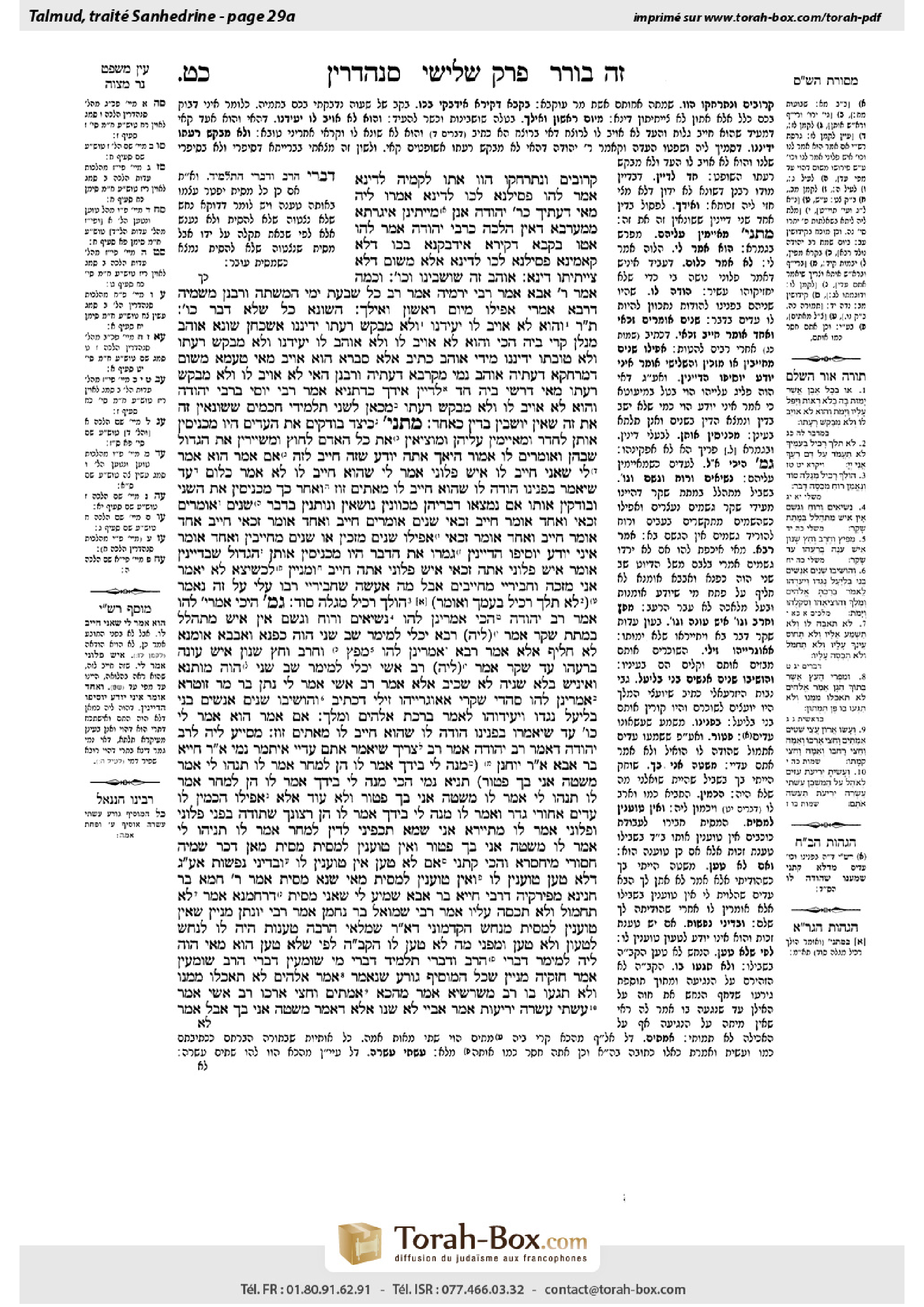
Sanhedrin 29a: Talmud study for Daf Yomi
Daf Yomi is the daily study of one Talmud folio. Explore 37 tractates with scans, Hebrew text, Sefaria English and AI-generated French translations where annotated.
Passage selection and English or AI-generated French translation are available where the scan has annotations. Daf Study is independent of Torah-Box and Sefaria.
Browse Sanhedrin · סנהדרין · All tractatesSanhedrin 29a text and translations
This page of Sanhedrin includes the Aramaic text, an English translation and an AI-generated French translation, alongside the scan above.
סנהדרין כ״ט א · Aramaic and Hebrew text
קְרוֹבִים וְנִתְרַחֲקוּ הֲווֹ. אֲתוֹ לְקַמֵּיהּ לְדִינָא. אֲמַר לְהוּ: פְּסִילְנָא לְכוּ לְדִינָא.
אֲמַרוּ לֵיהּ: מַאי דַּעְתָּיךְ? כְּרַבִּי יְהוּדָה? אֲנַן מַיְיתִינַן אִיגַּרְתָּא מִמַּעְרְבָא דְּאֵין הֲלָכָה כְּרַבִּי יְהוּדָה.
אֲמַר לְהוּ: אַטּוּ בְּקַבָּא דְקִירָא אִידְּבַקְנָא בְּכוּ? דְּלָא קָאָמֵינָא פְּסִילְנָא לְכוּ לְדִינָא, אֶלָּא מִשּׁוּם דְּלָא צָיְיתִיתוּ דִּינָא.
אוֹהֵב זֶה שׁוֹשְׁבִינוֹ וְכוּ׳.
וְכַמָּה? אָמַר רַבִּי אַבָּא אָמַר רַבִּי יִרְמְיָה אָמַר רַב: כׇּל שִׁבְעַת יְמֵי הַמִּשְׁתֶּה. וְרַבָּנַן מִשְּׁמֵיהּ דְּרָבָא אָמְרִי: אֲפִילּוּ מִיּוֹם רִאשׁוֹן וְאֵילָךְ.
הַשּׂוֹנֵא כֹּל שֶׁלֹּא דִּבֵּר כּוּ׳. תָּנוּ רַבָּנַן: ״וְהוּא לֹא אוֹיֵב לוֹ״ – יְעִידֶנּוּ, ״וְלֹא מְבַקֵּשׁ רָעָתוֹ״ – יְדִינֶנּוּ.
אַשְׁכְּחַן שׂוֹנֵא, אוֹהֵב מְנָלַן?
קָרֵי בֵּיהּ הָכִי: וְהוּא לֹא אוֹיֵב לוֹ וְלֹא אוֹהֵב לוֹ – יְעִידֶנּוּ, וְלֹא מְבַקֵּשׁ רָעָתוֹ וְלֹא טוֹבָתוֹ – יְדִינֶנּוּ.
מִידֵּי ״אוֹהֵב״ כְּתִיב? אֶלָּא סְבָרָא הוּא. אוֹיֵב – מַאי טַעְמָא? מִשּׁוּם דִּמְרַחֲקָא דַּעְתֵּיהּ. אוֹהֵב נָמֵי – מְקָרְבָא דַּעְתֵּיהּ.
וְרַבָּנַן, הַאי ״לֹא אוֹיֵב לוֹ וְלֹא מְבַקֵּשׁ רָעָתוֹ״ מַאי דָּרְשִׁי בֵּיהּ?
חַד לְדַיָּין.
אִידַּךְ, כִּדְתַנְיָא: אָמַר רַבִּי יוֹסֵי בְּרַבִּי יְהוּדָה, ״וְהוּא לֹא אוֹיֵב לוֹ וְלֹא מְבַקֵּשׁ רָעָתוֹ״ – מִכָּאן לִשְׁנֵי תַּלְמִידֵי חֲכָמִים שֶׁשּׂוֹנְאִין זֶה אֶת זֶה, שֶׁאֵין יוֹשְׁבִין בַּדִּין כְּאֶחָד.
מַתְנִי׳ כֵּיצַד בּוֹדְקִים אֶת הָעֵדִים? הָיוּ מַכְנִיסִין אוֹתָן לַחֶדֶר, וּמְאַיְּימִין עֲלֵיהֶן, וּמוֹצִיאִין אֶת כׇּל הָאָדָם לַחוּץ, וּמְשַׁיְּירִין אֶת הַגָּדוֹל שֶׁבָּהֶן.
וְאוֹמְרִים לוֹ: אֱמוֹר הֵיאַךְ אַתָּה יוֹדֵעַ שֶׁזֶּה חַיָּיב לָזֶה? אִם אָמַר: ״הוּא אָמַר לִי שֶׁאֲנִי חַיָּיב לוֹ״, ״אִישׁ פְּלוֹנִי אָמַר לִי שֶׁהוּא חַיָּיב לוֹ״ – לֹא אָמַר כְּלוּם, עַד שֶׁיֹּאמַר: ״בְּפָנֵינוּ הוֹדָה לוֹ שֶׁהוּא חַיָּיב לוֹ מָאתַיִם זוּז״.
וְאַחַר כָּךְ מַכְנִיסִין אֶת הַשֵּׁנִי, וּבוֹדְקִין אוֹתוֹ. אִם נִמְצְאוּ דִּבְרֵיהֶן מְכוּוָּנִין, נוֹשְׂאִין וְנוֹתְנִין בַּדָּבָר.
שְׁנַיִם אוֹמְרִים: זַכַּאי, וְאֶחָד אוֹמֵר: חַיָּיב – זַכַּאי. שְׁנַיִם אוֹמְרִים: חַיָּיב, וְאֶחָד אוֹמֵר: זַכַּאי – חַיָּיב. אֶחָד אוֹמֵר: חַיָּיב, וְאֶחָד אוֹמֵר: זַכַּאי, אֲפִילּוּ שְׁנַיִם מְזַכִּין אוֹ שְׁנַיִם מְחַיְּיבִין וְאֶחָד אוֹמֵר: אֵינִי יוֹדֵעַ – יוֹסִיפוּ הַדַּיָּינִין.
גָּמְרוּ אֶת הַדָּבָר, הָיוּ מַכְנִיסִין אוֹתָן. הַגָּדוֹל שֶׁבַּדַּיָּינִין אוֹמֵר: אִישׁ פְּלוֹנִי, אַתָּה זַכַּאי. אִישׁ פְּלוֹנִי, אַתָּה חַיָּיב.
וּמִנַּיִין לִכְשֶׁיֵּצֵא, לֹא יֹאמַר: אֲנִי מְזַכֶּה וַחֲבֵירַיי מְחַיְּיבִים, אֲבָל מָה אֶעֱשֶׂה שֶׁחֲבֵירַיי רַבּוּ עָלַי? עַל זֶה נֶאֱמַר: ״לֹא תֵלֵךְ רָכִיל בְּעַמֶּיךָ״, וְאוֹמֵר: ״הוֹלֵךְ רָכִיל מְגַלֶּה סּוֹד״.
גְּמָ׳ הֵיכִי אָמְרִינַן לְהוּ? אָמַר רַב יְהוּדָה: הָכִי אָמְרִינַן לְהוּ, ״נְשִׂיאִים וְרוּחַ וְגֶשֶׁם אָיִן אִישׁ מִתְהַלֵּל בְּמַתַּת שָׁקֶר״.
אֲמַר לֵיהּ רָבָא, יָכְלִי לְמֵימַר: שַׁב שְׁנֵי הֲוָה כַּפְנָא, וְאַבָּבָא אוּמָּנָא לָא חֲלֵיף.
אֶלָּא אָמַר רָבָא, אָמְרִינַן לְהוּ: ״מֵפִיץ וְחֶרֶב וְחֵץ שָׁנוּן אִישׁ עֹנֶה בְרֵעֵהוּ עֵד שָׁקֶר״.
אֲמַר לֵיהּ רַב אָשֵׁי, יָכְלִי לְמֵימַר: שַׁב שְׁנֵי הֲוָה מוֹתָנָא, וְאִינִישׁ בְּלָא שְׁנֵיהּ לָא שְׁכֵיב.
אֶלָּא אָמַר רַב אָשֵׁי: אָמַר לִי נָתָן בַּר מָר זוּטְרָא, אָמְרִינַן לְהוּ: סָהֲדֵי שַׁקָּרֵי אַאוֹגְרַיְיהוּ זִילִי, דִּכְתִיב: ״וְהוֹשִׁיבוּ שְׁנַיִם אֲנָשִׁים בְּנֵי בְלִיַּעַל נֶגְדּוֹ וִיעִדֻהוּ לֵאמֹר בֵּרַכְתָּ אֱלֹהִים וָמֶלֶךְ״.
אִם אָמַר ״הוּא אָמַר לִי כּוּ׳״. עַד שֶׁיֹּאמְרוּ: ״בְּפָנֵינוּ הוֹדָה לוֹ שֶׁהוּא חַיָּיב לוֹ מָאתַיִם זוּז״.
מְסַיַּיע לֵיהּ לְרַב יְהוּדָה, דְּאָמַר רַב יְהוּדָה אָמַר רַב: צָרִיךְ שֶׁיֹּאמַר ״אַתֶּם עֵדַיי״.
אִיתְּמַר נָמֵי: אָמַר רַבִּי חִיָּיא בַּר אַבָּא אָמַר רַבִּי יוֹחָנָן: ״מָנֶה לִי בְּיָדֶךָ״, אָמַר לוֹ: ״הֵן״. לְמָחָר אָמַר לוֹ: ״תְּנֵהוּ לִי״, אָמַר: ״מְשַׁטֶּה אֲנִי בָּךְ״ – פָּטוּר.
תַּנְיָא נָמֵי הָכִי: ״מָנֶה לִי בְּיָדֶךָ״, אָמַר לוֹ ״הֵן״. לְמָחָר אָמַר לוֹ ״תְּנֵהוּ לִי״, אָמַר לוֹ ״מְשַׁטֶּה אֲנִי בָּךְ״ – פָּטוּר.
וְלֹא עוֹד, אֶלָּא אֲפִילּוּ הִכְמִין לוֹ עֵדִים אֲחוֹרֵי גָּדֵר, וְאָמַר לוֹ: ״מָנֶה לִי בְּיָדֶךָ״, אָמַר לוֹ: ״הֵן״. ״רְצוֹנְךָ שֶׁתּוֹדֶה בִּפְנֵי פְּלוֹנִי וּפְלוֹנִי?״ אָמַר לוֹ: ״מִתְיָירֵא אֲנִי שֶׁמָּא תִּכְפֵּינִי לְדִין״. לְמָחָר אָמַר לוֹ: ״תְּנֵיהוּ לִי״, אָמַר לוֹ: ״מְשַׁטֶּה אֲנִי בָּךְ״ – פָּטוּר.
וְאֵין טוֹעֲנִין לַמֵּסִית.
מֵסִית? מַאן דְּכַר שְׁמֵיהּ! חַסּוֹרֵי מִיחַסְּרָא וְהָכִי קָתָנֵי: אִם לֹא טָעַן, אֵין טוֹעֲנִין לוֹ. וּבְדִינֵי נְפָשׁוֹת, אַף עַל גַּב דְּלָא טָעַן, טוֹעֲנִין לוֹ. וְאֵין טוֹעֲנִין לַמֵּסִית.
מַאי שְׁנָא מֵסִית? אָמַר רַבִּי חָמָא בַּר חֲנִינָא: מִפִּירְקֵיהּ דְּרַבִּי חִיָּיא בַּר אַבָּא שְׁמִיעַ לִי, שָׁאנֵי מֵסִית דְּרַחֲמָנָא אָמַר: ״לֹא תַחְמֹל וְלֹא תְכַסֶּה עָלָיו״.
אָמַר רַבִּי שְׁמוּאֵל בַּר נַחְמָן אָמַר רַבִּי יוֹנָתָן: מִנַּיִין שֶׁאֵין טוֹעֲנִין לַמֵּסִית? מִנָּחָשׁ הַקַּדְמוֹנִי. דְּאָמַר רַבִּי שִׂמְלַאי: הַרְבֵּה טְעָנוֹת הָיָה לוֹ לַנָּחָשׁ לִטְעוֹן, וְלֹא טָעַן. וּמִפְּנֵי מָה לֹא טָעַן לוֹ הַקָּדוֹשׁ בָּרוּךְ הוּא? לְפִי שֶׁלֹּא טָעַן הוּא.
מַאי הֲוָה לֵיהּ לְמֵימַר? דִּבְרֵי הָרַב וְדִבְרֵי תַּלְמִיד – דִּבְרֵי מִי שׁוֹמְעִין? דִּבְרֵי הָרַב שׁוֹמְעִין.
אָמַר חִזְקִיָּה: מִנַּיִין שֶׁכׇּל הַמּוֹסִיף גּוֹרֵעַ? שֶׁנֶּאֱמַר: ״אָמַר אֱלֹהִים לֹא תֹאכְלוּ מִמֶּנּוּ וְלֹא תִגְּעוּ בּוֹ״.
רַב מְשַׁרְשְׁיָא אָמַר, מֵהָכָא: ״אַמָּתַיִם וָחֵצִי אׇרְכּוֹ״.
רַב אָשֵׁי אָמַר: ״עַשְׁתֵּי עֶשְׂרֵה יְרִיעֹת״.
אָמַר אַבָּיֵי: לֹא שָׁנוּ אֶלָּא דְּאָמַר ״מְשַׁטֶּה אֲנִי בָּךְ״, אֲבָל אָמַר
Sanhedrin 29a · English translation
were relatives of his and became not related to him, as Mar Ukva’s wife, who was their sister, died. They came before him for judgment. Mar Ukva said to them: I am disqualified from adjudicating for you.
They said to Mar Ukva: What is your opinion according to which you disqualify yourself? Do you rule in accordance with the opinion of Rabbi Yehuda, that since you have children we are still relatives? We shall bring a letter from the West, Eretz Yisrael, that the halakha is not in accordance with the opinion of Rabbi Yehuda.
Mar Ukva said to them: Is that to say that I am stuck to you with a kav of wax [kira]? I agree that we are not considered relatives; I am saying that I am disqualified from adjudicating for you only because you will not obey the verdict, and I do not wish to participate in such judgment.
§ The mishna teaches that according to Rabbi Yehuda, one who loves or one who hates one of the litigants is disqualified from bearing witness. One who loves one of the litigants; this is referring to his groomsman.
The Gemara asks: And for how long is the groomsman disqualified? Rabbi Abba says that Rabbi Yirmeya says that Rav says: Throughout all of the seven days of feasting. And the Rabbis say in the name of Rava: Even from the first day after the wedding and onward he is no longer disqualified; he is disqualified only on the wedding day itself.
§ The mishna teaches: One who hates the litigant is referring to anyone who, out of enmity, did not speak with the litigant for three days. The Sages taught in a baraita: This halakha is derived from the verse: “And he was not his enemy, neither sought his harm” (Numbers 35:23), that one about whom it can be stated: “And he was not his enemy,” can testify about him. And one who “neither sought his harm” can judge him.
The Gemara asks: We found a source for the disqualification of one who hates; from where do we derive that one who loves is disqualified?
The Gemara answers that one should read into the verse like this: One about whom it can be stated: And he who was not his enemy nor one who loves him, can testify about him; and one who neither sought his harm nor his favor can judge him.
The Gemara asks: Is: One who loves, written in the verse? How can the verse be read in this manner? Rather, the extension of the disqualification to one who loves him as well is based on logical reasoning: What is the reason an enemy is disqualified from bearing witness? It is because he feels a sense of aversion toward that individual and might testify falsely against him. A similar logic can be employed with regard to one who loves, as well: He feels a sense of affinity toward that individual, and might testify falsely on his behalf.
The Gemara asks: And what do the Rabbis, who do not agree with Rabbi Yehuda, derive from this verse: “And he was not his enemy, neither sought his harm”?
The Gemara answers: One part of the verse is necessary for the halakha that a judge who loves or hates one of the litigants is disqualified. The Rabbis agree with this halakha, as such a judge is naturally inclined to favor one of the litigants.
The other part of the verse is interpreted in accordance with that which is taught in a baraita: Rabbi Yosei, son of Rabbi Yehuda, says: With regard to the verse “And he was not his enemy, neither sought his harm,” it is derived from here that two Torah scholars who hate each other cannot sit in judgment together as one. Because of their hatred they will come to contradict each other’s rulings unjustly.
MISHNA: How do the judges examine the witnesses? They bring them into a room in the courthouse and intimidate them so that they will speak only the truth. And they take all the people, other than the judges, outside so that they should not tell the other witnesses the questions the judges ask and the answers the first witness gives, and they leave only the eldest of the witnesses to testify first.
And they say to him: Say how exactly you know that this litigant owes money to that litigant, as the plaintiff claims. If he said: The defendant said to me: It is true that I owe the plaintiff, or if he says: So-and-so said to me that the defendant owes the plaintiff, the witness has said nothing and his testimony is disregarded. It is not valid testimony unless he says: The defendant admitted in our presence to the plaintiff that he owes him, e.g., two hundred dinars. By admitting to the debt in the presence of witnesses he renders himself liable to pay the amount that he mentioned.
And afterward they bring in the second witness and examine him in the same manner. If their statements are found to be congruent the judges then discuss the matter.
If the opinions of the judges are divided, as two judges say that the defendant is exempt from payment and one says he is liable to pay, he is exempt. If two say he is liable and one says he is exempt, he is liable. If one says he is liable and one says he is exempt, or even if two of the judges deem him exempt or two of them deem him liable, and the other one says: I do not know, the court must add more judges and then rule in accordance with the majority opinion. This is because the one who abstains is considered as though he is not a member of the court.
After the judges finish the matter and reach a decision, they bring in the litigants. The greatest of the judges says: So-and-so, you are exempt from paying; or: So-and-so, you are liable to pay.
And from where is it derived that when the judge leaves the courtroom he may not say: I deemed you exempt and my colleagues deemed you liable, but what can I do, as my colleagues outnumbered me and consequently you were deemed liable? About this it is stated: “You shall not go as a talebearer among your people” (Leviticus 19:16), and it says: “One who goes about as a talebearer reveals secrets, but one who is of a faithful spirit conceals a matter” (Proverbs 11:13).
GEMARA: The mishna teaches that the judges intimidate the witnesses. The Gemara asks: What do we say to them? Rav Yehuda says that this is what we say to them: It is stated: “As clouds and wind without rain, so is he who boasts himself of a false gift” (Proverbs 25:14). In other words, there will be no rain and no blessing from your deeds if you lie.
Rava said to him: If so, false witnesses can say to themselves that they do not have to worry about this punishment, according to the folk saying: Seven years there was a famine, but over the craftsman’s door it did not pass. If the witnesses are not farmers, they do not need to worry over lack of rain. Consequently, they will disregard this concern.
Rather, Rava said that we say this verse to them: “As a hammer, and a sword, and a sharp arrow, so is a man who bears false witness against his neighbor” (Proverbs 25:18), meaning that a false witness will die prematurely.
Rav Ashi said to him: Here too, false witnesses can say to themselves a folk saying: Seven years there was a pestilence, but a man who has not reached his years did not die; everyone dies at his predestined time. Therefore, they will disregard this concern as well.
The Gemara presents another suggestion: Rather, Rav Ashi said: Natan bar Mar Zutra said to me that we say to them that false witnesses are belittled even by those who hire them, and all the more so by others; as it is written that Jezebel said when she ordered witnesses to be hired to testify against Naboth: “And set two men, base fellows, before him, and let them bear witness against him, saying: You cursed God and the king” (I Kings 21:10). Even Jezebel, who gave the orders to hire them, called them “base fellows.”
§ The mishna teaches that if the witness said: The defendant said to me: It is true that I owe him, his testimony is disregarded unless he says: The defendant admitted in our presence to the plaintiff that he owes him two hundred dinars.
The Gemara comments: This supports the opinion of Rav Yehuda, as Rav Yehuda says that Rav says: The debtor needs to say to the witnesses to the loan or in his admission that he owes the creditor: You are my witnesses. Otherwise, their testimony is not valid.
It was also stated that Rabbi Ḥiyya bar Abba says that Rabbi Yoḥanan says: If one said to another: I have one hundred dinars in your possession, i.e., you owe me one hundred dinars, and the other said to him: Yes, and the next day the claimant said to him: Give it to me, if the other then said to him: I was teasing you, i.e., I did not mean it seriously when I said that I owed it to you, the respondent is exempt.
This is also taught in a baraita: If one said to another: I have one hundred dinars in your possession, and the other said to him: Yes, and the next day the claimant said to him: Give it to me, if the other then said to him: I was teasing you, the respondent is exempt.
And moreover, the respondent is exempt even in a case where the claimant hid witnesses for the respondent behind a fence so that the respondent would not see them, and said to him: I have one hundred dinars in your possession, and the respondent said to him: Yes, and the claimant then said to him: Do you wish to admit the debt in the presence of so-and-so and so-and-so? And the respondent said to him: I am afraid to do so, lest you compel me to go to judgment, where, based on their testimony, you will be given the right to forcibly take the money from me whenever you want. But between you and me, I admit that I owe you. And the next day the claimant said to him: Give me the one hundred dinars that you admitted to owing me, and the respondent said to him: I was teasing you. The respondent is exempt because he can claim that he stated his admission only to appease the claimant temporarily, and did not mean to actually admit to owing the money, as he did not know that there were witnesses present.
But the judges do not advance a claim on behalf of an inciter, i.e., one who is accused of inciting others to idol worship.
The Gemara asks: An inciter? Who mentioned anything about it? This matter was not discussed in the baraita. The Gemara answers: The baraita is incomplete, and this is what it is teaching: If the defendant did not advance a claim that he was teasing the plaintiff, the judges do not advance this claim for him. Apparently, he stated his admission seriously. But in cases of capital law, even if the defendant did not advance any claim on his own behalf, the judges advance a claim on his behalf. But the judges do not advance claims on behalf of an inciter.
The Gemara asks: What is different about an inciter, that the court does not seek to deem him innocent? Rabbi Ḥama bar Ḥanina says: I heard at the lecture of Rabbi Ḥiyya bar Abba that an inciter is different, as the Merciful One states concerning him: “Neither shall you spare, neither shall you conceal him” (Deuteronomy 13:9). In this unique case, the court is not required to try to deem him innocent.
Rabbi Shmuel bar Naḥman says that Rabbi Yonatan says: From where is it derived that the judges do not advance a claim on behalf of an inciter? It is derived from the incident of the primordial snake who tempted Eve; he was the first inciter. As Rabbi Simlai says: The snake could have advanced many claims on its own behalf, but it did not claim them. And for what reason did the Holy One, Blessed be He, not advance these claims for it, deeming the snake exempt from punishment? Because the snake did not advance these claims itself.
The Gemara asks: What could he have said? The Gemara answers: The snake could have said that it is not to blame, as when there is a contradiction between the statement of the teacher and the statement of the student, whose statement should one listen to? One should listen to the statement of the teacher. Since God instructed Adam and Eve not to eat from the fruit of the Tree of Knowledge, Adam and Eve should have heeded God’s words and not those of the snake.
Ḥizkiyya says: From where is it derived that anyone who adds, subtracts? It is derived from a verse, as it is stated that Eve said: “God has said: You shall not eat of it, neither shall you touch it” (Genesis 3:3), whereas God had actually rendered prohibited only eating from the tree but not touching it, as it is stated: “But of the Tree of Knowledge of good and evil, you shall not eat of it” (Genesis 2:17). Because Eve added that there was a prohibition against touching the tree, the snake showed her that touching it does not cause her to die, and she consequently sinned by eating from it as well.
Rav Mesharshiyya says that the idea that one who adds, subtracts can also be proven from here: “Two cubits [amatayim] and a half shall be its length” (Exodus 25:10). Without the letter alef at the beginning of the word amatayim, it would be read matayim, which would mean two hundred cubits. The addition of the alef therefore reduces this term to only two cubits.
Rav Ashi says another example: In the verse: “Eleven [ashtei esrei] curtains” (Exodus 26:7), without the letter ayin at the beginning of the phrase it would read shtei esrei, twelve. Therefore, the additional letter ayin reduces the amount from twelve to eleven.
Abaye says: With regard to the case of one who denies a debt to which he admitted in the presence of hidden witnesses, the Sages taught that he is exempt only in a case where he says: I was teasing you. But if he says:
Sanhedrin 29a · Traduction française (IA)
étaient ses parents, mais cessèrent de l’être lorsque mourut la femme de Mar Ukva, qui était leur sœur. Ils se présentèrent devant lui pour être jugés. Mar Ukva leur dit : « Je ne peux pas juger votre affaire. »
Ils dirent à Mar Ukva : « Quelle est donc ton opinion, selon laquelle tu te récuses ? Statues-tu conformément à l’opinion de Rabbi Yehuda, selon laquelle, puisque tu as des enfants, nous sommes encore parents ? Nous ferons venir une lettre de l’Occident, c’est-à-dire d’Eretz Israël, attestant que la halakha ne suit pas l’opinion de Rabbi Yehuda. »
Mar Ukva leur dit : « Est-ce à dire que je suis attaché à vous par un kav de cire [kira] ? Je reconnais que nous ne sommes pas considérés comme parents ; je dis seulement que je ne peux pas juger votre affaire, parce que vous ne vous conformerez pas au verdict, et je ne souhaite pas participer à un tel jugement. »
§ La Michna enseigne que, selon Rabbi Yehuda, celui qui aime ou qui hait l’un des plaideurs est inapte à témoigner. Celui qui aime l’un des plaideurs désigne son garçon d’honneur.
La Guemara demande : Pendant combien de temps le garçon d’honneur est-il inapte ? Rabbi Abba dit que Rabbi Yirmeya dit que Rav dit : « Pendant les sept jours des festivités. » Les Sages disent au nom de Rava : « Dès le lendemain du mariage, il n’est déjà plus inapte ; il ne l’est que le jour même du mariage. »
§ La Michna enseigne que celui qui hait le plaideur désigne toute personne qui, par inimitié, ne lui a pas parlé pendant trois jours. Les Sages ont enseigné dans une baraïta : Cette halakha se déduit du verset : « Il n’était pas son ennemi et ne cherchait pas son mal » (Nombres 35:23). Celui dont on peut dire « il n’était pas son ennemi » peut témoigner à son sujet, et celui qui « ne cherchait pas son mal » peut le juger.
La Guemara demande : Nous avons trouvé une source pour l’inaptitude de celui qui hait ; d’où déduisons-nous que celui qui aime est inapte ?
La Guemara répond qu’il faut comprendre le verset ainsi : celui dont on peut dire qu’il n’était ni son ennemi ni quelqu’un qui l’aimait peut témoigner à son sujet ; et celui qui ne cherchait ni son mal ni sa faveur peut le juger.
La Guemara demande : Le verset mentionne-t-il « celui qui aime » ? Comment peut-on le lire ainsi ? Il faut plutôt dire que l’extension de l’inaptitude à celui qui l’aime repose également sur un raisonnement logique : pour quelle raison un ennemi est-il inapte à témoigner ? Parce qu’il éprouve de l’aversion pour cette personne et pourrait témoigner faussement contre elle. Le même raisonnement vaut aussi pour celui qui l’aime : il éprouve de l’affection pour cette personne et pourrait témoigner faussement en sa faveur.
La Guemara demande : Et que déduisent les Sages, qui ne sont pas d’accord avec Rabbi Yehuda, du verset : « Il n’était pas son ennemi et ne cherchait pas son mal » ?
La Guemara répond : Une partie du verset est nécessaire pour établir la halakha selon laquelle un juge qui aime ou hait l’un des plaideurs est inapte. Les Sages acceptent cette halakha, car un tel juge est naturellement porté à favoriser l’un des plaideurs.
L’autre partie du verset est interprétée conformément à ce qui est enseigné dans une baraïta : Rabbi Yosei, fils de Rabbi Yehuda, dit : « Du verset “Il n’était pas son ennemi et ne cherchait pas son mal”, on déduit que deux érudits de la Torah qui se haïssent ne peuvent pas siéger ensemble comme juges. À cause de leur haine, ils en viendraient à contredire injustement les décisions l’un de l’autre. »
MICHNA : Comment les juges interrogent-ils les témoins ? Ils les font entrer dans une salle du tribunal et les intimident afin qu’ils ne disent que la vérité. Ils font sortir toutes les personnes, hormis les juges, pour qu’elles ne révèlent pas aux autres témoins les questions posées par les juges ni les réponses données par le premier témoin ; ils ne laissent que le plus âgé des témoins déposer en premier.
Ils lui disent : « Explique exactement comment tu sais que ce plaideur doit de l’argent à l’autre, comme le prétend le demandeur. » S’il dit : « Le défendeur m’a dit : “Il est vrai que je dois de l’argent au demandeur” », ou s’il dit : « Untel m’a dit que le défendeur devait de l’argent au demandeur », il n’a rien dit et son témoignage est écarté. Son témoignage n’est valable que s’il dit : « Le défendeur a reconnu devant nous, en présence du demandeur, qu’il lui devait, par exemple, deux cents dinars. » En reconnaissant la dette devant des témoins, il se rend redevable du montant qu’il a mentionné.
Ensuite, ils font entrer le second témoin et l’interrogent de la même manière. Si leurs déclarations concordent, les juges délibèrent alors sur l’affaire.
Si les avis des juges sont partagés — deux juges déclarant le défendeur quitte de tout paiement et un le déclarant redevable —, il est quitte. Si deux le déclarent redevable et un le déclare quitte, il est redevable. Si l’un le déclare redevable et l’autre quitte, ou même si deux juges le déclarent quitte ou deux le déclarent redevable, tandis que le troisième dit : « Je ne sais pas », le tribunal doit ajouter des juges, puis statuer conformément à l’avis majoritaire. En effet, celui qui s’abstient est considéré comme ne faisant pas partie du tribunal.
Lorsque les juges ont terminé l’examen de l’affaire et rendu leur décision, ils font entrer les plaideurs. Le plus éminent des juges dit : « Untel, tu es quitte de tout paiement », ou bien : « Untel, tu es redevable. »
Et d’où apprend-on que, lorsqu’il quitte la salle du tribunal, le juge ne peut pas dire : « Je t’ai déclaré quitte et mes collègues t’ont déclaré redevable, mais que puis-je faire ? Mes collègues étaient plus nombreux que moi et, par conséquent, tu as été déclaré redevable » ? À ce sujet, il est dit : « Tu n’iras pas colportant des propos parmi ton peuple » (Lévitique 19:16), et il est dit : « Celui qui va en colportant des propos révèle des secrets, mais celui qui a un esprit fidèle garde la chose secrète » (Proverbes 11:13).
GUEMARA : La Michna enseigne que les juges intimident les témoins. La Guemara demande : Que leur dit-on ? Rav Yehuda dit qu’on leur dit ceci : « Comme des nuages et du vent sans pluie, ainsi est celui qui se vante d’un faux don » (Proverbes 25:14). Autrement dit, il n’y aura ni pluie ni bénédiction à la suite de vos actes si vous mentez.
Rava lui dit : « Dans ce cas, les faux témoins peuvent se dire qu’ils n’ont pas à s’inquiéter de cette punition, conformément au dicton populaire : “Il y eut une famine pendant sept ans, mais elle ne passa pas devant la porte de l’artisan.” Si les témoins ne sont pas agriculteurs, ils n’ont pas à craindre le manque de pluie. Ils ne tiendront donc pas compte de cette menace. »
Rava dit plutôt qu’on leur cite ce verset : « Comme un marteau, une épée et une flèche acérée, ainsi est l’homme qui porte un faux témoignage contre son prochain » (Proverbes 25:18), ce qui signifie qu’un faux témoin mourra prématurément.
Rav Ashi lui dit : « Ici aussi, les faux témoins peuvent se dire, selon un dicton populaire : “Il y eut une épidémie pendant sept ans, mais un homme qui n’avait pas atteint le terme de ses années n’est pas mort ; chacun meurt au moment qui lui est prédestiné.” Ils ne tiendront donc pas compte non plus de cette menace. »
La Guemara présente une autre proposition : Rav Ashi dit plutôt : « Natan bar Mar Zutra m’a dit qu’on leur explique que même ceux qui les engagent les méprisent, et à plus forte raison les autres ; car il est écrit que Jézabel dit, lorsqu’elle ordonna d’engager des témoins pour déposer contre Naboth : “Placez deux hommes, des vauriens, devant lui, et qu’ils témoignent contre lui en disant : ‘Tu as maudit Dieu et le roi’” » (I Rois 21:10). Même Jézabel, qui leur avait ordonné de témoigner, les a appelés « vauriens ».
§ La Michna enseigne que si le témoin dit : « Le défendeur m’a dit : “Il est vrai que je lui dois de l’argent” », son témoignage est écarté, à moins qu’il ne dise : « Le défendeur a reconnu devant nous, en présence du demandeur, qu’il lui devait deux cents dinars. »
La Guemara fait remarquer que cela confirme l’opinion de Rav Yehuda, car Rav Yehuda dit que Rav dit : « Le débiteur doit dire aux témoins du prêt ou au moment de reconnaître sa dette au créancier : “Vous êtes mes témoins.” » Sinon, leur témoignage n’est pas valable.
Il a également été enseigné que Rabbi Ḥiyya bar Abba dit que Rabbi Yoḥanan dit : « Si quelqu’un dit à un autre : “Tu as en ta possession cent dinars qui m’appartiennent”, c’est-à-dire que tu me dois cent dinars, et que l’autre lui répond : “Oui”, puis que, le lendemain, le demandeur lui dit : “Rends-les-moi”, si l’autre lui répond alors : “Je plaisantais”, c’est-à-dire qu’il ne pensait pas sérieusement ce qu’il disait en reconnaissant la dette, le défendeur est quitte. »
Cela est également enseigné dans une baraïta : si quelqu’un dit à un autre : « Tu as en ta possession cent dinars qui m’appartiennent », et que l’autre lui répond : « Oui », puis que, le lendemain, le demandeur lui dit : « Rends-les-moi », si l’autre lui répond alors : « Je plaisantais », le défendeur est quitte.
De plus, le défendeur est quitte même dans le cas où le demandeur a caché des témoins derrière une clôture, à l’insu du défendeur, puis lui a dit : « Tu as en ta possession cent dinars qui m’appartiennent. » Le défendeur lui a répondu : « Oui. » Le demandeur lui a alors dit : « Veux-tu reconnaître la dette devant Untel et Untel ? » Le défendeur lui a répondu : « J’ai peur de le faire, de crainte que tu ne m’obliges à aller au tribunal, où, sur la foi de leur témoignage, tu obtiendrais le droit de me prendre de force l’argent quand tu le voudrais. Mais entre toi et moi, je reconnais que je te dois cette somme. » Le lendemain, le demandeur lui a dit : « Rends-moi les cent dinars que tu as reconnu me devoir », et le défendeur lui a répondu : « Je plaisantais. » Le défendeur est quitte, car il peut prétendre qu’il n’a fait cet aveu que pour apaiser momentanément le demandeur et qu’il ne voulait pas réellement reconnaître devoir l’argent, puisqu’il ignorait la présence de témoins.
Mais les juges ne présentent pas d’argument en faveur d’un incitateur, c’est-à-dire d’une personne accusée d’avoir incité d’autres à pratiquer l’idolâtrie.
La Guemara demande : « Un incitateur ? Qui a parlé de cela ? » Cette question n’a pas été abordée dans la baraïta. La Guemara répond : La baraïta est incomplète, et voici ce qu’elle enseigne : si le défendeur n’a pas avancé l’argument qu’il plaisantait avec le demandeur, les juges ne font pas valoir cet argument pour lui. Apparemment, il avait reconnu la dette sérieusement. Mais dans les affaires de droit pénal, même si le défendeur n’avance aucun argument en sa faveur, les juges en avancent pour lui. Toutefois, les juges ne présentent pas d’arguments en faveur d’un incitateur.
La Guemara demande : Qu’est-ce qui distingue l’incitateur, au point que le tribunal ne cherche pas à le déclarer innocent ? Rabbi Ḥama bar Ḥanina dit : « J’ai entendu lors de l’enseignement de Rabbi Ḥiyya bar Abba que l’incitateur est différent, car le Miséricordieux dit à son sujet : “Tu ne l’épargneras pas et tu ne le protégeras pas” » (Deutéronome 13:9). Dans ce cas particulier, le tribunal n’est pas tenu de chercher à le déclarer innocent.
Rabbi Shmuel bar Naḥman dit que Rabbi Yonatan dit : « D’où apprend-on que les juges ne présentent pas d’argument en faveur d’un incitateur ? On le déduit de l’épisode du serpent primordial, qui tenta Ève ; il fut le premier incitateur. Rabbi Simlai dit : Le serpent aurait pu présenter de nombreux arguments en sa faveur, mais ne les a pas invoqués. Pourquoi le Saint, béni soit-Il, n’a-t-Il pas avancé ces arguments pour lui afin de le déclarer quitte de toute punition ? Parce que le serpent ne les avait pas avancés lui-même. »
La Guemara demande : Qu’aurait-il pu dire ? La Guemara répond : Le serpent aurait pu dire qu’il n’était pas fautif, car, en cas de contradiction entre la parole du maître et celle de l’élève, laquelle faut-il écouter ? Il faut écouter la parole du maître. Puisque Dieu avait ordonné à Adam et Ève de ne pas manger du fruit de l’Arbre de la connaissance, Adam et Ève auraient dû tenir compte de la parole de Dieu et non de celle du serpent.
Ḥizkiyya dit : « D’où apprend-on que quiconque ajoute finit par retrancher ? » On le déduit d’un verset : Ève dit : « Dieu a dit : Vous n’en mangerez pas et vous n’y toucherez pas » (Genèse 3:3), alors que Dieu avait interdit seulement de manger de l’arbre, mais non d’y toucher, comme il est dit : « Mais de l’Arbre de la connaissance du bien et du mal, tu n’en mangeras pas » (Genèse 2:17). Parce qu’Ève avait ajouté l’interdiction de toucher l’arbre, le serpent lui montra que le toucher ne la faisait pas mourir ; elle pécha donc ensuite en en mangeant également.
Rav Mesharshiyya dit que l’idée selon laquelle celui qui ajoute finit par retrancher peut également se démontrer ici : « Deux coudées [amatayim] et demie sera sa longueur » (Exode 25:10). Sans la lettre alef au début du mot amatayim, on lirait matayim, ce qui signifierait deux cents coudées. L’ajout de l’alef réduit donc cette mesure à seulement deux coudées.
Rav Ashi donne un autre exemple : dans le verset « onze [ashtei esrei] tentures » (Exode 26:7), sans la lettre ayin au début de l’expression, on lirait shtei esrei, c’est-à-dire douze. La lettre ayin supplémentaire réduit donc le nombre de douze à onze.
Abaye dit : Dans le cas de celui qui nie une dette qu’il avait reconnue devant des témoins cachés, les Sages ont enseigné qu’il est quitte uniquement s’il dit : « Je plaisantais. » Mais s’il dit :
Traduction française générée par IA à partir de l’édition anglaise de Sefaria. Vérifie toujours un passage avec le texte source.
Text from Sefaria: William Davidson Edition - Vocalized Aramaic (CC BY NC); William Davidson Edition - English (CC BY NC).