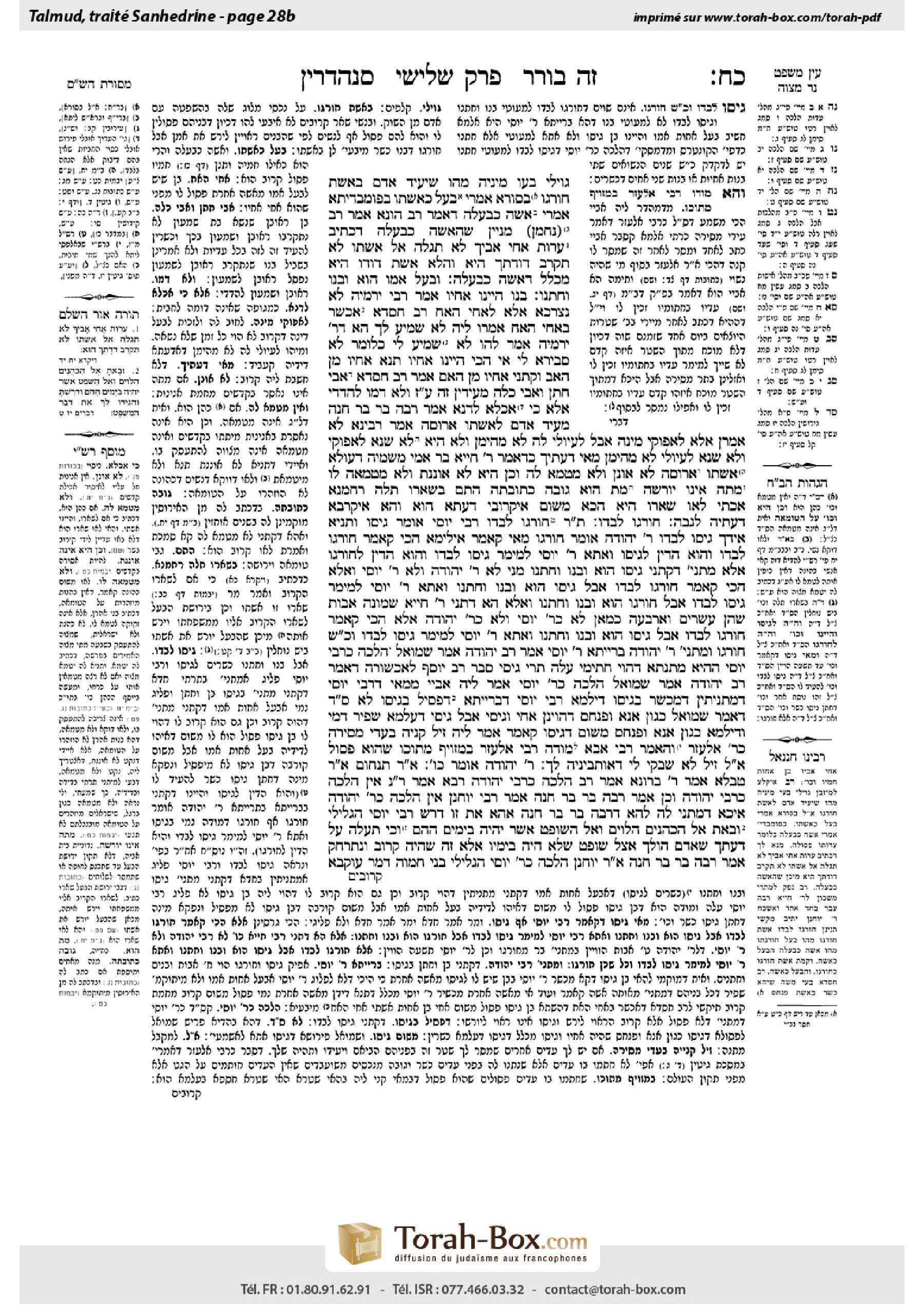
Sanhedrin 28b: Talmud study for Daf Yomi
Daf Yomi is the daily study of one Talmud folio. Explore 37 tractates with scans, Hebrew text, Sefaria English and AI-generated French translations where annotated.
Passage selection and English or AI-generated French translation are available where the scan has annotations. Daf Study is independent of Torah-Box and Sefaria.
Browse Sanhedrin · סנהדרין · All tractatesSanhedrin 28b text and translations
This page of Sanhedrin includes the Aramaic text, an English translation and an AI-generated French translation, alongside the scan above.
סנהדרין כ״ח ב · Aramaic and Hebrew text
גְּוִילֵי. בְּעוֹ מִינֵּיהּ: מַהוּ שֶׁיָּעִיד אָדָם בְּאֵשֶׁת חוֹרְגוֹ?
בְּסוּרָא אָמְרִי: בַּעַל כְּאִשְׁתּוֹ.
בְּפוּמְבְּדִיתָא אָמְרִי: אִשָּׁה כְּבַעְלָהּ. דְּאָמַר רַב הוּנָא אָמַר רַב נַחְמָן: מִנַּיִין שֶׁהָאִשָּׁה כְּבַעְלָהּ? דִּכְתִיב: ״עֶרְוַת אֲחִי אָבִיךָ לֹא תְגַלֵּה אֶל אִשְׁתּוֹ לֹא תִקְרָב דֹּדָתְךָ הִיא״. וַהֲלֹא אֵשֶׁת דּוֹדוֹ הִיא! מִכְּלָל דְּאִשָּׁה כְּבַעְלָהּ.
וּבַעַל אִמּוֹ, הוּא וּבְנוֹ וַחֲתָנוֹ. בְּנוֹ – הַיְינוּ אָחִיו?
אָמַר רַבִּי יִרְמְיָה: לֹא נִצְרְכָה אֶלָּא לַאֲחִי הָאָח.
רַב חִסְדָּא אַכְשַׁר בַּאֲחִי הָאָח. אֲמַרוּ לֵיהּ: לָא שְׁמִיעַ לָךְ הָא דְּרַבִּי יִרְמְיָה? אֲמַר לְהוּ: לָא שְׁמִיעַ לִי, כְּלוֹמַר, לָא סְבִירָא לִי.
אִי הָכִי, הַיְינוּ אָחִיו! תְּנָא אָחִיו מִן הָאָב, וְקָתָנֵי אָחִיו מִן הָאֵם.
אָמַר רַב חִסְדָּא: אֲבִי חָתָן וַאֲבִי כַּלָּה מְעִידִין זֶה עַל זֶה, וְלָא דָּמוּ לַהֲדָדֵי אֶלָּא כִּי אַכְלָא לְדַנָּא.
אָמַר רַבָּה בַּר בַּר חָנָה: מֵעִיד אָדָם לְאִשְׁתּוֹ אֲרוּסָה. אָמַר רָבִינָא: לָא אֲמַרַן אֶלָּא לְאַפּוֹקֵי מִינַּהּ, אֲבָל לְעַיּוֹלֵי לַהּ – לָא מְהֵימַן.
וְלָא הִיא, לָא שְׁנָא לְאַפּוֹקֵי וְלָא שְׁנָא לְעַיּוֹלֵי – לָא מְהֵימַן.
מַאי דַּעְתָּיךְ? כִּדְאָמַר רַבִּי חִיָּיא בַּר אַמֵּי מִשְּׁמֵיהּ דְּעוּלָּא: אִשְׁתּוֹ אֲרוּסָה לֹא אוֹנֵן וְלֹא מִטַּמֵּא לַהּ, וְכֵן הִיא לֹא אוֹנֶנֶת וְלֹא מִטַּמְּאָה לוֹ. מֵתָה – אֵינוֹ יוֹרְשָׁהּ, מֵת הוּא – גּוֹבָה כְּתוּבָּתָהּ.
הָתָם, בִּשְׁאֵרוֹ תְּלָה רַחֲמָנָא, אַכַּתִּי לָאו שְׁאֵרוֹ הִיא. הָכָא, מִשּׁוּם אִיקָּרוֹבֵי דַּעְתָּא הוּא, וְהָא אִיקָּרַבָא דַּעְתֵּיהּ לְגַבַּהּ.
חוֹרְגוֹ לְבַדּוֹ. תָּנוּ רַבָּנַן: חוֹרְגוֹ לְבַדּוֹ. רַבִּי יוֹסֵי אוֹמֵר: גִּיסוֹ. וְתַנְיָא אִידַּךְ: גִּיסוֹ לְבַדּוֹ. רַבִּי יְהוּדָה אוֹמֵר: חוֹרְגוֹ.
מַאי קָאָמַר? אִילֵּימָא הָכִי קָאָמַר: חוֹרְגוֹ לְבַדּוֹ, וְהוּא הַדִּין לְגִיסוֹ. וַאֲתָא רַבִּי יוֹסֵי לְמֵימַר: גִּיסוֹ לְבַדּוֹ, וְהוּא הַדִּין לְחוֹרְגוֹ. אֶלָּא מַתְנִיתִין דְּקָתָנֵי: גִּיסוֹ הוּא וּבְנוֹ וַחֲתָנוֹ, מַנִּי? לָא רַבִּי יְהוּדָה וְלָא רַבִּי יוֹסֵי.
וְאֶלָּא הָכִי קָאָמַר: חוֹרְגוֹ לְבַדּוֹ, אֲבָל גִּיסוֹ – הוּא וּבְנוֹ וַחֲתָנוֹ. וַאֲתָא רַבִּי יוֹסֵי לְמֵימַר: גִּיסוֹ לְבַדּוֹ, אֲבָל חוֹרְגוֹ – הוּא וּבְנוֹ וַחֲתָנוֹ.
וְאֶלָּא, הָא דְתָנֵי רַבִּי חִיָּיא: שְׁמוֹנָה אָבוֹת, שֶׁהֵן עֶשְׂרִים וְאַרְבָּעָה, כְּמַאן? לָא כְּרַבִּי יוֹסֵי וְלָא כְּרַבִּי יְהוּדָה!
אֶלָּא הָכִי קָאָמַר: חוֹרְגוֹ לְבַדּוֹ, אֲבָל גִּיסוֹ – הוּא וּבְנוֹ וַחֲתָנוֹ. וַאֲתָא רַבִּי יוֹסֵי לְמֵימַר: גִּיסוֹ לְבַדּוֹ, וְכׇל שֶׁכֵּן חוֹרְגוֹ. וּמַתְנִיתִין – רַבִּי יְהוּדָה, בָּרַיְיתָא – רַבִּי יוֹסֵי.
אָמַר רַב יְהוּדָה אָמַר שְׁמוּאֵל: הֲלָכָה כְּרַבִּי יוֹסֵי.
הָהִיא מַתַּנְתָּא דַּהֲווֹ חֲתִימִי עֲלַהּ תְּרֵי גִּיסֵי, סְבַר רַב יוֹסֵף לְאַכְשׁוֹרַהּ, דְּאָמַר רַב יְהוּדָה אָמַר שְׁמוּאֵל: הֲלָכָה כְּרַבִּי יוֹסֵי.
אֲמַר לֵיהּ אַבָּיֵי: מִמַּאי דְּרַבִּי יוֹסֵי דְּמַתְנִיתִין, דְּמַכְשַׁר בְּגִיסוֹ? דִּילְמָא רַבִּי יוֹסֵי דְּבָרַיְיתָא, דְּפָסֵיל בְּגִיסוֹ?
לָא סָלְקָא דַּעְתָּךְ, דְּאָמַר שְׁמוּאֵל: כְּגוֹן אֲנָא וּפִנְחָס דְּהָוֵינַן אֲחֵי וְגִיסֵי, אֲבָל גִּיסֵי דְּעָלְמָא שַׁפִּיר דָּמֵי.
וְדִילְמָא, כְּגוֹן אֲנָא וּפִנְחָס, מִשּׁוּם גִיסוֹ קָאָמַר?!
אֲמַר לֵיהּ: זִיל, קַנְיַהּ בְּעֵדֵי מְסִירָה, כְּרַבִּי אֶלְעָזָר.
וְהָאָמַר רַבִּי אַבָּא: מוֹדֶה רַבִּי אֶלְעָזָר בִּמְזוּיָּף מִתּוֹכוֹ שֶׁהוּא פָּסוּל? אֲמַר לֵיהּ: זִיל, לָא שָׁבְקִי לִי דְּאוֹתְבִינֵּיהּ לָךְ.
רַבִּי יְהוּדָה אוֹמֵר כּוּ׳. אָמַר רַבִּי תַּנְחוּם אָמַר רַבִּי טַבְלָא אָמַר רַבִּי בְּרוֹנָא אָמַר רַב: הֲלָכָה כְּרַבִּי יְהוּדָה. רָבָא אָמַר רַב נַחְמָן: אֵין הֲלָכָה כְּרַבִּי יְהוּדָה. וְכֵן אָמַר רַבָּה בַּר בַּר חָנָה אָמַר רַבִּי יוֹחָנָן: אֵין הֲלָכָה כְּרַבִּי יְהוּדָה.
אִיכָּא דְּמַתְנֵי לַהּ לְהָא דְּרַבָּה בַּר בַּר חָנָה אַהָא: אֶת זוֹ דָּרַשׁ רַבִּי יוֹסֵי הַגְּלִילִי, ״וּבָאתָ אֶל הַכֹּהֲנִים הַלְוִיִּם וְאֶל הַשֹּׁפֵט אֲשֶׁר יִהְיֶה בַּיָּמִים הָהֵם״. וְכִי תַּעֲלֶה עַל דַּעְתְּךָ שֶׁאָדָם הוֹלֵךְ אֵצֶל שׁוֹפֵט שֶׁלֹּא הָיָה בְּיָמָיו? אֶלָּא זֶה שֶׁהָיָה קָרוֹב וְנִתְרַחֵק.
אָמַר רַבָּה בַּר בַּר חָנָה אָמַר רַבִּי יוֹחָנָן: הֲלָכָה כְּרַבִּי יוֹסֵי הַגְּלִילִי.
בְּנֵי חֲמוּהּ דְּמָר עוּקְבָא
Sanhedrin 28b · English translation
scrolls of parchment. They asked of him there: What is the halakha as to whether a man can testify with regard to the wife of his stepson?
In Sura they say that Rav gave the following answer: A husband is considered like his wife. Since he is married to the son’s mother, the son’s wife is considered like his daughter-in-law.
In Pumbedita they say a different version of Rav’s answer: A wife is considered like her husband. Therefore, the wife of his stepson is considered like his stepson, and he cannot testify about her. As Rav Huna says that Rav Naḥman says: From where is it derived that a wife is considered like her husband? As it is written: “You shall not uncover the nakedness of your father’s brother; you shall not approach his wife: She is your aunt” (Leviticus 18:14). Isn’t she the wife of his uncle, and not his aunt, i.e., his father’s sister? It can therefore be concluded, by inference, that a wife is considered like her husband.
§ The mishna teaches that among the relatives disqualified from testifying are his mother’s husband, he, i.e., the mother’s husband himself, and his son, and his son-in-law. The Gemara challenges: The son of his mother’s husband is the same as his brother, i.e., his half brother, and the mishna already stated that his brother is disqualified.
Rabbi Yirmeya said: Mentioning this case is necessary only for the half brother of the half brother, i.e., the son of his stepfather from another woman. Although they are not biologically related, they are considered relatives.
Rav Ḥisda deemed the testimony of the half brother of the half brother fit. The other Sages said to him: Did you not hear this statement of Rabbi Yirmeya, that the half brother of the half brother is disqualified? Rav Ḥisda said to them: I did not hear this, as if to say: I do not hold in accordance with this opinion.
The Gemara asks: If so, the question asked above recurs: The son of his mother’s husband is the same as his brother. The Gemara answers: The mishna taught the case of a paternal half brother, and it also teaches the case of a maternal half brother.
§ Rav Ḥisda says: The father of the groom and the father of the bride can testify about each other, and this is because they are considered to each other only like a lid on a barrel, which is not part of the barrel, but merely rests on top of it.
Rabba bar bar Ḥana says: A man can testify about his betrothed wife; they are considered related only after marriage. Ravina says: We said this halakha only for testimony that removes money from her possession; but for testimony that awards her money, his testimony is not deemed credible, as he will ultimately marry her and benefit from the money.
The Gemara rejects this opinion: But that is not so. There is no difference whether the testimony removes money from her possession, and there is no difference whether it awards her money. In both cases, his testimony is not deemed credible.
The Gemara explains: What is your thinking that you deem a man fit to bear witness concerning his betrothed wife? It is as Rabbi Ḥiyya bar Ami said in the name of Ulla: One does not enter acute mourning on the day of the death of his betrothed wife, nor may he become ritually impure to bury her if he is a priest. Similarly, she does not enter acute mourning for him and is not obligated to become ritually impure to bury him. If she dies, he does not inherit her property. If he dies, she collects payment of her marriage contract if he wrote it at the time of the betrothal, as it is treated like any other monetary document. Evidently, a betrothed woman is not considered related to her husband.
The Gemara comments: That halakha does not serve as a proof for the halakha of testimony, as there, with regard to ritual impurity and the like, the Merciful One renders it dependent on the question of whether the woman is “his kin” (Leviticus 21:2), and a betrothed woman is not yet his kin, as they are not yet married. But here, with regard to testimony, it is due to a sense of affinity that he is disqualified, and one feels a sense of affinity toward his betrothed.
§ The mishna teaches that his stepson alone is disqualified from bearing witness about him, but not his stepson’s sons or sons-in-law. The Sages taught in a baraita: His stepson alone is disqualified. Rabbi Yosei says: His brother-in-law. And it is taught in another baraita: His brother-in-law alone is disqualified. Rabbi Yehuda says: His stepson.
The Gemara asks: What is the baraita saying? If we say that this is what it is saying: His stepson alone is disqualified, and the same is true with regard to his brother-in-law, i.e., a brother-in-law alone is disqualified but not a brother-in-law’s son or son-in-law; and Rabbi Yosei comes to say that his brother-in-law alone is disqualified, and the same is true with regard to his stepson; that interpretation is difficult. If so, whose opinion is expressed in the mishna, which teaches that his brother-in-law is disqualified, and this disqualification applies to he himself, and his son, and his son-in-law? It is neither the opinion of Rabbi Yehuda nor the opinion of Rabbi Yosei, as they both agree that the son and son-in-law of one’s brother-in-law are not disqualified.
Rather, this is what the baraita is saying: His stepson alone is disqualified, but as for his brother-in-law, he himself, and his son, and his son-in-law are disqualified. And Rabbi Yosei comes to disagree and say that his brother-in-law alone is disqualified, but as for his stepson, he himself, and his son, and his son-in-law are disqualified. Accordingly, the mishna is in accordance with the opinion of Rabbi Yehuda.
The Gemara asks: But then, in accordance with whose opinion is the baraita that Rabbi Ḥiyya teaches, that eight fathers, which are the eight principal relatives mentioned in the mishna, are disqualified, which are twenty-four including the son and son-in-law of each? It is neither in accordance with the opinion of Rabbi Yosei nor in accordance with the opinion of Rabbi Yehuda.
Rather, the above interpretation should be rejected, and this is what the baraita is saying: His stepson alone is disqualified, but as for his brother-in-law, he himself, and his son, and his son-in-law are disqualified. And Rabbi Yosei comes to say that his brother-in-law alone is disqualified, excluding his son and son-in-law, and all the more so his stepson. And accordingly, the mishna is in accordance with the opinion of Rabbi Yehuda, and the baraita that Rabbi Ḥiyya taught is in accordance with the opinion of Rabbi Yosei.
Rav Yehuda says that Shmuel says: The halakha is in accordance with the opinion of Rabbi Yosei.
The Gemara relates: There was a certain deed of gift on which two brothers-in-law were signed. Rav Yosef thought to deem it valid, as Rav Yehuda says that Shmuel says: The halakha is in accordance with the opinion of Rabbi Yosei. Rav Yosef assumed that Shmuel was referring to Rabbi Yosei’s opinion as cited in the mishna, that only relatives who are fit to inherit are disqualified, and one does not inherit from his brother-in-law.
Abaye said to him: From where do you conclude that Shmuel was referring to Rabbi Yosei as cited in the mishna, who deems one’s brother-in-law fit to bear witness with or about him? Perhaps he was referring to Rabbi Yosei as cited in the baraita, who deems one’s brother-in-law, though not the latter’s son and son-in-law, disqualified?
Rav Yosef answered: Do not let it enter your mind that Shmuel was referring to the opinion of Rabbi Yosei as cited in the baraita; as Shmuel said: For example, my brother Pineḥas and I are disqualified from bearing witness about one another. Apparently, he meant to say: We are disqualified because we are both brothers and brothers-in-law, as we married two sisters. But by inference, other brothers-in-law may well testify about each other.
Abaye raised an objection: But perhaps Shmuel said: For example, Pineḥas and I are disqualified, only because Pineḥas was his brother-in-law; he did not mean to say that they were disqualified only because they were brothers.
Due to Abaye’s objection, Rav Yosef said to the one holding the deed of gift: Since the witnesses signed on the document are disqualified from bearing witness together, go and acquire the gift by means of the witnesses who observed the transmission of the deed to you, in accordance with the opinion of Rabbi Elazar, who maintains that the witnesses who effect the transaction are not those who signed the deed but rather those who observed its transmission. A legal document is signed by witnesses merely to enhance its authority, not to effect the transaction.
Abaye raised an objection: But doesn’t Rabbi Abba say that Rabbi Elazar concedes with regard to a document whose falsification is inherent in it, that the deed is not valid despite the fact that it was properly transferred? In other words, although the signatures on a legal document are unnecessary insofar as effecting the transaction is concerned, a document that includes invalid signatures is not valid, and this is in order to prevent others from relying upon these witnesses. Rav Yosef said to the one holding the deed of gift: Go away; the rabbis do not let me give you the gift.
§ The mishna teaches that Rabbi Yehuda says that if the witness married the daughter of one of the litigants he is disqualified even if the daughter died, provided that he has children from her. Rabbi Tanḥum says that Rabbi Tavla says that Rabbi Beruna says that Rav says: The halakha is in accordance with the opinion of Rabbi Yehuda. Rava says that Rav Naḥman says: The halakha is not in accordance with the opinion of Rabbi Yehuda. And likewise Rabba bar bar Ḥana says that Rabbi Yoḥanan says: The halakha is not in accordance with the opinion of Rabbi Yehuda.
There are those who teach this ruling of Rabba bar bar Ḥana with regard to this baraita: Rabbi Yosei HaGelili interpreted this verse: “And you shall come to the priests the Levites, and to the judge who will be in those days” (Deuteronomy 17:9). Rabbi Yosei HaGelili asks: What is the meaning of the phrase “who will be in those days”? But will it enter your mind that a person would go to a judge that was not in his days? Rather, this is referring to one who was a relative of one of the litigants due to marriage, and then became not related. The litigant can therefore come before him only in those days that they are not related, and not while they are still related.
It is with regard to this baraita that Rabba bar bar Ḥana says that Rabbi Yoḥanan says: The halakha is in accordance with the opinion of Rabbi Yosei HaGelili. The ruling is the same as in Rabbi Yoḥanan’s aforementioned statement, i.e., a relative who became unrelated is fit to bear witness or serve as a judge, but it was stated in a different context.
The Gemara relates: The sons of the father-in-law of Mar Ukva
Sanhedrin 28b · Traduction française (IA)
des rouleaux de parchemin. On lui demanda là-bas : Quelle est la halakha concernant la possibilité pour un homme de témoigner au sujet de la femme de son beau-fils ?
À Soura, on rapporte que Rav donna la réponse suivante : un mari est considéré comme sa femme. Puisqu’il est marié à la mère du fils, la femme de celui-ci est considérée comme sa bru.
À Poumbedita, on rapporte une autre version de la réponse de Rav : une femme est considérée comme son mari. Par conséquent, la femme de son beau-fils est considérée comme son beau-fils, et il ne peut pas témoigner à son sujet. Rav Houna dit en effet au nom de Rav Naḥman : D’où déduit-on qu’une femme est considérée comme son mari ? Comme il est écrit : « Tu ne découvriras pas la nudité du frère de ton père ; tu ne t’approcheras pas de sa femme : elle est ta tante » (Lévitique 18,14). N’est-elle pas la femme de son oncle, et non sa tante, c’est-à-dire la sœur de son père ? On peut donc déduire de là qu’une femme est considérée comme son mari.
§ La Michna enseigne que parmi les proches inaptes à témoigner figurent le mari de sa mère, lui-même, c’est-à-dire le mari de sa mère, son fils et son gendre. La Guemara objecte : le fils du mari de sa mère, c’est son frère, c’est-à-dire son demi-frère, et la Michna a déjà indiqué que son frère est inapte.
Rabbi Yirmeya dit : ce cas n’est mentionné que pour le demi-frère de son demi-frère, c’est-à-dire le fils de son beau-père issu d’une autre femme. Bien qu’ils ne soient pas liés par le sang, ils sont considérés comme des proches.
Rav Ḥisda jugea recevable le témoignage du demi-frère de son demi-frère. Les autres Sages lui dirent : N’as-tu pas entendu cette déclaration de Rabbi Yirmeya, selon laquelle le demi-frère de son demi-frère est inapte ? Rav Ḥisda leur dit : Je ne l’ai pas entendue, autrement dit, je ne suis pas cet avis.
La Guemara demande : Dans ce cas, la question posée plus haut se pose de nouveau : le fils du mari de sa mère, c’est son frère. La Guemara répond : la Michna a enseigné le cas d’un demi-frère paternel, et elle enseigne aussi celui d’un demi-frère maternel.
§ Rav Ḥisda dit : le père du marié et le père de la mariée peuvent témoigner l’un au sujet de l’autre, car ils ne sont considérés l’un pour l’autre que comme le couvercle d’un tonneau, qui ne fait pas partie du tonneau, mais repose simplement dessus.
Rabba bar bar Ḥana dit : un homme peut témoigner au sujet de sa fiancée ; ils ne sont considérés comme parents qu’après le mariage. Ravina dit : Nous n’avons énoncé cette halakha que pour un témoignage qui lui retire de l’argent ; mais si le témoignage lui attribue de l’argent, son témoignage n’est pas jugé digne de foi, car il finira par l’épouser et bénéficiera de cet argent.
La Guemara rejette cet avis : Mais il n’en est pas ainsi. Il n’y a pas de différence entre un témoignage qui lui retire de l’argent et un témoignage qui lui en attribue : dans les deux cas, son témoignage n’est pas jugé digne de foi.
La Guemara explique : Sur quoi vous fondez-vous pour juger un homme apte à témoigner au sujet de sa fiancée ? Sur ce que Rabbi Ḥiyya bar Ami a dit au nom d’Oulla : On n’observe pas le deuil immédiat le jour du décès de sa fiancée, et un prêtre n’a pas le droit de se rendre rituellement impur pour l’enterrer. De même, elle n’observe pas le deuil immédiat pour lui et n’est pas tenue de se rendre rituellement impure pour l’enterrer. Si elle meurt, il n’hérite pas de ses biens. S’il meurt, elle perçoit le paiement de son contrat de mariage s’il l’a établi au moment des fiançailles, car il est traité comme tout autre acte pécuniaire. Il ressort manifestement de là qu’une femme fiancée n’est pas considérée comme apparentée à son mari.
La Guemara fait remarquer : cette halakha ne prouve rien quant à la halakha du témoignage. En effet, en ce qui concerne l’impureté rituelle et les règles analogues, le Miséricordieux subordonne la règle à la question de savoir si la femme est « sa proche parente » (Lévitique 21,2), et une fiancée n’est pas encore sa proche parente, puisqu’ils ne sont pas encore mariés. Mais ici, en matière de témoignage, c’est un sentiment d’affinité qui le rend inapte, et l’on éprouve un sentiment d’affinité envers sa fiancée.
§ La Michna enseigne que seul son beau-fils est inapte à témoigner à son sujet, mais pas les fils ni les gendres de son beau-fils. Les Sages ont enseigné dans une baraïta : seul son beau-fils est inapte. Rabbi Yossei dit : son beau-frère. Et une autre baraïta enseigne : seul son beau-frère est inapte. Rabbi Yehouda dit : son beau-fils.
La Guemara demande : Que dit la baraïta ? Si l’on suppose qu’elle dit ceci : seul son beau-fils est inapte, et qu’il en va de même pour son beau-frère, c’est-à-dire que seul le beau-frère est inapte, mais pas le fils ni le gendre de celui-ci ; et que Rabbi Yossei vient dire que seul son beau-frère est inapte, et qu’il en va de même pour son beau-fils, cette interprétation pose problème. Dans ce cas, à quel avis correspond la Michna, qui enseigne que son beau-frère est inapte, et que cette inaptitude s’étend à lui-même, à son fils et à son gendre ? Elle ne correspond ni à l’avis de Rabbi Yehouda ni à celui de Rabbi Yossei, car tous deux reconnaissent que le fils et le gendre de son beau-frère ne sont pas inaptes.
Mais voici ce que dit la baraïta : seul son beau-fils est inapte ; quant à son beau-frère, lui-même, son fils et son gendre sont inaptes. Rabbi Yossei vient contester cela et dire que seul son beau-frère est inapte ; quant à son beau-fils, lui-même, son fils et son gendre sont inaptes. Ainsi, la Michna suit l’avis de Rabbi Yehouda.
La Guemara demande : Mais alors, à quel avis correspond la baraïta enseignée par Rabbi Ḥiyya, selon laquelle huit pères, c’est-à-dire les huit proches principaux mentionnés dans la Michna, sont inaptes, ce qui fait vingt-quatre en comptant le fils et le gendre de chacun ? Elle ne correspond ni à l’avis de Rabbi Yossei ni à celui de Rabbi Yehouda.
Il faut donc rejeter l’interprétation précédente, et voici ce que dit la baraïta : seul son beau-fils est inapte ; quant à son beau-frère, lui-même, son fils et son gendre sont inaptes. Rabbi Yossei vient dire que seul son beau-frère est inapte, à l’exclusion de son fils et de son gendre, et à plus forte raison de son beau-fils. La Michna suit donc l’avis de Rabbi Yehouda, et la baraïta enseignée par Rabbi Ḥiyya suit l’avis de Rabbi Yossei.
Rav Yehouda dit au nom de Shmouel : la halakha suit l’avis de Rabbi Yossei.
La Guemara rapporte : un acte de donation avait été signé par deux beaux-frères. Rav Yossef envisagea de le déclarer valide, car Rav Yehouda dit au nom de Shmouel : la halakha suit l’avis de Rabbi Yossei. Rav Yossef supposait que Shmouel faisait référence à l’avis de Rabbi Yossei cité dans la Michna, selon lequel seuls les proches susceptibles d’hériter sont inaptes, et l’on n’hérite pas de son beau-frère.
Abayé lui dit : D’où conclus-tu que Shmouel faisait référence à Rabbi Yossei tel qu’il est cité dans la Michna, qui juge une personne apte à témoigner avec ou au sujet de son beau-frère ? Peut-être faisait-il référence à Rabbi Yossei tel qu’il est cité dans la baraïta, qui juge son beau-frère inapte, mais pas le fils ni le gendre de celui-ci ?
Rav Yossef répondit : Ne va pas imaginer que Shmouel faisait référence à l’avis de Rabbi Yossei cité dans la baraïta, car Shmouel a dit : Par exemple, mon frère Pineḥas et moi sommes inaptes à témoigner l’un au sujet de l’autre. Apparemment, il voulait dire : nous sommes inaptes parce que nous sommes à la fois frères et beaux-frères, ayant épousé deux sœurs. Mais on peut en déduire que d’autres beaux-frères pourraient bien témoigner l’un au sujet de l’autre.
Abayé objecta : Mais peut-être Shmouel a-t-il dit : Par exemple, Pineḥas et moi sommes inaptes uniquement parce que Pineḥas était son beau-frère ; il ne voulait pas dire qu’ils étaient inaptes uniquement parce qu’ils étaient frères.
À la suite de l’objection d’Abayé, Rav Yossef dit au détenteur de l’acte de donation : Puisque les témoins qui ont signé le document ne sont pas aptes à témoigner ensemble, va acquérir le don par l’intermédiaire des témoins qui ont assisté à la remise de l’acte, conformément à l’avis de Rabbi Elazar, qui soutient que les témoins qui réalisent la transaction ne sont pas ceux qui ont signé l’acte, mais ceux qui ont assisté à sa remise. Les témoins ne signent un acte juridique que pour en renforcer l’autorité, et non pour réaliser la transaction.
Abayé objecta : Mais Rabbi Abba ne dit-il pas que Rabbi Elazar reconnaît, au sujet d’un document dont la falsification est inhérente à son contenu, que l’acte n’est pas valide, même s’il a été remis comme il se doit ? Autrement dit, bien que les signatures figurant sur un document juridique ne soient pas nécessaires pour réaliser la transaction, un document comportant des signatures invalides n’est pas valide, afin d’éviter que d’autres ne se fient à ces témoins. Rav Yossef dit au détenteur de l’acte de donation : Va-t’en ; les rabbins ne me laissent pas te donner le don.
§ La Michna enseigne que Rabbi Yehouda dit que si le témoin a épousé la fille de l’un des plaideurs, il est inapte même si cette fille est morte, à condition qu’il ait eu des enfants d’elle. Rabbi Tanḥoum dit au nom de Rabbi Tavla, qui le dit au nom de Rabbi Berouna, qui le dit au nom de Rav : la halakha suit l’avis de Rabbi Yehouda. Rava dit au nom de Rav Naḥman : la halakha ne suit pas l’avis de Rabbi Yehouda. De même, Rabba bar bar Ḥana dit au nom de Rabbi Yoḥanan : la halakha ne suit pas l’avis de Rabbi Yehouda.
Certains transmettent cette décision de Rabba bar bar Ḥana au sujet de cette baraïta : Rabbi Yossei HaGelili a interprété ce verset : « Tu iras trouver les prêtres lévites et le juge qui sera en fonction en ces jours-là » (Deutéronome 17,9). Rabbi Yossei HaGelili demande : Que signifie l’expression « qui sera en fonction en ces jours-là » ? Peut-on imaginer qu’une personne s’adresse à un juge qui n’est pas de son époque ? Il s’agit plutôt d’un homme qui était apparenté à l’un des plaideurs par alliance, puis a cessé de l’être. Le plaideur ne peut donc se présenter devant lui que durant les jours où ils ne sont plus apparentés, et non tant qu’ils le sont encore.
C’est au sujet de cette baraïta que Rabba bar bar Ḥana dit au nom de Rabbi Yoḥanan : la halakha suit l’avis de Rabbi Yossei HaGelili. La décision est la même que dans la déclaration précédente de Rabbi Yoḥanan, à savoir qu’un proche qui a cessé de l’être est apte à témoigner ou à exercer la fonction de juge, mais elle a été formulée dans un autre contexte.
La Guemara rapporte : les fils du beau-père de Mar Oukva
Traduction française générée par IA à partir de l’édition anglaise de Sefaria. Vérifie toujours un passage avec le texte source.
Text from Sefaria: William Davidson Edition - Vocalized Aramaic (CC BY NC); William Davidson Edition - English (CC BY NC).