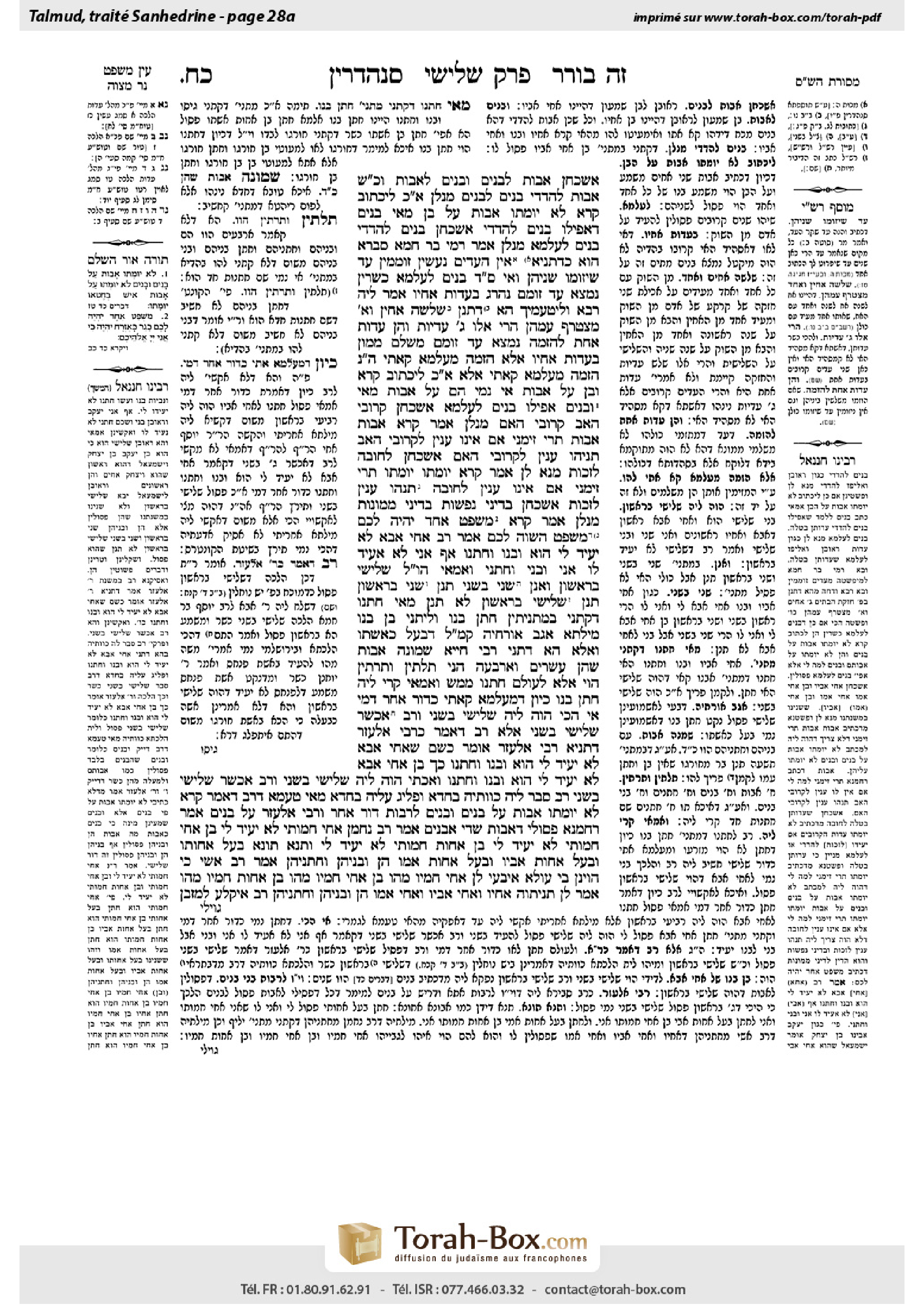
Sanhedrin 28a: Talmud study for Daf Yomi
Daf Yomi is the daily study of one Talmud folio. Explore 37 tractates with scans, Hebrew text, Sefaria English and AI-generated French translations where annotated.
Passage selection and English or AI-generated French translation are available where the scan has annotations. Daf Study is independent of Torah-Box and Sefaria.
Browse Sanhedrin · סנהדרין · All tractatesSanhedrin 28a text and translations
This page of Sanhedrin includes the Aramaic text, an English translation and an AI-generated French translation, alongside the scan above.
סנהדרין כ״ח א · Aramaic and Hebrew text
אַשְׁכְּחַן אָבוֹת לְבָנִים, וּבָנִים לְאָבוֹת.
וְכׇל שֶׁכֵּן אָבוֹת לַהֲדָדֵי.
בָּנִים לְבָנִים – מְנָלַן?
אִם כֵּן, לִיכְתּוֹב קְרָא: ״לֹא יוּמְתוּ אָבוֹת עַל בֵּן״! מַאי ״בָּנִים״? דַּאֲפִילּוּ בָּנִים לַהֲדָדֵי.
אַשְׁכְּחַן בָּנִים לַהֲדָדֵי, בָּנִים לְעָלְמָא מְנָלַן?
אָמַר רָמֵי בַּר חָמָא: סְבָרָא הוּא, כִּדְתַנְיָא: אֵין הָעֵדִים נַעֲשִׂין זוֹמְמִין עַד שֶׁיִּזּוֹמּוּ שְׁנֵיהֶן. וְאִי סָלְקָא דַעְתָּךְ בָּנִים לְעָלְמָא כְּשֵׁרִין, נִמְצָא עֵד זוֹמֵם נֶהֱרָג בְּעֵדוּת אָחִיו.
אֲמַר לֵיהּ רָבָא: וְלִיטַעְמָיךְ, הָא דִּתְנַן: שְׁלֹשָׁה אַחִין וְאֶחָד מִצְטָרֵף עִמָּהֶן – הֲרֵי אֵלּוּ שָׁלֹשׁ עֵדִיּוֹת, וְהֵן עֵדוּת אַחַת לַהֲזָמָה.
נִמְצָא עֵד זוֹמֵם מְשַׁלֵּם מָמוֹן בְּעֵדוּת אָחִיו.
אֶלָּא, הֲזָמָה מֵעָלְמָא קָאָתֵי. הָכָא נָמֵי, הֲזָמָה מֵעָלְמָא קָאָתֵי.
אֶלָּא, אִם כֵּן לִיכְתּוֹב קְרָא ״וּבֵן עַל אָבוֹת״, אִי נָמֵי ״הֵם עַל אָבוֹת״. מַאי ״וּבָנִים״? אֲפִילּוּ בָּנִים לְעָלְמָא.
אַשְׁכְּחַן קְרוֹבֵי הָאָב, קְרוֹבֵי הָאֵם מְנָלַן? אָמַר קְרָא: ״אָבוֹת״ ״אָבוֹת״ תְּרֵי זִימְנֵי. אִם אֵינוֹ עִנְיָן לִקְרוֹבֵי הָאָב, תְּנֵיהוּ עִנְיָן לִקְרוֹבֵי הָאֵם.
אַשְׁכְּחַן לְחוֹבָה, לִזְכוּת מְנָא לַן?
אָמַר קְרָא: ״יוּמְתוּ״, ״יוּמְתוּ״ – תְּרֵי זִימְנֵי. אִם אֵינוֹ עִנְיָן לְחוֹבָה, תְּנֵהוּ עִנְיָן לִזְכוּת.
אַשְׁכְּחַן בְּדִינֵי נְפָשׁוֹת, בְּדִינֵי מָמוֹנוֹת מְנָלַן?
אָמַר קְרָא: ״מִשְׁפַּט אֶחָד יִהְיֶה לָכֶם״ – מִשְׁפָּט הַשָּׁוֶה לָכֶם.
אָמַר רַב: אֲחִי אַבָּא לֹא יָעִיד לִי, הוּא וּבְנוֹ וַחֲתָנוֹ. אַף אֲנִי לֹא אָעִיד לוֹ, אֲנִי וּבְנִי וַחֲתָנִי.
וְאַמַּאי? הָוֵה לֵיהּ שְׁלִישִׁי בְּרִאשׁוֹן, וַאֲנַן שֵׁנִי בְּשֵׁנִי תְּנַן, שְׁנֵי בְּרִאשׁוֹן תְּנַן, שְׁלִישִׁי בְּרִאשׁוֹן לָא תְּנַן!
מַאי ״חֲתָנוֹ״ דְּקָתָנֵי בְּמַתְנִיתִין? חֲתַן בְּנוֹ.
וְלִיתְנֵי ״בֶּן בְּנוֹ״!
מִילְּתָא אַגַּב אוֹרְחֵיהּ קָא מַשְׁמַע לַן, דְּבַעַל כְּאִשְׁתּוֹ.
וְאֶלָּא הָא דְתָנֵי רַבִּי חִיָּיא: שְׁמוֹנָה אָבוֹת, שֶׁהֵן עֶשְׂרִים וְאַרְבָּעָה – הָנֵי תְּלָתִין וְתַרְתֵּין הָוֵי!
אֶלָּא, לְעוֹלָם חֲתָנוֹ מַמָּשׁ. וְאַמַּאי קָרֵי לֵיהּ ״חֲתַן בְּנוֹ״? כֵּיוָן דְּמֵעָלְמָא קָאָתֵי, כְּדוֹר אַחֵר דָּמֵי.
אִי הָכִי, הָוֵה לֵיהּ שְׁלִישִׁי בְּשֵׁנִי, וְרַב אַכְשַׁר שְׁלִישִׁי בְּשֵׁנִי.
אֶלָּא רַב דְּאָמַר כְּרַבִּי אֶלְעָזָר. דְּתַנְיָא: רַבִּי אֶלְעָזָר אוֹמֵר, כְּשֵׁם שֶׁאֲחִי אַבָּא לֹא יָעִיד לִי – הוּא וּבְנוֹ וַחֲתָנוֹ, כָּךְ בֶּן אֲחִי אַבָּא לֹא יָעִיד לִי – הוּא וּבְנוֹ וַחֲתָנוֹ.
וְאַכַּתִּי הָוֵה לֵיהּ שְׁלִישִׁי בְּשֵׁנִי, וְרַב אַכְשַׁר שְׁלִישִׁי בְּשֵׁנִי.
רַב סָבַר לֵיהּ כְּוָותֵיהּ בַּחֲדָא, וּפְלִיג עֲלֵיהּ בַּחֲדָא.
מַאי טַעְמָא דְּרַב? דְּאָמַר קְרָא: ״לֹא יוּמְתוּ אָבוֹת עַל בָּנִים וּבָנִים״, לְרַבּוֹת דּוֹר אַחֵר.
וְרַבִּי אֶלְעָזָר, ״עַל בָּנִים״ אָמַר רַחֲמָנָא: פְּסוּלֵי דְאָבוֹת שְׁדִי אַבָּנִים.
אָמַר רַב נַחְמָן: אֲחִי חֲמוֹתִי לֹא יָעִיד לִי, בֶּן אֲחִי חֲמוֹתִי לֹא יָעִיד לִי, בֶּן אֲחוֹת חֲמוֹתִי לֹא יָעִיד לִי. וּתְנָא תּוּנָא: בַּעַל אֲחוֹתוֹ, וּבַעַל אֲחוֹת אָבִיו, וּבַעַל אֲחוֹת אִמּוֹ, הֵן וּבְנֵיהֶן וְחַתְנֵיהֶן.
אָמַר רַב אָשֵׁי: כִּי הֲוֵינַן בֵּי עוּלָּא, אִיבְּעִי לַן: אֲחִי חָמִיו מַהוּ? בֶּן אֲחִי חָמִיו מַהוּ? בֶּן אֲחוֹת חָמִיו מַהוּ?
אֲמַר לַן: תְּנֵיתוּהָ, אָחִיו וַאֲחִי אָבִיו וַאֲחִי אִמּוֹ – הֵן וּבְנֵיהֶן וְחַתְנֵיהֶן.
רַב אִיקְּלַע לְמִזְבַּן
Sanhedrin 28a · English translation
§ The Gemara resumes its discussion of the source for the disqualification of relatives from bearing witness. From the fact that the verse: “The fathers shall not be put to death for the children” (Deuteronomy 24:16), is not phrased in the singular, i.e., A father shall not be put to death for his child, it is derived that not only are a father and child disqualified from bearing witness about one another, but closely related relatives, i.e., brothers, are also disqualified from bearing witness about each other’s children. Consequently, we found a source for the disqualification of fathers from bearing witness about their children or the children of their brothers, and for the disqualification of children from bearing witness about their fathers or their fathers’ brothers.
And all the more so, the related fathers, e.g., brothers, are disqualified from bearing witness about each other, as they are certainly more closely related to each other than are a nephew and an uncle.
But from where do we derive that one brother’s children cannot bear witness about the children of the other brother?
The Gemara answers: If so, if the children of one brother can bear witness about the children of the other brother, let the verse write: The fathers shall not be put to death for the child. For what reason is “children” written, in the plural? It is derived from here that even children of brothers are disqualified from bearing witness about each other.
We found a source for the halakha that the children of brothers cannot bear witness about each other. From where do we derive that the children of brothers cannot bear witness together about others?
Rami bar Ḥama says: This halakha is based on logical reasoning, and is not derived from a verse. This is as it is taught in a baraita: The witnesses are not rendered conspiring witnesses unless they are both rendered conspiring witnesses. And therefore, if it enters your mind that related children are fit to bear witness together about others, a conspiring witness can be found to be executed based on the testimony of his brother, i.e., his relative. Since a conspiring witness is executed for his testimony only if his co-witness is also rendered a conspiring witness, the testimony of his co-witness, who is a relative, is what causes him to be executed. This is tantamount to relatives bearing witness about each other. Therefore, relatives cannot serve as witnesses together.
Rava said to him: But according to your reasoning, there is a difficulty arising from that which we learned in a mishna (Bava Batra 56b): If one occupied land for three years, this serves in court as proof that he is the legal owner. If three brothers testify to his three-year possession of the land, with each one testifying separately about one year, and one unrelated individual joins with each of the brothers as the second witness, these are considered three distinct testimonies and are therefore accepted by the court. If they were to be considered one testimony it would not be accepted, as brothers may not testify together. But they are considered one testimony for the purpose of rendering them conspiring witnesses. In other words, they are punished only if all six of the witnesses are rendered conspiring witnesses, and the liability is divided among them.
Rava states his objection: If so, a conspiring witness can be found to be paying money due to the testimony of his brother, and nevertheless, the brothers’ testimony is not disqualified.
Rather, this is clearly not considered tantamount to brothers bearing witness about each other, as the rendering of one as a conspiring witness comes not from his co-witness but from others, i.e., the witnesses who testify that he had been with them. Here too, it cannot be proven logically that relatives are disqualified from bearing witness together, as the rendering of one as a conspiring witness comes from others.
Rather, the halakha that relatives are disqualified from bearing witness together is derived from a different source: If it is so that relatives can bear witness together, let the verse write: And a child shall not be put to death for the fathers, or: They shall not be put to death for the fathers. For what reason is “and the children” written in the plural? This indicates that related children are disqualified from bearing witness even about others.
The Gemara asks: We found a source for the disqualification of paternal relatives. From where do we derive the disqualification of maternal relatives? The Gemara answers: The verse states “fathers,” “fathers,” i.e., it states the word twice. This repetition is unnecessary, as the verse could have stated: And the children shall not be put to death for them. If the superfluous word “fathers” is not needed to teach the matter of paternal relatives, as this matter was already derived from the verse, apply it to the matter of maternal relatives.
The Gemara asks: We found a source for the halakha that one cannot bear witness to the detriment of his relative, as the verse states: “Shall not be put to death.” From where do we derive that one cannot testify to the benefit of his relative?
The Gemara answers: The verse states the term “shall not be put to death,” “shall not be put to death,” twice. If it is not needed to teach the matter of testimony to the detriment of one’s relative, as this halakha was already derived from the verse, apply it to the matter of testimony to the benefit of one’s relative.
The Gemara asks: We found a source for the disqualification of relatives in cases of capital law, as the verse is referring to execution. From where do we derive this halakha in cases of monetary law?
The Gemara answers that the verse states: “You shall have one manner of law” (Leviticus 24:22), which is interpreted to mean: A law that is equal for you. In other words, monetary law and capital law essentially follow the same guidelines.
§ Rav says: My paternal uncle will not testify about me, neither he, nor his son, nor his son-in-law, in accordance with the ruling of the mishna. Furthermore, I will not testify about him, neither I, nor my son, nor my son-in-law.
The Gemara asks: And why, for example, can Rav’s son not testify about the brother of his father’s father? But it is the testimony of a member of the third generation with regard to a related member of the first generation, as there is a two-generation difference between them. And we learned in the mishna that a member of the second generation cannot testify about a member of the second generation, e.g., one cannot testify about the son of his paternal uncle. We also learned that a member of the second generation cannot testify about a member of the first generation, e.g., one cannot testify about his uncle. But we did not learn that a member of the third generation cannot testify about a member of the first generation.
The Gemara answers: In the statement that is taught in the mishna: They themselves, and their sons, and their sons-in-law are considered relatives, what is the ruling of the mishna concerning his son-in-law referring to? It is referring to the son-in-law of his son. Accordingly, the mishna disqualifies the testimony of a member of the third generation about a member of the first generation.
The Gemara asks: But if so, let the mishna teach: And his son and the son of his son, instead of: His son-in-law. This would be a more straightforward manner of conveying the halakha with regard to a member of the third generation testifying about a member of the first generation.
The Gemara answers: By mentioning his son-in-law, the mishna teaches us a matter in passing: That with regard to the different levels of familial relationships, a husband is like his wife. Therefore, there is no difference between one’s son and one’s son-in-law.
The Gemara asks: But if the mishna is referring to the son-in-law of his son, a difficulty is posed by that which Rabbi Ḥiyya teaches in a baraita: Eight fathers, i.e., eight principal relatives mentioned in the mishna, are disqualified, which are twenty-four including the son and son-in-law of each. If the mishna is referring to one’s grandson these are thirty-two, as the son, the son-in-law, and the grandson of each are included.
The Gemara consequently rejects the explanation that the mishna is referring to the son-in-law of one’s son: Rather, the mishna is in fact referring to his actual son-in-law. And why does Rav refer to him as the son-in-law of his son, deriving from this case that a member of the third generation cannot testify about a member of the first generation? Since one’s son-in-law comes from outside the family he is considered a more distant relative than his son, as if he belongs to another generation.
The Gemara challenges this: If that is so, then the testimony of an individual with regard to the son-in-law of his father is equivalent to that of a member of the third generation with regard to a member of the second generation. And Rav is known to have deemed a member of the third generation fit to bear witness about a member of the second generation.
Rather, Rav stated his ruling not in accordance with the mishna, but in accordance with the opinion of Rabbi Elazar, as it is taught in a baraita that Rabbi Elazar says: Just as my paternal uncle will not testify about me, neither he, nor his son, nor his son-in-law, so too, the son of my paternal uncle will not testify about me, neither he, nor his son, nor his son-in-law. Accordingly, one cannot testify about the grandchild of his brother.
The Gemara asks: But still, according to Rabbi Elazar, the grandson of one’s uncle cannot testify about his great-great uncle, which is the testimony of a member of the third generation about a member of the second generation; and Rav deemed a member of the third generation fit to bear witness about a member of the second generation.
The Gemara answers: Rav holds in accordance with Rabbi Elazar’s opinion in one case, i.e., he disqualifies testimony of a member of the third generation with regard to a member of the first generation, and he disagrees with him in one case, i.e., he does not disqualify the testimony of a member of the third generation about a member of the second generation.
What is the reason for the opinion of Rav? It is as the verse states: “The fathers shall not be put to death for the children, and the children shall not be put to death for the fathers.” The phrase “for the children, and the children” is interpreted to include another generation, the grandchildren of one’s brother; they are also disqualified.
And Rabbi Elazar derives his opinion from the fact that the Merciful One states: “For the children,” which is interpreted to mean that the ones disqualified from bearing witness about the fathers are cast on the children as well. In other words, anyone who is disqualified from bearing witness about a father is also disqualified from bearing witness about his children.
§ Rav Naḥman says: The brother of my mother-in-law will not testify about me; the son of the brother of my mother-in-law will not testify about me; the son of the sister of my mother-in-law will not testify about me. And the tanna of the mishna also taught this halakha: His sister’s husband, and the husband of his father’s sister, and the husband of his mother’s sister, and his mother’s husband, and his father-in-law, and his brother-in-law, they themselves, and their sons, and their sons-in-law. This describes the same familial relationship from the perspective of the younger generation.
Rav Ashi said: When we were in Ulla’s study hall, we were asked: With regard to testifying about the brother of one’s father-in-law, what is the halakha? With regard to the son of the brother of one’s father-in-law, what is the halakha? With regard to the son of the sister of one’s father-in-law, what is the halakha?
And Ulla said to us: You learned the answer to this question in the mishna: His brother, and his paternal uncle, and his maternal uncle, and his mother’s husband, and his father-in-law, and his brother-in-law, they themselves, and their sons, and their sons-in-law. These relationships are the same as those you were asked about, from the perspective of the younger generation.
Rav arrived at a certain place to buy
Sanhedrin 28a · Traduction française (IA)
§ La Guemara reprend sa discussion sur la source de l’inaptitude des proches à témoigner. Du fait que le verset « Les pères ne seront pas mis à mort pour les enfants » (Deutéronome 24,16) n’est pas formulé au singulier — « Un père ne sera pas mis à mort pour son enfant » —, on déduit que non seulement un père et son enfant ne peuvent pas témoigner l’un contre l’autre, mais que des proches parents, c’est-à-dire des frères, ne peuvent pas non plus témoigner au sujet des enfants l’un de l’autre. Nous avons donc trouvé une source à l’inaptitude des pères à témoigner au sujet de leurs enfants ou des enfants de leurs frères, ainsi qu’à celle des enfants à témoigner au sujet de leurs pères ou des frères de leurs pères.
À plus forte raison, des pères apparentés, par exemple des frères, ne peuvent pas témoigner l’un au sujet de l’autre, puisqu’ils sont certainement plus étroitement apparentés entre eux qu’un neveu et son oncle.
Mais d’où déduit-on que les enfants d’un frère ne peuvent pas témoigner au sujet des enfants de l’autre frère ?
La Guemara répond : Si tel était le cas, si les enfants d’un frère pouvaient témoigner au sujet des enfants de l’autre frère, que le verset dise : « Les pères ne seront pas mis à mort pour l’enfant. » Pourquoi le mot « enfants » est-il au pluriel ? On en déduit que même les enfants de frères ne peuvent pas témoigner les uns au sujet des autres.
Nous avons trouvé une source à la halakha selon laquelle les enfants de frères ne peuvent pas témoigner les uns au sujet des autres. D’où déduit-on que des enfants de frères ne peuvent pas témoigner ensemble au sujet d’autres personnes ?
Rami bar Ḥama dit : Cette halakha repose sur un raisonnement logique et ne se déduit pas d’un verset. En effet, il est enseigné dans une baraïta : Les témoins ne sont considérés comme des témoins comploteurs que si tous deux sont déclarés témoins comploteurs. Par conséquent, si l’on pensait que des enfants apparentés peuvent témoigner ensemble au sujet d’autres personnes, un témoin comploteur pourrait être exécuté sur la foi du témoignage de son frère, c’est-à-dire de son parent. En effet, un témoin comploteur n’est exécuté pour son témoignage que si son co-témoin est lui aussi déclaré témoin comploteur ; c’est donc le témoignage de son co-témoin, qui est son parent, qui entraîne son exécution. Cela équivaut à des proches qui témoigneraient les uns au sujet des autres. Par conséquent, des proches ne peuvent pas servir ensemble de témoins.
Rava lui dit : Mais selon ton raisonnement, une difficulté découle de ce que nous avons appris dans une Michna (Bava Batra 56b) : Si quelqu’un a occupé un terrain pendant trois ans, cela constitue devant le tribunal une preuve qu’il en est le propriétaire légitime. Si trois frères témoignent de sa possession du terrain pendant trois ans, chacun témoignant séparément pour une année, et qu’un individu sans lien de parenté se joint à chacun d’eux comme second témoin, ces témoignages sont considérés comme trois témoignages distincts et sont donc acceptés par le tribunal. S’ils étaient considérés comme un seul témoignage, ils ne seraient pas acceptés, car des frères ne peuvent pas témoigner ensemble. Toutefois, ils sont considérés comme un seul témoignage pour déterminer s’ils sont des témoins comploteurs. Autrement dit, ils ne sont punis que si les six témoins sont tous déclarés témoins comploteurs, et la peine est répartie entre eux.
Rava formule son objection : Dans ce cas, un témoin comploteur pourrait être condamné à payer de l’argent à la suite du témoignage de son frère, et pourtant le témoignage des frères ne serait pas invalidé.
Au contraire, cela n’équivaut manifestement pas à des frères qui témoigneraient les uns au sujet des autres, car un témoin n’est déclaré témoin comploteur non pas sur la foi de son co-témoin, mais sur celle d’autres personnes, c’est-à-dire des témoins qui attestent qu’il se trouvait avec eux. Ici aussi, on ne peut pas démontrer par un raisonnement logique que des proches ne peuvent pas témoigner ensemble, car un témoin n’est déclaré témoin comploteur que sur le témoignage d’autres personnes.
Au contraire, la halakha selon laquelle des proches ne peuvent pas témoigner ensemble se déduit d’une autre source : Si des proches pouvaient témoigner ensemble, que le verset dise : « Un enfant ne sera pas mis à mort pour les pères », ou : « Ils ne seront pas mis à mort pour les pères. » Pourquoi le mot « enfants » est-il écrit au pluriel ? Cela indique que des enfants apparentés ne peuvent pas témoigner, même au sujet d’autres personnes.
La Guemara demande : Nous avons trouvé une source à l’inaptitude des parents du côté paternel. D’où déduit-on l’inaptitude des parents du côté maternel ? La Guemara répond : Le verset dit « pères », « pères », c’est-à-dire qu’il emploie deux fois ce mot. Cette répétition est superflue, car le verset aurait pu dire : « Et les enfants ne seront pas mis à mort pour eux. » Si le mot « pères », qui est superflu, n’est pas nécessaire pour enseigner la règle concernant les parents du côté paternel, puisque celle-ci a déjà été déduite du verset, applique-le à la règle concernant les parents du côté maternel.
La Guemara demande : Nous avons trouvé une source à l’interdiction de témoigner au détriment de son parent, puisque le verset dit : « Ne sera pas mis à mort. » D’où déduit-on qu’on ne peut pas témoigner en faveur de son parent ?
La Guemara répond : Le verset emploie deux fois l’expression « ne sera pas mis à mort ». Si elle n’est pas nécessaire pour enseigner la règle du témoignage au détriment de son parent, puisque cette halakha a déjà été déduite du verset, applique-la à la règle du témoignage en faveur de son parent.
La Guemara demande : Nous avons trouvé une source à l’inaptitude des proches dans les affaires pénales, puisque le verset porte sur l’exécution. D’où déduit-on cette halakha dans les affaires pécuniaires ?
La Guemara répond que le verset dit : « Vous aurez une seule règle de droit » (Lévitique 24,22), ce qui est interprété ainsi : une loi identique pour vous. Autrement dit, le droit pécuniaire et le droit pénal suivent fondamentalement les mêmes règles.
§ Rav dit : Mon oncle paternel ne témoignera pas à mon sujet, ni lui, ni son fils, ni son gendre, conformément à la décision de la Michna. En outre, je ne témoignerai pas à son sujet, ni moi, ni mon fils, ni mon gendre.
La Guemara demande : Pourquoi, par exemple, le fils de Rav ne pourrait-il pas témoigner au sujet du frère du père de son père ? Il s’agit pourtant du témoignage d’un membre de la troisième génération au sujet d’un parent de la première génération, avec deux générations d’écart entre eux. Or, nous avons appris dans la Michna qu’un membre de la deuxième génération ne peut pas témoigner au sujet d’un membre de la deuxième génération ; par exemple, on ne peut pas témoigner au sujet du fils de son oncle paternel. Nous avons également appris qu’un membre de la deuxième génération ne peut pas témoigner au sujet d’un membre de la première génération ; par exemple, on ne peut pas témoigner au sujet de son oncle. Mais nous n’avons pas appris qu’un membre de la troisième génération ne peut pas témoigner au sujet d’un membre de la première génération.
La Guemara répond : Dans l’énoncé de la Michna — « eux-mêmes, leurs fils et leurs gendres sont considérés comme des proches » —, à qui la règle de la Michna fait-elle référence en parlant de son gendre ? Au gendre de son fils. Ainsi, la Michna invalide le témoignage d’un membre de la troisième génération au sujet d’un membre de la première génération.
La Guemara demande : Mais dans ce cas, que la Michna enseigne « son fils et le fils de son fils » au lieu de « son gendre ». Ce serait une manière plus directe d’énoncer la halakha concernant un membre de la troisième génération qui témoigne au sujet d’un membre de la première génération.
La Guemara répond : En mentionnant son gendre, la Michna nous enseigne incidemment une règle : dans les différents degrés de parenté, un mari est considéré comme sa femme. Par conséquent, il n’y a pas de différence entre son fils et son gendre.
La Guemara demande : Mais si la Michna fait référence au gendre de son fils, une difficulté se pose à partir de ce que Rabbi Ḥiyya enseigne dans une baraïta : Huit pères, c’est-à-dire huit proches principaux mentionnés dans la Michna, sont inaptes, ce qui fait vingt-quatre personnes si l’on compte aussi le fils et le gendre de chacun. Si la Michna fait référence au petit-fils, le nombre est de trente-deux, puisque le fils, le gendre et le petit-fils de chacun sont inclus.
La Guemara rejette donc l’explication selon laquelle la Michna fait référence au gendre de son fils : au contraire, la Michna fait bien référence à son propre gendre. Pourquoi Rav parle-t-il de lui comme du gendre de son fils, déduisant de ce cas qu’un membre de la troisième génération ne peut pas témoigner au sujet d’un membre de la première génération ? Puisque le gendre vient de l’extérieur de la famille, il est considéré comme un parent plus éloigné que son fils, comme s’il appartenait à une autre génération.
La Guemara conteste cela : Dans ce cas, le témoignage d’un individu au sujet du gendre de son père équivaut à celui d’un membre de la troisième génération au sujet d’un membre de la deuxième génération. Or, Rav a établi qu’un membre de la troisième génération est apte à témoigner au sujet d’un membre de la deuxième génération.
Au contraire, Rav a énoncé sa décision non conformément à la Michna, mais conformément à l’opinion de Rabbi Elazar, car il est enseigné dans une baraïta que Rabbi Elazar dit : De même que mon oncle paternel ne témoignera pas à mon sujet, ni lui, ni son fils, ni son gendre, de même le fils de mon oncle paternel ne témoignera pas à mon sujet, ni lui, ni son fils, ni son gendre. Ainsi, on ne peut pas témoigner au sujet du petit-fils de son frère.
La Guemara demande : Mais même selon Rabbi Elazar, le petit-fils de son oncle ne peut pas témoigner au sujet de son grand-oncle, ce qui correspond au témoignage d’un membre de la troisième génération au sujet d’un membre de la deuxième génération ; pourtant, Rav a établi qu’un membre de la troisième génération est apte à témoigner au sujet d’un membre de la deuxième génération.
La Guemara répond : Rav suit l’opinion de Rabbi Elazar dans un cas, c’est-à-dire qu’il invalide le témoignage d’un membre de la troisième génération au sujet d’un membre de la première génération, et il est en désaccord avec lui dans un autre cas, c’est-à-dire qu’il n’invalide pas le témoignage d’un membre de la troisième génération au sujet d’un membre de la deuxième génération.
Quelle est la raison de l’opinion de Rav ? Elle découle de ce que dit le verset : « Les pères ne seront pas mis à mort pour les enfants, et les enfants ne seront pas mis à mort pour les pères. » L’expression « pour les enfants, et les enfants » est interprétée comme incluant une génération supplémentaire, les petits-enfants de son frère ; eux aussi sont inaptes à témoigner.
Et Rabbi Elazar déduit son opinion du fait que le Miséricordieux dit : « Pour les enfants », ce qui est interprété ainsi : ceux qui sont inaptes à témoigner au sujet des pères le sont aussi au sujet des enfants. Autrement dit, quiconque est inapte à témoigner au sujet d’un père l’est également au sujet de ses enfants.
§ Rav Naḥman dit : Le frère de ma belle-mère ne témoignera pas à mon sujet ; le fils du frère de ma belle-mère ne témoignera pas à mon sujet ; le fils de la sœur de ma belle-mère ne témoignera pas à mon sujet. Et le tanna de la Michna a lui aussi enseigné cette halakha : le mari de sa sœur, le mari de la sœur de son père, le mari de la sœur de sa mère, le mari de sa mère, son beau-père et son beau-frère — eux-mêmes, leurs fils et leurs gendres. Cela décrit le même lien de parenté du point de vue de la génération plus jeune.
Rav Ashi dit : Lorsque nous étions dans la maison d’étude d’Ulla, on nous posa les questions suivantes : Quelle est la halakha concernant le témoignage au sujet du frère de son beau-père ? Quelle est la halakha concernant le fils du frère de son beau-père ? Quelle est la halakha concernant le fils de la sœur de son beau-père ?
Ulla nous dit : Vous avez appris la réponse à ces questions dans la Michna : son frère, son oncle paternel, son oncle maternel, le mari de sa mère, son beau-père et son beau-frère — eux-mêmes, leurs fils et leurs gendres. Ces liens de parenté correspondent à ceux sur lesquels vous avez été interrogés, du point de vue de la génération plus jeune.
Rav arriva dans un certain endroit pour acheter
Traduction française générée par IA à partir de l’édition anglaise de Sefaria. Vérifie toujours un passage avec le texte source.
Text from Sefaria: William Davidson Edition - Vocalized Aramaic (CC BY NC); William Davidson Edition - English (CC BY NC).