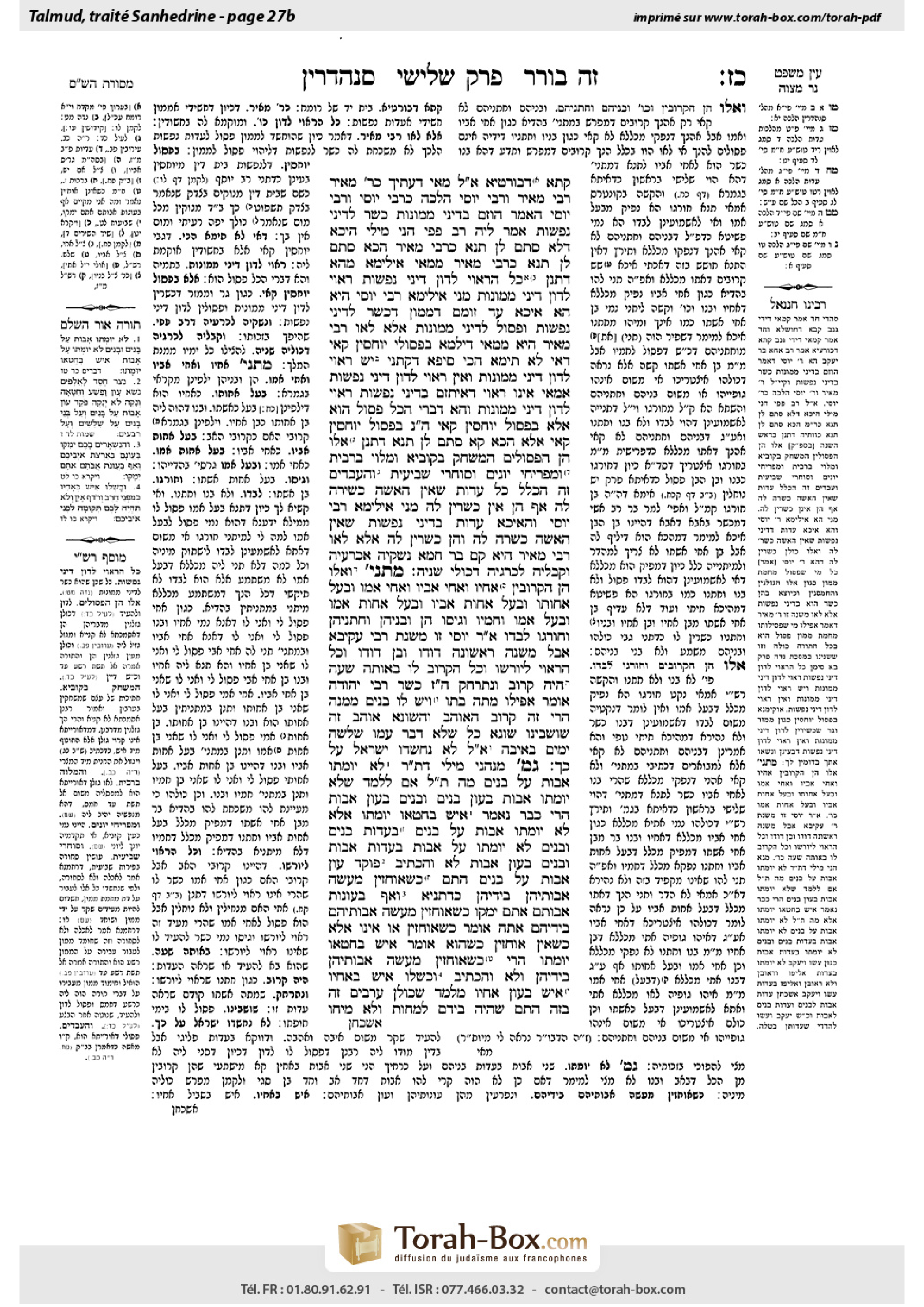
Sanhedrin 27b: Talmud study for Daf Yomi
Daf Yomi is the daily study of one Talmud folio. Explore 37 tractates with scans, Hebrew text, Sefaria English and AI-generated French translations where annotated.
Passage selection and English or AI-generated French translation are available where the scan has annotations. Daf Study is independent of Torah-Box and Sefaria.
Browse Sanhedrin · סנהדרין · All tractatesSanhedrin 27b text and translations
This page of Sanhedrin includes the Aramaic text, an English translation and an AI-generated French translation, alongside the scan above.
סנהדרין כ״ז ב · Aramaic and Hebrew text
קַתָּא דְבוּרְטְיָא.
אֲמַר לֵיהּ: מַאי דַּעְתָּיךְ? כְּרַבִּי מֵאִיר? רַבִּי מֵאִיר וְרַבִּי יוֹסֵי – הֲלָכָה כְּרַבִּי יוֹסֵי, וְרַבִּי יוֹסֵי הָאָמַר: הוּזַם בְּדִינֵי מָמוֹנוֹת – כָּשֵׁר לְדִינֵי נְפָשׁוֹת!
אֲמַר לֵיהּ רַב פַּפֵּי: הָנֵי מִילֵּי הֵיכָא דְּלָא סְתַם לַן תַּנָּא כְּרַבִּי מֵאִיר. הָכָא סְתַם לַן תַּנָּא כְּרַבִּי מֵאִיר.
מִמַּאי? אִילֵּימָא מֵהָא דִּתְנַן: כׇּל הָרָאוּי לָדוּן דִּינֵי נְפָשׁוֹת רָאוּי לָדוּן דִּינֵי מָמוֹנוֹת. מַנִּי? אִילֵּימָא רַבִּי יוֹסֵי הִיא, הָא אִיכָּא עֵד זוֹמֵם דְּמָמוֹן, דְּכָשֵׁר לְדִינֵי נְפָשׁוֹת וּפָסוּל לְדִינֵי מָמוֹנוֹת! אֶלָּא לָאו, רַבִּי מֵאִיר הִיא.
מִמַּאי? דִּילְמָא בִּפְסוּלֵי יוּחֲסִין קָאֵי!
דְּאִי לָא תֵּימָא הָכִי, סֵיפָא דְּקָתָנֵי: יֵשׁ רָאוּי לָדוּן דִּינֵי מָמוֹנוֹת וְאֵין רָאוּי לָדוּן דִּינֵי נְפָשׁוֹת, אַמַּאי אֵינוֹ רָאוּי? דְּאִיתַּזַּם בְּדִינֵי נְפָשׁוֹת רָאוּי לָדוּן דִּינֵי מָמוֹנוֹת? וְהָא דִּבְרֵי הַכֹּל פָּסוּל הוּא! אֶלָּא בִּפְסוּל יוּחֲסִין קָאֵי. הָכָא נָמֵי בִּפְסוּל יוּחֲסִין קָאֵי.
אֶלָּא, הָכָא קָא סָתַם לַן תְּנָא, דִּתְנַן: אֵלּוּ הֵן הַפְּסוּלִים – הַמְשַׂחֵק בְּקוּבְיָא, וּמַלְוֵי בְּרִבִּית, וּמַפְרִיחֵי יוֹנִים, וְסוֹחֲרֵי שְׁבִיעִית, וְהָעֲבָדִים. זֶה הַכְּלָל: כׇּל עֵדוּת שֶׁאֵין הָאִשָּׁה כְּשֵׁירָה לָהּ, אַף הֵן אֵין כְּשֵׁירִין לָהּ.
מַנִּי? אִילֵּימָא רַבִּי יוֹסֵי – וְהָאִיכָּא עֵדוּת בְּדִינֵי נְפָשׁוֹת, שֶׁאֵין הָאִשָּׁה כְּשֵׁרָה לָהּ, וְהֵן כְּשֵׁרִין לַהּ? אֶלָּא לָאו רַבִּי מֵאִיר הִיא!
קָם בַּר חָמָא, נַשְּׁקֵיהּ אַכַּרְעֵיהּ, וְקַבְּלֵיהּ לִכְרָגֵיהּ דְּכוּלֵּי שְׁנֵיהּ.
מַתְנִי׳ וְאֵלּוּ הֵן הַקְּרוֹבִין: אָחִיו, וַאֲחִי אָבִיו, וַאֲחִי אִמּוֹ, וּבַעַל אֲחוֹתוֹ, וּבַעַל אֲחוֹת אָבִיו, וּבַעַל אֲחוֹת אִמּוֹ, וּבַעַל אִמּוֹ, וְחָמִיו, וְגִיסוֹ. הֵן וּבְנֵיהֶן וְחַתְנֵיהֶן, וְחוֹרְגוֹ לְבַדּוֹ.
אָמַר רַבִּי יוֹסֵי: זוֹ מִשְׁנַת רַבִּי עֲקִיבָא, אֲבָל מִשְׁנָה רִאשׁוֹנָה – דּוֹדוֹ וּבֶן דּוֹדוֹ וְכׇל הָרָאוּי לְיוֹרְשׁוֹ, וְכׇל הַקָּרוֹב לוֹ בְּאוֹתָהּ שָׁעָה.
הָיָה קָרוֹב וְנִתְרַחֵק, הֲרֵי זֶה כָּשֵׁר. רַבִּי יְהוּדָה אוֹמֵר: אֲפִילּוּ מֵתָה בִּתּוֹ וְיֵשׁ לוֹ בָּנִים מִמֶּנָּה, הֲרֵי זֶה קָרוֹב.
הָאוֹהֵב וְהַשּׂוֹנֵא. אוֹהֵב – זֶה שׁוֹשְׁבִינוֹ. שׂוֹנֵא – כֹּל שֶׁלֹּא דִּבֵּר עִמּוֹ שְׁלֹשָׁה יָמִים בְּאֵיבָה. אָמְרוּ לוֹ: לֹא נֶחְשְׁדוּ יִשְׂרָאֵל עַל כָּךְ.
גְּמָ׳ מְנָהָנֵי מִילֵּי? דְּתָנוּ רַבָּנַן: ״לֹא יוּמְתוּ אָבוֹת עַל בָּנִים״. מָה תַּלְמוּד לוֹמַר? אִם לְלַמֵּד שֶׁלֹּא יוּמְתוּ אָבוֹת בַּעֲוֹן בָּנִים וּבָנִים בַּעֲוֹן אָבוֹת, הֲרֵי כְּבָר נֶאֱמַר: ״אִישׁ בְּחֶטְאוֹ יוּמָתוּ״.
אֶלָּא, ״לֹא יוּמְתוּ אָבוֹת עַל בָּנִים״ – בְּעֵדוּת בָּנִים, ״וּבָנִים לֹא יוּמְתוּ עַל אָבוֹת״ – בְּעֵדוּת אָבוֹת.
וּבָנִים בַּעֲוֹן אָבוֹת לָא? וְהָכְתִיב: ״פֹּקֵד עֲוֹן אָבוֹת עַל בָּנִים״!
הָתָם, כְּשֶׁאוֹחֲזִין מַעֲשֵׂה אֲבוֹתֵיהֶן בִּידֵיהֶן.
כִּדְתַנְיָא: ״וְאַף בַּעֲוֹנֹת אֲבֹתָם אִתָּם יִמָּקּוּ״ – כְּשֶׁאוֹחֲזִין מַעֲשֵׂה אֲבוֹתֵיהֶם בִּידֵיהֶם. אַתָּה אוֹמֵר כְּשֶׁאוֹחֲזִין, אוֹ אֵינוֹ אֶלָּא כְּשֶׁאֵין אוֹחֲזִין? כְּשֶׁהוּא אוֹמֵר ״אִישׁ בְּחֶטְאוֹ יוּמָתוּ״, הֲרֵי כְּשֶׁאוֹחֲזִין מַעֲשֵׂה אֲבוֹתֵיהֶן בִּידֵיהֶן.
וְלָא? וְהָכְתִיב: ״וְכָשְׁלוּ אִישׁ בְּאָחִיו״ – אִישׁ בַּעֲוֹן אָחִיו, מְלַמֵּד שֶׁכּוּלָּן עֲרֵבִים זֶה בָּזֶה.
הָתָם, שֶׁהָיָה בְּיָדָם לִמְחוֹת וְלֹא מִיחוּ.
Sanhedrin 27b · English translation
the handle of a spear [devortiya].
Rav Abba bar Ya’akov said to bar Ḥama: Why did you bring these witnesses? What do you hold? Do you hold like Rabbi Meir, that one who is guilty of a monetary transgression is disqualified from bearing witness in capital cases too? But in a dispute between Rabbi Meir and Rabbi Yosei, the halakha is in accordance with the opinion of Rabbi Yosei, and doesn’t Rabbi Yosei say that if one was rendered a conspiring witness in a case of monetary law he is fit to testify in cases of capital law?
Rav Pappi immediately said to him: This statement applies only where the tanna did not teach us an unattributed mishna in accordance with the opinion of Rabbi Meir. Here, the tanna taught us an unattributed mishna in accordance with the opinion of Rabbi Meir.
The Gemara asks: From what mishna is it seen that the tanna taught an unattributed mishna in accordance with the opinion of Rabbi Meir? If we say it is from that which we learned in a mishna (Nidda 49b): Anyone who is fit to adjudicate cases of capital law is fit to adjudicate cases of monetary law, that is inconclusive. Even though one can compare the halakhot of disqualifying judges to the halakhot of disqualifying witnesses, one cannot cite this as an example of a mishna taught in accordance with the opinion of Rabbi Meir. Whose opinion is recorded in this mishna? If we say it is the opinion of Rabbi Yosei, isn’t there the counterexample of a conspiring witness in monetary matters, who is fit to adjudicate cases of capital law but is disqualified from adjudicating cases of monetary law? Rather, is the ruling of the mishna not the opinion of Rabbi Meir?
The Gemara explains why this cannot be the source: If this is the unattributed mishna Rav Pappi was referring to, from where is it derived that it is the opinion of Rabbi Meir? Perhaps the mishna is referring to those who are disqualified from serving as judges due to their lineage, e.g., converts and mamzerim, not those who are disqualified due to sin.
As, if you do not say so, then with regard to the latter clause of that mishna, which teaches: There is one who is fit to adjudicate cases of monetary law but is unfit to adjudicate cases of capital law, to whom could this be referring? Why would one be unfit to adjudicate cases of capital law? If it is referring to one who was rendered a conspiring witness in a case of capital law, is he fit to adjudicate cases of monetary law? But doesn’t everyone agree that he is disqualified? Rather, the mishna is clearly referring to those who are disqualified from serving as judges due to their lineage. Here too, in the first clause, the mishna is referring to those who are disqualified from serving as judges due to their lineage.
Rather, the tanna taught us an unattributed mishna here, as we learned in a mishna (Rosh HaShana 22a): These people are disqualified from bearing witness, as they are considered wicked and guilty of monetary transgressions: One who plays with dice, and those who lend money with interest, and those who fly pigeons, and merchants who trade in produce of the Sabbatical Year. And Canaanite slaves are also disqualified. This is the principle: For any testimony for which a woman is not fit, these too are not fit. Although in certain cases a woman’s testimony is accepted, e.g., testimony concerning the death of someone’s husband, in most cases her testimony is not valid.
In accordance with whose opinion is this mishna? If we say it is the opinion of Rabbi Yosei, that is difficult: But isn’t there testimony in cases of capital law, for which a woman is not fit but for which those considered wicked due to having committed monetary transgressions are fit? Rather, is it not the opinion of Rabbi Meir, who maintains these people are disqualified from testifying in cases of capital law as well? Apparently, this unspecified mishna follows the opinion of Rabbi Meir. Therefore, the halakha is in accordance with his opinion.
Based on this conclusion, one of the witnesses who testified against bar Ḥama with regard to the murder was disqualified, and bar Ḥama was acquitted. Bar Ḥama then arose and kissed Rabbi Pappi on his feet and accepted upon himself to pay his tax [karga] for all of his years.
MISHNA: And these are the ones disqualified from bearing witness or from serving as judges due to their status as relatives of one of the litigants or of each other: One’s brother, and his paternal uncle, and his maternal uncle, and his sister’s husband, and the husband of his paternal aunt, and the husband of his maternal aunt, and his mother’s husband, and his father-in-law, and his brother-in-law, i.e., the husband of his wife’s sister. They themselves, all of these people, and also their sons, and their sons-in-law are considered relatives. And his stepson alone is disqualified, but not his stepson’s sons or sons-in-law.
Rabbi Yosei says: This aforementioned halakha is Rabbi Akiva’s version of the mishna. But the initial version of the mishna reads as follows: His uncle and the son of his uncle, and anyone who is fit to inherit from him. Only paternal relatives, who are fit to inherit from him, are disqualified; maternal relatives, who do not inherit from him, are not disqualified from bearing witness about him or from adjudicating his case. And the halakha disqualifying a relative from bearing witness or serving as a judge is referring to anyone who is related to him at the time of the trial.
If one was once a relative and became unrelated by the time of the trial, e.g., he married the daughter of one of the litigants, but she died or they were divorced, in this case he is fit. Rabbi Yehuda says: Even if his daughter died but her husband, the former son-in-law, has children from her, he is still considered a relative; the children cause them to remain related.
One who loves or one who hates one of the litigants is also disqualified. With regard to one who loves one of the litigants, this is referring to his groomsman. One who hates is referring to anyone who, out of enmity, did not speak with the litigant for three days. The Rabbis said to Rabbi Yehuda: The Jewish people are not suspected of bearing false witness due to love or hate.
GEMARA: From where is this matter, that relatives are disqualified from bearing witness, derived? The Gemara answers: It is as the Sages taught in a baraita: “The fathers shall not be put to death for the children, neither shall the children be put to death for the fathers; every man shall be put to death for his own sin” (Deuteronomy 24:16). Why must the verse state this first clause? If it is to teach that the fathers shall not be put to death for the sin of the children, nor shall the children be put to death for the sin of the fathers, this is unnecessary, as it is in any event stated: “Every man shall be put to death for his own sin.”
Rather, the statement “The fathers shall not be put to death for the children” should be interpreted to mean that they shall not be put to death by the testimony of the children, and the statement “Neither shall the children be put to death for the fathers” should be interpreted to mean that they shall not be put to death by the testimony of the fathers.
The Gemara asks: And are children not put to death for the sin of the fathers? But isn’t it written: “Visiting the iniquity of the fathers upon the children, and upon the children’s children, unto the third and unto the fourth generation” (Exodus 34:7)?
The Gemara answers: There, the verse is referring to a situation where the children adopt the actions of their ancestors as their own. If they do not behave like their ancestors they are not punished for their ancestors’ sins.
This is as it is taught in a baraita: The verse: “And also in the iniquities of their fathers shall they pine away with them” (Leviticus 26:39), is referring to a case where they adopt the actions of their ancestors as their own. Do you say that it is referring specifically to a case where they adopt the actions of their ancestors, or perhaps it applies even where they do not adopt their ancestors’ actions? When the verse states: “Every man shall be put to death for his own sin,” the Torah explicates that one is not put to death if he did not sin. Therefore, the verse in Leviticus is clearly referring to a case where they adopt the actions of their ancestors as their own.
The Gemara asks: And are descendants not punished for the sins of their ancestors unless they adopt their behavior? But isn’t it written: “And they shall stumble one upon another” (Leviticus 26:37)? This verse is homiletically interpreted to mean that the Jewish people shall stumble, one due to the iniquity of another, i.e., they are punished for each other’s sins, which teaches that all Jews are considered guarantors, i.e., responsible, for one another.
The Gemara answers: There, in the verse in Leviticus, the reference is to a case where others had the ability to protest the sin but they did not protest. Consequently, they are punished for not protesting, regardless of any familial relationship they may have with the sinner.
Sanhedrin 27b · Traduction française (IA)
le manche d’une lance [devortiya].
Rav Abba bar Ya’akov dit à bar Ḥama : Pourquoi as-tu fait venir ces témoins ? Quelle est ta position ? Penses-tu comme Rabbi Meïr, selon qui celui qui est coupable d’une transgression pécuniaire est également disqualifié pour témoigner dans les affaires capitales ? Pourtant, dans le différend entre Rabbi Meïr et Rabbi Yosei, la halakha suit l’avis de Rabbi Yosei. Or Rabbi Yosei ne dit-il pas que si quelqu’un a été déclaré témoin comploteur dans une affaire pécuniaire, il est apte à témoigner dans les affaires capitales ?
Rav Pappi lui dit aussitôt : Cette règle ne s’applique que lorsque le tanna ne nous a pas enseigné de Michna anonyme conformément à l’avis de Rabbi Meïr. Ici, le tanna nous a enseigné une Michna anonyme conformément à l’avis de Rabbi Meïr.
La Guemara demande : De quelle Michna voit-on que le tanna a enseigné une Michna anonyme conformément à l’avis de Rabbi Meïr ? S’il s’agit de ce que nous avons appris dans une Michna (Nidda 49b) : « Quiconque est apte à juger les affaires capitales est apte à juger les affaires pécuniaires », cela ne permet pas de conclure. Même si l’on peut comparer les règles de disqualification des juges à celles des témoins, on ne peut pas citer cette Michna comme exemple d’une Michna enseignée conformément à l’avis de Rabbi Meïr. Quel avis cette Michna rapporte-t-elle ? Si l’on dit qu’il s’agit de celui de Rabbi Yosei, il existe un contre-exemple : le témoin comploteur dans une affaire pécuniaire, qui est apte à juger les affaires capitales, mais disqualifié pour juger les affaires pécuniaires. La décision de la Michna ne correspond-elle donc pas plutôt à l’avis de Rabbi Meïr ?
La Guemara explique pourquoi cela ne peut pas être la source : si c’est cette Michna anonyme à laquelle Rav Pappi faisait référence, d’où déduit-on qu’elle suit l’avis de Rabbi Meïr ? Peut-être la Michna parle-t-elle de ceux qui sont disqualifiés pour exercer la fonction de juge en raison de leur ascendance, par exemple les convertis et les mamzérim, et non de ceux qui sont disqualifiés à cause d’une faute.
En effet, si l’on ne dit pas cela, alors, concernant la dernière partie de cette Michna, qui enseigne : « Il y en a un qui est apte à juger les affaires pécuniaires, mais inapte à juger les affaires capitales », de qui peut-il s’agir ? Pourquoi serait-il inapte à juger les affaires capitales ? S’il s’agit de quelqu’un qui a été déclaré témoin comploteur dans une affaire capitale, est-il apte à juger les affaires pécuniaires ? Tout le monde ne convient-il pas qu’il est disqualifié ? La Michna parle donc clairement de ceux qui sont disqualifiés pour exercer la fonction de juge en raison de leur ascendance. Ici aussi, dans la première partie, la Michna parle de ceux qui sont disqualifiés pour exercer la fonction de juge en raison de leur ascendance.
Il s’agit plutôt de la Michna anonyme que le tanna nous a enseignée ici, comme nous l’avons appris dans une Michna (Roch Hachana 22a) : « Voici ceux qui sont disqualifiés pour témoigner, car ils sont considérés comme méchants et coupables de transgressions pécuniaires : celui qui joue aux dés, ceux qui prêtent à intérêt, ceux qui font voler des pigeons et les marchands qui font commerce des produits de l’année sabbatique. Les esclaves cananéens sont également disqualifiés. Voici le principe : pour tout témoignage auquel une femme n’est pas apte, eux non plus ne sont pas aptes. » Bien que, dans certains cas, le témoignage d’une femme soit accepté, par exemple pour attester du décès du mari d’une femme, dans la plupart des cas son témoignage n’est pas recevable.
Selon quel avis cette Michna a-t-elle été enseignée ? Si l’on dit qu’il s’agit de l’avis de Rabbi Yosei, cela pose une difficulté : n’existe-t-il pas des témoignages dans les affaires capitales auxquels une femme n’est pas apte, mais auxquels ceux qui sont considérés comme méchants parce qu’ils ont commis des transgressions pécuniaires sont aptes ? Ne s’agit-il donc pas plutôt de l’avis de Rabbi Meïr, qui estime que ces personnes sont également disqualifiées pour témoigner dans les affaires capitales ? Il apparaît que cette Michna anonyme suit l’avis de Rabbi Meïr. Par conséquent, la halakha suit son avis.
À la suite de cette conclusion, l’un des témoins qui avaient témoigné contre bar Ḥama au sujet du meurtre fut disqualifié, et bar Ḥama fut acquitté. Bar Ḥama se leva alors, embrassa les pieds de Rabbi Pappi et s’engagea à lui verser son impôt [karga] pour toutes les années à venir.
MICHNA : Voici ceux qui sont disqualifiés pour témoigner ou exercer la fonction de juge en raison de leur parenté avec l’un des plaideurs ou entre eux : son frère, son oncle paternel, son oncle maternel, le mari de sa sœur, le mari de sa tante paternelle, le mari de sa tante maternelle, le mari de sa mère, son beau-père et son beau-frère, c’est-à-dire le mari de la sœur de sa femme. Toutes ces personnes, ainsi que leurs fils et leurs gendres, sont considérées comme des proches. Seul son beau-fils est disqualifié, mais pas les fils ni les gendres de celui-ci.
Rabbi Yosei dit : La halakha susmentionnée correspond à la version de la Michna de Rabbi Akiva. Mais la version initiale de la Michna se lit ainsi : « Son oncle et le fils de son oncle, et quiconque est apte à hériter de lui. » Seuls les parents du côté paternel, qui sont aptes à hériter de lui, sont disqualifiés ; les parents du côté maternel, qui n’héritent pas de lui, ne sont pas disqualifiés pour témoigner à son sujet ni pour juger son affaire. La règle qui disqualifie un proche pour témoigner ou exercer la fonction de juge concerne toute personne qui lui est apparentée au moment du procès.
Si quelqu’un était auparavant un proche, mais ne l’est plus au moment du procès — par exemple, s’il a épousé la fille de l’un des plaideurs, mais que celle-ci est morte ou qu’ils ont divorcé —, il est apte. Rabbi Yehouda dit : même si sa fille est morte, mais que son mari, l’ancien gendre, a eu des enfants avec elle, il est encore considéré comme un proche ; les enfants maintiennent leur lien de parenté.
Celui qui aime l’un des plaideurs ou le hait est également disqualifié. Celui qui aime l’un des plaideurs désigne son garçon d’honneur. Celui qui le hait désigne quiconque, par inimitié, n’a pas parlé au plaideur pendant trois jours. Les Sages dirent à Rabbi Yehouda : le peuple juif n’est pas soupçonné de porter un faux témoignage par amour ou par haine.
GUEMARA : D’où déduit-on que les proches sont disqualifiés pour témoigner ? La Guemara répond : comme les Sages l’ont enseigné dans une baraïta : « Les pères ne seront pas mis à mort pour les enfants, et les enfants ne seront pas mis à mort pour les pères ; chacun sera mis à mort pour sa propre faute » (Deutéronome 24:16). Pourquoi le verset doit-il énoncer cette première partie ? S’il s’agit d’enseigner que les pères ne seront pas mis à mort pour la faute de leurs enfants, ni les enfants pour celle de leurs pères, cela est superflu, puisqu’il est de toute façon dit : « Chacun sera mis à mort pour sa propre faute. »
Il faut plutôt interpréter la déclaration « Les pères ne seront pas mis à mort pour les enfants » comme signifiant qu’ils ne seront pas mis à mort sur le témoignage de leurs enfants, et la déclaration « Et les enfants ne seront pas mis à mort pour les pères » comme signifiant qu’ils ne seront pas mis à mort sur le témoignage de leurs pères.
La Guemara demande : Les enfants ne sont-ils donc pas mis à mort pour la faute de leurs pères ? N’est-il pas écrit : « Faisant retomber l’iniquité des pères sur les enfants et sur les enfants des enfants, jusqu’à la troisième et à la quatrième génération » (Exode 34:7) ?
La Guemara répond : Là, le verset parle d’une situation où les enfants adoptent comme leurs propres actions celles de leurs ancêtres. S’ils ne se conduisent pas comme leurs ancêtres, ils ne sont pas punis pour les fautes de ceux-ci.
C’est ce qui est enseigné dans une baraïta : le verset « Et ils dépériront aussi dans les iniquités de leurs pères, avec eux » (Lévitique 26:39) parle d’un cas où ils adoptent comme leurs propres actions celles de leurs ancêtres. Peut-on dire qu’il parle précisément d’un cas où ils adoptent les actions de leurs ancêtres, ou bien s’applique-t-il même lorsqu’ils ne les adoptent pas ? Lorsque le verset dit : « Chacun sera mis à mort pour sa propre faute », la Torah écrite précise qu’on n’est pas mis à mort si l’on n’a pas fauté. Par conséquent, le verset du Lévitique parle clairement d’un cas où ils adoptent comme leurs propres actions celles de leurs ancêtres.
La Guemara demande : Les descendants ne sont-ils pas punis pour les fautes de leurs ancêtres à moins qu’ils n’adoptent leur conduite ? N’est-il pas écrit : « Ils trébucheront l’un sur l’autre » (Lévitique 26:37) ? Ce verset est interprété de manière homilétique comme signifiant que les membres du peuple juif trébucheront à cause de l’iniquité d’un autre, c’est-à-dire qu’ils sont punis pour les fautes les uns des autres. Cela enseigne que tous les Juifs sont considérés comme garants, c’est-à-dire responsables, les uns des autres.
La Guemara répond : Là, dans le verset du Lévitique, il s’agit d’un cas où d’autres avaient la possibilité de protester contre la faute, mais ne l’ont pas fait. Par conséquent, ils sont punis pour ne pas avoir protesté, qu’ils aient ou non un lien de parenté avec le fautif.
Traduction française générée par IA à partir de l’édition anglaise de Sefaria. Vérifie toujours un passage avec le texte source.
Text from Sefaria: William Davidson Edition - Vocalized Aramaic (CC BY NC); William Davidson Edition - English (CC BY NC).