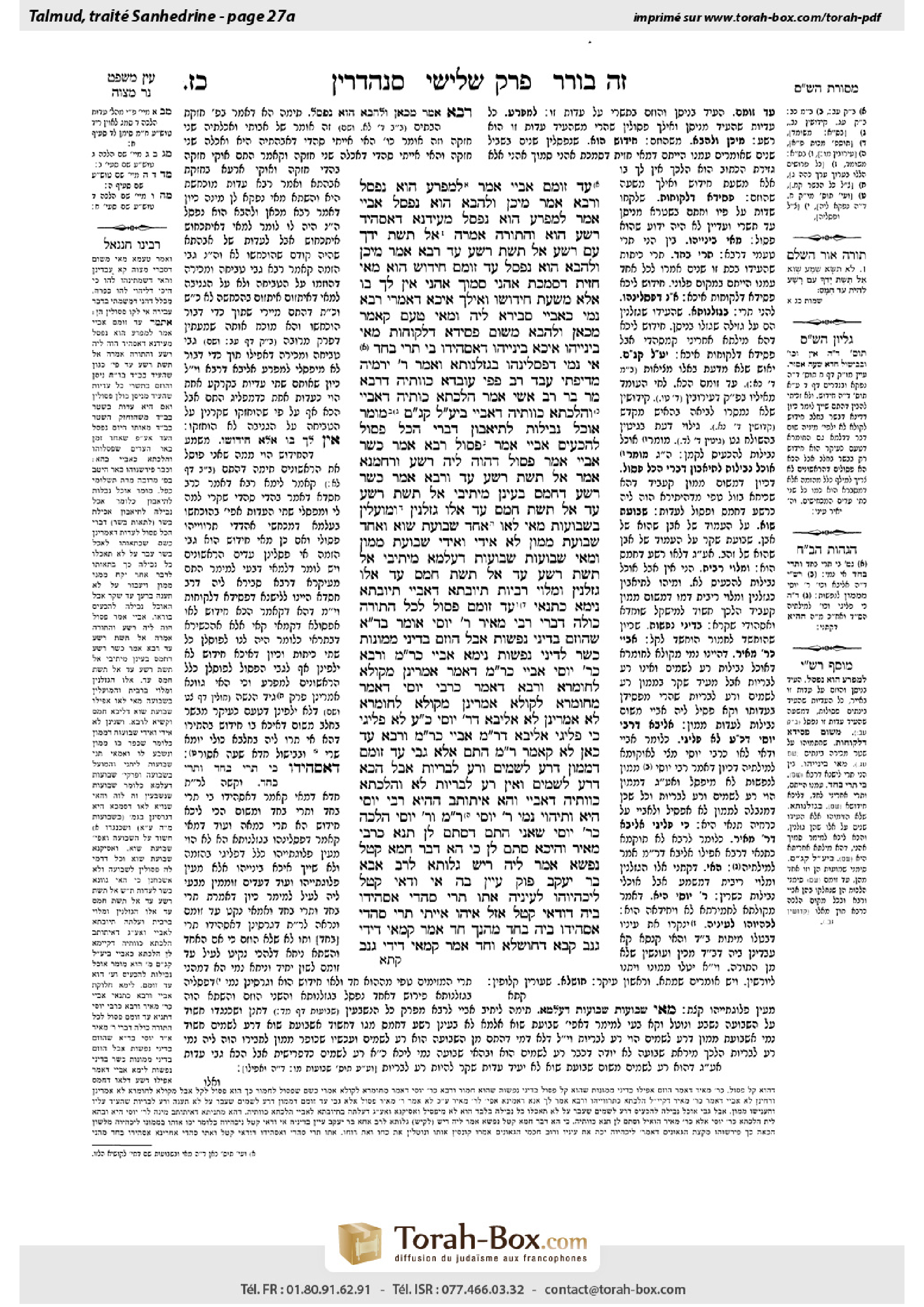
Sanhedrin 27a: Talmud study for Daf Yomi
Daf Yomi is the daily study of one Talmud folio. Explore 37 tractates with scans, Hebrew text, Sefaria English and AI-generated French translations where annotated.
Passage selection and English or AI-generated French translation are available where the scan has annotations. Daf Study is independent of Torah-Box and Sefaria.
Browse Sanhedrin · סנהדרין · All tractatesSanhedrin 27a text and translations
This page of Sanhedrin includes the Aramaic text, an English translation and an AI-generated French translation, alongside the scan above.
סנהדרין כ״ז א · Aramaic and Hebrew text
עֵד זוֹמֵם, אַבָּיֵי אָמַר: לְמַפְרֵעַ הוּא נִפְסָל; וְרָבָא אָמַר: מִיכָּן וּלְהַבָּא הוּא נִפְסָל.
אַבָּיֵי אָמַר: לְמַפְרֵעַ הוּא נִפְסָל, מֵעִידָּנָא דְּאַסְהֵיד רָשָׁע הוּא, וְהַתּוֹרָה אָמְרָה: ״אַל תָּשֶׁת יָדְךָ עִם רָשָׁע״ – אַל תָּשֶׁת רָשָׁע עֵד.
רָבָא אָמַר: מִיכָּן וּלְהַבָּא הוּא נִפְסָל. עֵד זוֹמֵם חִידּוּשׁ הוּא, מַאי חָזֵית דְּסָמְכַתְּ אַהָנֵי? סְמוֹךְ אַהָנֵי! אֵין לָךְ בּוֹ אֶלָּא מִשְּׁעַת חִידּוּשׁוֹ וְאֵילָךְ.
אִיכָּא דְאָמְרִי: רָבָא נָמֵי כְּאַבַּיֵּי סְבִירָא לֵיהּ, וּמַאי טַעַם קָאָמַר מִכָּאן וּלְהַבָּא? מִשּׁוּם פְּסֵידָא דְלָקוֹחוֹת.
מַאי בֵּינַיְיהוּ? אִיכָּא בֵּינַיְיהוּ דְּאַסְהִידוּ בֵּי תְרֵי בְּחַד. אִי נָמֵי, דְּפַסְלִינְהוּ בְּגַזְלָנוּתָא.
וְאָמַר רַבִּי יִרְמְיָה מִדִּיפְתִּי: עֲבַד רַב פַּפִּי עוֹבָדָא כְּוָותֵיהּ דְּרָבָא. מָר בַּר רַב אָשֵׁי אָמַר: הִלְכְתָא כְּוָותֵיהּ דְּאַבָּיֵי.
וְהִלְכְתָא כְּוָותֵיהּ דְּאַבָּיֵי בְּ״יַעַ״ל קַגַ״ם״.
מוּמָר אוֹכֵל נְבֵילוֹת לְתֵיאָבוֹן – דִּבְרֵי הַכֹּל פָּסוּל.
לְהַכְעִיס – אַבָּיֵי אָמַר: פָּסוּל, רָבָא אָמַר: כָּשֵׁר.
אַבָּיֵי אָמַר: פָּסוּל, דְּהָוֵה לֵיהּ רָשָׁע, וְרַחֲמָנָא אָמַר ״אַל תָּשֶׁת רָשָׁע עֵד״. וְרָבָא אָמַר: כָּשֵׁר, רָשָׁע דְּחָמָס בָּעֵינַן.
מֵיתִיבִי: ״אַל תָּשֶׁת רָשָׁע עֵד״, ״אַל תָּשֶׁת חָמָס עֵד״ – אֵלּוּ גַּזְלָנִין וּמוֹעֲלִין בִּשְׁבוּעוֹת. מַאי לָאו, אֶחָד שְׁבוּעַת שָׁוְא וְאֶחָד שְׁבוּעַת מָמוֹן?
לָא, אִידִי וְאִידִי שְׁבוּעַת מָמוֹן. וּמַאי ״שְׁבוּעוֹת״? שְׁבוּעוֹת דְּעָלְמָא.
מֵיתִיבִי: ״אַל תָּשֶׁת רָשָׁע עֵד״, ״אַל תָּשֶׁת חָמָס עֵד״ – אֵלּוּ גַּזְלָנִין וּמַלְוֵי רִבִּיּוֹת. תְּיוּבְתָּא דְאַבָּיֵי, תְּיוּבְתָּא.
נֵימָא כְּתַנָּאֵי: עֵד זוֹמֵם פָּסוּל לְכׇל הַתּוֹרָה כּוּלָּהּ, דִּבְרֵי רַבִּי מֵאִיר. רַבִּי יוֹסֵי אוֹמֵר: בַּמֶּה דְּבָרִים אֲמוּרִים? שֶׁהוּזַם בְּדִינֵי נְפָשׁוֹת; אֲבָל הוּזַם בְּדִינֵי מָמוֹנוֹת – כָּשֵׁר לְדִינֵי נְפָשׁוֹת.
נֵימָא: אַבָּיֵי כְּרַבִּי מֵאִיר, וְרָבָא כְּרַבִּי יוֹסֵי? אַבָּיֵי כְּרַבִּי מֵאִיר, דְּאָמַר: אָמְרִינַן מִקּוּלָּא לְחוּמְרָא. וְרָבָא דְּאָמַר כְּרַבִּי יוֹסֵי, דְּאָמַר: מֵחוּמְרָא לְקוּלָּא אָמְרִינַן, מִקּוּלָּא לְחוּמְרָא לָא אָמְרִינַן.
לָא. אַלִּיבָּא דְּרַבִּי יוֹסֵי כּוּלֵּי עָלְמָא לָא פְלִיגִי, כִּי פְּלִיגִי אַלִּיבָּא דְּרַבִּי מֵאִיר.
אַבָּיֵי כְּרַבִּי מֵאִיר, וְרָבָא: עַד כָּאן לָא קָאָמַר רַבִּי מֵאִיר הָתָם אֶלָּא גַּבֵּי עֵד זוֹמֵם דְּמָמוֹן, דְּרַע לַשָּׁמַיִם וְרַע לַבְּרִיּוֹת. אֲבָל הָכָא, דְּרַע לַשָּׁמַיִם וְאֵין רַע לַבְּרִיּוֹת – לָא.
וְהִלְכְתָא כְּוָותֵיהּ דְּאַבָּיֵי. וְהָא אִיתּוֹתַב? הָהִיא רַבִּי יוֹסֵי הִיא.
וְתִיהְוֵי נָמֵי רַבִּי יוֹסֵי? רַבִּי מֵאִיר וְרַבִּי יוֹסֵי – הֲלָכָה כְּרַבִּי יוֹסֵי!
שָׁאנֵי הָתָם, דִּסְתַם לַן תְּנָא כְּרַבִּי מֵאִיר. וְהֵיכָא סְתַם לַן?
כִּי הָא דְּבַר חָמָא קְטַל נַפְשָׁא, אֲמַר לֵיהּ רֵישׁ גָּלוּתָא לְרַב אַבָּא בַּר יַעֲקֹב: פּוֹק עַיֵּין בָּהּ, אִי וַדַּאי קְטַל – לִיכְהֲיוּהּ לְעֵינֵיהּ. אֲתוֹ תְּרֵי סָהֲדִי, אַסְהִידוּ בֵּיהּ דְּוַדַּאי קְטַל. אֲזַל אִיהוּ, אַיְיתִי תְּרֵי סָהֲדֵי, אַסְהִידוּ בֵּיהּ בְּחַד מֵהָנָךְ. חַד אָמַר: קַמַּאי דִּידִי גְּנַב קַבָּא דְחוּשְׁלָא, וְחַד אָמַר: קַמַּאי דִּידִי גְּנַב
Sanhedrin 27a · English translation
concerning a conspiring witness: Abaye says: He is disqualified retroactively, from when he provided his testimony. Any testimony he may have provided after that point in time is retroactively nullified. And Rava says: He is disqualified only from that point forward, i.e., from when he was established to be a conspiring witness, but not retroactively from when he provided his testimony.
The Gemara explains the reasons for the two opinions: Abaye says he is disqualified retroactively because it is from that time when he testified that he is considered a wicked man. And the Torah stated: “Do not put your hand with the wicked to be an unrighteous witness” (Exodus 23:1), which is interpreted to mean: Do not allow a wicked man to serve as a witness.
Rava says that he is disqualified only from that point forward because the disqualification of a conspiring witness is a novelty, i.e., it is not based on logic. The reason is that this is a case of two witnesses against two other witnesses, in which case the testimony of neither should be accepted. What did you see that causes you to rely on the second set of witnesses, who testify that the first set were not at the scene of the purported event? You could instead rely upon the first set of witnesses, who testify to the event, and consequently disbelieve the second set. Yet the Torah teaches that the second set of witnesses is always deemed credible and the first set is subjected to punishment as conspiring witnesses. Therefore, as the disqualification of a conspiring witness is an anomaly, you have the right to disqualify him only from the time of its novelty and onward; this counterintuitive disqualification is not applied retroactively.
There are those who say that Rava also holds like Abaye, who says that by rights a conspiring witness should be disqualified retroactively from when he provided his testimony. And what is the reason Rava says that the witness is disqualified only from that point forward? It is due to the potential monetary loss for purchasers, whose acquisitions had been validated by these witnesses between the time of the witnesses’ first testimony and when they were rendered conspiring witnesses. If the disqualification of the witnesses were applied retroactively, as by right it should, all these transactions would be nullified, which would cause a loss to these purchasers.
The Gemara asks: What is the practical difference between these two explanations of Rava’s opinion? After all, according to both explanations Rava did not apply the disqualification of conspiring witnesses retroactively. The Gemara explains that there is a difference between them in a case where two witnesses testify about one of the witnesses that he was not at the scene of the supposed event, and two other witnesses testify about the other witness in a similar manner. Alternatively, there is a practical difference between the two explanations in a case where two witnesses disqualified the first set of witnesses by testifying that the first set had once committed robbery and are therefore unfit to give testimony. If the reason Rava does not disqualify conspiring witnesses retroactively is that it is a novel ruling, it is limited to that case. But if it is to protect purchasers, that would apply to the disqualifications of all witnesses, not only conspiring witnesses.
And Rav Yirmeya of Difti related: Rav Pappi once performed an action, i.e., issued a practical ruling, in accordance with the opinion of Rava. Mar bar Rav Ashi says: The halakha is in accordance with the opinion of Abaye.
The Gemara comments: And in disputes between Abaye and Rava the halakha is in accordance with the opinion of Rava, except for six cases in which the halakha is in accordance with the opinion of Abaye. They are: In the cases represented by the mnemonic yod, ayin, lamed, kuf, gimmel, mem: Unknown despair [ye’ush]; conspiring witnesses [eidim] who are disqualified retroactively; a side post [leḥi] standing alone; betrothal [kiddushin] that is not given to consummation; revealing intent with a bill of divorce [get]; and an apostate [mumar] who sins rebelliously.
§ The Gemara cites another dispute between Abaye and Rava with regard to disqualification of a witness. Concerning a transgressor who eats carcasses, i.e., non-kosher meat, due to appetite, i.e., because he desires this type of meat, or because it is less expensive or otherwise more accessible, everyone agrees that he is disqualified from bearing witness; it is suspected that just as he transgresses the halakhot of the Torah to satisfy his appetite, so too, he is willing to testify falsely for personal benefit.
With regard to one who eats non-kosher meat to express insolence, Abaye says that he is disqualified from bearing witness and Rava says that he is fit.
Abaye says he is disqualified because he is wicked, and the Merciful One states: Do not put the wicked in a position to serve as a witness. And Rava says that he is fit because for one to be disqualified from bearing witness we require him to be a wicked person guilty of specifically a monetary transgression [deḥamas], e.g., robbery. This is because the verse: “Do not put your hand with the wicked to be an unrighteous [ḥamas] witness” (Exodus 23:1) alludes to such a transgression.
The Gemara raises an objection to Rava’s opinion from a baraita: The verse: “Do not put your hand with the wicked to be an unrighteous [ḥamas] witness,” is interpreted in the following manner: Do not put the wicked in a position to serve as a witness; do not put one who is guilty of a monetary transgression in a position to serve as a witness. These are robbers and those who betray oaths, who are disqualified from bearing witness. The Gemara explains the objection: What, doesn’t the category of those who betray oaths refer to both one who takes an oath in vain, without any monetary application, and one who falsely takes an oath concerning monetary matters? Apparently, any transgressor is disqualified, even if he did so to express insolence and not for monetary gain.
The Gemara answers: No, both this and that oath included in the phrase in the baraita: Those who betray oaths, are oaths concerning monetary matters. And accordingly, what is the reason the baraita uses the word oaths, in the plural? The baraita is referring to oaths in general, not to multiple categories of oaths.
The Gemara raises an objection to Abaye’s opinion from a baraita: Do not put the wicked in a position to serve as a witness; do not put one who is guilty of a monetary transgression in a position to serve as a witness. These are robbers and those who lend money with interest. The fact that only monetary transgressions are mentioned does not accord with the opinion of Abaye. The Gemara concludes: The refutation of the opinion of Abaye is indeed a conclusive refutation.
The Gemara suggests: Let us say that this dispute is parallel to a dispute between tanna’im: A conspiring witness is disqualified from bearing witness about any matter in the entire Torah. This is the statement of Rabbi Meir. Rabbi Yosei says: In what situation is this statement said? Where he was rendered a conspiring witness with regard to a case of capital law; since he is assumed to have testified falsely with regard to a matter of life and death, he would certainly treat less serious testimonies lightly. Therefore, he is disqualified from bearing witness about any matter. But if he was rendered a conspiring witness with regard to a case of monetary law, he is fit to testify about cases of capital law, as there is no indication that he treats this matter lightly.
The Gemara concludes its suggestion: Let us say that the opinion of Abaye is in accordance with the opinion of Rabbi Meir, and the opinion of Rava is in accordance with the opinion of Rabbi Yosei. The Gemara clarifies: The opinion of Abaye is in accordance with the opinion of Rabbi Meir, who says that we say that from being rendered a conspiring witness with regard to a minor issue one is disqualified from bearing witness even with regard to a major issue. And the opinion of Rava is in accordance with the opinion of Rabbi Yosei, who says that we say that from being rendered a conspiring witness with regard to a relatively major issue one is disqualified with regard to a relatively minor issue; but we do not say that from being rendered a conspiring witness with regard to a relatively minor issue one is disqualified even with regard to a relatively major issue.
The Gemara rejects this suggestion: No. Everyone agrees that according to the opinion of Rabbi Yosei one who is rendered a conspiring witness with regard to a minor issue is not suspected of lying about a major issue. When Abaye and Rava disagree, it is according to the opinion of Rabbi Meir, i.e., they disagree concerning what Rabbi Meir holds.
Abaye holds in accordance with the opinion of Rabbi Meir, and derives from his opinion that one who eats non-kosher meat to express insolence is disqualified from bearing witness. And Rava holds that only there, with regard to a conspiring witness in a monetary case, does Rabbi Meir state his ruling that one who is rendered a conspiring witness about a minor issue is suspected of lying with regard to major issues as well. Rabbi Meir is of the opinion that he is both bad toward Heaven, having transgressed the prohibition against bearing false witness, and bad toward people, having caused another to lose money unrightfully. He is therefore suspected of testifying falsely with regard to any matter. But here, with regard to one who eats non-kosher meat to express insolence, a person who is bad toward Heaven but is not proven to be bad toward people, he is not disqualified.
The Gemara concludes: And the halakha is in accordance with the opinion of Abaye. The Gemara asks: But wasn’t his opinion conclusively refuted? The Gemara answers: That baraita from which Abaye’s opinion was refuted is in accordance with the opinion of Rabbi Yosei, and Abaye does not accept his opinion.
The Gemara asks: And let it even be in accordance with the opinion of Rabbi Yosei. According to the principles of halakhic ruling, in a dispute between Rabbi Meir and Rabbi Yosei, the halakha is in accordance with the opinion of Rabbi Yosei. How can his opinion be rejected?
The Gemara answers: There it is different, as the tanna taught us an unattributed mishna in accordance with the opinion of Rabbi Meir, and it is a general principle that the halakha is in accordance with rulings found in unattributed mishnayot. The Gemara asks: And where did the tanna teach us such an unattributed mishna?
The Gemara answers that this was established through a certain incident, as that incident occurred in which a man named bar Ḥama killed a person. The Exilarch said to Rav Abba bar Ya’akov: Go investigate this case, and if he certainly killed him, let them put his eyes out. Subsequently two witnesses came and testified that he certainly killed him. Bar Ḥama then went and brought two other witnesses, who testified about one of those first witnesses. One said: He stole, in my presence, a kav of barley; and one said: He stole, in my presence,
Sanhedrin 27a · Traduction française (IA)
Au sujet d’un témoin comploteur, Abaye dit qu’il est disqualifié rétroactivement, à compter du moment où il a témoigné. Tout témoignage qu’il a pu donner après ce moment est annulé rétroactivement. Rava dit qu’il n’est disqualifié qu’à partir de ce moment, c’est-à-dire à partir du moment où il a été reconnu comme témoin comploteur, et non rétroactivement à compter du moment où il a témoigné.
La Guemara explique les raisons de ces deux opinions. Abaye dit qu’il est disqualifié rétroactivement, car c’est dès le moment où il a témoigné qu’il est considéré comme un homme méchant. Or la Torah dit : « Ne joins pas ta main au méchant pour être un témoin injuste » (Exode 23, 1), ce qui est interprété ainsi : ne permets pas à un homme méchant de servir de témoin.
Rava dit qu’il n’est disqualifié qu’à partir de ce moment, car la disqualification d’un témoin comploteur est une nouveauté, c’est-à-dire qu’elle ne repose pas sur la logique. En effet, il s’agit d’un cas où deux témoins s’opposent à deux autres témoins, auquel cas le témoignage d’aucun des deux groupes ne devrait être accepté. Pourquoi se fier au second groupe de témoins, qui affirme que le premier groupe ne se trouvait pas sur les lieux de l’événement allégué ? On pourrait plutôt se fier au premier groupe, qui témoigne de l’événement, et, par conséquent, ne pas croire le second groupe. Pourtant, la Torah enseigne que le second groupe de témoins est toujours considéré comme crédible et que le premier groupe est puni comme témoin comploteur. Par conséquent, puisque la disqualification d’un témoin comploteur est une anomalie, on ne peut le disqualifier qu’à compter du moment où cette nouveauté prend effet ; cette disqualification contraire à la logique ne s’applique pas rétroactivement.
Certains disent que Rava partage également l’avis d’Abaye, selon lequel un témoin comploteur devrait, en droit, être disqualifié rétroactivement à compter du moment où il a témoigné. Pourquoi Rava dit-il alors que le témoin n’est disqualifié qu’à partir de ce moment ? C’est pour éviter une perte financière aux acquéreurs dont les acquisitions avaient été validées par ces témoins entre le moment où ceux-ci ont témoigné pour la première fois et celui où ils ont été reconnus comme témoins comploteurs. Si la disqualification des témoins s’appliquait rétroactivement, comme elle le devrait en droit, toutes ces transactions seraient annulées, ce qui entraînerait une perte pour ces acquéreurs.
La Guemara demande : Quelle est la différence pratique entre ces deux explications de l’opinion de Rava ? Après tout, selon les deux explications, Rava n’applique pas rétroactivement la disqualification des témoins comploteurs. La Guemara explique qu’il y a une différence dans le cas où deux témoins déclarent au sujet de l’un des témoins qu’il ne se trouvait pas sur les lieux de l’événement supposé, tandis que deux autres témoins déclarent la même chose au sujet de l’autre témoin. Une autre différence pratique entre les deux explications apparaît dans le cas où deux témoins disqualifient le premier groupe en attestant que ses membres avaient autrefois commis un vol et sont donc inaptes à témoigner. Si Rava ne disqualifie pas rétroactivement les témoins comploteurs parce que cette règle constitue une nouveauté, cela ne s’applique qu’à ce cas. Mais si c’est pour protéger les acquéreurs, cela s’appliquerait à la disqualification de tous les témoins, et pas seulement à celle des témoins comploteurs.
Rav Yirmeya de Difti rapporta que Rav Pappi avait un jour rendu une décision pratique conformément à l’opinion de Rava. Mar bar Rav Ashi dit : La halakha suit l’opinion d’Abaye.
La Guemara fait remarquer que, dans les controverses entre Abaye et Rava, la halakha suit l’opinion de Rava, sauf dans six cas où elle suit celle d’Abaye. Ces cas sont désignés par le moyen mnémotechnique yod, ayin, lamed, qof, guimel, mem : le désespoir inconnu [ye’ush] ; les témoins [eidim] comploteurs, qui sont disqualifiés rétroactivement ; un leḥi [poutre latérale] isolé ; des fiançailles [kiddushin] qui ne sont pas destinées à être consommées ; la révélation d’une intention au moyen d’un acte de divorce [get] ; et un apostat [mumar] qui pèche par rébellion.
§ La Guemara cite une autre controverse entre Abaye et Rava concernant la disqualification d’un témoin. Au sujet d’un transgresseur qui mange des carcasses, c’est-à-dire de la viande non cachère, par appétit — parce qu’il désire ce type de viande, parce qu’elle coûte moins cher ou parce qu’elle lui est plus accessible —, tous conviennent qu’il est disqualifié comme témoin. On soupçonne en effet que, de même qu’il transgresse les halakhot de la Torah pour satisfaire son appétit, il est également prêt à témoigner faussement pour son intérêt personnel.
Quant à celui qui mange de la viande non cachère par insolence, Abaye dit qu’il est disqualifié comme témoin, tandis que Rava dit qu’il est apte à témoigner.
Abaye dit qu’il est disqualifié parce qu’il est méchant, et le Miséricordieux dit : Ne place pas le méchant en position de servir de témoin. Rava dit qu’il est apte, car, pour qu’une personne soit disqualifiée comme témoin, nous exigeons qu’elle soit méchante et coupable d’une transgression spécifiquement pécuniaire [deḥamas], par exemple un vol. En effet, le verset « Ne joins pas ta main au méchant pour être un témoin injuste [ḥamas] » (Exode 23, 1) fait allusion à une telle transgression.
La Guemara soulève une objection contre l’opinion de Rava à partir d’une baraïta : le verset « Ne joins pas ta main au méchant pour être un témoin injuste [ḥamas] » est interprété ainsi : ne place pas le méchant en position de servir de témoin ; ne place pas celui qui a commis une transgression pécuniaire en position de servir de témoin. Il s’agit des voleurs et de ceux qui trahissent leurs serments, qui sont disqualifiés comme témoins. La Guemara explique l’objection : la catégorie de ceux qui trahissent leurs serments ne désigne-t-elle pas à la fois celui qui prête un serment vain, sans rapport avec une question pécuniaire, et celui qui prête un faux serment concernant des affaires pécuniaires ? Apparemment, tout transgresseur est disqualifié, même s’il a agi par insolence et non dans un but de gain financier.
La Guemara répond : Non, les deux serments compris dans l’expression « ceux qui trahissent leurs serments » dans la baraïta, celui-ci comme celui-là, concernent des affaires pécuniaires. Dès lors, pourquoi la baraïta emploie-t-elle le mot « serments » au pluriel ? Elle parle des serments en général, et non de plusieurs catégories de serments.
La Guemara soulève une objection contre l’opinion d’Abaye à partir d’une baraïta : ne place pas le méchant en position de servir de témoin ; ne place pas celui qui a commis une transgression pécuniaire en position de servir de témoin. Il s’agit des voleurs et de ceux qui prêtent de l’argent à intérêt. Le fait que seules des transgressions pécuniaires soient mentionnées ne concorde pas avec l’opinion d’Abaye. La Guemara conclut : la réfutation de l’opinion d’Abaye est effectivement irréfutable.
La Guemara suggère : disons que cette controverse correspond à une controverse entre tannaïm. Un témoin comploteur est disqualifié comme témoin pour toute affaire dans l’ensemble de la Torah. Telle est l’opinion de Rabbi Meïr. Rabbi Yossi dit : dans quelle situation cette déclaration s’applique-t-elle ? Lorsqu’il a été reconnu comme témoin comploteur dans une affaire de droit pénal ; puisqu’il est présumé avoir témoigné faussement dans une affaire de vie ou de mort, il traiterait certainement à la légère des témoignages moins graves. Il est donc disqualifié comme témoin pour toute affaire. Mais s’il a été reconnu comme témoin comploteur dans une affaire pécuniaire, il est apte à témoigner dans des affaires de droit pénal, car rien n’indique qu’il traite cette matière à la légère.
La Guemara achève sa suggestion : disons que l’opinion d’Abaye concorde avec celle de Rabbi Meïr, et celle de Rava avec celle de Rabbi Yossi. L’opinion d’Abaye concorde avec celle de Rabbi Meïr, qui estime que le fait d’être reconnu comme témoin comploteur dans une affaire mineure entraîne la disqualification comme témoin même dans une affaire majeure. L’opinion de Rava concorde avec celle de Rabbi Yossi, qui estime que le fait d’être reconnu comme témoin comploteur dans une affaire relativement importante entraîne la disqualification dans une affaire relativement mineure ; mais qu’une personne reconnue comme témoin comploteur dans une affaire relativement mineure n’est pas pour autant disqualifiée dans une affaire relativement importante.
La Guemara rejette cette suggestion : non. Tous conviennent que, selon l’opinion de Rabbi Yossi, celui qui est reconnu comme témoin comploteur dans une affaire mineure n’est pas soupçonné de mentir dans une affaire majeure. Le désaccord entre Abaye et Rava porte sur l’opinion de Rabbi Meïr, c’est-à-dire qu’ils divergent sur ce que pense Rabbi Meïr.
Abaye est d’accord avec l’opinion de Rabbi Meïr et en déduit que celui qui mange de la viande non cachère par insolence est disqualifié comme témoin. Rava soutient que Rabbi Meïr ne formule cette décision que dans le cas d’un témoin comploteur impliqué dans une affaire pécuniaire : une personne reconnue comme témoin comploteur dans une affaire mineure est également soupçonnée de mentir dans des affaires majeures. Rabbi Meïr estime qu’elle est à la fois méchante envers le Ciel, puisqu’elle a transgressé l’interdiction de porter un faux témoignage, et méchante envers les hommes, puisqu’elle a fait perdre injustement de l’argent à autrui. Elle est donc soupçonnée de témoigner faussement dans toute affaire. Mais dans le cas de celui qui mange de la viande non cachère par insolence, homme méchant envers le Ciel sans qu’il soit établi qu’il soit méchant envers les hommes, il n’est pas disqualifié.
La Guemara conclut : la halakha suit l’opinion d’Abaye. La Guemara demande : mais son opinion n’a-t-elle pas été réfutée de manière irréfutable ? La Guemara répond : la baraïta qui réfutait l’opinion d’Abaye suit l’opinion de Rabbi Yossi, et Abaye n’accepte pas son opinion.
La Guemara demande : admettons même que cela soit conforme à l’opinion de Rabbi Yossi. Selon les principes de décision halakhique, dans une controverse entre Rabbi Meïr et Rabbi Yossi, la halakha suit l’opinion de Rabbi Yossi. Comment peut-on rejeter son opinion ?
La Guemara répond : ce cas est différent, car le tanna nous a enseigné une Michna anonyme conforme à l’opinion de Rabbi Meïr, et le principe général veut que la halakha suive les décisions énoncées dans les Michnayot anonymes. La Guemara demande : et où le tanna nous a-t-il enseigné une telle Michna anonyme ?
La Guemara répond que cela a été établi à partir d’un certain incident : un homme nommé bar Ḥama tua quelqu’un. L’exilarque dit à Rav Abba bar Ya’akov : « Va examiner cette affaire et, s’il est certain qu’il l’a tué, qu’on lui crève les yeux. » Par la suite, deux témoins vinrent et attestèrent qu’il l’avait certainement tué. Bar Ḥama alla alors chercher deux autres témoins, qui témoignèrent au sujet de l’un des premiers témoins. L’un dit : « Il a volé, en ma présence, un kav d’orge » ; et l’autre dit : « Il a volé, en ma présence, »
Traduction française générée par IA à partir de l’édition anglaise de Sefaria. Vérifie toujours un passage avec le texte source.
Text from Sefaria: William Davidson Edition - Vocalized Aramaic (CC BY NC); William Davidson Edition - English (CC BY NC).