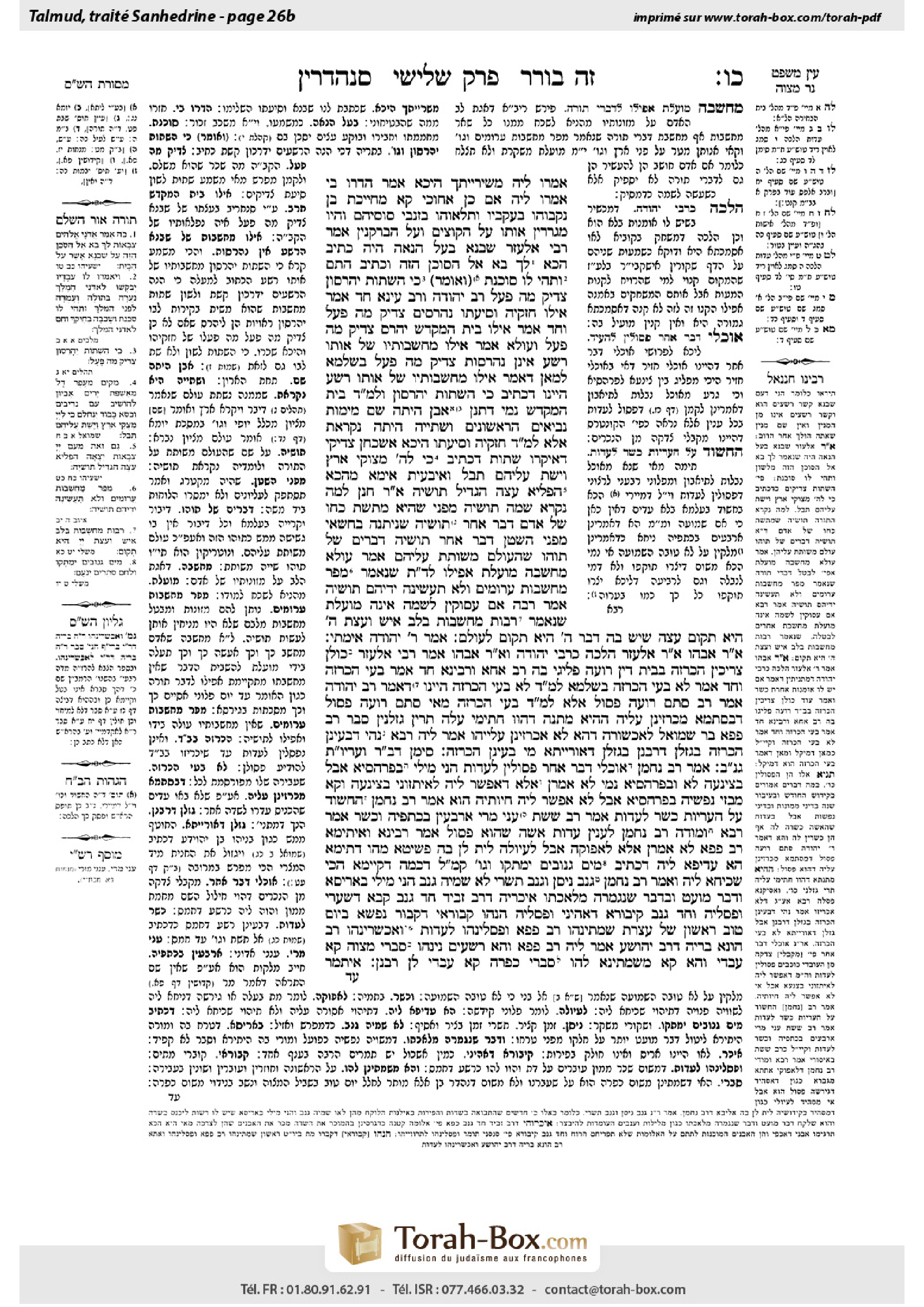
Sanhedrin 26b: Talmud study for Daf Yomi
Daf Yomi is the daily study of one Talmud folio. Explore 37 tractates with scans, Hebrew text, Sefaria English and AI-generated French translations where annotated.
Passage selection and English or AI-generated French translation are available where the scan has annotations. Daf Study is independent of Torah-Box and Sefaria.
Browse Sanhedrin · סנהדרין · All tractatesSanhedrin 26b text and translations
This page of Sanhedrin includes the Aramaic text, an English translation and an AI-generated French translation, alongside the scan above.
סנהדרין כ״ו ב · Aramaic and Hebrew text
אֲמַרוּ לֵיהּ: מַשְׁירְיָיתָךְ הֵיכָא? אֲמַר: הֲדַרוּ בִּי. אֲמַרוּ לֵיהּ: אִם כֵּן, אַחוֹכֵי קָא מַחְיְיכַתְּ בַּן! נְקָבוּהוּ בַּעֲקָבָיו וּתְלָאוּהוּ בְּזַנְבֵי סוּסֵיהֶם, וְהָיוּ מְגָרְרִין אוֹתוֹ עַל הַקּוֹצִים וְעַל הַבַּרְקָנִין.
אָמַר רַבִּי אֶלְעָזָר: שֶׁבְנָא בַּעַל הֲנָאָה הָיָה. כְּתִיב הָכָא: ״לֶךְ בֹּא אֶל הַסֹּכֵן הַזֶּה״, וּכְתִיב הָתָם: ״וַתְּהִי לוֹ סֹכֶנֶת״.
וְאוֹמֵר: ״כִּי הַשָּׁתוֹת יֵהָרֵסוּן צַדִּיק מַה פָּעָל״. רַב יְהוּדָה וְרַב עֵינָא, חַד אָמַר: אִילּוּ חִזְקִיָּה וְסִיעָתוֹ נֶהֱרָסִים, צַדִּיק מַה פָּעָל? וְחַד אָמַר: אִילּוּ בֵּית הַמִּקְדָּשׁ יַהָרֵס, צַדִּיק מַה פָּעָל? וְעוּלָּא אָמַר: אִילּוּ מַחְשְׁבוֹתָיו שֶׁל אוֹתוֹ רָשָׁע אֵינָן נֶהֱרָסוֹת, צַדִּיק מַה פָּעָל?
בִּשְׁלָמָא לְמַאן דְּאָמַר: אִילּוּ מַחְשְׁבוֹתָיו שֶׁל אוֹתוֹ רָשָׁע, הַיְינוּ דִּכְתִיב ״כִּי הַשָּׁתוֹת יֵהָרֵסוּן״.
וּלְמַאן דְּאָמַר בֵּית הַמִּקְדָּשׁ, נָמֵי – דִּתְנַן: אֶבֶן הָיְתָה שָׁם מִימוֹת נְבִיאִים הָרִאשׁוֹנִים, וּשְׁתִיָּיה הָיְתָה נִקְרֵאת.
אֶלָּא לְמַאן דְּאָמַר חִזְקִיָּה וְסִיעָתוֹ, הֵיכָא אַשְׁכְּחַן צַדִּיקֵי דְּאִיקְּרוּ ״שָׁתוֹת״?
דִּכְתִיב: ״כִּי לַה׳ מְצֻקֵי אֶרֶץ וַיָּשֶׁת עֲלֵיהֶם תֵּבֵל״. וְאִיבָּעֵית אֵימָא מֵהָכָא: ״הִפְלִיא עֵצָה הִגְדִּיל תּוּשִׁיָּה״.
אָמַר רַבִּי חָנָן: לָמָּה נִקְרָא שְׁמָהּ תּוּשִׁיָּה? מִפְּנֵי שֶׁהִיא מַתֶּשֶׁת כֹּחוֹ שֶׁל אָדָם. דָּבָר אַחֵר: תּוּשִׁיָּה – שֶׁנִּיתְּנָה בַּחֲשַׁאי מִפְּנֵי הַשָּׂטָן. דָּבָר אַחֵר: תּוּשִׁיָּה – דְּבָרִים שֶׁל תּוֹהוּ שֶׁהָעוֹלָם מְשׁוּתָּת עֲלֵיהֶם.
אָמַר עוּלָּא: מַחְשָׁבָה מוֹעֶלֶת אֲפִילּוּ לְדִבְרֵי תוֹרָה, שֶׁנֶּאֱמַר: ״מֵפֵר מַחְשְׁבוֹת עֲרוּמִים וְלֹא תַעֲשֶׂינָה יְדֵיהֶם תּוּשִׁיָּה״.
אָמַר רַבָּה: אִם עֲסוּקִין לִשְׁמָהּ, אֵינָהּ מוֹעֶלֶת, שֶׁנֶּאֱמַר: ״רַבּוֹת מַחֲשָׁבוֹת בְּלֶב אִישׁ וַעֲצַת ה׳ הִיא תָקוּם״. עֵצָה שֶׁיֵּשׁ בָּהּ דְּבַר ה׳ הִיא תָּקוּם לְעוֹלָם.
אָמַר רַבִּי יְהוּדָה אֵימָתַי. אָמַר רַבִּי אֲבָהוּ אָמַר רַבִּי אֶלְעָזָר: הֲלָכָה כְּרַבִּי יְהוּדָה.
וְאָמַר רַבִּי אֲבָהוּ אָמַר רַבִּי אֶלְעָזָר: כּוּלָּן צְרִיכִין הַכְרָזָה בְּבֵית דִּין.
רוֹעֶה – פְּלִיגִי בַּהּ רַב אַחָא וְרָבִינָא: חַד אָמַר בָּעֵי הַכְרָזָה, וְחַד אָמַר לָא בָּעֵי הַכְרָזָה.
בִּשְׁלָמָא לְמַאן דְּאָמַר לָא בָּעֵי הַכְרָזָה, הַיְינוּ דְּאָמַר רַב יְהוּדָה אָמַר רַב: סְתָם רוֹעֶה פָּסוּל. אֶלָּא לְמַאן דְּאָמַר בָּעֵי הַכְרָזָה, מַאי סְתָם רוֹעֶה פָּסוּל?
דְּבִסְתָמָא מַכְרְזִינַן עֲלֵיהּ.
הָהִיא מַתָּנָה דַּהֲווֹ חֲתִימִי עֲלַהּ תְּרֵין גַּזְלָנִין, סְבַר רַב פָּפָּא בַּר שְׁמוּאֵל לְאַכְשׁוֹרַהּ, דְּהָא לָא אַכְרְזִינַן עֲלַיְיהוּ.
אֲמַר לֵיהּ רָבָא: נְהִי דְּבָעֵינַן הַכְרָזָה בְּגַזְלָן דְּרַבָּנַן, בְּגַזְלָן דְּאוֹרָיְיתָא מִי בָּעֵינַן הַכְרָזָה?
סִימָן: דָּבָר, וַעֲרָיוֹת, גַּנָּב.
אָמַר רַב נַחְמָן: אוֹכְלֵי דָּבָר אַחֵר פְּסוּלִין לְעֵדוּת.
הָנֵי מִילֵּי בְּפַרְהֶסְיָא, אֲבָל בְּצִינְעָה לָא. וּבְפַרְהֶסְיָא נָמֵי לָא אֲמַרַן אֶלָּא דְּאֶפְשָׁר לֵיהּ לְאִיתְּזוֹנֵי בְּצִינְעָה, וְקָא מְבַזֵּי נַפְשֵׁיהּ בְּפַרְהֶסְיָא. אֲבָל לָא אֶפְשָׁר לֵיהּ – חַיּוּתֵיהּ הוּא.
אָמַר רַב נַחְמָן: הֶחָשׁוּד עַל הָעֲרָיוֹת כָּשֵׁר לְעֵדוּת. אָמַר רַב שֵׁשֶׁת: עֲנִי מָרִי, אַרְבְּעִין בְּכַתְפֵּיהּ וְכָשֵׁר?
אָמַר רָבָא: וּמוֹדֶה רַב נַחְמָן לְעִנְיַן עֵדוּת אִשָּׁה שֶׁהוּא פָּסוּל. אָמַר רָבִינָא, וְאִיתֵּימָא רַב פָּפָּא: לָא אֲמַרַן אֶלָּא לְאַפּוֹקַהּ, אֲבָל לְעַיּוֹלַהּ – לֵית לַן בַּהּ.
פְּשִׁיטָא! מַהוּ דְּתֵימָא הָא עֲדִיפָא לֵיהּ, דִּכְתִיב: ״מַיִם גְּנוּבִים יִמְתָּקוּ וְגוֹ׳״? קָא מַשְׁמַע לַן דְּכַמָּה דְּקַיְימָא הָכִי שְׁכִיחָא לֵיהּ.
וְאָמַר רַב נַחְמָן: גַּנַּב נִיסָן וְגַנַּב תִּשְׁרֵי – לָא שְׁמֵיהּ גַּנָּב.
וְהָנֵי מִילֵּי בַּאֲרִיסָא, וְדָבָר מוּעָט, וּבְדָבָר שֶׁנִּגְמְרָה מְלַאכְתּוֹ.
אִיכָּרֵיהּ דְּרַב זְבִיד, חַד גְּנַב קַבָּא דִשְׂעָרֵי, וּפַסְלֵיהּ, וְחַד גְּנַב קִיבּוּרָא דַאֲהִינֵי, וּפַסְלֵיהּ.
הָנְהוּ קָבוֹרָאֵי דִּקְבוּר נַפְשָׁא בְּיוֹם טוֹב רִאשׁוֹן שֶׁל עֲצֶרֶת, שַׁמְּתִינְהוּ רַב פָּפָּא וּפַסְלִינְהוּ לְעֵדוּת, וְאַכְשְׁרִינְהוּ רַב הוּנָא בְּרֵיהּ דְּרַב יְהוֹשֻׁעַ.
אֲמַר לֵיהּ רַב פָּפָּא: וְהָא רְשָׁעִים נִינְהוּ? סָבְרִי: מִצְוָה קָא עָבְדִי.
וְהָא קָא מְשַׁמְּתִינַן לְהוּ? סָבְרִי: כַּפָּרָה קָא עָבְדִי לַן רַבָּנַן.
אִיתְּמַר:
Sanhedrin 26b · English translation
The Assyrians said to him: Where is your camp? Shebna said: They backed out on me. They said to him: If so, you are mocking us; you led us to believe that behind you stands a large camp of supporters. They punched holes in his heels and hung him by the tails of their horses, and dragged him on the thorns and on the bristles.
Rabbi Elazar says: Shebna was a hedonist. It is written here: “Go, get yourself to this steward [hasokhen], to Shebna, who is over the house” (Isaiah 22:15), and it is written there with regard to Abishag the Shunammite: “And let her be a companion [sokhenet] to him; and let her lie in your bosom, that my lord the king may get heat” (I Kings 1:2).
And following the aforementioned verse: “For behold, the wicked bend the bow, they have made ready their arrow upon the string,” the next verse states: “When the foundations are destroyed, what has the Righteous One done?” (Psalms 11:3). Rav Yehuda and Rav Eina interpret this verse. One says: If Hezekiah and his camp are destroyed, what has the Righteous One done? And one says: If the Temple should be destroyed, what has the Righteous One done? And Ulla says: If the intentions of that wicked person, Sennacherib, are not destroyed, what has the Righteous One done?
The Gemara asks: Granted, according to the one who says that the verse means: If the intentions of that wicked person are not destroyed, what has the Righteous One done, this is the reason that it is written: “When the foundations [hashatot] are destroyed,” i.e., the intentions of Sennacherib are destroyed, as intentions are called shatot.
And according to the one who says it is referring to the Temple, the word hashatot is also clear, as we learned in a mishna (Yoma 53b): There was a stone in the Holy of Holies from the days of the early prophets, David and Samuel, who laid the groundwork for construction of the Temple, and this stone was called the Foundation [shetiyya] Stone.
But according to the one who says that the reference is to Hezekiah and his camp, where do we find that righteous people are referred to as shatot?
The Gemara answers: As it is written: “He raises up the poor out of the dust, He lifts up the needy from the dung hill, to make them sit with princes and inherit the throne of glory; for the pillars of the earth are the Lord’s, and He has set [vayyashet] the world upon them” (I Samuel 2:8). Since the righteous are considered the foundations of the world, this verse is interpreted in reference to them. And if you wish, say instead that it is derived from here: “Wonderful is His counsel, and great His wisdom [tushiyya]” (Isaiah 28:29). Accordingly, the wise, righteous people are called shatot.
With regard to the latter verse, Rabbi Ḥanan says: Why is the Torah called tushiyya? Because it weakens [matteshet] the strength of a person who engages in its study. Alternatively, tushiyya can be interpreted as an abbreviation: That it was given in secret [shenittena beḥashai]. This was done because of the Satan, lest he claim that the Jewish people are not worthy of it. Alternatively, tushiyya can be interpreted as an abbreviation for amorphous [tohu] matters that seem foreign and strange, but nevertheless the world is founded [meshotat] on them.
Ulla says: Thought, i.e., concern, is effective [mo’elet] in disturbing even the study of statements of Torah, as it is stated: “He frustrates the thoughts of the crafty, so that their hands can perform nothing [velo…tushiyya]” (Job 5:12), and tushiyya is a reference to Torah.
Rabba says: If people engage in Torah study for its own sake, concern is not effective; as it is stated: “There are many devices in a man’s heart; but the counsel of the Lord, that shall stand” (Proverbs 19:21). Rabba interprets this to mean that a counsel that has in it the statement of the Lord shall rise forever and cannot be disturbed.
§ The mishna teaches that Rabbi Yehuda says: When are all these people, e.g., gamblers and those who lend with interest, disqualified from bearing witness? It is when they have no occupation other than this one. Rabbi Abbahu says that Rabbi Elazar says: The halakha is in accordance with the opinion of Rabbi Yehuda.
And Rabbi Abbahu says that Rabbi Elazar says: All of these require a proclamation in the court. In other words, one is disqualified only after it is proclaimed in court that he was found guilty of this behavior.
With regard to a shepherd, who is also disqualified from bearing witness, Rav Aḥa and Ravina disagree. One says that he requires a proclamation that he is disqualified due to his being a shepherd, and one says that he does not require a proclamation and is disqualified automatically.
The Gemara asks: Granted, according to the one who says that he does not require a proclamation, this is what Rav Yehuda means when he says that Rav says that an ordinary shepherd is disqualified, i.e., he does not require a specific proclamation. But according to the one who says that a shepherd requires a proclamation, what is meant by the statement that an ordinary shepherd is disqualified?
The Gemara answers: It means that in an ordinary case, the court proclaims about him that he is disqualified for having engaged in shepherding. If the court discovers that he regularly engages in this trade, it proclaims immediately that he is disqualified, and the court does not need to prove that he shepherds his flock in the fields of others.
The Gemara recounts: With regard to a certain deed of gift on which the names of two robbers were signed, Rav Pappa bar Shmuel thought to deem it valid despite the identity of the witnesses, as the court did not proclaim about them that they were disqualified.
Rava said to him: Although we require a proclamation in order to disqualify a robber from bearing witness, this is only with regard to a robber who is guilty of stealing by rabbinic law; with regard to a robber who is guilty of stealing by Torah law, do we require a proclamation? He is disqualified automatically.
§ The Gemara states a mnemonic for the following statements with regard to disqualification from testifying: Something; and forbidden sexual relations; and a thief.
Rav Naḥman says: Those who eat something else, a euphemism for pork, are disqualified from bearing witness. This is referring to those who accept charity from gentiles, thereby causing a desecration of God’s name. They are tantamount to wicked people guilty of monetary transgressions, as they are willing to desecrate God’s name for monetary gain.
The Gemara comments: This statement applies with regard to taking charity from gentiles in public [befarhesya], but if one takes it in private he is not disqualified. And even if he takes it in public, we said that he is disqualified only in a case where he can sustain himself by accepting charity from gentiles in private and despite this he disgraces himself by taking it in public. But if he cannot support himself in any other manner, he is not disqualified, as it is his livelihood.
Rav Naḥman says: One who due to a rumor is suspected of engaging in forbidden sexual relations is fit to bear witness. Rav Sheshet said to him: Answer me, my Master: The halakha is that one who is rumored to have engaged in forbidden sexual intercourse receives forty lashes on his shoulders, and yet you say he is fit to bear witness?
Rava said: And Rav Naḥman concedes that he is disqualified with regard to testimony about the status of a married woman, as he is clearly under suspicion with regard to this matter. Ravina says, and some say Rav Pappa says: We said he is disqualified only with regard to testimony that removes her status as a married woman, e.g., testimony that her husband died, as he is suspected of wanting her for himself. But with regard to testimony that establishes her in that status, we have no problem with it.
The Gemara asks: Isn’t that obvious? Why should he be suspected of lying in order to render a woman married? The Gemara answers: Lest you say that if he wants her for himself, this situation, i.e., her being married to another, is preferable to him; as it is written: “Stolen waters are sweet and bread eaten in secret is pleasant” (Proverbs 9:17), i.e., the forbidden is more pleasant than the permitted, Rav Pappa teaches us that this is not the case, as the way the woman is now, being unmarried, she is more available to him. He therefore is not motivated to testify falsely that she is married.
And Rav Naḥman says: A thief of Nisan and a thief of Tishrei, i.e., one who steals during the harvest seasons, is not called a thief and is therefore not disqualified from bearing witness.
The Gemara explains: This statement applies specifically with regard to a tenant farmer, and it is a situation where he took a small amount, and in a case where it was an item whose work was completed, i.e., that needed no further processing. Since the produce was sufficiently processed, the tenant may assume that he deserves additional pay for any further labor and justify taking a small amount of the produce for his effort. Consequently, his theft is not willful.
The Gemara recounts: An incident occurred with the tenant farmers of Rav Zevid. One stole a kav of barley, and Rav Zevid disqualified him from bearing witness, and one stole a cluster of dates, and he disqualified him. The reason for their disqualification is that the quantity of produce they stole is not considered a small amount.
The Gemara relates: There were these gravediggers, who buried a person on the first day of the festival of Shavuot, desecrating the Festival. Rav Pappa excommunicated them and then disqualified them from bearing witness, and Rav Huna, son of Rav Yehoshua, deemed them fit to bear witness.
Rav Pappa said to Rav Huna, son of Rav Yehoshua: But aren’t they wicked people, as they violated a Torah prohibition? Rav Huna, son of Rav Yehoshua, answered him: They assumed they were doing a mitzva, as they were burying the dead.
Rav Pappa asked: But didn’t I excommunicate them for this? Nevertheless, they continued to bury people on the Festival. Rav Huna, son of Rav Yehoshua, answered: They assumed: We were not excommunicated for doing something wrong. Rather, since the mitzva of burying the dead involved desecrating the Festival, the Sages are achieving atonement for us, although our behavior was appropriate.
§ A conspiring witness is one who testified that a certain incident occurred at a particular time and place, and then two other witnesses testify that he was elsewhere at that time. The Gemara discusses the disqualification of a conspiring witness from providing testimony in other cases. It was stated
Sanhedrin 26b · Traduction française (IA)
Les Assyriens lui dirent : « Où est ton camp ? » Shebna répondit : « Ils se sont désistés. » Ils lui dirent : « Dans ce cas, tu te moques de nous : tu nous as fait croire qu’une grande armée de partisans se tenait derrière toi. » Ils lui percèrent les talons, le suspendirent par les queues de leurs chevaux et le traînèrent sur les épines et les ronces.
Rabbi Elazar dit : Shebna était un hédoniste. Il est écrit ici : « Va trouver cet intendant [hasokhen], Shebna, qui est à la tête de la maison » (Isaïe 22:15), et il est écrit ailleurs, au sujet d’Abishag la Shounamite : « Qu’elle soit sa compagne [sokhenet] et qu’elle couche dans ton sein, afin que mon seigneur le roi ait chaud » (I Rois 1:2).
À la suite du verset précité — « Car voici, les méchants bandent leur arc, ils ajustent leur flèche sur la corde » —, le verset suivant dit : « Quand les fondements sont détruits, que peut faire le Juste ? » (Psaumes 11:3). Rav Yehouda et Rav Eina interprètent ce verset. Selon l’un, il signifie : « Si Ézéchias et son camp sont détruits, que peut faire le Juste ? » Selon l’autre : « Si le Temple est détruit, que peut faire le Juste ? » Et Oulla dit : « Si les desseins de ce méchant, Sennachérib, ne sont pas détruits, que peut faire le Juste ? »
La Guemara demande : Il est compréhensible que, selon celui qui dit que le verset signifie : « Si les desseins de ce méchant ne sont pas détruits, que peut faire le Juste ? », le terme « fondements » dans « Quand les fondements [hashatot] sont détruits » désigne les desseins de Sennachérib, car les desseins sont appelés shatot.
Et selon celui qui dit que le verset parle du Temple, le mot hashatot s’explique également, comme nous l’avons appris dans une Michna (Yoma 53b) : il y avait dans le Saint des saints une pierre datant de l’époque des premiers prophètes, David et Samuel, qui avaient posé les fondations de la construction du Temple ; cette pierre était appelée la pierre de fondation [shetiyya].
Mais selon celui qui dit qu’il s’agit d’Ézéchias et de son camp, où trouve-t-on que les justes sont désignés par le terme shatot ?
La Guemara répond : comme il est écrit : « Il relève le pauvre de la poussière, il élève le nécessiteux du tas de fumier, pour les faire siéger avec les princes et leur faire hériter un trône de gloire ; car les piliers de la terre appartiennent au Seigneur, et c’est sur eux qu’il a posé [vayyashet] le monde » (I Samuel 2:8). Puisque les justes sont considérés comme les fondements du monde, ce verset est interprété à leur sujet. Et si tu préfères, dis plutôt que cela se déduit de ce verset : « Admirable est son conseil, et grande sa sagesse [tushiyya] » (Isaïe 28:29). Ainsi, les sages justes sont appelés shatot.
À propos de ce dernier verset, Rabbi Ḥanan dit : Pourquoi la Torah est-elle appelée tushiyya ? Parce qu’elle affaiblit [matteshet] la force de celui qui l’étudie. Autre interprétation : tushiyya peut être compris comme une abréviation de « elle fut donnée en secret [shenittena beḥashai] ». Cela fut fait à cause du Satan, de peur qu’il ne prétende que le peuple juif n’en était pas digne. Autre interprétation : tushiyya peut être compris comme une abréviation désignant des choses informes [tohu], qui semblent étrangères et étranges, mais sur lesquelles le monde est néanmoins fondé [meshotat].
Oulla dit : La préoccupation, c’est-à-dire l’inquiétude, est efficace [mo’elet] pour troubler même l’étude des paroles de Torah, comme il est dit : « Il déjoue les pensées des rusés, afin que leurs mains n’accomplissent rien [velo…tushiyya] » (Job 5:12) ; tushiyya désigne la Torah.
Rabba dit : Si les gens étudient la Torah pour elle-même, l’inquiétude n’a pas d’effet, comme il est dit : « Il y a beaucoup de projets dans le cœur de l’homme, mais le dessein du Seigneur, lui, subsistera » (Proverbes 19:21). Rabba interprète cela ainsi : un dessein qui contient une parole du Seigneur subsistera pour toujours et ne peut être troublé.
§ La Michna enseigne que Rabbi Yehouda dit : Dans quel cas tous ces gens, par exemple les joueurs et ceux qui prêtent à intérêt, sont-ils inaptes à témoigner ? Lorsqu’ils n’ont pas d’autre occupation que celle-là. Rabbi Abbahou dit au nom de Rabbi Elazar : La halakha est conforme à l’opinion de Rabbi Yehouda.
Et Rabbi Abbahou dit au nom de Rabbi Elazar : Tous ceux-là nécessitent une proclamation au tribunal. Autrement dit, une personne n’est déclarée inapte qu’après qu’il a été proclamé au tribunal qu’elle a été reconnue coupable de ce comportement.
Au sujet du berger, qui est lui aussi inapte à témoigner, Rav Aḥa et Ravina sont en désaccord. Selon l’un, il faut proclamer qu’il est inapte parce qu’il est berger ; selon l’autre, aucune proclamation n’est nécessaire et il est automatiquement inapte.
La Guemara demande : Il est compréhensible que, selon celui qui dit qu’aucune proclamation n’est nécessaire, tels soient les propos de Rav Yehouda rapportant au nom de Rav qu’un berger ordinaire est inapte : aucune proclamation spécifique n’est donc nécessaire. Mais, selon celui qui dit qu’un berger doit faire l’objet d’une proclamation, que signifie l’affirmation selon laquelle un berger ordinaire est inapte ?
La Guemara répond : Cela signifie que, dans un cas ordinaire, le tribunal proclame que cet homme est inapte parce qu’il s’est adonné au métier de berger. Si le tribunal découvre qu’il exerce régulièrement ce métier, il proclame immédiatement qu’il est inapte, sans avoir besoin de prouver qu’il fait paître son troupeau dans les champs d’autrui.
La Guemara rapporte : À propos d’un certain acte de donation sur lequel étaient signés les noms de deux voleurs, Rav Pappa bar Shmuel envisagea de le déclarer valide malgré l’identité des témoins, car le tribunal n’avait pas proclamé qu’ils étaient inaptes.
Rava lui dit : Bien qu’une proclamation soit nécessaire pour disqualifier un voleur comme témoin, cela ne concerne que celui qui est coupable d’un vol selon la loi rabbinique. Pour un voleur coupable d’un vol selon la Torah, faut-il une proclamation ? Il est automatiquement inapte.
§ La Guemara donne un moyen mnémotechnique pour les propos suivants concernant les motifs d’inaptitude à témoigner : quelque chose ; les relations sexuelles interdites ; et un voleur.
Rav Naḥman dit : Ceux qui mangent « autre chose », euphémisme désignant le porc, sont inaptes à témoigner. Il s’agit de ceux qui acceptent la charité des non-Juifs, provoquant ainsi une profanation du nom de Dieu. Ils sont assimilés à des méchants coupables de transgressions pécuniaires, puisqu’ils sont prêts à profaner le nom de Dieu pour un gain financier.
La Guemara précise : Ce propos s’applique à celui qui reçoit la charité des non-Juifs en public [befarhesya], mais celui qui la reçoit en privé n’est pas inapte. Même lorsqu’il la reçoit en public, nous avons dit qu’il est inapte uniquement dans le cas où il peut subvenir à ses besoins en recevant la charité des non-Juifs en privé et où, malgré cela, il se déshonore en la recevant en public. Mais s’il ne peut subvenir à ses besoins d’aucune autre manière, il n’est pas inapte, car c’est son moyen de subsistance.
Rav Naḥman dit : Celui qui est soupçonné, à la suite d’une rumeur, d’avoir eu des relations sexuelles interdites peut témoigner. Rav Sheshet lui dit : Réponds-moi, mon maître : la halakha veut que celui dont on dit qu’il a eu des relations sexuelles interdites reçoive quarante coups sur les épaules ; pourtant, tu dis qu’il peut témoigner ?
Rava dit : Rav Naḥman reconnaît qu’il est inapte à témoigner sur le statut d’une femme mariée, car il est clairement soupçonné à cet égard. Ravina dit, et certains disent que c’est Rav Pappa qui le dit : Nous avons dit qu’il est inapte uniquement pour un témoignage qui ferait perdre à la femme son statut de femme mariée, par exemple un témoignage selon lequel son mari est mort, car il est soupçonné de vouloir l’épouser. Mais il n’y a pas de problème à ce qu’il témoigne pour établir qu’elle a le statut de femme mariée.
La Guemara demande : N’est-ce pas évident ? Pourquoi le soupçonnerait-on de mentir pour faire d’une femme une femme mariée ? La Guemara répond : De peur que tu ne dises que, s’il la veut pour lui-même, cette situation — c’est-à-dire le fait qu’elle soit mariée à un autre — lui est préférable, comme il est écrit : « Les eaux dérobées sont douces, et le pain mangé en secret est agréable » (Proverbes 9:17), c’est-à-dire que l’interdit est plus agréable que ce qui est permis. Rav Pappa nous enseigne que ce n’est pas le cas : dans sa situation actuelle, non mariée, elle lui est plus accessible. Il n’est donc pas motivé à témoigner faussement qu’elle est mariée.
Rav Naḥman dit aussi : Un voleur de Nissan et un voleur de Tishrei, c’est-à-dire celui qui vole pendant les saisons des récoltes, n’est pas appelé voleur et n’est donc pas inapte à témoigner.
La Guemara explique : Ce propos concerne spécifiquement un métayer qui a pris une petite quantité d’un produit dont le travail était achevé, c’est-à-dire qui ne nécessitait plus aucun traitement. Le produit ayant été suffisamment préparé, le métayer peut supposer qu’il mérite une rémunération supplémentaire pour tout travail additionnel et justifier ainsi d’en prendre une petite quantité en contrepartie de ses efforts. Par conséquent, son vol n’est pas délibéré.
La Guemara rapporte : Un incident se produisit avec les métayers de Rav Zevid. L’un vola un kav d’orge, et Rav Zevid le déclara inapte à témoigner ; un autre vola une grappe de dattes, et Rav Zevid le déclara inapte. Ils furent déclarés inaptes parce que la quantité de produits qu’ils avaient volée n’est pas considérée comme faible.
La Guemara relate : Il y avait des fossoyeurs qui enterrèrent quelqu’un le premier jour de la fête de Chavouot, profanant ainsi la fête. Rav Pappa les mit au ban, puis les déclara inaptes à témoigner, tandis que Rav Huna, fils de Rav Yehoshua, les jugea aptes à témoigner.
Rav Pappa dit à Rav Huna, fils de Rav Yehoshua : Mais ne sont-ils pas des méchants, puisqu’ils ont transgressé une interdiction de la Torah ? Rav Huna, fils de Rav Yehoshua, lui répondit : Ils pensaient accomplir une mitsva, puisqu’ils enterraient les morts.
Rav Pappa demanda : Mais ne les ai-je pas mis au ban pour cela ? Pourtant, ils continuèrent à enterrer des gens pendant la fête. Rav Huna, fils de Rav Yehoshua, répondit : Ils pensaient : « Nous n’avons pas été mis au ban pour avoir fait quelque chose de mal. Au contraire, puisque la mitsva d’enterrer les morts impliquait de profaner la fête, les Sages nous procurent l’expiation », alors même que notre comportement était approprié.
§ Un témoin comploteur est quelqu’un qui a témoigné qu’un événement précis s’était produit à un endroit et à un moment déterminés, puis contre qui deux autres témoins témoignent qu’il se trouvait ailleurs à ce moment-là. La Guemara examine l’inaptitude d’un témoin comploteur à témoigner dans d’autres affaires. Il a été enseigné
Traduction française générée par IA à partir de l’édition anglaise de Sefaria. Vérifie toujours un passage avec le texte source.
Text from Sefaria: William Davidson Edition - Vocalized Aramaic (CC BY NC); William Davidson Edition - English (CC BY NC).