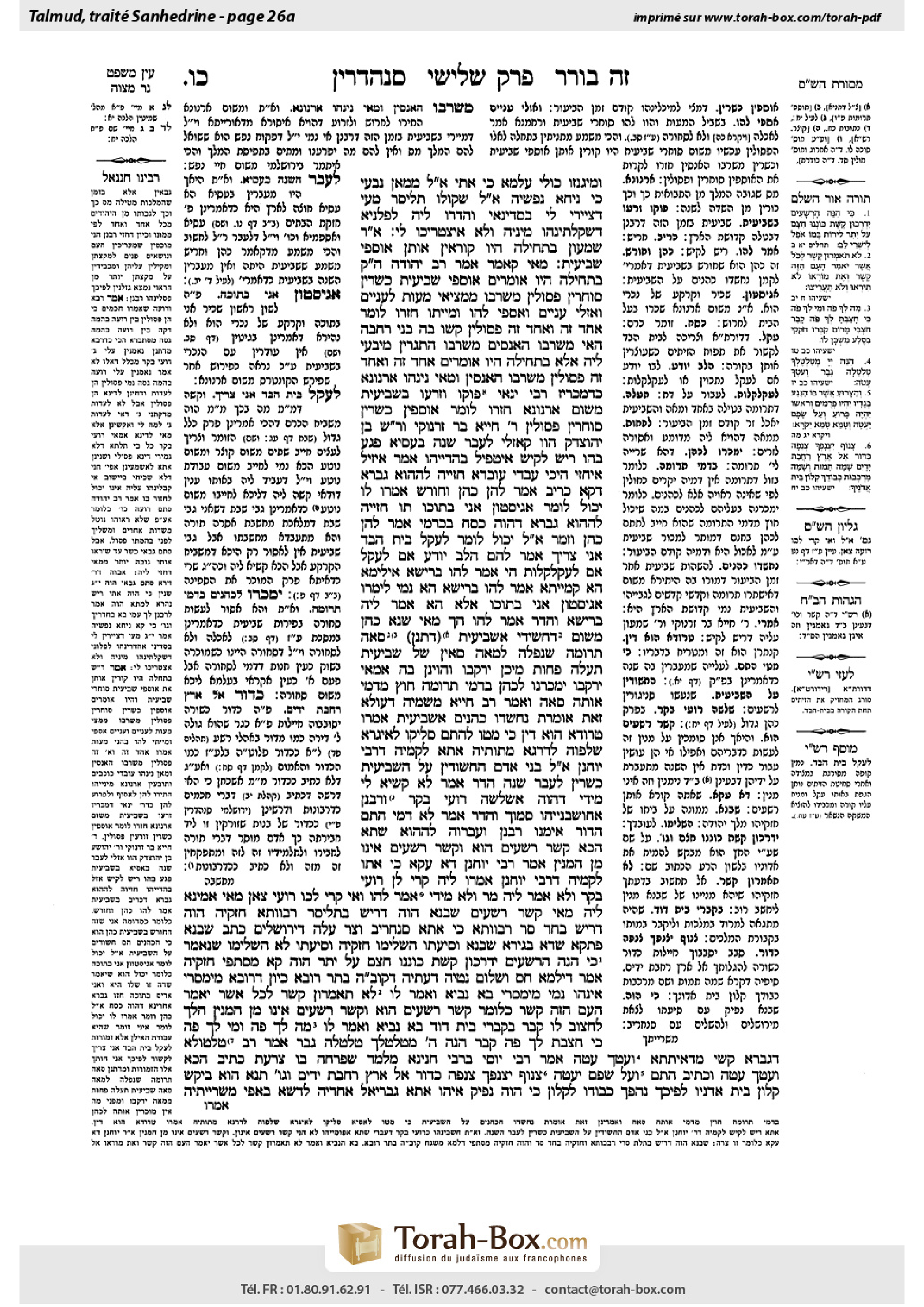
Sanhedrin 26a: Talmud study for Daf Yomi
Daf Yomi is the daily study of one Talmud folio. Explore 37 tractates with scans, Hebrew text, Sefaria English and AI-generated French translations where annotated.
Passage selection and English or AI-generated French translation are available where the scan has annotations. Daf Study is independent of Torah-Box and Sefaria.
Browse Sanhedrin · סנהדרין · All tractatesSanhedrin 26a text and translations
This page of Sanhedrin includes the Aramaic text, an English translation and an AI-generated French translation, alongside the scan above.
סנהדרין כ״ו א · Aramaic and Hebrew text
וּמִיגַּנְזוּ כּוּלֵּי עָלְמָא. כִּי אָתֵי, אֲמַר לֵיהּ: מִמַּאן נִבְעֵי?
כִּי נִיחָא נַפְשֵׁיהּ, אֲמַר לְהוּ: שְׁקוּלוּ תְּלֵיסַר מָעֵי דְּצַיְירִי לִי בִּסְדִינַאי, וְאַהְדַּרוּ לֵיהּ לִפְלָנְיָא, דִּשְׁקַלְתִּינְהוּ מִינֵּיהּ וְלָא אִיצְטְרִיכוּ לִי.
אָמַר רַבִּי שִׁמְעוֹן: בַּתְּחִילָּה הָיוּ קוֹרְאִין אוֹתָן ״אוֹסְפֵי שְׁבִיעִית״.
מַאי קָאָמַר? אָמַר רַב יְהוּדָה: הָכִי קָאָמַר, בַּתְּחִילָּה הָיוּ אוֹמְרִים: אוֹסְפֵי שְׁבִיעִית – כְּשֵׁרִין, סוֹחֲרִין – פְּסוּלִין.
מִשֶּׁרַבּוּ מַמְצִיאֵי מָעוֹת לַעֲנִיִּים, וְאָזְלִי עֲנִיִּים וְאָסְפִי לְהוּ וּמַיְיתוּ, חָזְרוּ לוֹמַר: אֶחָד זֶה וְאֶחָד זֶה פְּסוּלִין.
קָשׁוּ בָּהּ בְּנֵי רַחֲבָה: הַאי ״מִשֶּׁרַבּוּ הָאַנָּסִים״? ״מִשֶּׁרַבּוּ הַתַּגָּרִין״ מִיבְּעֵי לֵיהּ!
אֶלָּא, בַּתְּחִילָּה הָיוּ אוֹמְרִים: אֶחָד זֶה וְאֶחָד זֶה פְּסוּלִין. מִשֶּׁרַבּוּ הָאַנָּסִין – וּמַאי נִינְהוּ? אַרְנוֹנָא – כִּדְמַכְרִיז רַבִּי יַנַּאי: ״פּוּקוּ וּזְרַעוּ בַּשְּׁבִיעִית מִשּׁוּם אַרְנוֹנָא״. חָזְרוּ לוֹמַר: אוֹסְפִין כְּשֵׁרִין, סוֹחֲרִין פְּסוּלִין.
רַבִּי חִיָּיא בַּר זַרְנוֹקֵי וְרַבִּי שִׁמְעוֹן בֶּן יְהוֹצָדָק הֲווֹ קָאָזְלִי לְעַבֵּר שָׁנָה בְּעַסְיָא. פְּגַע בְּהוּ רֵישׁ לָקִישׁ, אִיטַּפַּל בַּהֲדַיְיהוּ. אָמַר: אֵיזִיל אִיחְזֵי הֵיכִי עָבְדִי עוֹבָדָא.
חַזְיֵיהּ לְהָהוּא גַּבְרָא דְּקָא כָרֵיב. אָמַר לָהֶן: כֹּהֵן וְחוֹרֵשׁ! אָמְרוּ לוֹ, יָכוֹל לוֹמַר: ״אַגִּיסְטְוָן אֲנִי בְּתוֹכוֹ״.
תּוּ חַזְיֵיהּ לְהָהוּא גַּבְרָא דַּהֲוָה כָּסַח בְּכַרְמֵי. אָמַר לָהֶן: כֹּהֵן וְזָמַר! אָמְרוּ לוֹ: יָכוֹל לוֹמַר ״לְעֵקֶל בֵּית הַבַּד אֲנִי צָרִיךְ״. אָמַר לָהֶם: הַלֵּב יוֹדֵעַ אִם לְעֵקֶל אִם לַעֲקַלְקַלּוֹת.
הֵי אֲמַר לְהוּ בְּרֵישָׁא? אִילֵימָא הָא קַמַּיְיתָא אֲמַר לְהוּ בְּרֵישָׁא, הָא נָמֵי לֵימְרוּ: ״אַגִּיסְטְוָן אֲנִי בְּתוֹכוֹ״! אֶלָּא, הָא אֲמַר לְהוּ בְּרֵישָׁא, וַהֲדַר אֲמַר לְהוּ הָךְ.
מַאי שְׁנָא כֹּהֵן? מִשּׁוּם דַּחֲשִׁידִי אַשְּׁבִיעִית.
דִּתְנַן: סְאָה תְּרוּמָה שֶׁנָּפְלָה לְמֵאָה סְאִין שֶׁל שְׁבִיעִית – תַּעֲלֶה. פָּחוֹת מִיכֵּן – יֵרָקְבוּ.
וְהָוֵינַן בַּהּ: אַמַּאי יֵרָקְבוּ? יִמְכְּרֶנּוּ לַכֹּהֵן בִּדְמֵי תְרוּמָה, חוּץ מִדְּמֵי אוֹתָהּ סְאָה.
וְאָמַר רַב חִיָּיא מִשְּׁמֵיהּ דְּעוּלָּא: זֹאת אוֹמֶרֶת, נֶחְשְׁדוּ כֹּהֲנִים אַשְּׁבִיעִית.
אָמְרוּ: טָרוֹדָא הוּא דֵּין. כִּי מְטוֹ לְהָתָם, סְלִיקוּ לְאִיגָּרָא, שַׁלְּפוּהּ לְדַרְגָּא מִתּוּתֵיהּ.
אֲתָא לְקַמֵּיהּ דְּרַבִּי יוֹחָנָן. אֲמַר לֵיהּ: בְּנֵי אָדָם הַחֲשׁוּדִין עַל הַשְּׁבִיעִית, כְּשֵׁרִין לְעַבֵּר שָׁנָה?
הֲדַר אָמַר: לָא קַשְׁיָא לִי, מִידֵּי דְּהָוֵה אַשְּׁלֹשָׁה רוֹעֵי בָקָר, וְרַבָּנַן אַחוּשְׁבָּנַיְיהוּ סְמוּךְ.
וַהֲדַר אָמַר: לָא דָּמֵי. הָתָם, הֲדוּר אִימְּנוֹ רַבָּנַן וְעַבְּרוּהָ לְהָהִוא שַׁתָּא. הָכָא, קֶשֶׁר רְשָׁעִים הוּא, וְקֶשֶׁר רְשָׁעִים אֵינוֹ מִן הַמִּנְיָן. אָמַר רַבִּי יוֹחָנָן: דָּא עָקָא.
כִּי אֲתוֹ לְקַמֵּיהּ דְּרַבִּי יוֹחָנָן, אֲמַרוּ לֵיהּ: קָרֵי לַן ״רוֹעֵי בָקָר״, וְלָא אֲמַר לֵיהּ מָר וְלָא מִידֵּי? אֲמַר לְהוּ: וְאִי קָרֵי לְכוּ ״רוֹעֵי צֹאן״, מַאי אָמֵינָא לֵיהּ?
מַאי קֶשֶׁר רְשָׁעִים? שֶׁבְנָא הֲוָה דָּרֵישׁ בִּתְלֵיסַר רִבְּוָותָא, חִזְקִיָּה הֲוָה דָּרֵישׁ בְּחַד סַר רִבְּוָותָא.
כִּי אֲתָא סַנְחֵרִיב וְצַר עֲלַהּ דִּירוּשְׁלֶם, כְּתַב שֶׁבְנָא פִּתְקָא שְׁדָא בְּגִירָא: ״שֶׁבְנָא וְסִיעָתוֹ הִשְׁלִימוּ, חִזְקִיָּה וְסִיעָתוֹ לֹא הִשְׁלִימוּ״. שֶׁנֶּאֱמַר: ״כִּי הִנֵּה הָרְשָׁעִים יִדְרְכוּן קֶשֶׁת כּוֹנְנוּ חִצָּם עַל יֶתֶר״.
הֲוָה קָא מִסְתְּפֵי חִזְקִיָּה, אֲמַר: דִּילְמָא חַס וְשָׁלוֹם נָטְיָה דַּעְתֵּיהּ דְּקוּדְשָׁא בְּרִיךְ הוּא בָּתַר רוּבָּא, כֵּיוָן דְּרוּבָּא מִימַּסְרִי אִינְהוּ נָמֵי מִימַּסְרִי. בָּא נָבִיא וְאָמַר לוֹ: ״לֹא תֹאמְרוּן קֶשֶׁר לְכֹל אֲשֶׁר יֹאמַר הָעָם הַזֶּה קָשֶׁר״, כְּלוֹמַר, קֶשֶׁר רְשָׁעִים הוּא, וְקֶשֶׁר רְשָׁעִים אֵינוֹ מִן הַמִּנְיָן.
הָלַךְ לַחְצֹב לוֹ קֶבֶר בְּקִבְרֵי בֵּית דָּוִד. בָּא נָבִיא וְאָמַר לוֹ: ״מָה לְּךָ פֹה וּמִי לְךָ פֹה כִּי חָצַבְתָּ לְּךָ פֹּה קָבֶר... הִנֵּה ה׳ מְטַלְטֶלְךָ טַלְטֵלָה גָּבֶר״.
אָמַר רַב: טִלְטוּלָא דְּגַבְרָא קָשֵׁי מִדְּאִיתְּתָא.
״וְעֹטְךָ עָטֹה״ – אָמַר רַבִּי יוֹסֵי בְּרַבִּי חֲנִינָא: מְלַמֵּד שֶׁפָּרְחָה בּוֹ צָרַעַת. כְּתִיב הָכָא ״וְעֹטְךָ עָטֹה״, וּכְתִיב הָתָם ״וְעַל שָׂפָם יַעְטֶה״.
״צָנוֹף יִצְנׇפְךָ צְנֵפָה כַּדּוּר אֶל אֶרֶץ רַחֲבַת יָדָיִם וְגוֹ׳״. תָּנָא: הוּא בִּיקֵּשׁ קְלוֹן בֵּית אֲדֹנָיו, לְפִיכָךְ נֶהְפַּךְ כְּבוֹדוֹ לְקָלוֹן. כִּי הֲוָה נָפֵיק אִיהוּ, אֲתָא גַּבְרִיאֵל אַחְדֵּיהּ לְדַשָּׁא בְּאַפֵּי מַשְׁרְיָיתֵיהּ.
Sanhedrin 26a · English translation
And everyone would hide. When the head tax collector would arrive, Rabbi Zeira’s father would say to him: From whom shall I request taxes? The city is scarcely populated, and only a small sum of taxes should be imposed on it.
When he was dying, he said to those standing around his deathbed: Take thirteen ma’a that are tied up in my sheet and return them to so-and-so, as I took them from him but I did not need them to pay the tax. Evidently, some tax collectors are God-fearing, and should not be disqualified.
§ The mishna teaches that Rabbi Shimon said: Initially people would call them: Gatherers of the produce of the Sabbatical Year. Once the tax collectors grew abundant they would then call them: Merchants who trade in the produce of the Sabbatical Year.
The Gemara asks: What is he saying? What is Rabbi Shimon teaching in this statement? Rav Yehuda says this is what he is saying: Initially the Sages would say that gatherers of the produce of the Sabbatical Year, i.e., those who gather a large quantity of produce of the Sabbatical Year for themselves, are fit to bear witness, but merchants who trade in the produce of the Sabbatical Year are disqualified.
Once those who would offer money to the poor to gather produce for them grew abundant, and the poor would go and gather the produce for those who hired them and bring it to them, then gathering a large amount of produce of the Sabbatical Year was considered a business. The Sages then said that both this category, gatherers of the produce of the Sabbatical Year, and that category, merchants who trade in the produce of the Sabbatical Year, are disqualified.
The children of the Sage Raḥava had a difficulty with this explanation, as accordingly this phrase: Once the tax collectors grew abundant, is inaccurate; the mishna should have stated: Once the merchants grew abundant.
Rather, Rabbi Shimon’s statement should be explained differently, as follows: Initially the Sages would say that both this category, gatherers of the produce of the Sabbatical Year, and that category, merchants who trade in the produce of the Sabbatical Year, are disqualified. Once the tax collectors grew abundant it was permitted to gather the produce of the Sabbatical Year. And what tax did they collect? Arnona, which was a heavy tax on property collected both during the Sabbatical Year and in other years, placing pressure on those observing the Sabbatical Year. As Rabbi Yannai proclaimed: Go out and sow the fields during the Sabbatical Year due to the arnona that you must pay. Once this happened, the Sages then said: Gatherers of the produce of the Sabbatical Year are fit to bear witness, as they were no longer viewed as transgressors, but merchants who trade in this produce are still disqualified.
§ The Gemara recounts an incident connected tangentially to the discussion concerning the Sabbatical Year: Rabbi Ḥiyya bar Zarnokei and Rabbi Shimon ben Yehotzadak were going to intercalate the year in Asya, as circumstances did not enable them to perform the intercalation of the year in Eretz Yisrael. Reish Lakish met them and joined with them. He said: I will go see how they do the deed, i.e., how the intercalation is performed practically.
Reish Lakish saw a certain man plowing a field. He said to the other Sages: Look at this priest who is plowing during the Sabbatical Year. They said to him that he could say in his own defense: I am a hired worker [agiston] in the field, which belongs to a gentile. Therefore, it is permitted.
Reish Lakish further saw a certain man pruning vines in the vineyards. He said to the other Sages: Look at this priest who is pruning vines during the Sabbatical Year. They said to him that he could say: I need the branches to make a bale [ekel ] for my olive press, i.e., a basket to hold olives for pressing. Since he is not pruning the vines for agricultural purposes but to use the branches, it is permitted for him to do so in the Sabbatical Year. Reish Lakish said to them, in a play on words: The heart knows whether he is doing so for a bale [ekel ], or whether he is saying this as deceit [la’akalkalot].
The Gemara asks: Which did he say to them first? Which incident occurred first? If we say that first he said to them that first exclamation, that a priest was plowing the field, let them say to him in this latter incident too, in which someone was pruning vines, that he could claim in his defense: I am a hired worker in the field. This would have been a better justification than claiming he needed the branches. Rather, apparently first he said to them this exclamation, that a priest was pruning vines, and only then he said to them that a priest was plowing the field.
The Gemara asks: What is different about a priest? Why did Reish Lakish assume the man was a priest? The Gemara answers: It is because priests are suspected of desecrating the Sabbatical Year.
As we learned in a baraita: A se’a of teruma, the portion of the produce designated for the priest, that fell into a hundred se’a of Sabbatical Year produce and was indistinguishable, is nullified, i.e., it no longer has the status of teruma, and can be eaten until the time that Sabbatical Year produce must be removed from one’s possession. If it fell into a lesser quantity of Sabbatical Year produce, the entire mixture must be left to rot, as it is prohibited for non-priests to partake of teruma.
And we discussed it: Why must the produce rot? Let its owner sell it to a priest in accordance with its value as teruma, which is less expensive than regular produce because it can be eaten only by priests, and except for the value of that se’a of teruma that fell in, which the owner is required to give to a priest for free. The priest may then partake of the produce, treating the entire mixture as though it has the sanctity of teruma, and both the priest and the owner will benefit.
And Rav Ḥiyya said in the name of Ulla: That is to say, i.e., one can infer from the fact that one is not permitted to sell the mixture to a priest, that priests are suspected of desecrating the Sabbatical Year by partaking of its produce after the time it must be removed from one’s possession. They did so because they considered it theirs, the same as teruma, as both mitzvot pertain to the produce of Eretz Yisrael. Therefore, produce of the Sabbatical Year should not be given or sold to priests. Similarly, Reish Lakish assumed that those who desecrated the Sabbatical Year were priests.
After Reish Lakish continually bothered them with his comments, Rabbi Ḥiyya bar Zarnokei and Rabbi Shimon ben Yehotzadak said: This one is a nuisance. In order to rid themselves of him, when they reached the location where they intended to intercalate the year, they went up to the roof and took the ladder out from under them so that he would stay below and would not be able to join them.
Sometime later, Reish Lakish came before Rabbi Yoḥanan. Reish Lakish said to him: Are people who are suspected of desecrating the Sabbatical Year fit to intercalate the year? He believed that the two Sages who were sent to intercalate the year treated the sanctity of the Sabbatical Year with disrespect.
Reish Lakish then said in response to his own question: This is not difficult for me; just as the Sages once intercalated the year in accordance with the assessment of three cattle herders (see 18b), which was permitted, as the Sages depended not on the assessment of the cattle herders but on their own calculation, perhaps here too the Sages depended on their own calculations and not on the decision of Rabbi Ḥiyya bar Zarnokei and Rabbi Shimon ben Yehotzadak.
Reish Lakish changed his mind and then said: It is not similar. There, in the case of the cattle herders, afterward the Sages were counted, i.e., they made a decision, and intercalated that year themselves. Here, by contrast, it is a conspiracy of wicked people, as the Sages who intercalated the year are disqualified from doing so; and a conspiracy of wicked people is not counted. Rabbi Yoḥanan said: This problem you raise is troublesome.
When Rabbi Ḥiyya bar Zarnokei and Rabbi Shimon ben Yehotzadak subsequently came before Rabbi Yoḥanan, after hearing about his discussion with Reish Lakish, they said to him bitterly: Reish Lakish referred to us as cattle herders, and the Master said nothing to him in response? Rabbi Yoḥanan said to them dismissively: And even if he had referred to you as shepherds, who are disqualified from bearing witness in addition to being disqualified from serving as judges, what should I have said to him? He is correct.
§ The Gemara asks: What is the source of the halakha that a conspiracy of wicked people is not counted as part of a group? The Gemara answers: Shebna, a steward and a minister in King Hezekiah’s court, was a prominent and influential figure. He would teach Torah to an audience of 130,000 followers, whereas King Hezekiah would teach Torah to an audience of merely 110,000 followers.
When Sennacherib came and besieged Jerusalem, Shebna wrote a note and shot it over the wall with an arrow. It read: Shebna and his camp have appeased Sennacherib and are ready to surrender; Hezekiah and his camp have not appeased Sennacherib. As it is stated in allusion to this incident: “For behold, the wicked bend the bow, they have made ready their arrow upon the string” (Psalms 11:2).
Hezekiah was afraid. He said: Perhaps, God forbid, the opinion of the Holy One, Blessed be He, will follow the majority; and since the majority have submitted to the Assyrians, even those who have not submitted will also be submitted into their hands. The prophet Isaiah then came and said to him: “Say not: A conspiracy, concerning all of which this people say: A conspiracy” (Isaiah 8:12). Meaning, it is a conspiracy of wicked people, and a conspiracy of wicked people is not counted. Therefore, although they are many, they are not considered the majority.
Shebna went to carve out a grave for himself among the graves of the house of David, as he thought that the kingship would be given to him. The prophet Isaiah then came and said to him: “What have you here, and whom have you here, that you have carved out a grave for yourself here? You, who have carved yourself out a grave on high, and hollowed a habitation for yourself in the rock? Behold, the Lord will make you wander like the wandering of a man; and he will wind you round and round” (Isaiah 22:16–17).
The Gemara mentions tangentially: Rav says that the wandering of a man is more difficult than that of a woman. He derives it from the expression “like the wandering of a man.”
With regard to the phrase: “And he will wind you round and round,” Rabbi Yosei, son of Rabbi Ḥanina, says: This teaches that Shebna developed leprosy; it is written here: “And he will wind you round and round [ve’otkha ato],” and it is written there, in the Torah, with regard to a leper: “And the leper in whom the plague is, his clothes shall be torn, and the hair of his head shall go loose, and he shall cover his upper lip [ya’te]” (Leviticus 13:45). The Hebrew word for upper lip is from the same root as the verb in the verse cited from Isaiah.
The Gemara continues to interpret the prophecy about Shebna: “He will violently roll and toss you like a ball into a large country; there you shall die, and there shall be the chariots of your glory, you shame of your lord’s house” (Isaiah 22:18). A baraita taught: He, Shebna, desired shame for his master’s house; therefore his glory turned to shame. This is what happened to him: When he was going out of the gate of Jerusalem to submit to the Assyrians, the angel Gabriel came and held the gate in front of his camp so they could not follow him. Consequently, he went out by himself.
Sanhedrin 26a · Traduction française (IA)
Et tous se cachaient. Lorsque le chef des collecteurs d’impôts arrivait, le père de Rabbi Zeira lui disait : « À qui réclamerai-je les impôts ? La ville est à peine peuplée et il ne faudrait lui imposer qu’une faible somme d’impôts. »
Alors qu’il était mourant, il dit aux personnes qui se tenaient autour de son lit : « Prenez les treize ma’a noués dans mon drap et rendez-les à untel, car je les lui ai pris, mais je n’en ai pas eu besoin pour payer l’impôt. » Il apparaît donc que certains collecteurs d’impôts craignent Dieu et ne doivent pas être disqualifiés.
§ La Michna enseigne que Rabbi Shimon a dit : « Au début, on les appelait “ceux qui ramassent les produits de l’année sabbatique”. Lorsque les collecteurs d’impôts devinrent nombreux, on les appela alors “marchands qui font le commerce des produits de l’année sabbatique”. »
La Guemara demande : Que veut-il dire ? Quel enseignement Rabbi Shimon transmet-il par cette déclaration ? Rav Yehouda dit : Voici ce qu’il veut dire : au début, les Sages disaient que ceux qui ramassent les produits de l’année sabbatique, c’est-à-dire ceux qui en recueillent une grande quantité pour eux-mêmes, sont aptes à témoigner, tandis que les marchands qui font le commerce des produits de l’année sabbatique sont disqualifiés.
Lorsque ceux qui donnaient de l’argent aux pauvres pour qu’ils ramassent des produits à leur place devinrent nombreux, les pauvres allaient ramasser les produits pour ceux qui les avaient engagés et les leur apportaient. Ramasser une grande quantité de produits de l’année sabbatique fut alors considéré comme une activité commerciale. Les Sages déclarèrent donc que les uns comme les autres, ceux qui ramassent les produits de l’année sabbatique et les marchands qui en font le commerce, sont disqualifiés.
Les fils du sage Raḥava eurent une difficulté avec cette explication, car, selon celle-ci, l’expression « lorsque les collecteurs d’impôts devinrent nombreux » est inexacte ; la Michna aurait dû dire : « lorsque les marchands devinrent nombreux ».
Il faut plutôt expliquer autrement la déclaration de Rabbi Shimon, comme suit : au début, les Sages disaient que les uns comme les autres, ceux qui ramassent les produits de l’année sabbatique et les marchands qui en font le commerce, sont disqualifiés. Lorsque les collecteurs d’impôts devinrent nombreux, il fut permis de ramasser les produits de l’année sabbatique. Quel impôt percevaient-ils ? L’arnona, un lourd impôt foncier prélevé aussi bien pendant l’année sabbatique que les autres années, qui faisait peser une lourde charge sur ceux qui observaient l’année sabbatique. Rabbi Yannai proclama en effet : « Sortez et semez les champs pendant l’année sabbatique, à cause de l’arnona que vous devez payer. » Dès lors, les Sages déclarèrent que ceux qui ramassent les produits de l’année sabbatique sont aptes à témoigner, car ils n’étaient plus considérés comme des transgresseurs, mais que les marchands qui font le commerce de ces produits restent disqualifiés.
§ La Guemara rapporte un incident lié de manière incidente à la discussion sur l’année sabbatique : Rabbi Ḥiyya bar Zarnokei et Rabbi Shimon ben Yehotzadak se rendaient à Asya pour intercaler l’année, car les circonstances ne leur permettaient pas de procéder à l’intercalation de l’année en Eretz Yisrael. Reish Lakish les rencontra et se joignit à eux. Il dit : « Je vais voir comment ils procèdent », c’est-à-dire comment l’intercalation est réalisée en pratique.
Reish Lakish vit un homme qui labourait un champ. Il dit aux autres Sages : « Regardez ce prêtre qui laboure pendant l’année sabbatique. » Ils lui répondirent que l’homme pouvait se défendre en disant : « Je suis un ouvrier salarié [agiston] dans ce champ, qui appartient à un non-Juif. » Cela est donc permis.
Reish Lakish vit ensuite un homme tailler des vignes dans un vignoble. Il dit aux autres Sages : « Regardez ce prêtre qui taille des vignes pendant l’année sabbatique. » Ils lui répondirent qu’il pouvait dire : « J’ai besoin des sarments pour faire une balle [ekel] pour mon pressoir à olives », c’est-à-dire un panier destiné à contenir les olives à presser. Puisqu’il ne taille pas les vignes à des fins agricoles, mais pour utiliser les sarments, il lui est permis de le faire pendant l’année sabbatique. Reish Lakish leur dit, en jouant sur les mots : « Le cœur sait s’il agit ainsi pour faire une balle [ekel] ou s’il dit cela par ruse [la’akalkalot]. »
La Guemara demande : Lequel de ces propos leur a-t-il tenu en premier ? Quel incident s’est produit en premier ? Si l’on dit qu’il leur a d’abord lancé cette première exclamation, à savoir qu’un prêtre labourait un champ, qu’ils lui répondent alors, dans ce second incident également, où un homme taillait des vignes, qu’il pouvait se défendre en affirmant : « Je suis un ouvrier salarié dans ce champ. » Cela aurait été une meilleure justification que de prétendre qu’il avait besoin des sarments. Il apparaît donc qu’il leur a d’abord lancé cette exclamation au sujet d’un prêtre qui taillait des vignes, et qu’il leur a seulement ensuite dit qu’un prêtre labourait un champ.
La Guemara demande : Pourquoi Reish Lakish a-t-il supposé que l’homme était un prêtre ? La Guemara répond : Parce que les prêtres sont soupçonnés de profaner l’année sabbatique.
Comme nous l’avons appris dans une baraïta : une séa de terouma — la part des produits réservée au prêtre — qui tombe dans cent séa de produits de l’année sabbatique et s’y trouve mélangée sans pouvoir être distinguée est annulée, c’est-à-dire qu’elle ne conserve plus le statut de terouma ; on peut alors consommer le mélange jusqu’au moment où les produits de l’année sabbatique doivent être retirés de sa possession. Si elle tombe dans une quantité moindre de produits de l’année sabbatique, tout le mélange doit être laissé à pourrir, car les non-prêtres n’ont pas le droit de consommer de la terouma.
Et nous avons discuté de ce sujet : pourquoi les produits doivent-ils pourrir ? Que leur propriétaire les vende à un prêtre à leur valeur en tant que terouma, inférieure à celle des produits ordinaires puisqu’ils ne peuvent être consommés que par des prêtres, mais qu’il déduise la valeur de cette séa de terouma qui est tombée dans le mélange et qu’il doit donner gratuitement à un prêtre. Le prêtre pourra alors consommer les produits en considérant que tout le mélange a la sainteté de la terouma ; le prêtre comme le propriétaire en tireront profit.
Rav Ḥiyya dit au nom d’Ulla : « Cela signifie », c’est-à-dire qu’on peut déduire du fait qu’il est interdit de vendre le mélange à un prêtre que les prêtres sont soupçonnés de profaner l’année sabbatique en consommant ses produits après le moment où ils doivent être retirés de sa possession. Ils le faisaient parce qu’ils les considéraient comme leur appartenant, à l’instar de la terouma, puisque ces deux mitsvot concernent les produits d’Eretz Yisrael. Par conséquent, il ne faut ni donner ni vendre aux prêtres les produits de l’année sabbatique. De même, Reish Lakish supposa que ceux qui profanaient l’année sabbatique étaient des prêtres.
Après que Reish Lakish les eut constamment importunés par ses remarques, Rabbi Ḥiyya bar Zarnokei et Rabbi Shimon ben Yehotzadak dirent : « Celui-ci est un importun. » Pour se débarrasser de lui, lorsqu’ils arrivèrent à l’endroit où ils avaient l’intention d’intercaler l’année, ils montèrent sur le toit et retirèrent l’échelle placée sous leurs pieds, afin qu’il reste en bas et ne puisse pas les rejoindre.
Quelque temps plus tard, Reish Lakish se présenta devant Rabbi Yoḥanan. Il lui dit : « Des personnes soupçonnées de profaner l’année sabbatique sont-elles aptes à intercaler l’année ? » Il pensait que les deux Sages chargés d’intercaler l’année traitaient avec mépris la sainteté de l’année sabbatique.
Reish Lakish répondit ensuite à sa propre question : « Cela ne me pose pas de difficulté ; de même que les Sages intercalèrent jadis l’année sur la base de l’évaluation de trois gardiens de troupeaux (voir 18b), ce qui était permis puisque les Sages s’appuyèrent non pas sur l’évaluation des gardiens de troupeaux, mais sur leur propre calcul, peut-être qu’ici aussi les Sages se sont appuyés sur leurs propres calculs et non sur la décision de Rabbi Ḥiyya bar Zarnokei et de Rabbi Shimon ben Yehotzadak. »
Reish Lakish changea d’avis et dit ensuite : « Ce n’est pas comparable. Dans le cas des gardiens de troupeaux, les Sages se réunirent ensuite, c’est-à-dire qu’ils prirent une décision, et intercalèrent eux-mêmes cette année. Ici, en revanche, il s’agit d’une conspiration de méchants, puisque les Sages qui ont intercalé l’année ne sont pas habilités à le faire ; or une conspiration de méchants n’est pas prise en compte. » Rabbi Yoḥanan dit : « Le problème que tu soulèves est difficile. »
Lorsque Rabbi Ḥiyya bar Zarnokei et Rabbi Shimon ben Yehotzadak se présentèrent ensuite devant Rabbi Yoḥanan, après avoir appris sa discussion avec Reish Lakish, ils lui dirent avec amertume : « Reish Lakish nous a traités de gardiens de troupeaux, et le Maître ne lui a rien répondu ? » Rabbi Yoḥanan leur répondit avec dédain : « Et même s’il vous avait traités de bergers, qui sont disqualifiés pour témoigner en plus de l’être pour exercer comme juges, qu’aurais-je dû lui dire ? Il a raison. »
§ La Guemara demande : Quelle est la source de la halakha selon laquelle une conspiration de méchants n’est pas comptée comme faisant partie d’un groupe ? La Guemara répond : Shebna, intendant et ministre à la cour du roi Ézéchias, était une personnalité éminente et influente. Il enseignait la Torah à un public de 130 000 disciples, tandis que le roi Ézéchias enseignait la Torah à un public de seulement 110 000 disciples.
Lorsque Sennachérib vint assiéger Jérusalem, Shebna écrivit un billet et le lança par-dessus la muraille avec une flèche. Il y était écrit : « Shebna et son camp ont conclu un accord avec Sennachérib et sont prêts à se rendre ; Ézéchias et son camp n’ont pas conclu d’accord avec Sennachérib. » Il est fait allusion à cet épisode dans le verset : « Car voici, les méchants bandent l’arc, ils ajustent leur flèche sur la corde » (Psaumes 11:2).
Ézéchias eut peur. Il dit : « Peut-être, à Dieu ne plaise, l’opinion du Saint, béni soit-Il, suivra-t-elle la majorité ; et puisque la majorité s’est soumise aux Assyriens, ceux qui ne se sont pas soumis seront eux aussi livrés entre leurs mains. » Le prophète Isaïe vint alors lui dire : « Ne dites pas : “Conspiration”, au sujet de tout ce que ce peuple appelle conspiration » (Isaïe 8:12). Cela signifie qu’il s’agit d’une conspiration de méchants et qu’une conspiration de méchants n’est pas prise en compte. Par conséquent, même s’ils sont nombreux, ils ne sont pas considérés comme la majorité.
Shebna alla se faire creuser une tombe parmi celles de la maison de David, car il pensait que la royauté lui serait attribuée. Le prophète Isaïe vint alors lui dire : « Qu’as-tu ici, et qui as-tu ici, pour t’être creusé ici une tombe ? Toi qui t’es creusé une tombe sur les hauteurs et t’es taillé une demeure dans le roc ! Voici, le Seigneur te fera errer comme erre un homme ; et il te fera tournoyer sans cesse » (Isaïe 22:16–17).
La Guemara mentionne incidemment que Rav dit que l’errance d’un homme est plus pénible que celle d’une femme. Il le déduit de l’expression « comme erre un homme ».
À propos de l’expression « et il te fera tournoyer sans cesse », Rabbi Yosei, fils de Rabbi Ḥanina, dit : « Cela enseigne que Shebna fut atteint de lèpre. » En effet, il est écrit ici : « et il te fera tournoyer sans cesse [ve’otkha ato] », et il est écrit là, dans la Torah, au sujet d’un lépreux : « Le lépreux atteint de la plaie aura ses vêtements déchirés, les cheveux de sa tête défaits, et il se couvrira la lèvre supérieure [ya’te] » (Lévitique 13:45). Le terme hébreu désignant la lèvre supérieure a la même racine que le verbe du verset d’Isaïe cité ici.
La Guemara poursuit l’interprétation de la prophétie au sujet de Shebna : « Il te fera rouler et tournoyer violemment comme une balle vers un vaste pays ; là tu mourras, et là seront les chars de ta gloire, toi, déshonneur de la maison de ton maître » (Isaïe 22:18). Une baraïta enseigna : « Il souhaitait le déshonneur de la maison de son maître ; c’est pourquoi sa gloire se transforma en déshonneur. » Voici ce qui lui arriva : alors qu’il sortait par la porte de Jérusalem pour se rendre aux Assyriens, l’ange Gabriel vint et bloqua la porte devant son camp, de sorte que ses hommes ne purent le suivre. Il sortit donc seul.
Traduction française générée par IA à partir de l’édition anglaise de Sefaria. Vérifie toujours un passage avec le texte source.
Text from Sefaria: William Davidson Edition - Vocalized Aramaic (CC BY NC); William Davidson Edition - English (CC BY NC).