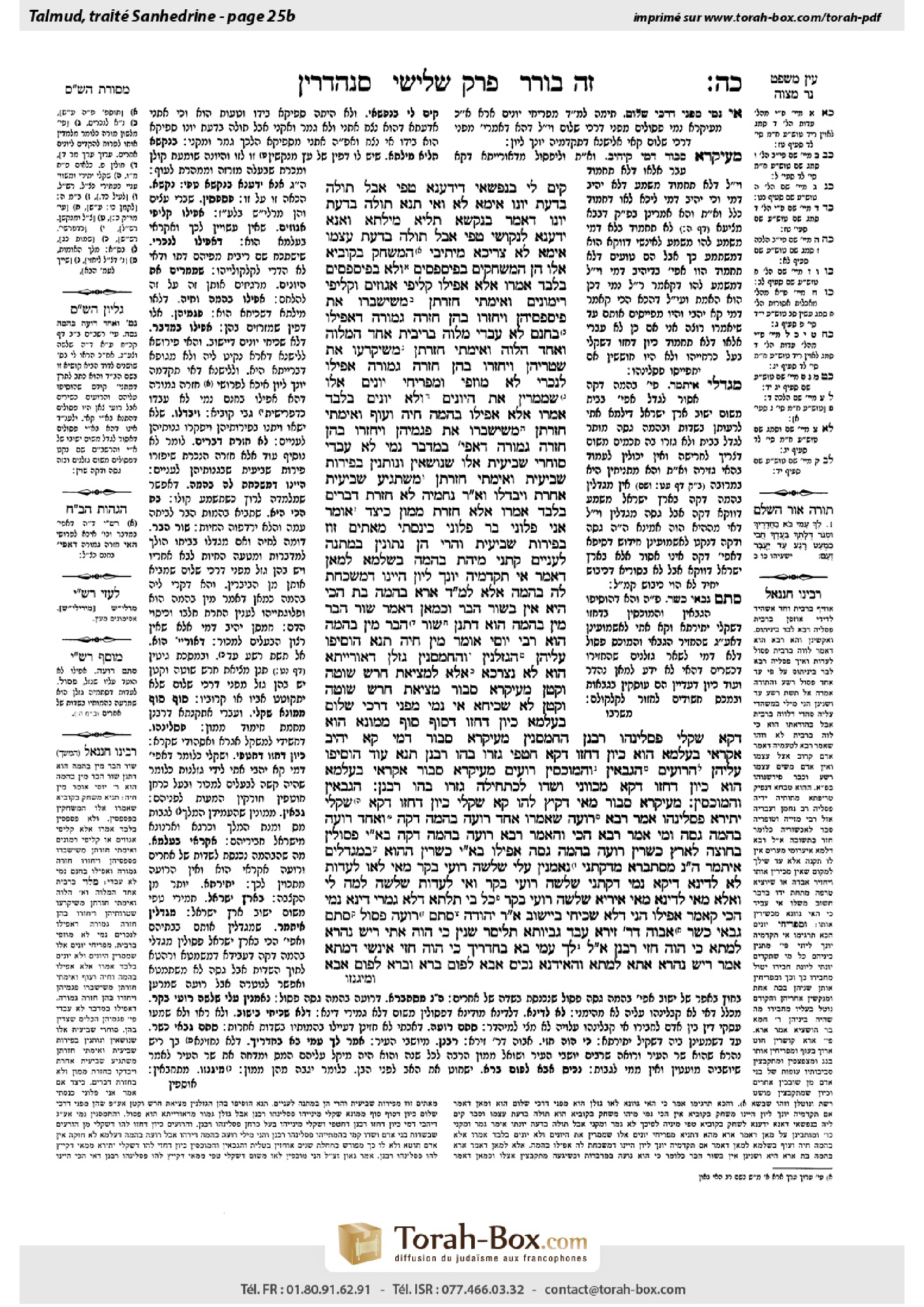
Sanhedrin 25b: Talmud study for Daf Yomi
Daf Yomi is the daily study of one Talmud folio. Explore 37 tractates with scans, Hebrew text, Sefaria English and AI-generated French translations where annotated.
Passage selection and English or AI-generated French translation are available where the scan has annotations. Daf Study is independent of Torah-Box and Sefaria.
Browse Sanhedrin · סנהדרין · All tractatesSanhedrin 25b text and translations
This page of Sanhedrin includes the Aramaic text, an English translation and an AI-generated French translation, alongside the scan above.
סנהדרין כ״ה ב · Aramaic and Hebrew text
קִים לִי בְּנַפְשַׁאי דְּיָדַעְנָא טְפֵי. אֲבָל תּוֹלֶה בְּדַעַת יוֹנוֹ – אֵימָא לָא.
וְאִי תְּנָא תּוֹלֶה בְּדַעַת יוֹנוֹ, דְּאָמַר: בְּנַקָּשָׁא תַּלְיָא מִילְּתָא, וַאֲנָא יָדַעְנָא לְנַקּוֹשֵׁי טְפֵי. אֲבָל תּוֹלֶה בְּדַעַת עַצְמוֹ – אֵימָא לָא. צְרִיכָא.
מֵיתִיבִי: הַמְשַׂחֵק בְּקוּבְיָא – אֵלּוּ הֵן הַמְשַׂחֲקִים בִּפְסֵיפָסִים. וְלֹא בִּפְסֵיפָסִים בִּלְבַד אָמְרוּ, אֶלָּא אֲפִילּוּ קְלִיפֵּי אֱגוֹזִים וּקְלִיפֵּי רִימּוֹנִים.
וְאֵימָתַי חֲזָרָתָן? מִשֶּׁיְּשַׁבְּרוּ אֶת פְּסֵיפָסֵיהֶן וְיַחְזְרוּ בָּהֶן חֲזָרָה גְּמוּרָה, דַּאֲפִילּוּ בְּחִנָּם לָא עָבְדִי.
מַלְוֶה בְּרִיבִּית: אֶחָד הַמַּלְוֶה וְאֶחָד הַלֹּוֶה. וְאֵימָתַי חֲזָרָתָן? מִשֶּׁיְּקָרְעוּ אֶת שְׁטָרֵיהֶן, וְיַחְזְרוּ בָּהֶן חֲזָרָה גְּמוּרָה, דַּאֲפִילּוּ לְגוֹי לָא מוֹזְפִי.
וּמַפְרִיחֵי יוֹנִים – אֵלּוּ שֶׁמַּמְרִין אֶת הַיּוֹנִים. וְלֹא יוֹנִים בִּלְבַד אָמְרוּ, אֶלָּא אֲפִילּוּ בְּהֵמָה חַיָּה וָעוֹף. וְאֵימָתַי חֲזָרָתָן? מִשֶּׁיְּשַׁבְּרוּ אֶת פְּגָמֵיהֶן, וְיַחְזְרוּ בָּהֶן חֲזָרָה גְּמוּרָה, דַּאֲפִילּוּ בַּמִּדְבָּר נָמֵי לָא עָבְדִי.
סוֹחֲרֵי שְׁבִיעִית – אֵלּוּ שֶׁנּוֹשְׂאִין וְנוֹתְנִין בְּפֵירוֹת שְׁבִיעִית. וְאֵימָתַי חֲזָרָתָן? מִשֶּׁתַּגִּיעַ שְׁבִיעִית אַחֶרֶת וְיִבָּדְלוּ.
וְאָמַר רַבִּי נְחֶמְיָה: לֹא חֲזָרַת דְּבָרִים בִּלְבַד אָמְרוּ, אֶלָּא חֲזָרַת מָמוֹן. כֵּיצַד? אוֹמֵר: אֲנִי פְּלוֹנִי בַּר פְּלוֹנִי, כִּינַּסְתִּי מָאתַיִם זוּז בְּפֵירוֹת שְׁבִיעִית, וַהֲרֵי הֵן נְתוּנִין בְּמַתָּנָה לַעֲנִיִּים.
קָתָנֵי מִיהַת: בְּהֵמָה. בִּשְׁלָמָא לְמַאן דְּאָמַר ״אִי תִּקְדְּמֵיהּ יוֹנָךְ לְיוֹן״, הַיְינוּ דְּמַשְׁכַּחַתְּ לַהּ בְּהֵמָה. אֶלָּא לְמַאן דְּאָמַר ״אָרָא״, בְּהֵמָה בַּת הָכִי הִיא?
אִין, בְּשׁוֹר הַבָּר, וּכְמַאן דְּאָמַר שׁוֹר הַבָּר מִין בְּהֵמָה הוּא, דִּתְנַן: שׁוֹר הַבָּר מִין בְּהֵמָה הוּא. רַבִּי יוֹסֵי אוֹמֵר: מִין חַיָּה.
תָּנָא: הוֹסִיפוּ עֲלֵיהֶן הַגַּזְלָנִין וְהַחַמְסָנִין.
גַּזְלָן? דְּאוֹרָיְיתָא הוּא! לֹא נִצְרְכָא אֶלָּא לִמְצִיאַת חֵרֵשׁ, שׁוֹטֶה, וְקָטָן.
מֵעִיקָּרָא סְבוּר: מְצִיאַת חֵרֵשׁ, שׁוֹטֶה, וְקָטָן לָא שְׁכִיחָא. אִי נָמֵי, מִפְּנֵי דַּרְכֵי שָׁלוֹם בְּעָלְמָא. כֵּיוָן דַּחֲזוֹ דְּסוֹף סוֹף מָמוֹנָא הוּא דְּקָא שָׁקְלִי, פַּסְלִינְהוּ רַבָּנַן.
הַחַמְסָנִין, מֵעִיקָּרָא סְבוּר דְּמֵי קָא יָהֵיב (אַקְרַאי בְּעָלְמָא הוּא). כֵּיוָן דַּחֲזוֹ דְּקָא חָטְפִי, גְּזַרוּ בְּהוּ רַבָּנַן.
תָּנָא: עוֹד הוֹסִיפוּ עֲלֵיהֶן הָרוֹעִים, הַגַּבָּאִין, וְהַמּוֹכְסִין.
רוֹעִים, מֵעִיקָּרָא סְבוּר אַקְרַאי בְּעָלְמָא הוּא. כֵּיוָן דַּחֲזוֹ דְּקָא מְכַוְּונִי וְשָׁדוּ לְכַתְּחִילָּה, גְּזַרוּ בְּהוּ רַבָּנַן. הַגַּבָּאִין וְהַמּוֹכְסִין, מֵעִיקָּרָא סְבוּר מַאי דְּקִיץ לְהוּ קָא שָׁקְלִי. כֵּיוָן דַּחֲזוֹ דְּקָא שָׁקְלִי יַתִּירָא, פַּסְלִינְהוּ.
אָמַר רָבָא: רוֹעֶה שֶׁאָמְרוּ, אֶחָד רוֹעֵה בְּהֵמָה דַּקָּה וְאֶחָד רוֹעֵה בְּהֵמָה גַּסָּה.
וּמִי אָמַר רָבָא הָכִי? וְהָאָמַר רָבָא: רוֹעֵה בְּהֵמָה דַּקָּה בְּאֶרֶץ יִשְׂרָאֵל – פְּסוּלִין, בְּחוּצָה לָאָרֶץ – כְּשֵׁרִין. רוֹעֵה בְּהֵמָה גַּסָּה, אֲפִילּוּ בְּאֶרֶץ יִשְׂרָאֵל – כְּשֵׁרִין. הָהוּא בִּמְגַדְּלִים אִיתְּמַר.
הָכִי נָמֵי מִסְתַּבְּרָא, מִדְּקָתָנֵי: נֶאֱמָנִין עָלַי שְׁלֹשָׁה רוֹעֵי בָקָר. מַאי לָאו, לְעֵדוּת?
לָא, לְדִינָא. דַּיְקָא נָמֵי, דְּקָתָנֵי: שְׁלֹשָׁה רוֹעֵי בָקָר. וְאִי לְעֵדוּת, שְׁלֹשָׁה לְמָה לִי?
וְאֶלָּא מַאי, לְדִינָא? מַאי אִירְיָא שְׁלֹשָׁה רוֹעֵי בָקָר? כֹּל בֵּי תְלָתָא דְּלָא גְּמִרִי דִּינָא נָמֵי!
הָכִי קָאָמַר: אֲפִילּוּ הָנֵי דְּלָא שְׁכִיחִי בַּיִּישּׁוּב.
אָמַר רַב יְהוּדָה: סְתָם רוֹעֶה – פָּסוּל, סְתָם גַּבַּאי – כָּשֵׁר.
אֲבוּהּ דְּרַבִּי זֵירָא עֲבַד גַּבְיוּתָא תְּלֵיסַר שְׁנִין. כִּי הֲוָה אָתֵי רֵישׁ נַהֲרָא לְמָתָא, כִּי הֲוָה חָזֵי רַבָּנַן אֲמַר לְהוּ: ״לֵךְ עַמִּי בֹּא בַחֲדָרֶיךָ״. כִּי הֲוָה חָזֵי אִינָשֵׁי דְּמָתָא אָמַר: רֵישׁ נַהֲרָא אֲתָא לְמָתָא, וְהָאִידָּנָא נָכֵיס אַבָּא לְפוּם בְּרָא וּבְרָא לְפוּם אַבָּא,
Sanhedrin 25b · English translation
I am certain of myself that I know better than my competitor how to win. But with regard to one who makes it dependent on the decision of his pigeon, say that he is not disqualified from bearing witness, as he is aware that he cannot guarantee the results and therefore resolves to transfer the money if he loses.
And conversely, had the mishna taught this halakha only with regard to one who makes it dependent on the decision of his pigeon, one might assume that only this type of gambler is disqualified, as he presumably says: The matter, i.e., the race, is determined by knocking on trees and other objects to speed up the pigeons, and I know how to knock better than my opponent. Therefore, he does not resolve to transfer the money if he loses. But with regard to one who makes it dependent on his own decision, say that he is not disqualified from bearing witness, as the roll of the dice is pure chance. Therefore, it is necessary for the mishna to teach both cases.
The Gemara raises an objection to the opinion that the expression: Those who fly pigeons, refers to an ara, from a baraita: With regard to the expression one who plays with dice, these are ones who play with pispasim, which are dice of marble or other types of stone. But the Sages did not mean to say that only one who plays with pispasim is disqualified from bearing witness, but rather even one who plays with nutshells or pomegranate shells is disqualified.
And when is their repentance accepted, so that they may resume being fit to bear witness? Once they break their pispasim and repent of them completely, abandoning this occupation entirely, where they do not do this even for nothing, i.e., they do not play even without betting.
The baraita continues: The expression: One who lends with interest, is referring to both the lender and the borrower. Both are disqualified. And when is their repentance accepted? Once they tear their promissory notes and repent of them completely, abandoning this occupation entirely, where they do not lend with interest even to a gentile.
The expression: And those who fly pigeons, is referring to those who induce the pigeons to behave in this manner, i.e., they train them. And the Sages did not mean to say that only those who fly pigeons are disqualified; rather, even those who do this with a domesticated animal, an undomesticated animal, or any type of bird are disqualified. And when is their repentance accepted? Once they break their fixtures [pigmeihen] upon which they stand the competing animals, and repent completely, abandoning this occupation entirely, where they do not do this even in the wilderness, where there is no one from whom to steal.
The expression: Merchants who trade in the produce of the Sabbatical Year, is referring to those who do business with the produce of the Sabbatical Year. And when is their repentance accepted? Once another Sabbatical Year occurs and they refrain from selling its produce or from assuming ownership of such produce.
The baraita continues: And Rabbi Neḥemya said: The Sages did not say that verbal repentance alone is sufficient for a merchant who traded in the produce of the Sabbatical Year to be reinstated as a valid witness; rather, returning the money is also necessary. How can one return the money he gained from selling produce of the Sabbatical Year? He says: I, so-and-so the son of so-and-so, gathered, i.e., profited, two hundred dinars from trading in the produce of the Sabbatical Year, and as I gained it improperly, this sum is hereby given as a gift to the poor.
The Gemara explains the objection: In any event, it is taught in the baraita that the status of one who flies pigeons applies to one who uses a domesticated animal in the same manner. Granted, according to the one who says that the term: One who flies pigeons, is referring to those who race pigeons, saying: If your pigeon reaches a certain destination before my pigeon I will give you such and such an amount of money, this is how you find a parallel case of one who races a domesticated animal against another animal. But according to the one who says that the term pigeon flyer means an ara, is a domesticated animal capable of luring other domesticated animals?
The Gemara answers: Yes, the baraita states this with regard to the wild ox, which can be lured away from its owner’s property because it is not a completely domesticated animal. And the baraita states this according to the one who says that the wild ox is a species of domesticated animal, as we learned in a mishna (Kilayim 8:6): The wild ox is a species of domesticated animal. But Rabbi Yosei says: It is a species of undomesticated animal.
§ It was taught in a baraita: The Sages added the robbers and those who force transactions, i.e., who compel others to sell to them, to the list of those who are disqualified from bearing witness.
The Gemara asks: A robber is disqualified by Torah law; why is it necessary for the Sages to add such an individual to the list? The Gemara answers: It is necessary only to add one who steals an item found by a deaf-mute, an imbecile, or a minor, who acquire those items by rabbinic law only (see Gittin 59b). Since these people are not considered halakhically competent, by Torah law they do not acquire an item that they find, and consequently one who steals such an item from them is not in violation of a prohibition by Torah law.
One possibility is that taking such an item is prohibited by rabbinic law because it constitutes robbery. Nevertheless, initially the Sages did not disqualify such an individual from bearing witness, as they assumed that the case of an item found by a deaf-mute, an imbecile, or a minor is uncommon. Therefore, it was not deemed necessary to disqualify one who robs them of such an item. Alternatively, the Sages may have reasoned that taking such an item is prohibited merely on account of the ways of peace, i.e., to foster peace and prevent strife and controversy, and is not considered actual robbery. When they realized that ultimately these people were taking property from others and were likely to perform actual robbery, the Sages disqualified them.
Similarly, with regard to those who force transactions, initially the Sages did not disqualify them, as they assumed that their behavior could be excused for two reasons: They would pay money for the items they took, and their forcing transactions was merely occasional; it was not a common practice. When they realized that these people were snatching items regularly, the Sages issued a decree that they are disqualified from bearing witness.
§ It is taught in a baraita: The Sages further added the following to the list of those disqualified from bearing witness: The shepherds, who shepherd their animals in the fields of others and are therefore considered like robbers; the collectors of government taxes, who collect more than the amount that people are legally liable to pay; and the customs officials, who collect customs in an illegal manner.
The Gemara explains: Shepherds were not disqualified at first, as the Sages initially assumed it was merely incidental that they would let their animals graze in the fields of others. When they realized that they would intentionally send the animals to the fields of others from the outset, the Sages issued a decree that they are disqualified from bearing witness. The collectors of taxes and the customs officials were not disqualified at first, as the Sages initially assumed they would take the set amount they were instructed to take. When they realized that these officials were taking more than that, they disqualified them.
Rava says: The shepherd that the Sages said is disqualified from bearing witness is referring to both a shepherd of small livestock and a herder of large livestock.
The Gemara asks: And does Rava say this? But doesn’t Rava say: Shepherds of small livestock in Eretz Yisrael are disqualified from bearing witness, as besides grazing in others’ fields they also ruin the land? Outside of Eretz Yisrael they are fit to bear witness. By contrast, herders of large livestock, even in Eretz Yisrael, are fit to bear witness. The Gemara answers: That was stated with regard to those who raise their animals on their own land, without herding them on land in the public domain.
The Gemara suggests a proof for Rava’s opinion that a herder of large livestock is also disqualified: This too stands to reason, from the fact that the mishna (24a) teaches that a litigant may state: Three cattle herders are trusted for me in court; by inference, cattle herders are generally disqualified. What, is it not with regard to bearing witness that cattle herders are disqualified, in accordance with Rava’s statement?
The Gemara rejects this proof: No, it is with regard to sitting in judgment. The Gemara comments: The language of the mishna is also precise according to this interpretation, as it teaches: Three cattle herders are trusted for me. And if it is with regard to bearing witness, why do I need three witnesses? Two are enough.
The Gemara asks: But rather, with regard to what are cattle herders disqualified? If it is with regard to sitting in judgment, why does the mishna mention specifically three cattle herders? Any three people who did not study halakha are also disqualified from serving as a court.
The Gemara answers: This is what the mishna is saying: The litigants can accept as judges even those cattle herders who dwell in the fields and do not frequent the settled area, and are therefore not proficient in the ways of business.
Rav Yehuda says: An ordinary shepherd is disqualified from bearing witness unless the court recognizes him as one who does not let his animals graze in the fields of others. An ordinary tax collector is fit unless the court determines he is one who collects more than people are obligated to pay.
The Gemara relates a story about a tax collector: The father of Rabbi Zeira collected taxes for thirteen years. When the head tax collector of the river region would come to the city, Rabbi Zeira’s father would prepare the residents ahead of time. When he would see the rabbis, he would say to them as a hint: “Come, my people, enter into your chambers, and shut your doors behind you; hide yourself for a little moment until the indignation has passed” (Isaiah 26:20). He said this so that the head tax collector would not see the rabbis, and it would be possible to lower the taxes of the city. When he would see the ordinary people of the city, he would say to them: Beware, as the head tax collector of the river region is coming to the city, and will now slaughter the father, i.e., take one’s money, before the son, and the son before the father.
Sanhedrin 25b · Traduction française (IA)
Je suis sûr de moi : je sais mieux que mon concurrent comment gagner. Mais, pour celui qui fait dépendre l’issue de la décision de son pigeon, dis qu’il n’est pas disqualifié comme témoin, car il sait qu’il ne peut pas garantir le résultat et décide donc de transférer l’argent s’il perd.
À l’inverse, si la Michna avait enseigné cette halakha uniquement au sujet de celui qui fait dépendre l’issue de la décision de son pigeon, on aurait pu supposer que seul ce type de joueur est disqualifié, puisqu’il se dit vraisemblablement : « La course se décide en frappant sur les arbres et d’autres objets pour faire accélérer les pigeons, et je sais mieux frapper que mon adversaire. » Il ne décide donc pas de transférer l’argent s’il perd. Mais, pour celui qui fait dépendre l’issue de sa propre décision, dis qu’il n’est pas disqualifié comme témoin, puisque le lancer des dés relève du pur hasard. Il est donc nécessaire que la Michna enseigne les deux cas.
La Guemara soulève une objection à l’opinion selon laquelle l’expression « ceux qui font voler des pigeons » désigne un ara, à partir d’une baraïta : l’expression « celui qui joue aux dés » désigne ceux qui jouent avec des pispasim, des dés de marbre ou d’autres sortes de pierre. Mais les Sages n’ont pas voulu dire que seul celui qui joue avec des pispasim est disqualifié comme témoin ; celui qui joue avec des coquilles de noix ou de grenade l’est également.
Et quand leur repentir est-il accepté, de sorte qu’ils puissent de nouveau être aptes à témoigner ? Lorsqu’ils brisent leurs pispasim et s’en repentent complètement, abandonnant entièrement cette activité : ils ne s’y livrent même pas gratuitement, c’est-à-dire qu’ils ne jouent même pas sans miser.
La baraïta poursuit : l’expression « celui qui prête à intérêt » désigne aussi bien le prêteur que l’emprunteur. Tous deux sont disqualifiés. Et quand leur repentir est-il accepté ? Lorsqu’ils déchirent leurs reconnaissances de dette et s’en repentent complètement, abandonnant entièrement cette activité : ils ne prêtent même pas à intérêt à un non-Juif.
L’expression « ceux qui font voler des pigeons » désigne ceux qui incitent les pigeons à se comporter ainsi, c’est-à-dire qui les dressent. Les Sages n’ont pas voulu dire que seuls ceux qui font voler des pigeons sont disqualifiés ; ceux qui agissent ainsi avec un animal domestique, un animal sauvage ou n’importe quelle espèce d’oiseau le sont également. Et quand leur repentir est-il accepté ? Lorsqu’ils brisent leurs dispositifs [pigmeihen], sur lesquels ils placent les animaux qui s’affrontent, et se repentent complètement, abandonnant entièrement cette activité : ils ne s’y livrent même pas dans le désert, où il n’y a personne à qui voler.
L’expression « les marchands qui font commerce des produits de l’année sabbatique » désigne ceux qui font des affaires avec ces produits. Et quand leur repentir est-il accepté ? Lorsqu’une autre année sabbatique survient et qu’ils s’abstiennent de vendre ses produits ou d’en prendre possession.
La baraïta poursuit : Rabbi Neḥemya a dit : « Les Sages n’ont pas dit que le repentir verbal suffit pour qu’un marchand ayant fait commerce des produits de l’année sabbatique soit rétabli dans son statut de témoin apte ; il faut également rendre l’argent. » Comment peut-on rendre l’argent gagné par la vente de ces produits ? On déclare : « Moi, untel fils d’untel, j’ai recueilli, c’est-à-dire tiré profit, de deux cents dinars en faisant commerce des produits de l’année sabbatique ; comme je les ai gagnés illicitement, cette somme est désormais donnée en cadeau aux pauvres. »
La Guemara explique l’objection : Quoi qu’il en soit, la baraïta enseigne que le statut de celui qui fait voler des pigeons s’applique aussi à celui qui utilise de la même manière un animal domestique. Certes, selon celui qui dit que l’expression « celui qui fait voler des pigeons » désigne ceux qui font courir des pigeons, en disant : « Si ton pigeon atteint telle destination avant le mien, je te donnerai telle somme d’argent », on trouve un cas parallèle où quelqu’un fait courir un animal domestique contre un autre. Mais, selon celui qui dit que l’expression « celui qui fait voler des pigeons » désigne un ara, un animal domestique est-il capable d’attirer d’autres animaux domestiques ?
La Guemara répond : Oui, la baraïta parle du bœuf sauvage, que l’on peut attirer hors de la propriété de son propriétaire, car ce n’est pas un animal entièrement domestiqué. La baraïta suit l’opinion selon laquelle le bœuf sauvage est une espèce d’animal domestique, comme nous l’avons appris dans une Michna (Kilayim 8,6) : « Le bœuf sauvage est une espèce d’animal domestique. » Mais Rabbi Yosei dit : « C’est une espèce d’animal sauvage. »
§ Il a été enseigné dans une baraïta : Les Sages ont ajouté les voleurs et ceux qui imposent des transactions, c’est-à-dire qui contraignent les autres à leur vendre des biens, à la liste de ceux qui sont disqualifiés comme témoins.
La Guemara demande : Un voleur est disqualifié par la Torah écrite ; pourquoi les Sages ont-ils besoin d’ajouter une telle personne à la liste ? La Guemara répond : Il s’agit seulement d’ajouter celui qui vole un objet trouvé par une personne sourde-muette, un déficient intellectuel ou un mineur, lesquels acquièrent ces objets uniquement selon la loi rabbinique (voir Gittin 59b). Comme ces personnes ne sont pas considérées comme ayant la capacité halakhique, elles n’acquièrent pas, selon la Torah écrite, un objet qu’elles trouvent ; par conséquent, celui qui leur vole un tel objet ne transgresse pas une interdiction de la Torah écrite.
Il se peut que prendre un tel objet soit interdit par la loi rabbinique parce que cela constitue un vol. Néanmoins, au départ, les Sages n’ont pas disqualifié une telle personne comme témoin, car ils supposaient que le cas d’un objet trouvé par une personne sourde-muette, un déficient intellectuel ou un mineur était rare. Il ne leur semblait donc pas nécessaire de disqualifier celui qui leur dérobait un tel objet. Autre possibilité : les Sages ont pu estimer que prendre un tel objet n’est interdit qu’au titre des voies de la paix, c’est-à-dire afin de favoriser la paix et d’éviter les conflits et les querelles, et que cela ne constitue pas un véritable vol. Lorsqu’ils se sont rendu compte qu’en définitive ces personnes prenaient les biens d’autrui et étaient susceptibles de commettre de véritables vols, les Sages les ont disqualifiées.
De même, pour ceux qui imposent des transactions, les Sages ne les ont pas disqualifiés au départ, car ils supposaient que leur comportement pouvait être excusé pour deux raisons : ils payaient les objets qu’ils prenaient, et ces transactions forcées n’étaient qu’occasionnelles, elles ne constituaient pas une pratique courante. Lorsqu’ils se sont rendu compte que ces personnes s’emparaient régulièrement d’objets, les Sages ont décrété qu’elles étaient disqualifiées comme témoins.
§ Il est enseigné dans une baraïta : Les Sages ont encore ajouté à la liste de ceux qui sont disqualifiés comme témoins les bergers, qui font paître leurs animaux dans les champs d’autrui et sont donc assimilés à des voleurs ; les collecteurs d’impôts du gouvernement, qui prélèvent davantage que ce que les gens sont légalement tenus de payer ; et les percepteurs des droits de douane, qui prélèvent ces droits de manière illégale.
La Guemara explique : Les bergers n’ont pas été disqualifiés au départ, car les Sages supposaient initialement que le fait de laisser leurs animaux paître dans les champs d’autrui n’était qu’accidentel. Lorsqu’ils se sont rendu compte qu’ils envoyaient délibérément leurs animaux dans les champs d’autrui dès le départ, les Sages ont décrété qu’ils étaient disqualifiés comme témoins. Les collecteurs d’impôts et les percepteurs des droits de douane n’ont pas été disqualifiés au départ, car les Sages supposaient initialement qu’ils prélevaient le montant fixe qu’on leur avait ordonné de percevoir. Lorsqu’ils se sont rendu compte que ces fonctionnaires prélevaient davantage, ils les ont disqualifiés.
Rava dit : Le berger que les Sages ont déclaré disqualifié comme témoin désigne aussi bien un berger de petit bétail qu’un berger de gros bétail.
La Guemara demande : Rava dit-il cela ? Rava ne dit-il pas que les bergers de petit bétail en Eretz Israël sont disqualifiés comme témoins, car, outre le fait qu’ils font paître leurs bêtes dans les champs d’autrui, ils dégradent aussi la terre ? En dehors d’Eretz Israël, ils sont aptes à témoigner. En revanche, les bergers de gros bétail, même en Eretz Israël, sont aptes à témoigner. La Guemara répond : Cela a été dit au sujet de ceux qui élèvent leurs animaux sur leurs propres terres, sans les faire paître sur des terres du domaine public.
La Guemara propose une preuve à l’appui de l’opinion de Rava selon laquelle un berger de gros bétail est lui aussi disqualifié : cela paraît également logique, puisque la Michna (24a) enseigne qu’un plaideur peut déclarer : « Trois gardiens de troupeaux me sont dignes de confiance au tribunal » ; on en déduit que les gardiens de troupeaux sont généralement disqualifiés. N’est-ce pas en matière de témoignage que les gardiens de gros bétail sont disqualifiés, conformément à la déclaration de Rava ?
La Guemara rejette cette preuve : Non, il s’agit de siéger comme juge. La Guemara remarque : Le libellé de la Michna est également précis selon cette interprétation, puisqu’elle enseigne : « Trois gardiens de troupeaux me sont dignes de confiance. » Et s’il s’agissait de témoigner, pourquoi aurais-je besoin de trois témoins ? Deux suffisent.
La Guemara demande : Mais alors, en quoi les gardiens de gros bétail sont-ils disqualifiés ? S’il s’agit de siéger comme juges, pourquoi la Michna mentionne-t-elle spécifiquement trois gardiens de gros bétail ? Trois personnes quelconques qui n’ont pas étudié la halakha sont également disqualifiées pour siéger comme tribunal.
La Guemara répond : Voici ce que dit la Michna : les plaideurs peuvent accepter comme juges même ces gardiens de troupeaux qui vivent dans les champs et ne fréquentent pas les zones habitées, et qui, par conséquent, ne connaissent pas bien les usages du commerce.
Rav Yehuda dit : Un berger ordinaire est disqualifié comme témoin, à moins que le tribunal ne sache qu’il ne laisse pas ses animaux paître dans les champs d’autrui. Un collecteur d’impôts ordinaire est apte à témoigner, à moins que le tribunal n’établisse qu’il prélève davantage que ce que les gens sont tenus de payer.
La Guemara rapporte une histoire au sujet d’un collecteur d’impôts : le père de Rabbi Zeira a perçu des impôts pendant treize ans. Lorsque le chef des collecteurs d’impôts de la région du fleuve venait en ville, le père de Rabbi Zeira avertissait les habitants à l’avance. Lorsqu’il voyait les rabbins, il leur disait par allusion : « Va, mon peuple, entre dans tes chambres et ferme les portes derrière toi ; cache-toi un instant, jusqu’à ce que l’indignation soit passée » (Isaïe 26,20). Il disait cela afin que le chef des collecteurs ne voie pas les rabbins et qu’il soit possible de réduire les impôts de la ville. Lorsqu’il voyait les gens ordinaires de la ville, il leur disait : « Attention, le chef des collecteurs d’impôts de la région du fleuve arrive en ville ; il va maintenant égorger le père, c’est-à-dire prendre son argent, avant le fils, et le fils avant le père. »
Traduction française générée par IA à partir de l’édition anglaise de Sefaria. Vérifie toujours un passage avec le texte source.
Text from Sefaria: William Davidson Edition - Vocalized Aramaic (CC BY NC); William Davidson Edition - English (CC BY NC).