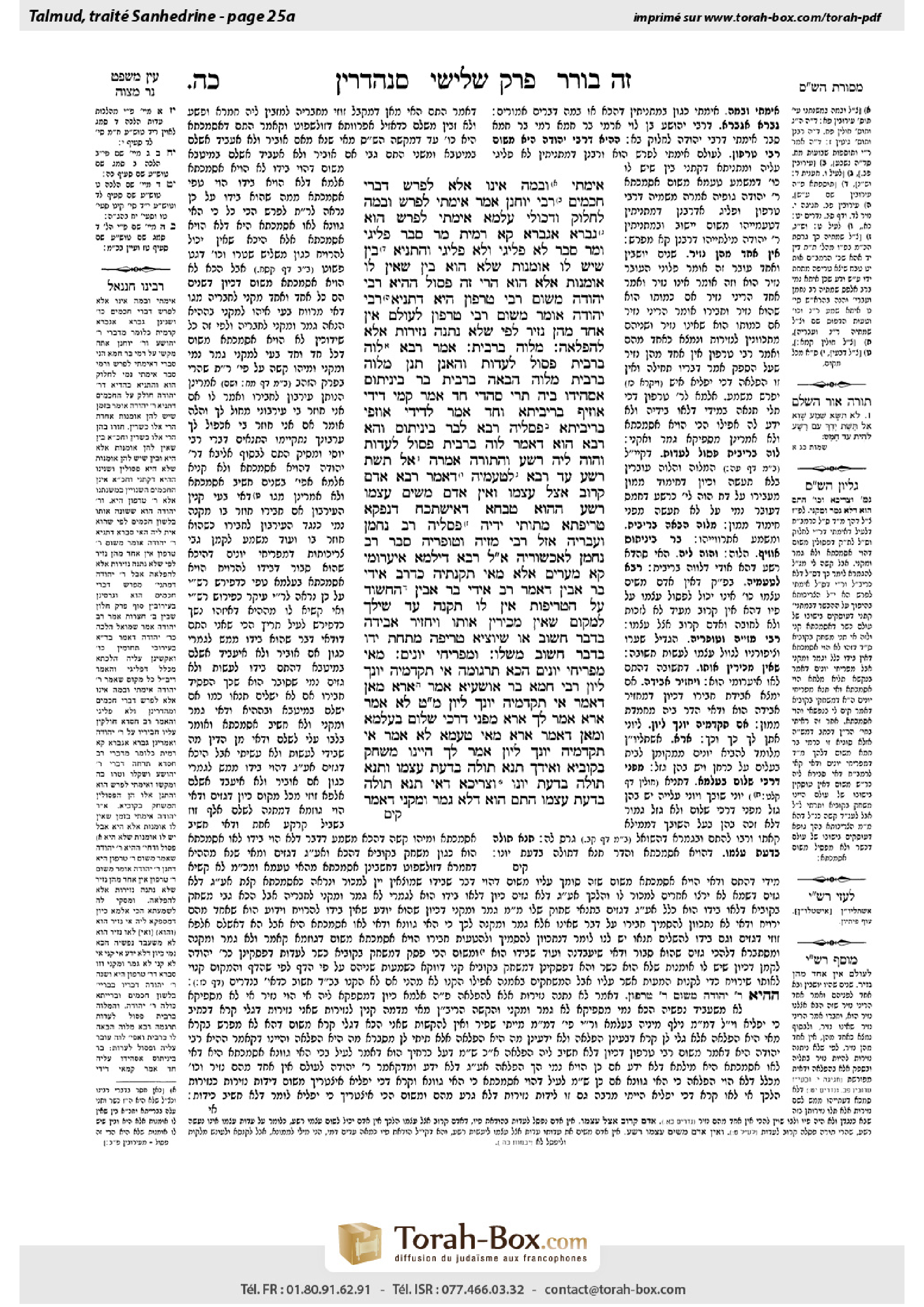
Sanhedrin 25a: Talmud study for Daf Yomi
Daf Yomi is the daily study of one Talmud folio. Explore 37 tractates with scans, Hebrew text, Sefaria English and AI-generated French translations where annotated.
Passage selection and English or AI-generated French translation are available where the scan has annotations. Daf Study is independent of Torah-Box and Sefaria.
Browse Sanhedrin · סנהדרין · All tractatesSanhedrin 25a text and translations
This page of Sanhedrin includes the Aramaic text, an English translation and an AI-generated French translation, alongside the scan above.
סנהדרין כ״ה א · Aramaic and Hebrew text
״אֵימָתַי״ וּ״בַמֶּה״ אֵינוֹ אֶלָּא לְפָרֵשׁ דִּבְרֵי חֲכָמִים.
רַבִּי יוֹחָנָן אָמַר: ״אֵימָתַי״ – לְפָרֵשׁ, וּ״בַמֶּה״ – לַחְלוֹק. וּדְכוּלֵּי עָלְמָא ״אֵימָתַי״ לְפָרֵשׁ הוּא.
גַּבְרָא אַגַּבְרָא קָא רָמֵית? מָר סָבַר: פְּלִיגִי, וּמָר סָבַר: לָא פְּלִיגִי.
וְלָא פְּלִיגִי? וְהָתַנְיָא: בֵּין שֶׁיֵּשׁ לוֹ אוּמָּנוּת שֶׁלֹּא הוּא, בֵּין שֶׁאֵין לוֹ אוּמָּנוּת אֶלָּא הוּא – הֲרֵי זֶה פָּסוּל.
הָהִיא רַבִּי יְהוּדָה מִשּׁוּם רַבִּי טַרְפוֹן הִיא, דְּתַנְיָא: רַבִּי יְהוּדָה אוֹמֵר מִשּׁוּם רַבִּי טַרְפוֹן, לְעוֹלָם אֵין אֶחָד מֵהֶן נָזִיר, לְפִי שֶׁלֹּא נִתְּנָה נְזִירוּת אֶלָּא לְהַפְלָאָה.
מַלְוֶה בְּרִבִּית. אָמַר רָבָא: לָוָה בְּרִבִּית – פָּסוּל לְעֵדוּת. וְהָאֲנַן תְּנַן: מַלְוֶה בְּרִבִּית? מִלְוָה הַבָּאָה בְּרִבִּית.
בַּר בִּינִיתּוֹס אַסְהִידוּ בֵּיהּ תְּרֵי סָהֲדֵי. חַד אָמַר: קַמֵּי דִּידִי אוֹזֵיף בְּרִיבִּיתָא, וְחַד אָמַר: לְדִידִי אוֹזְפַן בְּרִיבִּיתָא. פַּסְלֵיהּ רָבָא לְבַר בִּינִיתּוֹס.
וְהָא רָבָא הוּא דְּאָמַר: לָוָה בְּרִבִּית פָּסוּל לְעֵדוּת, וְהָוֵה לֵיהּ רָשָׁע, וְהַתּוֹרָה אָמְרָה: ״אַל תָּשֶׁת רָשָׁע עֵד״.
רָבָא לְטַעְמֵיהּ, דְּאָמַר רָבָא: אָדָם קָרוֹב אֵצֶל עַצְמוֹ, וְאֵין אָדָם מֵשִׂים עַצְמוֹ רָשָׁע.
הָהוּא טַבָּחָא דְּאִישְׁתְּכַח דִּנְפַקָא טְרֵיפְתָּא מִתּוּתֵי יְדֵיהּ, פַּסְלֵיהּ רַב נַחְמָן וְעַבְּרֵיהּ. אֲזַל רַבִּי מַזְיֵהּ וְטוּפְרֵיהּ. סְבַר רַב נַחְמָן לְאַכְשׁוֹרֵיהּ.
אֲמַר לֵיהּ רָבָא: דִּילְמָא אִיעָרוֹמֵי קָא מַעֲרֵים?
אֶלָּא מַאי תַּקַּנְתֵּיהּ? כִּדְרַב אִידִי בַּר אָבִין, דְּאָמַר רַב אִידִי בַּר אָבִין: הֶחָשׁוּד עַל הַטְּרֵיפוֹת אֵין לוֹ תַּקָּנָה עַד שֶׁיֵּלֵךְ לְמָקוֹם שֶׁאֵין מַכִּירִין אוֹתוֹ וְיַחְזִיר אֲבֵידָה בְּדָבָר חָשׁוּב, אוֹ שֶׁיּוֹצִיא טְרֵיפָה מִתַּחַת יָדוֹ בְּדָבָר חָשׁוּב מִשֶּׁלּוֹ.
וּמַפְרִיחֵי יוֹנִים, מַאי מַפְרִיחֵי יוֹנִים? הָכָא תַּרְגִּימוּ: ״אִי תִּקְדְּמֵיהּ יוֹנָךְ לְיוֹן״. רַבִּי חָמָא בַּר אוֹשַׁעְיָא אָמַר: ״אָרָא״.
מַאן דְּאָמַר: ״אִי תִּקְדְּמֵיהּ יוֹנָךְ לְיוֹן״, מַאי טַעְמָא לָא אָמַר ״אָרָא״?
אָמַר לָךְ: ״אָרָא״ – מִפְּנֵי דַּרְכֵי שָׁלוֹם בְּעָלְמָא.
וּמַאן דְּאָמַר ״אָרָא״, מַאי טַעְמָא לָא אָמַר: ״אִי תִּקְדְּמֵיהּ יוֹנָךְ לְיוֹן״? אָמַר לָךְ: הַיְינוּ מְשַׂחֵק בְּקוּבְיָא.
וְאִידַּךְ?
תְּנָא תּוֹלֶה בְּדַעַת עַצְמוֹ, וּתְנָא תּוֹלֶה בְּדַעַת יוֹנוֹ.
וּצְרִיכָא, דְּאִי תְּנָא תּוֹלֶה בְּדַעַת עַצְמוֹ – הָתָם הוּא דְּלָא גָּמַר וּמַקְנֵי, דְּאָמַר:
Sanhedrin 25a · English translation
When does this halakha apply, or: In what case is this statement said, he intends only to explain the statement of the Rabbis, not to disagree with them?
Granted, Rabbi Yoḥanan disagrees with Rabbi Yehoshua ben Levi, and says that only the term: When does this halakha apply, indicates that Rabbi Yehuda intends to explain the previous statement of the Rabbis, but the term: In what case is this statement said, indicates that he intends to disagree. But according to everyone, the term when indicates that he intends to explain the previous statement. This is difficult according to Rami bar Ḥama.
The Gemara responds: Are you setting the statement of one man against the statement of another man? One Sage, Rami bar Ḥama, holds that Rabbi Yehuda and the Rabbis disagree even when Rabbi Yehuda employs the term: When does this halakha apply, and one Sage, Rabbi Yehoshua ben Levi, and similarly Rabbi Yoḥanan, holds that they do not disagree.
The Gemara asks: And do they not disagree? But isn’t it taught in a baraita: Whether a dice player has an occupation other than this one, or whether he does not have an occupation other than this one, he is disqualified from bearing witness? This baraita is in accordance with the opinion of Rami bar Ḥama.
The Gemara answers: That baraita is not the opinion of the Rabbis in the mishna, but rather it is the opinion of Rabbi Yehuda in the name of Rabbi Tarfon. As it is taught in a baraita that Rabbi Yehuda says in the name of Rabbi Tarfon: In the case where two people quarreled and each of them declared that if the other is right he will become a nazirite, actually, neither of them becomes a nazirite, as naziriteship is determined only by explicitness. A vow of naziriteship does not take effect if the individual does not vow clearly and with certitude. Here too, Rabbi Tarfon maintains that one who bets on games played with dice is considered a thief, as one can acquire the money of another legally only if the latter gives it to him with certain and conclusive intent. Since one who plays dice is not certain that he will have to pay the other player, as he considers it likely that he will win, the transaction is an asmakhta and is legally invalid.
§ The mishna teaches that one who lends money with interest is disqualified from bearing witness. Rava says: One who borrows money with interest is disqualified from bearing witness. The Gemara asks: But didn’t we learn in the mishna that specifically one who lends money with interest is disqualified? The Gemara answers: The reference in the mishna is to a loan that comes with interest, and is teaching that all those who participate in the loan are disqualified.
The Gemara recounts: Two witnesses testified about bar Binittos. One said: He lent money with interest in my presence, and the other one said: He lent me money with interest. Rava rendered bar Binittos disqualified from bearing witness and from serving as a judge.
The Gemara asks: But isn’t Rava the one who said that one who borrows money with interest is disqualified from bearing witness? And accordingly the latter witness is considered a wicked man, as by his own account he borrowed money with interest from bar Binittos, and the Torah states: Do not place a wicked man as a witness (see Exodus 23:1). Consequently, the testimony of that witness cannot be accepted, and bar Binittos should not have been disqualified.
The Gemara answers: Rava conforms to his standard line of reasoning, as Rava says: A person is his own relative and a person cannot make himself wicked. Consequently, the part of the testimony that relates to the witness’s own status is not accepted, while the part that relates to bar Binittos is accepted.
There was a certain slaughterer about whom it was discovered that a tereifa, an animal with a wound that would have caused it to die within twelve months, emerged from his possession. In other words, he sold tereifa meat without informing the customers of its status. Rav Naḥman disqualified him from bearing witness and removed him from his position as a slaughterer. The slaughterer subsequently went and grew his fingernails and his hair out of remorse over his actions. Rav Naḥman thought to deem him fit again for bearing witness, as he clearly repented, and once someone repents for his sin, his status as a valid witness is restored.
Rava said to Rav Naḥman: Perhaps he is employing artifice, pretending to repent in order to be reinstated as a slaughterer.
Rather, what is his remedy? It is in accordance with the statement of Rav Idi bar Avin; as Rav Idi bar Avin says: One who is suspected of selling tereifot to others has no remedy to restore his fitness to bear witness until he goes to a locale where they do not recognize him and returns a lost item of substantial value that he finds, or removes his own tereifa meat of significant value from his possession. These actions demonstrate that he has repented, as he is willing to lose money for a mitzva. By contrast, if he does so in a place where he is recognized his fitness in not reinstated based on these actions, as perhaps he performed them only in order to be reinstated.
§ Among the list of those who are disqualified from bearing witness the mishna teaches: And those who fly pigeons. The Gemara asks: What is meant by: Those who fly pigeons? Here, in Babylonia, the Sages explained that these are people who gamble on pigeon races, i.e., one says to another: If your pigeon reaches a certain destination before my pigeon I will give you such and such an amount of money. Rabbi Ḥama bar Oshaya says: It is referring to an ara, i.e., one who trains his pigeons to bring him pigeons from the property of others.
The Gemara asks: With regard to the one who says that it is referring to those who say: If your pigeon reaches a certain destination before my pigeon I will give you such and such an amount of money, what is the reason that he does not say that it is referring to an ara?
The Gemara answers: He could say to you that an ara is not considered a robber, as the pigeons that he has his pigeons bring do not actually belong to those from whom he takes them. Rather, they dwell on the property of these individuals, and it is prohibited to take them merely due to the ways of peace.
The Gemara asks: And with regard to the one who says that the mishna is referring to an ara, what is the reason that he does not say that it is referring to one who says: If your pigeon reaches a certain destination before my pigeon I will give you such and such an amount of money? The Gemara answers: He could say to you that this individual is the same as one who plays with dice; they both gamble on games of chance. This type of disqualification is already listed in the mishna.
The Gemara asks: And how would the other Sage, who maintains that the expression: Those who fly pigeons, is referring to those who gamble on racing their pigeons, respond to this claim?
The Gemara answers that it is necessary for the mishna to teach that both types of gamblers are disqualified. The mishna taught that one who bets on dice, making it dependent on his own decision, as he believes he has a method by which he will win, is disqualified, and the mishna taught that one who bets on pigeon races, making it dependent on the decision of his pigeon, is also disqualified.
The Gemara explains: And both are necessary. As had the mishna taught this halakha only with regard to one who bets on dice, making it dependent on his own decision, one might reason that it is specifically there that a gambler is considered a thief. The reason for this is that he presumably does not resolve to transfer the money if he loses; as he says to himself:
Sanhedrin 25a · Traduction française (IA)
Quand cette halakha s’applique — autrement dit, dans quel cas cette déclaration est-elle formulée ? Il entend seulement expliquer la déclaration des Rabbins, et non s’opposer à eux.
Certes, Rabbi Yoḥanan est en désaccord avec Rabbi Yehoshua ben Levi et dit que seule l’expression « Quand cette halakha s’applique » indique que Rabbi Yehuda entend expliquer la déclaration précédente des Rabbins, tandis que l’expression « Dans quel cas cette déclaration est-elle formulée ? » indique qu’il entend s’opposer à eux. Mais, selon tous, le terme « quand » indique qu’il entend expliquer la déclaration précédente. Cela pose une difficulté à l’opinion de Rami bar Ḥama.
La Guemara répond : Opposes-tu la déclaration d’un homme à celle d’un autre ? Un Sage, Rami bar Ḥama, soutient que Rabbi Yehuda et les Rabbins sont en désaccord même lorsque Rabbi Yehuda emploie l’expression « Quand cette halakha s’applique », tandis qu’un autre Sage, Rabbi Yehoshua ben Levi — et Rabbi Yoḥanan également — soutient qu’ils ne sont pas en désaccord.
La Guemara demande : Mais ne sont-ils pas en désaccord ? N’est-il pas enseigné dans une baraïta : Qu’un joueur de dés ait ou non une autre activité professionnelle, il est disqualifié pour témoigner ? Cette baraïta est conforme à l’opinion de Rami bar Ḥama.
La Guemara répond : Cette baraïta ne reflète pas l’opinion des Rabbins de la Michna ; elle reflète plutôt celle de Rabbi Yehuda au nom de Rabbi Tarfon. En effet, il est enseigné dans une baraïta que Rabbi Yehuda dit au nom de Rabbi Tarfon : Dans le cas de deux personnes qui se sont disputées et dont chacune a déclaré que, si l’autre avait raison, elle deviendrait nazir, en réalité, aucune des deux ne devient nazir, car le naziréat n’est déterminé que par une déclaration explicite. Un vœu de naziréat ne prend pas effet si la personne ne le formule pas clairement et avec certitude. Ici aussi, Rabbi Tarfon soutient que celui qui parie aux dés est considéré comme un voleur, car on ne peut acquérir légalement l’argent d’autrui que si celui-ci le lui remet avec une intention certaine et sans équivoque. Puisque celui qui joue aux dés n’est pas certain de devoir payer l’autre joueur, car il estime probable qu’il gagnera, la transaction constitue une asmakhta et est juridiquement invalide.
§ La Michna enseigne que celui qui prête de l’argent à intérêt est disqualifié pour témoigner. Rava dit : Celui qui emprunte de l’argent à intérêt est disqualifié pour témoigner. La Guemara demande : Mais n’avons-nous pas appris dans la Michna que c’est précisément celui qui prête de l’argent à intérêt qui est disqualifié ? La Guemara répond : La Michna parle d’un prêt à intérêt et enseigne que tous ceux qui prennent part au prêt sont disqualifiés.
La Guemara rapporte : Deux témoins ont déposé au sujet de bar Binittos. L’un a dit : « Il a prêté de l’argent à intérêt en ma présence », et l’autre a dit : « Il m’a prêté de l’argent à intérêt. » Rava a déclaré bar Binittos disqualifié pour témoigner et exercer la fonction de juge.
La Guemara demande : Mais n’est-ce pas Rava qui a dit que celui qui emprunte de l’argent à intérêt est disqualifié pour témoigner ? Par conséquent, le second témoin est considéré comme un homme mauvais, puisqu’il reconnaît lui-même avoir emprunté de l’argent à intérêt à bar Binittos, et la Torah dit : « Ne place pas un homme mauvais comme témoin » (voir Exode 23:1). Dès lors, le témoignage de ce témoin ne peut être accepté, et bar Binittos n’aurait pas dû être disqualifié.
La Guemara répond : Rava reste fidèle à son raisonnement habituel, car Rava dit : Une personne est apparentée à elle-même, et une personne ne peut pas se rendre mauvaise. Par conséquent, la partie du témoignage qui concerne le statut du témoin lui-même n’est pas acceptée, tandis que celle qui concerne bar Binittos est acceptée.
Il y avait un certain boucher chez qui l’on découvrit une tereifa — un animal atteint d’une blessure qui l’aurait fait mourir dans les douze mois. Autrement dit, il vendait de la viande de tereifa sans informer ses clients de son statut. Rav Naḥman le disqualifia pour témoigner et le démit de ses fonctions de boucher. Par la suite, le boucher se laissa pousser les ongles et les cheveux, par remords pour ses actes. Rav Naḥman envisagea de le déclarer à nouveau apte à témoigner, puisqu’il s’était manifestement repenti et que, dès lors qu’une personne se repent de son péché, son statut de témoin valide lui est rendu.
Rava dit à Rav Naḥman : Peut-être use-t-il d’un artifice et feint-il de se repentir afin d’être réintégré dans ses fonctions de boucher.
Alors, quel est son recours ? Il faut suivre l’enseignement de Rav Idi bar Avin, car Rav Idi bar Avin dit : Celui qui est soupçonné d’avoir vendu des tereifot à autrui ne peut retrouver son aptitude à témoigner qu’après s’être rendu dans un endroit où l’on ne le connaît pas et y avoir restitué un objet perdu de grande valeur qu’il a trouvé, ou après avoir retiré de sa propre possession de la viande de tereifa d’une valeur importante. Ces actes démontrent qu’il s’est repenti, puisqu’il est disposé à perdre de l’argent pour accomplir une mitsva. En revanche, s’il agit ainsi dans un endroit où on le connaît, ces actes ne lui rendent pas son aptitude, car il se peut qu’il les ait accomplis uniquement pour être réintégré.
§ Parmi les catégories de personnes disqualifiées pour témoigner, la Michna enseigne : « Et ceux qui font voler des pigeons. » La Guemara demande : Que signifie « ceux qui font voler des pigeons » ? Ici, en Babylonie, les Sages ont expliqué qu’il s’agit de personnes qui parient sur des courses de pigeons : l’une dit à l’autre : « Si ton pigeon atteint un certain endroit avant le mien, je te donnerai telle somme d’argent. » Rabbi Ḥama bar Oshaya dit : Il s’agit d’un ara, c’est-à-dire de quelqu’un qui dresse ses pigeons pour qu’ils lui rapportent des pigeons appartenant à autrui.
La Guemara demande : Pour celui qui dit qu’il s’agit de personnes qui disent : « Si ton pigeon atteint un certain endroit avant le mien, je te donnerai telle somme d’argent », pourquoi ne dit-il pas qu’il s’agit d’un ara ?
La Guemara répond : Il pourrait te dire qu’un ara n’est pas considéré comme un voleur, car les pigeons que ses pigeons lui rapportent n’appartiennent pas réellement à ceux à qui il les prend. Ils séjournent plutôt sur les propriétés de ces personnes, et il est interdit de les prendre uniquement au titre des voies de la paix.
La Guemara demande : Et pour celui qui dit que la Michna parle d’un ara, pourquoi ne dit-il pas qu’elle parle de quelqu’un qui dit : « Si ton pigeon atteint un certain endroit avant le mien, je te donnerai telle somme d’argent » ? La Guemara répond : Il pourrait te dire que cette personne est semblable à celui qui joue aux dés : tous deux parient à des jeux de hasard. Cette catégorie de personnes disqualifiées figure déjà dans la Michna.
La Guemara demande : Et que répondrait l’autre Sage, qui soutient que l’expression « ceux qui font voler des pigeons » désigne ceux qui parient sur des courses de pigeons ?
La Guemara répond qu’il est nécessaire que la Michna enseigne que les deux types de joueurs sont disqualifiés. La Michna a enseigné qu’est disqualifié celui qui parie aux dés, en faisant dépendre l’issue de sa propre décision, car il pense disposer d’une méthode qui lui permettra de gagner ; et elle a enseigné qu’est également disqualifié celui qui parie sur des courses de pigeons, en faisant dépendre l’issue de la décision de son pigeon.
La Guemara explique : Les deux cas sont nécessaires. Car si la Michna avait enseigné cette halakha uniquement à propos de celui qui parie aux dés, en faisant dépendre l’issue de sa propre décision, on aurait pu penser que c’est précisément dans ce cas qu’un joueur est considéré comme un voleur. La raison en est qu’il ne se résout vraisemblablement pas à transférer l’argent s’il perd, puisqu’il se dit :
Traduction française générée par IA à partir de l’édition anglaise de Sefaria. Vérifie toujours un passage avec le texte source.
Text from Sefaria: William Davidson Edition - Vocalized Aramaic (CC BY NC); William Davidson Edition - English (CC BY NC).