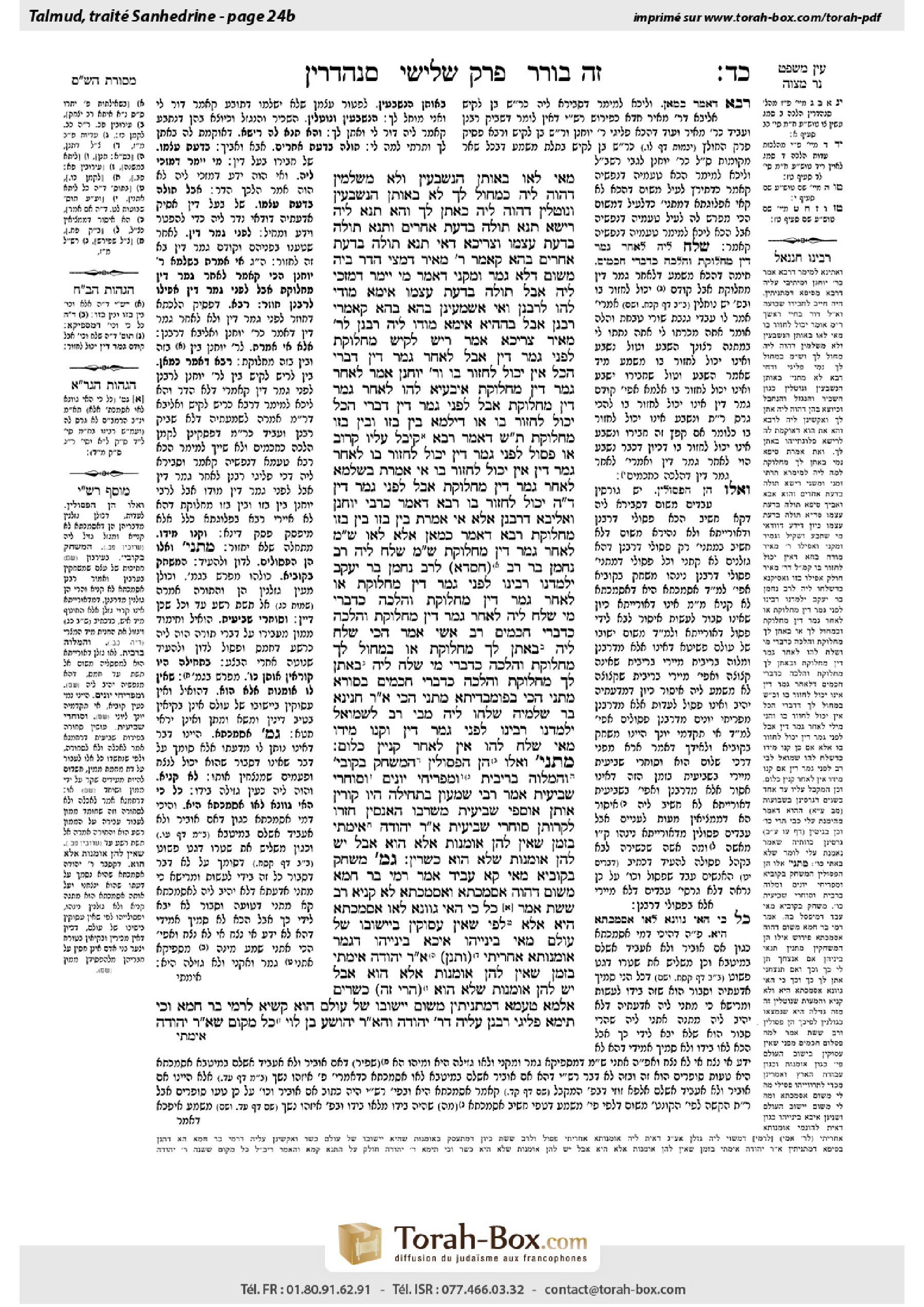
Sanhedrin 24b: Talmud study for Daf Yomi
Daf Yomi is the daily study of one Talmud folio. Explore 37 tractates with scans, Hebrew text, Sefaria English and AI-generated French translations where annotated.
Passage selection and English or AI-generated French translation are available where the scan has annotations. Daf Study is independent of Torah-Box and Sefaria.
Browse Sanhedrin · סנהדרין · All tractatesSanhedrin 24b text and translations
This page of Sanhedrin includes the Aramaic text, an English translation and an AI-generated French translation, alongside the scan above.
סנהדרין כ״ד ב · Aramaic and Hebrew text
מַאי לָאו בְּאוֹתָן הַנִּשְׁבָּעִין וְלֹא מְשַׁלְּמִין, דַּהֲוָה לֵיהּ כְּ״מָחוּל לָךְ״?
לָא, בְּאוֹתָן הַנִּשְׁבָּעִין וְנוֹטְלִין, דְּהָוֵה לֵיהּ כְּ״אֶתֵּן לָךְ״.
וְהָא תְּנָא לֵיהּ רֵישָׁא!
תְּנָא תּוֹלֶה בְּדַעַת אֲחֵרִים, וּתְנָא תּוֹלֶה בְּדַעַת עַצְמוֹ.
וּצְרִיכָא, דְּאִי תְּנָא תּוֹלֶה בְּדַעַת אֲחֵרִים – בְּהָא קָאָמַר רַבִּי מֵאִיר דְּמָצֵי הָדַר בֵּיהּ, מִשּׁוּם דְּלָא גָּמַר וּמַקְנֵי, דְּאָמַר: ״מִי יֵימַר דִּמְזַכֵּי לֵיהּ?״ אֲבָל תּוֹלֶה בְּדַעַת עַצְמוֹ, אֵימָא מוֹדֵי לְהוּ לְרַבָּנַן.
וְאִי אַשְׁמְעִינַן בְּהָא, בְּהָא קָאָמְרִי רַבָּנַן, אֲבָל בְּהַהִיא אֵימָא מוֹדוּ לֵיהּ רַבָּנַן לְרַבִּי מֵאִיר. צְרִיכָא.
אָמַר רֵישׁ לָקִישׁ: מַחְלוֹקֶת לִפְנֵי גְּמַר דִּין, אֲבָל לְאַחַר גְּמַר דִּין – דִּבְרֵי הַכֹּל אֵין יָכוֹל לַחְזוֹר בּוֹ. וְרַבִּי יוֹחָנָן אָמַר: לְאַחַר גְּמַר דִּין מַחְלוֹקֶת.
אִיבַּעְיָא לְהוּ: לְאַחַר גְּמַר דִּין מַחְלוֹקֶת, אֲבָל לִפְנֵי גְּמַר דִּין דִּבְרֵי הַכֹּל יָכוֹל לַחְזוֹר בּוֹ? אוֹ דִילְמָא: בֵּין בָּזוֹ וּבֵין בָּזוֹ מַחְלוֹקֶת?
תָּא שְׁמַע, דְּאָמַר רָבָא: קִיבֵּל עָלָיו קָרוֹב אוֹ פָּסוּל – לִפְנֵי גְּמַר דִּין יָכוֹל לַחְזוֹר בּוֹ, לְאַחַר גְּמַר דִּין אֵין יָכוֹל לַחְזוֹר בּוֹ.
אִי אָמְרַתְּ בִּשְׁלָמָא: לְאַחַר גְּמַר דִּין מַחְלוֹקֶת, אֲבָל לִפְנֵי גְּמַר דִּין דִּבְרֵי הַכֹּל יָכוֹל לַחְזוֹר בּוֹ – רָבָא דְּאָמַר כְּרַבִּי יוֹחָנָן וְאַלִּיבָּא דְּרַבָּנַן. אֶלָּא אִי אָמְרַתְּ: בֵּין בָּזוֹ בֵּין בָּזוֹ מַחְלוֹקֶת – רָבָא דְּאָמַר כְּמַאן?
אֶלָּא, לָאו שְׁמַע מִינַּהּ: לְאַחַר גְּמַר דִּין מַחְלוֹקֶת? שְׁמַע מִינַּהּ.
שְׁלַח לֵיהּ רַב נַחְמָן בַּר רַב חִסְדָּא לְרַב נַחְמָן בַּר יַעֲקֹב: יְלַמְּדֵנוּ רַבֵּינוּ, לִפְנֵי גְּמַר דִּין מַחְלוֹקֶת אוֹ לְאַחַר גְּמַר דִּין מַחְלוֹקֶת? וַהֲלָכָה כְּדִבְרֵי מִי? שְׁלַח לֵיהּ: לְאַחַר גְּמַר דִּין מַחְלוֹקֶת, וַהֲלָכָה כְּדִבְרֵי חֲכָמִים.
רַב אָשֵׁי אָמַר: הָכִי שְׁלַח לֵיהּ, בְּ״אֶתֵּן לָךְ״ מַחְלוֹקֶת, אוֹ בְּ״מָחוּל לָךְ״ מַחְלוֹקֶת? וַהֲלָכָה כְּדִבְרֵי מִי? שְׁלַח לֵיהּ: בְּ״אֶתֵּן לָךְ״ מַחְלוֹקֶת, וַהֲלָכָה כְּדִבְרֵי חֲכָמִים.
בְּסוּרָא מַתְנוּ הָכִי. בְּפוּמְבְּדִיתָא מַתְנוּ הָכִי, אָמַר רַב חֲנִינָא בַּר שֶׁלֶמְיָה: שְׁלַחוּ לֵיהּ מִבֵּי רַב לִשְׁמוּאֵל, יְלַמְּדֵנוּ רַבֵּינוּ: לִפְנֵי גְּמַר דִּין וְקָנוּ מִיָּדוֹ, מַאי? שְׁלַח לְהוּ: אֵין לְאַחַר קִנְיָין כְּלוּם.
מַתְנִי׳ וְאֵלּוּ הֵן הַפְּסוּלִין: הַמְשַׂחֵק בְּקוּבְיָא, וְהַמַּלְוֶה בְּרִיבִּית, וּמַפְרִיחֵי יוֹנִים, וְסוֹחֲרֵי שְׁבִיעִית.
אָמַר רַבִּי שִׁמְעוֹן: בַּתְּחִילָּה הָיוּ קוֹרִין אוֹתָן אוֹסְפֵי שְׁבִיעִית. מִשֶּׁרַבּוּ הָאַנָּסִין, חָזְרוּ לִקְרוֹתָן סוֹחֲרֵי שְׁבִיעִית.
אָמַר רַבִּי יְהוּדָה: אֵימָתַי? בִּזְמַן שֶׁאֵין לָהֶן אוּמָּנוּת אֶלָּא הוּא, אֲבָל יֵשׁ לָהֶן אוּמָּנוּת שֶׁלֹּא הוּא – כְּשֵׁרִין.
גְּמָ׳ מְשַׂחֵק בְּקוּבְיָא, מַאי קָא עָבֵיד? אָמַר רָמֵי בַּר חָמָא: מִשּׁוּם דְּהָוֵה אַסְמַכְתָּא, וְאַסְמַכְתָּא לָא קָנְיָא.
רַב שֵׁשֶׁת אָמַר: כֹּל כִּי הַאי גַוְונָא לָאו אַסְמַכְתָּא הִיא, אֶלָּא לְפִי שֶׁאֵין עֲסוּקִין בְּיִישּׁוּבוֹ שֶׁל עוֹלָם.
מַאי בֵּינַיְיהוּ? אִיכָּא בֵּינַיְיהוּ דִּגְמַר אוּמָּנוּתָא אַחֲרִיתִי.
וּתְנַן, אָמַר רַבִּי יְהוּדָה: אֵימָתַי? בִּזְמַן שֶׁאֵין לָהֶן אוּמָּנוּת אֶלָּא הוּא; אֲבָל יֵשׁ לָהֶן אוּמָּנוּת שֶׁלֹּא הוּא – הֲרֵי זֶה כְּשֵׁרִים. אַלְמָא, טַעְמָא דְמַתְנִיתִין מִשּׁוּם יִישּׁוּבוֹ שֶׁל עוֹלָם הוּא. קַשְׁיָא לְרָמֵי בַּר חָמָא!
וְכִי תֵּימָא: פְּלִיגִי רַבָּנַן עֲלֵיהּ דְּרַבִּי יְהוּדָה? וְהָא אָמַר רַבִּי יְהוֹשֻׁעַ בֶּן לֵוִי: כׇּל מָקוֹם שֶׁאָמַר רַבִּי יְהוּדָה
Sanhedrin 24b · English translation
What, is it not referring to those who take an oath and do not pay, i.e., cases where the defendant is obligated to take an oath that the claim against him is false, and he is thereby exempt from paying? Accordingly, it is the claimant who suggests that the defendant take a vow instead, which is the same as saying: If you take a vow, the money I claim you owe is forgiven you.
The Gemara rejects this objection: No, it is referring to those who take an oath and collect a debt. There are cases where it is the claimant who is obligated to take an oath, and he then collects the money that he claims. In a case where the defendant suggests that the claimant take a vow instead, it is the same as saying: If you take a vow I will give you what you claim.
The Gemara challenges: But according to Rava’s interpretation, the mishna already taught the halakha in a case where the defendant says: I will give you, in the first clause, where the defendant accepts unfit judges.
The Gemara answers: The mishna taught in the former clause a case where the defendant makes the outcome dependent on the decision of others, namely, his father or the father of the claimant; and the mishna taught in the latter clause a case where he makes the outcome dependent on the claimant’s own decision.
And it is necessary for the mishna to teach both cases, since if the mishna taught only the case where he makes the outcome dependent on the decision of others, one might reason that specifically in this case Rabbi Meir says that he can retract his acceptance of the unfit judges. This is because he presumably did not resolve to transfer the money if these judges deem him liable, as he must have said to himself: Who will say that the judges will rule in favor of the claimant? But in a case where he makes the outcome dependent on the claimant’s own decision by suggesting that he take a vow, say that Rabbi Meir concedes to the Rabbis that the defendant cannot retract his commitment to pay.
And conversely, if the mishna would teach us only this latter case, where the defendant suggests that the claimant take a vow, one might reason that specifically in this case the Rabbis say that he cannot retract his offer; but in that former case, where he makes the outcome dependent on the decision of others, say that the Rabbis concede to Rabbi Meir that he can retract his acceptance of the unfit judges. Therefore, it is necessary for the mishna to teach both cases.
§ Reish Lakish says: The dispute between Rabbi Meir and the Rabbis concerns whether or not one can retract his acceptance of unfit judges before the verdict is issued. But after the verdict is issued, everyone agrees that one cannot retract his acceptance, as he has already been deemed liable. And Rabbi Yoḥanan says: The dispute concerns whether or not one can retract his acceptance after the verdict is issued.
A dilemma was raised before the Sages with regard to the opinion of Rabbi Yoḥanan: Is the dispute over whether one can retract his acceptance after the verdict is issued, but before the verdict is issued, everyone agrees that he can retract his acceptance? Or perhaps Rabbi Yoḥanan maintains that the dispute is both with regard to this case and with regard to that case.
The Gemara suggests: Come and hear a resolution to the dilemma, as Rava says: If one accepted a relative upon himself as a judge or witness, or if he accepted one who is disqualified for another reason from serving as a judge or a witness, he can retract his acceptance before the verdict is issued. He cannot retract his acceptance after the verdict is issued.
Granted, this makes sense if you say that according to Rabbi Yoḥanan too, the dispute concerns whether one can retract his acceptance after the verdict is issued, but before the verdict is issued everyone agrees that one can retract his acceptance; then this means that Rava is stating the halakha in accordance with the opinion of Rabbi Yoḥanan, and according to the opinion of the Rabbis. But if you say that according to Rabbi Yoḥanan, the dispute is both with regard to this case and with regard to that case, then in accordance with whose opinion is Rava stating the halakha? His statement is in accordance with the opinion of neither Reish Lakish nor Rabbi Yoḥanan.
Rather, must we not conclude from Rava’s statement that the dispute is over whether one can retract his acceptance after the verdict is issued? The Gemara affirms: Conclude from Rava’s statement that this is so.
Rav Naḥman, son of Rav Ḥisda, sent the following question to Rav Naḥman bar Ya’akov: Our teacher, instruct us: Does the dispute concern whether or not one can retract his acceptance before the verdict is issued, or does the dispute concern whether or not one can retract his acceptance after the verdict is issued? And furthermore, in accordance with whose statement is the halakha? Rav Naḥman bar Ya’akov sent to him in response: The dispute concerns whether one can retract his acceptance after the verdict is issued, and the halakha is in accordance with the statement of the Rabbis.
Rav Ashi says a different version of the question and answer: This is the question that Rav Naḥman, son of Rav Ḥisda, sent to Rav Naḥman bar Ya’akov: Is the dispute with regard to a case where the defendant says: I will give you, or is the dispute with regard to a case where the claimant says: The money I claim you owe me is forgiven you? And furthermore, in accordance with whose statement is the halakha? Rav Naḥman bar Ya’akov sent this response to him: The dispute is with regard to a case where the defendant says: I will give you, and the halakha is in accordance with the statement of the Rabbis.
In Sura they teach that previous version of the question and the answer. In Pumbedita they teach this following version: Rav Ḥanina bar Shelemya says that they sent the following question from Rav’s study hall to Shmuel: Our teacher, instruct us: In a case where one litigant wishes to retract his acceptance of the judges before the verdict is issued, and the other litigant had performed a formal act of acquisition with him giving legal power to the acceptance, what is the halakha? Shmuel sent them in response: Nothing can be retracted after an act of acquisition was performed.
MISHNA: And these on the following list are the ones who are disqualified by the Sages from bearing witness due to their unseemly behavior, as they are considered wicked individuals guilty of monetary transgressions: One who plays with dice [bekubbiyya] for money, and one who lends money with interest, and those who fly pigeons, and merchants who trade in the produce of the Sabbatical Year, which may be eaten but may not be sold as an object of commerce.
Rabbi Shimon said: Initially, people would call them: Gatherers of the produce of the Sabbatical Year. Once the tax collectors grew abundant they would then call them: Merchants who trade in the produce of the Sabbatical Year, as the Gemara will explain.
Rabbi Yehuda said: When are the people listed above disqualified from bearing witness? It is when they have no occupation but this one. But if they have an occupation other than this one, although they also make money by these inappropriate means, they are fit to bear witness.
GEMARA: With regard to one who plays with dice for money, what is he doing that disqualifies him from bearing witness? Rami bar Ḥama says: He is disqualified because gambling is a transaction with inconclusive consent [asmakhta], as one who gambles does not have conclusive consent to pay when he loses since he plays under the assumption that he will win. And as an asmakhta does not effect acquisition, the one who wins takes money that is not legally his, and is considered a robber.
Rav Sheshet says: Any case like this is not an asmakhta. In a game of dice both sides realize that they might lose, and consent at the outset to pay if that happens. Rather, those who play dice are disqualified because they are not involved in settling the world, i.e., in productive occupations that demand hard work. Since they do not realize the effort required of most people to earn a living they might not be scrupulous about other people’s money, and their testimony cannot be relied upon.
The Gemara asks: What is the practical difference between the explanations of Rami bar Ḥama and Rav Sheshet? The Gemara answers: The practical difference between them is in a case where the dice player learns another occupation, and is involved in that occupation as well. According to Rav Sheshet, since he has a productive occupation he is fit to bear witness. According to Rami bar Ḥama, since he is considered a robber, as the money he gains from gambling is not legally his, he is disqualified.
The Gemara raises a difficulty against the opinion of Rami bar Ḥama: But we learned in the mishna that Rabbi Yehuda said: When are they disqualified from bearing witness? It is when they have no occupation but this one. But if they have an occupation other than this one they are fit to bear witness. Apparently, the reason that the mishna disqualifies these individuals from bearing witness is that they are not involved in settling the world, in accordance with the opinion of Rav Sheshet. This poses a difficulty to the opinion of Rami bar Ḥama.
And if you would say this is not difficult, as the Rabbis disagree with Rabbi Yehuda, this would be a problem as well. But doesn’t Rabbi Yehoshua ben Levi say: Any place where Rabbi Yehuda says in the corpus of the Mishna:
Sanhedrin 24b · Traduction française (IA)
Ne s’agit-il pas de ceux qui prêtent serment et ne paient pas, c’est-à-dire de cas où le défendeur est tenu de jurer que la réclamation portée contre lui est fausse, et où il est ainsi dispensé de payer ? Par conséquent, c’est le demandeur qui propose que le défendeur prononce plutôt un vœu, ce qui revient à dire : « Si tu prononces un vœu, je te remets la somme que je prétends que tu me dois. »
La Guemara rejette cette objection : non, il s’agit de ceux qui prêtent serment et recouvrent une créance. Il existe des cas où c’est le demandeur qui est tenu de prêter serment, puis recouvre la somme qu’il réclame. Lorsque le défendeur propose que le demandeur prononce plutôt un vœu, cela revient à dire : « Si tu prononces un vœu, je te donnerai ce que tu réclames. »
La Guemara objecte : mais, selon l’interprétation de Rava, la Michna enseigne déjà la halakha dans un cas où le défendeur dit : « Je te donnerai », dans la première partie, où le défendeur accepte des juges inaptes.
La Guemara répond : dans la première partie, la Michna enseigne un cas où le défendeur fait dépendre l’issue de la décision d’autres personnes, à savoir son père ou le père du demandeur ; dans la seconde partie, elle enseigne un cas où il fait dépendre l’issue de la décision du demandeur lui-même.
Il est nécessaire que la Michna enseigne les deux cas, car si elle n’enseignait que le cas où le défendeur fait dépendre l’issue de la décision d’autres personnes, on pourrait penser que Rabbi Meïr affirme qu’il peut revenir sur son acceptation des juges inaptes précisément dans ce cas. En effet, il n’a sans doute pas décidé de transférer l’argent si ces juges le déclarent débiteur, car il a dû se dire : « Qui peut affirmer que les juges donneront raison au demandeur ? » Mais dans le cas où il fait dépendre l’issue de la décision du demandeur lui-même en lui proposant de prononcer un vœu, on pourrait penser que Rabbi Meïr reconnaît aux Rabbins que le défendeur ne peut pas revenir sur son engagement de payer.
Inversement, si la Michna ne nous enseignait que ce dernier cas, où le défendeur propose au demandeur de prononcer un vœu, on pourrait penser que les Rabbins affirment qu’il ne peut pas revenir sur son offre précisément dans ce cas ; mais, dans le premier cas, où il fait dépendre l’issue de la décision d’autres personnes, on pourrait penser que les Rabbins reconnaissent à Rabbi Meïr qu’il peut revenir sur son acceptation des juges inaptes. Il est donc nécessaire que la Michna enseigne les deux cas.
§ Reish Lakish dit : le différend entre Rabbi Meïr et les Rabbins porte sur la possibilité de revenir ou non sur l’acceptation de juges inaptes avant que le verdict soit rendu. Mais après que le verdict a été rendu, tous s’accordent à dire qu’on ne peut pas revenir sur son acceptation, puisqu’on l’a déjà déclaré débiteur. Rabbi Yoḥanan dit : le différend porte sur la possibilité de revenir ou non sur son acceptation après que le verdict a été rendu.
Une question fut posée aux Sages au sujet de l’opinion de Rabbi Yoḥanan : le différend porte-t-il sur la possibilité de revenir sur son acceptation après que le verdict a été rendu, tandis qu’avant que le verdict soit rendu, tous s’accordent à dire qu’il peut revenir sur son acceptation ? Ou bien Rabbi Yoḥanan estime-t-il que le différend porte à la fois sur ce cas et sur l’autre cas ?
La Guemara suggère : examinons une réponse à cette question, car Rava dit : si quelqu’un a accepté comme juge ou témoin un membre de sa famille, ou une personne inapte à exercer comme juge ou témoin pour une autre raison, il peut revenir sur son acceptation avant que le verdict soit rendu. Il ne peut pas revenir sur son acceptation après que le verdict a été rendu.
Cela se comprend si l’on dit que, selon Rabbi Yoḥanan également, le différend porte sur la possibilité de revenir sur son acceptation après que le verdict a été rendu, tandis qu’avant que le verdict soit rendu, tous s’accordent à dire qu’il peut revenir sur son acceptation. Cela signifie alors que Rava énonce la halakha conformément à l’opinion de Rabbi Yoḥanan et à celle des Rabbins. Mais si l’on dit que, selon Rabbi Yoḥanan, le différend porte à la fois sur ce cas et sur l’autre cas, alors, selon quelle opinion Rava énonce-t-il la halakha ? Sa déclaration ne concorde ni avec l’opinion de Reish Lakish ni avec celle de Rabbi Yoḥanan.
Au contraire, ne devons-nous pas conclure de la déclaration de Rava que le différend porte sur la possibilité de revenir sur son acceptation après que le verdict a été rendu ? La Guemara confirme : conclus de la déclaration de Rava qu’il en est bien ainsi.
Rav Naḥman, fils de Rav Ḥisda, envoya la question suivante à Rav Naḥman bar Ya’akov : « Notre maître, instruis-nous : le différend porte-t-il sur la possibilité de revenir ou non sur son acceptation avant que le verdict soit rendu, ou porte-t-il sur la possibilité de revenir ou non sur son acceptation après que le verdict a été rendu ? Et en outre, selon quelle opinion la halakha est-elle fixée ? » Rav Naḥman bar Ya’akov lui envoya cette réponse : « Le différend porte sur la possibilité de revenir sur son acceptation après que le verdict a été rendu, et la halakha est conforme à l’opinion des Rabbins. »
Rav Ashi rapporte une autre version de la question et de la réponse : voici la question que Rav Naḥman, fils de Rav Ḥisda, envoya à Rav Naḥman bar Ya’akov : « Le différend porte-t-il sur un cas où le défendeur dit : “Je te donnerai”, ou sur un cas où le demandeur dit : “Je te remets la somme que je prétends que tu me dois” ? Et en outre, selon quelle opinion la halakha est-elle fixée ? » Rav Naḥman bar Ya’akov lui envoya cette réponse : « Le différend porte sur un cas où le défendeur dit : “Je te donnerai”, et la halakha est conforme à l’opinion des Rabbins. »
À Soura, on enseigne cette version précédente de la question et de la réponse. À Poumbedita, on enseigne la version suivante : Rav Ḥanina bar Shelemya dit qu’ils envoyèrent la question suivante de l’école de Rav à Shmuel : « Notre maître, instruis-nous : dans le cas où un plaideur souhaite revenir sur son acceptation des juges avant que le verdict soit rendu, et où l’autre plaideur a accompli avec lui un acte formel d’acquisition conférant une force juridique à cette acceptation, quelle est la halakha ? » Shmuel leur envoya cette réponse : « On ne peut plus revenir sur rien après qu’un acte d’acquisition a été accompli. »
Michna : voici ceux de la liste suivante que les Sages déclarent inaptes à témoigner en raison de leur conduite indigne, car ils sont considérés comme des individus malfaisants coupables de transgressions financières : celui qui joue aux dés [bekubbiyya] pour de l’argent, celui qui prête de l’argent à intérêt, ceux qui font voler des pigeons et les marchands qui font commerce des produits de l’année sabbatique, lesquels peuvent être consommés mais ne peuvent pas être vendus à des fins commerciales.
Rabbi Shimon dit : au début, on les appelait « ceux qui ramassent les produits de l’année sabbatique ». Lorsque les collecteurs d’impôts se multiplièrent, on les appela alors « les marchands qui font commerce des produits de l’année sabbatique », comme la Guemara l’expliquera.
Rabbi Yehouda dit : dans quelles circonstances les personnes énumérées ci-dessus sont-elles inaptes à témoigner ? Lorsqu’elles n’ont pas d’autre métier que celui-là. Mais si elles exercent un autre métier, elles sont aptes à témoigner, même si elles gagnent aussi de l’argent par ces moyens inappropriés.
Guemara : en quoi celui qui joue aux dés pour de l’argent se rend-il inapte à témoigner ? Rami bar Ḥama dit : il est inapte parce que le jeu d’argent est une transaction conclue sans consentement ferme [asmakhta] ; en effet, celui qui joue ne consent pas fermement à payer lorsqu’il perd, puisqu’il joue en supposant qu’il va gagner. Or, une asmakhta ne produit pas d’acquisition : le gagnant prend donc de l’argent qui ne lui appartient pas légalement et est considéré comme un voleur.
Rav Sheshet dit : un tel cas ne constitue pas une asmakhta. Dans un jeu de dés, les deux parties savent qu’elles peuvent perdre et consentent dès le départ à payer si cela se produit. Au contraire, ceux qui jouent aux dés sont inaptes parce qu’ils ne contribuent pas à l’organisation de la société, c’est-à-dire qu’ils n’exercent pas de métiers productifs exigeant un travail assidu. Comme ils ne se rendent pas compte des efforts que la plupart des gens doivent fournir pour gagner leur vie, ils risquent de ne pas être scrupuleux au sujet de l’argent d’autrui, et on ne peut pas se fier à leur témoignage.
La Guemara demande : quelle est la conséquence pratique des explications de Rami bar Ḥama et de Rav Sheshet ? La Guemara répond : la différence pratique entre eux concerne le cas où le joueur de dés apprend un autre métier et l’exerce également. Selon Rav Sheshet, puisqu’il exerce un métier productif, il est apte à témoigner. Selon Rami bar Ḥama, puisqu’il est considéré comme un voleur, car l’argent qu’il gagne au jeu ne lui appartient pas légalement, il est inapte.
La Guemara soulève une difficulté contre l’opinion de Rami bar Ḥama : mais nous avons appris dans la Michna que Rabbi Yehouda dit : « Dans quelles circonstances sont-ils inaptes à témoigner ? Lorsqu’ils n’ont pas d’autre métier que celui-là. Mais s’ils exercent un autre métier, ils sont aptes à témoigner. » Apparemment, si la Michna déclare ces personnes inaptes à témoigner, c’est parce qu’elles ne contribuent pas à l’organisation de la société, conformément à l’opinion de Rav Sheshet. Cela soulève une difficulté contre l’opinion de Rami bar Ḥama.
Et si tu dis que cela ne soulève pas de difficulté, puisque les Rabbins ne sont pas d’accord avec Rabbi Yehouda, cela pose également problème. Mais Rabbi Yehoshua ben Levi ne dit-il pas : « Partout où Rabbi Yehouda dit dans le corpus de la Michna : »
Traduction française générée par IA à partir de l’édition anglaise de Sefaria. Vérifie toujours un passage avec le texte source.
Text from Sefaria: William Davidson Edition - Vocalized Aramaic (CC BY NC); William Davidson Edition - English (CC BY NC).