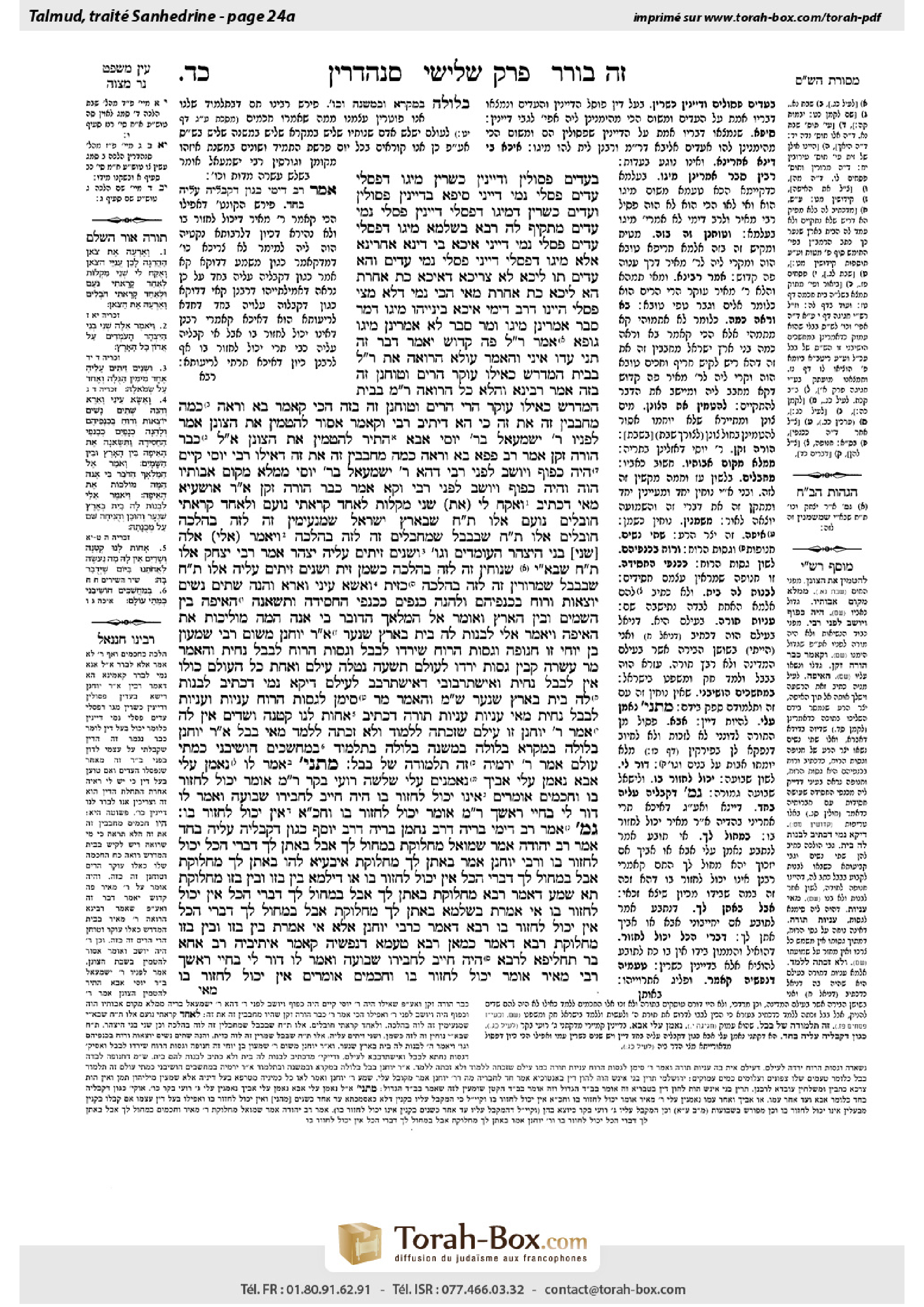
Sanhedrin 24a: Talmud study for Daf Yomi
Daf Yomi is the daily study of one Talmud folio. Explore 37 tractates with scans, Hebrew text, Sefaria English and AI-generated French translations where annotated.
Passage selection and English or AI-generated French translation are available where the scan has annotations. Daf Study is independent of Torah-Box and Sefaria.
Browse Sanhedrin · סנהדרין · All tractatesSanhedrin 24a text and translations
This page of Sanhedrin includes the Aramaic text, an English translation and an AI-generated French translation, alongside the scan above.
סנהדרין כ״ד א · Aramaic and Hebrew text
בְּעֵדִים פְּסוּלִין וְדַיָּינִין כְּשֵׁרִין, מִיגּוֹ דְּפָסְלִי עֵידֵי – פָּסְלִי נָמֵי דַּיָּינֵי. סֵיפָא: בְּדַיָּינִין פְּסוּלִין וְעֵדִים כְּשֵׁרִין, דְּמִיגּוֹ דְּפָסְלִי דַּיָּינֵי – פָּסְלִי נָמֵי עֵידֵי.
מַתְקֵיף לַהּ רָבָא: בִּשְׁלָמָא, מִיגּוֹ דְּפָסְלִי עֵדֵי פָּסְלִי נָמֵי דַּיָּינֵי, אִיכָּא בֵּי דִינָא אַחֲרִינָא. אֶלָּא מִיגּוֹ דְּפָסְלִי דַּיָּינֵי פָּסְלִי נָמֵי עֵדֵי? וְהָא עֵדִים תּוּ לֵיכָּא!
לָא צְרִיכָא, דְּאִיכָּא כַּת אַחֶרֶת.
הָא לֵיכָּא כַּת אַחֶרֶת, מַאי? הָכִי נָמֵי דְּלָא מָצֵי פָּסְלִי? הַיְינוּ דְּרַב דִּימִי!
אִיכָּא בֵּינַיְיהוּ מִיגּוֹ, דְּמָר סָבַר: אָמְרִינַן מִיגּוֹ, וּמָר סָבַר: לָא אָמְרִינַן מִיגּוֹ.
גּוּפָא, אָמַר רֵישׁ לָקִישׁ: פֶּה קָדוֹשׁ יֹאמַר דָּבָר זֶה? תְּנִי: ״עֵדוֹ״.
אִינִי? וְהָאָמַר עוּלָּא: הָרוֹאֶה אֶת רֵישׁ לָקִישׁ בְּבֵית הַמִּדְרָשׁ, כְּאִילּוּ עוֹקֵר הָרִים וְטוֹחֲנָן זֶה בָּזֶה.
אָמַר רָבִינָא: וַהֲלֹא כׇּל הָרוֹאֶה רַבִּי מֵאִיר בְּבֵית הַמִּדְרָשׁ, כְּאִילּוּ עוֹקֵר הָרֵי הָרִים וְטוֹחֲנָן זֶה בָּזֶה!
הָכִי קָאָמַר: בָּא וּרְאֵה כַּמָּה מְחַבְּבִין זֶה אֶת זֶה.
כִּי הָא דְּיָתֵיב רַבִּי וְקָאָמַר: אָסוּר לְהַטְמִין אֶת הַצּוֹנֵן. אָמַר לְפָנָיו רַבִּי יִשְׁמָעֵאל בְּרַבִּי יוֹסֵי: אַבָּא הִתִּיר לְהַטְמִין אֶת הַצּוֹנֵן. אָמַר לָהֶם: כְּבָר הוֹרָה זָקֵן.
אָמַר רַב פָּפָּא: בֹּא וּרְאֵה כַּמָּה מְחַבְּבִין זֶה אֶת זֶה, דְּאִילּוּ רַבִּי יוֹסֵי קַיָּים הָיָה, כָּפוּף וְיוֹשֵׁב לִפְנֵי רַבִּי. דְּהָא רַבִּי יִשְׁמָעֵאל בְּרַבִּי יוֹסֵי מְמַלֵּא מְקוֹם אֲבוֹתָיו הֲוָה, וְהָיָה כָּפוּף וְיוֹשֵׁב לִפְנֵי רַבִּי, וְקָא אָמַר: כְּבָר הוֹרָה זָקֵן.
אָמַר רַבִּי אוֹשַׁעְיָא: מַאי דִּכְתִיב ״וָאֶקַּח לִי אֶת שְׁנֵי מַקְלוֹת לְאַחַד קָרָאתִי נוֹעַם וּלְאַחַד קָרָאתִי חוֹבְלִים״? ״נוֹעַם״ – אֵלּוּ תַּלְמִידֵי חֲכָמִים שֶׁבְּאֶרֶץ יִשְׂרָאֵל, שֶׁמַּנְעִימִין זֶה לָזֶה בַּהֲלָכָה. ״חוֹבְלִים״ – אֵלּוּ תַּלְמִידֵי חֲכָמִים שֶׁבְּבָבֶל, שֶׁמְּחַבְּלִים זֶה לָזֶה בַּהֲלָכָה.
״וַיֹּאמֶר אֵלַי אֵלֶּה [שְׁנֵי] בְנֵי הַיִּצְהָר הָעֹמְדִים וְגוֹ׳ וּשְׁנַיִם זֵיתִים עָלֶיהָ״. ״יִצְהָר״ – אָמַר רַבִּי יִצְחָק: אֵלּוּ תַּלְמִידֵי חֲכָמִים שֶׁבְּאֶרֶץ יִשְׂרָאֵל, שֶׁנּוֹחִין זֶה לָזֶה בַּהֲלָכָה כְּשֶׁמֶן זַיִת. ״וּשְׁנַיִם זֵיתִים עָלֶיהָ״ – אֵלּוּ תַּלְמִידֵי חֲכָמִים שֶׁבְּבָבֶל, שֶׁמְּרוֹרִין זֶה לָזֶה בַּהֲלָכָה כְּזַיִת.
״וָאֶשָּׂא עֵינַי וָאֵרֶא וְהִנֵּה שְׁתַּיִם נָשִׁים יוֹצְאוֹת וְרוּחַ בְּכַנְפֵיהֶם וְלָהֵנָּה כְנָפַיִם כְּכַנְפֵי הַחֲסִידָה וַתִּשֶּׂאנָה הָאֵיפָה בֵּין הַשָּׁמַיִם וּבֵין הָאָרֶץ. וָאֹמַר אֶל הַמַּלְאָךְ הַדֹּבֵר בִּי אָנָה הֵמָּה מוֹלִכוֹת אֶת הָאֵיפָה. וַיֹּאמֶר אֵלַי לִבְנוֹת לָה בַיִת בְּאֶרֶץ שִׁנְעָר״. אָמַר רַבִּי יוֹחָנָן מִשּׁוּם רַבִּי שִׁמְעוֹן בֶּן יוֹחַאי: זוֹ חֲנוּפָּה וְגַסּוּת הָרוּחַ שֶׁיָּרְדוּ לְבָבֶל.
וְגַסּוּת הָרוּחַ לְבָבֶל נְחִית? וְהָאָמַר מָר: עֲשָׂרָה קַבִּין גַּסּוּת יָרְדוּ לְעוֹלָם, תִּשְׁעָה נָטְלָה עֵילָם וְאַחַת כׇּל הָעוֹלָם כּוּלּוֹ!
אִין, לְבָבֶל נְחִית, וְאִישְׁתַּרְבּוֹבֵי [הוּא] דְּאִישְׁתַּרְבַּב לְעֵילָם. דַּיְקָא נָמֵי, דִּכְתִיב: ״לִבְנוֹת לָה בַיִת בְּאֶרֶץ שִׁנְעָר״. שְׁמַע מִינַּהּ.
וְהָאָמַר מָר: סִימָן לְגַסּוּת הָרוּחַ – עֲנִיּוּת, וַעֲנִיּוּת לְבָבֶל נְחִית! מַאי עֲנִיּוּת? עֲנִיּוּת תּוֹרָה, דִּכְתִיב: ״אָחוֹת לָנוּ קְטַנָּה וְשָׁדַיִם אֵין לָהּ״. אָמַר רַבִּי יוֹחָנָן: זוֹ עֵילָם, שֶׁזָּכְתָה לִלְמוֹד וְלֹא זָכְתָה לְלַמֵּד.
מַאי בָּבֶל? אָמַר רַבִּי יוֹחָנָן: בְּלוּלָה בַּמִּקְרָא, בְּלוּלָה בַּמִּשְׁנָה, בְּלוּלָה בַּתַּלְמוּד. ״בְּמַחֲשַׁכִּים הוֹשִׁיבַנִי כְּמֵתֵי עוֹלָם״ – אָמַר רַבִּי יִרְמְיָה: זֶה תַּלְמוּדָהּ שֶׁל בָּבֶל.
מַתְנִי׳ אָמַר לוֹ: ״נֶאֱמָן עָלַי אַבָּא״, ״נֶאֱמָן עָלַי אָבִיךָ״, ״נֶאֱמָנִים עָלַי שְׁלֹשָׁה רוֹעֵי בָּקָר״. רַבִּי מֵאִיר אוֹמֵר: יָכוֹל לַחְזוֹר בּוֹ, וַחֲכָמִים אוֹמְרִים: אֵינוֹ יָכוֹל לַחְזוֹר בּוֹ.
הָיָה חַיָּיב לַחֲבֵירוֹ שְׁבוּעָה, וְאָמַר לוֹ: ״דּוֹר לִי בְּחַיֵּי רֹאשֶׁךָ״. רַבִּי מֵאִיר אוֹמֵר: יָכוֹל לַחְזוֹר בּוֹ, וַחֲכָמִים אוֹמְרִים: אֵין יָכוֹל לַחְזוֹר בּוֹ.
גְּמָ׳ אָמַר רַב דִּימִי בְּרֵיהּ דְּרַב נַחְמָן בְּרֵיהּ דְּרַב יוֹסֵף: כְּגוֹן דְּקַבְּלֵיהּ עֲלֵיהּ בְּחַד.
אָמַר רַב יְהוּדָה אָמַר שְׁמוּאֵל: מַחְלוֹקֶת בְּ״מָחוּל לָךְ״, אֲבָל בְּ״אֶתֵּן לָךְ״ – דִּבְרֵי הַכֹּל יָכוֹל לַחְזוֹר בּוֹ. וְרַבִּי יוֹחָנָן אָמַר: בְּ״אֶתֵּן לָךְ״ – מַחְלוֹקֶת.
אִיבַּעְיָא לְהוּ: בְּ״אֶתֵּן לָךְ״ – מַחְלוֹקֶת, אֲבָל בְּ״מָחוּל לָךְ״ – דִּבְרֵי הַכֹּל אֵין יָכוֹל לַחְזוֹר בּוֹ? אוֹ דִילְמָא: בֵּין בָּזוֹ וּבֵין בָּזוֹ מַחְלוֹקֶת?
תָּא שְׁמַע, דְּאָמַר רָבָא: מַחְלוֹקֶת בְּ״אֶתֵּן לָךְ״, אֲבָל בְּ״מָחוּל לָךְ״ – דִּבְרֵי הַכֹּל אֵין יָכוֹל לַחְזוֹר בּוֹ.
אִי אָמְרַתְּ בִּשְׁלָמָא בְּ״אֶתֵּן לָךְ״ – מַחְלוֹקֶת, אֲבָל בְּ״מָחוּל לָךְ״ – דִּבְרֵי הַכֹּל אֵין יָכוֹל לַחְזוֹר בּוֹ, רָבָא דְּאָמַר כְּרַבִּי יוֹחָנָן. אֶלָּא אִי אָמְרַתְּ בֵּין בָּזוֹ וּבֵין בָּזוֹ מַחְלוֹקֶת, רָבָא דְּאָמַר כְּמַאן?
רָבָא טַעְמָא דְנַפְשֵׁיהּ קָאָמַר.
אֵיתִיבֵיהּ רַב אַחָא בַּר תַּחְלִיפָא לְרָבָא: הָיָה חַיָּיב לַחֲבֵירוֹ שְׁבוּעָה, וְאָמַר לוֹ: ״דּוֹר לִי בְּחַיֵּי רֹאשֶׁךָ״. רַבִּי מֵאִיר אוֹמֵר: יָכוֹל לַחְזוֹר בּוֹ, וַחֲכָמִים אוֹמְרִים: אֵין יָכוֹל לַחְזוֹר בּוֹ.
Sanhedrin 24a · English translation
is stated with regard to a case of disqualified witnesses and fit judges, i.e., the litigant claims that both the witnesses and the judges are disqualified and proves his claim only with regard to the witnesses. Rabbi Meir holds that since the witnesses are disqualified the judges are also disqualified, as the litigant’s entire claim is deemed credible. The latter clause, where Rabbi Meir rules that a litigant can disqualify witnesses, is stated with regard to a case of disqualified judges and fit witnesses, i.e., the litigant proves his claim only with regard to the judges. Since the judges are disqualified the witnesses were also disqualified.
Rava objects to this interpretation: Granted, in the former clause, it is reasonable that since the witnesses are disqualified the judges are also disqualified, as, since there is the option of going to another court, disqualifying these specific judges has no irreversible effect on the outcome of the case. But in the latter case, how can Rabbi Meir hold that since the judges are disqualified, the witnesses are also disqualified without proof? This disqualification nullifies the entire case, as there are no more witnesses.
The Gemara answers: No, the mishna is not referring to a case where there are no other witnesses. The dispute between Rabbi Meir and the Rabbis is necessary only in a case where there is another set of witnesses, which the litigant did not disqualify. Since disqualifying this set will not predetermine the outcome, the litigant’s claim that these witnesses are disqualified is accepted.
The Gemara asks: But if there is no other set of witnesses, what is the halakha? Is it indeed true that the litigant cannot disqualify them? If so, this is identical to Rav Dimi’s interpretation that the mishna is referring to a case where there are two sets of witnesses.
The Gemara answers: There is a practical difference between them with regard to the principle that since [miggo] one of the litigant’s claims is found to be correct, it can be assumed that other claims of his are correct as well. As one Sage, Ravin, holds that according to Rabbi Meir, we say miggo, i.e., this principle should be followed, and one Sage, Rav Dimi, holds that we do not say miggo, but rather the litigant is required to prove every claim he makes.
§ The Gemara returns to discuss the matter itself: Reish Lakish says: Would a holy mouth, i.e., that of Rabbi Meir, say this strange statement, that a litigant can prevent a witness from testifying against him? Rather, emend the text of the mishna and teach: His witness, in the singular, meaning that a litigant can disqualify only a witness who testifies alone.
The Gemara asks: Is that so? Was it in character for Reish Lakish to speak of Rabbi Meir with such reverence when disagreeing with his ruling? But doesn’t Ulla say: When one sees Reish Lakish studying Torah in the study hall it is as though he is uprooting mountains and grinding them into each other? Reish Lakish was evidently very sharp in his analyses.
Ravina said in response: What is the difficulty? But is it not so that when anyone sees Rabbi Meir studying Torah in the study hall, it is as though he is uprooting the highest of mountains and grinding them into each other? Rabbi Meir was a greater scholar than Reish Lakish, so it was fitting for Reish Lakish to speak of him with reverence.
The Gemara answers: The question: Is that so, was not stated to raise a difficulty; rather, this is what he is saying, i.e., this is what the Gemara was noting: Come and see how much the Sages love each other. Although Reish Lakish was himself very sharp and a great Torah scholar, he spoke of Rabbi Meir with reverence.
The Gemara cites another example of Torah scholars who spoke of each other with reverence. It is like that incident where Rabbi Yehuda HaNasi sat and said: It is prohibited to insulate cold food on Shabbat to keep it cold, as this may lead one to insulate hot food on Shabbat to keep it hot. Rabbi Yishmael, son of Rabbi Yosei, said before him: My father ruled that it is permitted to insulate cold food on Shabbat. There is no concern that this will lead one to insulate hot food on Shabbat. Rabbi Yehuda HaNasi subsequently said to those who asked him about this issue: I retract my previous statement; the elder, Rabbi Yosei, has already issued a ruling on this topic, and I defer to his ruling.
Rav Pappa says: Come and see how much they loved each other. As, had Rabbi Yosei still been alive, he would have been subordinate to and sitting before Rabbi Yehuda HaNasi as his student, as Rabbi Yishmael, son of Rabbi Yosei, was his fathers’ replacement, i.e., he was as great a Torah scholar as his forebears, and he was subordinate to and sitting before Rabbi Yehuda HaNasi as his student. And, nevertheless, Rabbi Yehuda HaNasi said: The elder has already issued a ruling on this topic, and he deferred to Rabbi Yosei’s ruling.
This demonstrates what Rabbi Oshaya says: What is the meaning of that which is written: “And I took for myself two staves; the one I called Graciousness, and the other I called Binders” (Zechariah 11:7)? “Graciousness”; these are the Torah scholars in Eretz Yisrael, who are gracious to one another in discussions of halakha. They treat each other with honor and love, as demonstrated in the statements of Reish Lakish and Rabbi Yehuda HaNasi. “Binders [ḥovelim]”; these are the Torah scholars in Babylonia, who injure [shemeḥabbelim] each other in discussions of halakha, i.e., they speak harshly to each other when they disagree.
Similarly, it is stated: “Then he said to me: These are the two anointed ones, that stand by the Lord of the whole earth” (Zechariah 4:14), and it is stated: “And two olive trees by it, one upon the right side of the bowl, and the other upon its left side” (Zechariah 4:3). With regard to the expression “anointed ones,” Rabbi Yitzḥak says: These are the Torah scholars in Eretz Yisrael, who are pleasant to each other in discussions of halakha like olive oil, which is not bitter. The verse “and two olive trees by it” should be interpreted as follows: These are the Torah scholars in Babylonia, who are bitter to each other in discussions of halakha like an olive.
The Gemara interprets another verse in Zechariah: “Then I lifted my eyes and saw, and behold there came forth two women, and the wind was in their wings, for they had wings like the wings of a stork. And they lifted up the measure between the earth and the heaven. Then I said to the angel that spoke with me: To where do they take the measure? And he said to me: To build her a house in the land of Shinar” (Zechariah 5:9–11). Rabbi Yoḥanan says in the name of Rabbi Shimon ben Yoḥai: This measure refers to flattery and arrogance that descended to Babylonia, i.e., Shinar.
The Gemara asks: And did arrogance descend to Babylonia? But doesn’t the Master say: Ten kav of arrogance descended to the world; Eilam took nine and all the rest of the world in its entirety took one?
The Gemara answers: Yes, it descended to Babylonia, and it made its way to Eilam. The language of the verse is also precise, as it is written: “To build her a house in the land of Shinar,” which indicates that the original intention was to build a house in Babylonia, but it was not built there. The Gemara comments: Conclude from it that arrogance did not remain in Babylonia.
The Gemara asks: But doesn’t the Master say: A sign of arrogance is poverty? And poverty descended to Babylonia, not to Eilam. The Gemara answers: To what kind of poverty is this referring? It is poverty with regard to Torah, which was characteristic of Eilam. As it is written: “We have a little sister, and she has no breasts” (Song of Songs 8:8), and Rabbi Yoḥanan says: This refers to Eilam, whose inhabitants merited to learn Torah but did not merit to teach it. They did not produce Torah scholars capable of imparting their wisdom to others.
The Gemara asks: What is the homiletic interpretation of the word Babylonia? Rabbi Yoḥanan says, as a tribute to the Jewish community of Babylonia and its Torah scholars: It means mixed with Bible, mixed with Mishna, and mixed with Talmud. Other Sages had a different opinion of the Torah in Babylonia: With regard to the verse: “He has made me dwell in dark places, as those that have been long dead” (Lamentations 3:6), Rabbi Yirmeya says: This is the Talmud of Babylonia, which is not as clear as the Talmud of Eretz Yisrael.
MISHNA: If one litigant says to the other: My father is trusted to adjudicate for me, or: Your father is trusted to adjudicate for me, or: Three cattle herders, who are not proficient in halakha, are trusted to adjudicate for me, all of whom are disqualified from serving as judges, Rabbi Meir says: The one who made the offer can retract it, and the Rabbis say: He cannot retract it, but must accept their verdict.
Similarly, one who was obligated by Torah law to take an oath to another, which is done while grasping a sacred object, and the latter said to him: Instead of taking an oath, merely vow to me by the life of your head that what you claim is true, Rabbi Meir says: The one who made the offer can retract it, and demand that the other litigant take an oath, as he is obligated to do by Torah law. And the Rabbis say: He cannot retract his offer. Once he has agreed to accept a vow, which is of less severity than an oath, he cannot retract his agreement.
GEMARA: Rav Dimi, son of Rav Naḥman, son of Rav Yosef, says: The case of a litigant who accepts his father or the father of the other litigant as a judge is referring to where the litigant accepted this relative upon himself as one of the judges in a court of three, where the other two judges are fit. It is not referring to where he accepted him as the sole judge.
Rav Yehuda says that Shmuel says: The dispute between Rabbi Meir and the Rabbis is with regard to a case where the claimant had said to the defendant: The money I claim you owe me is forgiven you if my father or your father rules as judge to that effect, and the claimant subsequently wishes to retract his offer. But in a case where it is the defendant who said: I will give you what you claim if that is the ruling of this judge, everyone agrees that he can retract his offer. And Rabbi Yoḥanan says: The dispute is with regard to a case where the defendant said: I will give you what you claim if that is the ruling of this judge.
A dilemma was raised before the Sages with regard to the opinion of Rabbi Yoḥanan: Is the dispute only with regard to a case where the defendant says: I will give you, but in a case where the claimant says: The money I claim you owe me is forgiven you, everyone agrees that he cannot retract his offer? Or perhaps Rabbi Yoḥanan maintains that the dispute is both with regard to this case and with regard to that case?
The Gemara suggests: Come and hear a resolution from that which Rava says: The dispute is with regard to a case where the defendant says: I will give you, but in a case where the claimant says: The money I claim you owe me is forgiven you, everyone agrees that he cannot retract his offer.
Granted, this makes sense if you say that according to Rabbi Yoḥanan too, the dispute is with regard to a case where the defendant says: I will give you, but in a case where the claimant says: The money I claim you owe me is forgiven you, everyone agrees that he cannot retract his offer; this means that Rava is stating the halakha in accordance with the opinion of Rabbi Yoḥanan. But if you say that according to Rabbi Yoḥanan the dispute is both with regard to this case and with regard to that case, then in accordance with whose opinion is Rava stating the halakha? His statement is in accordance with neither Shmuel’s opinion nor Rabbi Yoḥanan’s opinion.
The Gemara rejects this: Perhaps Rava is stating his own explanation of the dispute.
Rav Aḥa bar Taḥlifa raised an objection to the opinion of Rava from the latter clause in the mishna: With regard to one who was obligated by Torah law to take an oath to another, and the latter said to him: Vow to me by the life of your head that what you claim is true, Rabbi Meir says: The one who made the offer can retract it; and the Rabbis say: He cannot retract his offer.
Sanhedrin 24a · Traduction française (IA)
est énoncée à propos d’un cas où les témoins sont invalides et les juges aptes, c’est-à-dire que le plaideur affirme que les témoins et les juges sont tous invalides, mais ne prouve son affirmation qu’en ce qui concerne les témoins. Rabbi Meïr estime que, puisque les témoins sont invalides, les juges le sont également, car toute l’affirmation du plaideur est tenue pour crédible. La clause suivante, où Rabbi Meïr statue qu’un plaideur peut récuser des témoins, concerne un cas où les juges sont invalides et les témoins aptes, c’est-à-dire que le plaideur ne prouve son affirmation qu’en ce qui concerne les juges. Puisque les juges sont invalides, les témoins l’étaient également.
Rava objecte à cette interprétation : certes, dans la première clause, il est logique que, puisque les témoins sont invalides, les juges le soient également, car on peut saisir un autre tribunal ; récuser ces juges précis n’a donc aucun effet irréversible sur l’issue de l’affaire. Mais, dans le second cas, comment Rabbi Meïr peut-il estimer que, puisque les juges sont invalides, les témoins le sont également, sans preuve ? Cette récusation annule toute l’affaire, puisqu’il ne reste plus de témoins.
La Guemara répond : Non, la Michna ne parle pas d’un cas où il n’y a pas d’autres témoins. Le désaccord entre Rabbi Meïr et les Rabbins ne concerne qu’un cas où il existe un autre groupe de témoins, que le plaideur n’a pas récusé. Puisque récuser ce groupe ne prédétermine pas l’issue de l’affaire, l’affirmation du plaideur selon laquelle ces témoins sont invalides est acceptée.
La Guemara demande : Mais s’il n’existe pas d’autre groupe de témoins, quelle est la halakha ? Est-il effectivement vrai que le plaideur ne peut pas les récuser ? Si oui, cela revient exactement à l’interprétation de Rav Dimi, selon laquelle la Michna parle d’un cas où il y a deux groupes de témoins.
La Guemara répond : Il existe entre eux une différence pratique concernant le principe selon lequel [miggo], puisqu’une des affirmations du plaideur se révèle exacte, on peut supposer que ses autres affirmations le sont également. En effet, un Sage, Ravin, estime que, selon Rabbi Meïr, on applique le principe du miggo, c’est-à-dire qu’il faut suivre ce principe ; un autre Sage, Rav Dimi, estime qu’on ne l’applique pas, mais que le plaideur doit prouver chacune de ses affirmations.
§ La Guemara revient à la discussion du sujet lui-même : Reish Lakish dit : Une bouche sainte, celle de Rabbi Meïr, aurait-elle prononcé cette déclaration étrange, selon laquelle un plaideur peut empêcher un témoin de témoigner contre lui ? Il faut plutôt corriger le texte de la Michna et lire : « Son témoin », au singulier, ce qui signifie qu’un plaideur ne peut récuser qu’un témoin qui témoigne seul.
La Guemara demande : Est-ce bien le cas ? Reish Lakish avait-il l’habitude de parler de Rabbi Meïr avec tant de révérence lorsqu’il contestait sa décision ? Pourtant, Oula ne dit-il pas : « Quand on voit Reish Lakish étudier la Torah dans la maison d’étude, c’est comme s’il déracinait des montagnes et les broyait les unes contre les autres » ? Reish Lakish était manifestement d’une grande acuité dans ses analyses.
Ravina répondit : Où est la difficulté ? Quand on voit Rabbi Meïr étudier la Torah dans la maison d’étude, n’est-ce pas comme s’il déracinait les plus hautes montagnes et les broyait les unes contre les autres ? Rabbi Meïr était un plus grand érudit que Reish Lakish ; il convenait donc que Reish Lakish parle de lui avec révérence.
La Guemara répond : La question « Est-ce bien le cas ? » n’a pas été posée pour soulever une difficulté. Voici plutôt ce qu’il voulait dire, c’est-à-dire ce que la Guemara faisait remarquer : « Viens et vois combien les Sages s’aiment les uns les autres. » Bien que Reish Lakish lui-même fût très perspicace et un grand érudit en Torah, il parlait de Rabbi Meïr avec révérence.
La Guemara cite un autre exemple d’érudits en Torah qui se parlaient avec révérence. Il en va ainsi dans cet épisode où Rabbi Yehouda HaNassi était assis et déclara : « Il est interdit d’isoler des aliments froids pendant Chabbat afin de les garder froids, car cela pourrait amener à isoler des aliments chauds pendant Chabbat afin de les garder chauds. » Rabbi Yishmaël, fils de Rabbi Yossi, lui dit : « Mon père a statué qu’il est permis d’isoler des aliments froids pendant Chabbat. Il n’y a pas lieu de craindre que cela amène à isoler des aliments chauds pendant Chabbat. » Par la suite, Rabbi Yehouda HaNassi dit à ceux qui l’interrogeaient sur cette question : « Je rétracte ma déclaration précédente ; l’ancien, Rabbi Yossi, a déjà statué sur ce sujet, et je m’en remets à sa décision. »
Rav Pappa dit : « Viens et vois combien ils s’aimaient les uns les autres. » En effet, si Rabbi Yossi avait encore été en vie, il aurait été subordonné à Rabbi Yehouda HaNassi et se serait assis devant lui comme son élève, tout comme Rabbi Yishmaël, fils de Rabbi Yossi, qui avait pris la place de son père, c’est-à-dire qui était un érudit en Torah aussi grand que ses ancêtres, et qui était subordonné à Rabbi Yehouda HaNassi et s’asseyait devant lui comme son élève. Et pourtant, Rabbi Yehouda HaNassi dit : « L’ancien a déjà statué sur ce sujet », et il s’en remit à la décision de Rabbi Yossi.
Cela illustre ce que dit Rabbi Oshaya : Quel est le sens de ce qui est écrit : « Et je pris pour moi deux bâtons ; j’appelai l’un Grâce, et l’autre Liens » (Zacharie 11:7) ? « Grâce » : ce sont les érudits en Torah d’Eretz Israël, qui se montrent bienveillants les uns envers les autres dans les discussions de halakha. Ils se traitent avec respect et amour, comme le montrent les paroles de Reish Lakish et de Rabbi Yehouda HaNassi. « Liens [ḥovelim] » : ce sont les érudits en Torah de Babylonie, qui se blessent [shemeḥabbelim] les uns les autres dans les discussions de halakha, c’est-à-dire qu’ils se parlent durement lorsqu’ils sont en désaccord.
De même, il est dit : « Il me dit alors : “Ce sont les deux oints qui se tiennent auprès du Seigneur de toute la terre” » (Zacharie 4:14), et il est dit : « “Et deux oliviers auprès d’elle, l’un à droite de la coupe et l’autre à sa gauche” » (Zacharie 4:3). À propos de l’expression « les oints », Rabbi Yitzḥak dit : « Ce sont les érudits en Torah d’Eretz Israël, qui sont agréables les uns aux autres dans leurs discussions de halakha, comme l’huile d’olive, qui n’est pas amère. » Le verset « et deux oliviers auprès d’elle » doit être interprété ainsi : ce sont les érudits en Torah de Babylonie, qui sont amers les uns envers les autres dans leurs discussions de halakha, comme une olive.
La Guemara interprète un autre verset de Zacharie : « Je levai les yeux et regardai : voici que deux femmes sortaient, et le vent était dans leurs ailes, car elles avaient des ailes comme celles d’une cigogne. Elles soulevèrent le boisseau entre la terre et le ciel. Je demandai alors à l’ange qui me parlait : “Où emportent-elles le boisseau ?” Il me répondit : “Pour lui bâtir une maison au pays de Shinar” » (Zacharie 5:9-11). Rabbi Yoḥanan dit au nom de Rabbi Shimon ben Yoḥai : Ce boisseau désigne la flatterie et l’arrogance qui descendirent en Babylonie, c’est-à-dire à Shinar.
La Guemara demande : L’arrogance est-elle donc descendue en Babylonie ? Pourtant, le Maître ne dit-il pas : « Dix kav d’arrogance descendirent dans le monde ; Eilam en prit neuf et le monde entier, tout le reste, en prit un » ?
La Guemara répond : Oui, elle descendit en Babylonie, puis se rendit à Eilam. La formulation du verset est également précise, puisqu’il est écrit : « Pour lui bâtir une maison au pays de Shinar », ce qui indique que l’intention initiale était de bâtir une maison en Babylonie, mais qu’elle n’y fut pas bâtie. La Guemara commente : On peut en conclure que l’arrogance ne demeura pas en Babylonie.
La Guemara demande : Pourtant, le Maître ne dit-il pas que la pauvreté est un signe d’arrogance ? Or, la pauvreté descendit en Babylonie, et non à Eilam. La Guemara répond : De quelle pauvreté s’agit-il ? De la pauvreté en Torah, qui caractérisait Eilam. En effet, il est écrit : « Nous avons une petite sœur, qui n’a pas de seins » (Cantique des cantiques 8:8), et Rabbi Yoḥanan dit : « Cela désigne Eilam, dont les habitants méritèrent d’étudier la Torah, mais ne méritèrent pas de l’enseigner. » Ils ne produisirent pas d’érudits en Torah capables de transmettre leur sagesse à d’autres.
La Guemara demande : Quelle est l’interprétation homilétique du mot « Babylonie » ? Rabbi Yoḥanan dit, en hommage à la communauté juive de Babylonie et à ses érudits en Torah : cela signifie « mêlée de Bible, mêlée de Michna et mêlée de Talmud ». D’autres Sages avaient une opinion différente de la Torah en Babylonie. À propos du verset « Il m’a fait habiter dans des lieux obscurs, comme ceux qui sont morts depuis longtemps » (Lamentations 3:6), Rabbi Yirmeya dit : Cela désigne le Talmud de Babylonie, qui est moins clair que le Talmud d’Eretz Israël.
MICHNA : Si un plaideur dit à l’autre : « Mon père est habilité à juger pour moi », ou : « Ton père est habilité à juger pour moi », ou : « Trois gardiens de troupeaux, qui ne connaissent pas bien la halakha, sont habilités à juger pour moi » — tous étant inaptes à exercer la fonction de juges —, Rabbi Meïr dit : « Celui qui a fait cette proposition peut se rétracter », et les Rabbins disent : « Il ne peut pas se rétracter, mais doit accepter leur verdict. »
De même, celui qui est tenu par la Torah de prêter serment à un autre — ce qui se fait en tenant un objet sacré — et à qui l’autre dit : « Au lieu de prêter serment, fais-moi simplement un vœu sur la vie de ta tête, attestant que ce que tu prétends est vrai », Rabbi Meïr dit : « Celui qui a fait cette proposition peut se rétracter et exiger que l’autre plaideur prête serment, comme il y est tenu par la Torah. » Les Rabbins disent : « Il ne peut pas revenir sur sa proposition. » Une fois qu’il a accepté un vœu, qui est moins contraignant qu’un serment, il ne peut pas revenir sur son accord.
GUEMARA : Rav Dimi, fils de Rav Naḥman, fils de Rav Yosef, dit : Le cas d’un plaideur qui accepte son père ou le père de l’autre plaideur comme juge concerne celui où le plaideur accepte ce parent comme l’un des juges d’un tribunal de trois membres, les deux autres juges étant aptes. Il ne s’agit pas d’un cas où il l’accepte comme juge unique.
Rav Yehouda dit au nom de Shmuel : Le désaccord entre Rabbi Meïr et les Rabbins concerne un cas où le demandeur avait dit au défendeur : « La somme que je prétends que tu me dois t’est remise si mon père ou ton père statue en ce sens », et où le demandeur souhaite ensuite revenir sur sa proposition. Mais si c’est le défendeur qui a dit : « Je te donnerai ce que tu réclames si tel est le jugement de ce juge », tous conviennent qu’il peut revenir sur sa proposition. Rabbi Yoḥanan dit : Le désaccord concerne un cas où le défendeur a dit : « Je te donnerai ce que tu réclames si tel est le jugement de ce juge. »
Les Sages soulevèrent une question concernant l’opinion de Rabbi Yoḥanan : Le désaccord porte-t-il uniquement sur le cas où le défendeur dit : « Je te donnerai », tandis que, dans le cas où le demandeur dit : « La somme que je prétends que tu me dois t’est remise », tous conviennent qu’il ne peut pas revenir sur sa proposition ? Ou peut-être Rabbi Yoḥanan estime-t-il que le désaccord porte à la fois sur ce cas et sur l’autre ?
La Guemara suggère : « Viens et écoute » une résolution tirée de ce que dit Rava : Le désaccord porte sur le cas où le défendeur dit : « Je te donnerai », tandis que, dans le cas où le demandeur dit : « La somme que je prétends que tu me dois t’est remise », tous conviennent qu’il ne peut pas revenir sur sa proposition.
Cela est logique si l’on dit que, selon Rabbi Yoḥanan également, le désaccord porte sur le cas où le défendeur dit : « Je te donnerai », tandis que, dans le cas où le demandeur dit : « La somme que je prétends que tu me dois t’est remise », tous conviennent qu’il ne peut pas revenir sur sa proposition ; cela signifie que Rava énonce la halakha conformément à l’opinion de Rabbi Yoḥanan. Mais si l’on dit que, selon Rabbi Yoḥanan, le désaccord porte à la fois sur ce cas et sur l’autre, alors conformément à l’opinion de qui Rava énonce-t-il la halakha ? Sa déclaration ne correspond ni à l’opinion de Shmuel ni à celle de Rabbi Yoḥanan.
La Guemara rejette cette objection : Peut-être Rava donne-t-il sa propre explication du désaccord.
Rav Aḥa bar Taḥlifa objecta à l’opinion de Rava en s’appuyant sur la dernière clause de la Michna : À propos de celui qui est tenu par la Torah de prêter serment à un autre, et à qui l’autre dit : « Fais-moi un vœu sur la vie de ta tête, attestant que ce que tu prétends est vrai », Rabbi Meïr dit : « Celui qui a fait cette proposition peut se rétracter » ; et les Rabbins disent : « Il ne peut pas revenir sur sa proposition. »
Traduction française générée par IA à partir de l’édition anglaise de Sefaria. Vérifie toujours un passage avec le texte source.
Text from Sefaria: William Davidson Edition - Vocalized Aramaic (CC BY NC); William Davidson Edition - English (CC BY NC).