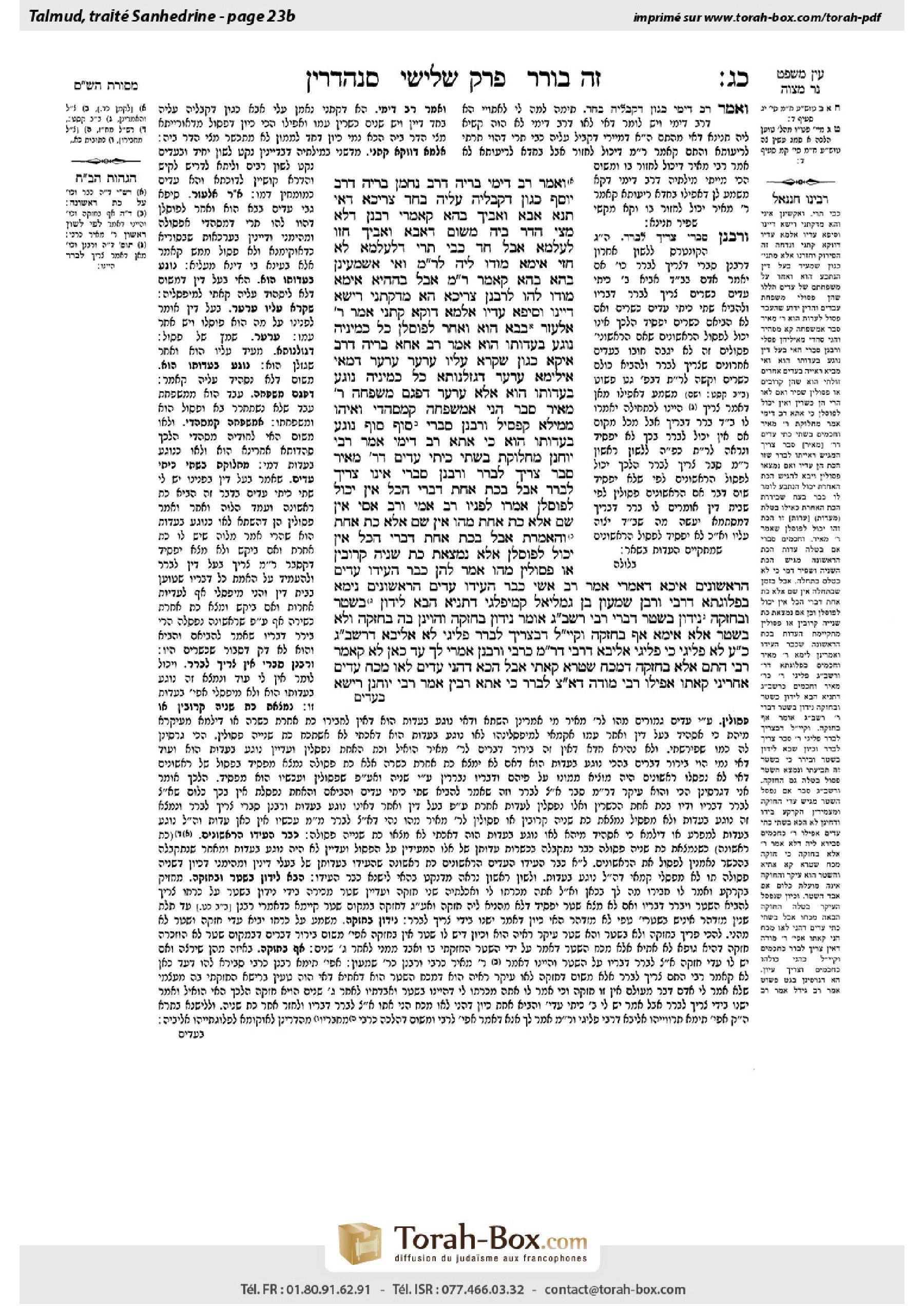
Sanhedrin 23b: Talmud study for Daf Yomi
Daf Yomi is the daily study of one Talmud folio. Explore 37 tractates with scans, Hebrew text, Sefaria English and AI-generated French translations where annotated.
Passage selection and English or AI-generated French translation are available where the scan has annotations. Daf Study is independent of Torah-Box and Sefaria.
Browse Sanhedrin · סנהדרין · All tractatesSanhedrin 23b text and translations
This page of Sanhedrin includes the Aramaic text, an English translation and an AI-generated French translation, alongside the scan above.
סנהדרין כ״ג ב · Aramaic and Hebrew text
וְאָמַר רַב דִּימִי בְּרֵיהּ דְּרַב נַחְמָן בְּרֵיהּ דְּרַב יוֹסֵף: כְּגוֹן דְּקַבְּלֵיהּ עֲלֵיהּ בְּחַד.
צְרִיכָא, דְּאִי תְּנָא ״אַבָּא״ וְ״אָבִיךְ״ – בְּהָא קָאָמְרִי רַבָּנַן דְּלָא מָצֵי הָדַר בֵּיהּ, מִשּׁוּם דְּאַבָּא וְאָבִיךְ חֲזוּ לְעָלְמָא. אֲבָל חַד כְּבֵי תְרֵי, דִּלְעָלְמָא לָא חֲזֵי – אֵימָא: מוֹדוּ לֵיהּ לְרַבִּי מֵאִיר.
וְאִי אַשְׁמְעִינַן בְּהָא, בְּהָא קָאָמַר רַבִּי מֵאִיר, אֲבָל בְּהַהִיא – אֵימָא מוֹדוּ לְהוּ לְרַבָּנַן. צְרִיכָא.
הָא מִדְּקָתָנֵי רֵישָׁא ״דַּיָּינוֹ״, וְסֵיפָא ״עֵדָיו״ – אַלְמָא דַּוְקָא קָתָנֵי.
אָמַר רַבִּי אֶלְעָזָר: בְּבָא הוּא וְאַחֵר לְפוֹסְלָן.
כֹּל כְּמִינֵּיהּ? נוֹגֵעַ בְּעֵדוּתוֹ הוּא!
אָמַר רַב אַחָא בְּרֵיהּ דְּרַב אִיקָא: כְּגוֹן שֶׁקָּרָא עָלָיו עַרְעָר.
עַרְעָר דְּמַאי? אִילֵּימָא עַרְעָר דְּגַזְלָנוּתָא, כֹּל כְּמִינֵּיהּ? נוֹגֵעַ בְּעֵדוּתוֹ הוּא!
אֶלָּא: עַרְעָר דִּפְגַם מִשְׁפָּחָה. רַבִּי מֵאִיר סָבַר: הָנֵי אַמִּשְׁפָּחָה קָמַסְהֲדִי, וְאִיהוּ מִמֵּילָא קָפָסֵיל. וְרַבָּנַן סָבְרִי: סוֹף סוֹף נוֹגֵעַ בְּעֵדוּתוֹ הוּא.
כִּי אֲתָא רַב דִּימִי, אָמַר רַבִּי יוֹחָנָן: מַחֲלוֹקֶת בִּשְׁתֵּי כִּיתֵּי עֵדִים.
דְּרַבִּי מֵאִיר סָבַר: צָרִיךְ לְבָרֵר, וְרַבָּנַן סָבְרִי: אֵינוֹ צָרִיךְ לְבָרֵר. אֲבָל בְּכַת אַחַת – דִּבְרֵי הַכֹּל אֵין יָכוֹל לְפוֹסְלָן.
אָמְרוּ לְפָנָיו רַב אַמֵּי וְרַב אַסִּי: אֵין שָׁם אֶלָּא כַּת אַחַת, מַהוּ?
אֵין שָׁם אֶלָּא כַּת אַחַת? וְהָאָמְרַתְּ: אֲבָל בְּכַת אַחַת דִּבְרֵי הַכֹּל אֵין יָכוֹל לְפוֹסְלָן! אֶלָּא, נִמְצֵאת כַּת שְׁנִיָּה קְרוֹבִין אוֹ פְסוּלִין – מַהוּ?
אָמַר לָהֶן: כְּבָר הֵעִידוּ עֵדִים הָרִאשׁוֹנִים. אִיכָּא דְּאָמְרִי, אָמַר רַב אָשֵׁי: כְּבָר הֵעִידוּ עֵדִים הָרִאשׁוֹנִים.
נֵימָא, בִּפְלוּגְתָּא דְּרַבִּי וְרַבָּן שִׁמְעוֹן בֶּן גַּמְלִיאֵל קָמִיפַּלְגִי?
דְּתַנְיָא: הַבָּא לִידּוֹן בִּשְׁטָר וּבַחֲזָקָה, נִידּוֹן בִּשְׁטָר – דִּבְרֵי רַבִּי. רַבָּן שִׁמְעוֹן בֶּן גַּמְלִיאֵל אוֹמֵר: נִידּוֹן בַּחֲזָקָה.
וְהָוֵינַן בַּהּ: בַּחֲזָקָה וְלֹא בִּשְׁטָר? אֶלָּא אֵימָא: אַף בַּחֲזָקָה.
וְקַיְימָא לַן, דִּבְצָרִיךְ לְבָרֵר פְּלִיגִי.
לָא. אַלִּיבָּא דְּרַבָּן שִׁמְעוֹן בֶּן גַּמְלִיאֵל, כּוּלֵּי עָלְמָא לָא פְּלִיגִי. כִּי פְּלִיגִי, אַלִּיבָּא דְּרַבִּי. דְּרַבִּי מֵאִיר כְּרַבִּי.
וְרַבָּנַן אָמְרִי לָךְ: עַד כָּאן לָא קָאָמַר רַבִּי הָתָם אֶלָּא בַּחֲזָקָה, דְּמִכֹּחַ שְׁטָרָא קָאָתֵי. אֲבָל הָכָא, דְּהָנֵי עֵדִים לָאו מִכֹּחַ עֵדִים אַחֲרִינֵי קָאָתוּ, אֲפִילּוּ רַבִּי מוֹדֶה דְּאֵין צָרִיךְ לְבָרֵר.
כִּי אֲתָא רָבִין, אָמַר רַבִּי יוֹחָנָן: רֵישָׁא
Sanhedrin 23b · English translation
And Rav Dimi, son of Rav Naḥman, son of Rav Yosef, says: This is referring to a case where the litigant accepted one of these people upon himself as one of the judges, in addition to two fit judges. Since the dispute between Rabbi Meir and the Rabbis with regard to a litigant retracting his acceptance of someone who is generally disqualified from judging is stated in the next mishna, why is it stated in this mishna as well?
The Gemara answers: The statements in both mishnayot are necessary. As, had the Mishna taught this dispute only with regard to a litigant who said: My father is trusted to adjudicate for me, or: Your father is trusted to adjudicate for me, one might have reasoned that only in this case did the Rabbis say that he cannot retract his acceptance, because: My father, and: Your father, are fit to judge for the general public. But in a case where a litigant accepts one witness as equivalent to two witnesses, since one witness is someone who is not fit to testify by himself for the general public one might say that the Rabbis concede to Rabbi Meir that he can retract his acceptance. Therefore, it is necessary for the dispute to be stated with regard to the case in this mishna as well.
And conversely, if the Mishna would teach us their dispute only with regard to this case, where a litigant effectively accepted one witness as equivalent to two, one might have reasoned that specifically in this case Rabbi Meir says that he can retract his acceptance. But in that case, where he accepted his father or the father of the other litigant as a judge, one might say that Rabbi Meir concedes to the Rabbis that he cannot retract his acceptance. It is therefore necessary for the mishna to state both disputes.
The Gemara asks: But from the fact that in the former clause the mishna teaches that one litigant can disqualify the judge, in singular, chosen by the other litigant, and in the latter clause the wording is his witnesses, in plural, evidently the mishna teaches this specifically with regard to a case of two witnesses. It is incorrect to emend the text to read witness instead of witnesses.
Rabbi Elazar said: The mishna is referring to a case where the litigant and another person come to disqualify the witnesses, testifying that they are disqualified from bearing witness.
The Gemara asks: Is it in his power to testify that the witnesses of the other litigant are disqualified from bearing witness? His testimony is tainted by a conflict of interest; how can the court accept it?
Rav Aḥa, son of Rav Ika, said: The mishna is referring to a case where he raised a challenge against the witness’s fitness to testify, which cannot be disregarded due to his conflict of interest.
The Gemara asks: A challenge over which matter? If we say that he raises a challenge by testifying that the witness is guilty of theft or some other transgression, is it in his power to testify to that effect? His testimony is tainted by a conflict of interest.
Rather, it is a challenge over a family flaw. The litigant testifies that the witness’s lineage prevents him from testifying, as he is from a family of Canaanite slaves. Rabbi Meir holds that the litigant’s testimony is accepted, as these witnesses, the litigant and the witness who testifies with him, are testifying about the family of the witness, and the witness is disqualified indirectly. The litigant is therefore not disqualified from giving this testimony due to his conflict of interest. And the Rabbis hold that since his testimony is ultimately tainted by a conflict of interest, it is not accepted.
When Rav Dimi came from Eretz Yisrael, he said that Rabbi Yoḥanan says: The dispute is with regard to a case in which one of the litigants claims that there are two sets of witnesses who can testify on his behalf, and the other litigant responds that one of the sets of witnesses is disqualified. In this case, the second litigant’s claim is not tainted by a conflict of interest, as there is another set of witnesses who can testify against him in any event.
Rabbi Meir maintains that the litigant cannot give this testimony, as Rabbi Meir holds that a litigant who claims in court to have a certain number of witnesses ready to testify on his behalf is required to substantiate that they exist. Therefore, there is no concern that the other set of witnesses will not be brought to court, causing that litigant to lose the case due to the disqualification of the first set. And the Rabbis hold that one is not required to substantiate the existence of witnesses he claims to have. As the disqualification of the first set of witnesses can cause the first litigant to lose the case, the second litigant is consequently unable to disqualify that first set, due to his conflict of interest. But in a case of one set of witnesses, everyone agrees that a litigant cannot disqualify them, due to his conflict of interest.
Rav Dimi continued: Rav Ami and Rav Asi said before Rabbi Yoḥanan: If there is only one set of witnesses there, what is the halakha?
The Gemara interrupts: If there is only one set of witnesses there, what is the dilemma? But didn’t you already say: But in a case of one set of witnesses, everyone agrees that a litigant cannot disqualify them? Rather, the question should be understood as follows: According to Rabbi Meir, who holds that a litigant can disqualify one of the other litigant’s two sets of witnesses, if the second set is ultimately found to be related to one of the litigants or to each other, or is disqualified from bearing witness for other reasons, what is the halakha? Can the litigant whose witnesses were disqualified then claim that the other litigant was not capable of disqualifying the first set, as it turned out that they were the only witnesses who would be testifying against him?
Rabbi Yoḥanan said to them: The first pair of witnesses, i.e., the second litigant, who disqualified the other litigant’s first set of witnesses, already testified. Since his testimony was valid at the time it cannot be disqualified afterward. Some say this statement in the name of a different amora: Rav Ashi says: The first pair of witnesses already testified.
The Gemara asks: Shall we say that Rabbi Meir and the Rabbis disagree with regard to the issue that is the subject of the dispute between Rabbi Yehuda HaNasi and Rabban Shimon ben Gamliel?
As it is taught in a baraita: With regard to one who comes to court to be judged concerning a claim against land that is in his possession, if in order to support his claim of ownership he comes to court both with a deed of purchase proving that the land is his and with a claim of presumptive ownership of the land stating that it had been in his possession for the past three years, which would render the deed superfluous, in this case his claim is judged on the basis of the deed. The court examines whether or not the deed is valid. This is the statement of Rabbi Yehuda HaNasi. Rabban Shimon ben Gamliel says: His claim is judged on the basis of his presumptive ownership.
And we discussed this dispute, asking: Can Rabban Shimon ben Gamliel possibly mean that the defendant’s claim is judged on the basis of only his presumptive ownership and not on the basis of his deed, i.e., is his deed of purchase ignored? Clearly, there is no reason to ignore the deed of purchase. Rather, say that Rabban Shimon ben Gamliel means that the defendant’s claim is judged not only on the basis of the deed of purchase, but even on the basis of his presumptive ownership. In other words, either claim suffices.
And we maintain that they disagree with regard to whether or not a litigant who claims to have more than one type of evidence is required to substantiate the existence of all his types of evidence. Rabbi Yehuda HaNasi holds that one who claims to have a deed of purchase is required to bring it to court and cannot rely on his presumptive ownership, whereas according to Rabban Shimon ben Gamliel he can rely on his presumptive ownership. Apparently, this dispute is parallel to the dispute between Rabbi Meir and the Rabbis in the mishna.
The Gemara rejects this: No. According to the opinion of Rabban Shimon ben Gamliel, everyone agrees that there is no need to substantiate the existence of all the types of evidence. When Rabbi Meir and the Rabbis disagree in the mishna it is according to the opinion of Rabbi Yehuda HaNasi, as Rabbi Meir holds that one is required to substantiate the existence of all of his types of evidence, in accordance with the opinion of Rabbi Yehuda HaNasi.
And the Rabbis could have said to you that Rabbi Yehuda HaNasi says there that one is required to substantiate the existence of his types of evidence only vis-à-vis a claim of presumptive ownership of the land. If one claims that he possesses the deed of sale for his land he cannot rely on his presumptive ownership, as the power of his presumptive ownership comes from the power of the deed; mere possession without an accompanying claim of how one became the owner is disregarded (see Bava Batra 41a). But here, in the case of two sets of witnesses, since the power of these witnesses does not come from the power of the other witnesses, even Rabbi Yehuda HaNasi concedes that one is not required to substantiate the existence of the other set of witnesses.
When Ravin came from Eretz Yisrael, he said that Rabbi Yoḥanan says a different interpretation of the dispute: The former clause, where Rabbi Meir rules that a litigant can disqualify a judge,
Sanhedrin 23b · Traduction française (IA)
Et Rav Dimi, fils de Rav Naḥman, fils de Rav Yosef, dit : Cela concerne un cas où le plaideur a accepté que l’une de ces personnes siège parmi les juges, en plus de deux juges aptes. Puisque la controverse entre Rabbi Meïr et les Rabbins au sujet du plaideur qui revient sur son acceptation d’une personne généralement inapte à juger est exposée dans la Michna suivante, pourquoi l’expose-t-on également dans cette Michna ?
La Guemara répond : Les enseignements des deux Michnayot sont nécessaires. En effet, si la Michna avait exposé cette controverse uniquement à propos d’un plaideur qui dit : « Mon père est digne de confiance pour juger en ma faveur », ou : « Ton père est digne de confiance pour juger en ma faveur », on aurait pu penser que les Rabbins ont dit qu’il ne peut pas revenir sur son acceptation uniquement dans ce cas, parce que mon père et ton père sont aptes à juger pour le grand public. Mais, dans le cas où un plaideur accepte un témoin comme équivalent à deux témoins, puisque le témoin seul n’est pas apte à témoigner pour le grand public, on aurait pu dire que les Rabbins concèdent à Rabbi Meïr qu’il peut revenir sur son acceptation. Il est donc nécessaire d’exposer également la controverse à propos du cas de cette Michna.
Inversement, si la Michna nous avait enseigné leur controverse uniquement à propos de ce cas, où un plaideur a effectivement accepté un témoin comme équivalent à deux, on aurait pu penser que Rabbi Meïr dit qu’il peut revenir sur son acceptation précisément dans ce cas. Mais, dans le cas où il a accepté son père ou le père de l’autre plaideur comme juge, on aurait pu dire que Rabbi Meïr concède aux Rabbins qu’il ne peut pas revenir sur son acceptation. Il est donc nécessaire que la Michna expose les deux controverses.
La Guemara demande : Mais puisque, dans la première partie, la Michna enseigne qu’un plaideur peut récuser le juge choisi par l’autre plaideur, au singulier, tandis que, dans la dernière partie, elle dit « ses témoins », au pluriel, il est évident que la Michna enseigne cette règle précisément à propos de deux témoins. Il est donc incorrect de corriger le texte en remplaçant « témoins » par « témoin ».
Rabbi Elazar dit : La Michna concerne un cas où le plaideur et une autre personne viennent récuser les témoins en attestant qu’ils sont inaptes à témoigner.
La Guemara demande : Est-il en son pouvoir d’attester que les témoins de l’autre plaideur sont inaptes à témoigner ? Son témoignage est entaché d’un conflit d’intérêts ; comment le tribunal pourrait-il l’accepter ?
Rav Aḥa, fils de Rav Ika, dit : La Michna concerne un cas où il a contesté l’aptitude du témoin à témoigner, contestation qui ne peut être écartée en raison de son conflit d’intérêts.
La Guemara demande : Sur quel motif porte cette contestation ? Si l’on dit qu’il conteste en attestant que le témoin est coupable de vol ou d’une autre transgression, est-il en son pouvoir d’en témoigner ? Son témoignage est entaché d’un conflit d’intérêts.
Il s’agit plutôt d’une contestation portant sur une tare généalogique. Le plaideur atteste que l’ascendance du témoin l’empêche de témoigner, car il est issu d’une famille d’esclaves cananéens. Rabbi Meïr estime que le témoignage du plaideur est accepté, car ces témoins — le plaideur et le témoin qui témoigne avec lui — témoignent au sujet de la famille du témoin, lequel est disqualifié indirectement. Le plaideur n’est donc pas disqualifié pour produire ce témoignage en raison de son conflit d’intérêts. Les Rabbins, eux, estiment que, puisque son témoignage est en définitive entaché d’un conflit d’intérêts, il n’est pas accepté.
Lorsque Rav Dimi vint d’Eretz Israël, il rapporta que Rabbi Yoḥanan dit : La controverse concerne un cas où l’un des plaideurs affirme qu’il existe deux groupes de témoins susceptibles de témoigner en sa faveur, et où l’autre plaideur répond que l’un de ces groupes est disqualifié. Dans ce cas, l’argument du second plaideur n’est pas entaché d’un conflit d’intérêts, car il existe malgré tout un autre groupe de témoins qui peut déposer contre lui.
Rabbi Meïr soutient que le plaideur ne peut pas produire ce témoignage, car, selon lui, un plaideur qui affirme devant le tribunal disposer d’un certain nombre de témoins prêts à déposer en sa faveur doit prouver qu’ils existent. Il n’y a donc pas à craindre que l’autre groupe de témoins ne soit pas présenté au tribunal, ce qui ferait perdre l’affaire au plaideur en raison de la disqualification du premier groupe. Les Rabbins, eux, estiment qu’il n’est pas nécessaire de prouver l’existence des témoins dont on affirme disposer. Puisque la disqualification du premier groupe de témoins peut faire perdre l’affaire au premier plaideur, le second ne peut donc pas récuser ce premier groupe en raison de son conflit d’intérêts. Mais, dans le cas d’un seul groupe de témoins, tous reconnaissent qu’un plaideur ne peut pas les récuser en raison de son conflit d’intérêts.
Rav Dimi poursuivit : Rav Ami et Rav Asi dirent devant Rabbi Yoḥanan : S’il n’y a là qu’un seul groupe de témoins, quelle est la halakha ?
La Guemara interrompt : S’il n’y a là qu’un seul groupe de témoins, quel est le dilemme ? Mais n’avez-vous pas déjà dit : « Dans le cas d’un seul groupe de témoins, tous reconnaissent qu’un plaideur ne peut pas les récuser » ? Il faut plutôt comprendre la question ainsi : Selon Rabbi Meïr, qui estime qu’un plaideur peut récuser l’un des deux groupes de témoins de l’autre plaideur, quelle est la halakha si l’on découvre finalement que le second groupe est apparenté à l’un des plaideurs ou que ses membres sont apparentés entre eux, ou encore qu’il est disqualifié pour d’autres raisons ? Le plaideur dont les témoins ont été disqualifiés peut-il alors soutenir que l’autre plaideur n’avait pas le droit de récuser le premier groupe, puisqu’il s’avère qu’il s’agissait des seuls témoins qui allaient déposer contre lui ?
Rabbi Yoḥanan leur dit : La première paire de témoins, c’est-à-dire le second plaideur, qui a récusé le premier groupe de témoins de l’autre plaideur, a déjà témoigné. Puisque son témoignage était valide à ce moment-là, on ne peut pas l’invalider après coup. Certains rapportent cet enseignement au nom d’un autre amora : Rav Ashi dit : La première paire de témoins a déjà témoigné.
La Guemara demande : Faut-il en conclure que Rabbi Meïr et les Rabbins sont en désaccord sur la question qui fait l’objet de la controverse entre Rabbi Yehouda HaNassi et Rabban Shimon ben Gamliel ?
En effet, il est enseigné dans une baraïta : Celui qui se présente au tribunal pour répondre à une revendication portant sur un terrain en sa possession et qui, pour étayer sa revendication de propriété, apporte à la fois un acte d’achat prouvant que le terrain lui appartient et une revendication de possession présomptive du terrain, affirmant qu’il en a eu la possession durant les trois dernières années — ce qui rendrait l’acte superflu —, voit son affaire jugée sur la base de l’acte. Le tribunal vérifie si celui-ci est valide. Telle est la déclaration de Rabbi Yehouda HaNassi. Rabban Shimon ben Gamliel dit : Son affaire est jugée sur la base de sa possession présomptive.
Nous avons examiné cette controverse en demandant : Rabban Shimon ben Gamliel peut-il vraiment vouloir dire que l’affaire du défendeur est jugée sur la seule base de sa possession présomptive, et non sur la base de son acte, c’est-à-dire que son acte d’achat est ignoré ? Il n’y a manifestement aucune raison d’ignorer l’acte d’achat. Il faut plutôt dire que Rabban Shimon ben Gamliel veut dire que l’affaire du défendeur est jugée non seulement sur la base de l’acte d’achat, mais aussi sur la base de sa possession présomptive. Autrement dit, l’une ou l’autre de ses revendications suffit.
Nous considérons qu’ils sont en désaccord sur la question de savoir si un plaideur qui affirme disposer de plusieurs types de preuves doit prouver l’existence de chacun d’eux. Rabbi Yehouda HaNassi estime que celui qui affirme détenir un acte d’achat doit le présenter au tribunal et ne peut pas s’appuyer sur sa possession présomptive, tandis que, selon Rabban Shimon ben Gamliel, il peut s’appuyer sur celle-ci. Cette controverse semble donc parallèle à celle qui oppose Rabbi Meïr aux Rabbins dans la Michna.
La Guemara rejette cette interprétation : Non. Selon Rabban Shimon ben Gamliel, tous reconnaissent qu’il n’est pas nécessaire de prouver l’existence de tous les types de preuves. Lorsque Rabbi Meïr et les Rabbins sont en désaccord dans la Michna, c’est conformément à l’opinion de Rabbi Yehouda HaNassi : Rabbi Meïr estime en effet qu’il faut prouver l’existence de tous les types de preuves dont on affirme disposer, conformément à l’opinion de Rabbi Yehouda HaNassi.
Les Rabbins auraient pu te répondre que Rabbi Yehouda HaNassi dit là qu’il faut prouver l’existence des différents types de preuves dont on dispose uniquement en ce qui concerne une revendication de possession présomptive du terrain. Si l’on affirme détenir l’acte de vente de son terrain, on ne peut pas s’appuyer sur sa possession présomptive, car la force probante de celle-ci découle de celle de l’acte ; la simple possession, sans revendication expliquant comment on est devenu propriétaire, est écartée (voir Baba Batra 41a). Mais ici, dans le cas de deux groupes de témoins, puisque la force probante de ces témoins ne découle pas de celle des autres témoins, même Rabbi Yehouda HaNassi reconnaît qu’il n’est pas nécessaire de prouver l’existence de l’autre groupe de témoins.
Lorsque Ravin vint d’Eretz Israël, il rapporta que Rabbi Yoḥanan donne une autre interprétation de la controverse : dans la première partie, où Rabbi Meïr statue qu’un plaideur peut récuser un juge,
Traduction française générée par IA à partir de l’édition anglaise de Sefaria. Vérifie toujours un passage avec le texte source.
Text from Sefaria: William Davidson Edition - Vocalized Aramaic (CC BY NC); William Davidson Edition - English (CC BY NC).