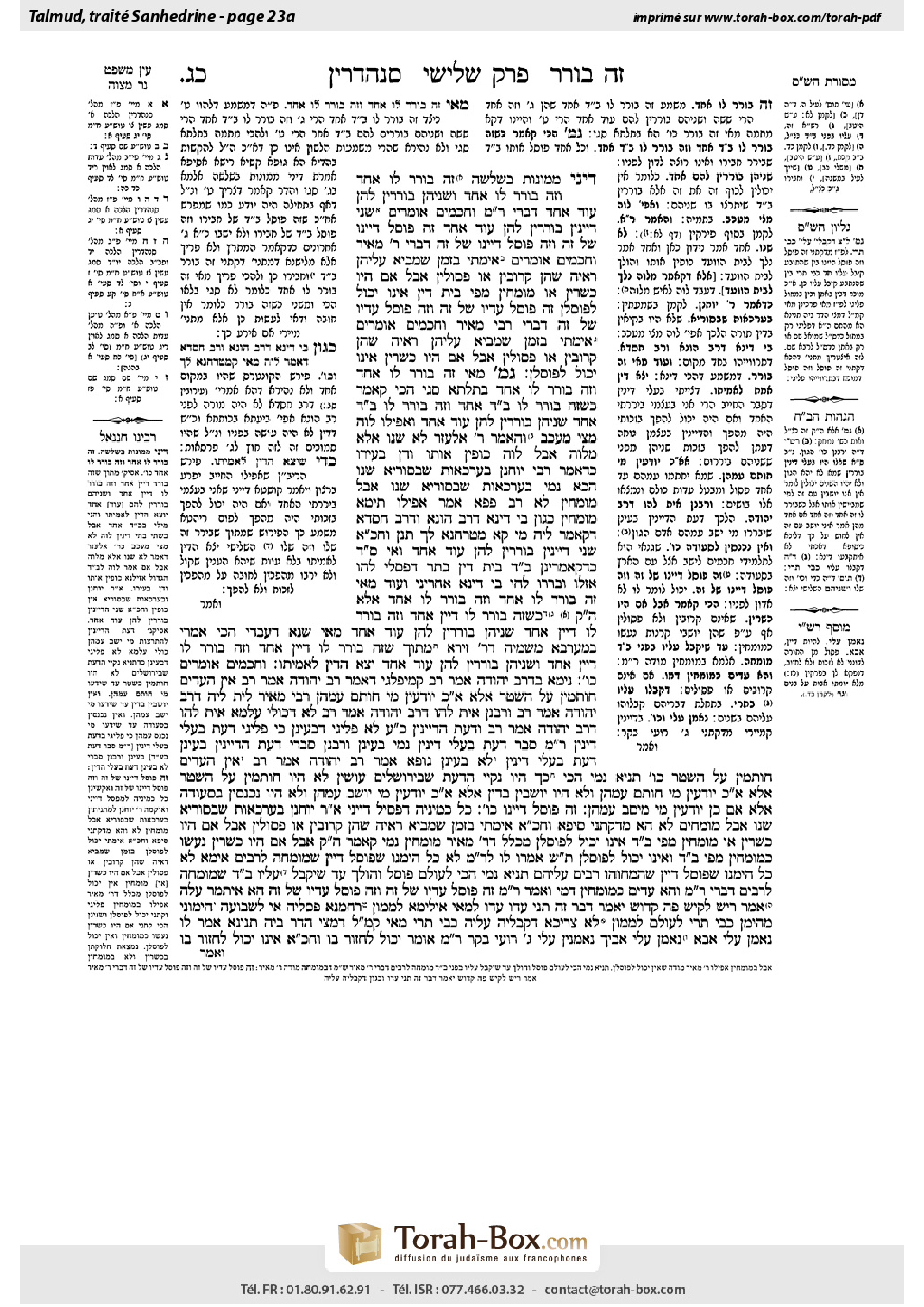
Sanhedrin 23a: Talmud study for Daf Yomi
Daf Yomi is the daily study of one Talmud folio. Explore 37 tractates with scans, Hebrew text, Sefaria English and AI-generated French translations where annotated.
Passage selection and English or AI-generated French translation are available where the scan has annotations. Daf Study is independent of Torah-Box and Sefaria.
Browse Sanhedrin · סנהדרין · All tractatesSanhedrin 23a text and translations
This page of Sanhedrin includes the Aramaic text, an English translation and an AI-generated French translation, alongside the scan above.
סנהדרין כ״ג א · Aramaic and Hebrew text
מַתְנִי׳ דִּינֵי מָמוֹנוֹת בִּשְׁלֹשָׁה. זֶה בּוֹרֵר לוֹ אֶחָד, וְזֶה בּוֹרֵר לוֹ אֶחָד, וּשְׁנֵיהֶן בּוֹרְרִין לָהֶן עוֹד אֶחָד, דִּבְרֵי רַבִּי מֵאִיר. וַחֲכָמִים אוֹמְרִים: שְׁנֵי דַיָּינִין בּוֹרְרִין לָהֶן עוֹד אֶחָד.
זֶה פּוֹסֵל דַּיָּינוֹ שֶׁל זֶה, וְזֶה פּוֹסֵל דַּיָּינוֹ שֶׁל זֶה – דִּבְרֵי רַבִּי מֵאִיר. וַחֲכָמִים אוֹמְרִים: אֵימָתַי? בִּזְמַן שֶׁמֵּבִיא עֲלֵיהֶן רְאָיָה שֶׁהֵן קְרוֹבִין אוֹ פְּסוּלִין. אֲבָל אִם הָיוּ כְּשֵׁרִין אוֹ מוּמְחִין מִפִּי בֵּית דִּין – אֵינוֹ יָכוֹל לְפוֹסְלָן.
זֶה פּוֹסֵל עֵדָיו שֶׁל זֶה, וְזֶה פּוֹסֵל עֵדָיו שֶׁל זֶה. דִּבְרֵי רַבִּי מֵאִיר. וַחֲכָמִים אוֹמְרִים: אֵימָתַי? בִּזְמַן שֶׁמֵּבִיא עֲלֵיהֶן רְאָיָה שֶׁהֵן קְרוֹבִין אוֹ פְּסוּלִין, אֲבָל אִם הָיוּ כְּשֵׁרִין – אֵינוֹ יָכוֹל לְפוֹסְלָן.
גְּמָ׳ מַאי ״זֶה בּוֹרֵר לוֹ אֶחָד וְזֶה בּוֹרֵר לוֹ אֶחָד״? בִּתְלָתָא סַגִּי!
הָכִי קָאָמַר: כְּשֶׁזֶּה בּוֹרֵר לוֹ בֵּית דִּין אֶחָד, וְזֶה בּוֹרֵר לוֹ בֵּית דִּין אֶחָד, שְׁנֵיהֶן בּוֹרְרִין לָהֶן עוֹד אֶחָד.
וַאֲפִילּוּ לֹוֶה מָצֵי מְעַכֵּב? וְהָאָמַר רַבִּי אֶלְעָזָר: לֹא שָׁנוּ אֶלָּא מַלְוֶה, אֲבָל לֹוֶה כּוֹפִין אוֹתוֹ וְדָן בְּעִירוֹ.
כִּדְאָמַר רַבִּי יוֹחָנָן: בְּעַרְכָּאוֹת שֶׁבְּסוּרְיָא שָׁנוּ. הָכָא נָמֵי, בְּעַרְכָּאוֹת שֶׁבְּסוּרְיָא שָׁנוּ. אֲבָל מוּמְחִין – לָא.
רַב פָּפָּא אָמַר: אֲפִילּוּ תֵּימָא מוּמְחִין, כְּגוֹן בֵּי דִינָא דְּרַב הוּנָא וּדְרַב חִסְדָּא, דְּקָאָמַר לֵיהּ: מִי קָא מַטְרַחְנָא לָךְ?
תְּנַן: וַחֲכָמִים אוֹמְרִים, שְׁנֵי דַיָּינִין בּוֹרְרִין לָהֶן עוֹד אֶחָד. וְאִי סָלְקָא דַעְתָּךְ כִּדְקָאָמְרִינַן בֵּית דִּין – בֵּית דִּין בָּתַר דְּפָסְלִי לְהוּ, אָזְלוּ וּבָרְרוּ לְהוּ בֵּי דִינָא אַחֲרִינֵי?
וְעוֹד, מַאי ״זֶה בּוֹרֵר לוֹ אֶחָד וְזֶה בּוֹרֵר לוֹ אֶחָד״?
אֶלָּא הָכִי קָאָמַר: כְּשֶׁזֶּה בּוֹרֵר לוֹ דַּיָּין אֶחָד, וְזֶה בּוֹרֵר לוֹ דַּיָּין אֶחָד, שְׁנֵיהֶן בּוֹרְרִין לָהֶן עוֹד אֶחָד.
מַאי שְׁנָא דְּעָבְדִי הָכִי? אָמְרִי בְּמַעְרְבָא מִשְּׁמֵיהּ דְּרַבִּי זֵירָא: מִתּוֹךְ שֶׁזֶּה בּוֹרֵר לוֹ דַּיָּין אֶחָד, וְזֶה בּוֹרֵר לוֹ דַּיָּין אֶחָד, וּשְׁנֵיהֶן בּוֹרְרִין לָהֶן עוֹד אֶחָד – יֵצֵא הַדִּין לַאֲמִיתּוֹ.
וַחֲכָמִים אוֹמְרִים כּוּ׳. נֵימָא בִּדְרַב יְהוּדָה אָמַר רַב קָמִיפַּלְגִי?
דְּאָמַר רַב יְהוּדָה אָמַר רַב: אֵין הָעֵדִים חוֹתְמִין עַל הַשְּׁטָר אֶלָּא אִם כֵּן יוֹדְעִין מִי חוֹתֵם עִמָּהֶן. רַבִּי מֵאִיר לֵית לֵיהּ דְּרַב יְהוּדָה אָמַר רַב, וְרַבָּנַן אִית לְהוּ דְּרַב יְהוּדָה אָמַר רַב.
לָא, דְּכוּלֵּי עָלְמָא אִית לְהוּ דְּרַב יְהוּדָה אָמַר רַב, וְדַעַת הַדַּיָּינִין – כּוּלֵּי עָלְמָא לָא פְּלִיגִי דְּבָעֵינַן. כִּי פְּלִיגִי – דַּעַת בַּעֲלֵי דִינִין: רַבִּי מֵאִיר סָבַר דַּעַת בַּעֲלֵי דִינִין נָמֵי בָּעֵינַן, וְרַבָּנַן סָבְרִי דַּעַת הַדַּיָּינִין בָּעֵינַן, דַּעַת בַּעֲלֵי דִינִין לָא בָּעֵינַן.
גּוּפָא, אָמַר רַב יְהוּדָה אָמַר רַב: אֵין הָעֵדִים חוֹתְמִין עַל הַשְּׁטָר כּוּ׳. תַּנְיָא נָמֵי הָכִי: כָּךְ הָיוּ נְקִיֵּי הַדַּעַת שֶׁבִּירוּשָׁלַיִם עוֹשִׂין – לֹא הָיוּ חוֹתְמִין עַל הַשְּׁטָר אֶלָּא אִם כֵּן יוֹדְעִין מִי חוֹתֵם עִמָּהֶן, וְלֹא הָיוּ יוֹשְׁבִין בְּדִין אֶלָּא אִם כֵּן יוֹדְעִין מִי יוֹשֵׁב עִמָּהֶן, וְלֹא הָיוּ נִכְנָסִין בִּסְעוּדָה אֶלָּא אִם כֵּן יוֹדְעִין מִי מֵסֵב עִמָּהֶן.
זֶה פּוֹסֵל דַּיָּינוֹ כּוּ׳. כֹּל כְּמִינֵּיהּ דְּפָסֵיל דַּיָּינֵי?
אָמַר רַבִּי יוֹחָנָן: בְּעַרְכָּאוֹת שֶׁבְּסוּרְיָא שָׁנוּ, אֲבָל מוּמְחִים – לֹא.
הָא מִדְּקָתָנֵי סֵיפָא: וַחֲכָמִים אוֹמְרִים, אֵימָתַי? בִּזְמַן שֶׁמֵּבִיא רְאָיָה שֶׁהֵן קְרוֹבִין אוֹ פְּסוּלִין. אֲבָל אִם הָיוּ כְּשֵׁרִין, אוֹ מוּמְחִין מִפִּי בֵּית דִּין – אֵינוֹ יָכוֹל לְפוֹסְלָן, מִכְּלָל דְּרַבִּי מֵאִיר מוּמְחִין נָמֵי קָאָמַר!
הָכִי קָאָמַר: אֲבָל אִם הָיוּ כְּשֵׁרִין, נַעֲשׂוּ כְּמוּמְחִין מִפִּי בֵּית דִּין, וְאֵינוֹ יָכוֹל לְפוֹסְלָן.
תָּא שְׁמַע: אָמְרוּ לוֹ לְרַבִּי מֵאִיר, לֹא כׇּל הֵימֶנּוּ שֶׁפּוֹסֵל דַּיָּין שֶׁמּוּמְחֶה לְרַבִּים.
אֵימָא: לֹא כׇּל הֵימֶנּוּ שֶׁפּוֹסֵל דַּיָּין שֶׁהִמְחוּהוּ רַבִּים עֲלֵיהֶם.
תַּנְיָא נָמֵי הָכִי: לְעוֹלָם פּוֹסֵל וְהוֹלֵךְ, עַד שֶׁיְּקַבֵּל עָלָיו בֵּית דִּין שֶׁמּוּמְחֶה לְרַבִּים. דִּבְרֵי רַבִּי מֵאִיר.
וְהָא עֵדִים כְּמוּמְחִין דָּמֵי? וְאָמַר רַבִּי מֵאִיר: זֶה פּוֹסֵל עֵדָיו שֶׁל זֶה, וְזֶה פּוֹסֵל עֵדָיו שֶׁל זֶה.
הָא אִיתְּמַר עֲלַהּ, אָמַר רֵישׁ לָקִישׁ: פֶּה קָדוֹשׁ יֹאמַר דָּבָר זֶה? תְּנִי: ״עֵדוֹ״.
עֵדוֹ לְמַאי? אִילֵימָא לְמָמוֹן, רַחֲמָנָא פַּסְלֵיהּ! אִי לִשְׁבוּעָה, הֵימוֹנֵי מְהֵימַן כְּבֵי תְּרֵי!
לְעוֹלָם לְמָמוֹן. לָא צְרִיכָא, דְּקַבְּלֵיהּ עֲלֵיהּ כְּבֵי תְרֵי.
מַאי קָא מַשְׁמַע לַן: דְּמָצֵי הָדַר בֵּיהּ? תְּנֵינָא: אָמַר לוֹ ״נֶאֱמָן עָלַי אַבָּא״, ״נֶאֱמָן עָלַי אָבִיךָ״, ״נֶאֱמָנִין עָלַי שְׁלֹשָׁה רוֹעֵי בָּקָר״ – רַבִּי מֵאִיר אוֹמֵר: יָכוֹל לַחֲזוֹר בּוֹ, וַחֲכָמִים אוֹמְרִים: אֵינוֹ יָכוֹל לַחֲזוֹר בּוֹ.
Sanhedrin 23a · English translation
MISHNA: Cases of monetary law are adjudicated by three. They are chosen in the following manner: This litigant chooses one for himself and that litigant chooses one for himself, and the two of them choose one more for themselves; this is the statement of Rabbi Meir. And the Rabbis say: The two judges that were chosen choose one more judge for themselves.
This litigant can disqualify the judge chosen by that litigant and that litigant can disqualify the judge chosen by this litigant; this is the statement of Rabbi Meir. And the Rabbis say: When can one of the litigants disqualify the judges? Only when he brings evidence about them that they are related to one of the litigants or to each other, or that they are disqualified from serving as judges for another reason. But if they are fit to serve as judges or are experts ordained by the court, he cannot disqualify them.
This litigant can disqualify the witnesses of that litigant and that litigant can disqualify the witnesses of this litigant; this is the statement of Rabbi Meir. And the Rabbis say: When can one litigant disqualify the other’s witnesses? Only when he brings evidence about them that they are related to one of the litigants or to each other, or that they are disqualified from bearing witness for another reason. But if they are fit to serve as witnesses, he cannot disqualify them.
GEMARA: The Gemara assumes that the statement: This litigant chooses one and that litigant chooses one and the two of them choose one more, means that each litigant chooses a court of three judges and the two courts together choose one more court, for a total of nine judges. The Gemara asks: For what purpose does this litigant choose one court for himself and that litigant choose one court for himself; isn’t it sufficient to judge the case with three judges?
The Gemara answers: This is what the mishna is saying: In a case where this litigant chooses one court for himself, i.e., he requests to be judged before three specific judges, and that litigant chooses one other court of three judges for himself, as he does not wish to be judged before the court that the first litigant requested, in this case, both of them choose one more court for themselves, i.e., they must reach a compromise and decide about the composition of the court that will judge them.
The Gemara asks: And can even a debtor restrict the choice of the court? But doesn’t Rabbi Elazar say: The Sages taught that only a creditor can refuse a court chosen by the debtor, due to his desire to be judged by a prominent court, but that as for a debtor, they compel him to appear in the court that presides in his own city.
The Gemara answers: It is as Rabbi Yoḥanan says concerning a different matter, that the Sages taught that other matter with regard to the laymen’s courts [be’arkaot] in Syria. Here too, the Sages taught the halakha in the mishna with regard to the laymen’s courts in Syria, which allow even the debtor to refuse to be judged before the court chosen by the creditor, claiming that they are not worthy judges. But if the creditor chooses a court of experts, the debtor does not have the right to refuse to be judged before them.
Rav Pappa said: You may even say that the mishna is referring to courts of experts in the same city, such as the courts of Rav Huna and of Rav Ḥisda. As in that case, each litigant can say to the other: Am I burdening you by requesting that you be judged by a different court?
We learned in the mishna: And the Rabbis say: The two judges that were chosen choose one more for themselves. And if it enters your mind to interpret the mishna as we said before, that each litigant chose a court of three judges, this statement is difficult; after each court was disqualified by one of the litigants, shall the members of both courts go and choose another court for themselves?
And furthermore, for what reason would the mishna state that the standard procedure for choosing judges is that this litigant chooses one court for himself and that litigant chooses one court for himself, each disqualifying the court that the other chose?
Rather, this is what the mishna is saying: When this litigant chooses one judge for himself before whom he requests to be judged, and that litigant chooses one other judge for himself before whom he requests to be judged, the two litigants then choose one more judge for themselves, and the case is adjudicated by these three judges.
The Gemara asks: What is different about this procedure; i.e., that the selection of the judges is performed specifically in this manner? The Sages in the West, Eretz Yisrael, say in the name of Rabbi Zeira: As a result of the fact that this litigant chooses one judge for himself, and that litigant chooses one judge for himself, and the two litigants choose one more judge for themselves, the true judgment will emerge. Each litigant assumes that the judges he chose do not bear a grudge against him, and he will accept their ruling.
§ The mishna teaches: And the Rabbis say: The two judges that were chosen choose one more judge. The Gemara suggests: Let us say that Rabbi Meir and the Rabbis disagree with regard to what Rav Yehuda says that Rav says.
As Rav Yehuda says that Rav says: Witnesses do not sign a document unless they know who is signing with them. One does not sign a document unless he recognizes that those signing with him are fit to bear witness. According to the Gemara’s suggestion, Rabbi Meir does not accept that which Rav Yehuda says that Rav says. Therefore, the litigants can choose the third judge, as the first two judges will be amenable to signing the court order without knowing the third judge. And the Rabbis accept that which Rav Yehuda says that Rav says; and the judges would not sign the court order without themselves knowing the third judge.
The Gemara rejects this suggestion: No, everyone accepts that which Rav Yehuda says that Rav says; and everyone agrees with the premise that we need the consent of the first two judges for the appointment of the third. Rather, when they disagree, it is about whether the consent of the litigants is necessary. Rabbi Meir holds that we need the consent of the litigants as well, and the Rabbis hold that although we need the consent of the other two judges, we do not need the consent of the litigants.
Returning to the matter itself, Rav Yehuda says that Rav says: Witnesses do not sign a document unless they know who is signing with them. That is also taught in a baraita: This is what the scrupulous people of Jerusalem would do: They would not sign a document unless they knew who was signing with them, and they would not sit in judgment unless they knew who was sitting with them, and they would not join a meal unless they knew who was reclining, i.e., eating, with them.
§ The mishna teaches: This litigant can disqualify the judge chosen by that litigant and that litigant can disqualify the judge chosen by this litigant. The Gemara asks: Is it in his power to disqualify judges?
Rabbi Yoḥanan says: The Sages taught this matter with regard to the laymen’s courts in Syria. In those courts, each litigant can refuse to be judged by the judge the other litigant chose. But this halakha is not stated with regard to a court of expert judges.
The Gemara challenges: From the fact that the mishna teaches in the latter clause: And the Rabbis say: When can one of the litigants disqualify the judges? When he brings evidence that they are related to one of the litigants or to each other, or that they are disqualified from serving as judges for another reason; but if they are fit to serve as judges, or are experts ordained by the court, he cannot disqualify them. By inference, Rabbi Meir is also speaking of a court of experts when he says that one can refuse to be judged.
The Gemara answers: This is what the mishna is saying: But if they are fit to serve as judges they are treated like experts ordained by the court, and he cannot disqualify them.
The Gemara suggests: Come and hear a baraita that contradicts this interpretation: The Rabbis said to Rabbi Meir: It is not within a litigant’s power to disqualify a judge who is accepted as an expert for the public. Apparently, Rabbi Meir disagrees with the Rabbis with regard to an expert judge.
The Gemara answers: Say that the baraita should be emended as follows: It is not within a litigant’s power to disqualify a judge whom the public accepted upon themselves as an expert judge for their matters, just as the halakha is concerning the laymen’s courts in Syria.
That interpretation is also taught in a baraita, which teaches: A litigant can continuously disqualify the judges chosen by the other litigant forever, until the latter accepts to be judged by a court that is accepted as an expert court for the public; this is the statement of Rabbi Meir. Clearly, Rabbi Meir concedes that one cannot refuse to have the case judged by an expert court.
The Gemara asks: But aren’t witnesses like experts, in that their standing is independent of their being accepted by the litigants? And yet Rabbi Meir says: This litigant can disqualify the witnesses of that litigant and that litigant can disqualify the witnesses of this litigant.
The Gemara answers: It was stated with regard to that statement of Rabbi Meir that Reish Lakish says: Would a holy mouth, i.e., that of Rabbi Meir, say this strange statement, that a litigant can prevent a witness from testifying against him? Rather, emend the text of the mishna and teach: His witness, in the singular, meaning that a litigant can disqualify only a witness who testifies alone.
The Gemara asks: For what purpose does his single witness testify? If we say it is to testify about monetary matters, the Merciful One already disqualifies him, as by Torah law the testimony of only one witness is not accepted. If it is to render the defendant liable to take an oath that he does not owe the money being claimed, in this regard the testimony of one witness is deemed credible like two witnesses; the Torah states that if one witness supports the claim of the claimant, the defendant is required to take an oath that he does not owe the money.
The Gemara answers: Actually, the purpose of the testimony is to testify about monetary matters; and no, one should not raise that challenge, as this ruling is necessary only in a case where the litigant initially accepted upon himself the single witness as equivalent to two witnesses. Afterward, he retracted his agreement to accept the single witness’s testimony as if it were that of two witnesses. Rabbi Meir rules that his retraction is valid, and the testimony is not accepted.
The Gemara asks: What is this teaching us, that one can retract this kind of agreement? We learn this in the following mishna (24a): If one of the litigants says to the other: My father is trusted to adjudicate for me, or: Your father is trusted to adjudicate for me, or: Three cattle herders, who are not proficient in halakha, are trusted to adjudicate for me, all of whom are legally disqualified from serving as judges, Rabbi Meir says that the one who made the offer can retract it; and the Rabbis say that he cannot retract it, and must accept their verdict.
Sanhedrin 23a · Traduction française (IA)
MICHNA : Les litiges pécuniaires sont jugés par trois juges, désignés de la manière suivante : un plaideur en choisit un pour lui-même, l’autre plaideur en choisit un pour lui-même, puis tous deux en choisissent un troisième. Telle est la déclaration de Rabbi Meïr. Les Sages disent : les deux juges qui ont été choisis en désignent un troisième.
Un plaideur peut récuser le juge choisi par l’autre plaideur, et l’autre plaideur peut récuser le juge choisi par le premier. Telle est la déclaration de Rabbi Meïr. Les Sages disent : dans quel cas un plaideur peut-il récuser les juges ? Uniquement s’il apporte la preuve qu’ils sont apparentés à l’un des plaideurs ou entre eux, ou qu’ils sont disqualifiés pour exercer la fonction de juge pour une autre raison. Mais s’ils sont aptes à exercer cette fonction ou sont des experts ordonnés par le tribunal, il ne peut pas les récuser.
Un plaideur peut récuser les témoins de l’autre plaideur, et l’autre plaideur peut récuser les témoins du premier. Telle est la déclaration de Rabbi Meïr. Les Sages disent : dans quel cas un plaideur peut-il récuser les témoins de l’autre ? Uniquement s’il apporte la preuve qu’ils sont apparentés à l’un des plaideurs ou entre eux, ou qu’ils sont disqualifiés pour témoigner pour une autre raison. Mais s’ils sont aptes à témoigner, il ne peut pas les récuser.
GUEMARA : La Guemara suppose que la déclaration « un plaideur en choisit un, l’autre plaideur en choisit un, puis tous deux en choisissent un autre » signifie que chaque plaideur choisit pour lui-même un tribunal de trois juges, et que les deux tribunaux choisissent ensemble un tribunal supplémentaire, soit neuf juges au total. La Guemara demande : Dans quel but un plaideur choisit-il un tribunal pour lui-même et l’autre plaideur en choisit-il un pour lui-même ? Ne suffit-il pas que l’affaire soit jugée par trois juges ?
La Guemara répond : Voici ce que dit la Michna : lorsqu’un plaideur choisit un tribunal pour lui-même, c’est-à-dire qu’il demande à être jugé par trois juges précis, et que l’autre plaideur choisit pour lui-même un autre tribunal de trois juges, car il ne souhaite pas être jugé par le tribunal demandé par le premier plaideur, alors tous deux choisissent un tribunal supplémentaire pour eux-mêmes, c’est-à-dire qu’ils doivent parvenir à un compromis et décider de la composition du tribunal qui les jugera.
La Guemara demande : Même un débiteur peut-il restreindre le choix du tribunal ? Rabbi Elazar ne dit-il pas que les Sages ont enseigné que seul un créancier peut refuser le tribunal choisi par le débiteur, parce qu’il souhaite être jugé par un tribunal éminent, tandis que le débiteur, lui, est contraint de comparaître devant le tribunal qui siège dans sa propre ville ?
La Guemara répond : Il en va comme dans le cas d’un autre sujet au sujet duquel Rabbi Yoḥanan dit que les Sages ont enseigné la règle concernant les tribunaux de profanes [be’arkaot] en Syrie. Ici aussi, les Sages ont enseigné la halakha de la Michna à propos des tribunaux de profanes en Syrie, où même le débiteur peut refuser d’être jugé par le tribunal choisi par le créancier, au motif que ses juges ne sont pas dignes de cette fonction. Mais si le créancier choisit un tribunal d’experts, le débiteur n’a pas le droit de refuser d’être jugé devant lui.
Rav Pappa dit : On peut même dire que la Michna parle de tribunaux d’experts dans une même ville, comme ceux de Rav Houna et de Rav Ḥisda. En effet, dans ce cas, chaque plaideur peut dire à l’autre : « Est-ce que je t’impose une charge en demandant que tu sois jugé par un autre tribunal ? »
Nous avons appris dans la Michna : « Les Sages disent : les deux juges qui ont été choisis en désignent un autre. » Or, si l’on interprétait la Michna comme nous l’avons dit précédemment, à savoir que chaque plaideur a choisi un tribunal de trois juges, cette déclaration serait difficile à comprendre : après que chacun des plaideurs a récusé le tribunal choisi par l’autre, les membres des deux tribunaux devraient-ils aller en choisir un autre ?
De plus, pour quelle raison la Michna dirait-elle que la procédure habituelle de désignation des juges consiste à ce qu’un plaideur choisisse un tribunal pour lui-même et que l’autre plaideur en choisisse un pour lui-même, chacun récusant le tribunal choisi par l’autre ?
Mais voici ce que dit la Michna : lorsqu’un plaideur choisit un juge devant lequel il demande à être jugé et que l’autre plaideur choisit un autre juge devant lequel il demande à être jugé, les deux plaideurs choisissent ensuite un troisième juge, et l’affaire est jugée par ces trois juges.
La Guemara demande : En quoi cette procédure se distingue-t-elle, c’est-à-dire pourquoi les juges sont-ils désignés précisément de cette manière ? Les Sages d’Occident, en Terre d’Israël, disent au nom de Rabbi Zeira : Puisqu’un plaideur choisit un juge pour lui-même, que l’autre plaideur en choisit un pour lui-même, puis que les deux plaideurs en choisissent un troisième, le jugement véritable émergera. Chaque plaideur suppose que les juges qu’il a choisis ne lui gardent pas rancune, et il acceptera leur décision.
§ La Michna enseigne : « Les Sages disent : les deux juges qui ont été choisis en désignent un autre. » La Guemara propose : Disons que Rabbi Meïr et les Sages sont en désaccord sur la règle énoncée par Rav Yehouda au nom de Rav.
Rav Yehouda dit en effet au nom de Rav : Les témoins ne signent pas un document sans savoir qui le signe avec eux. Personne ne signe un document sans reconnaître que ceux qui le signent avec lui sont aptes à témoigner. Selon l’hypothèse de la Guemara, Rabbi Meïr n’admet pas la règle énoncée par Rav Yehouda au nom de Rav. Les plaideurs peuvent donc choisir le troisième juge, puisque les deux premiers juges accepteront de signer l’acte du tribunal sans connaître le troisième juge. Les Sages, eux, admettent la règle énoncée par Rav Yehouda au nom de Rav, et les juges ne signeraient pas l’acte du tribunal sans connaître eux-mêmes le troisième juge.
La Guemara rejette cette hypothèse : Non, tous admettent la règle énoncée par Rav Yehouda au nom de Rav, et tous reconnaissent que le consentement des deux premiers juges est nécessaire à la désignation du troisième. Leur désaccord porte plutôt sur la nécessité du consentement des plaideurs. Rabbi Meïr estime que le consentement des plaideurs est également nécessaire, tandis que les Sages estiment que, bien que le consentement des deux autres juges soit nécessaire, celui des plaideurs ne l’est pas.
Revenons au sujet lui-même. Rav Yehouda dit au nom de Rav : Les témoins ne signent pas un document sans savoir qui le signe avec eux. Cela est également enseigné dans une baraïta : Voici ce que faisaient les gens scrupuleux de Jérusalem : ils ne signaient un document que s’ils savaient qui le signait avec eux ; ils ne siégeaient pas pour juger sans savoir qui siégeait avec eux ; et ils ne se joignaient pas à un repas sans savoir qui était assis avec eux, c’est-à-dire qui mangeait avec eux.
§ La Michna enseigne : « Un plaideur peut récuser le juge choisi par l’autre plaideur, et l’autre plaideur peut récuser le juge choisi par le premier. » La Guemara demande : A-t-il le pouvoir de récuser des juges ?
Rabbi Yoḥanan dit : Les Sages ont enseigné cette règle à propos des tribunaux de profanes en Syrie. Dans ces tribunaux, chaque plaideur peut refuser d’être jugé par le juge choisi par l’autre plaideur. Mais cette halakha ne concerne pas un tribunal composé de juges experts.
La Guemara objecte : Dans la suite de la Michna, il est enseigné : « Les Sages disent : dans quel cas un plaideur peut-il récuser les juges ? Lorsqu’il apporte la preuve qu’ils sont apparentés à l’un des plaideurs ou entre eux, ou qu’ils sont disqualifiés pour exercer la fonction de juge pour une autre raison ; mais s’ils sont aptes à exercer cette fonction ou sont des experts ordonnés par le tribunal, il ne peut pas les récuser. » On en déduit que Rabbi Meïr parle lui aussi d’un tribunal d’experts lorsqu’il dit qu’un plaideur peut refuser d’être jugé par lui.
La Guemara répond : Voici ce que dit la Michna : s’ils sont aptes à exercer la fonction de juge, ils sont considérés comme des experts ordonnés par le tribunal, et le plaideur ne peut pas les récuser.
La Guemara propose : Écoutez une baraïta qui contredit cette interprétation : Les Sages dirent à Rabbi Meïr : « Un plaideur n’a pas le pouvoir de récuser un juge reconnu comme expert par le public. » Il semble donc que Rabbi Meïr soit en désaccord avec les Sages au sujet d’un juge expert.
La Guemara répond : Il faut corriger la baraïta comme suit : « Un plaideur n’a pas le pouvoir de récuser un juge que le public a accepté pour juger ses affaires en tant que juge expert », comme c’est le cas pour les tribunaux de profanes en Syrie.
Cette interprétation est également enseignée dans une baraïta : Un plaideur peut récuser sans cesse les juges choisis par l’autre plaideur, jusqu’à ce que ce dernier accepte d’être jugé par un tribunal reconnu par le public comme un tribunal d’experts. Telle est la déclaration de Rabbi Meïr. Il est donc clair que Rabbi Meïr admet qu’on ne peut pas refuser que l’affaire soit jugée par un tribunal d’experts.
La Guemara demande : Mais les témoins ne sont-ils pas comme des experts, en ce que leur statut ne dépend pas de l’acceptation des plaideurs ? Pourtant, Rabbi Meïr dit : « Un plaideur peut récuser les témoins de l’autre plaideur, et l’autre plaideur peut récuser les témoins du premier. »
La Guemara répond : À propos de cette déclaration de Rabbi Meïr, Reish Lakish dit : « Une bouche sainte, c’est-à-dire celle de Rabbi Meïr, pourrait-elle prononcer cette déclaration étrange, selon laquelle un plaideur peut empêcher un témoin de témoigner contre lui ? » Il faut plutôt corriger le texte de la Michna et lire « son témoin », au singulier, ce qui signifie qu’un plaideur peut récuser uniquement un témoin qui témoigne seul.
La Guemara demande : Dans quel but son témoin unique témoigne-t-il ? Si l’on dit que c’est pour témoigner dans une affaire pécuniaire, le Miséricordieux l’a déjà disqualifié, puisque, selon la Torah, le témoignage d’un seul témoin n’est pas accepté. Si c’est pour obliger le défendeur à prêter serment qu’il ne doit pas l’argent qui lui est réclamé, alors, à cet égard, le témoignage d’un seul témoin est tenu pour crédible comme celui de deux témoins : la Torah déclare que si un seul témoin appuie la réclamation du demandeur, le défendeur doit prêter serment qu’il ne doit pas cet argent.
La Guemara répond : En réalité, le témoignage vise une affaire pécuniaire. Mais il ne faut pas soulever cette objection, car cette règle n’est nécessaire que dans le cas où le plaideur a d’abord accepté que le témoin unique soit considéré comme deux témoins. Par la suite, il est revenu sur son accord à traiter le témoignage du témoin unique comme celui de deux témoins. Rabbi Meïr statue que cette rétractation est valable et que le témoignage n’est pas accepté.
La Guemara demande : Que nous apprend-on en disant qu’on peut revenir sur ce type d’accord ? Nous l’apprenons dans la Michna suivante (24a) : si l’un des plaideurs dit à l’autre : « Mon père est digne de confiance pour juger mon affaire », ou : « Ton père est digne de confiance pour juger mon affaire », ou encore : « Trois gardiens de bétail, qui ne connaissent pas bien la halakha, sont dignes de confiance pour juger mon affaire », alors que tous sont légalement disqualifiés pour exercer la fonction de juge, Rabbi Meïr dit que celui qui a fait cette proposition peut revenir sur celle-ci ; les Sages disent qu’il ne le peut pas et qu’il doit accepter leur verdict.
Traduction française générée par IA à partir de l’édition anglaise de Sefaria. Vérifie toujours un passage avec le texte source.
Text from Sefaria: William Davidson Edition - Vocalized Aramaic (CC BY NC); William Davidson Edition - English (CC BY NC).