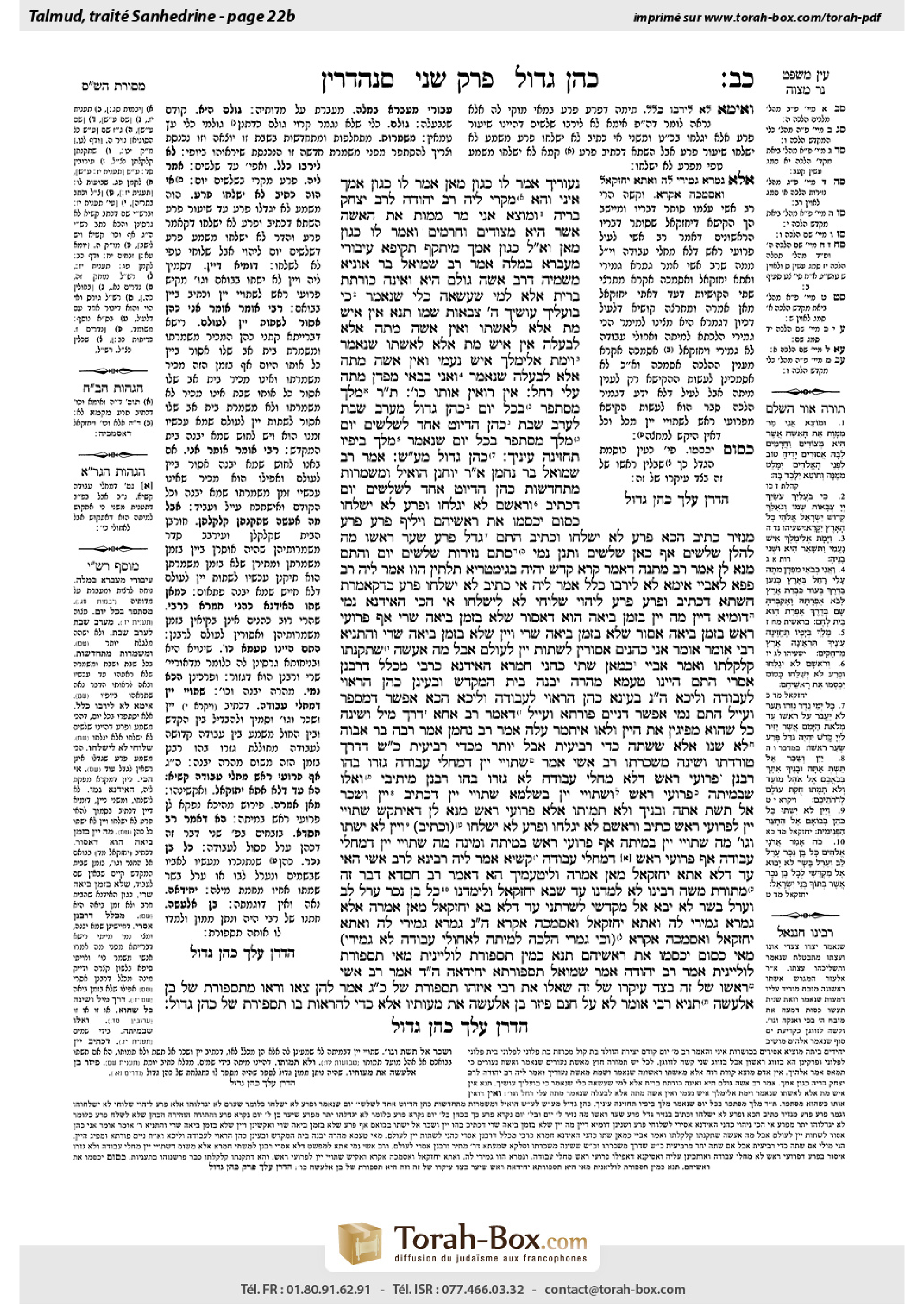
Sanhedrin 22b: Talmud study for Daf Yomi
Daf Yomi is the daily study of one Talmud folio. Explore 37 tractates with scans, Hebrew text, Sefaria English and AI-generated French translations where annotated.
Passage selection and English or AI-generated French translation are available where the scan has annotations. Daf Study is independent of Torah-Box and Sefaria.
Browse Sanhedrin · סנהדרין · All tractatesSanhedrin 22b text and translations
This page of Sanhedrin includes the Aramaic text, an English translation and an AI-generated French translation, alongside the scan above.
סנהדרין כ״ב ב · Aramaic and Hebrew text
נְעוּרֶיךָ״. אָמַר לוֹ: כְּגוֹן מַאן? אָמַר לוֹ: כְּגוֹן אִמָּךְ.
אִינִי? וְהָא מַקְרֵי לֵיהּ רַב יְהוּדָה לְרַב יִצְחָק בְּרֵיהּ: ״וּמוֹצֶא אֲנִי מָר מִמָּוֶת אֶת הָאִשָּׁה אֲשֶׁר הִיא מְצוֹדִים וַחֲרָמִים״. וְאָמַר לוֹ: כְּגוֹן מַאן? וְאָמַר לוֹ: כְּגוֹן אִמָּךְ. מִיתְקָף תַּקִּיפָא, עַיבּוֹרֵי מְעַבְּרָא בְּמִלַּהּ.
אָמַר רַב שְׁמוּאֵל בַּר אוּנְיָא מִשְּׁמֵיהּ דְּרַב: אִשָּׁה גּוֹלֶם הִיא, וְאֵינָהּ כּוֹרֶתֶת בְּרִית אֶלָּא לְמִי שֶׁעֲשָׂאָהּ כְּלִי, שֶׁנֶּאֱמַר: ״כִּי בֹעֲלַיִךְ עֹשַׂיִךְ ה׳ צְבָאוֹת שְׁמוֹ״.
תָּנָא: אֵין אִישׁ מֵת אֶלָּא לְאִשְׁתּוֹ, וְאֵין אִשָּׁה מֵתָה אֶלָּא לְבַעְלָהּ. אֵין אִישׁ מֵת אֶלָּא לְאִשְׁתּוֹ, שֶׁנֶּאֱמַר: ״וַיָּמָת אֱלִימֶלֶךְ אִישׁ נׇעֳמִי״. וְאֵין אִשָּׁה מֵתָה אֶלָּא לְבַעְלָהּ, שֶׁנֶּאֱמַר: ״וַאֲנִי בְּבֹאִי מִפַּדָּן מֵתָה עָלַי רָחֵל״.
אֵין רוֹאִין אוֹתוֹ כּוּ׳. תָּנוּ רַבָּנַן: מֶלֶךְ מִסְתַּפֵּר בְּכׇל יוֹם, כֹּהֵן גָּדוֹל מֵעֶרֶב שַׁבָּת לְעֶרֶב שַׁבָּת, כֹּהֵן הֶדְיוֹט אֶחָד לִשְׁלשִׁים יוֹם.
מֶלֶךְ מִסְתַּפֵּר בְּכׇל יוֹם, שֶׁנֶּאֱמַר: ״מֶלֶךְ בְּיׇפְיוֹ תֶּחֱזֶינָה עֵינֶיךָ״. כֹּהֵן גָּדוֹל מֵעֶרֶב שַׁבָּת, אָמַר רַב שְׁמוּאֵל בַּר נַחְמָן אָמַר רַבִּי יוֹחָנָן: הוֹאִיל וּמִשְׁמָרוֹת מִתְחַדְּשׁוֹת.
כֹּהֵן הֶדְיוֹט אֶחָד לִשְׁלֹשִׁים יוֹם, דִּכְתִיב: ״וְרֹאשָׁם לֹא יְגַלֵּחוּ וּפֶרַע לֹא יְשַׁלֵּחוּ כָּסוֹם יִכְסְמוּ אֶת רָאשֵׁיהֶם״, וְיָלֵיף פֶּרַע פֶּרַע מִנָּזִיר. כְּתִיב הָכָא: ״פֶּרַע לֹא יְשַׁלֵּחוּ״, וּכְתִיב הָתָם: ״גַּדֵּל פֶּרַע שְׂעַר רֹאשׁוֹ״. מָה לְהַלָּן שְׁלֹשִׁים, אַף כָּאן שְׁלֹשִׁים. וּתְנַן נָמֵי: סְתַם נְזִירוּת שְׁלֹשִׁים יוֹם.
וְהָתָם מְנָא לַן? אָמַר רַב מַתְנָה: דְּאָמַר קְרָא ״קָדֹשׁ יִהְיֶה״, בְּגִימַטְרִיָּא תְּלָתִין הָווּ.
אֲמַר לֵיהּ רַב פָּפָּא לְאַבָּיֵי: אֵימָא לָא לִירַבּוֹ כְּלָל! אֲמַר לֵיהּ: אִי כְּתִיב ״לֹא יְשַׁלֵּחוּ פֶּרַע״ – כִּדְקָאָמְרַתְּ, הַשְׁתָּא דִּכְתִיב ״וּפֶרַע [לֹא יְשַׁלֵּחוּ]״ – פֶּרַע לֶיהֱוֵי, שַׁלּוֹחֵי לָא לִשַׁלְּחוּ.
אִי הָכִי, הָאִידָּנָא נָמֵי? דּוּמְיָא דְּיַיִן: מָה יַיִן, בִּזְמַן בִּיאָה הוּא דְּאָסוּר, שֶׁלֹּא בִּזְמַן בִּיאָה שְׁרֵי – אַף פְּרוּעֵי רֹאשׁ, בִּזְמַן בִּיאָה אָסוּר, שֶׁלֹּא בִּזְמַן בִּיאָה שְׁרֵי.
וְיַיִן שֶׁלֹּא בִּזְמַן בִּיאָה שְׁרֵי? וְהָתַנְיָא: רַבִּי אוֹמֵר, אוֹמֵר אֲנִי: כֹּהֲנִים אֲסוּרִין לִשְׁתּוֹת יַיִן לְעוֹלָם, אֲבָל מָה אֶעֱשֶׂה שֶׁתַּקָּנָתוֹ קַלְקָלָתוֹ. וְאָמַר אַבָּיֵי: כְּמַאן שָׁתוּ כָּהֲנֵי חַמְרָא הָאִידָּנָא? כְּרַבִּי. מִכְּלָל דְּרַבָּנַן אָסְרִי.
הָתָם הַיְינוּ טַעְמָא, מְהֵרָה יִבָּנֶה בֵּית הַמִּקְדָּשׁ, וּבָעֵינַן כֹּהֵן הָרָאוּי לָעֲבוֹדָה, וְלֵיכָּא. הָכָא נָמֵי, בָּעֵינָא כֹּהֵן הָרָאוּי לָעֲבוֹדָה, וְלֵיכָּא.
הָכָא אֶפְשָׁר דִּמְסַפַּר וְעָיֵיל. הָתָם נָמֵי אֶפְשָׁר דְּנָיֵים פּוּרְתָּא וְעָיֵיל, דְּאָמַר רַב אַחָא: דֶּרֶךְ מִיל וְשֵׁינָה כׇּל שֶׁהוּא מְפִיגִין אֶת הַיַּיִן. וְלָאו אִיתְּמַר עֲלַהּ: אָמַר רַב נַחְמָן אָמַר רַבָּה בַּר אֲבוּהּ: לֹא שָׁנוּ אֶלָּא שֶׁשָּׁתָה כְּדֵי רְבִיעִית, אֲבָל יוֹתֵר מִכְּדֵי רְבִיעִית – כׇּל שֶׁכֵּן דְּדֶרֶךְ טוֹרַדְתּוֹ וְשֵׁינָה מְשַׁכַּרְתּוֹ.
רַב אָשֵׁי אָמַר: שְׁתוּיֵי יַיִן דְּמַחֲלִי עֲבוֹדָה – גְּזַרוּ בְּהוּ רַבָּנַן, פְּרוּעֵי רֹאשׁ דְּלָא מַחֲלִי עֲבוֹדָה – לָא גְּזַרוּ בְּהוּ רַבָּנַן.
מֵיתִיבִי: וְאֵלּוּ שֶׁבְּמִיתָה – פְּרוּעֵי רֹאשׁ וּשְׁתוּיֵי יַיִן.
בִּשְׁלָמָא שְׁתוּיֵי יַיִן, דִּכְתִיב: ״יַיִן וְשֵׁכָר אַל תֵּשְׁתְּ אַתָּה וּבָנֶיךָ... וְלֹא תָמֻתוּ״. אֶלָּא פְּרוּעֵי רֹאשׁ, מְנָא לַן?
דְּאִיתַּקַּשׁ שְׁתוּיֵי יַיִן לִפְרוּעֵי רֹאשׁ, כְּתִיב: ״וְרֹאשָׁם לֹא יְגַלֵּחוּ וּפֶרַע לֹא יְשַׁלֵּחוּ״, וּכְתִיב: ״וְיַיִן לֹא יִשְׁתּוּ וְגוֹ׳״. מָה שְׁתוּיֵי יַיִן בְּמִיתָה, אַף פְּרוּעֵי רֹאשׁ בְּמִיתָה.
וּמִינַּהּ: מָה שְׁתוּיֵי יַיִן דְּמַחֲלִי עֲבוֹדָה – אַף פְּרוּעֵי רֹאשׁ דְּמַחֲלִי עֲבוֹדָה. קַשְׁיָא!
אֲמַר לֵיהּ רָבִינָא לְרַב אָשֵׁי: הַאי, עַד דְּלָא אֲתָא יְחֶזְקֵאל, מַאן אַמְרַהּ? וְלִיטַעְמָיךְ, הָא דְּאָמַר רַב חִסְדָּא: דָּבָר זֶה מִתּוֹרַת מֹשֶׁה רַבֵּינוּ לֹא לָמַדְנוּ, עַד שֶׁבָּא יְחֶזְקֵאל וְלִימְּדָנוּ: ״כׇּל בֶּן נֵכָר עֶרֶל לֵב וְעֶרֶל בָּשָׂר לֹא יָבוֹא אֶל מִקְדָּשִׁי לְשָׁרְתֵנִי״, עַד דְּלֹא בָּא יְחֶזְקֵאל מַאן אַמְרַהּ? אֶלָּא, גְּמָרָא גְּמִירִי לַהּ, וַאֲתָא יְחֶזְקֵאל וְאַסְמְכַהּ אַקְּרָא. הָכָא נָמֵי, גְּמָרָא גְּמִירִי לַהּ, וַאֲתָא יְחֶזְקֵאל וְאַסְמְכַהּ אַקְּרָא.
וְכִי גָמְרִי הֲלָכָה לְמִיתָה, לְאַחוֹלֵי עֲבוֹדָה לָא גְּמִירִי.
מַאי ״כָּסוֹם יִכְסְמוּ אֶת רָאשֵׁיהֶם״? תָּנָא: כְּמִין תִּסְפּוֹרֶת לוּלְיָינִית. מַאי תִּסְפּוֹרֶת לוּלְיָינִית? אָמַר רַב יְהוּדָה אָמַר שְׁמוּאֵל: תִּסְפּוּרְתָּא יְחִידָאָה. הֵיכִי דָּמֵי? אָמַר רַב אָשֵׁי: רֹאשׁוֹ שֶׁל זֶה בְּצַד עִיקָּרוֹ שֶׁל זֶה.
שָׁאֲלוּ אֶת רַבִּי: אֵיזֶהוּ תִּסְפּוֹרֶת שֶׁל כֹּהֵן גָּדוֹל? אָמַר לָהֶן: צְאוּ וּרְאוּ מִתִּסְפּוֹרֶת שֶׁל בֶּן אֶלְעָשָׂה. תַּנְיָא, רַבִּי אוֹמֵר: לֹא עַל חִנָּם פִּיזֵּר בֶּן אֶלְעָשָׂה אֶת מְעוֹתָיו, אֶלָּא כְּדֵי לְהַרְאוֹת בּוֹ תִּסְפּוֹרֶת שֶׁל כֹּהֵן גָּדוֹל.
הֲדַרַן עֲלָךְ כֹּהֵן גָּדוֹל.
Sanhedrin 22b · English translation
your youth” (Proverbs 5:18). Rav Yitzḥak, his son, said to him: Such as whom? Rav Yehuda said to him: Such as your mother.
The Gemara wonders: Is that so? But didn’t Rav Yehuda once read to Rav Yitzḥak, his son, from the verse: “And I find more bitter than death the woman whose heart is snares and nets” (Ecclesiastes 7:26)? And Rav Yitzḥak said to him: Such as whom? And Rav Yehuda said to him: Such as your mother. The Gemara responds: This is not a contradiction. Granted, she is difficult and angry, but afterward she is conciliatory, so she is both more bitter than death and a source of calmness and joy for him, at different times.
Rav Shmuel bar Unya says in the name of Rav: A woman is raw material, like a vessel that has not been completed, and makes a covenant, becoming truly connected, only to the one who made her a vessel through her first act of sexual intercourse, as it is stated: “For your Maker is your husband, the Lord of hosts is His name” (Isaiah 54:5).
It is taught in a baraita: A man dies only to his wife, i.e., it is primarily she who suffers the pain and sadness resulting from his death, and a woman dies only to her husband. A man dies only to his wife, as it is stated: “And Elimelech, Naomi’s husband, died” (Ruth 1:3), and a woman dies only to her husband, as it is stated in Jacob’s parting words to Joseph: “And as for me, when I came from Paddan, Rachel died on me” (Genesis 48:7).
§ The mishna teaches: One may not see the king when he is having his hair cut. The Sages taught in a baraita: A king has his hair cut every day. A High Priest waits from the eve of Shabbat to the eve of Shabbat between haircuts. An ordinary priest has his hair cut once every thirty days.
The Gemara explains: A king has his hair cut every day, as it is stated: “Your eyes should see the king in his beauty” (Isaiah 33:17), so his beauty must be tended to daily. A High Priest waits from the eve of Shabbat to the eve of Shabbat, as Rav Shmuel bar Naḥman says that Rabbi Yoḥanan says: Since new priestly watches begin every week on the eve of Shabbat, the High Priest must have his hair cut in order to look his best when the new watch arrives.
The Gemara continues its explanation of the baraita: An ordinary priest has his hair cut once every thirty days, as it is written with regard to the priests: “They shall not shave their heads, and long hair they shall not grow out; they shall trim only their heads” (Ezekiel 44:20), and derive by verbal analogy “long hair” in this verse from “long hair” in the verse written with regard to the nazirite. It is written here, with regard to the priests: “And long hair they shall not grow out,” and it is written there, with regard to the nazirite: “Long hair growing on his head” (Numbers 6:5). Just as there, nazirite hair growth is at least thirty days, so too here, it is thirty days, and the priest must cut his hair before it is called long. And we also learn in a mishna (Nazir 5a): A term of naziriteship of unspecified length is thirty days.
The Gemara asks: And there, in the verse about the nazirite, from where do we derive that thirty days is the minimum length of a term? Rav Mattana says: As the verse states: “He shall be [yihye] holy” (Numbers 6:5): The word “yihye” has the numerical value of thirty.
Rav Pappa said to Abaye: Say that the priests should not grow their hair at all, but shave their heads instead. Abaye said to him: Had it been written: They shall not grow long hair, it would be as you said, but now that it is written: “And long hair” (Ezekiel 44:20), it can be somewhat long hair, but they should not grow it out very long.
The Gemara asks: If so, that the restriction on priests growing long hair is a mitzva by Torah law and not just a regulation for its time, now too, after the destruction of the Temple, priests should be required to have their hair cut every thirty days. The Gemara responds: The prohibition against priests growing long hair is similar to the prohibition against their drinking wine. Just as with regard to wine, only at the time of their entering the Temple is it forbidden to the priests, but when it is not the time of their entering the Temple it is permitted, so too, with regard to those with long hair, at the time of their entering the Temple, growing their hair long is prohibited, but when it is not the time of their entering the Temple, it is permitted.
The Gemara challenges this comparison: And is wine permitted when it is not the time of their entering the Temple? But isn’t it taught in a baraita: Rabbi Yehuda HaNasi says: I say that actually, it is always prohibited for priests to drink wine, even since the destruction of the Temple, but what can I do, as his repair is his ruin, meaning that it is the same destruction of the Temple that ruined and confused all priestly regulations and that also improved priests’ lifestyle by enabling them to drink. And Abaye said: In accordance with whose opinion do priests drink wine nowadays? In accordance with the opinion of Rabbi Yehuda HaNasi. The Gemara concludes by inference that if Rabbi Yehuda HaNasi is singled out as a lone opinion, then the Rabbis prohibit it.
The Gemara responds: There, with regard to drinking wine, this is the reason for the prohibition: The Temple will speedily be built, and we need a priest who is fit for the Temple service; and if the priests drink wine there are none. Therefore, none of them may drink wine. The Gemara objects: If so, here too, with regard to growing hair long, I need a priest who is fit for performing the Temple service as soon as the Temple is rebuilt, and if the priests grow their hair long, there are none.
The Gemara responds: Here it is possible for him to cut his hair and enter the Temple immediately. The Gemara objects: There too, it is possible for him to sleep a little and go in, as Rav Aḥa says: Walking the distance of a mil or sleeping even a minimal amount will dispel the effect of wine that one has drunk. The Gemara responds: But wasn’t it stated with regard to Rav Aḥa’s statement: Rav Naḥman says that Rabba bar Avuh says: They taught that the wine’s effect is dispelled in such a way only when he drank a quarter-log, at most, but if he drank more than a quarter-log, all the more so that walking that distance disturbs him and sleep makes him more drunk, unless he sleeps for a long time.
Rav Ashi said: The difference between drinking wine and growing hair is this: Concerning priests drunk on wine, who desecrate the Temple service when they perform it while intoxicated, the Sages decreed about them not to drink even after the Temple was destroyed. With regard to long-haired priests, who do not desecrate Temple service by performing it with hair that is too long, the Sages did not decree about them not to grow their hair long after the Temple was destroyed.
The Gemara raises an objection to Rav Ashi’s distinction from a baraita (Tosefta, Karetot 1:2): And these are they who are sentenced to death at the hand of Heaven: Priests who enter the Temple with long hair or drunk on wine.
The Gemara comments: Granted, priests entering the Temple drunk on wine are liable for death, as it is written: “Drink no wine nor strong drink, you, nor your sons with you, when you go into the Tent of Meeting, that you not die; it shall be a statute forever throughout your generations” (Leviticus 10:9). But as for priests with long hair, from where do we derive that they are punished with death at the hand of Heaven?
The Gemara responds: It is from the fact that priests drunk on wine were juxtaposed to those with long hair. It is written: “They shall not shave their heads, and long hair they shall not grow out” (Ezekiel 44:20), and it is written in the next verse: “Neither shall any priest drink wine when they enter the inner court” (Ezekiel 44:21). Just as priests drunk on wine are liable to receive death at the hand of Heaven, so too, those with long hair are liable to receive death at the hand of Heaven.
And if so, from this very juxtaposition one may learn that just as priests drunk on wine desecrate the Temple service, so too, those with long hair desecrate the Temple service, which poses a difficulty for Rav Ashi’s statement. The Gemara acknowledges: This poses a difficulty.
Ravina said to Rav Ashi: This halakha, until Ezekiel came and taught it, who said it? How can a halakha by Torah law be derived from the juxtaposition of verses in Ezekiel? Rav Ashi responds: And according to your reasoning, then, with regard to this statement that Rav Ḥisda says: We did not learn this following matter from the Torah of Moses, our teacher, until Ezekiel came and taught it to us: “No stranger, uncircumcised in heart and uncircumcised in flesh, shall enter into My Sanctuary to serve Me” (Ezekiel 44:9), until Ezekiel came and taught it, who said it? Rather, this halakha is learned as a tradition and therefore was observed for generations, and Ezekiel came and gave it support by writing a verse. Here too, this halakha is learned as a tradition, and Ezekiel came and gave it support by writing a verse.
The Gemara comments: And when they learned this halakha, it was to teach that a priest who violates the restriction is liable to receive death at the hand of Heaven. But the fact that it is considered desecration of the Temple service is not learned as a tradition.
The Gemara asks: What is the meaning of “they shall trim only their heads” (Ezekiel 44:20)? The Sages taught in a baraita: Like a lulyanit haircut. The Gemara asks: What is a lulyanit haircut? Rav Yehuda says that Shmuel says: A unique haircut. The Gemara asks again: What is it like? Rav Ashi says: The hair is cut so that the head of the hair in this row is at the side of the bottom of that row.
The Sages asked Rabbi Yehuda HaNasi: What was the haircut of the High Priest? He said to them: Go out and see the haircut of ben Elasa, who was the son-in-law of Rabbi Yehuda HaNasi, and who sported the High Priest’s hairstyle. It is taught in a baraita: Rabbi Yehuda HaNasi says: Not for nothing did ben Elasa disburse his money on his haircuts, but in order to demonstrate on himself the haircut of the High Priest.
Sanhedrin 22b · Traduction française (IA)
« de ta jeunesse » (Proverbes 5,18). Rav Yitzḥak, son fils, lui demanda : « De qui parles-tu ? » Rav Yehuda lui répondit : « De ta mère. »
La Guemara s’étonne : Est-ce vraiment ainsi ? Rav Yehuda n’a-t-il pas un jour lu à Rav Yitzḥak, son fils, le verset : « Et je trouve plus amère que la mort la femme dont le cœur est rempli de pièges et de filets » (Ecclésiaste 7,26) ? Rav Yitzḥak lui demanda : « De qui parles-tu ? » Rav Yehuda lui répondit : « De ta mère. » La Guemara répond : Il n’y a pas là de contradiction. Certes, elle est difficile et irascible, mais ensuite elle se montre conciliante ; elle est donc, à des moments différents, à la fois plus amère que la mort et une source de calme et de joie pour lui.
Rav Shmuel bar Unya dit au nom de Rav : La femme est une matière brute, comme un récipient inachevé, et ne conclut une alliance, c’est-à-dire ne se lie véritablement, qu’avec celui qui l’a façonnée en récipient par leur premier rapport sexuel, ainsi qu’il est dit : « Car ton Créateur est ton époux, le Seigneur des armées est Son nom » (Isaïe 54,5).
Il est enseigné dans une baraïta : Un homme ne meurt que pour son épouse, c’est-à-dire que c’est principalement elle qui souffre de la douleur et de la tristesse causées par sa mort ; et une femme ne meurt que pour son époux. Un homme ne meurt que pour son épouse, ainsi qu’il est dit : « Élimélek, l’époux de Noémi, mourut » (Ruth 1,3) ; et une femme ne meurt que pour son époux, ainsi qu’il est dit dans les dernières paroles de Jacob à Joseph : « Quant à moi, Rachel mourut auprès de moi lorsque je revenais de Paddan » (Genèse 48,7).
§ La Michna enseigne qu’on ne peut pas voir le roi pendant qu’on lui coupe les cheveux. Les Sages ont enseigné dans une baraïta : Le roi se fait couper les cheveux chaque jour. Le grand prêtre attend d’une veille de Chabbat à la veille de Chabbat suivante entre deux coupes de cheveux. Un prêtre ordinaire se fait couper les cheveux une fois tous les trente jours.
La Guemara explique : Le roi se fait couper les cheveux chaque jour, ainsi qu’il est dit : « Tes yeux verront le roi dans sa beauté » (Isaïe 33,17) ; sa beauté doit donc être entretenue quotidiennement. Le grand prêtre attend d’une veille de Chabbat à la veille de Chabbat suivante, comme le dit Rav Shmuel bar Naḥman au nom de Rabbi Yoḥanan : Puisque de nouvelles équipes sacerdotales entrent en fonction chaque semaine, à la veille de Chabbat, le grand prêtre doit se faire couper les cheveux afin d’être à son avantage lorsque la nouvelle équipe arrive.
La Guemara poursuit son explication de la baraïta : Un prêtre ordinaire se fait couper les cheveux une fois tous les trente jours, ainsi qu’il est écrit au sujet des prêtres : « Ils ne se raseront pas la tête et ne laisseront pas pousser leurs cheveux longs ; ils ne tailleront que leurs têtes » (Ézéchiel 44,20). On établit une analogie verbale entre l’expression « cheveux longs » dans ce verset et la même expression dans le verset concernant le nazir. Il est écrit ici, au sujet des prêtres : « Ils ne laisseront pas pousser leurs cheveux longs », et il est écrit là, au sujet du nazir : « Les cheveux longs poussant sur sa tête » (Nombres 6,5). De même que là, la pousse des cheveux du nazir dure au moins trente jours, de même ici, elle dure trente jours ; le prêtre doit donc se couper les cheveux avant qu’ils ne soient considérés comme longs. Nous l’apprenons également dans une Michna (Nazir 5a) : Une période de naziréat dont la durée n’est pas précisée est de trente jours.
La Guemara demande : Et là, dans le verset concernant le nazir, d’où déduit-on que la durée minimale d’une période est de trente jours ? Rav Mattana dit : Le verset énonce : « Il sera [yihye] saint » (Nombres 6,5) ; le mot « yihye » a une valeur numérique de trente.
Rav Pappa dit à Abaye : Dis plutôt que les prêtres ne doivent pas laisser pousser leurs cheveux du tout, mais qu’ils doivent se raser la tête. Abaye lui répondit : S’il était écrit : « Ils ne laisseront pas pousser des cheveux longs », tu aurais raison. Mais puisqu’il est écrit : « Et des cheveux longs » (Ézéchiel 44,20), cela signifie qu’ils peuvent avoir les cheveux quelque peu longs, mais ne doivent pas les laisser pousser très longtemps.
La Guemara demande : Si tel est le cas, si l’interdiction faite aux prêtres de laisser pousser leurs cheveux longs est une mitsva de la Torah et non une simple règle propre à cette époque, aujourd’hui encore, après la destruction du Temple, les prêtres devraient être tenus de se faire couper les cheveux tous les trente jours. La Guemara répond : L’interdiction faite aux prêtres de laisser pousser leurs cheveux longs est comparable à l’interdiction de boire du vin. De même que, pour le vin, il n’est interdit aux prêtres d’en boire qu’au moment où ils entrent dans le Temple, mais que cela leur est permis lorsqu’ils n’y entrent pas, de même, pour les cheveux longs, il leur est interdit de les laisser pousser au moment où ils entrent dans le Temple, mais cela leur est permis lorsqu’ils n’y entrent pas.
La Guemara conteste cette comparaison : Le vin est-il permis lorsqu’ils n’entrent pas dans le Temple ? N’est-il pas enseigné dans une baraïta : Rabbi Yehuda HaNasi dit : En réalité, je dis qu’il est toujours interdit aux prêtres de boire du vin, même depuis la destruction du Temple. Mais que puis-je faire ? Sa réparation est sa ruine, c’est-à-dire que la destruction du Temple a bouleversé et déréglementé toutes les règles sacerdotales, tout en améliorant aussi le mode de vie des prêtres en leur permettant de boire. Abaye a dit : Selon l’opinion de qui les prêtres boivent-ils du vin de nos jours ? Selon l’opinion de Rabbi Yehuda HaNasi. La Guemara en déduit que si Rabbi Yehuda HaNasi est cité comme opinion isolée, les Sages l’interdisent.
La Guemara répond : Là, pour ce qui est de boire du vin, voici la raison de l’interdiction : Le Temple sera bientôt reconstruit, et il nous faut un prêtre apte au service du Temple ; or, si les prêtres boivent du vin, il n’y en aura aucun. Par conséquent, aucun d’eux ne peut boire de vin. La Guemara objecte : Dans ce cas, ici aussi, pour ce qui est de laisser pousser les cheveux longs, il nous faut un prêtre apte à accomplir le service du Temple dès que celui-ci sera reconstruit ; or, si les prêtres laissent pousser leurs cheveux longs, il n’y en aura aucun.
La Guemara répond : Ici, il peut se couper les cheveux et entrer immédiatement dans le Temple. La Guemara objecte : Là aussi, il peut dormir un peu et entrer, car Rav Aḥa dit : Marcher sur une distance d’un mil ou dormir même très peu dissipe l’effet du vin qu’on a bu. La Guemara répond : Mais n’a-t-il pas été dit au sujet de la déclaration de Rav Aḥa que Rav Naḥman dit au nom de Rabba bar Avuh : Ils ont enseigné que l’effet du vin se dissipe de cette manière seulement s’il a bu au maximum un quart de log ; mais s’il a bu plus d’un quart de log, à plus forte raison la marche sur cette distance le trouble et le sommeil le rend plus ivre, à moins qu’il ne dorme longtemps.
Rav Ashi dit : La différence entre boire du vin et laisser pousser les cheveux tient à ceci : À propos des prêtres ivres de vin, qui profanent le service du Temple lorsqu’ils l’accomplissent en état d’ivresse, les Sages ont décrété qu’ils ne boivent pas, même après la destruction du Temple. En revanche, à propos des prêtres aux cheveux longs, qui ne profanent pas le service du Temple en l’accomplissant avec des cheveux trop longs, les Sages n’ont pas décrété qu’ils ne doivent pas laisser pousser leurs cheveux après la destruction du Temple.
La Guemara soulève une objection à la distinction de Rav Ashi à partir d’une baraïta (Tossefta, Keritot 1,2) : Voici ceux qui sont condamnés à mort par la main du Ciel : les prêtres qui entrent dans le Temple avec les cheveux longs ou ivres de vin.
La Guemara fait remarquer : Il est évident que les prêtres qui entrent dans le Temple ivres de vin sont passibles de mort, car il est écrit : « Ne buvez pas de vin ni de boisson enivrante, toi et tes fils avec toi, lorsque vous entrez dans la Tente d’assignation, afin que vous ne mouriez pas ; ce sera une loi perpétuelle pour vos générations » (Lévitique 10,9). Mais concernant les prêtres aux cheveux longs, d’où déduit-on qu’ils sont punis de mort par la main du Ciel ?
La Guemara répond : On le déduit du fait que les prêtres ivres de vin sont juxtaposés à ceux qui ont les cheveux longs. Il est écrit : « Ils ne se raseront pas la tête et ne laisseront pas pousser leurs cheveux longs » (Ézéchiel 44,20), puis, au verset suivant : « Aucun prêtre ne boira de vin lorsqu’il entrera dans le parvis intérieur » (Ézéchiel 44,21). De même que les prêtres ivres de vin sont passibles de mort par la main du Ciel, de même ceux qui ont les cheveux longs sont passibles de mort par la main du Ciel.
Or, dans ce cas, cette juxtaposition même permet d’apprendre que, de même que les prêtres ivres de vin profanent le service du Temple, ceux qui ont les cheveux longs profanent eux aussi le service du Temple, ce qui met en difficulté la déclaration de Rav Ashi. La Guemara reconnaît : Cela pose une difficulté.
Ravina dit à Rav Ashi : Cette halakha, avant qu’Ézéchiel ne vienne l’enseigner, qui l’avait énoncée ? Comment peut-on déduire une halakha de la Torah écrite de la juxtaposition de versets dans Ézéchiel ? Rav Ashi lui répond : Selon ton raisonnement, au sujet de cette déclaration de Rav Ḥisda : « Nous n’avons pas appris la chose suivante de la Torah de Moïse notre maître avant qu’Ézéchiel ne vienne nous l’enseigner : “Aucun étranger, incirconcis de cœur et incirconcis de chair, n’entrera dans Mon sanctuaire pour Me servir” » (Ézéchiel 44,9), qui l’avait donc énoncée avant qu’Ézéchiel ne vienne l’enseigner ? Il faut plutôt dire que cette halakha a été transmise par tradition et qu’elle a donc été observée au fil des générations ; Ézéchiel est venu lui apporter un appui en écrivant un verset. Ici aussi, cette halakha a été transmise par tradition, et Ézéchiel est venu lui apporter un appui en écrivant un verset.
La Guemara fait remarquer : Lorsqu’ils ont appris cette halakha, c’était pour enseigner qu’un prêtre qui enfreint l’interdiction est passible de mort par la main du Ciel. Mais le fait que cela soit considéré comme une profanation du service du Temple n’a pas été appris par tradition.
La Guemara demande : Que signifie « ils ne tailleront que leurs têtes » (Ézéchiel 44,20) ? Les Sages ont enseigné dans une baraïta : Cela signifie une coupe de cheveux de type lulyanit. La Guemara demande : Qu’est-ce qu’une coupe de cheveux de type lulyanit ? Rav Yehuda dit au nom de Shmuel : Une coupe particulière. La Guemara demande encore : À quoi ressemble-t-elle ? Rav Ashi dit : Les cheveux sont coupés de sorte que l’extrémité de cette rangée se trouve sur le côté de la base de la rangée suivante.
Les Sages demandèrent à Rabbi Yehuda HaNasi : Quelle était la coupe de cheveux du grand prêtre ? Il leur répondit : Allez voir la coupe de cheveux de ben Elasa, qui était le gendre de Rabbi Yehuda HaNasi et arborait la coiffure du grand prêtre. Il est enseigné dans une baraïta : Rabbi Yehuda HaNasi dit : Ce n’est pas sans raison que ben Elasa dépensait son argent pour ses coupes de cheveux, mais afin de reproduire sur lui-même la coiffure du grand prêtre.
Traduction française générée par IA à partir de l’édition anglaise de Sefaria. Vérifie toujours un passage avec le texte source.
Text from Sefaria: William Davidson Edition - Vocalized Aramaic (CC BY NC); William Davidson Edition - English (CC BY NC).