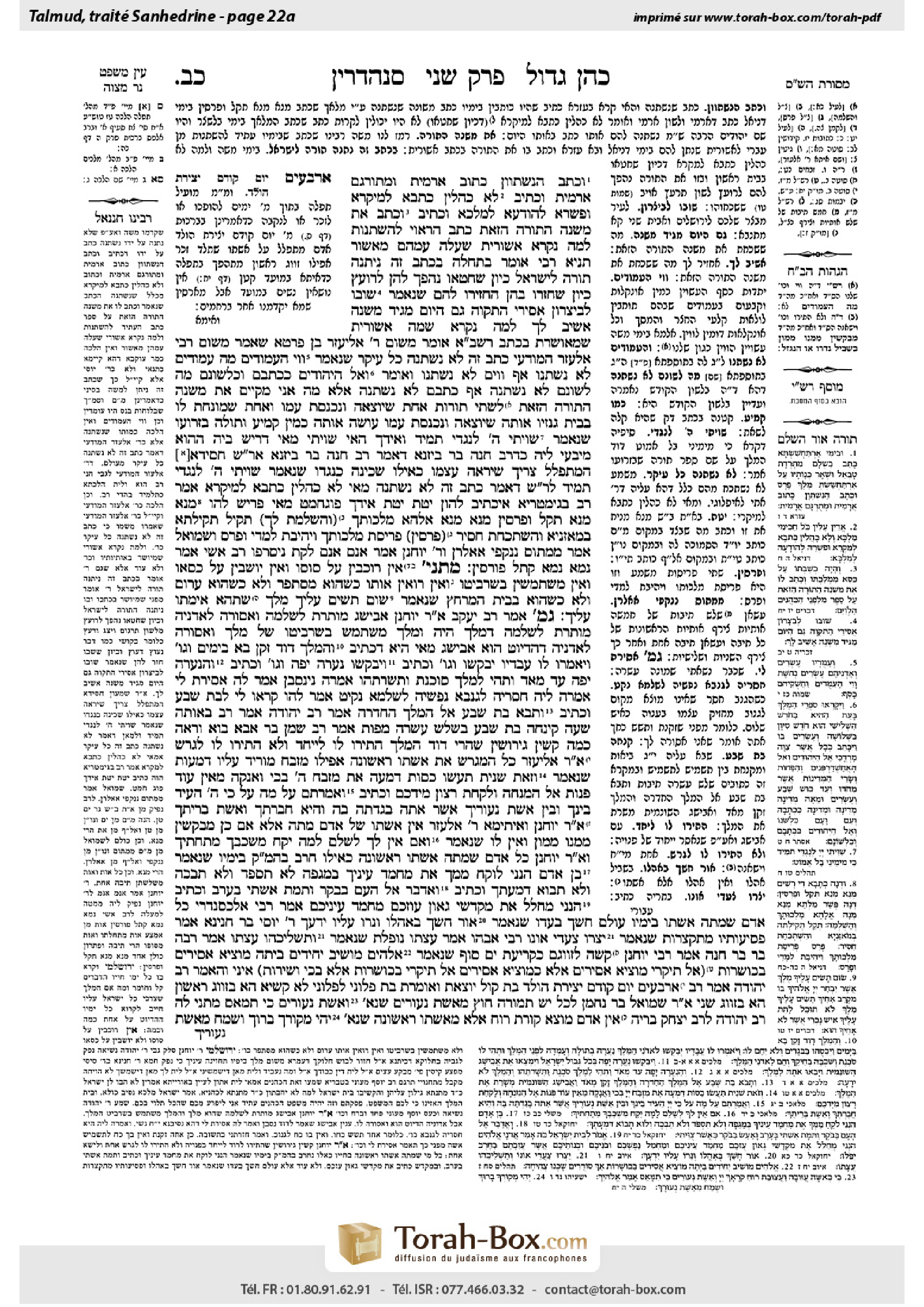
Sanhedrin 22a: Talmud study for Daf Yomi
Daf Yomi is the daily study of one Talmud folio. Explore 37 tractates with scans, Hebrew text, Sefaria English and AI-generated French translations where annotated.
Passage selection and English or AI-generated French translation are available where the scan has annotations. Daf Study is independent of Torah-Box and Sefaria.
Browse Sanhedrin · סנהדרין · All tractatesSanhedrin 22a text and translations
This page of Sanhedrin includes the Aramaic text, an English translation and an AI-generated French translation, alongside the scan above.
סנהדרין כ״ב א · Aramaic and Hebrew text
״וּכְתָב הַנִּשְׁתְּוָן כָּתוּב אֲרָמִית וּמְתֻרְגָּם אֲרַמִּית״. וּכְתִיב: ״לָא כָהֲלִין כְּתָבָא לְמִקְרֵא וּפִשְׁרֵהּ לְהוֹדָעָה לְמַלְכָּא״. [מְלַמֵּד שֶׁבְּאוֹתוֹ הַיּוֹם נִיתַּן] וּכְתִיב: ״וְכָתַב אֶת מִשְׁנֵה הַתּוֹרָה הַזֹּאת״ – כְּתָב הָרָאוּי לְהִשְׁתַּנּוֹת.
לָמָּה נִקְרָא שְׁמוֹ אַשּׁוּרִי? שֶׁעָלָה עִמָּהֶם מֵאַשּׁוּר.
תַּנְיָא, רַבִּי אוֹמֵר: בַּתְּחִלָּה בִּכְתָב זֶה נִיתְּנָה תּוֹרָה לְיִשְׂרָאֵל. כֵּיוָן שֶׁחָטְאוּ, נֶהְפַּךְ לָהֶן לְרוֹעֵץ. כֵּיוָן שֶׁחָזְרוּ בָּהֶן, הֶחְזִירוֹ לָהֶם, שֶׁנֶּאֱמַר: ״שׁוּבוּ לְבִצָּרוֹן אֲסִירֵי הַתִּקְוָה גַּם הַיּוֹם מַגִּיד מִשְׁנֶה אָשִׁיב לָךְ״.
לָמָּה נִקְרָא שְׁמוֹ אַשּׁוּרִי? שֶׁמְּאוּשָּׁר בִּכְתָבוֹ.
רַבִּי שִׁמְעוֹן בֶּן אֶלְעָזָר אוֹמֵר מִשּׁוּם רַבִּי אֱלִיעֶזֶר בֶּן פַּרְטָא, שֶׁאָמַר מִשּׁוּם רַבִּי אֶלְעָזָר הַמּוֹדָעִי: כְּתָב זֶה לֹא נִשְׁתַּנָּה כׇּל עִיקָּר, שֶׁנֶּאֱמַר: ״וָוֵי הָעַמּוּדִים״. מָה עַמּוּדִים לֹא נִשְׁתַּנּוּ, אַף וָוִים לֹא נִשְׁתַּנּוּ. וְאוֹמֵר: ״וְאֶל הַיְּהוּדִים כִּכְתָבָם וְכִלְשׁוֹנָם״ – מָה לְשׁוֹנָם לֹא נִשְׁתַּנָּה, אַף כְּתָבָם לֹא נִשְׁתַּנָּה.
אֶלָּא מָה אֲנִי מְקַיֵּים ״אֶת מִשְׁנֵה הַתּוֹרָה הַזֹּאת״? לִשְׁתֵּי תּוֹרוֹת: אַחַת שֶׁיּוֹצְאָה וְנִכְנֶסֶת עִמּוֹ, וְאַחַת שֶׁמּוּנַּחַת לוֹ בְּבֵית גְּנָזָיו. אוֹתָהּ שֶׁיּוֹצְאָה וְנִכְנֶסֶת עִמּוֹ – עוֹשֶׂה אוֹתָהּ כְּמִין קָמֵיעַ וְתוֹלָהּ בִּזְרוֹעוֹ, שֶׁנֶּאֱמַר: ״שִׁוִּיתִי ה׳ לְנֶגְדִּי תָּמִיד״.
וְאִידַּךְ, הַאי ״שִׁוִּיתִי״ מַאי דָּרֵישׁ בֵּיהּ? הָהוּא מִיבְּעֵי לֵיהּ כִּדְרַב חָנָה בַּר בִּיזְנָא, דְּאָמַר רַב חָנָה בַּר בִּיזְנָא אָמַר רַבִּי שִׁמְעוֹן חֲסִידָא: הַמִּתְפַּלֵּל צָרִיךְ שֶׁיִּרְאֶה עַצְמוֹ כְּאִילּוּ שְׁכִינָה כְּנֶגְדּוֹ, שֶׁנֶּאֱמַר: ״שִׁוִּיתִי ה׳ לְנֶגְדִּי תָמִיד״.
לְרַבִּי שִׁמְעוֹן, דְּאָמַר: ״כְּתָב זֶה לֹא נִשְׁתַּנָּה״, מַאי ״לָא כָהֲלִין כְּתָבָא לְמִקְרֵא״? אָמַר רַב: בְּגִימַטְרִיָּא אִיכְּתִיב לְהוֹן ״יטת יטת אדך פוגחמט״.
מַאי פָּרֵישׁ לְהוּ? ״מְנֵא מְנֵא תְּקֵל וּפַרְסִין״. ״מְנֵא״ – מְנָא אֱלָהָא מַלְכוּתָךְ וְהַשְׁלְמַהּ לָךְ. ״תְּקֵל״ – תְּקִילְתָּא בְמֹאזַנְיָא וְהִשְׁתְּכַחַתְּ חַסִּיר. ״פַּרְסִין״ – פְּרִיסַת מַלְכוּתָךְ וִיהִיבַת לְמָדַי וּפָרָס.
וּשְׁמוּאֵל אָמַר: ״ממתוס ננקפי אאלרן״. וְרַבִּי יוֹחָנָן אָמַר: ״אנם אנם לקת ניסרפו״. רַב אָשֵׁי אָמַר: ״נמא נמא קתל פורסין״.
מַתְנִי׳ אֵין רוֹכְבִין עַל סוּסוֹ, וְאֵין יוֹשְׁבִין עַל כִּסְאוֹ, וְאֵין מִשְׁתַּמְּשִׁין בְּשַׁרְבִיטוֹ, וְאֵין רוֹאִין אוֹתוֹ כְּשֶׁהוּא מִסְתַּפֵּר, וְלֹא כְּשֶׁהוּא עָרוֹם, וְלֹא כְּשֶׁהוּא בְּבֵית הַמֶּרְחָץ, שֶׁנֶּאֱמַר: ״שׂוֹם תָּשִׂים עָלֶיךָ מֶלֶךְ״, שֶׁתְּהֵא אֵימָתוֹ עָלֶיךָ.
גְּמָ׳ אָמַר רַב יַעֲקֹב אָמַר רַבִּי יוֹחָנָן: אֲבִישַׁג מוּתֶּרֶת לִשְׁלֹמֹה, וַאֲסוּרָה לַאֲדֹנִיָּה. מוּתֶּרֶת לִשְׁלֹמֹה – דְּמֶלֶךְ הָיָה, וּמֶלֶךְ מִשְׁתַּמֵּשׁ בְּשַׁרְבִיטוֹ שֶׁל מֶלֶךְ. וַאֲסוּרָה לַאֲדֹנִיָּה – דְּהֶדְיוֹט הוּא.
אֲבִישַׁג מַאי הִיא? דִּכְתִיב: ״וְהַמֶּלֶךְ דָּוִד זָקֵן בָּא בַּיָּמִים וְגוֹ׳ וַיֹּאמְרוּ לוֹ עֲבָדָיו יְבַקְשׁוּ וְגוֹ׳״, וּכְתִיב: ״וַיְבַקְשׁוּ נַעֲרָה יָפָה וְגוֹ׳״, וּכְתִיב: ״וְהַנַּעֲרָה יָפָה עַד מְאֹד וַתְּהִי לַמֶּלֶךְ סֹכֶנֶת וַתְּשָׁרְתֵהוּ״. אֲמַרָה: ״נִינְסְבַן!״ אֲמַר לַהּ: ״אֲסִירַתְּ לִי״.
אֲמַרָה לֵיהּ: חַסְּרֵיהּ לְגַנָּבָא, נַפְשֵׁיהּ בְּשַׁלְמָנָא נָקֵיט. אֲמַר לְהוּ: קִרְאוּ לִי לְבַת שֶׁבַע. וּכְתִיב: ״וַתָּבֹא בַת שֶׁבַע אֶל הַמֶּלֶךְ הַחַדְרָה״. אָמַר רַב יְהוּדָה אָמַר רַב: בְּאוֹתָהּ שָׁעָה קִינְּחָה בַּת שֶׁבַע בִּשְׁלֹשׁ עֶשְׂרֵה מַפּוֹת.
אָמַר רַב שֶׁמֶן בַּר אַבָּא: בֹּא וּרְאֵה כַּמָּה קָשִׁין גֵּירוּשִׁין, שֶׁהֲרֵי דָּוִד הַמֶּלֶךְ הִתִּירוּ לוֹ לְיַיחֵד, וְלֹא הִתִּירוּ לוֹ לְגָרֵשׁ.
אָמַר רַבִּי אֱלִיעֶזֶר: כׇּל הַמְגָרֵשׁ אֶת אִשְׁתּוֹ רִאשׁוֹנָה, אֲפִילּוּ מִזְבֵּחַ מוֹרִיד עָלָיו דְּמָעוֹת, שֶׁנֶּאֱמַר: ״וְזֹאת שֵׁנִית תַּעֲשׂוּ כַּסּוֹת דִּמְעָה אֶת מִזְבַּח ה׳ בְּכִי וַאֲנָקָה מֵאֵין עוֹד פְּנוֹת אֶל הַמִּנְחָה וְלָקַחַת רָצוֹן מִיֶּדְכֶם״, וּכְתִיב: ״וַאֲמַרְתֶּם עַל מָה עַל כִּי ה׳ הֵעִיד בֵּינְךָ וּבֵין אֵשֶׁת נְעוּרֶיךָ אֲשֶׁר אַתָּה בָּגַדְתָּה בָּהּ וְהִיא חֲבֶרְתְּךָ וְאֵשֶׁת בְּרִיתֶךָ״.
אָמַר רַבִּי יוֹחָנָן, וְאִיתֵּימָא רַבִּי אֶלְעָזָר: אֵין אִשְׁתּוֹ שֶׁל אָדָם מֵתָה אֶלָּא אִם כֵּן מְבַקְּשִׁין מִמֶּנּוּ מָמוֹן וְאֵין לוֹ, שֶׁנֶּאֱמַר: ״וְאִם אֵין לְךָ לְשַׁלֵּם לָמָּה יִקַּח מִשְׁכָּבְךָ מִתַּחְתֶּיךָ״.
וְאָמַר רַבִּי יוֹחָנָן: כׇּל אָדָם שֶׁמֵּתָה אִשְׁתּוֹ רִאשׁוֹנָה, כְּאִילּוּ חָרַב בֵּית הַמִּקְדָּשׁ בְּיָמָיו, שֶׁנֶּאֱמַר: ״בֶּן אָדָם הִנְנִי לֹקֵחַ מִמְּךָ אֶת מַחְמַד עֵינֶיךָ בְּמַגֵּפָה לֹא תִסְפֹּד וְלֹא תִבְכֶּה וְלֹא תָבוֹא דִּמְעָתֶךָ״. וּכְתִיב: ״וָאֲדַבֵּר אֶל הָעָם בַּבֹּקֶר וַתָּמׇת אִשְׁתִּי בָּעָרֶב״. וּכְתִיב: ״הִנְנִי מְחַלֵּל אֶת מִקְדָּשִׁי גְּאוֹן עֻזְּכֶם מַחְמַד עֵינֵיכֶם״.
אָמַר רַבִּי אֲלֶכְּסַנְדְּרִי: כׇּל אָדָם שֶׁמֵּתָה אִשְׁתּוֹ בְּיָמָיו, עוֹלָם חָשַׁךְ בַּעֲדוֹ, שֶׁנֶּאֱמַר: ״אוֹר חָשַׁךְ בְּאׇהֳלוֹ וְנֵרוֹ עָלָיו יִדְעָךְ״. רַבִּי יוֹסֵי בַּר חֲנִינָא אָמַר: פְּסִיעוֹתָיו מִתְקַצְּרוֹת, שֶׁנֶּאֱמַר: ״יֵצְרוּ צַעֲדֵי אוֹנוֹ״. רַבִּי אֲבָהוּ אָמַר: עֲצָתוֹ נוֹפֶלֶת, שֶׁנֶּאֱמַר: ״וְתַשְׁלִיכֵהוּ עֲצָתוֹ״.
אָמַר רַבָּה בַּר בַּר חָנָה אָמַר רַבִּי יוֹחָנָן: קָשֶׁה לְזַוְּוגָם כִּקְרִיעַת יַם סוּף, שֶׁנֶּאֱמַר: ״אֱלֹהִים מוֹשִׁיב יְחִידִים בַּיְתָה מוֹצִיא אֲסִירִים בַּכּוֹשָׁרוֹת״. אַל תִּיקְרֵי ״מוֹצִיא אֲסִירִים״ אֶלָּא ״כְּמוֹצִיא אֲסִירִים״, אַל תִּיקְרֵי ״בַּכּוֹשָׁרוֹת״ אֶלָּא ״בְּכִי וְשִׁירוֹת״.
אִינִי? וְהָאָמַר רַב יְהוּדָה אָמַר רַב: אַרְבָּעִים יוֹם קוֹדֶם יְצִירַת הַוָּלָד, בַּת קוֹל יוֹצֵאת וְאוֹמֶרֶת ״בַּת פְּלוֹנִי לִפְלוֹנִי״! לָא קַשְׁיָא: הָא בְּזִוּוּג רִאשׁוֹן, הָא בְּזִוּוּג שֵׁנִי.
אָמַר רַבִּי שְׁמוּאֵל בַּר נַחְמָן: לַכֹּל יֵשׁ תְּמוּרָה, חוּץ מֵאֵשֶׁת נְעוּרִים, שֶׁנֶּאֱמַר: ״וְאֵשֶׁת נְעוּרִים כִּי תִמָּאֵס״. מַתְנֵי לַהּ רַב יְהוּדָה לְרַב יִצְחָק בְּרֵיהּ: אֵין אָדָם מוֹצֵא קוֹרַת רוּחַ אֶלָּא מֵאִשְׁתּוֹ רִאשׁוֹנָה, שֶׁנֶּאֱמַר: ״יְהִי מְקוֹרְךָ בָרוּךְ וּשְׂמַח מֵאֵשֶׁת
Sanhedrin 22a · English translation
“And the writing of the letter [hannishtevan] was written in the Aramaic script, and set forth in the Aramaic tongue” (Ezra 4:7). The term “hannishtevan” is similar to the word nishtana, meaning changed, alluding to the fact that the script had been changed. And it is written with regard to the writing on the wall of Belshazzar’s palace: “Then came in all the king’s wise men. But they could not read the writing, nor make known to the king the interpretation” (Daniel 5:8), and the reason they could not read it is that it was written in the new script that Ezra would transmit. And it is written: “That he shall write for himself a second [mishne] Torah” (Deuteronomy 17:18), where “second [mishne]” teaches that it is written in a script that is apt to be changed [lehishtannot].
The baraita continues: Why is this script called Ashurit? Because it ascended with the Jewish people from Ashur when they returned from their exile in Babylonia.
It is taught in a baraita (Tosefta 4:5): Rabbi Yehuda HaNasi says: Initially, the Torah was given to the Jewish people in this script, Ashurit, which is in use today. Once the Jewish people sinned, it turned into an impairment for them and they began writing with a different script, Libona’a. Once they repented, the first script was returned to them, and they resumed writing with Ashurit script, as it is stated: “Return to the stronghold, you prisoners of hope; even today do I declare that I will render double [mishne] unto you” (Zechariah 9:12), meaning that God restored to the Jewish people this script that had been changed [nishtanna].
The baraita continues: If this script predates the exile to Babylonia, why is it called Ashurit? Because it is meusheret, beautiful and straight, in script.
The baraita continues: Rabbi Shimon ben Elazar says in the name of Rabbi Eliezer ben Perata, who said in the name of Rabbi Elazar HaModa’i: This script did not change at all, as it is stated with regard to the construction of the Tabernacle: “The hooks of [vavei] the poles” (Exodus 27:10). This teaches that just as the poles were not changed, so too, the hooks [vavim] were not changed. The letter vav in Ashurit script has the shape of a hook. Evidently, this is why the term for hook in the Torah is vav. And the verse states: “And to the Jews according to their script and according to their language” (Esther 8:9). This teaches that just as their language was not changed over the generations but remained Hebrew, so too, their script was not changed.
The baraita continues: But if the script was in fact not changed, how do I realize the meaning of the phrase “a second [mishne] Torah” (Deuteronomy 17:18)? This serves to teach the halakha concerning the two Torah scrolls that the king writes, one that goes out and comes in with him, and one that is placed in his treasury. With regard to the one that goes out and comes in with him, he makes it very small, like an amulet, and he hangs it on his arm. As it is stated by King David: “I have set the Lord always before me; He is at my right hand, that I shall not be moved” (Psalms 16:8). This verse alludes to the two Torah scrolls, one that is before him and one that is in his right hand.
The Gemara asks: And with regard to the other Sage, i.e., Rabbi Yehuda HaNasi, who does not hold that the king must write and affix the second scroll to his arm, what does he expound from that verse: “I have set” (Psalms 16:8)? The Gemara responds: He requires that verse in accordance with the statement of Rav Ḥana bar Bizna, as Rav Ḥana bar Bizna says that Rabbi Shimon Ḥasida says: One who prays needs to see himself as if the Divine Presence is opposite him, as it is stated: “I have set the Lord always before me” (Psalms 16:8).
The Gemara asks: According to Rabbi Shimon, who says that this script was not changed at all, what is the reason “they could not read the writing” (Daniel 5:8)? Rav says: Because it was written for them in the obscure code of gimatriyya. It was written: Yod, tet, tav; yod, tet, tav; alef, yod, dalet, khaf; peh, vav, gimmel, ḥet, mem, tet. These letters correspond with: Mem, nun, alef; mem, nun, alef; tav, kuf, lamed; vav, peh, reish, samekh, yod, nun; this is based on the exchange of letters known as at bash, or the exchanging of a letter with its counterpart in the opposite place in the alphabet, e.g., alef, the first letter, for tav, the last letter.
What did Daniel explain to them? The letters stand for the terms: “Mene mene tekel ufarsin” (Daniel 5:25). He then explained the meaning: “Mene”: God has numbered [mena] the days of your kingdom and brought it to an end. “Tekel”: You are weighed [tekilta] on the scale and are found lacking. “Parsin”: Your kingdom is divided [perisat] and given to the Medes and Persians” (Daniel 5:26–28).
And Shmuel says: The writing used the correct letters for those terms, but instead of being written in order, the four words, mene mene tekel ufarsin were written vertically and were therefore meant to be read from the top down. If read in the usual way, from right to left, it says: “Mamtos nankafei a’alran.” And Rabbi Yoḥanan says: Each word was written backward, so that read right to left, they spelled, Anem anem leket nisrapu. Rav Ashi says: They were written with the first two letters of each word reversed: Nema nema ketal pursin.
MISHNA: One may not ride on the king’s horse, and one may not sit on his throne, and one may not use his scepter, and one may not see him when he is having his hair cut, nor when he is naked, nor when he is in the bathhouse, as it is stated: “You shall set a king over you” (Deuteronomy 17:15), meaning, ensure that his fear should be upon you. All of these actions would lessen one’s fear of and reverence for the king.
GEMARA: Rav Ya’akov says that Rabbi Yoḥanan says: Abishag the Shunammite was permitted to Solomon but forbidden to Adonijah, who in fact wanted to marry her. She was permitted to Solomon, as he was a king, and a king may use the scepter of a king. Abishag’s status was similar to the king’s scepter, as she had been designated to serve King David. She was forbidden to Adonijah, as he was an ordinary person, not a king.
The Gemara clarifies: The story of Abishag, what is it? As it is written: “Now King David was old and stricken in years…and his servants said to him, let there be sought…a young virgin…and let her lie in your bosom, that my lord the king may get heat” (I Kings 1:1–2); and it is written: “So they sought for a beautiful maiden…and found Abishag” (I Kings 1:1–3); and it is written: “And the maiden was very beautiful and she became a companion to the king and ministered to him, but the king did not know her” (I Kings 1:1–4). Abishag said to King David: Marry me. King David said to her: You are forbidden to me, as I already have eighteen wives.
Abishag said to him: When the thief is lacking what to steal, he makes himself like a man of peace. In other words, she was saying that since King David was physically unable to engage in intercourse, he devised an excuse not to marry her. King David said to his attendants: Call Bathsheba to me. And it is written: “And Bathsheba went in to the king into the chamber; now the king was very old and Abishag the Shunammite ministered to the king” (I Kings 1:15). Rav Yehuda says that Rav says: At that time, Bathsheba wiped herself with thirteen cloths, corresponding to the number of words in the verse, indicating that she engaged in intercourse with King David thirteen times.
Rav Shemen bar Abba says: Come and see how severe a matter divorce is, as they rendered it permitted for King David to be secluded with Abishag without marrying her, but they did not render it permitted for him to divorce one of his wives to enable him to marry Abishag.
§ Rabbi Eliezer says: Concerning anyone who divorces his first wife, even the altar sheds tears about him, as it is stated: “And further, this you should do: Cover the altar of the Lord with tears, with weeping and sighing, from His no longer showing regard to the offering, nor receiving it with goodwill from your hand” (Malachi 2:13), and it is written: “Yet you say: Why? Because the Lord has been witness between you and the wife of your youth, against whom you have dealt treacherously, though she is your companion and the wife of your covenant” (Malachi 2:14).
Rabbi Yoḥanan, and some say Rabbi Elazar, says: A man’s wife does not die unless his creditors ask him for money that he owes and he does not have it, as it is stated: “If you do not have with what to pay, why should he take away your bed from under you?” (Proverbs 22:27). The bed mentioned in the verse alludes to one’s wife.
And Rabbi Yoḥanan says: For any man whose first wife dies, it is as if the Temple were destroyed in his days, as it is stated: “Son of man, behold, I take away from you the desire of your eyes with a stroke; yet neither shall you make lamentation nor weep, neither shall your tears run down” (Ezekiel 24:16). And it is written: “So I spoke to the people in the morning and in the evening my wife died” (Ezekiel 24:18). And it is written in the continuation of the same passage: “Behold I will profane My Sanctuary, the pride of your power, the desire of your eyes” (Ezekiel 24:21), illustrating that a man’s wife is as precious to him as the Temple is for the entire Jewish nation.
Rabbi Alexandri says: For any man whose wife dies in his days, the world is dark for him, as it is stated: “The light shall be dark in his tent and his lamp over him shall be put out” (Job 18:6), since the word tent is commonly employed as a metonym for a wife. Rabbi Yosei bar Ḥanina says: His steps get shorter, as it is stated: “The steps of his strength shall be constrained” (Job 18:7). Rabbi Abbahu says: His counsel falls, as it is stated: “And his own counsel shall cast him down” (Job 18:7).
Rabba bar bar Ḥana says that Rabbi Yoḥanan says: It is as difficult to match a couple as the splitting of the Red Sea, as it is stated: “God makes the solitary dwell in a house; He brings out prisoners into prosperity” (Psalms 68:7). Do not read the verse as “brings out prisoners”; rather, read it as: Like bringing out prisoners. Accordingly, the act described in the first clause of the verse, God’s causing the solitary to dwell in a house, i.e., to marry, is compared to the act described in the next clause in the verse, i.e., bringing out prisoners. And do not read the verse as “into prosperity [bakkosharot]”; rather, read it as: Crying and singing [bekhi veshirot], which alludes to the splitting of the Red Sea, when there was both crying and singing.
The Gemara asks: Is that so that it is this difficult to find a match? But doesn’t Rav Yehuda say that Rav says: Forty days before the formation of the fetus a Divine Voice emerges and states: The daughter of so-and-so shall be the wife of so-and-so? Why should matching them be so difficult, since they are prepared for this from before their birth? The Gemara responds: This is not difficult. This latter statement, about predestined matches, is stated with regard to the first match; that former statement, about the difficulty of matchmaking, is stated with regard to the second match.
Rabbi Shmuel bar Naḥman says: For everything that is lost there is a substitute, except for one’s wife from youth who dies, as it is stated: “And a wife from youth, can she be rejected?” (Isaiah 54:6). Rav Yehuda taught Rav Yitzḥak, his son: A man finds calmness of spirit only from his first wife, as it is stated: “Let your fountain be blessed and have joy with the wife of
Sanhedrin 22a · Traduction française (IA)
« L’écriture de la lettre [hannishtevan] était rédigée en écriture araméenne et formulée en langue araméenne » (Esdras 4:7). Le terme « hannishtevan » ressemble au mot nishtana, qui signifie « changé », et fait allusion au fait que l’écriture avait été modifiée. Et il est écrit, au sujet de l’inscription sur le mur du palais de Belshatsar : « Alors entrèrent tous les sages du roi. Mais ils ne purent lire l’inscription ni en faire connaître l’interprétation au roi » (Daniel 5:8). S’ils ne pouvaient pas la lire, c’est parce qu’elle était écrite dans la nouvelle écriture qu’Esdras allait transmettre. Et il est écrit : « Il écrira pour lui-même une seconde [mishne] Torah » (Deutéronome 17:18) ; le mot « seconde [mishne] » enseigne qu’elle est écrite dans une écriture susceptible d’être modifiée [lehishtannot].
La baraïta poursuit : Pourquoi cette écriture est-elle appelée achourite ? Parce qu’elle est montée avec le peuple juif depuis Ashour, à son retour de l’exil en Babylonie.
Il est enseigné dans une baraïta (Tosefta 4:5) : Rabbi Yehouda HaNassi dit : Au début, la Torah fut donnée au peuple juif dans cette écriture, l’achourite, qui est utilisée aujourd’hui. Lorsque le peuple juif pécha, elle devint pour lui un handicap, et il se mit à écrire dans une autre écriture, la libona’a. Lorsqu’il se repentit, la première écriture lui fut rendue et il recommença à écrire en écriture achourite, comme il est dit : « Retournez à la forteresse, prisonniers de l’espérance ; aujourd’hui encore, je vous l’annonce : je vous rendrai le double [mishne] » (Zacharie 9:12). Cela signifie que Dieu rendit au peuple juif cette écriture qui avait été modifiée [nishtanna].
La baraïta poursuit : Si cette écriture est antérieure à l’exil en Babylonie, pourquoi est-elle appelée achourite ? Parce qu’elle est meusheret, c’est-à-dire belle et droite en tant qu’écriture.
La baraïta poursuit : Rabbi Shimon ben Elazar dit au nom de Rabbi Eliezer ben Perata, qui l’a dit au nom de Rabbi Elazar HaModa’i : Cette écriture n’a pas du tout changé, comme il est dit à propos de la construction du Tabernacle : « Les crochets [vavei] des poteaux » (Exode 27:10). Cela enseigne que, de même que les poteaux n’ont pas été modifiés, les crochets [vavim] ne l’ont pas été non plus. La lettre vav en écriture achourite a la forme d’un crochet. Cela explique pourquoi le terme désignant le crochet dans la Torah est vav. Et le verset dit : « Aux Juifs, selon leur écriture et selon leur langue » (Esther 8:9). Cela enseigne que, de même que leur langue n’a pas changé au fil des générations et est restée l’hébreu, leur écriture n’a pas changé non plus.
La baraïta poursuit : Mais si l’écriture n’a effectivement pas changé, comment comprendre l’expression « une seconde [mishne] Torah » (Deutéronome 17:18) ? Elle sert à enseigner la halakha concernant les deux rouleaux de la Torah que le roi écrit : l’un qu’il emporte avec lui lorsqu’il sort et qu’il reprend lorsqu’il rentre, et l’autre qu’il place dans son trésor. Quant à celui qu’il emporte et reprend avec lui, il le fait très petit, comme une amulette, et le suspend à son bras. Car le roi David dit : « J’ai constamment placé le Seigneur devant moi ; puisqu’Il est à ma droite, je ne chancellerai pas » (Psaumes 16:8). Ce verset fait allusion aux deux rouleaux de la Torah : l’un qui est devant lui et l’autre qui se trouve dans sa main droite.
La Guemara demande : Et l’autre Sage, c’est-à-dire Rabbi Yehouda HaNassi, qui ne considère pas que le roi doit écrire et fixer le second rouleau à son bras, que déduit-il du verset : « J’ai placé » (Psaumes 16:8) ? La Guemara répond : Il a besoin de ce verset conformément à l’enseignement de Rav Ḥana bar Bizna. Car Rav Ḥana bar Bizna dit au nom de Rabbi Shimon Ḥasida : Celui qui prie doit se voir comme si la Présence divine se tenait devant lui, comme il est dit : « J’ai constamment placé le Seigneur devant moi » (Psaumes 16:8).
La Guemara demande : Selon Rabbi Shimon, qui dit que cette écriture n’a pas du tout été modifiée, pourquoi « ils ne purent pas lire l’inscription » (Daniel 5:8) ? Rav dit : Parce qu’elle était écrite pour eux selon le code obscur de la gimatriya. On y avait écrit : yod, tet, tav ; yod, tet, tav ; alef, yod, dalet, khaf ; peh, vav, gimmel, ḥet, mem, tet. Ces lettres correspondent à : mem, nun, alef ; mem, nun, alef ; tav, kuf, lamed ; vav, peh, reish, samekh, yod, nun. Cela repose sur l’échange de lettres appelé at bash, où une lettre est remplacée par celle qui occupe la position opposée dans l’alphabet ; par exemple, alef, la première lettre, par tav, la dernière.
Qu’expliqua Daniel ? Les lettres correspondent aux termes : « Mene mene tekel ufarsin » (Daniel 5:25). Il en expliqua ensuite le sens : « Mene » : Dieu a compté [mena] les jours de ton royaume et y a mis fin. « Tekel » : Tu as été pesé [tekilta] sur la balance et trouvé insuffisant. « Parsin » : Ton royaume est divisé [perisat] et donné aux Mèdes et aux Perses » (Daniel 5:26–28).
Et Shmuel dit : L’inscription employait les lettres correctes pour ces termes, mais, au lieu d’être écrits dans l’ordre, les quatre mots, mene mene tekel ufarsin, étaient disposés verticalement et devaient donc se lire de haut en bas. Lus de la manière habituelle, de droite à gauche, ils disent : « Mamtos nankafei a’alran ». Rabbi Yoḥanan dit que chaque mot était écrit à l’envers ; lus de droite à gauche, ils formaient donc : Anem anem leket nisrapu. Rav Ashi dit qu’on avait inversé les deux premières lettres de chaque mot : Nema nema ketal pursin.
MICHNA : Il est interdit de monter le cheval du roi, de s’asseoir sur son trône, d’utiliser son sceptre et de le voir lorsqu’il se fait couper les cheveux, lorsqu’il est nu ou lorsqu’il se trouve au bain, comme il est dit : « Tu établiras sur toi un roi » (Deutéronome 17:15), ce qui signifie : veille à ce que sa crainte repose sur toi. Toutes ces actions diminueraient la crainte et le respect que l’on doit au roi.
GUEMARA : Rav Ya’akov dit au nom de Rabbi Yoḥanan : Abishag la Shounamite était permise à Salomon, mais interdite à Adonias, qui voulait en fait l’épouser. Elle était permise à Salomon, car il était roi, et un roi peut utiliser le sceptre d’un roi. Abishag avait un statut semblable à celui du sceptre du roi, puisqu’elle avait été désignée pour servir le roi David. Elle était interdite à Adonias, car il était un homme ordinaire, et non un roi.
La Guemara précise : Quelle est l’histoire d’Abishag ? Comme il est écrit : « Le roi David était vieux, avancé en âge… et ses serviteurs lui dirent : Qu’on cherche… une jeune vierge… et qu’elle se couche dans ton sein, afin que mon seigneur le roi ait chaud » (I Rois 1:1–2). Et il est écrit : « Ils cherchèrent une jeune fille belle… et trouvèrent Abishag » (I Rois 1:1–3). Et il est écrit : « La jeune fille était très belle ; elle devint la compagne du roi et le servait, mais le roi ne la connut pas » (I Rois 1:1–4). Abishag dit au roi David : Épouse-moi. Le roi David lui répondit : Tu m’es interdite, car j’ai déjà dix-huit femmes.
Abishag lui dit : Quand le voleur n’a plus rien à voler, il se fait passer pour un homme de paix. Autrement dit, elle voulait dire que, puisque le roi David était physiquement incapable d’avoir des rapports sexuels, il avait trouvé une excuse pour ne pas l’épouser. Le roi David dit à ses serviteurs : Appelez Bath-Shéba auprès de moi. Et il est écrit : « Bath-Shéba entra dans la chambre auprès du roi ; le roi était très vieux, et Abishag la Shounamite servait le roi » (I Rois 1:15). Rav Yehouda dit au nom de Rav : À ce moment-là, Bath-Shéba s’essuya avec treize linges, correspondant au nombre de mots du verset, ce qui indique qu’elle eut treize rapports sexuels avec le roi David.
Rav Shemen bar Abba dit : Venez voir combien le divorce est une affaire grave : on autorisa le roi David à s’isoler avec Abishag sans l’épouser, mais on ne l’autorisa pas à divorcer de l’une de ses femmes pour pouvoir épouser Abishag.
§ Rabbi Eliezer dit : Pour quiconque divorce de sa première femme, même l’autel verse des larmes à son sujet, comme il est dit : « Et voici encore ce que vous faites : vous couvrez l’autel du Seigneur de larmes, de pleurs et de soupirs, si bien qu’Il ne prête plus attention à l’offrande et ne l’accueille plus favorablement de votre main » (Malachie 2:13). Et il est écrit : « Vous dites pourtant : Pourquoi ? Parce que le Seigneur a été témoin entre toi et la femme de ta jeunesse, envers laquelle tu as agi avec perfidie, bien qu’elle soit ta compagne et la femme de ton alliance » (Malachie 2:14).
Rabbi Yoḥanan — et certains disent Rabbi Elazar — dit : La femme d’un homme ne meurt que lorsque ses créanciers lui réclament l’argent qu’il leur doit et qu’il ne l’a pas, comme il est dit : « Si tu n’as pas de quoi payer, pourquoi prendrait-il ton lit de dessous toi ? » (Proverbes 22:27). Le lit mentionné dans le verset fait allusion à la femme.
Et Rabbi Yoḥanan dit : Pour tout homme dont la première femme meurt, c’est comme si le Temple avait été détruit de son vivant, comme il est dit : « Fils de l’homme, voici que je t’enlève d’un coup celle qui fait le délice de tes yeux ; pourtant, tu ne te lamenteras pas, tu ne pleureras pas et tes larmes ne couleront pas » (Ézéchiel 24:16). Et il est écrit : « Je parlai au peuple le matin, et le soir ma femme mourut » (Ézéchiel 24:18). Et il est écrit dans la suite du même passage : « Voici, je profanerai Mon sanctuaire, l’orgueil de votre force, le délice de vos yeux » (Ézéchiel 24:21), ce qui illustre que la femme d’un homme lui est aussi précieuse que le Temple l’est pour tout le peuple juif.
Rabbi Alexandri dit : Pour tout homme dont la femme meurt de son vivant, le monde s’obscurcit pour lui, comme il est dit : « La lumière s’obscurcit dans sa tente et sa lampe au-dessus de lui s’éteint » (Job 18:6), car le mot « tente » est couramment employé comme métonymie de la femme. Rabbi Yosei bar Ḥanina dit : Ses pas raccourcissent, comme il est dit : « Les pas de sa force seront entravés » (Job 18:7). Rabbi Abbahou dit : Ses conseils échouent, comme il est dit : « Son propre conseil le précipitera » (Job 18:7).
Rabba bar bar Ḥana dit au nom de Rabbi Yoḥanan : Former un couple est aussi difficile que la séparation de la mer Rouge, comme il est dit : « Dieu fait habiter les solitaires dans une maison ; Il fait sortir les prisonniers vers la prospérité » (Psaumes 68:7). Ne lis pas le verset comme « Il fait sortir les prisonniers », mais comme « comme lorsqu’Il fait sortir les prisonniers ». Ainsi, l’action décrite dans la première partie du verset — Dieu faisant habiter les solitaires dans une maison, c’est-à-dire les mariant — est comparée à celle décrite dans la partie suivante, la libération des prisonniers. Et ne lis pas « vers la prospérité [bakkosharot] », mais « dans les pleurs et les chants [bekhi veshirot] », ce qui fait allusion à la séparation de la mer Rouge, qui s’accompagna à la fois de pleurs et de chants.
La Guemara demande : Est-il donc vrai qu’il est si difficile de trouver un conjoint ? Rav Yehouda ne dit-il pas au nom de Rav : Quarante jours avant la formation du fœtus, une Voix céleste se fait entendre et déclare : La fille d’Untel sera l’épouse d’Untel. Pourquoi leur union serait-elle si difficile à former, puisqu’elle est déterminée avant leur naissance ? La Guemara répond : Il n’y a pas de difficulté. Cette dernière déclaration, concernant les unions prédestinées, se rapporte au premier mariage ; la déclaration précédente, concernant la difficulté de former un couple, se rapporte au second mariage.
Rabbi Shmuel bar Naḥman dit : À toute chose perdue, il existe un substitut, à l’exception de la femme de sa jeunesse lorsqu’elle meurt, comme il est dit : « Et une femme de jeunesse, peut-elle être rejetée ? » (Isaïe 54:6). Rav Yehouda enseigna à Rav Yitzḥak, son fils : Un homme ne trouve la sérénité de l’esprit qu’auprès de sa première femme, comme il est dit : « Que ta source soit bénie, et réjouis-toi avec la femme de
Traduction française générée par IA à partir de l’édition anglaise de Sefaria. Vérifie toujours un passage avec le texte source.
Text from Sefaria: William Davidson Edition - Vocalized Aramaic (CC BY NC); William Davidson Edition - English (CC BY NC).