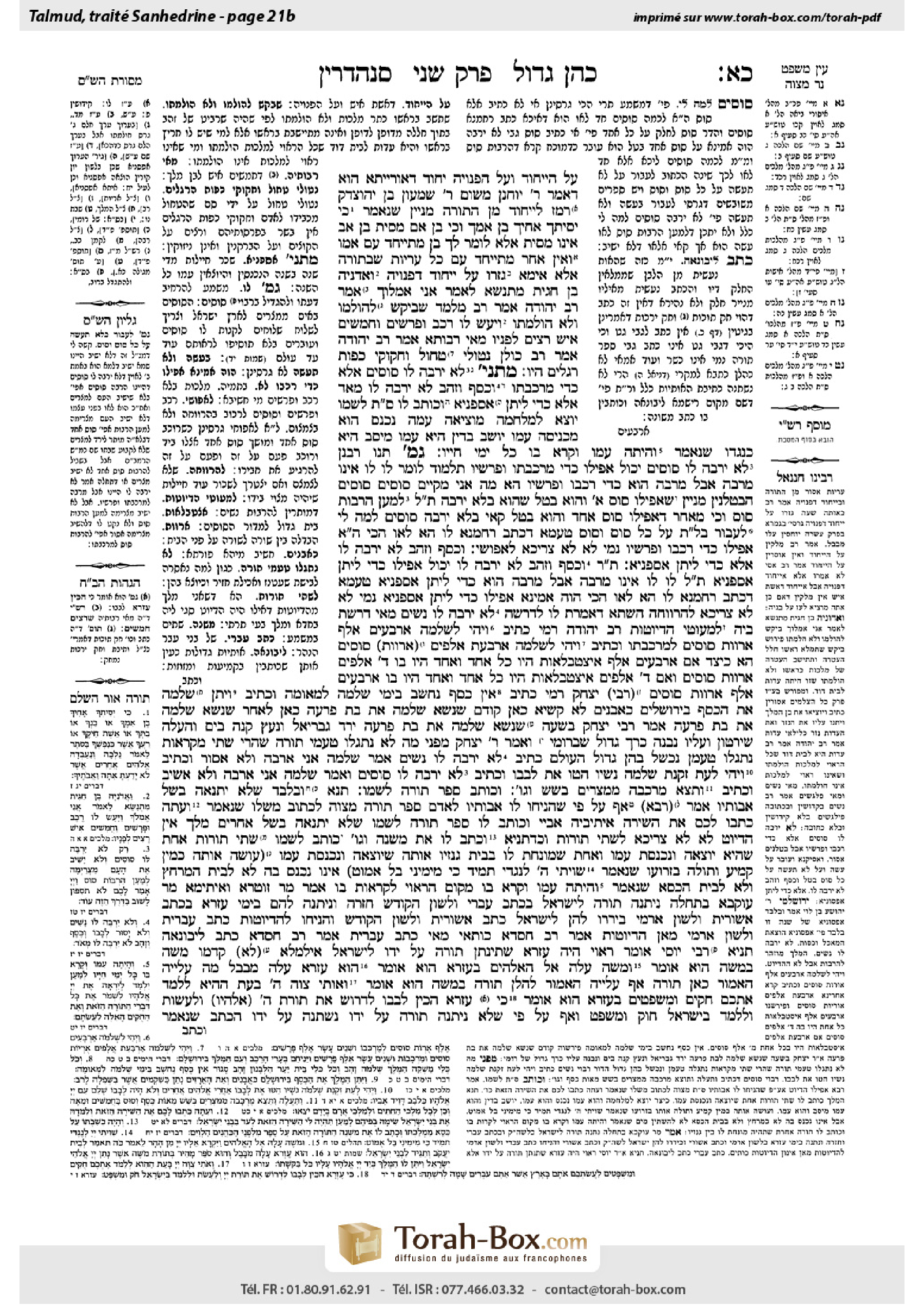
Sanhedrin 21b: Talmud study for Daf Yomi
Daf Yomi is the daily study of one Talmud folio. Explore 37 tractates with scans, Hebrew text, Sefaria English and AI-generated French translations where annotated.
Passage selection and English or AI-generated French translation are available where the scan has annotations. Daf Study is independent of Torah-Box and Sefaria.
Browse Sanhedrin · סנהדרין · All tractatesSanhedrin 21b text and translations
This page of Sanhedrin includes the Aramaic text, an English translation and an AI-generated French translation, alongside the scan above.
סנהדרין כ״א ב · Aramaic and Hebrew text
עַל הַיִּיחוּד, וְעַל הַפְּנוּיָה.
יִחוּד? דְּאוֹרָיְיתָא הוּא! דְּאָמַר רַבִּי יוֹחָנָן מִשּׁוּם רַבִּי שִׁמְעוֹן בֶּן יְהוֹצָדָק: רֶמֶז לְיִיחוּד מִן הַתּוֹרָה מִנַּיִין? שֶׁנֶּאֱמַר: ״כִּי יְסִיתְךָ אָחִיךָ בֶן אִמֶּךָ״. וְכִי בֶּן אֵם מֵסִית, בֶּן אָב אֵינוֹ מֵסִית? אֶלָּא לוֹמַר לָךְ: בֵּן מִתְיַיחֵד עִם אִמּוֹ, וְאֵין אַחֵר מִתְיַיחֵד עִם כׇּל עֲרָיוֹת שֶׁבַּתּוֹרָה.
אֶלָּא אֵימָא: גָּזְרוּ עַל יִיחוּד דִּפְנוּיָה.
״וַאֲדֹנִיָּה בֶן חַגִּית מִתְנַשֵּׂא לֵאמֹר אֲנִי אֶמְלֹךְ״. אָמַר רַב יְהוּדָה אָמַר רַב: מְלַמֵּד שֶׁבִּיקֵּשׁ לְהוֹלְמוֹ, וְלֹא הוֹלַמְתּוֹ.
״וַיַּעַשׂ לוֹ רֶכֶב וּפָרָשִׁים וַחֲמִשִּׁים אִישׁ רָצִים לְפָנָיו״. מַאי רְבוּתָא? אָמַר רַב יְהוּדָה אָמַר רַב: כּוּלָּן נְטוּלֵי טְחוֹל וַחֲקוּקֵי כַּפּוֹת רַגְלַיִם הָיוּ.
מַתְנִי׳ ״לֹא יַרְבֶּה לּוֹ סוּסִים״, אֶלָּא כְּדֵי מֶרְכַּבְתּוֹ. ״וְכֶסֶף וְזָהָב לֹא יַרְבֶּה לּוֹ מְאֹד״, אֶלָּא כְּדֵי לִיתֵּן אַפְסַנְיָא. וְכוֹתֵב לוֹ סֵפֶר תּוֹרָה לִשְׁמוֹ. יוֹצֵא לַמִּלְחָמָה – מוֹצִיאָהּ עִמּוֹ, נִכְנָס – הוּא מַכְנִיסָהּ עִמּוֹ, יוֹשֵׁב בַּדִּין – הִיא עִמּוֹ, מֵיסֵב – הִיא כְּנֶגְדּוֹ, שֶׁנֶּאֱמַר: ״וְהָיְתָה עִמּוֹ וְקָרָא בוֹ כׇּל יְמֵי חַיָּיו״.
גְּמָ׳ תָּנוּ רַבָּנַן: ״לֹא יַרְבֶּה לוֹ סוּסִים״ – יָכוֹל אֲפִילּוּ כְּדֵי מֶרְכַּבְתּוֹ וּפָרָשָׁיו? תַּלְמוּד לוֹמַר ״לוֹ״ – לוֹ אֵינוֹ מַרְבֶּה, אֲבָל מַרְבֶּה הוּא כְּדֵי רִכְבּוֹ וּפָרָשָׁיו. הָא מָה אֲנִי מְקַיֵּים ״סוּסִים״? סוּסִים הַבַּטְלָנִין. מִנַּיִין שֶׁאֲפִילּוּ סוּס אֶחָד וְהוּא בָּטֵל שֶׁהוּא בְּ״לֹא יַרְבֶּה״? תַּלְמוּד לוֹמַר ״לְמַעַן הַרְבּוֹת סוּס״.
וְכִי מֵאַחַר דַּאֲפִילּוּ סוּס אֶחָד וְהוּא בָּטֵל קָאֵי בְּ״לֹא יַרְבֶּה״, ״סוּסִים״ לְמָה לִי? לַעֲבוֹר בְּלֹא תַעֲשֶׂה עַל כׇּל סוּס וְסוּס.
טַעְמָא דִּכְתַב רַחֲמָנָא ״לוֹ״, הָא לָאו הָכִי הֲוָה אָמֵינָא אֲפִילּוּ כְּדֵי רִכְבּוֹ וּפָרָשָׁיו נָמֵי לָא? לָא צְרִיכָא, לְאַפּוֹשֵׁי.
״וְכֶסֶף וְזָהָב לֹא יַרְבֶּה לוֹ״, אֶלָּא כְּדֵי לִיתֵּן אַפְסַנְיָא. תָּנוּ רַבָּנַן: ״וְכֶסֶף וְזָהָב לֹא יַרְבֶּה לוֹ״ – יָכוֹל אֲפִילּוּ כְּדֵי לִיתֵּן אַפְסַנְיָא? תַּלְמוּד לוֹמַר ״לוֹ״ – לוֹ אֵינוֹ מַרְבֶּה, אֲבָל מַרְבֶּה הוּא כְּדֵי לִיתֵּן אַפְסַנְיָא.
טַעְמָא דִּכְתַב רַחֲמָנָא ״לוֹ״? הָא לָאו הָכִי, הֲוָה אָמֵינָא: אֲפִילּוּ כְּדֵי לִיתֵּן אַפְסַנְיָא נָמֵי לָא? לָא צְרִיכָא, לְהַרְוָוחָה.
הַשְׁתָּא דְּאָמְרַתְּ ״לוֹ״ לִדְרָשָׁה, ״לֹא יַרְבֶּה לוֹ נָשִׁים״ מַאי דָּרְשַׁתְּ בֵּיהּ? לְמַעוֹטֵי הֶדְיוֹטוֹת.
רַב יְהוּדָה רָמֵי: כְּתִיב ״וַיְהִי לִשְׁלֹמֹה אַרְבָּעִים אֶלֶף אֻרְוֹת סוּסִים לְמֶרְכַּבְתּוֹ״, וּכְתִיב ״וַיְהִי לִשְׁלֹמֹה אַרְבַּעַת אֲלָפִים אֻרְווֹת סוּסִים״. הָא כֵּיצַד? אִם אַרְבָּעִים אֶלֶף אִיצְטַבְלָאוֹת הָיוּ, כׇּל אֶחָד וְאֶחָד הָיוּ בּוֹ אַרְבַּעַת אֲלָפִים אֻרְווֹת סוּסִים. וְאִם אַרְבַּעַת אֲלָפִים אִיצְטַבְלָאוֹת הָיוּ, כׇּל אֶחָד וְאֶחָד הָיוּ בּוֹ אַרְבָּעִים אֶלֶף אֻרְווֹת סוּסִים.
רַבִּי יִצְחָק רָמֵי: כְּתִיב ״אֵין כֶּסֶף נֶחְשָׁב בִּימֵי שְׁלֹמֹה לִמְאוּמָה״, וּכְתִיב ״וַיִּתֵּן שְׁלֹמֹה אֶת הַכֶּסֶף בִּירוּשָׁלִַים כָּאֲבָנִים״? לָא קַשְׁיָא: כָּאן – קוֹדֶם שֶׁנָּשָׂא שְׁלֹמֹה אֶת בַּת פַּרְעֹה, כָּאן – לְאַחַר שֶׁנָּשָׂא שְׁלֹמֹה אֶת בַּת פַּרְעֹה.
אָמַר רַבִּי יִצְחָק: בְּשָׁעָה שֶׁנָּשָׂא שְׁלֹמֹה אֶת בַּת פַּרְעֹה, יָרַד גַּבְרִיאֵל וְנָעַץ קָנֶה בַּיָּם, וְהֶעֱלָה שִׂירְטוֹן, וְעָלָיו נִבְנָה כְּרַךְ גָּדוֹל שֶׁבְּרוֹמִי.
וְאָמַר רַבִּי יִצְחָק: מִפְּנֵי מָה לֹא נִתְגַּלּוּ טַעֲמֵי תּוֹרָה? שֶׁהֲרֵי שְׁתֵּי מִקְרָאוֹת נִתְגַּלּוּ טַעְמָן, וְנִכְשַׁל בָּהֶן גְּדוֹל הָעוֹלָם. כְּתִיב: ״לֹא יַרְבֶּה לוֹ נָשִׁים״. אָמַר שְׁלֹמֹה: ״אֲנִי אַרְבֶּה וְלֹא אָסוּר״. וּכְתִיב: ״וַיְהִי לְעֵת זִקְנַת שְׁלֹמֹה נָשָׁיו הִטּוּ אֶת לְבָבוֹ״.
וּכְתִיב: ״לֹא יַרְבֶּה לּוֹ סוּסִים״, וְאָמַר שְׁלֹמֹה: ״אֲנִי אַרְבֶּה וְלֹא אָשִׁיב״. וּכְתִיב: ״וַתֵּצֵא מֶרְכָּבָה מִמִּצְרַיִם בְּשֵׁשׁ וְגוֹ׳״.
וְכוֹתֵב סֵפֶר תּוֹרָה לִשְׁמוֹ. תְּנָא: וּבִלְבַד שֶׁלֹּא יִתְנָאֶה בְּשֶׁל אֲבוֹתָיו.
אָמַר רָבָא: אַף עַל פִּי שֶׁהִנִּיחוּ לוֹ אֲבוֹתָיו לְאָדָם סֵפֶר תּוֹרָה, מִצְוָה לִכְתּוֹב מִשֶּׁלּוֹ, שֶׁנֶּאֱמַר: ״וְעַתָּה כִּתְבוּ לָכֶם אֶת הַשִּׁירָה״. אֵיתִיבֵיהּ אַבָּיֵי: וְכוֹתֵב לוֹ סֵפֶר תּוֹרָה לִשְׁמוֹ, שֶׁלֹּא יִתְנָאֶה בְּשֶׁל אֲחֵרִים. מֶלֶךְ – אִין, הֶדְיוֹט – לֹא!
לָא, צְרִיכָא לִשְׁתֵּי תּוֹרוֹת, וְכִדְתַנְיָא: ״וְכָתַב לוֹ אֶת מִשְׁנֵה וְגוֹ׳״ – כּוֹתֵב לִשְׁמוֹ שְׁתֵּי תּוֹרוֹת: אַחַת שֶׁהִיא יוֹצְאָה וְנִכְנֶסֶת עִמּוֹ, וְאַחַת שֶׁמּוּנַּחַת לוֹ בְּבֵית גְּנָזָיו.
אוֹתָהּ שֶׁיּוֹצְאָה וְנִכְנֶסֶת עִמּוֹ, עוֹשֶׂה אוֹתָהּ כְּמִין קָמֵיעַ וְתוֹלָהּ בִּזְרוֹעוֹ, שֶׁנֶּאֱמַר: ״שִׁוִּיתִי ה׳ לְנֶגְדִּי תָמִיד כִּי מִימִינִי בַּל אֶמּוֹט״. אֵינוֹ נִכְנָס בָּהּ לֹא לְבֵית הַמֶּרְחָץ וְלֹא לְבֵית הַכִּסֵּא, שֶׁנֶּאֱמַר: ״וְהָיְתָה עִמּוֹ וְקָרָא בוֹ״ – מָקוֹם הָרָאוּי לִקְרוֹת בּוֹ.
אָמַר מָר זוּטְרָא, וְאִיתֵּימָא מָר עוּקְבָא: בַּתְּחִלָּה נִיתְּנָה תּוֹרָה לְיִשְׂרָאֵל בִּכְתָב עִבְרִי וּלְשׁוֹן הַקּוֹדֶשׁ. חָזְרָה וְנִיתְּנָה לָהֶם בִּימֵי עֶזְרָא בִּכְתָב אַשּׁוּרִי וּלְשׁוֹן אֲרַמִּי. בֵּירְרוּ לָהֶן יִשְׂרָאֵל כְּתָב אַשּׁוּרִי וּלְשׁוֹן הַקּוֹדֶשׁ, וְהִנִּיחוּ לַהֶדְיוֹטוֹת כְּתָב עִבְרִית וּלְשׁוֹן אֲרַמִּי.
מַאן הֶדְיוֹטוֹת? אָמַר רַב חִסְדָּא: כּוּתָאֵי. מַאי כְּתָב עִבְרִית? אָמַר רַב חִסְדָּא: כְּתָב לִיבּוֹנָאָה.
תַּנְיָא, רַבִּי יוֹסֵי אוֹמֵר: רָאוּי הָיָה עֶזְרָא שֶׁתִּינָּתֵן תּוֹרָה עַל יָדוֹ לְיִשְׂרָאֵל, אִילְמָלֵא לֹא קְדָמוֹ מֹשֶׁה. בְּמֹשֶׁה הוּא אוֹמֵר: ״וּמֹשֶׁה עָלָה אֶל הָאֱלֹהִים״, בְּעֶזְרָא הוּא אוֹמֵר: ״הוּא עֶזְרָא עָלָה מִבָּבֶל״. מָה עֲלִיָּיה הָאֲמוּרָה כָּאן – תּוֹרָה, אַף עֲלִיָּיה הָאֲמוּרָה לְהַלָּן – תּוֹרָה.
בְּמֹשֶׁה הוּא אוֹמֵר: ״וְאֹתִי צִוָּה ה׳ בָּעֵת הַהִיא לְלַמֵּד אֶתְכֶם חֻקִּים וּמִשְׁפָּטִים״. בְּעֶזְרָא הוּא אוֹמֵר: ״כִּי עֶזְרָא הֵכִין לְבָבוֹ לִדְרֹשׁ אֶת תּוֹרַת ה׳ אֱלֹהָיו וְלַעֲשֹׂת וּלְלַמֵּד בְּיִשְׂרָאֵל חֹק וּמִשְׁפָּט״. וְאַף עַל פִּי שֶׁלֹּא נִיתְּנָה תּוֹרָה עַל יָדוֹ, נִשְׁתַּנָּה עַל יָדוֹ הַכְּתָב, שֶׁנֶּאֱמַר:
Sanhedrin 21b · English translation
about seclusion, that a man should not be secluded with women who are forbidden to him, and about a single woman.
The Gemara objects: Seclusion with a woman forbidden by familial ties is prohibited by Torah law, and was not a rabbinic decree issued in the time of David. As Rabbi Yoḥanan says in the name of Rabbi Shimon ben Yehotzadak: From where is there an allusion to the halakha that seclusion is forbidden by Torah law? As it is stated: “If your brother, the son of your mother, entices you” (Deuteronomy 13:7). One can ask: But does the son of a mother entice, and does the son of a father not entice? Why mention only the son of a mother? Rather, this verse serves to tell you that only a son may be secluded with his mother. Sons are frequently with their mother, and two half-brothers of one mother consequently have the opportunity to grow close to one another. But another individual may not be secluded with those with whom relations are forbidden by the Torah, including a stepmother. Therefore, half-brothers of one father spend less time together.
Since seclusion, then, is prohibited by Torah law, how did Rav say that it was prohibited by a decree issued in King David’s time? Rather, say that they decreed against seclusion of a man with a single woman, to prevent occurrences like that of Amnon and Tamar.
Apropos Amnon, the Gemara cites traditions about another son of David: “Now Adonijah, son of Haggith, exalted himself, saying: I will be king” (I Kings 1:5). Rav Yehuda says that Rav says: The term “exalted himself” teaches that he sought for the monarchy to fit him, but it did not fit him.
The verse continues: “And he prepared for himself chariots and riders and fifty people to run before him” (I Kings 1:5). The Gemara asks: What is the novelty of these actions, since other wealthy people do the same, even if they are not the sons of kings, with designs on the throne? Rav Yehuda says that Rav says: What was unique was that the runners all had their spleens removed and had the soles of their feet hollowed, removing the flesh of their feet, and these two procedures enhanced their speed.
MISHNA: The king “shall not accumulate many horses for himself” (Deuteronomy 17:16), but only enough for his chariot in war and in peace. “Neither shall he greatly accumulate silver and gold for himself” (Deuteronomy 17:17), but only enough to provide his soldiers’ sustenance [aspanya]. And the king writes himself a Torah scroll for his sake, as stipulated in Deuteronomy 17:18. When he goes out to war, he brings it out with him. When he comes in from war, he brings it in with him. When he sits in judgment, it is with him. When he reclines to eat, it is opposite him, as it is stated: “And it shall be with him and he shall read it all the days of his life” (Deuteronomy 17:19).
GEMARA: The Sages taught in a baraita with regard to the verse: “He shall not accumulate many horses [susim] for himself nor return the people to Egypt for the sake of accumulating horses [sus]” (Deuteronomy 17:16): One might have thought that he shall not have even enough horses for his chariot and riders. Therefore, the verse states: “For himself,” teaching that only if the horses are for himself, for personal pleasure, he shall not accumulate them, but he may accumulate horses for his chariot and riders. How, then, do I realize the meaning of “horses [susim]” in the verse? It is referring to idle horses, which serve no purpose other than glorifying the king. From where is it derived that even if the king has one horse that is idle, that he transgresses “he shall not accumulate”? The verse states: “For the sake of accumulating horses [sus],” with the term for horses written in the singular.
The Gemara asks: But once the verse taught that even one horse that is idle stands to be included in the prohibition of “he shall not accumulate,” why do I need the plural form “horses” in the first clause of the verse? The Gemara responds: Its purpose is to teach that a king would transgress the prohibition an additional time for each and every idle horse.
The Gemara questions this ruling: The specific reason for limiting the prohibition to idle horses is that the Merciful One writes: “He shall not accumulate for himself,” which indicates, consequently, that if the Torah had not written this, I would say that even enough horses for his chariot and riders are not permitted; and this is unreasonable, since the king needs an army. The Gemara responds: No, the term “for himself” is necessary to teach that it is permitted for the king to add a reasonable number of horses beyond the necessary minimum, and it is only strictly personal use that is prohibited.
The mishna teaches: “Neither shall he greatly accumulate silver and gold for himself” (Deuteronomy 17:17), but only enough to provide his soldiers’ sustenance. The Sages taught in a baraita: From the command “neither shall he greatly accumulate silver and gold for himself,” one might have thought that he should not have even enough to provide his soldiers’ sustenance. To counter this, the verse states: “For himself,” teaching that only if the silver and gold is for himself, for personal pleasure, he shall not accumulate it, but he may accumulate enough silver and gold to provide his soldiers’ sustenance.
The Gemara questions this ruling: The specific reason for limiting the accumulation of personal wealth is that the Merciful One writes: “Neither shall he greatly accumulate silver and gold for himself,” which indicates, consequently, that if the Torah had not written this, I would say that it is not permitted for the king to accumulate even enough silver and gold to provide his soldiers’ sustenance; this is unreasonable, since the king needs an army. The Gemara responds: No, the term “for himself” is necessary to teach that the king is permitted to allow for a liberal appropriation to the military budget, so that the army has a comfortable financial cushion.
The Gemara asks: Now that you have said that the term “for himself” in the verse is stated for the purpose of a derivation for practical halakha, which limits and narrows the verse’s scope, what do you derive from the next phrase in the verse: “He shall not add many wives for himself”? The Gemara answers: That usage of “for himself” serves to exclude ordinary people, to specify that only the king is restricted from having many wives, but a civilian may marry as many women as he wants, provided he can support them financially.
§ Rav Yehuda raises a contradiction: It is written in one verse: “And Solomon had forty thousand stalls of horses for his chariots” (I Kings 5:6), and it is written in another verse: “And Solomon had four thousand stalls for horses and chariots” (II Chronicles 9:25). How can these texts be reconciled? If there were forty thousand large stables [itztablaot], each and every one of them had in it four thousand stalls, or rows, for horses. And alternatively, if there were four thousand large stables, each and every one had in it forty thousand stalls for horses. Therefore the two verses are reconciled.
Rabbi Yitzḥak raises a contradiction: It is written in one verse: “Silver was not worth anything in the days of Solomon” (II Chronicles 9:20), and it is written in another verse: “And the king made silver in Jerusalem as stones” (I Kings 10:27), i.e., gems. The Gemara responds: It is not difficult: Here, where silver was worthless, this was before Solomon sinfully married Pharaoh’s daughter. There, where the silver was valuable, this was after Solomon married Pharaoh’s daughter.
Rabbi Yitzḥak says: When Solomon married Pharaoh’s daughter, the angel Gabriel descended from Heaven and implanted a pole in the sea. And it gradually raised up a sandbar [sirton] around it, creating new, dry land, and on it the great city of Rome was built. This shows that the beginning of the Jewish people’s downfall to Rome came with Solomon’s marriage to Pharaoh’s daughter.
And Rabbi Yitzḥak says: For what reason were the rationales of Torah commandments not revealed? It was because the rationales of two verses were revealed, and the greatest in the world, King Solomon, failed in those matters. It is written with regard to a king: “He shall not add many wives for himself, that his heart should not turn away” (Deuteronomy 17:17). Solomon said: I will add many, but I will not turn away, as he thought that it is permitted to have many wives if one is otherwise meticulous not to stray. And later, it is written: “For it came to pass, when Solomon was old, that his wives turned away his heart after other gods” (I Kings 11:4).
And it is also written: “Only he shall not accumulate many horses for himself nor return the people to Egypt for the sake of accumulating horses” (Deuteronomy 17:16), and Solomon said: I will accumulate many, but I will not return. And it is written: “And a chariot came up and went out of Egypt for six hundred shekels of silver” (I Kings 10:29), teaching that not only did Solomon violate the Torah, but he also failed in applying the rationale given for its commandments. This demonstrates the wisdom in the Torah’s usual silence as to the rationale for its mitzvot, as individuals will not mistakenly rely on their own wisdom to reason that the mitzvot are inapplicable in some circumstances.
§ The mishna teaches that the king writes a Torah scroll for his sake. The Sages taught in a baraita (Tosefta 4:4): The king fulfills the mitzva provided that he does not beautify himself with the Torah scroll of his ancestors for this purpose, i.e., he must write his own scroll.
Rava says: With regard to the mitzva for every Jew to write himself a Torah scroll, even if a person’s ancestors left him a Torah scroll, it is a mitzva to write a scroll of one’s own, as it is stated: “Now, therefore, write for yourselves this song and teach it to the children of Israel” (Deuteronomy 31:19). Abaye raised an objection to him from a baraita concerning the king’s Torah scroll: And he writes himself a Torah scroll for his sake, so that he does not beautify himself with the Torah scroll of others. Read precisely, this indicates that a king, yes, he is included in the halakha not to have a scroll inherited from his ancestors suffice, but an ordinary person is not.
The Gemara dismisses Abaye’s objection: No, the ruling of that baraita is necessary to teach that the king is commanded to write two Torah scrolls; he writes one scroll as does any Jew, and he writes an additional scroll because he is king. And this is as it is taught in a baraita: The verse states: “That he shall write for himself a second Torah in a scroll, out of that which is before the priests the Levites” (Deuteronomy 17:18). This teaches that he writes for his sake two Torah scrolls, one that goes out and comes in with him at all times, and one that is placed in his treasury.
The baraita continues: With regard to the one that goes out and comes in with him, he makes it very small, like an amulet, and he hangs it on his arm, as it is stated: “I have set the Lord always before me; He is at my right hand, that I shall not be moved” (Psalms 16:8). This alludes to the small Torah scroll that is always on his right hand. He does not go into the bathhouse with it, nor into the bathroom, as it is stated: “And it shall be with him and he shall read from it” (Deuteronomy 17:19), meaning, it shall remain in a place that is appropriate for reading from it.
§ Mar Zutra says, and some say that it is Mar Ukva who says: Initially, the Torah was given to the Jewish people in Ivrit script, the original form of the written language, and the sacred tongue, Hebrew. It was given to them again in the days of Ezra in Ashurit script and the Aramaic tongue. The Jewish people selected Ashurit script and the sacred tongue for the Torah scroll and left Ivrit script and the Aramaic tongue for the commoners.
The Gemara asks: Who are these commoners? Rav Ḥisda said: The Samaritans [Kutim]. The Gemara asks: What is Ivrit script? Rav Ḥisda says: Libona’a script.
It is taught in a baraita (Tosefta 4:5): Rabbi Yosei says: Ezra was suitable, given his greatness, for the Torah to be given by him to the Jewish people, had Moses not come first and received the Torah already. With regard to Moses the verse states: “And Moses went up to God” (Exodus 19:3), and with regard to Ezra the verse states: “This Ezra went up from Babylon and he was a ready scribe in the Torah of Moses, which the Lord, the God of Israel, had given” (Ezra 7:6). Just as the going up stated here, with regard to Moses, is for the Torah, which he received from God and transmitted to the Jewish people, so too, the going up stated there, with regard to Ezra, is for the Torah, as he taught Torah to the Jewish people and was suitable to have originally merited to give it.
The baraita continues: With regard to Moses the verse states: “And the Lord commanded me at that time to teach you statutes and ordinances” (Deuteronomy 4:14), and with regard to Ezra the verse states: “For Ezra had set his heart to seek the Torah of the Lord his God and to do it and to teach in Israel statutes and ordinances” (Ezra 7:10). And even though the Torah was not given literally by him, the script of the Torah was changed by him, as it is stated:
Sanhedrin 21b · Traduction française (IA)
au sujet de l’isolement : un homme ne doit pas se retrouver seul avec des femmes qui lui sont interdites, ni avec une femme célibataire.
La Guemara objecte : l’isolement avec une femme interdite en raison de liens familiaux est prohibé par la Torah et ne résulte pas d’un décret rabbinique promulgué à l’époque de David. En effet, Rabbi Yoḥanan dit au nom de Rabbi Shimon ben Yehotzadak : D’où tire-t-on une allusion à la halakha selon laquelle l’isolement est interdit par la Torah ? Comme il est dit : « Si ton frère, le fils de ta mère, t’incite » (Deutéronome 13:7). On peut demander : Le fils d’une mère incite-t-il, tandis que le fils d’un père ne le fait pas ? Pourquoi le texte ne mentionne-t-il que le fils d’une mère ? Ce verset vient plutôt t’enseigner que seul un fils peut être seul avec sa mère. Les fils sont souvent auprès de leur mère ; par conséquent, deux demi-frères ayant la même mère ont l’occasion de se rapprocher l’un de l’autre. Mais nul autre ne peut se retrouver seul avec celles avec qui les relations lui sont interdites par la Torah, y compris une belle-mère. C’est pourquoi les demi-frères ayant le même père passent moins de temps ensemble.
Puisque l’isolement est donc interdit par la Torah, comment Rav a-t-il pu dire qu’il a été interdit par un décret promulgué à l’époque du roi David ? Il faut plutôt dire qu’ils ont décrété qu’un homme ne pouvait pas rester seul avec une femme célibataire, afin d’éviter des événements comme celui d’Amnon et Tamar.
À propos d’Amnon, la Guemara cite des traditions concernant un autre fils de David : « Or Adonias, fils de Haggith, s’exalta en disant : “C’est moi qui serai roi” » (I Rois 1:5). Rav Yehuda dit au nom de Rav : L’expression « s’exalta » enseigne qu’il voulait que la royauté lui convienne, mais qu’elle ne lui convenait pas.
Le verset poursuit : « Il se procura des chars et des cavaliers, ainsi que cinquante hommes qui couraient devant lui » (I Rois 1:5). La Guemara demande : Qu’y a-t-il de nouveau dans ces actes, puisque d’autres riches agissent de même, même s’ils ne sont pas fils de rois et ne convoitent pas le trône ? Rav Yehuda dit au nom de Rav : Ce qui était particulier, c’est que les coureurs avaient tous subi l’ablation de la rate et qu’on leur avait creusé la plante des pieds en en retirant la chair ; ces deux opérations amélioraient leur vitesse.
MICHNA : Le roi « ne devra pas accumuler pour lui un grand nombre de chevaux » (Deutéronome 17:16), mais seulement assez pour son char, en temps de guerre comme en temps de paix. « Il ne devra pas non plus accumuler pour lui une grande quantité d’argent et d’or » (Deutéronome 17:17), mais seulement de quoi assurer la subsistance de ses soldats [aspanya]. Le roi écrit pour lui-même un rouleau de la Torah, comme le prescrit Deutéronome 17:18. Lorsqu’il part en guerre, il l’emporte avec lui. Lorsqu’il revient de guerre, il le rapporte avec lui. Lorsqu’il siège pour rendre la justice, il est avec lui. Lorsqu’il s’allonge pour manger, il est en face de lui, comme il est dit : « Il sera avec lui et il le lira tous les jours de sa vie » (Deutéronome 17:19).
GUEMARA : Les Sages ont enseigné dans une baraïta à propos du verset : « Il ne devra pas accumuler pour lui un grand nombre de chevaux [susim], ni faire retourner le peuple en Égypte pour accumuler des chevaux [sus] » (Deutéronome 17:16) : On aurait pu penser qu’il ne doit même pas avoir assez de chevaux pour son char et ses cavaliers. Le verset précise donc : « pour lui », ce qui enseigne que c’est seulement s’il s’agit de chevaux pour lui-même, pour son plaisir personnel, qu’il ne doit pas en accumuler ; mais il peut en accumuler pour son char et ses cavaliers. Comment faut-il alors comprendre le mot « chevaux [susim] » dans le verset ? Il désigne des chevaux inutilisés, qui n’ont d’autre fonction que de glorifier le roi. D’où déduit-on que même si le roi ne possède qu’un seul cheval inutilisé, il transgresse l’interdiction « il ne devra pas accumuler » ? Le verset dit : « pour accumuler des chevaux [sus] », le terme désignant les chevaux étant au singulier.
La Guemara demande : Mais puisque le verset enseigne qu’un seul cheval inutilisé tombe déjà sous le coup de l’interdiction « il ne devra pas accumuler », pourquoi le pluriel « chevaux » est-il nécessaire dans la première partie du verset ? La Guemara répond : Il sert à enseigner que le roi transgresse l’interdiction une fois de plus pour chaque cheval inutilisé.
La Guemara met cette règle en question : Si l’interdiction est limitée aux chevaux inutilisés, c’est précisément parce que le Miséricordieux écrit : « Il ne devra pas accumuler pour lui », ce qui implique que, si la Torah ne l’avait pas écrit, j’aurais dit que même le nombre de chevaux nécessaire pour son char et ses cavaliers est interdit ; or cela serait déraisonnable, puisque le roi a besoin d’une armée. La Guemara répond : Non, l’expression « pour lui » est nécessaire pour enseigner qu’il est permis au roi d’ajouter un nombre raisonnable de chevaux au-delà du minimum nécessaire ; seul un usage strictement personnel est interdit.
La Michna enseigne : « Il ne devra pas non plus accumuler pour lui une grande quantité d’argent et d’or » (Deutéronome 17:17), mais seulement de quoi assurer la subsistance de ses soldats. Les Sages ont enseigné dans une baraïta : À partir de l’ordre « il ne devra pas accumuler pour lui une grande quantité d’argent et d’or », on aurait pu penser qu’il ne doit même pas posséder assez pour assurer la subsistance de ses soldats. Pour écarter cette interprétation, le verset précise : « pour lui », enseignant que c’est seulement si l’argent et l’or sont pour lui-même, pour son plaisir personnel, qu’il ne doit pas les accumuler ; mais il peut en accumuler assez pour assurer la subsistance de ses soldats.
La Guemara met cette règle en question : Si l’accumulation de richesse personnelle est limitée pour la raison précise que le Miséricordieux écrit : « Il ne devra pas accumuler pour lui une grande quantité d’argent et d’or », cela implique que, si la Torah ne l’avait pas écrit, j’aurais dit qu’il n’est pas permis au roi d’accumuler même assez d’argent et d’or pour assurer la subsistance de ses soldats ; or cela serait déraisonnable, puisque le roi a besoin d’une armée. La Guemara répond : Non, l’expression « pour lui » est nécessaire pour enseigner que le roi peut prévoir une dotation généreuse au budget militaire, afin que l’armée dispose d’une réserve financière confortable.
La Guemara demande : À présent que tu as dit que l’expression « pour lui » dans le verset sert à une déduction ayant une portée halakhique pratique, qui limite et restreint la portée du verset, que déduis-tu de la phrase suivante : « Il ne devra pas prendre pour lui un grand nombre de femmes » ? La Guemara répond : Cette occurrence de l’expression « pour lui » sert à exclure les gens ordinaires : elle précise que seul le roi est limité quant au nombre de femmes qu’il peut avoir, tandis qu’un particulier peut épouser autant de femmes qu’il le souhaite, à condition d’avoir les moyens de subvenir à leurs besoins.
§ Rav Yehuda soulève une contradiction : Un verset dit : « Salomon avait quarante mille stalles de chevaux pour ses chars » (I Rois 5:6), et un autre dit : « Salomon avait quatre mille stalles pour les chevaux et les chars » (II Chroniques 9:25). Comment concilier ces textes ? S’il y avait quarante mille grandes écuries [itztablaot], chacune contenait quatre mille stalles, ou rangées, pour les chevaux. Autre possibilité : s’il y avait quatre mille grandes écuries, chacune contenait quarante mille stalles pour les chevaux. Les deux versets sont ainsi conciliés.
Rabbi Yitzḥak soulève une contradiction : Un verset dit : « L’argent n’avait aucune valeur à l’époque de Salomon » (II Chroniques 9:20), et un autre dit : « Le roi rendit l’argent aussi abondant à Jérusalem que les pierres » (I Rois 10:27), c’est-à-dire comme les pierres précieuses. La Guemara répond : Il n’y a pas de difficulté : dans le premier cas, où l’argent n’avait aucune valeur, c’était avant que Salomon épouse, dans le péché, la fille de Pharaon ; dans le second, où l’argent avait de la valeur, c’était après qu’il eut épousé la fille de Pharaon.
Rabbi Yitzḥak dit : Lorsque Salomon épousa la fille de Pharaon, l’ange Gabriel descendit du Ciel et planta un poteau dans la mer. Un banc de sable [sirton] se forma progressivement autour de lui, créant de nouvelles terres émergées ; c’est là que fut bâtie la grande ville de Rome. Cela montre que le déclin du peuple juif face à Rome commença avec le mariage de Salomon avec la fille de Pharaon.
Et Rabbi Yitzḥak dit : Pour quelle raison les motifs des commandements de la Torah n’ont-ils pas été révélés ? Parce que les motifs de deux versets furent révélés, et que le plus grand homme du monde, le roi Salomon, échoua dans ces domaines. À propos d’un roi, il est écrit : « Il ne devra pas prendre pour lui un grand nombre de femmes, de peur que son cœur ne se détourne » (Deutéronome 17:17). Salomon dit : J’en prendrai beaucoup, mais je ne me détournerai pas, car il pensait qu’il était permis d’avoir de nombreuses femmes à condition de veiller par ailleurs à ne pas s’égarer. Plus tard, il est écrit : « Or, lorsque Salomon fut vieux, ses femmes détournèrent son cœur vers d’autres dieux » (I Rois 11:4).
Il est également écrit : « Seulement, il ne devra pas accumuler pour lui un grand nombre de chevaux, ni faire retourner le peuple en Égypte pour accumuler des chevaux » (Deutéronome 17:16), et Salomon dit : J’en accumulerai beaucoup, mais je ne ferai pas retourner le peuple. Or, il est écrit : « Un char montait et sortait d’Égypte au prix de six cents sicles d’argent » (I Rois 10:29), ce qui enseigne que Salomon ne s’est pas contenté de transgresser la Torah : il a aussi échoué à appliquer le motif donné pour ses commandements. Cela démontre la sagesse du silence habituel de la Torah quant au motif de ses mitsvot : les individus ne s’appuieront pas à tort sur leur propre sagesse pour conclure que les mitsvot ne s’appliquent pas dans certaines circonstances.
§ La Michna enseigne que le roi écrit pour lui-même un rouleau de la Torah. Les Sages ont enseigné dans une baraïta (Tosefta 4:4) : Le roi accomplit la mitsva à condition de ne pas se parer, à cette fin, du rouleau de la Torah de ses ancêtres ; autrement dit, il doit écrire son propre rouleau.
Rava dit : Concernant la mitsva pour chaque Juif d’écrire un rouleau de la Torah, même si ses ancêtres lui ont laissé un rouleau, il a la mitsva d’en écrire un qui lui soit propre, comme il est dit : « Maintenant donc, écrivez pour vous ce cantique et enseignez-le aux enfants d’Israël » (Deutéronome 31:19). Abaye lui objecta une baraïta au sujet du rouleau de la Torah du roi : Il écrit pour lui-même un rouleau de la Torah, afin de ne pas se parer du rouleau de la Torah d’autrui. À lire cette formulation avec précision, elle indique que le roi, oui, est concerné par la halakha selon laquelle il ne peut se contenter d’un rouleau hérité de ses ancêtres, mais pas le particulier.
La Guemara écarte l’objection d’Abaye : Non, cette règle de la baraïta est nécessaire pour enseigner que le roi a l’obligation d’écrire deux rouleaux de la Torah : il en écrit un comme tout Juif et un autre parce qu’il est roi. Cela correspond à ce qui est enseigné dans une baraïta : Le verset dit : « Il écrira pour lui-même une deuxième Torah en rouleau, d’après celle qui se trouve auprès des prêtres lévites » (Deutéronome 17:18). Cela enseigne qu’il écrit pour lui-même deux rouleaux de la Torah, l’un qu’il emporte avec lui lorsqu’il sort et qu’il rapporte lorsqu’il revient, et l’autre qui est placé dans son trésor.
La baraïta poursuit : Quant au rouleau qu’il emporte avec lui lorsqu’il sort et qu’il rapporte lorsqu’il revient, il le fait très petit, comme une amulette, et le suspend à son bras, comme il est dit : « Je place constamment l’Éternel devant moi ; puisqu’il est à ma droite, je ne chancellerai pas » (Psaumes 16:8). Cela fait allusion au petit rouleau de la Torah qui se trouve toujours à sa main droite. Il ne va ni aux bains ni aux toilettes avec lui, comme il est dit : « Il sera avec lui et il le lira » (Deutéronome 17:19), c’est-à-dire qu’il doit rester dans un endroit où il convient de le lire.
§ Mar Zutra dit, et certains disent que c’est Mar Ukva qui le dit : Au début, la Torah fut donnée au peuple juif dans l’écriture Ivrit, forme originelle de la langue écrite, et dans la langue sacrée, l’hébreu. Elle lui fut donnée de nouveau à l’époque d’Ezra, dans l’écriture Ashurit et la langue araméenne. Le peuple juif choisit l’écriture Ashurit et la langue sacrée pour le rouleau de la Torah, et laissa l’écriture Ivrit et la langue araméenne aux gens du commun.
La Guemara demande : Qui sont ces gens du commun ? Rav Ḥisda dit : Les Samaritains [Kutim]. La Guemara demande : Qu’est-ce que l’écriture Ivrit ? Rav Ḥisda dit : L’écriture Libona’a.
Il est enseigné dans une baraïta (Tosefta 4:5) : Rabbi Yosei dit : Ezra était digne, par sa grandeur, que la Torah soit transmise au peuple juif par lui, si Moïse n’était pas venu le premier et ne l’avait pas déjà reçue. À propos de Moïse, le verset dit : « Moïse monta vers Dieu » (Exode 19:3) ; et à propos d’Ezra, le verset dit : « Cet Ezra monta de Babylone. C’était un scribe versé dans la Torah de Moïse, que l’Éternel, Dieu d’Israël, avait donnée » (Esdras 7:6). De même que la montée mentionnée ici à propos de Moïse concernait la Torah, qu’il reçut de Dieu et transmit au peuple juif, de même la montée mentionnée là à propos d’Ezra concernait la Torah : il enseigna la Torah au peuple juif et aurait pu avoir le mérite de la lui transmettre à l’origine.
La baraïta poursuit : À propos de Moïse, le verset dit : « L’Éternel m’ordonna alors de vous enseigner des statuts et des règles » (Deutéronome 4:14) ; et à propos d’Ezra, le verset dit : « Car Ezra avait disposé son cœur à étudier la Torah de l’Éternel, son Dieu, à la pratiquer et à enseigner en Israël les statuts et les règles » (Esdras 7:10). Et même si la Torah ne lui fut pas littéralement donnée par lui, c’est lui qui en modifia l’écriture, comme il est dit :
Traduction française générée par IA à partir de l’édition anglaise de Sefaria. Vérifie toujours un passage avec le texte source.
Text from Sefaria: William Davidson Edition - Vocalized Aramaic (CC BY NC); William Davidson Edition - English (CC BY NC).