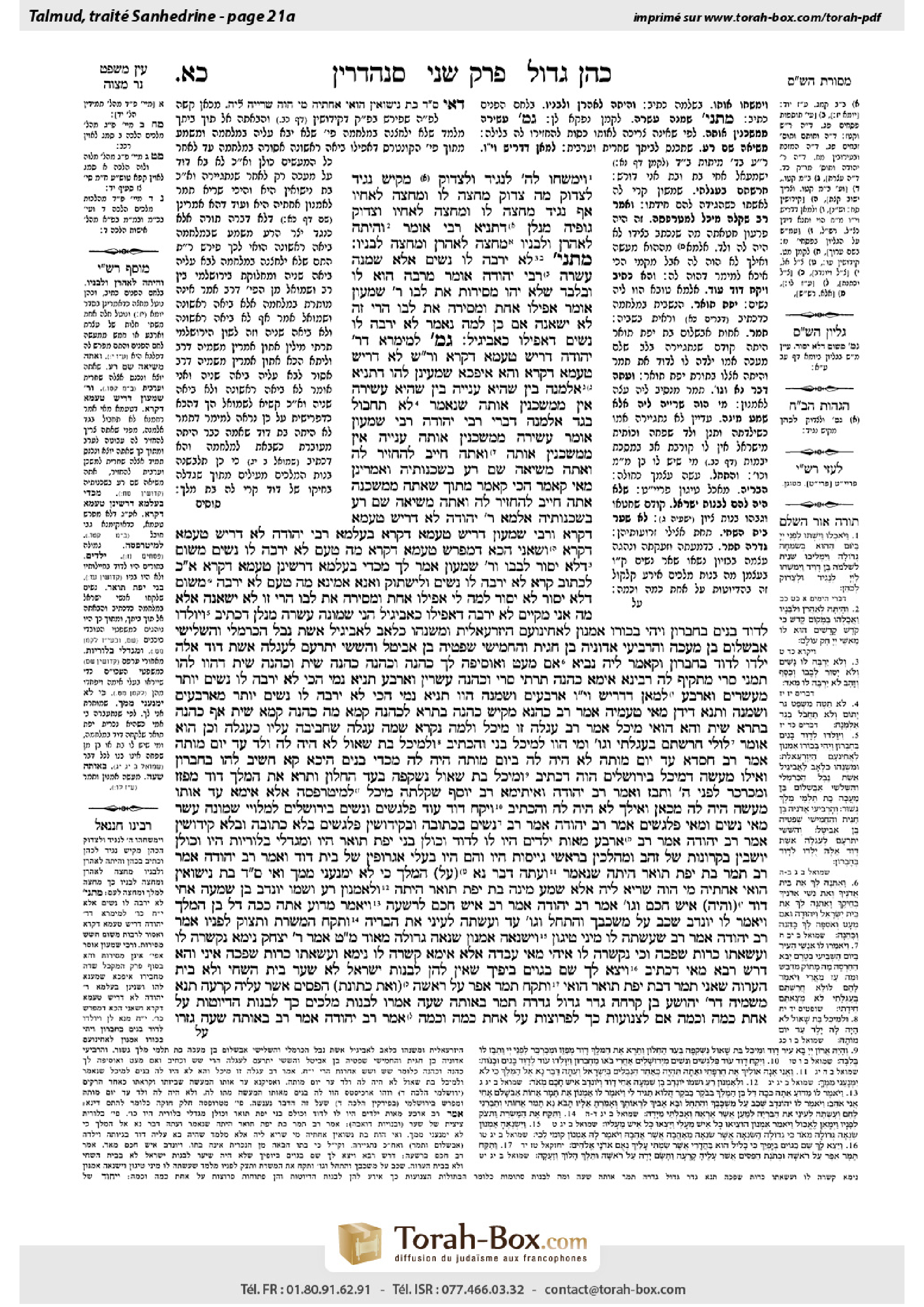
Sanhedrin 21a: Talmud study for Daf Yomi
Daf Yomi is the daily study of one Talmud folio. Explore 37 tractates with scans, Hebrew text, Sefaria English and AI-generated French translations where annotated.
Passage selection and English or AI-generated French translation are available where the scan has annotations. Daf Study is independent of Torah-Box and Sefaria.
Browse Sanhedrin · סנהדרין · All tractatesSanhedrin 21a text and translations
This page of Sanhedrin includes the Aramaic text, an English translation and an AI-generated French translation, alongside the scan above.
סנהדרין כ״א א · Aramaic and Hebrew text
״וַיִּמְשְׁחוּ לַה׳ לְנָגִיד וּלְצָדוֹק״, מַקִּישׁ נָגִיד לְצָדוֹק: מָה צָדוֹק – מֶחֱצָה לוֹ וּמֶחֱצָה לְאֶחָיו, אַף נָגִיד – מֶחֱצָה לוֹ וּמֶחֱצָה לְאֶחָיו.
וְצָדוֹק גּוּפֵיהּ מְנָלַן? דְּתַנְיָא: רַבִּי אוֹמֵר: ״וְהָיְתָה לְאַהֲרֹן וּלְבָנָיו״ – מֶחֱצָה לְאַהֲרֹן וּמֶחֱצָה לְבָנָיו.
מַתְנִי׳ ״לֹא יַרְבֶּה לוֹ נָשִׁים״, אֶלָּא שְׁמֹנֶה עֶשְׂרֵה. רַבִּי יְהוּדָה אוֹמֵר: מַרְבֶּה הוּא לוֹ, וּבִלְבַד שֶׁלֹּא יְהוּ מְסִירוֹת אֶת לִבּוֹ. רַבִּי שִׁמְעוֹן אוֹמֵר: אֲפִילּוּ אַחַת וּמְסִירָה אֶת לִבּוֹ – הֲרֵי זֶה לֹא יִשָּׂאֶנָּה. אִם כֵּן, לָמָּה נֶאֱמַר ״לֹא יַרְבֶּה לוֹ נָשִׁים״? דַּאֲפִילּוּ כַּאֲבִיגַיִל.
גְּמָ׳ לְמֵימְרָא דְּרַבִּי יְהוּדָה דָּרֵישׁ טַעְמָא דִּקְרָא, וְרַבִּי שִׁמְעוֹן לָא דָּרֵישׁ טַעְמָא דִּקְרָא? וְהָא אִיפְּכָא שָׁמְעִינַן לְהוּ!
דְּתַנְיָא: אַלְמָנָה, בֵּין שֶׁהִיא עֲנִיָּה בֵּין שֶׁהִיא עֲשִׁירָה, אֵין מְמַשְׁכְּנִין אוֹתָהּ, שֶׁנֶּאֱמַר: ״לֹא תַחֲבֹל בֶּגֶד אַלְמָנָה״ – דִּבְרֵי רַבִּי יְהוּדָה. רַבִּי שִׁמְעוֹן אוֹמֵר: עֲשִׁירָה – מְמַשְׁכְּנִין אוֹתָהּ, עֲנִיָּיה – אֵין מְמַשְׁכְּנִין אוֹתָהּ, וְאַתָּה חַיָּיב לְהַחְזִיר לָהּ, וְאַתָּה מַשִּׂיאָהּ שֵׁם רַע בִּשְׁכֵנוֹתֶיהָ.
וְאָמְרִינַן: מַאי קָאָמַר? הָכִי קָאָמַר: מִתּוֹךְ שֶׁאַתָּה מְמַשְׁכְּנָהּ, אַתָּה חַיָּיב לְהַחֲזִיר לָהּ, וְאַתָּה מַשִּׂיאָהּ שֵׁם רַע בִּשְׁכֵנוֹתֶיהָ. אַלְמָא, רַבִּי יְהוּדָה לָא דָּרֵישׁ טַעְמָא דִּקְרָא, וְרַבִּי שִׁמְעוֹן דָּרֵישׁ טַעְמָא דִּקְרָא.
בְּעָלְמָא, רַבִּי יְהוּדָה לָא דָּרֵישׁ טַעְמָא דִּקְרָא, וְשָׁאנֵי הָכָא דִּמְפָרֵשׁ טַעְמָא דִקְרָא: מַה טַּעַם ״לֹא יַרְבֶּה לוֹ נָשִׁים״? מִשּׁוּם דְּ״לֹא יָסוּר לְבָבוֹ״.
וְרַבִּי שִׁמְעוֹן אָמַר לָךְ: מִכְּדִי בְּעָלְמָא דָּרְשִׁינַן טַעְמָא דִּקְרָא, אִם כֵּן לִכְתּוֹב קְרָא ״לֹא יַרְבֶּה לוֹ נָשִׁים״ וְלִישְׁתּוֹק, וַאֲנָא אָמֵינָא: מָה טַעַם ״לֹא יַרְבֶּה״? מִשּׁוּם דְּ״לֹא יָסוּר״. ״לֹא יָסוּר״ לְמָה לִי? אֲפִילּוּ אַחַת וּמְסִירָה אֶת לִבּוֹ – הֲרֵי זוֹ לֹא יִשָּׂאֶנָּה. אֶלָּא מָה אֲנִי מְקַיֵּים ״לֹא יַרְבֶּה״? דַּאֲפִילּוּ כַּאֲבִיגַיִל.
הָנֵי שְׁמוֹנֶה עֶשְׂרֵה מְנָלַן? דִּכְתִיב: ״וַיִּוָּלְדוּ לְדָוִד בָּנִים בְּחֶבְרוֹן וַיְהִי בְכוֹרוֹ אַמְנוֹן לַאֲחִינֹעַם הַיִּזְרְעֵאלִית. וּמִשְׁנֵהוּ כִלְאָב לַאֲבִיגַיִל אֵשֶׁת נָבָל הַכַּרְמְלִי וְהַשְּׁלִישִׁי אַבְשָׁלוֹם בֶּן מַעֲכָה ... וְהָרְבִיעִי אֲדֹנִיָּה בֶן חַגִּית וְהַחֲמִישִׁי שְׁפַטְיָה בֶן אֲבִיטָל. וְהַשִּׁשִּׁי יִתְרְעָם לְעֶגְלָה אֵשֶׁת דָּוִד אֵלֶּה יֻלְּדוּ לְדָוִד בְּחֶבְרוֹן״.
וְקָאָמַר לֵיהּ נָבִיא: ״אִם מְעַט, וְאֹסִיפָה לְּךָ כָּהֵנָּה וְכָהֵנָּה״. ״כָּהֵנָּה״ – שֵׁית, ״וְכָהֵנָּה״ – שֵׁית, דְּהָווּ לְהוּ תַּמְנֵי סְרֵי.
מַתְקֵיף לַהּ רָבִינָא: אֵימַר, ״כָּהֵנָּה״ – תַּרְתֵּי סְרֵי, ״וְכָהֵנָּה״ – עֶשְׂרִין וְאַרְבַּע.
תַּנְיָא נָמֵי הָכִי: ״לֹא יַרְבֶּה לוֹ נָשִׁים״ – יוֹתֵר מֵעֶשְׂרִים וְאַרְבַּע. לְמַאן דְּדָרֵישׁ וָיו, אַרְבָּעִים וּשְׁמֹנֶה הָווּ. תַּנְיָא נָמֵי הָכִי: ״לֹא יַרְבֶּה לוֹ נָשִׁים״ – יוֹתֵר מֵאַרְבָּעִים וּשְׁמֹנֶה.
וְתַנָּא דִּידַן, מַאי טַעְמֵיהּ? אָמַר רַב כָּהֲנָא: מַקִּישׁ ״כָּהֵנָּה״ בָּתְרָא לְ״כָּהֵנָּה״ קַמָּא: מָה ״כָּהֵנָּה״ קַמָּא – שֵׁית, אַף ״כָּהֵנָּה״ בָּתְרָא – שֵׁית.
וְהָא הֲוַאי מִיכַל! אָמַר רַב: עֶגְלָה זוֹ מִיכַל, וְלָמָּה נִקְרָא שְׁמָהּ עֶגְלָה? שֶׁחֲבִיבָה עָלָיו כְּעֶגְלָה. וְכֵן הוּא אוֹמֵר: ״לוּלֵי חֲרַשְׁתֶּם בְּעֶגְלָתִי וְגוֹ׳״.
וּמִי הֲווֹ לְמִיכַל בְּנֵי? וְהָכְתִיב: ״וּלְמִיכַל בַּת שָׁאוּל לֹא הָיָה לָהּ וָלָד עַד יוֹם מוֹתָהּ״! אָמַר רַב חִסְדָּא: עַד יוֹם מוֹתָהּ לֹא הָיָה לָהּ, בְּיוֹם מוֹתָהּ הָיָה לָהּ.
מִכְּדֵי, בָּנִים הֵיכָא קָא חָשֵׁיב לְהוּ? בְּחֶבְרוֹן. וְאִילּוּ מַעֲשֶׂה דְּמִיכַל בִּירוּשָׁלַיִם הֲוָה, דִּכְתִיב: ״וּמִיכַל בַּת שָׁאוּל נִשְׁקְפָה בְּעַד הַחַלּוֹן וַתֵּרֶא אֶת הַמֶּלֶךְ דָּוִד מְפַזֵּז וּמְכַרְכֵּר לִפְנֵי ה׳ וַתִּבֶז״. וְאָמַר רַב יְהוּדָה, וְאִיתֵּימָא רַב יוֹסֵף: שְׁקַלְתֵּהּ מִיכַל לְמִיטְרַפְסַהּ! אֶלָּא אֵימָא: עַד אוֹתוֹ מַעֲשֶׂה – הָיָה לָהּ, מִכָּאן וְאֵילָךְ – לֹא הָיָה לָהּ.
וְהָכְתִיב: ״וַיִּקַּח דָּוִד עוֹד פִּלַגְשִׁים וְנָשִׁים בִּירוּשָׁלַיִם״? לְמַלּוֹיֵי שְׁמוֹנָה עֶשְׂרֵה. מַאי ״נָשִׁים״ וּמַאי ״פִּלַגְשִׁים״? אָמַר רַב יְהוּדָה אָמַר רַב: נָשִׁים – בִּכְתוּבָּה וּבְקִידּוּשִׁין, פִּלַגְשִׁים – בְּלֹא כְּתוּבָּה וּבְלֹא קִידּוּשִׁין.
אָמַר רַב יְהוּדָה אָמַר רַב: אַרְבַּע מֵאוֹת יְלָדִים הָיוּ לוֹ לְדָוִד, וְכוּלָּן בְּנֵי יְפַת תּוֹאַר הָיוּ, וּמְגַדְּלֵי בְלוֹרִיּוֹת הָיוּ, וְכוּלָּן יוֹשְׁבִין בִּקְרוֹנוֹת שֶׁל זָהָב, וּמְהַלְּכִין בְּרָאשֵׁי גְיָיסוֹת הָיוּ, וְהֵם הָיוּ בַּעֲלֵי אֶגְרוֹפִין שֶׁל בֵּית דָּוִד.
וְאָמַר רַב יְהוּדָה אָמַר רַב: תָּמָר בַּת יְפַת תּוֹאַר הָיְתָה, שֶׁנֶּאֱמַר: ״וְעַתָּה דַּבֶּר נָא אֶל הַמֶּלֶךְ כִּי לֹא יִמְנָעֵנִי מִמֶּךָּ״. וְאִי סָלְקָא דַעְתָּךְ בַּת נִישּׂוּאִין הֲוַאי, אֲחָתֵיהּ מִי הֲוָה שַׁרְיָא לֵיהּ? אֶלָּא שְׁמַע מִינַּהּ: בַּת יְפַת תּוֹאַר הָיְתָה.
״וּלְאַמְנוֹן רֵעַ וּשְׁמוֹ יוֹנָדָב בֶּן שִׁמְעָה אֲחִי דָוִד וְיוֹנָדָב אִישׁ חָכָם וְגוֹ׳״. אָמַר רַב יְהוּדָה אָמַר רַב: אִישׁ חָכָם לְרִשְׁעָה.
״וַיֹּאמֶר ... מַדּוּעַ אַתָּה כָּכָה דַּל בֶּן הַמֶּלֶךְ ... וַיֹּאמֶר לוֹ יוֹנָדָב שְׁכַב עַל מִשְׁכָּבְךָ וְהִתְחָל וְגוֹ׳״, עַד ״וְעָשְׂתָה לְעֵינַי אֶת הַבִּרְיָה״. ״וַתִּקַּח הַמַּשְׂרֵת וַתִּצֹק לְפָנָיו״. אָמַר רַב יְהוּדָה אָמַר רַב: שֶׁעָשְׂתָה לוֹ מִינֵי טִיגּוּן.
״וַיִּשְׂנָאֶהָ אַמְנוֹן שִׂנְאָה גְּדוֹלָה מְאֹד״. מַאי טַעְמָא? אָמַר רַבִּי יִצְחָק: נִימָא נִקְשְׁרָה לוֹ וַעֲשָׂאַתּוּ כְּרוּת שׇׁפְכָה. וְכִי נִקְשְׁרָה לוֹ, אִיהִי מַאי עֲבַדָה? אֶלָּא אֵימָא: קָשְׁרָה לוֹ נִימָא וַעֲשָׂאַתּוּ כְּרוּת שׇׁפְכָה.
אִינִי? וְהָא דָּרֵשׁ רָבָא: מַאי דִּכְתִיב ״וַיֵּצֵא לָךְ שֵׁם בַּגּוֹיִם בְּיׇפְיֵךְ״? שֶׁאֵין לָהֶן לִבְנוֹת יִשְׂרָאֵל לֹא שְׂעַר בֵּית הַשֶּׁחִי וְלָא בֵּית הָעֶרְוָה! שָׁאנֵי תָּמָר, דְּבַת יְפַת תּוֹאַר הֲוַאי.
״וַתִּקַּח תָּמָר אֵפֶר עַל רֹאשָׁהּ וְאֶת כְּתֹנֶת הַפַּסִּים אֲשֶׁר עָלֶיהָ קָרָעָה״. תָּנָא מִשְּׁמֵיהּ דְּרַבִּי יְהוֹשֻׁעַ בֶּן קׇרְחָה: גָּדֵר גָּדוֹל גָּדְרָה תָּמָר בְּאוֹתָהּ שָׁעָה. אָמְרוּ: לִבְנוֹת מְלָכִים כָּךְ, לִבְנוֹת הֶדְיוֹטוֹת עַל אַחַת כַּמָּה וְכַמָּה. אִם לַצְּנוּעוֹת כָּךְ, לַפְּרוּצוֹת עַל אַחַת כַּמָּה וְכַמָּה. אָמַר רַב יְהוּדָה אָמַר רַב: בְּאוֹתָהּ שָׁעָה גָּזְרוּ
Sanhedrin 21a · English translation
“And they made Solomon, son of David, king the second time, and anointed him unto the Lord to be leader, and Tzadok to be priest” (I Chronicles 29:22). This verse compares a leader, referring to King Solomon, to Tzadok, the High Priest: Just as for Tzadok, half of the shewbread given to the priests is for him, the High Priest, and half is for all his brothers, the other priests, so too for the leader, half is for him and half is for his brothers, the rest of the army.
The Gemara asks: And with regard to Tzadok himself, from where do we derive that the High Priest takes half? The Gemara responds: As it is taught in a baraita: Rabbi Yehuda HaNasi says: The Torah states with regard to the apportionment of the shewbread: “And it shall be for Aaron and his sons, and they shall eat it in a holy place” (Leviticus 24:9), from which it is inferred: Half for Aaron and half for his sons.
MISHNA: The king “shall not add many wives for himself” (Deuteronomy 17:17), but only eighteen. Rabbi Yehuda says: He may add many wives for himself, provided that they are not like those who turn his heart away from reverence for God. Rabbi Shimon says: Even if he wants to marry only one wife, if she turns his heart away, he should not marry her. If so, why is it stated: “He shall not add many wives for himself”? This teaches that even if his wives are like Abigail, who was righteous and prevented David from sin (see I Samuel, chapter 25), it is prohibited for him to have many wives.
GEMARA: The Gemara asks: Is this to say that Rabbi Yehuda interprets the rationale behind the mitzva in the verse and draws halakhic conclusions based on that interpretation, and Rabbi Shimon does not interpret the rationale in the verse? But didn’t we hear them hold the opposite opinions with regard to interpreting the rationale behind a mitzva in a verse?
As it is taught in a baraita (Tosefta, Bava Metzia 10:3): In the case of a widow, whether she is poor or whether she is wealthy, one may not take collateral from her for a loan, as it is stated: “You may not take the garment of a widow for a pledge” (Deuteronomy 24:17); this is the statement of Rabbi Yehuda. Rabbi Shimon says: In the case of a wealthy widow, one may take collateral from her. But in the case of a poor widow, one may not take collateral from her, because you are obligated to return it to her, and you will give her a bad name among her neighbors.
And we say about this dispute: What is Rabbi Shimon saying? This is what he is saying: Because you take collateral from her, you are required to return it to her, as the verse states: “And if he is a poor person, you shall not sleep with his pledge; you shall restore the pledge to him when the sun goes down” (Deuteronomy 24:12–13), and you thereby give her a bad name among her neighbors, who will suspect licentious behavior when they see a man come to her house every morning and evening. Evidently, according to this dispute Rabbi Yehuda does not interpret the rationale in the verse and Rabbi Shimon does interpret the rationale in the verse.
The Gemara explains: Generally, Rabbi Yehuda does not interpret the rationale in the verse, but it is different here, as the verse itself explains the rationale in the verse: What is the reason that “he shall not add many wives for himself”? He should not add many wives because of what is articulated in the continuation of the verse: “His heart should not turn.”
And Rabbi Shimon could have said to you: Since generally we interpret the rationale in the verse, then if it is so that the prohibition against marrying many wives applies only to wives that are likely to lead his heart astray, the verse should write only: “He shall not add many wives for himself” and then be silent. In that case, I would say, on my own, what is the reason that he shall not add many wives? It is so that his heart should not turn away. Accordingly, why do I need the additional phrase “his heart should not turn away”? It serves to teach another halakha, that even if he wants to marry only one wife, if she turns his heart away, he should not marry her. But then how do I realize the meaning of the verse: “He shall not add many wives for himself”? It means that he should not have many wives even if they are like Abigail.
§ As for those eighteen women that the king may marry, from where do we derive that number? The Gemara responds: As it is written: “And to David sons were born in Hebron; and his firstborn was Amnon, from Ahinoam the Jezreelitess; and his second, Chileab, from Abigail the wife of Nabal the Carmelite; and the third, Absalom, son of Maacah, the daughter of Talmai, king of Geshur; and the fourth, Adonijah, son of Haggith; and the fifth, Shephatiah, son of Abital; and the sixth, Ithream, of Eglah, David’s wife. These were born to David in Hebron” (II Samuel 3:2–5). In these verses, a total of six wives are mentioned.
And the prophet Nathan said to King David in his rebuke: “And I gave you your master’s house and your master’s wives into your bosom and I gave you the house of Israel and Judah; and if that were too little, then I would add to you like these and like those” (II Samuel 12:8). “Like these”; this is referring to the wives enumerated above, meaning another six. “And like those”; this is referring to another six, so that all together there are eighteen he would be permitted to marry.
Ravina objects to this explanation: Say instead: “Like these”; this is referring to an additional six, like the wives enumerated above, totaling twelve. “And like those”; this is referring to all of those enumerated previously, totaling twenty-four.
The Gemara adds: Support for Ravina’s interpretation is also taught in a baraita: “He shall not add many wives to himself”; this means he may not marry more than twenty-four women. The Gemara comments: According to the one who interprets the letter vav, translated as the conjunction “and” in the term “and like those,” to add and expand upon what came before, the vav is written in order to add more, and therefore, there are forty-eight women. The Gemara comments: Support for this interpretation is also taught in a baraita: “He shall not add many wives to himself”; this means he may not marry more than forty-eight women.
The Gemara asks: And as for the tanna of our mishna, what is his reason for limiting the number to eighteen? Rav Kahana says: The verse compares the latter term: “Like those [kahenna],” to the former term: “Like these [kahenna],” teaching that just as the former term: “Like these,” means six, so too, the latter term: “Like those,” means six and no more.
The Gemara challenges the notion that David had only six wives. But there was also Michal, and so he had at least seven wives. Rav said: One of those six wives, Eglah, is Michal, and why was she called Eglah in the verse? It was because she was dear to him like a calf [egla], and so the verse states that Samson referred to his wife with the same term: “If you had not plowed with my calf you would not have found my secret” (Judges 14:18).
The Gemara challenges the identification of Eglah with Michal: And did Michal have children? But isn’t it written: “And Michal the daughter of Saul had no child until the day of her death” (II Samuel 6:23)? Rav Ḥisda said: Until the day of her death she had no child, but on the day of her death she had a child.
The Gemara challenges this: Now, these children of David’s, where does it count them? In Hebron, as Eglon was listed above with David’s wives in Hebron. But the incident with Michal, in the context of which the verse says she had no children, was in Jerusalem, as it is written: “And it was so, as the Ark of the Lord came into the city of David, that Michal the daughter of Saul looked out the window and saw King David leaping and dancing before the Lord, and she despised him in her heart” (II Samuel 6:16). And Rav Yehuda says, and some say it is Rav Yosef who says: Michal received her punishment [lemitarpesah] immediately, and therefore could not have had children afterward. Rather, say a different explanation: Until that incident, she had a child; from that point forward, she did not have a child.
The Gemara challenges the notion that David had only this limited number of wives. But isn’t it written: “And David took more concubines and wives in Jerusalem after he came from Hebron” (II Samuel 5:13). The Gemara responds: All of these were to complete the tally of eighteen and no more. The Gemara asks about this verse: What is the meaning of “wives” and what is the meaning of “concubines” in that verse? Rav Yehuda says that Rav says: Wives receive a marriage contract and betrothal; concubines are taken without a marriage contract and without betrothal.
Rav Yehuda says that Rav says: David had four hundred children in his army, and all of them were sons of beautiful women taken captive from their gentile homes during war (see Deuteronomy 21:10–14). And they grew their hair in a gentile hairstyle, and they all sat in carriages [bikronot] of gold. And they walked at the head of the troops, and they were the strong-arm enforcers of the house of David, on whose loyalty David’s monarchy relied.
And Rav Yehuda says that Rav says: David’s daughter Tamar was the daughter of a beautiful woman taken captive in war and was born before her mother converted. Therefore, Tamar was not considered the daughter of David according to halakha. The proof of this is in what she said to Amnon, son of David, as it is stated: “Now, therefore, speak, please, to the king, for he will not withhold me from you” (II Samuel 13:13). And if it enters your mind to say that she was the daughter of a woman David married, would David have permitted Amnon’s sister to him as a wife? Rather, learn from this verse that she was the daughter of a beautiful woman who converted after Tamar was born, so halakhically Tamar was not a daughter of David.
The Gemara continues to interpret the story of Amnon and Tamar. The verse states: “And Amnon had a friend whose name was Jonadab, son of Shimeah, David’s brother, and Jonadab was a very wise man” (II Samuel 13:3). Rav Yehuda says that Rav says: A wise man for wickedness.
The verse recounts Jonadab’s words to Amnon: “And he said to him: Why, son of the king, are you so, becoming leaner from day to day… and Jonadab said to him: Lie on your bed and feign illness, and when your father comes to see you, say to him: Let my sister Tamar come, please, and give me bread, and she should dress the food in my sight…And she took the pan and poured them out before him” (II Samuel 13:4–5, 9). Rav Yehuda says that Rav says: This means that Tamar prepared various kinds of fried [tiggun] food for Amnon.
At the end of the story, the verse states: “Then Amnon hated her with exceeding, great hatred, for greater was the hatred with which he hated her than the love with which he had loved her” (II Samuel 13:15). The Gemara asks: What is the reason for Amnon’s intense hatred? Rabbi Yitzḥak says: While he raped her, a hair [nima] of hers became tied around his penis and caused him to be one whose penis has been severed. The Gemara asks: But if the hair became tied around his penis, what did she do? Why would Amnon hold this against her? Rather, say that she intentionally tied a hair around his penis during intercourse, and she made him one whose penis has been severed in order to take revenge on him, and for this he hated her.
The Gemara challenges this: Is that so? But didn’t Rava interpret a verse homiletically: What is the meaning of that which is written: “And your renown went forth among the nations about your beauty” (Ezekiel 16:14)? This teaches that Jewish women do not have armpit hair or pubic hair. Therefore, Tamar would have had no hair to injure Amnon in that way. The Gemara responds: Tamar is different, as she was the daughter of a beautiful woman, who was a gentile.
The verse relates that after Amnon raped her: “And Tamar put ashes on her head and rent her garment of many colors that was on her” (II Samuel 13:19). The Sages taught in the name of Rabbi Yehoshua ben Korḥa: Tamar established a great fence at that time by way of her public outcry, as people said: If such an occurrence could happen to the daughters of kings, all the more so could it happen to the daughters of ordinary people. If such an occurrence could happen to modest women like Tamar, who resisted, all the more so could it happen to licentious women. Rav Yehuda says that Rav says: At that time they decreed
Sanhedrin 21a · Traduction française (IA)
« Et ils firent roi Salomon, fils de David, pour la seconde fois, et ils l'oint pour le Seigneur afin qu'il soit chef, et Tsadok pour être sacrificateur » (I Chroniques 29:22). Ce verset compare un chef, désignant le roi Salomon, à Tsadok, le Grand Prêtre : de même que pour Tsadok, la moitié du pain de proposition donné aux sacrificateurs est pour lui, le Grand Prêtre, et la moitié pour tous ses frères, les autres sacrificateurs, de même pour le chef, la moitié est pour lui et la moitié pour ses frères, le reste de l'armée.
La Guemara demande : Et quant à Tsadok lui-même, d'où déduisons-nous que le Grand Prêtre prend la moitié ? La Guemara répond : Comme il est enseigné dans une baraïta : Rabbi Yehuda HaNasi dit : La Torah énonce à propos du partage du pain de proposition : « Et ce sera pour Aaron et pour ses fils, et ils le mangeront en un lieu saint » (Lévitique 24:9), d'où l'on déduit : la moitié pour Aaron et la moitié pour ses fils.
MICHNA : Le roi « ne se fera pas un grand nombre de femmes » (Deutéronome 17:17), mais seulement dix-huit. Rabbi Yehuda dit : Il peut se faire un grand nombre de femmes, à condition qu'elles ne soient pas de celles qui détournent son cœur de la crainte de Dieu. Rabbi Chimon dit : Même s'il veut n'épouser qu'une seule femme, si elle détourne son cœur, il ne doit pas l'épouser. Si tel est le cas, pourquoi est-il écrit : « Il ne se fera pas un grand nombre de femmes » ? Cela enseigne que même si ses femmes sont comme Abigaïl, qui était juste et empêcha David de pécher (voir I Samuel, chapitre 25), il lui est interdit d'avoir un grand nombre de femmes.
GUEMARA : La Guemara demande : Est-ce à dire que Rabbi Yehuda interprète la raison de la mitsva dans le verset et en tire des conclusions halakhiques basées sur cette interprétation, tandis que Rabbi Chimon n'interprète pas la raison dans le verset ? Mais n'avons-nous pas entendu qu'ils tenaient les opinions opposées quant à l'interprétation de la raison d'une mitsva dans un verset ?
Comme il est enseigné dans une baraïta (Tosefta, Bava Metzia 10:3) : Dans le cas d'une veuve, qu'elle soit pauvre ou qu'elle soit riche, on ne peut pas prendre de gage d'elle pour un prêt, comme il est écrit : « Tu ne prendras pas en gage le vêtement d'une veuve » (Deutéronome 24:17) ; c'est l'avis de Rabbi Yehuda. Rabbi Chimon dit : Dans le cas d'une veuve riche, on peut prendre de gage d'elle. Mais dans le cas d'une veuve pauvre, on ne peut pas prendre de gage d'elle, car tu es obligé de le lui rendre, et tu lui ferais une mauvaise réputation auprès de ses voisins.
Et nous disons à propos de ce débat : Que dit Rabbi Chimon ? Voici ce qu'il dit : Parce que tu prends de gage d'elle, tu es tenu de le lui rendre, comme le verset l'énonce : « Et s'il est pauvre, tu ne dormiras pas avec son gage ; tu rendras son gage au coucher du soleil » (Deutéronome 24:12-13), et tu lui feras ainsi une mauvaise réputation auprès de ses voisins, qui soupçonneront un comportement licencieux lorsqu'ils verront un homme venir chez elle chaque matin et chaque soir. Évidemment, selon ce débat, Rabbi Yehuda n'interprète pas la raison dans le verset et Rabbi Chimon interprète la raison dans le verset.
La Guemara explique : En général, Rabbi Yehuda n'interprète pas la raison dans le verset, mais ici c'est différent, car le verset lui-même explique la raison : Quelle est la raison pour laquelle « il ne se fera pas un grand nombre de femmes » ? Il ne doit pas se faire un grand nombre de femmes à cause de ce qui est articulé dans la suite du verset : « Son cœur ne se détournera pas ».
Et Rabbi Chimon aurait pu vous dire : Puisque en général nous interprétons la raison dans le verset, alors si c'est le cas que l'interdiction d'épouser un grand nombre de femmes ne s'applique qu'aux femmes susceptibles de détournner son cœur, le verset devrait écrire seulement : « Il ne se fera pas un grand nombre de femmes » et se taire ensuite. Dans ce cas, je dirais, de moi-même, quelle est la raison pour laquelle il ne doit pas se faire un grand nombre de femmes ? C'est afin que son cœur ne se détourne pas. En conséquence, pourquoi ai-je besoin de la phrase supplémentaire « son cœur ne se détournera pas » ? Elle sert à enseigner une autre halakha, que même s'il veut n'épouser qu'une seule femme, si elle détourne son cœur, il ne doit pas l'épouser. Mais alors, comment réalise-je le sens du verset : « Il ne se fera pas un grand nombre de femmes » ? Cela signifie qu'il ne doit pas avoir un grand nombre de femmes même si elles sont comme Abigaïl.
§ Quant à ces dix-huit femmes que le roi peut épouser, d'où déduisons-nous ce nombre ? La Guemara répond : Comme il est écrit : « Et à David naquirent des fils à Hébron ; et son aîné fut Amnon, d'Achinoam la Jizréélite ; et le second, Kileab, d'Abigaïl, femme de Nabal le Carmélite ; et le troisième, Absalom, fils de Maaka, fille de Talmaï, roi de Gueschur ; et le quatrième, Adonija, fils de Haggith ; et le cinquième, Shephatia, fils d'Abital ; et le sixième, Ithream, d'Eglah, femme de David. Ce sont ceux qui naquirent à David à Hébron » (II Samuel 3:2-5). Dans ces versets, un total de six femmes sont mentionnées.
Et le prophète Nathan dit au roi David dans sa réprimande : « Et je t'ai donné la maison de ton maître et les femmes de ton maître dans ton sein, et je t'ai donné la maison d'Israël et de Juda ; et si cela t'a été trop peu, alors j'aurais ajouté à toi comme ceux-ci et comme ceux-là » (II Samuel 12:8). « Comme ceux-ci » ; cela fait référence aux femmes énumérées ci-dessus, signifiant six autres. « Et comme ceux-là » ; cela fait référence à six autres, de sorte qu'au total il y en a dix-huit qu'il lui serait permis d'épouser.
Ravina objecte à cette explication : Dis plutôt : « Comme ceux-ci » ; cela fait référence à six autres, comme les femmes énumérées ci-dessus, totalisant douze. « Et comme ceux-là » ; cela fait référence à toutes celles qui ont été énumérées précédemment, totalisant vingt-quatre.
La Guemara ajoute : Un appui à l'interprétation de Ravina est également enseigné dans une baraïta : « Il ne doit pas s'ajouter beaucoup de femmes » ; cela signifie qu'il ne peut pas épouser plus de vingt-quatre femmes. La Guemara commente : Selon celui qui interprète la lettre vav, traduite par la conjonction « et » dans le terme « et comme celles-là », comme ajoutant et élargissant ce qui a précédé, la vav est écrite afin d'ajouter davantage, et par conséquent, il y a quarante-huit femmes. La Guemara commente : Un appui à cette interprétation est également enseigné dans une baraïta : « Il ne doit pas s'ajouter beaucoup de femmes » ; cela signifie qu'il ne peut pas épouser plus de quarante-huit femmes.
La Guemara demande : Et quant au tanna de notre Michna, quelle est sa raison de limiter le nombre à dix-huit ? Rav Kahana dit : Le verset compare le terme ultérieur : « Comme celles-là [kahenna] », au terme antérieur : « Comme celles-ci [kahenna] », enseignant que de même que le terme antérieur : « Comme celles-ci », signifie six, de même le terme ultérieur : « Comme celles-là », signifie six et pas plus.
La Guemara conteste l'idée que David n'avait que six épouses. Mais il y avait aussi Michal, et il avait donc au moins sept épouses. Rav dit : L'une de ces six épouses, Eglah, est Michal, et pourquoi était-elle appelée Eglah dans le verset ? C'est parce qu'elle lui était chère comme une jeune vache [egla], et c'est pourquoi le verset indique que Samson s'est référé à sa femme avec le même terme : « Si tu n'avais pas labouré avec ma jeune vache, tu n'aurais pas trouvé mon secret » (Juges 14:18).
La Guemara conteste l'identification d'Eglah avec Michal : Et Michal avait-elle des enfants ? N'est-il pas écrit : « Et Michal, fille de Saül, n'eut point d'enfant jusqu'au jour de sa mort » (II Samuel 6:23) ? Rav Ḥisda dit : Jusqu'au jour de sa mort elle n'avait pas d'enfant, mais le jour de sa mort elle a eu un enfant.
La Guemara objecte : Or, ces enfants de David, où sont-ils comptés ? À Hébron, car Eglon est cité plus haut parmi les épouses de David à Hébron. Mais l'incident concernant Michal, dans le contexte duquel le verset indique qu'elle n'avait pas d'enfants, s'est produit à Jérusalem, comme il est écrit : « Et il arriva, lorsque l'Arche de l'Éternel entra dans la ville de David, que Michal, fille de Saül, regarda par la fenêtre et vit le roi David sauter et danser devant l'Éternel, et elle le méprisa dans son cœur » (II Samuel 6:16). Et Rav Yehuda dit, et certains disent que c'est Rav Yosef qui dit : Michal a reçu sa punition [lemitarpesah] immédiatement, et par conséquent n'a pas pu avoir d'enfants par la suite. Plutôt, propose une explication différente : Jusqu'à cet incident, elle avait un enfant ; à partir de ce moment-là, elle n'avait plus d'enfant.
La Guemara conteste l'idée que David n'avait que ce nombre limité d'épouses. N'est-il pas écrit : « Et David prit encore des concubines et des épouses à Jérusalem, après qu'il fut venu d'Hébron » (II Samuel 5:13) ? La Guemara répond : Toutes celles-ci étaient pour compléter le décompte de dix-huit et pas plus. La Guemara demande au sujet de ce verset : Quelle est la signification de « épouses » et quelle est la signification de « concubines » dans ce verset ? Rav Yehuda dit que Rav dit : Les épouses reçoivent un contrat de mariage et une fiançaille ; les concubines sont prises sans contrat de mariage et sans fiançaille.
Rav Yehuda dit que Rav dit : David avait quatre cents enfants dans son armée, et tous étaient des fils de belles femmes prises en captivité de leurs maisons païennes pendant la guerre (voir Deutéronome 21:10–14). Et elles faisaient pousser leurs cheveux dans une coiffure païenne, et elles s'asseyaient toutes dans des carrosses [bikronot] d'or. Et elles marchaient à la tête des troupes, et elles étaient les exécuteurs de la force du bras de la maison de David, sur la loyauté de laquelle reposait la monarchie de David.
Et Rav Yehuda dit que Rav dit : Tamar, fille de David, était la fille d'une belle femme prise captive lors d'une guerre et née avant la conversion de sa mère. Par conséquent, Tamar n'était pas considérée comme la fille de David selon la halakha. La preuve en est dans ce qu'elle a dit à Amnon, fils de David, comme il est écrit : « Parle donc, je te prie, au roi, car il ne me refusera pas à toi » (II Samuel 13:13). Et si tu pensais qu'elle était la fille d'une femme que David avait épousée, David aurait-il permis à Amnon de prendre sa sœur pour épouse ? Apprends plutôt de ce verset qu'elle était la fille d'une belle femme qui s'est convertie après la naissance de Tamar, de sorte que, selon la halakha, Tamar n'était pas une fille de David.
La Guemara continue d'interpréter l'histoire d'Amnon et de Tamar. Le verset déclare : « Or, Amnon avait un ami, Jonadab, fils de Shimeah, frère de David, et Jonadab était un homme très sage » (II Samuel 13:3). Rav Yehuda dit que Rav dit : Un homme sage pour la méchanceté.
Le verset rapporte les paroles de Jonadab à Amnon : « Et il lui dit : Pourquoi, fils du roi, es-tu ainsi, devenant plus maigre de jour en jour… Et Jonadab lui dit : Allonge-toi sur ton lit et fais semblant d'être malade, et lorsque ton père viendra te voir, dis-lui : Que ma sœur Tamar vienne, je te prie, et me prépare du pain, et qu'elle fasse la cuisine devant mes yeux… Et elle prit la poêle et la versa devant lui » (II Samuel 13:4–5, 9). Rav Yehuda dit que Rav dit : Cela signifie que Tamar préparait diverses sortes de plats frits [tiggun] pour Amnon.
À la fin de l'histoire, le verset déclare : « Alors Amnon la haït d'une haine excessive, car la haine avec laquelle il la haïssait était plus grande que l'amour avec lequel il l'avait aimée » (II Samuel 13:15). La Guemara demande : Quelle est la raison de l'intense haine d'Amnon ? Rabbi Yitzḥak dit : Pendant qu'il la violait, un cheveu [nima] d'elle s'est noué autour de son pénis et l'a rendu celui dont le pénis a été tranché. La Guemara demande : Mais si le cheveu s'est noué autour de son pénis, que a-t-elle fait ? Pourquoi Amnon lui en tiendrait-il rigueur ? Plutôt, dis qu'elle a intentionnellement noué un cheveu autour de son pénis pendant le rapport, et elle l'a rendu celui dont le pénis a été tranché afin de se venger de lui, et pour cela il la haïssait.
La Guemara conteste ce point : En est-il ainsi ? Mais n'est-ce pas Rava qui a interprété homilétiquement un verset : Quelle est la signification de ce qui est écrit : « Et votre renommée s'est répandue parmi les nations à cause de votre beauté » (Ézéchiel 16:14) ? Cela enseigne que les femmes juives n'ont pas de poils sous les aisselles ni de poils pubiens. Par conséquent, Tamar n'aurait pas eu de poils pour blesser Amnon de cette manière. La Guemara répond : Tamar est un cas particulier, car elle était la fille d'une femme belle, qui était une non-Juive.
Le verset rapporte qu'après qu'Amnon l'eut violée : « Et Tamar mit de la cendre sur sa tête et déchira sa robe de plusieurs couleurs qu'elle portait » (II Samuel 13:19). Les Sages ont enseigné au nom de Rabbi Yehoshua ben Korḥa : Tamar a établi une grande barrière à ce moment-là par le biais de sa protestation publique, car les gens disaient : Si un tel événement pouvait arriver aux filles de rois, à plus forte raison pouvait-il arriver aux filles du peuple ordinaire. Si un tel événement pouvait arriver à des femmes pudiques comme Tamar, qui a résisté, à plus forte raison pouvait-il arriver à des femmes licencieuses. Rav Yehuda dit que Rav dit : À ce moment-là, ils ont décrété
Traduction française générée par IA à partir de l’édition anglaise de Sefaria. Vérifie toujours un passage avec le texte source.
Text from Sefaria: William Davidson Edition - Vocalized Aramaic (CC BY NC); William Davidson Edition - English (CC BY NC).