Sanhedrin 20b: Talmud study for Daf Yomi
Daf Yomi is the daily study of one Talmud folio. Explore 37 tractates with scans, Hebrew text, Sefaria English and AI-generated French translations where annotated.
Passage selection and English or AI-generated French translation are available where the scan has annotations. Daf Study is independent of Torah-Box and Sefaria.
Browse Sanhedrin · סנהדרין · All tractatesSanhedrin 20b text and translations
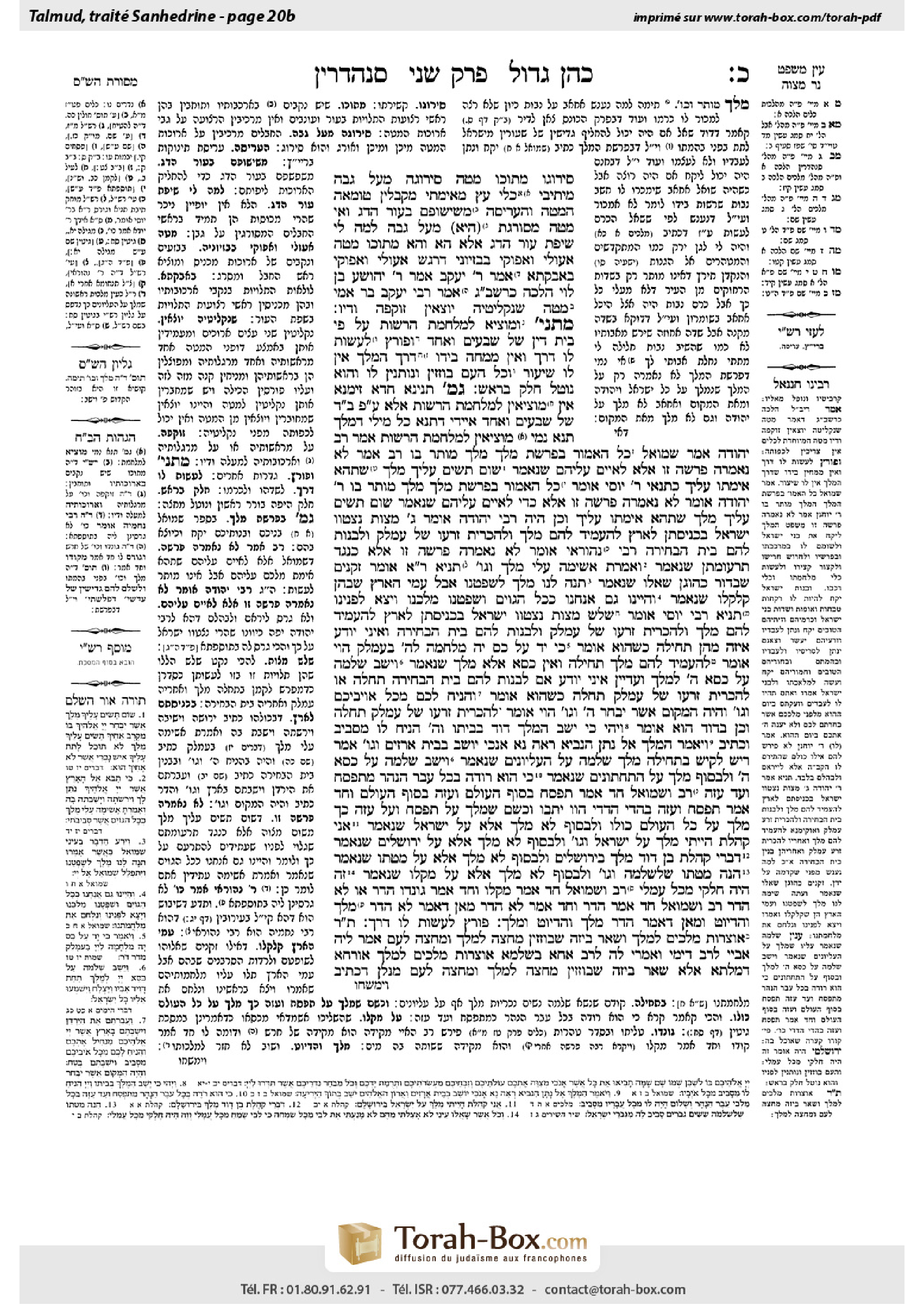
This page of Sanhedrin includes the Aramaic text, an English translation and an AI-generated French translation, alongside the scan above.
סנהדרין כ׳ ב · Aramaic and Hebrew text
סֵירוּגוֹ מִתּוֹכוֹ, מִטָּה – סֵירוּגָהּ מֵעַל גַּבָּהּ.
מֵיתִיבִי: כְּלֵי עֵץ, מֵאֵימָתַי מְקַבְּלִין טוּמְאָה? הַמִּטָּה וְהָעֲרִיסָה – מִשֶּׁיְּשׁוּפֵם בְּעוֹר הַדָּג. וְאִי מִטָּה מְסוֹרֶגֶת הִיא מֵעַל גַּבָּהּ, לְמָה לִי שִׁיפַת עוֹר הַדָּג? אֶלָּא, הָא וְהָא מִתּוֹכוֹ: מִטָּה – אַעוֹלֵי וְאַפּוֹקֵי בְּבִזְיוֹנֵי, דַּרְגֵּשׁ – אַעוֹלֵי וְאַפּוֹקֵי בְּאַבְקָתָא.
אָמַר רַבִּי יַעֲקֹב: אָמַר רַבִּי יְהוֹשֻׁעַ בֶּן לֵוִי: הֲלָכָה כְּרַבָּן שִׁמְעוֹן בֶּן גַּמְלִיאֵל. אָמַר רַבִּי יַעֲקֹב בַּר אַמֵּי: מִטָּה שֶׁנַּקְלִיטֶיהָ יוֹצְאִין – זוֹקְפָהּ, וְדַיּוֹ.
מַתְנִי׳ וּמוֹצִיא לְמִלְחֶמֶת הָרְשׁוּת עַל פִּי בֵּית דִּין שֶׁל שִׁבְעִים וְאֶחָד, וּפוֹרֵץ לַעֲשׂוֹת לוֹ דֶּרֶךְ וְאֵין מְמַחֶה בְּיָדוֹ. דֶּרֶךְ הַמֶּלֶךְ אֵין לוֹ שִׁיעוּר, וְכׇל הָעָם בּוֹזְזִין וְנוֹתְנִין לוֹ, וְהוּא נוֹטֵל חֵלֶק בָּרֹאשׁ.
גְּמָ׳ תְּנֵינָא חֲדָא זִימְנָא: אֵין מוֹצִיאִין לְמִלְחֶמֶת הָרְשׁוּת אֶלָּא עַל פִּי בֵּית דִּין שֶׁל שִׁבְעִים וְאֶחָד. אַיְּידֵי דִּתְנָא כֹּל מִילֵּי דְּמֶלֶךְ, תְּנָא נָמֵי מוֹצִיאִין לְמִלְחֶמֶת הָרְשׁוּת.
אָמַר רַב יְהוּדָה אָמַר שְׁמוּאֵל: כׇּל הָאָמוּר בְּפָרָשַׁת מֶלֶךְ – מֶלֶךְ מוּתָּר בּוֹ. רַב אָמַר: לֹא נֶאֶמְרָה פָּרָשָׁה זוֹ אֶלָּא לְאַיֵּים עֲלֵיהֶם, שֶׁנֶּאֱמַר: ״שׂוֹם תָּשִׂים עָלֶיךָ מֶלֶךְ״ – שֶׁתְּהֵא אֵימָתוֹ עָלֶיךָ.
כְּתַנָּאֵי, רַבִּי יוֹסֵי אוֹמֵר: כׇּל הָאָמוּר בְּפָרָשַׁת מֶלֶךְ – מֶלֶךְ מוּתָּר בּוֹ. רַבִּי יְהוּדָה אוֹמֵר: לֹא נֶאֶמְרָה פָּרָשָׁה זוֹ אֶלָּא כְּדֵי לְאַיֵּים עֲלֵיהֶם, שֶׁנֶּאֱמַר: ״שׂוֹם תָּשִׂים עָלֶיךָ מֶלֶךְ״ – שֶׁתְּהֵא אֵימָתוֹ עָלֶיךָ.
וְכֵן הָיָה רַבִּי יְהוּדָה אוֹמֵר: שָׁלֹשׁ מִצְוֹת נִצְטַוּוּ יִשְׂרָאֵל בִּכְנִיסָתָן לָאָרֶץ – לְהַעֲמִיד לָהֶם מֶלֶךְ, וּלְהַכְרִית זַרְעוֹ שֶׁל עֲמָלֵק, וְלִבְנוֹת לָהֶם בֵּית הַבְּחִירָה.
רַבִּי נְהוֹרַאי אוֹמֵר: לֹא נֶאֶמְרָה פָּרָשָׁה זוֹ אֶלָּא כְּנֶגֶד תַּרְעוֹמְתָּן, שֶׁנֶּאֱמַר: ״וְאָמַרְתָּ אָשִׂימָה עָלַי מֶלֶךְ וְגוֹ׳״.
תַּנְיָא, רַבִּי אֱלִיעֶזֶר אוֹמֵר: זְקֵנִים שֶׁבַּדּוֹר כַּהוֹגֶן שָׁאֲלוּ, שֶׁנֶּאֱמַר: ״תְּנָה לָנוּ מֶלֶךְ לְשׇׁפְטֵנוּ״. אֲבָל עַמֵּי הָאָרֶץ שֶׁבָּהֶן קִלְקְלוּ, שֶׁנֶּאֱמַר: ״וְהָיִינוּ גַם אֲנַחְנוּ כְּכׇל הַגּוֹיִם וּשְׁפָטָנוּ מַלְכֵּנוּ וְיָצָא לְפָנֵינוּ״.
תַּנְיָא, רַבִּי יוֹסֵי אוֹמֵר: שָׁלֹשׁ מִצְוֹת נִצְטַוּוּ יִשְׂרָאֵל בִּכְנִיסָתָן לָאָרֶץ – לְהַעֲמִיד לָהֶם מֶלֶךְ, וּלְהַכְרִית זַרְעוֹ שֶׁל עֲמָלֵק, וְלִבְנוֹת לָהֶם בֵּית הַבְּחִירָה. וְאֵינִי יוֹדֵעַ אֵיזֶה מֵהֶן תְּחִילָּה.
כְּשֶׁהוּא אוֹמֵר: ״כִּי יָד עַל כֵּס יָהּ מִלְחָמָה לַה׳ בַּעֲמָלֵק״, הֱוֵי אוֹמֵר: לְהַעֲמִיד לָהֶם מֶלֶךְ תְּחִילָּה. וְאֵין ״כִּסֵּא״ אֶלָּא מֶלֶךְ, שֶׁנֶּאֱמַר: ״וַיֵּשֶׁב שְׁלֹמֹה עַל כִּסֵּא ה׳ לְמֶלֶךְ״.
וַעֲדַיִין אֵינִי יוֹדֵעַ אִם לִבְנוֹת לָהֶם בֵּית הַבְּחִירָה תְּחִלָּה, אוֹ לְהַכְרִית זַרְעוֹ שֶׁל עֲמָלֵק תְּחִלָּה. כְּשֶׁהוּא אוֹמֵר: ״וְהֵנִיחַ לָכֶם מִכׇּל אוֹיְבֵיכֶם וְגוֹ׳ וְהָיָה הַמָּקוֹם אֲשֶׁר יִבְחַר ה׳ וְגוֹ׳״, הֱוֵי אוֹמֵר: לְהַכְרִית זַרְעוֹ שֶׁל עֲמָלֵק תְּחִלָּה.
וְכֵן בְּדָוִד הוּא אוֹמֵר: ״וַיְהִי כִּי יָשַׁב הַמֶּלֶךְ דָּוִד בְּבֵיתוֹ וַה׳ הֵנִיחַ לוֹ מִסָּבִיב״, וּכְתִיב: ״וַיֹּאמֶר הַמֶּלֶךְ אֶל נָתָן הַנָּבִיא רְאֵה נָא אָנֹכִי יוֹשֵׁב בְּבֵית אֲרָזִים וְגוֹ׳״.
אָמַר רֵישׁ לָקִישׁ: בַּתְּחִילָּה מָלַךְ שְׁלֹמֹה עַל הָעֶלְיוֹנִים, שֶׁנֶּאֱמַר: ״וַיֵּשֶׁב שְׁלֹמֹה עַל כִּסֵּא ה׳״, וּלְבַסּוֹף מָלַךְ עַל הַתַּחְתּוֹנִים, שֶׁנֶּאֱמַר: ״כִּי הוּא רֹדֶה בְּכׇל עֵבֶר הַנָּהָר מִתִּפְסַח וְעַד עַזָּה״.
רַב וּשְׁמוּאֵל: חַד אָמַר, ״תִּפְסַח בְּסוֹף הָעוֹלָם וְעַזָּה בְּסוֹף הָעוֹלָם״, וְחַד אָמַר, ״תִּפְסַח וְעַזָּה בַּהֲדֵי הֲדָדֵי הֲווֹ יָתְבִי״, וּכְשֵׁם שֶׁמָּלַךְ עַל תִּפְסַח וְעַל עַזָּה כָּךְ מָלַךְ עַל כׇּל הָעוֹלָם כּוּלּוֹ.
וּלְבַסּוֹף לֹא מָלַךְ אֶלָּא עַל יִשְׂרָאֵל, שֶׁנֶּאֱמַר: ״אֲנִי קֹהֶלֶת הָיִיתִי מֶלֶךְ עַל יִשְׂרָאֵל וְגוֹ׳״. וּלְבַסּוֹף לֹא מָלַךְ אֶלָּא עַל יְרוּשָׁלַיִם, שֶׁנֶּאֱמַר: ״דִּבְרֵי קֹהֶלֶת בֶּן דָּוִד מֶלֶךְ בִּירוּשָׁלִָים״. וּלְבַסּוֹף, לֹא מָלַךְ אֶלָּא עַל מִטָּתוֹ, שֶׁנֶּאֱמַר: ״הִנֵּה מִטָּתוֹ שֶׁלִּשְׁלֹמֹה וְגוֹ׳״.
וּלְבַסּוֹף לֹא מָלַךְ אֶלָּא עַל מַקְלוֹ, שֶׁנֶּאֱמַר: ״זֶה הָיָה חֶלְקִי מִכׇּל עֲמָלִי״. רַב וּשְׁמוּאֵל: חַד אָמַר מַקְלוֹ, וְחַד אָמַר גּוּנְדּוֹ.
הֲדַר אוֹ לָא הֲדַר? רַב וּשְׁמוּאֵל: חַד אָמַר הֲדַר, וְחַד אָמַר לָא הֲדַר. מַאן דְּאָמַר לָא הֲדַר – מֶלֶךְ וְהֶדְיוֹט, וּמַאן דְּאָמַר הֲדַר – מֶלֶךְ וְהֶדְיוֹט וָמֶלֶךְ.
פּוֹרֵץ לַעֲשׂוֹת לוֹ דֶּרֶךְ. תָּנוּ רַבָּנַן: אוֹצְרוֹת מְלָכִים – לַמֶּלֶךְ, וּשְׁאָר בִּיזָּה שֶׁבּוֹזְזִין – מֶחֱצָה לַמֶּלֶךְ וּמֶחֱצָה לָעָם. אֲמַר לֵיהּ אַבָּיֵי לְרַב דִּימִי, וְאָמְרִי לַהּ לְרַב אַחָא: בִּשְׁלָמָא אוֹצְרוֹת מְלָכִים לַמֶּלֶךְ – אוֹרְחָא דְמִלְּתָא, אֶלָּא שְׁאָר בִּיזָּה שֶׁבּוֹזְזִין מֶחֱצָה לַמֶּלֶךְ וּמֶחֱצָה לָעָם – מְנָלַן? דִּכְתִיב:
Sanhedrin 20b · English translation
has its weaving on its inside, in that the straps woven to hold the bedding are tied in holes inside the bed posts, while a bed has its weaving on its outside, in that its straps are tied around the posts.
The Gemara raises an objection from the mishna (Kelim 16:1): From when are wooden vessels considered complete and susceptible to impurity? In the case of a bed or a crib, this happens once they are rubbed with fish skin, which smoothens the wood. The Gemara asks: And if a bed is woven on its back side, as Rabbi Yoḥanan claimed, why do I need rubbing with fish skin? Doesn’t the weaving cover the smooth part of the bed? Rather, instead of Rabbi Yoḥanan’s explanation, say that the weaving of both this and that, a dargash and a bed, is on its inside, and the difference between them is that on a bed, the straps go in and out of holes on the posts, whereas on a dargash, they go in and out of loops.
Rabbi Ya’akov says that Rabbi Yehoshua ben Levi says: The halakha is in accordance with the opinion of Rabban Shimon ben Gamliel that a mourner is not required to overturn a dargash, but only to untie the straps around its posts to let it fall on its own. In connection with this matter Rabbi Ya’akov bar Ami says: In the case of a bed whose posts [naklitim] on which the canopy is spread extend, meaning that they are very long, so that the bed will remain high off the ground even if it is overturned, the mourner stands it up in the time of mourning and that is sufficient.
MISHNA: And the king brings out people for conscription in an optional war, i.e., a war that is not mandated by the Torah and is not a war of defense, on the basis of a court of seventy-one, and breaches fences of anyone in his way to create a pathway for himself for his various needs, and no one can protest his power. The pathway of the king has no measure, neither lengthwise nor widthwise, and one cannot protest that this pathway is wider than necessary. And all the people take spoils in war and give them to him, and he takes the first portion of the spoils.
GEMARA: We already learn this on another occasion in the mishna (2a): And the king may bring out the nation to an optional war only on the basis of a court of seventy-one judges. Why did the mishna need to repeat it here? The Gemara explains: Since in the mishna here the tanna taught all matters pertaining to the king, he also taught the halakha of bringing out the nation to an optional war, although this halakha was taught at the beginning of the tractate in the context of the halakhot of the court of seventy-one judges.
With regard to the king’s rights, the Sages engaged in a dispute: Rav Yehuda says that Shmuel says: Concerning all the actions that are stated in the biblical passage about the king (see I Samuel 8:11–17), it is permitted for a king to perform them. Rav says: This biblical passage was stated only in order to threaten the Jewish people, so that they would accept the king’s sovereignty with reverence, as it is stated: “You shall set a king over you” (Deuteronomy 17:15), meaning, it is necessary that his fear should be upon you. But the king is not actually permitted to perform the actions stated there.
The Gemara comments that this dispute is parallel to a dispute between tanna’im, as it is taught in a baraita: Rabbi Yosei says: Concerning all the actions that are stated in the biblical passage about the king, it is permitted for a king to perform them. Rabbi Yehuda says: This biblical passage was stated only in order to threaten the Jewish people, as it is stated: “You shall set a king over you” (Deuteronomy 17:15), meaning, it is necessary that his fear should be upon you.
The baraita continues: And so would Rabbi Yehuda say: Three mitzvot were commanded to the Jewish people upon their entrance into Eretz Yisrael, which apply only in Eretz Yisrael: They were commanded to establish a king for themselves (see Deuteronomy 17:14–15), and to cut off the seed of Amalek in war (see Deuteronomy 25:17–19), and to build the Chosen House, i.e., the Temple, in Jerusalem (see Deuteronomy 12:10–12).
The baraita continues: Rabbi Nehorai says: This biblical passage about appointing a king was stated only in response to the Jewish people’s complaint, as it is stated: “When you come unto the land that the Lord your God gives you, and shall possess it, and shall dwell therein, and shall say: I will set a king over me, like all the nations that are around me” (Deuteronomy 17:14). The verse indicates that appointing a king is not a mitzva and that when Samuel spoke to them, he intended to frighten them so that they might regret their complaint and retract their request for a king.
It is taught in a baraita: Rabbi Eliezer says: The elders of Samuel’s generation asked appropriately, as it is stated: “Give us a king to judge us” (I Samuel 8:6), since they wanted a steady leader in place of Samuel. But the ignoramuses among them ruined it, as it is stated: “But the people refused to heed the voice of Samuel; and they said: No, but there shall be a king over us, that we also may be like all the nations, and that our king may judge us, and emerge before us, and fight our battles” (I Samuel 8:19–20).
It is taught in a baraita: Rabbi Yosei says: Three mitzvot were commanded to the Jewish people upon their entrance into Eretz Yisrael: To establish a king for themselves, and to cut off the seed of Amalek in war, and to build for themselves the Chosen House in Jerusalem. But I do not know which one they are obligated to do first.
When the verse states: “The hand upon the throne [kes] of the Lord: The Lord will have war with Amalek from generation to generation” (Exodus 17:16), you must say that this means they are obligated to establish a king for themselves first, before waging war with Amalek, and the verse is interpreted as follows: “Throne of the Lord” is nothing other than a symbolic name for a king, as it is stated: “Then Solomon sat on the throne [kisei] of the Lord as king” (I Chronicles 29:23), indicating that a king sits on “the throne of the Lord.”
The baraita continues: And still I do not know whether building them the Chosen House is first, or cutting off the seed of Amalek is first, i.e., after the appointing of the king. When the verse states: “And He will give you rest from all your enemies round about, so that you dwell in safety; then it shall come to pass that the place that the Lord your God shall choose to cause His name to dwell there, there shall you bring all that I command you” (Deuteronomy 12:10–11), you must say that the Jewish people were to cut off the seed of Amalek first.
The baraita continues: And so the verse states concerning David: “And it came to pass, when King David dwelled in his house and the Lord had given him rest round about from all his enemies” (II Samuel 7:1). And it is written immediately afterward: “That the king said to Nathan the prophet: See now, I dwell in a house of cedar but the Ark of God dwells within curtains” (II Samuel 7:2), and King David then began seeking a site to build the Temple.
§ The Gemara cites another tradition about Solomon’s kingdom. Reish Lakish says: Initially, Solomon ruled even over the supernal worlds, as it is stated: “Then Solomon sat on the throne of the Lord” (I Chronicles 29:23), indicating that his kingdom was like the Lord’s kingdom, reigning over all worlds. But ultimately, after he married foreign wives, he ruled over only the lower worlds, as it is stated: “For he had dominion over all the region on this side of the river, from Tiphsah even to Gaza” (I Kings 5:4).
Rav and Shmuel disagreed with regard to the meaning of this verse: One says that Tiphsah is a name of a place at the end of the world, at one end of Solomon’s kingdom, and Gaza is at the other end of the world. And one says that Tiphsah and Gaza sat next to each other, and the verse serves to teach that just as he ruled over Tiphsah and over Gaza, so he ruled over the whole world.
Reish Lakish continues: And ultimately, Solomon declined further still in that he ruled only over Israel, as it is stated: “I, Koheleth, have been king over Israel in Jerusalem” (Ecclesiastes 1:12). And ultimately, he ruled over only Jerusalem, as it is stated: “The words of Koheleth, the son of David, king in Jerusalem” (Ecclesiastes 1:1). And ultimately, he ruled over only his bed, as it is stated: “Behold, it is the bed of Solomon; threescore mighty men are about it, of the mighty men of Israel” (Song of Songs 3:7).
And ultimately, he declined so much that he ruled over only his staff, as it is stated: “And this was my portion from all of my labor” (Ecclesiastes 2:10). Rav and Shmuel disagreed with regard to the meaning of this latter verse as well. One says that the term “this” is a reference to his staff, and one says that it is a reference to his cloak.
The Gemara asks: Did he return to reign over the whole world, or did he ultimately not return? Rav and Shmuel disagreed about this: One says that he returned, and one says that he did not return. The one who says that he did not return reasons that Solomon was first a king and then an ordinary person [hedyot] and did not return to his reign; and the one who says that he returned reasons that Solomon was first a king and then an ordinary person and ultimately returned to be a king.
§ The mishna teaches that the king breaches fences of anyone in his way to create a pathway for himself. The Sages taught in a baraita: Treasures of kings taken as spoils in war belong to the king, and as for the rest of the spoils that are taken in a war, half is for the king and half is for the people. Abaye said to Rav Dimi, and some say that he said this to Rav Aḥa: Granted, treasures of kings belong to the king. This is the typical manner of kings, as it is fitting that the king should use the treasures of the kings he conquers; but with regard to the rest of the spoils that are taken in a war, where half is for the king and half is for the people, from where do we derive this halakha? He answered Abaye: The source is as it is written:
Sanhedrin 20b · Traduction française (IA)
son tissage se trouve sur sa face intérieure : les sangles tissées qui soutiennent la literie sont nouées dans des trous situés à l’intérieur des montants du lit, tandis que, pour un lit, le tissage se trouve sur sa face extérieure, car les sangles sont nouées autour des montants.
La Guemara soulève une objection à partir de la Michna (Kelim 16:1) : À partir de quand les ustensiles en bois sont-ils considérés comme achevés et susceptibles de contracter l’impureté ? Dans le cas d’un lit ou d’un berceau, ils le sont lorsqu’on les frotte avec de la peau de poisson, qui lisse le bois. La Guemara demande : Or, si le tissage d’un lit se trouve sur sa face arrière, comme l’a affirmé Rabbi Yoḥanan, pourquoi faut-il le frotter avec de la peau de poisson ? Le tissage ne recouvre-t-il pas la partie lisse du lit ? Il faut plutôt dire, au lieu de retenir l’explication de Rabbi Yoḥanan, que le tissage des deux, du dargash comme du lit, se trouve sur leur face intérieure ; la différence entre eux est que, pour un lit, les sangles passent dans des trous des montants puis en ressortent, tandis que, pour un dargash, elles passent dans des boucles puis en ressortent.
Rabbi Ya’akov dit au nom de Rabbi Yehoshua ben Levi : La halakha suit l’opinion de Rabban Shimon ben Gamliel, selon laquelle l’endeuillé n’est pas tenu de renverser un dargash ; il lui suffit de dénouer les sangles autour de ses montants pour qu’il tombe de lui-même. À ce propos, Rabbi Ya’akov bar Ami dit : Dans le cas d’un lit dont les montants [naklitim], sur lesquels est tendu le baldaquin, sont très longs, si bien que le lit reste élevé au-dessus du sol même lorsqu’on le renverse, l’endeuillé le redresse pendant la période de deuil, et cela suffit.
MICHNA : Le roi fait partir des hommes pour la conscription lors d’une guerre facultative, c’est-à-dire une guerre qui n’est pas prescrite par la Torah et qui n’est pas une guerre défensive, avec l’autorisation d’un tribunal de soixante et onze juges. Il abat les clôtures de quiconque se trouve sur son chemin afin de se frayer une voie pour ses différents besoins, et nul ne peut s’opposer à son pouvoir. Le chemin du roi n’a aucune limite, ni en longueur ni en largeur, et nul ne peut objecter qu’il est plus large que nécessaire. Tout le peuple prend le butin de guerre et le lui remet, et il prélève la première part du butin.
GUEMARA : Nous avons déjà appris cela ailleurs dans la Michna (2a) : Le roi ne peut faire partir le peuple pour une guerre facultative qu’avec l’autorisation d’un tribunal de soixante et onze juges. Pourquoi la Michna devait-elle le répéter ici ? La Guemara explique : Puisque, dans la Michna ici, le tanna a enseigné toutes les questions relatives au roi, il a également enseigné la halakha concernant le départ du peuple pour une guerre facultative, bien que cette halakha ait été enseignée au début du traité dans le cadre des halakhot du tribunal de soixante et onze juges.
Au sujet des prérogatives du roi, les Sages sont en désaccord. Rav Yehuda dit au nom de Shmuel : Toutes les actions mentionnées dans le passage biblique relatif au roi (voir I Samuel 8:11–17) lui sont permises. Rav dit : Ce passage biblique n’a été énoncé que pour menacer le peuple juif, afin qu’il accepte avec révérence la souveraineté du roi, comme il est dit : « Tu établiras sur toi un roi » (Deutéronome 17:15), ce qui signifie qu’il faut que la crainte du roi s’impose à vous. Mais le roi n’est pas réellement autorisé à accomplir les actions qui y sont mentionnées.
La Guemara fait remarquer que ce désaccord correspond à une controverse entre tannaïm, comme on l’enseigne dans une baraïta : Rabbi Yosei dit : Toutes les actions mentionnées dans le passage biblique relatif au roi lui sont permises. Rabbi Yehuda dit : Ce passage biblique n’a été énoncé que pour menacer le peuple juif, comme il est dit : « Tu établiras sur toi un roi » (Deutéronome 17:15), ce qui signifie qu’il faut que la crainte du roi s’impose à vous.
La baraïta poursuit : Et Rabbi Yehuda disait également : Trois mitsvot ont été prescrites au peuple juif lorsqu’il est entré en Eretz Yisrael, et elles ne s’appliquent qu’en Eretz Yisrael : se donner un roi (voir Deutéronome 17:14–15), exterminer la descendance d’Amalek dans la guerre (voir Deutéronome 25:17–19) et bâtir la Maison choisie, c’est-à-dire le Temple, à Jérusalem (voir Deutéronome 12:10–12).
La baraïta poursuit : Rabbi Nehorai dit : Ce passage biblique relatif à la nomination d’un roi n’a été énoncé qu’en réponse à la plainte du peuple juif, comme il est dit : « Lorsque tu seras entré dans le pays que l’Éternel, ton Dieu, te donne, que tu en auras pris possession et que tu y habiteras, et que tu diras : “Je veux établir sur moi un roi, comme toutes les nations qui m’entourent” » (Deutéronome 17:14). Le verset indique que la nomination d’un roi n’est pas une mitsva et que, lorsque Samuel leur a parlé, il voulait les effrayer afin qu’ils regrettent leur plainte et retirent leur demande d’un roi.
On enseigne dans une baraïta : Rabbi Eliezer dit : Les anciens de la génération de Samuel ont formulé une demande convenable, comme il est dit : « Donne-nous un roi pour nous juger » (I Samuel 8:6), car ils voulaient un dirigeant stable pour remplacer Samuel. Mais les ignorants parmi eux ont tout gâché, comme il est dit : « Mais le peuple refusa d’écouter la voix de Samuel, et ils dirent : “Non, mais il y aura un roi sur nous, afin que nous aussi nous soyons comme toutes les nations, que notre roi nous juge, marche devant nous et livre nos batailles” » (I Samuel 8:19–20).
On enseigne dans une baraïta : Rabbi Yosei dit : Trois mitsvot ont été prescrites au peuple juif lorsqu’il est entré en Eretz Yisrael : se donner un roi, exterminer la descendance d’Amalek dans la guerre et bâtir la Maison choisie à Jérusalem. Mais je ne sais pas laquelle ils avaient l’obligation d’accomplir en premier.
Lorsque le verset dit : « La main sur le trône [kes] de l’Éternel : l’Éternel fera la guerre à Amalek de génération en génération » (Exode 17:16), il faut dire que cela signifie qu’ils avaient l’obligation de se donner d’abord un roi, avant de faire la guerre à Amalek. Le verset s’interprète ainsi : le « trône de l’Éternel » n’est qu’un nom symbolique du roi, comme il est dit : « Salomon s’assit sur le trône [kisei] de l’Éternel comme roi » (I Chroniques 29:23), ce qui indique qu’un roi siège sur « le trône de l’Éternel ».
La baraïta poursuit : Et je ne sais toujours pas si la construction de la Maison choisie devait avoir lieu en premier, ou si l’extermination de la descendance d’Amalek devait avoir lieu en premier, c’est-à-dire après la nomination du roi. Lorsque le verset dit : « Il vous donnera du repos face à tous vos ennemis alentour, et vous habiterez en sécurité ; alors, le lieu que l’Éternel, votre Dieu, choisira pour y faire résider son nom sera celui où vous apporterez tout ce que je vous ordonne » (Deutéronome 12:10–11), il faut en conclure que le peuple juif devait d’abord exterminer la descendance d’Amalek.
La baraïta poursuit : Le verset dit également au sujet de David : « Or, lorsque le roi David habita dans sa maison et que l’Éternel lui eut accordé le repos alentour, à l’abri de tous ses ennemis » (II Samuel 7:1). Et il est écrit immédiatement après : « Le roi dit alors à Nathan le prophète : “Vois, j’habite dans une maison de cèdre, tandis que l’Arche de Dieu habite sous des tentures” » (II Samuel 7:2), et le roi David se mit alors à chercher un emplacement pour bâtir le Temple.
§ La Guemara cite une autre tradition au sujet du royaume de Salomon. Reish Lakish dit : Au début, Salomon régnait même sur les mondes supérieurs, comme il est dit : « Salomon s’assit sur le trône de l’Éternel » (I Chroniques 29:23), ce qui indique que son royaume était semblable à celui de l’Éternel et s’étendait sur tous les mondes. Mais finalement, après avoir épousé des femmes étrangères, il ne régna plus que sur les mondes inférieurs, comme il est dit : « Car il dominait sur toute la région de ce côté du fleuve, depuis Tiphsah jusqu’à Gaza » (I Rois 5:4).
Rav et Shmuel étaient en désaccord sur le sens de ce verset. Selon l’un, Tiphsah est le nom d’un lieu situé à l’extrémité du monde, à l’une des limites du royaume de Salomon, et Gaza se trouve à l’autre extrémité du monde. Selon l’autre, Tiphsah et Gaza étaient voisines, et le verset enseigne que, de même qu’il régnait sur Tiphsah et sur Gaza, il régnait aussi sur le monde entier.
Reish Lakish poursuit : Finalement, Salomon déclina encore et ne régna plus que sur Israël, comme il est dit : « Moi, Koheleth, j’ai été roi sur Israël, à Jérusalem » (Ecclésiaste 1:12). Puis il ne régna plus que sur Jérusalem, comme il est dit : « Paroles de Koheleth, fils de David, roi à Jérusalem » (Ecclésiaste 1:1). Enfin, il ne régna plus que sur son lit, comme il est dit : « Voici le lit de Salomon ; soixante vaillants hommes l’entourent, parmi les vaillants d’Israël » (Cantique des Cantiques 3:7).
Finalement, il déclina au point de ne plus régner que sur son bâton, comme il est dit : « Et ceci fut ma part de tout mon labeur » (Ecclésiaste 2:10). Rav et Shmuel étaient également en désaccord sur le sens de ce dernier verset. Selon l’un, le terme « ceci » désigne son bâton ; selon l’autre, il désigne son manteau.
La Guemara demande : Est-il revenu à régner sur le monde entier, ou n’y est-il finalement pas revenu ? Rav et Shmuel étaient en désaccord à ce sujet : selon l’un, il y est revenu ; selon l’autre, il n’y est pas revenu. Celui qui affirme qu’il n’y est pas revenu explique que Salomon fut d’abord roi, puis un simple particulier [hedyot], et qu’il ne retrouva pas son règne ; celui qui affirme qu’il y est revenu explique que Salomon fut d’abord roi, puis un simple particulier, avant de redevenir finalement roi.
§ La Michna enseigne que le roi abat les clôtures de quiconque se trouve sur son chemin afin de se frayer une voie. Les Sages ont enseigné dans une baraïta : Les trésors des rois pris comme butin de guerre appartiennent au roi ; quant au reste du butin pris lors d’une guerre, la moitié revient au roi et l’autre moitié au peuple. Abaye dit à Rav Dimi — certains disent qu’il dit cela à Rav Aḥa : Il est entendu que les trésors des rois appartiennent au roi. C’est l’usage des rois, car il convient que le roi s’approprie les trésors des rois qu’il a vaincus. Mais pour le reste du butin pris lors d’une guerre, partagé à parts égales entre le roi et le peuple, de quelle source tirons-nous cette halakha ? Rav Dimi répondit à Abaye : La source est ce qui est écrit :
Traduction française générée par IA à partir de l’édition anglaise de Sefaria. Vérifie toujours un passage avec le texte source.
Text from Sefaria: William Davidson Edition - Vocalized Aramaic (CC BY NC); William Davidson Edition - English (CC BY NC).