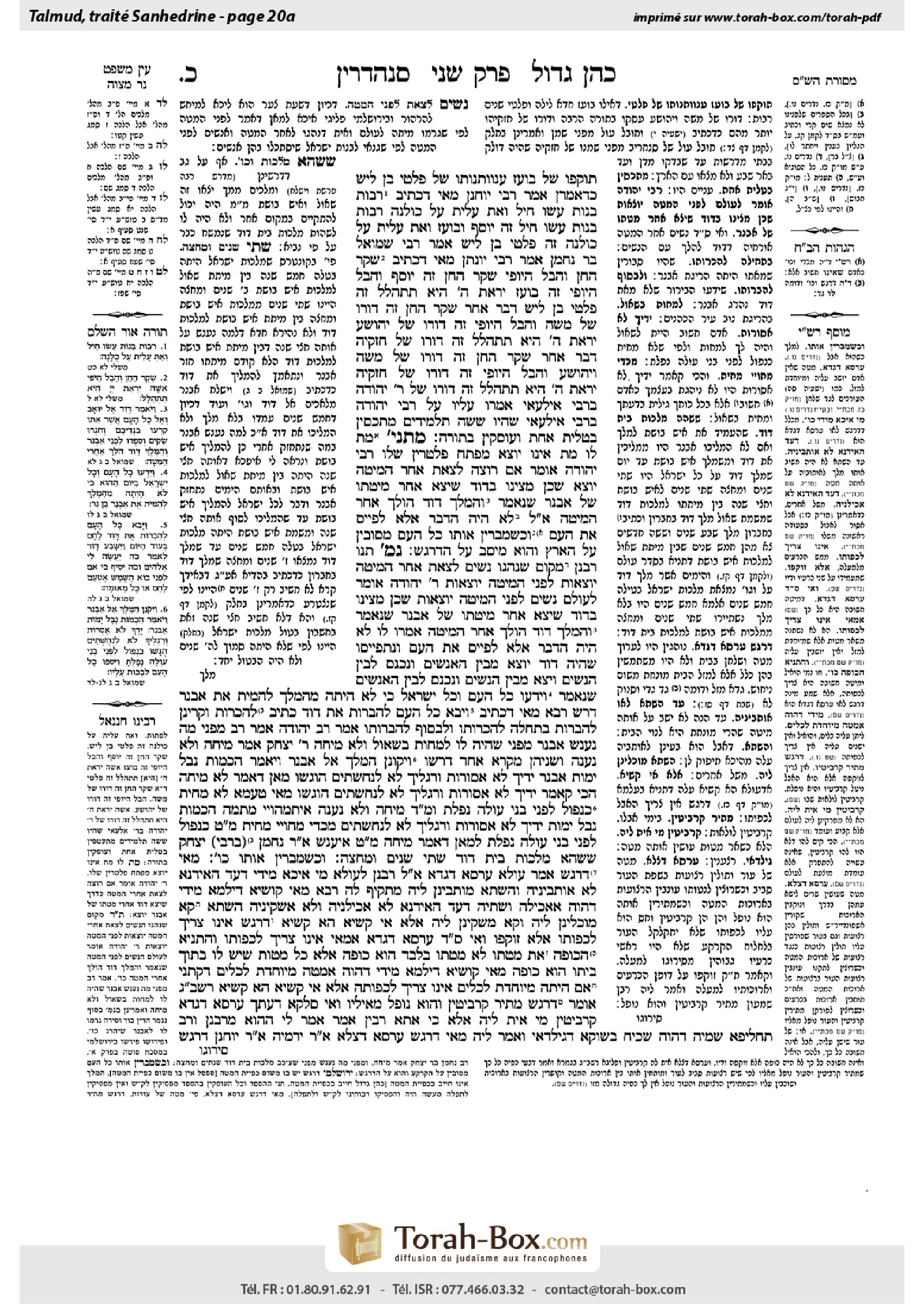
Sanhedrin 20a: Talmud study for Daf Yomi
Daf Yomi is the daily study of one Talmud folio. Explore 37 tractates with scans, Hebrew text, Sefaria English and AI-generated French translations where annotated.
Passage selection and English or AI-generated French translation are available where the scan has annotations. Daf Study is independent of Torah-Box and Sefaria.
Browse Sanhedrin · סנהדרין · All tractatesSanhedrin 20a text and translations
This page of Sanhedrin includes the Aramaic text, an English translation and an AI-generated French translation, alongside the scan above.
סנהדרין כ׳ א · Aramaic and Hebrew text
תּוֹקְפּוֹ שֶׁל בּוֹעַז – עִנְוְותָנוּתוֹ שֶׁל פַּלְטִי בֶּן לַיִשׁ, כְּדַאֲמַרַן.
אָמַר רַבִּי יוֹחָנָן: מַאי דִּכְתִיב ״רַבּוֹת בָּנוֹת עָשׂוּ חָיִל וְאַתְּ עָלִית עַל כֻּלָּנָה״? ״רַבּוֹת בָּנוֹת עָשׂוּ חָיִל״ – זֶה יוֹסֵף וּבוֹעַז. ״וְאַתְּ עָלִית עַל כֻּלָּנָה״ – זֶה פַּלְטִי בֶּן לַיִשׁ.
אָמַר רַבִּי שְׁמוּאֵל בַּר נַחְמָן אָמַר רַבִּי יוֹנָתָן: מַאי דִּכְתִיב ״שֶׁקֶר הַחֵן וְהֶבֶל הַיֹּפִי״? ״שֶׁקֶר הַחֵן״ – זֶה יוֹסֵף, ״וְהֶבֶל הַיֹּפִי״ – זֶה בּוֹעַז. ״יִרְאַת ה׳ הִיא תִתְהַלָּל״ – זֶה פַּלְטִי בֶּן לַיִשׁ.
דָּבָר אַחֵר: ״שֶׁקֶר הַחֵן״ – זֶה דּוֹרוֹ שֶׁל מֹשֶׁה, ״וְהֶבֶל הַיֹּפִי״ – זֶה דּוֹרוֹ שֶׁל יְהוֹשֻׁעַ, ״יִרְאַת ה׳ הִיא תִתְהַלָּל״ – זֶה דּוֹרוֹ שֶׁל חִזְקִיָּה.
דָּבָר אַחֵר: ״שֶׁקֶר הַחֵן״ – זֶה דּוֹרוֹ שֶׁל מֹשֶׁה וִיהוֹשֻׁעַ. ״וְהֶבֶל הַיֹּפִי״ – זֶה דּוֹרוֹ שֶׁל חִזְקִיָּה. ״יִרְאַת ה׳ הִיא תִתְהַלָּל״ – זֶה דּוֹרוֹ שֶׁל רַבִּי יְהוּדָה בְּרַבִּי אִילְעַאי. אָמְרוּ עָלָיו עַל רַבִּי יְהוּדָה בְּרַבִּי אִילְעַאי, שֶׁהָיוּ שִׁשָּׁה תַּלְמִידִים מִתְכַּסִּין בְּטַלִּית אַחַת וְעוֹסְקִין בַּתּוֹרָה.
מַתְנִי׳ מֵת לוֹ מֵת – אֵינוֹ יוֹצֵא מִפֶּתַח פַּלְטֵרִין שֶׁלּוֹ. רַבִּי יְהוּדָה אוֹמֵר: אִם רוֹצֶה לָצֵאת אַחַר הַמִּיטָּה – יוֹצֵא, שֶׁכֵּן מָצִינוּ בְּדָוִד שֶׁיָּצָא אַחַר מִיטָּתוֹ שֶׁל אַבְנֵר, שֶׁנֶּאֱמַר: ״וְהַמֶּלֶךְ דָּוִד הֹלֵךְ אַחַר הַמִּטָּה״. אָמְרוּ לוֹ: לֹא הָיָה הַדָּבָר אֶלָּא לְפַיֵּיס אֶת הָעָם. וּכְשֶׁמַּבְרִין אוֹתוֹ – כׇּל הֶעָם מְסוּבִּין עַל הָאָרֶץ, וְהוּא מֵיסֵב עַל הַדַּרְגֵּשׁ.
גְּמָ׳ תָּנוּ רַבָּנַן: מָקוֹם שֶׁנָּהֲגוּ נָשִׁים לָצֵאת אַחַר הַמִּיטָּה – יוֹצְאוֹת, לִפְנֵי הַמִּיטָּה – יוֹצְאוֹת. רַבִּי יְהוּדָה אוֹמֵר: לְעוֹלָם נָשִׁים לִפְנֵי הַמִּיטָּה יוֹצְאוֹת, שֶׁכֵּן מָצִינוּ בְּדָוִד שֶׁיָּצָא אַחַר מִיטָּתוֹ שֶׁל אַבְנֵר, שֶׁנֶּאֱמַר: ״וְהַמֶּלֶךְ דָּוִד הֹלֵךְ אַחַר הַמִּטָּה״.
אָמְרוּ לוֹ: לֹא הָיָה הַדָּבָר אֶלָּא לְפַיֵּיס אֶת הָעָם, וְנִתְפַּיְּיסוּ. שֶׁהָיָה דָּוִד יוֹצֵא מִבֵּין הָאֲנָשִׁים וְנִכְנָס לְבֵין הַנָּשִׁים, וְיוֹצֵא מִבֵּין הַנָּשִׁים וְנִכְנָס לְבֵין הָאֲנָשִׁים, שֶׁנֶּאֱמַר: ״וַיֵּדְעוּ כׇל הָעָם וְכׇל יִשְׂרָאֵל כִּי לֹא הָיְתָה מֵהַמֶּלֶךְ לְהָמִית אֶת אַבְנֵר״.
דָּרֵשׁ רָבָא, מַאי דִּכְתִיב: ״וַיָּבֹא כׇל הָעָם לְהַבְרוֹת אֶת דָּוִד״? כְּתִיב ״לְהַכְרוֹת״, וְקָרֵינַן ״לְהַבְרוֹת״. בַּתְּחִלָּה לְהַכְרוֹתוֹ, וּלְבַסּוֹף לְהַבְרוֹתוֹ.
אָמַר רַב יְהוּדָה אָמַר רַב: מִפְּנֵי מָה נֶעֱנַשׁ אַבְנֵר? מִפְּנֵי שֶׁהָיָה לוֹ לְמַחוֹת בְּשָׁאוּל וְלֹא מִיחָה. רַבִּי יִצְחָק אָמַר: מִיחָה וְלֹא נַעֲנָה. וּשְׁנֵיהֶן מִקְרָא אֶחָד דָּרְשׁוּ: ״וַיְקֹנֵן הַמֶּלֶךְ אֶל אַבְנֵר וַיֹּאמַר הַכְּמוֹת נָבָל יָמוּת אַבְנֵר יָדֶיךָ לֹא אֲסֻרוֹת וְרַגְלֶיךָ לֹא לִנְחֻשְׁתַּיִם הֻגָּשׁוּ״.
מַאן דְּאָמַר לָא מִיחָה, הָכִי קָאָמַר: ״יָדֶיךָ לֹא אֲסֻרוֹת וְרַגְלֶיךָ לֹא לִנְחֻשְׁתַּיִם הוּגָּשׁוּ״, מַאי טַעְמָא לָא מַחֵית? ״כִּנְפוֹל לִפְנֵי בְנֵי עַוְלָה נָפָלְתָּ״. וּמַאן דְּאָמַר מִיחָה וְלֹא נַעֲנָה, אַתְמוֹהֵי מַתְמַהּ: ״הַכְּמוֹת נָבָל יָמוּת״? ״יָדֶיךָ לֹא אֲסוּרוֹת וְרַגְלֶיךָ לֹא לִנְחֻשְׁתַּיִם״, מִכְּדֵי מַחוֹיֵי מַחֵית, מַאי טַעְמָא ״כִּנְפוֹל לִפְנֵי בְנֵי עַוְלָה נָפָלְתָּ״?
לְמַאן דְּאָמַר מִיחָה, מַאי טַעְמָא אִיעֲנַשׁ? אָמַר רַב נַחְמָן בְּרַבִּי יִצְחָק: שֶׁשִּׁהָא מַלְכוּת בֵּית דָּוִד שְׁתֵּי שָׁנִים וּמֶחֱצָה.
וּכְשֶׁמַּבְרִין אוֹתוֹ כּוּ׳. מַאי דַּרְגֵּשׁ? אָמַר עוּלָּא: עַרְסָא דְּגַדָּא. אֲמַרוּ לֵיהּ רַבָּנַן לְעוּלָּא: מִי אִיכָּא מִידֵּי דְּעַד הָאִידָּנָא לָא אוֹתְבִינֵּיהּ, וְהַשְׁתָּא מוֹתְבִינַן לֵיהּ?
מַתְקֵיף לַהּ רָבָא: מַאי קוּשְׁיָא? דִּילְמָא מִידֵּי דְּהָוֵה אַאֲכִילָה וּשְׁתִיָּה, דְּעַד הָאִידָּנָא לָא אֹכְילִנֵּיהּ וְלָא אַשְׁקִינֵּיהּ, הַשְׁתָּא קָא מוֹכְלִינַן לֵיהּ וְקָא מַשְׁקִינַן לֵיהּ. אֶלָּא אִי קַשְׁיָא, הָא קַשְׁיָא: דַּרְגֵּשׁ אֵינוֹ צָרִיךְ לִכְפּוֹתוֹ, אֶלָּא זוֹקְפוֹ. וְאִי סָלְקָא דַעְתָּךְ עַרְסָא דְּגַדָּא, אַמַּאי אֵינוֹ צָרִיךְ לִכְפּוֹתוֹ? וְהָתַנְיָא: הַכּוֹפֶה אֶת מִטָּתוֹ, לֹא מִטָּתוֹ בִּלְבַד הוּא כּוֹפֶה, אֶלָּא כׇּל מִטּוֹת שֶׁיֵּשׁ לוֹ בְּתוֹךְ בֵּיתוֹ הוּא כּוֹפֶה.
מַאי קוּשְׁיָא? דִּילְמָא מִידֵּי דְּהָוֵה אַמִּטָּה מְיוּחֶדֶת לְכֵלִים, דְּקָתָנֵי: אִם הָיְתָה מְיוּחֶדֶת לְכֵלִים – אֵינוֹ צָרִיךְ לִכְפּוֹתָהּ. אֶלָּא, אִי קַשְׁיָא – הָא קַשְׁיָא: רַבָּן שִׁמְעוֹן בֶּן גַּמְלִיאֵל אוֹמֵר: דַּרְגֵּשׁ – מַתִּיר קַרְבִּיטִין וְהוּא נוֹפֵל מֵאֵילָיו. וְאִי סָלְקָא דַעְתָּךְ עַרְסָא דְגַדָּא, קַרְבִּיטִין מִי אִית לֵיהּ?
אֶלָּא, כִּי אֲתָא רָבִין אֲמַר: אֲמַר לִי הַהוּא מֵרַבָּנַן, וְרַב תַּחְלִיפָא שְׁמֵיהּ, דַּהֲוָה שְׁכִיחַ בְּשׁוּקָא דְּגִילְדָּאֵי, וַאֲמַר לֵיהּ: מַאי דַּרְגֵּשׁ? עַרְסָא דְּצַלָּא. אָמַר רַבִּי יִרְמְיָה אָמַר רַבִּי יוֹחָנָן: דַּרְגֵּשׁ —
Sanhedrin 20a · English translation
Boaz’s power is the humility of Palti, son of Laish, as we said, for he conquered his desire not only for one night, as Boaz did, but for many nights
Rabbi Yoḥanan says: What is the meaning of that which is written: “Many daughters have done valiantly, but you excel above them all” (Proverbs 31:29)? “Many daughters have done valiantly”; this is a reference to Joseph and Boaz. “But you excel above them all”; this is a reference to Palti, son of Laish, who exceeded Joseph and Boaz in restraint, as discussed above.
Rabbi Shmuel bar Naḥman says that Rabbi Yonatan says: What is the meaning of that which is written: “Grace is deceitful, and beauty is vain, but a woman who fears the Lord, she shall be praised” (Proverbs 31:30). “Grace is deceitful”; this is a reference to Joseph. “And beauty is vain”; this is a reference to Boaz. “Who fears the Lord, she shall be praised”; this is a reference to Palti, son of Laish, who did not sin with Michal. Although the behavior of Joseph and Boaz is commendable, it is “deceitful” and “vain” relative to that of Palti ben Laish.
Alternatively: “Grace is deceitful”; this is a reference to the generation of Moses. “And beauty is vain”; this is a reference to the generation of Joshua. “Who fears the Lord, she shall be praised”; this is a reference to the generation of Hezekiah. Although the studying of Torah during the generations of Moses and Joshua was commendable, it was “deceitful” and “vain” relative to that of the generation of Hezekiah, during which the people studied Torah assiduously, despite the suffering caused by war and foreign rule.
Alternatively: “Grace is deceitful”; this is a reference to the generation of Moses and Joshua. “And beauty is vain”; this is a reference to the generation of Hezekiah. “Who fears the Lord, she shall be praised”; this is a reference to the generation of Rabbi Yehuda, son of Rabbi Ilai, who lived after the decrees of Hadrian, when the people were impoverished and oppressed. It was said about Rabbi Yehuda, son of Rabbi Ilai, that six of his students would cover themselves with one garment, due to their poverty, and nevertheless they would engage in Torah study. Although the studying of Torah during the generations of Moses, Joshua, and Hezekiah was commendable, it was “deceitful” and “vain” relative to that of the people in the generation of Rabbi Yehuda, son of Rabbi Ilai, who studied Torah despite their hardships.
MISHNA: If a relative of the king dies, he does not emerge from the entrance of his palace [palterin], as it does not befit one of his stature to accompany the deceased. Rabbi Yehuda says: If he wishes to follow the bier, he follows it, as that is what we found with regard to King David, who followed the bier of Abner. As it is stated: “And King David followed the bier” (II Samuel 3:31). The Sages said to Rabbi Yehuda: The matter was only to appease the people, so that they should not suspect David of ordering Abner’s death. And when the people comfort the king with the meal of comfort, all the people recline on the ground, and he reclines on the dargash.
GEMARA: The Sages taught in a baraita: In a place where women were accustomed to follow the bier, they would follow it, and the men would walk in front of the bier, and if the women were accustomed to walk in front of the bier, they would go in front of it. Rabbi Yehuda says: Women always go in front of the bier, as that is what we found with regard to King David, who followed the bier of Abner, as it is stated: “And King David followed the bier,” and presumably David did not go among the women.
The Sages said to him: The matter was only to appease the people, and they were appeased. As David would go out from among the men and go in among the women, and went out from among the women and went in among the men, as it is stated: “So all the people and all Israel understood that day that it was not from the king to slay Abner, son of Ner” (II Samuel 3:37).
Rava interpreted a verse homiletically: What is the meaning of that which is written: “And all the people came to comfort David” (II Samuel 3:35)? It is written: “To destroy [lehakhrot],” and we read: “To comfort [lehavrot],” meaning, in the beginning they wanted to destroy him, as they suspected him of ordering Abner’s assassination, and ultimately, when they saw that he was truly mourning, they decided to comfort him.
Rav Yehuda says that Rav says: For what reason was Abner punished by being killed? It is because he should have protested to Saul about the killing of the priests of Nob (see I Samuel 22:17–19), but he did not protest. Rabbi Yitzḥak says: He did protest, so that is not the reason for his death, but he was not answered. And both of these Sages interpreted one verse: “And the king lamented for Abner, and said: Should Abner die as a churl dies? Your hands were not bound, nor your feet put into fetters; as a man falls before the children of iniquity, so did you fall” (II Samuel 3:33–34).
The Gemara explains how each Sage understands the verse: The one who says he did not protest explains that this is what the verse is saying: As “your hands were not bound, nor your feet put into fetters,” what is the reason you did not protest against Saul? Therefore, since you could have protested but did not, then “as a man falls before the children of iniquity, so did you fall.” And the one who says he protested and was not answered explains that this is what the verse is saying: David wondered: “Should Abner die as a churl dies? Your hands were not bound, nor your feet put into fetters,” since you protested at the right time. Since that is the case, what is the reason that “as a man falls before the children of iniquity, so did you fall”?
The Gemara asks: According to the one who says that Abner protested, what is the reason he was punished with this death? Rav Naḥman, son of Rabbi Yitzḥak, says: It is because he delayed the kingdom of the house of David two and a half years, by supporting the kingdom of Ish-bosheth, the son of Saul, for this period of time.
§ The mishna teaches: And when they comfort the king with the meal of comfort, he reclines on the dargash. The Gemara asks: What is a dargash? Ulla says: A bed of fortune, which would be designated in houses for decoration and for good fortune, and no one would sit on it. The Sages said to Ulla: Is there anything which until now we did not authorize one to sit on, but now, in his time of mourning, we seat him on it?
Rava objects to this question: What is the difficulty in this? Perhaps sitting on the dargash is just as it is with eating and drinking. As until now, we did not feed him nor give him drink, but now, in his time of mourning, we feed him and give him drink, in the meal of comfort. Rather, if it is difficult, this is what is difficult, as it is taught in a baraita: Concerning a dargash, the mourner is not required to overturn it during mourning. Rather, he stands it up on its side. And if it enters your mind to say that this is a bed of fortune, why is he not required to overturn it? But isn’t it taught in a baraita: With regard to one who overturns his bed during mourning, not only does he overturn his own bed, but rather he overturns all the beds he has in his house?
The Gemara responds: What is the difficulty in this? Perhaps the lack of requirement to overturn the dargash is just as it is with a bed that is designated for the storage of garments, and not for sleeping, as it is taught in a baraita: If it was designated for the storage of garments and not for people to lie down on, he is not required to overturn it. Rather, if it is difficult, this is what is difficult, as it is taught in a baraita: Rabban Shimon ben Gamliel says: One is not required to overturn a dargash. Rather, the mourner loosens the straps [karvitin] and it falls on its own. And if it enters your mind to say that this is a bed of fortune, does such a bed have straps?
Rather, when Ravin came he said: One of the Sages said to me, and Rav Taḥlifa is his name, that he was often in the market of the leather workers, and he said to him: What is the meaning of dargash? A leather bed. Rabbi Yirmeya says that Rabbi Yoḥanan says: The difference between a bed and a dargash is this: A dargash
Sanhedrin 20a · Traduction française (IA)
La force de Boaz est l’humilité de Palti, fils de Laïsh, comme nous l’avons dit : il a maîtrisé son désir non pas seulement pendant une nuit, comme Boaz, mais pendant de nombreuses nuits.
Rabbi Yoḥanan dit : Quel est le sens de ce qui est écrit : « De nombreuses filles ont agi vaillamment, mais toi, tu les surpasses toutes » (Proverbes 31:29) ? « De nombreuses filles ont agi vaillamment » fait référence à Joseph et à Boaz. « Mais toi, tu les surpasses toutes » fait référence à Palti, fils de Laïsh, qui a surpassé Joseph et Boaz par sa retenue, comme cela a été expliqué plus haut.
Rabbi Shmuel bar Naḥman dit au nom de Rabbi Yonatan : Quel est le sens de ce qui est écrit : « La grâce est trompeuse et la beauté est vaine, mais la femme qui craint le Seigneur sera louée » (Proverbes 31:30) ? « La grâce est trompeuse » fait référence à Joseph. « Et la beauté est vaine » fait référence à Boaz. « La femme qui craint le Seigneur sera louée » fait référence à Palti, fils de Laïsh, qui n’a pas péché avec Michal. Bien que la conduite de Joseph et de Boaz soit louable, elle est « trompeuse » et « vaine » en comparaison de celle de Palti ben Laïsh.
Autre explication : « La grâce est trompeuse » fait référence à la génération de Moïse. « Et la beauté est vaine » fait référence à la génération de Josué. « La femme qui craint le Seigneur sera louée » fait référence à la génération d’Ézéchias. Bien que l’étude de la Torah par les générations de Moïse et de Josué ait été louable, elle était « trompeuse » et « vaine » en comparaison de celle de la génération d’Ézéchias, durant laquelle le peuple étudiait la Torah avec assiduité, malgré les souffrances causées par la guerre et la domination étrangère.
Autre explication : « La grâce est trompeuse » fait référence aux générations de Moïse et de Josué. « Et la beauté est vaine » fait référence à la génération d’Ézéchias. « La femme qui craint le Seigneur sera louée » fait référence à la génération de Rabbi Yehuda, fils de Rabbi Ilai, qui vécut après les décrets d’Hadrien, lorsque le peuple était appauvri et opprimé. On disait de Rabbi Yehuda, fils de Rabbi Ilai, que six de ses élèves se couvraient d’un seul vêtement en raison de leur pauvreté et qu’ils étudiaient néanmoins la Torah. Bien que l’étude de la Torah par les générations de Moïse, de Josué et d’Ézéchias ait été louable, elle était « trompeuse » et « vaine » en comparaison de celle des gens de la génération de Rabbi Yehuda, fils de Rabbi Ilai, qui étudiaient la Torah malgré leurs difficultés.
MICHNA : Si un parent du roi meurt, celui-ci ne sort pas par l’entrée de son palais [palterin], car il ne sied pas à un personnage de son rang d’accompagner le défunt. Rabbi Yehuda dit : S’il souhaite suivre le cercueil, il le suit, car nous avons trouvé que le roi David avait suivi le cercueil d’Avner. Comme il est dit : « Et le roi David suivit le cercueil » (II Samuel 3:31). Les Sages dirent à Rabbi Yehuda : Il ne l’a fait que pour apaiser le peuple, afin que celui-ci ne soupçonne pas David d’avoir ordonné la mort d’Avner. Et lorsque le peuple vient réconforter le roi lors du repas de consolation, tout le monde s’allonge à même le sol, tandis que le roi s’allonge sur le dargash.
GUEMARA : Les Sages ont enseigné dans une baraïta : Dans un lieu où les femmes avaient coutume de suivre le cercueil, elles le suivaient et les hommes marchaient devant lui ; et si les femmes avaient coutume de marcher devant le cercueil, elles marchaient devant lui. Rabbi Yehuda dit : Les femmes marchent toujours devant le cercueil, car nous avons trouvé que le roi David avait suivi le cercueil d’Avner, comme il est dit : « Et le roi David suivit le cercueil » ; or, David ne marchait vraisemblablement pas parmi les femmes.
Les Sages lui dirent : Il ne l’a fait que pour apaiser le peuple, et celui-ci fut apaisé. En effet, David sortait du groupe des hommes pour aller parmi les femmes, puis sortait du groupe des femmes pour aller parmi les hommes, comme il est dit : « Tout le peuple et tout Israël comprirent ce jour-là que le roi n’était pas à l’origine du meurtre d’Avner, fils de Ner » (II Samuel 3:37).
Rava interpréta un verset de manière homilétique : Quel est le sens de ce qui est écrit : « Et tout le peuple vint réconforter David » (II Samuel 3:35) ? Le texte est écrit « pour le détruire [lehakhrot] », mais nous le lisons « pour le réconforter [lehavrot] », ce qui signifie qu’au début, ils voulaient le détruire, car ils le soupçonnaient d’avoir ordonné l’assassinat d’Avner ; finalement, lorsqu’ils virent qu’il était véritablement en deuil, ils décidèrent de le réconforter.
Rav Yehuda dit au nom de Rav : Pour quelle raison Avner fut-il puni par la mort ? C’est parce qu’il aurait dû protester auprès de Saül contre le meurtre des prêtres de Nob (voir I Samuel 22:17–19), mais il ne protesta pas. Rabbi Yitzḥak dit : Il protesta ; ce n’est donc pas la raison de sa mort, mais il ne fut pas entendu. Ces deux Sages interprètent un même verset : « Le roi se lamenta sur Avner et dit : Avner devait-il mourir comme meurt un vaurien ? Tes mains n’étaient pas liées, et tes pieds n’étaient pas mis aux fers ; comme un homme tombe devant les fils de l’iniquité, ainsi es-tu tombé » (II Samuel 3:33–34).
La Guemara explique comment chacun des Sages comprend le verset : Celui qui dit qu’Avner n’a pas protesté explique que le verset signifie ceci : Puisque « tes mains n’étaient pas liées et tes pieds n’étaient pas mis aux fers », pour quelle raison n’as-tu pas protesté contre Saül ? Par conséquent, puisque tu aurais pu protester mais ne l’as pas fait, « comme un homme tombe devant les fils de l’iniquité, ainsi es-tu tombé ». Celui qui dit qu’Avner a protesté sans être entendu explique que le verset signifie ceci : David s’étonnait : « Avner devait-il mourir comme meurt un vaurien ? Tes mains n’étaient pas liées et tes pieds n’étaient pas mis aux fers », puisque tu as protesté au moment opportun. Dans ce cas, pour quelle raison « comme un homme tombe devant les fils de l’iniquité, ainsi es-tu tombé » ?
La Guemara demande : Selon celui qui dit qu’Avner a protesté, pour quelle raison fut-il puni de cette mort ? Rav Naḥman, fils de Rabbi Yitzḥak, dit : C’est parce qu’il retarda de deux ans et demi l’avènement du royaume de la maison de David, en soutenant pendant cette période le royaume d’Ish-Bosheth, fils de Saül.
§ La Michna enseigne : Et lorsque le peuple vient réconforter le roi lors du repas de consolation, celui-ci s’allonge sur le dargash. La Guemara demande : Qu’est-ce qu’un dargash ? Oulla dit : Un lit de bon augure, placé dans les maisons à titre décoratif et pour porter chance, sur lequel personne ne s’asseyait. Les Sages dirent à Oulla : Existe-t-il une chose sur laquelle on ne permettait jusque-là à personne de s’asseoir, mais sur laquelle on ferait asseoir le roi maintenant, pendant son deuil ?
Rava objecte à cette question : Où est la difficulté ? Peut-être est-ce comme pour la nourriture et la boisson : jusque-là, on ne le nourrissait pas et on ne lui donnait pas à boire, mais maintenant, pendant son deuil, on le nourrit et on lui donne à boire lors du repas de consolation. Mais voici plutôt la difficulté : une baraïta enseigne au sujet du dargash que l’endeuillé n’est pas tenu de le renverser pendant le deuil ; il le redresse plutôt sur le côté. Et si tu envisages qu’il s’agit d’un lit de bon augure, pourquoi n’est-il pas tenu de le renverser ? N’enseigne-t-on pas dans une baraïta que celui qui renverse son lit pendant le deuil ne renverse pas seulement son propre lit, mais tous les lits qu’il possède dans sa maison ?
La Guemara répond : Où est la difficulté ? Peut-être le fait qu’il ne soit pas tenu de renverser le dargash s’explique-t-il comme dans le cas d’un lit réservé au rangement des vêtements, et non au sommeil, comme l’enseigne une baraïta : S’il était réservé au rangement des vêtements et non pour qu’on s’y allonge, il n’est pas tenu de le renverser. Mais voici plutôt la difficulté : une baraïta enseigne que Rabban Shimon ben Gamliel dit : Il n’est pas nécessaire de renverser un dargash ; l’endeuillé en desserre plutôt les sangles [karvitin], et il tombe de lui-même. Et si tu envisages qu’il s’agit d’un lit de bon augure, un tel lit a-t-il des sangles ?
Mais lorsque Ravin arriva, il dit : L’un des Sages — il s’appelle Rav Taḥlifa — me dit qu’il se rendait souvent au marché des tanneurs et lui demanda : Que signifie dargash ? Un lit en cuir. Rabbi Yirmeya dit au nom de Rabbi Yoḥanan : Voici la différence entre un lit et un dargash : un dargash
Traduction française générée par IA à partir de l’édition anglaise de Sefaria. Vérifie toujours un passage avec le texte source.
Text from Sefaria: William Davidson Edition - Vocalized Aramaic (CC BY NC); William Davidson Edition - English (CC BY NC).