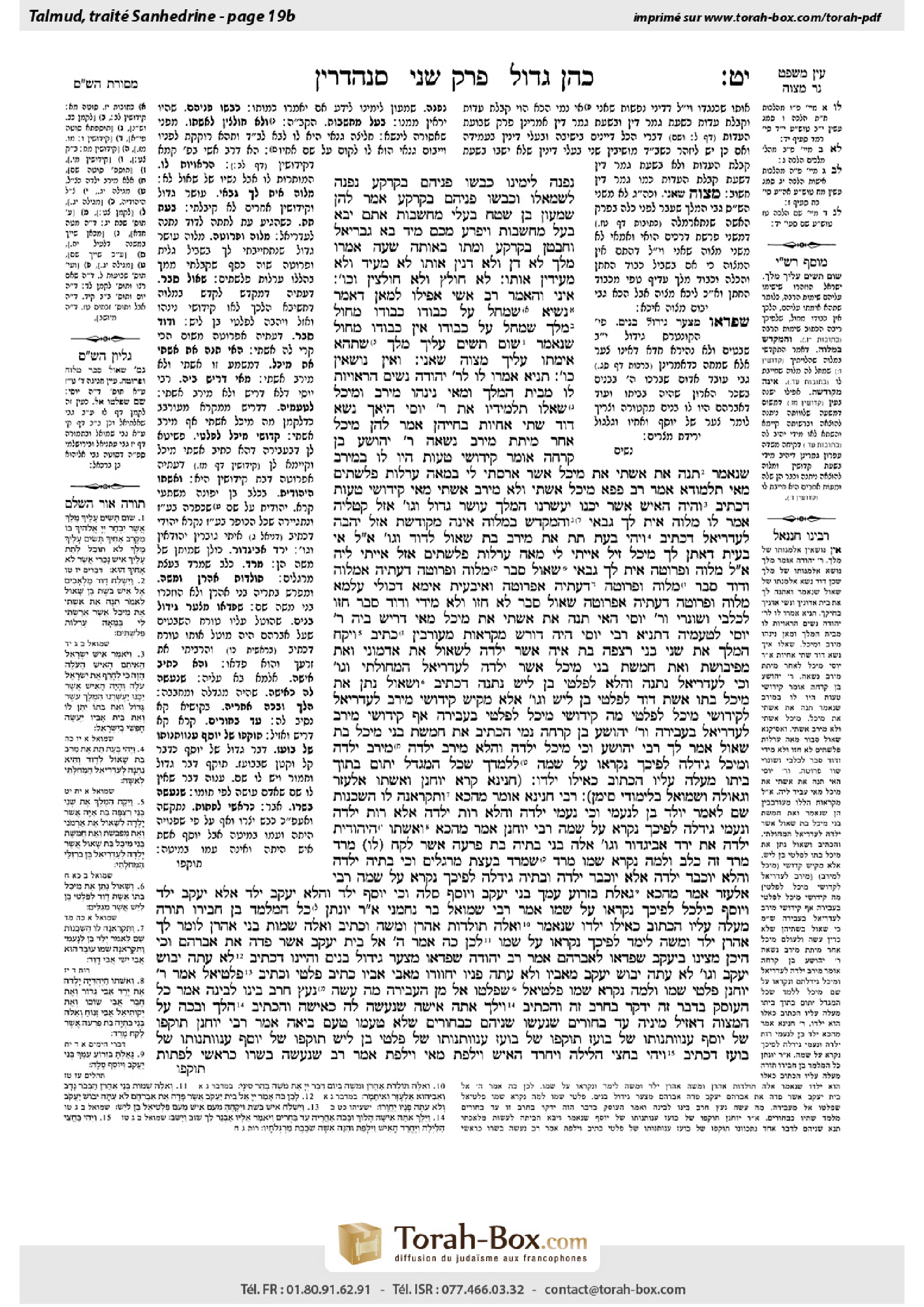
Sanhedrin 19b: Talmud study for Daf Yomi
Daf Yomi is the daily study of one Talmud folio. Explore 37 tractates with scans, Hebrew text, Sefaria English and AI-generated French translations where annotated.
Passage selection and English or AI-generated French translation are available where the scan has annotations. Daf Study is independent of Torah-Box and Sefaria.
Browse Sanhedrin · סנהדרין · All tractatesSanhedrin 19b text and translations
This page of Sanhedrin includes the Aramaic text, an English translation and an AI-generated French translation, alongside the scan above.
סנהדרין י״ט ב · Aramaic and Hebrew text
נִפְנָה לִימִינוֹ – כָּבְשׁוּ פְּנֵיהֶם בַּקַּרְקַע. נִפְנָה לִשְׂמֹאלוֹ – וְכָבְשׁוּ פְּנֵיהֶם בַּקַּרְקַע. אָמַר לָהֶן שִׁמְעוֹן בֶּן שָׁטַח: בַּעֲלֵי מַחְשָׁבוֹת אַתֶּם, יָבֹא בַּעַל מַחְשָׁבוֹת וְיִפָּרַע מִכֶּם! מִיָּד בָּא גַּבְרִיאֵל וַחֲבָטָן בַּקַּרְקַע, וּמֵתוּ. בְּאוֹתָהּ שָׁעָה אָמְרוּ: מֶלֶךְ לֹא דָּן וְלֹא דָּנִין אוֹתוֹ, לֹא מֵעִיד וְלֹא מְעִידִין אוֹתוֹ.
לֹא חוֹלֵץ וְלֹא חוֹלְצִין וְכוּ׳. אִינִי? וְהָאָמַר רַב אָשֵׁי: אֲפִילּוּ לְמַאן דְּאָמַר נָשִׂיא שֶׁמָּחַל עַל כְּבוֹדוֹ – כְּבוֹדוֹ מָחוּל, מֶלֶךְ שֶׁמָּחַל עַל כְּבוֹדוֹ – אֵין כְּבוֹדוֹ מָחוּל, שֶׁנֶּאֱמַר: ״שׂוֹם תָּשִׂים עָלֶיךָ מֶלֶךְ״, שֶׁתְּהֵא אֵימָתוֹ עָלֶיךָ! מִצְוָה שָׁאנֵי.
וְאֵין נוֹשְׂאִין כּוּ׳. תַּנְיָא, אָמְרוּ לוֹ לְרַבִּי יְהוּדָה: נָשִׁים הָרְאוּיוֹת לוֹ מִבֵּית הַמֶּלֶךְ. וּמַאי נִינְהוּ? מֵירַב וּמִיכַל.
שָׁאֲלוּ תַּלְמִידָיו אֶת רַבִּי יוֹסֵי: הֵיאַךְ נָשָׂא דָּוִד שְׁתֵּי אֲחָיוֹת בְּחַיֵּיהֶן? אָמַר לָהֶן: מִיכַל אַחַר מִיתַת מֵירַב נְשָׂאָהּ. רַבִּי יְהוֹשֻׁעַ בֶּן קׇרְחָה אוֹמֵר: קִידּוּשֵׁי טָעוּת הָיוּ לוֹ בְּמֵירַב, שֶׁנֶּאֱמַר: ״תְּנָה אֶת אִשְׁתִּי אֶת מִיכַל אֲשֶׁר אֵרַסְתִּי לִי בְּמֵאָה עׇרְלוֹת פְּלִשְׁתִּים״.
מַאי תַּלְמוּדָא? אָמַר רַב פָּפָּא: ״מִיכַל אִשְׁתִּי״, וְלֹא מֵירַב אִשְׁתִּי.
מַאי קִידּוּשֵׁי טָעוּת? דִּכְתִיב: ״וְהָיָה הָאִישׁ אֲשֶׁר יַכֶּנּוּ יַעְשְׁרֶנּוּ הַמֶּלֶךְ עֹשֶׁר גָּדוֹל וְגוֹ׳״. אֲזַל קַטְלֵיהּ. אָמַר לוֹ: מִלְוָה אִית לָךְ גַּבַּאי, וְהַמְקַדֵּשׁ בְּמִלְוֶה אֵינָהּ מְקוּדֶּשֶׁת.
אֲזַל יַהֲבַהּ לְעַדְרִיאֵל, דִּכְתִיב: ״וַיְהִי בְּעֵת תֵּת אֶת מֵירַב בַּת שָׁאוּל לְדָוִד וְגוֹ׳״. אֲמַר לֵיהּ: אִי בָּעֵית דְּאֶתֵּן לָךְ מִיכַל, זִיל אַיְיתִי לִי מֵאָה עׇרְלוֹת פְּלִשְׁתִּים. אֲזַל אַיְיתִי לֵיהּ. אֲמַר לֵיהּ: מִלְוָה וּפְרוּטָה אִית לָךְ גַּבַּאי.
שָׁאוּל סְבַר: מִלְוָה וּפְרוּטָה – דַּעְתֵּיהּ אַמִּלְוָה, וְדָוִד סְבַר: מִלְוָה וּפְרוּטָה – דַּעְתֵּיהּ אַפְּרוּטָה.
וְאִיבָּעֵית אֵימָא: דְּכוּלֵּי עָלְמָא מִלְוָה וּפְרוּטָה – דַּעְתֵּיהּ אַפְּרוּטָה. שָׁאוּל סְבַר: לָא חֲזוּ וְלָא מִידֵּי, וְדָוִד סְבַר: חֲזוֹ לְכַלְבֵי וְשׁוּנָּרֵי.
וְרַבִּי יוֹסֵי, הַאי ״תְּנָה אֶת אִשְׁתִּי אֶת מִיכַל״ מַאי דָּרֵישׁ בֵּיהּ? רַבִּי יוֹסֵי לְטַעְמֵיהּ, דְּתַנְיָא: רַבִּי יוֹסֵי הָיָה דּוֹרֵשׁ מִקְרָאוֹת מְעוֹרָבִין.
כְּתִיב: ״וַיִּקַּח הַמֶּלֶךְ אֶת שְׁנֵי בְּנֵי רִצְפָּה בַת אַיָּה אֲשֶׁר יָלְדָה לְשָׁאוּל אֶת אַרְמֹנִי וְאֶת מְפִיבֹשֶׁת וְאֶת חֲמֵשֶׁת בְּנֵי מִיכַל אֲשֶׁר יָלְדָה לְעַדְרִיאֵל הַמְּחֹלָתִי וְגוֹ׳״. וְכִי לְעַדְרִיאֵל נִתְּנָה? וַהֲלֹא לְפַלְטִי בֶּן לַיִשׁ נִתְּנָה! דִּכְתִיב: ״וְשָׁאוּל נָתַן אֶת מִיכַל בִּתּוֹ אֵשֶׁת דָּוִד לְפַלְטִי בֶן לַיִשׁ וְגוֹ׳״.
אֶלָּא מַקִּישׁ קִידּוּשֵׁי מֵירַב לְעַדְרִיאֵל לְקִידּוּשֵׁי מִיכַל לְפַלְטִי: מָה קִידּוּשֵׁי מִיכַל לְפַלְטִי – בַּעֲבֵירָה, אַף קִידּוּשֵׁי מֵירַב לְעַדְרִיאֵל – בַּעֲבֵירָה.
וְרַבִּי יְהוֹשֻׁעַ בֶּן קׇרְחָה נָמֵי, הָכְתִיב: ״אֶת חֲמֵשֶׁת בְּנֵי מִיכַל בַּת שָׁאוּל״? אָמַר לְךָ רַבִּי יְהוֹשֻׁעַ: וְכִי מִיכַל יָלְדָה? וַהֲלֹא מֵירַב יָלְדָה! מֵירַב יָלְדָה וּמִיכַל גִּידְּלָה, לְפִיכָךְ נִקְרְאוּ עַל שְׁמָהּ. לְלַמֶּדְךָ שֶׁכׇּל הַמְגַדֵּל יָתוֹם בְּתוֹךְ בֵּיתוֹ מַעֲלֶה עָלָיו הַכָּתוּב כְּאִילּוּ יְלָדוֹ.
(חֲנִינָא קָרָא יוֹחָנָן וְאִשְׁתּוֹ אֶלְעָזָר וּגְאוּלָּה וּשְׁמוּאֵל בְּלִימּוּדוֹ סִימָן.) רַבִּי חֲנִינָא אוֹמֵר, מֵהָכָא: ״וַתִּקְרֶאנָה לוֹ הַשְּׁכֵנוֹת שֵׁם לֵאמֹר יוּלַּד בֵּן לְנׇעֳמִי״. וְכִי נָעֳמִי יָלְדָה? וַהֲלֹא רוּת יָלְדָה! אֶלָּא רוּת יָלְדָה וְנׇעֳמִי גִּידְּלָה, לְפִיכָךְ נִקְרָא עַל שְׁמָהּ.
רַבִּי יוֹחָנָן אָמַר, מֵהָכָא: ״וְאִשְׁתּוֹ הַיְהֻדִיָּה יָלְדָה אֶת יֶרֶד אֲבִי גְדוֹר וְגוֹ׳ וְאֵלֶּה בְּנֵי בִּתְיָה בַת פַּרְעֹה אֲשֶׁר לָקַח (לוֹ) מָרֶד״. מָרֶד זֶה כָּלֵב, וְלָמָּה נִקְרָא שְׁמוֹ מֶרֶד? שֶׁמָּרַד בַּעֲצַת מְרַגְּלִים. וְכִי בִּתְיָה יָלְדָה? וַהֲלֹא יוֹכֶבֶד יָלְדָה! אֶלָּא יוֹכֶבֶד יָלְדָה וּבִתְיָה גִּידְּלָה, לְפִיכָךְ נִקְרָא עַל שְׁמָהּ.
רַבִּי אֶלְעָזָר אָמַר, מֵהָכָא: ״גָּאַלְתָּ בִּזְרוֹעַ עַמֶּךָ בְּנֵי יַעֲקֹב וְיוֹסֵף סֶלָה״. וְכִי יוֹסֵף יָלַד? וַהֲלֹא יַעֲקֹב יָלַד! אֶלָּא, יַעֲקֹב יָלַד וְיוֹסֵף כִּילְכֵּל, לְפִיכָךְ נִקְרְאוּ עַל שְׁמוֹ.
אָמַר רַבִּי שְׁמוּאֵל בַּר נַחְמָנִי אָמַר רַבִּי יוֹנָתָן: כׇּל הַמְלַמֵּד בֶּן חֲבֵירוֹ תּוֹרָה, מַעֲלֶה עָלָיו הַכָּתוּב כְּאִילּוּ יְלָדוֹ, שֶׁנֶּאֱמַר: ״וְאֵלֶּה תּוֹלְדֹת אַהֲרֹן וּמֹשֶׁה״, וּכְתִיב: ״וְאֵלֶּה שְׁמוֹת בְּנֵי אַהֲרֹן״. לוֹמַר לָךְ: אַהֲרֹן יָלַד וּמֹשֶׁה לִימֵּד, לְפִיכָךְ נִקְרְאוּ עַל שְׁמוֹ.
״לָכֵן כֹּה אָמַר ה׳ אֶל בֵּית יַעֲקֹב אֲשֶׁר פָּדָה אֶת אַבְרָהָם״, וְכִי הֵיכָן מָצִינוּ בְּיַעֲקֹב שֶׁפְּדָאוֹ לְאַבְרָהָם? אָמַר רַב יְהוּדָה: שֶׁפְּדָאוֹ מִצַּעַר גִּידּוּל בָּנִים. וְהַיְינוּ דִּכְתִיב: ״לֹא עַתָּה יֵבוֹשׁ יַעֲקֹב וְגוֹ׳״, ״לֹא עַתָּה יֵבוֹשׁ יַעֲקֹב״ – מֵאָבִיו, ״וְלֹא עַתָּה פָּנָיו יֶחֱוָרוּ״ – מֵאֲבִי אָבִיו.
כְּתִיב ״פַּלְטִי״ וּכְתִיב ״פַּלְטִיאֵל״. אָמַר רַבִּי יוֹחָנָן: פַּלְטִי שְׁמוֹ, וְלָמָּה נִקְרָא שְׁמוֹ פַּלְטִיאֵל? שֶׁפִּלְּטוֹ אֵל מִן הָעֲבֵירָה. מָה עָשָׂה? נָעַץ חֶרֶב בֵּינוֹ לְבֵינָהּ. אָמַר: כׇּל הָעוֹסֵק בְּדָבָר זֶה יִדָּקֵר בֶּחָרֶב (זֶה).
וְהָכְתִיב: ״וַיֵּלֶךְ אִתָּהּ אִישָׁהּ״? שֶׁנַּעֲשָׂה לָהּ כְּאִישָׁהּ. וְהָכְתִיב: ״הָלוֹךְ וּבָכֹה״? עַל מִצְוָה דַּאֲזַיל מִינֵּיהּ. ״עַד בַּחֻרִים״, שֶׁנַּעֲשׂוּ שְׁנֵיהֶם כְּבַחוּרִים, שֶׁלֹּא טָעֲמוּ טַעַם בִּיאָה.
אָמַר רַבִּי יוֹחָנָן: תּוֹקְפּוֹ שֶׁל יוֹסֵף – עִנְוְותָנוּתוֹ שֶׁל בּוֹעַז, תּוֹקְפּוֹ שֶׁל בּוֹעַז – עִנְוְותָנוּתוֹ שֶׁל פַּלְטִי בֶּן לַיִשׁ. תּוֹקְפּוֹ שֶׁל יוֹסֵף – עִנְוְותָנוּתוֹ שֶׁל בּוֹעַז, דִּכְתִיב: ״וַיְהִי בַּחֲצִי הַלַּיְלָה וַיֶּחֱרַד הָאִישׁ וַיִּלָּפֵת״. מַאי ״וַיִּלָּפֵת״? אָמַר רַב: שֶׁנַּעֲשָׂה בְּשָׂרוֹ כְּרָאשֵׁי לְפָתוֹת.
Sanhedrin 19b · English translation
Shimon ben Shataḥ turned to his right. The judges forced their faces to the ground out of fear and said nothing. He turned to his left, and they forced their faces to the ground and said nothing. Shimon ben Shataḥ said to them: You are masters of thoughts, enjoying your private thoughts, and not speaking. May the Master of thoughts, God, come and punish you. Immediately, the angel Gabriel came and struck those judges to the ground, and they died. At that moment, when they saw that the Sanhedrin does not have power to force the king to heed its instructions, the Sages said: A king does not judge others and others do not judge him, and he does not testify and others do not testify concerning him, due to the danger of the matter.
The mishna teaches that the king does not perform ḥalitza with his brother’s widow and his brother does not perform ḥalitza with his wife, and Rabbi Yehuda says that he may do so if he wishes. The Gemara challenges Rabbi Yehuda’s opinion: Is that so? But doesn’t Rav Ashi say: Even according to the one who says that with regard to a Nasi who relinquished the honor due him, his honor is relinquished, nevertheless, with regard to a king who relinquished the honor due him, his honor is not relinquished, as it is stated: “You shall set a king over you” (Deuteronomy 17:15), meaning that his fear should be upon you. The preservation of a king’s honor is mandated by the Torah. How could Rabbi Yehuda allow him to waive it? The Gemara answers: A mitzva is different; a king is not disgraced if he relinquishes his honor to perform a mitzva.
The mishna teaches: And no one may marry the king’s widow, and Rabbi Yehuda says that a king may marry another king’s widow, as proven by King David, who was promised with regard to King Saul after his death: “And I have given you the house of your master and the wives of your master” (II Samuel 12:8). It is taught in a baraita: The Sages said to Rabbi Yehuda: The meaning of the verse is not that David married Saul’s widows, but that he married women appropriate for him from the house of the king. And who are they? Merab and Michal, the daughters of Saul.
The Gemara relates a discussion about David’s marriage to Merab and Michal from a baraita (Tosefta, Sota 11:9): Rabbi Yosei’s students asked him: How did David marry two sisters while they were both alive? Rabbi Yosei said to them: He married Michal only after the death of Merab, which is permitted. Rabbi Yehoshua ben Korḥa says a different explanation: His betrothal to Merab was in error and therefore void from the outset, and so Michal was permitted to him. This is as it is stated in the words of King David to Saul’s son Ish-bosheth: “Deliver me my wife Michal, whom I betrothed to me for one hundred foreskins of the Philistines” (II Samuel 3:14).
The Gemara asks: What is the biblical derivation here? How does Rabbi Yehoshua ben Korḥa learn from this verse that King David’s betrothal to Merab was in error? Rav Pappa says: In the verse, David indicates: Michal is my wife but Merab is not my wife.
The Gemara asks: What caused the betrothal between David and Merab to be a mistaken betrothal? The Gemara responds: As it is written about Israel’s war against the Philistines and Goliath: “And it shall be that the man who kills him, the king will enrich him with great riches and will give him his daughter, and make his father’s house free in Israel” (I Samuel 17:25). David went and killed Goliath. King Saul said to him: You have a loan in my possession, as I owe you the great wealth that I promised, though David had not given him an actual monetary loan. And the halakha is that with regard to one who betroths a woman by forgiving a loan, she is not betrothed, and therefore David’s betrothal of Merab did not take effect.
Saul went and gave Merab to Adriel, as it is written: “But it came to pass at the time when Merab, Saul’s daughter, should have been given to David, that she was given to Adriel the Meholathite as a wife” (I Samuel 18:19). Saul said to David: If you want me to give you Michal, go bring me one hundred foreskins of the Philistines (see I Samuel 18:25–27). David went and brought Saul two hundred foreskins. Saul said to him: Even though you brought the foreskins, the betrothal is not valid, as you, David, have a loan and one peruta in my possession, i.e., the wealth Saul owed him for slaying Goliath as well as the item of lesser monetary value, the foreskins of the Philistines.
Saul and David had a halakhic dispute on this point: Saul reasoned that in the case of one who betroths a woman by forgiving a loan and giving her one peruta, his mind is focused on the loan and not on the additional peruta, and therefore the betrothal is not valid. And David reasoned that in the case of one who betroths a woman by forgiving a loan and giving her one peruta, his mind is focused on the peruta and therefore the betrothal is valid.
And if you wish, say instead: Everyone reasons that in the case of one who betroths a woman by forgiving a loan and giving her one peruta, his mind is focused on the peruta. Saul reasoned that foreskins of Philistines are not fit for any purpose and as such are worth not even one peruta, and that consequently the betrothal did not take effect. And David reasoned that they are fit for dogs and cats as food and as such are worth at least one peruta, and therefore the betrothal takes effect.
The Gemara asks: And according to Rabbi Yosei, who explains that David married Michal after the death of Merab, with regard to this verse: “Deliver me my wife Michal” (II Samuel 3:14), what does he derive from it? The Gemara answers: Rabbi Yosei conforms to his standard line of reasoning, as it is taught in a baraita (Tosefta, Sota 11:8): Rabbi Yosei would derive meaning from mixed verses that seem contradictory.
The Tosefta continues. It is written: “But the king took the two sons of Rizpah, daughter of Aiah, whom she bore unto Saul, Armoni and Mephibosheth, and the five sons of Michal, daughter of Saul, whom she bore to Adriel, son of Barzillai the Meholathite” (II Samuel 21:8). But did Saul give Michal to Adriel? But didn’t he give her to Palti, son of Laish, as it is written: “Now Saul had given Michal his daughter, David’s wife, to Palti, son of Laish” (I Samuel 25:44)?
The Tosefta continues: The first verse does not mean, then, that Michal married Adriel. Rather, the verse compares Merab’s betrothal to Adriel to Michal’s betrothal to Palti: Just as Michal’s betrothal to Palti was effected in transgression, according to all opinions, since she was already married to David, so, too, Merab’s betrothal to Adriel was effected in transgression, since according to halakha she was betrothed to David.
The Gemara asks: And according to Rabbi Yehoshua ben Korḥa as well, isn’t it written: “And the five sons of Michal, daughter of Saul, whom she bore to Adriel” (II Samuel 21:8). Rabbi Yehoshua ben Korḥa could have said to you to understand it this way: And did Michal give birth to these children? But didn’t Merab give birth to them for Adriel? Rather, Merab gave birth to them and died, and Michal raised them in her house. Therefore, the children were called by her name, to teach you that with regard to anyone who raises an orphan in his house, the verse ascribes him credit as if he gave birth to him.
The Gemara presents a mnemonic for the following discussion: Ḥanina called; Yoḥanan and his wife; Elazar and redemption; and Shmuel in my studies. Rabbi Ḥanina says: Proof for the aforementioned statement can be derived from here: “And the neighbors gave him a name, saying: There is a son born to Naomi” (Ruth 4:17). And did Naomi give birth to the son? But didn’t Ruth give birth to him? Rather, Ruth gave birth and Naomi raised him. Therefore, he was called by her name: “A son born to Naomi.”
Rabbi Yoḥanan says: Proof for the aforementioned statement can be derived from here: “And his wife Hajehudijah gave birth to Jered the father of Gedor, and Heber the father of Soco, and Jekuthiel the father of Zanoah, and these are the sons of Bithiah, daughter of Pharaoh, whom Mered took” (I Chronicles 4:18). Mered is Caleb, and why was his name called Mered? Because he rebelled [marad] against the counsel of the spies. And according to the midrash, Jered, Heber, and Jekuthiel all refer to Moses our teacher. And did Bithiah give birth to Moses? But didn’t Jochebed give birth to him? Rather, Jochebed gave birth to him and Bithiah raised him. Therefore, he was called by her name as though she had given birth to him.
Rabbi Elazar says: Proof for the aforementioned statement can be derived from here: “You have with Your arm redeemed your people, the children of Jacob and Joseph, Selah” (Psalms 77:16). And did Joseph sire all of the children of Israel? But didn’t Jacob sire them? Rather, Jacob sired them and Joseph sustained them financially. Therefore, they were called by his name; all of Israel were called the children of Joseph.
Rabbi Shmuel bar Naḥmani says that Rabbi Yonatan says: Anyone who teaches another person’s son Torah, the verse ascribes him credit as if he sired him, as it is stated: “Now these are the generations of Aaron and Moses” (Numbers 3:1), and it is written immediately afterward: “And these are the names of the sons of Aaron: Nadav the firstborn and Avihu, Eleazar, and Ithamar” (Numbers 3:2), but it does not mention the names of Moses’ children. This serves to say to you that Aaron sired his children, but Moses taught them Torah. Therefore, the children were also called by his name.
The Gemara cites another derivation connected to child-rearing: “Therefore, so says the Lord to the house of Jacob, who redeemed Abraham; Jacob shall not now be ashamed, neither shall his face now wax pale” (Isaiah 29:22). But where have we found any indication about Jacob that he redeemed Abraham? Rav Yehuda says: It means that he redeemed him from the suffering of raising children, in that Abraham did not have twelve tribes and the resultant hardships involved in raising them, as Jacob did, as Jacob assumed the burden of raising the tribes of Israel. And this is as it is written: “Jacob shall not now be ashamed, neither shall his face now wax pale,” meaning: “Jacob shall not now be ashamed” before his father, and “neither shall his face now wax pale” before his father’s father, since he took upon himself the role that they bore as well.
The Gemara cites a tradition with regard to Palti, son of Laish: It is written in one place “Palti” (I Samuel 25:44), and it is written in another place “Paltiel” (II Samuel 3:15). Rabbi Yoḥanan says: Palti was his real name, and why was his name called Paltiel? To teach that God [El ] saved [pelato] him from the sin, by giving him the insight that he may not touch Michal, understanding that she was still David’s wife and therefore forbidden to him. What did he do? He embedded a sword in the bed between him and her, and said: Anyone who engages in this matter, i.e., sexual intercourse, should be stabbed by this sword.
The Gemara challenges this: But isn’t it written: “And her husband went with her, weeping as he went, and followed her to Bahurim” (II Samuel 3:16), referring to Palti as Michal’s husband? The Gemara responds: This means that he became like a husband for her through his affection and concern for her. The Gemara counters: But isn’t it written in that very verse: “weeping as he went”? If from the outset he thought that she was David’s wife, why was he crying? The Gemara responds: He was weeping about the mitzva that left him, as from now on, he would receive no reward for restraining his desire. The end of the verse says that they went “to Bahurim,” meaning that they both became like young men [baḥurim] in that they did not taste sexual intercourse at all.
Rabbi Yoḥanan says: Joseph’s power is the humility of Boaz, as Joseph is praised for showing strength with regard to an accomplishment that was insignificant for Boaz (see Genesis, chapter 39). Likewise, Boaz’s power is the humility of Palti, son of Laish, as Palti’s capacity for restraint was greater still. Joseph’s power is the humility of Boaz, as it is written about Boaz: “And it came to pass at midnight that the man was startled and turned himself, and behold, a woman lay at his feet” (Ruth 3:8). What is the meaning of “and turned himself [vayyilafet]”? Rav says: The meaning is that his flesh became like the heads of turnips [lefatot], his sexual organ hardening out of arousal, but even though Ruth was not married he refrained from engaging in intercourse with her; while Joseph had to exert more effort, despite the fact that Potiphar’s wife was married.
Sanhedrin 19b · Traduction française (IA)
Shimon ben Shataḥ se tourna vers sa droite. Les juges plaquèrent leur visage contre le sol, saisis de peur, et ne dirent rien. Il se tourna vers sa gauche ; ils plaquèrent leur visage contre le sol et ne dirent rien. Shimon ben Shataḥ leur dit : « Vous êtes maîtres de vos pensées, vous vous complaisez dans vos pensées secrètes et ne dites rien. Que le Maître des pensées, Dieu, vienne vous punir. » Aussitôt, l’ange Gabriel vint frapper ces juges à terre, et ils moururent. À ce moment-là, lorsqu’ils virent que le Sanhédrin n’avait pas le pouvoir de contraindre le roi à suivre ses instructions, les Sages dirent : « Un roi ne juge pas autrui, et autrui ne le juge pas ; il ne témoigne pas, et autrui ne témoigne pas contre lui », en raison du danger que cela comportait.
La Michna enseigne que le roi ne fait pas la ḥalitsa avec la veuve de son frère, et que son frère ne fait pas la ḥalitsa avec sa femme ; Rabbi Yehuda dit qu’il peut le faire s’il le souhaite. La Guemara met en cause l’avis de Rabbi Yehuda : Est-ce bien ainsi ? Rav Ashi ne dit-il pas que même selon celui qui affirme qu’un Nasi peut renoncer à l’honneur qui lui est dû, et que cette renonciation est valable, lorsqu’il s’agit d’un roi qui renonce à l’honneur qui lui est dû, sa renonciation n’est pas valable, comme il est écrit : « Tu établiras sur toi un roi » (Deutéronome 17,15), ce qui signifie que tu dois le craindre ? La Torah prescrit de préserver l’honneur du roi. Comment Rabbi Yehuda peut-il lui permettre d’y renoncer ? La Guemara répond : Une mitsva est différente ; le roi n’est pas déshonoré lorsqu’il renonce à son honneur pour accomplir une mitsva.
La Michna enseigne : Nul ne peut épouser la veuve du roi ; Rabbi Yehuda dit qu’un roi peut épouser la veuve d’un autre roi, comme le prouve le cas du roi David, à qui il fut promis au sujet du roi Saül, après sa mort : « Je t’ai donné la maison de ton maître et les femmes de ton maître » (II Samuel 12,8). Une baraïta enseigne que les Sages dirent à Rabbi Yehuda : Le verset ne signifie pas que David épousa les veuves de Saül, mais qu’il épousa des femmes qui lui convenaient, issues de la maison du roi. Qui étaient-elles ? Merab et Michal, les filles de Saül.
La Guemara rapporte une discussion sur le mariage de David avec Merab et Michal à partir d’une baraïta (Tosefta, Sota 11,9) : Les élèves de Rabbi Yosei lui demandèrent : Comment David a-t-il pu épouser deux sœurs alors qu’elles étaient toutes deux vivantes ? Rabbi Yosei leur répondit : Il n’épousa Michal qu’après la mort de Merab, ce qui est permis. Rabbi Yehoshua ben Korḥa donne une autre explication : ses fiançailles avec Merab étaient entachées d’une erreur et donc nulles dès le départ ; Michal lui était ainsi permise. C’est ce qu’indiquent les paroles du roi David au fils de Saül, Ish-bosheth : « Fais-moi remettre ma femme Michal, que j’ai fiancée pour cent prépuces de Philistins » (II Samuel 3,14).
La Guemara demande : Quelle est ici la déduction scripturaire ? Comment Rabbi Yehoshua ben Korḥa déduit-il de ce verset que les fiançailles du roi David avec Merab étaient entachées d’une erreur ? Rav Pappa dit : Dans le verset, David indique : Michal est ma femme, mais Merab n’est pas ma femme.
La Guemara demande : Qu’est-ce qui a rendu erronées les fiançailles entre David et Merab ? La Guemara répond : Il est écrit, au sujet de la guerre d’Israël contre les Philistins et Goliath : « L’homme qui le tuera, le roi l’enrichira de grandes richesses, lui donnera sa fille et rendra la maison de son père exempte d’impôts en Israël » (I Samuel 17,25). David alla tuer Goliath. Le roi Saül lui dit : Tu as une créance sur moi, car je te dois les grandes richesses que j’ai promises, bien que David ne lui ait pas prêté d’argent à proprement parler. Or, selon la halakha, une femme qu’un homme fiance en lui remettant une créance n’est pas fiancée ; les fiançailles de David avec Merab ne prirent donc pas effet.
Saül alla donner Merab à Adriel, comme il est écrit : « Or, au moment où Merab, fille de Saül, aurait dû être donnée à David, elle fut donnée pour femme à Adriel le Meholathite » (I Samuel 18,19). Saül dit à David : Si tu veux que je te donne Michal, va m’apporter cent prépuces de Philistins (voir I Samuel 18,25–27). David alla apporter à Saül deux cents prépuces. Saül lui dit : Même si tu as apporté les prépuces, les fiançailles ne sont pas valides, car toi, David, tu as une créance et une perouta en ma possession, c’est-à-dire la richesse que Saül lui devait pour avoir tué Goliath, ainsi que l’objet de moindre valeur monétaire, les prépuces des Philistins.
Saül et David avaient sur ce point un différend halakhique : Saül raisonnait ainsi : lorsqu’un homme fiance une femme en lui remettant une créance et une perouta, il a à l’esprit la créance et non la perouta supplémentaire ; les fiançailles ne sont donc pas valides. David raisonnait ainsi : lorsqu’un homme fiance une femme en lui remettant une créance et une perouta, il a à l’esprit la perouta ; les fiançailles sont donc valides.
Et si tu le souhaites, dis plutôt ceci : tous raisonnent que lorsqu’un homme fiance une femme en lui remettant une créance et une perouta, il a à l’esprit la perouta. Saül raisonnait que les prépuces des Philistins ne pouvaient servir à rien et ne valaient donc même pas une perouta ; les fiançailles n’avaient par conséquent pas pris effet. David raisonnait qu’ils pouvaient servir de nourriture aux chiens et aux chats et valaient donc au moins une perouta ; les fiançailles prenaient par conséquent effet.
La Guemara demande : Et selon Rabbi Yosei, qui explique que David épousa Michal après la mort de Merab, que déduit-il de ce verset : « Fais-moi remettre ma femme Michal » (II Samuel 3,14) ? La Guemara répond : Rabbi Yosei reste fidèle à son raisonnement habituel, comme l’enseigne une baraïta (Tosefta, Sota 11,8) : Rabbi Yosei tirait un sens de versets contradictoires qui semblent s’opposer.
La Tosefta poursuit. Il est écrit : « Le roi prit les deux fils de Rizpa, fille d’Aïa, qu’elle avait enfantés à Saül, Armoni et Mephibosheth, et les cinq fils de Michal, fille de Saül, qu’elle avait enfantés à Adriel, fils de Barzillai le Meholathite » (II Samuel 21,8). Mais Saül avait-il donné Michal à Adriel ? Ne l’avait-il pas donnée à Palti, fils de Laïsh, comme il est écrit : « Saül avait donné sa fille Michal, femme de David, à Palti, fils de Laïsh » (I Samuel 25,44) ?
La Tosefta poursuit : Le premier verset ne signifie donc pas que Michal épousa Adriel. Le verset compare plutôt les fiançailles de Merab avec Adriel à celles de Michal avec Palti : de même que les fiançailles de Michal avec Palti avaient été contractées dans la transgression, selon toutes les opinions, puisqu’elle était déjà mariée à David, de même les fiançailles de Merab avec Adriel avaient été contractées dans la transgression, puisqu’elle était fiancée à David selon la halakha.
La Guemara demande : Et selon Rabbi Yehoshua ben Korḥa également, n’est-il pas écrit : « Les cinq fils de Michal, fille de Saül, qu’elle avait enfantés à Adriel » (II Samuel 21,8) ? Rabbi Yehoshua ben Korḥa aurait pu répondre ainsi : Michal a-t-elle donc donné naissance à ces enfants ? N’est-ce pas Merab qui les a mis au monde pour Adriel ? Merab leur donna naissance et mourut, puis Michal les éleva dans sa maison. C’est pourquoi ils furent désignés par son nom, afin de t’enseigner que le verset attribue à quiconque élève un orphelin dans sa maison le mérite de lui avoir donné naissance.
La Guemara fournit un moyen mnémotechnique pour la discussion qui suit : Ḥanina appelle ; Yoḥanan et son épouse ; Elazar et la rédemption ; et Shmuel dans mes études. Rabbi Ḥanina dit : On peut tirer la preuve de l’affirmation précédente de ce verset : « Les voisins lui donnèrent un nom, en disant : Un fils est né à Naomi » (Ruth 4,17). Naomi a-t-elle donc donné naissance à cet enfant ? N’est-ce pas Ruth qui l’a mis au monde ? Ruth lui donna naissance et Naomi l’éleva. C’est pourquoi il fut désigné par son nom : « Un fils est né à Naomi. »
Rabbi Yoḥanan dit : On peut tirer la preuve de l’affirmation précédente de ce verset : « Et sa femme Hajehudijah donna naissance à Jered, père de Gedor, à Heber, père de Soco, et à Jekuthiel, père de Zanoah ; ceux-ci sont les fils de Bithiah, fille de Pharaon, que Mered prit » (I Chroniques 4,18). Mered est Caleb. Pourquoi fut-il appelé Mered ? Parce qu’il se rebella [marad] contre le conseil des explorateurs. Selon le midrash, Jered, Heber et Jekuthiel désignent tous Moïse notre maître. Bithiah a-t-elle donc donné naissance à Moïse ? N’est-ce pas Jokébed qui l’a mis au monde ? Jokébed lui donna naissance et Bithiah l’éleva. C’est pourquoi il fut désigné par son nom, comme si elle lui avait donné naissance.
Rabbi Elazar dit : On peut tirer la preuve de l’affirmation précédente de ce verset : « Par ton bras, tu as racheté ton peuple, les enfants de Jacob et de Joseph, Sélah » (Psaumes 77,16). Joseph a-t-il donc engendré tous les enfants d’Israël ? N’est-ce pas Jacob qui les a engendrés ? Jacob les engendra et Joseph pourvut à leur subsistance. C’est pourquoi ils furent désignés par son nom : tout Israël fut appelé les enfants de Joseph.
Rabbi Shmuel bar Naḥmani dit au nom de Rabbi Yonatan : Quiconque enseigne la Torah au fils d’un autre, le verset lui en attribue le mérite comme s’il l’avait engendré, comme il est dit : « Voici les générations d’Aaron et de Moïse » (Nombres 3,1), et il est écrit immédiatement après : « Voici les noms des fils d’Aaron : Nadav, le premier-né, puis Avihu, Elazar et Itamar » (Nombres 3,2), sans mentionner les noms des enfants de Moïse. Cela t’enseigne qu’Aaron engendra ses enfants, tandis que Moïse leur enseigna la Torah. C’est pourquoi les enfants furent également désignés par son nom.
La Guemara cite une autre déduction liée à l’éducation des enfants : « C’est pourquoi, ainsi parle le Seigneur à la maison de Jacob, lui qui racheta Abraham : Jacob ne sera plus honteux désormais, et son visage ne pâlira plus » (Isaïe 29,22). Mais où trouve-t-on la moindre indication que Jacob aurait racheté Abraham ? Rav Yehuda dit : Cela signifie qu’il l’a racheté des souffrances liées à l’éducation des enfants, en ce qu’Abraham n’eut pas douze tribus ni les difficultés qui en résultent pour les élever, comme Jacob les connut, car celui-ci assuma la charge d’élever les tribus d’Israël. C’est ce que signifie le verset : « Jacob ne sera plus honteux désormais, et son visage ne pâlira plus » : « Jacob ne sera plus honteux » devant son père, et « son visage ne pâlira plus » devant le père de son père, puisqu’il assuma également le rôle qui leur incombait.
La Guemara rapporte une tradition concernant Palti, fils de Laïsh : à un endroit, il est écrit « Palti » (I Samuel 25,44), et à un autre, « Paltiel » (II Samuel 3,15). Rabbi Yoḥanan dit : Palti était son vrai nom. Pourquoi fut-il appelé Paltiel ? Pour enseigner que Dieu [El ] le sauva [pelato] du péché en lui donnant la lucidité de comprendre qu’il ne pouvait toucher Michal, puisqu’elle était encore la femme de David et lui était donc interdite. Que fit-il ? Il planta une épée dans le lit, entre elle et lui, et dit : « Quiconque s’engage dans cette affaire, c’est-à-dire dans une relation sexuelle, doit être transpercé par cette épée. »
La Guemara objecte : N’est-il pas écrit : « Son mari l’accompagna en pleurant, et la suivit jusqu’à Bahurim » (II Samuel 3,16), désignant Palti comme le mari de Michal ? La Guemara répond : Cela signifie qu’il devint comme un mari pour elle par l’affection et le souci qu’il lui témoignait. La Guemara réplique : Mais n’est-il pas écrit dans ce même verset : « en pleurant » ? S’il avait pensé dès le départ qu’elle était la femme de David, pourquoi pleurait-il ? La Guemara répond : Il pleurait la mitsva qui le quittait, car désormais il ne recevrait plus de récompense pour avoir maîtrisé son désir. La fin du verset dit qu’ils se rendirent « à Bahurim », ce qui signifie qu’ils devinrent tous deux comme de jeunes hommes [baḥurim], car ils ne goûtèrent jamais aux relations sexuelles.
Rabbi Yoḥanan dit : La force de Joseph est l’humilité de Boaz, car Joseph est loué pour avoir fait preuve de force à propos d’un exploit qui, pour Boaz, était sans importance (voir Genèse, chapitre 39). De même, la force de Boaz est l’humilité de Palti, fils de Laïsh, car la capacité de Palti à se contenir était encore plus grande. La force de Joseph est l’humilité de Boaz, comme il est écrit au sujet de Boaz : « Au milieu de la nuit, l’homme fut saisi de frayeur, se retourna et vit une femme couchée à ses pieds » (Ruth 3,8). Que signifie « il se retourna [vayyilafet] » ? Rav dit : Cela signifie que sa chair devint comme des têtes de navets [lefatot] : son organe sexuel se raidit sous l’effet de l’excitation. Pourtant, bien que Ruth ne fût pas mariée, il s’abstint d’avoir des relations sexuelles avec elle ; Joseph, lui, dut faire davantage d’efforts, bien que la femme de Potiphar fût mariée.
Traduction française générée par IA à partir de l’édition anglaise de Sefaria. Vérifie toujours un passage avec le texte source.
Text from Sefaria: William Davidson Edition - Vocalized Aramaic (CC BY NC); William Davidson Edition - English (CC BY NC).