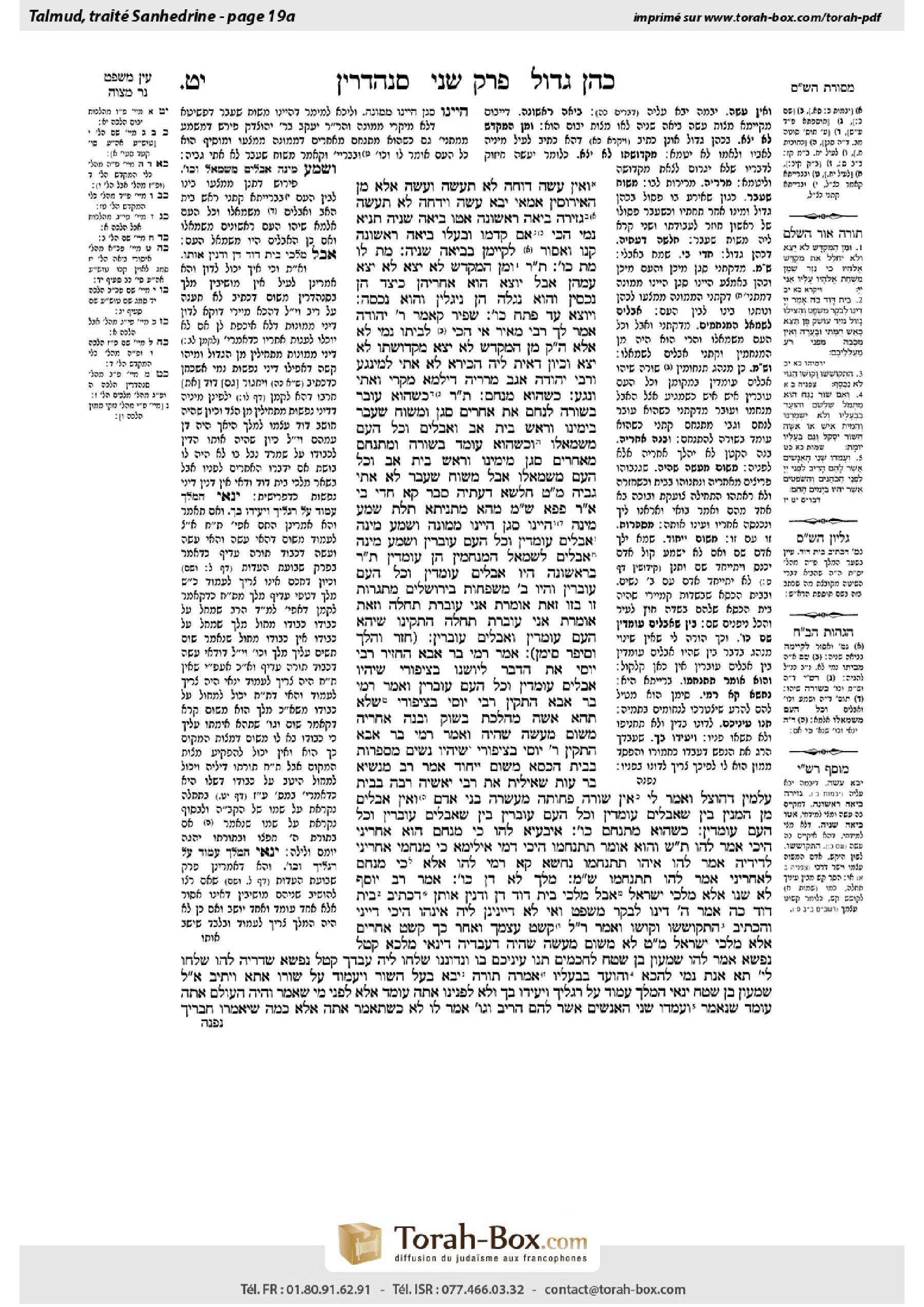
Sanhedrin 19a: Talmud study for Daf Yomi
Daf Yomi is the daily study of one Talmud folio. Explore 37 tractates with scans, Hebrew text, Sefaria English and AI-generated French translations where annotated.
Passage selection and English or AI-generated French translation are available where the scan has annotations. Daf Study is independent of Torah-Box and Sefaria.
Browse Sanhedrin · סנהדרין · All tractatesSanhedrin 19a text and translations
This page of Sanhedrin includes the Aramaic text, an English translation and an AI-generated French translation, alongside the scan above.
סנהדרין י״ט א · Aramaic and Hebrew text
וְאֵין עֲשֵׂה דּוֹחֶה לֹא תַעֲשֶׂה וַעֲשֵׂה. אֶלָּא מִן הָאֵירוּסִין אַמַּאי? יָבֹא עֲשֵׂה וְיִדְחֶה לֹא תַעֲשֶׂה!
גְּזֵירָה בִּיאָה רִאשׁוֹנָה, אַטּוּ בִּיאָה שְׁנִיָּה.
תַּנְיָא נָמֵי הָכִי: אִם קָדְמוּ וּבָעֲלוּ בִּיאָה רִאשׁוֹנָה – קָנוּ, וְאָסוּר לְקַיְּימָן בְּבִיאָה שְׁנִיָּה.
מֵת לוֹ מֵת כּוּ׳. תָּנוּ רַבָּנַן: ״וּמִן הַמִּקְדָּשׁ לֹא יֵצֵא״ – לֹא יֵצֵא עִמָּהֶן, אֲבָל יוֹצֵא הוּא אַחֲרֵיהֶן. כֵּיצַד? הֵן נִכְסִין וְהוּא נִגְלֶה, הֵן נִיגְלִין וְהוּא נִכְסֶה.
וְיוֹצֵא עַד פֶּתַח כּוּ׳. שַׁפִּיר קָאָמַר רַבִּי יְהוּדָה.
אָמַר לָךְ רַבִּי מֵאִיר: אִי הָכִי, לְבֵיתוֹ נָמֵי לָא! אֶלָּא הָכִי קָאָמַר: ״מִן הַמִּקְדָּשׁ לֹא יֵצֵא״ – מִקְּדוּשָּׁתוֹ לֹא יֵצֵא. וְכֵיוָן דְּאִית לֵיהּ הֶכֵּירָא, לָא אָתֵי לְמִינְגַּע.
וְרַבִּי יְהוּדָה: אַגַּב מְרָרֵיהּ, דִּילְמָא מִקְּרֵי וְאָתֵי וְנָגַע.
כְּשֶׁהוּא מְנַחֵם. תָּנוּ רַבָּנַן: כְּשֶׁהוּא עוֹבֵר בַּשּׁוּרָה לְנַחֵם אֶת אֲחֵרִים – סְגָן וּמָשׁוּחַ שֶׁעָבַר בִּימִינוֹ, וְרֹאשׁ בֵּית אָב וַאֲבֵלִים וְכׇל הָעָם מִשְּׂמֹאלוֹ. וּכְשֶׁהוּא עוֹמֵד בַּשּׁוּרָה וּמִתְנַחֵם מֵאֲחֵרִים – סְגָן מִימִינוֹ, וְרֹאשׁ בֵּית אָב וְכׇל הָעָם מִשְּׂמֹאלוֹ.
אֲבָל מָשׁוּחַ שֶׁעָבַר לָא אָתֵי גַּבֵּיהּ. מַאי טַעְמָא? חָלְשָׁא דַּעְתֵּיהּ. סָבַר: קָא חָדֵי בִּי. אָמַר רַב פָּפָּא: שְׁמַע מִינַּהּ מֵהָא מַתְנִיתָא תְּלָת. שְׁמַע מִינַּהּ: הַיְינוּ סְגַן הַיְינוּ מְמוּנֶּה, וּשְׁמַע מִינַּהּ: אֲבֵלִים עוֹמְדִין וְכׇל הָעָם עוֹבְרִין, וּשְׁמַע מִינַּהּ: אֲבֵלִים לִשְׂמֹאל הַמְנַחֲמִין הֵן עוֹמְדִין.
תָּנוּ רַבָּנַן: בָּרִאשׁוֹנָה הָיוּ אֲבֵלִים עוֹמְדִין, וְכׇל הָעָם עוֹבְרִין. וְהָיוּ שְׁתֵּי מִשְׁפָּחוֹת בִּירוּשָׁלַיִם מִתְגָּרוֹת זוֹ בָּזוֹ, זֹאת אוֹמֶרֶת: ״אֲנִי עוֹבֶרֶת תְּחִלָּה״, וְזֹאת אוֹמֶרֶת: ״אֲנִי עוֹבֶרֶת תְּחִלָּה״. הִתְקִינוּ שֶׁיְּהֵא הָעָם עוֹמְדִין וַאֲבֵלִים עוֹבְרִין.
(חָזַר, וְהָלַךְ, וְסִיפֵּר. סִימָן).
אָמַר רָמֵי בַּר אַבָּא: הֶחְזִיר רַבִּי יוֹסֵי אֶת הַדָּבָר לְיוֹשְׁנוֹ בְּצִיפּוֹרִי, שֶׁיִּהְיוּ אֲבֵלִים עוֹמְדִין וְכׇל הָעָם עוֹבְרִין. וְאָמַר רָמֵי בַּר אַבָּא: הִתְקִין רַבִּי יוֹסֵי בְּצִיפּוֹרִי שֶׁלֹּא תְּהֵא אִשָּׁה מְהַלֶּכֶת בַּשּׁוּק וּבְנָהּ אַחֲרֶיהָ, מִשּׁוּם מַעֲשֶׂה שֶׁהָיָה. וְאָמַר רָמֵי בַּר אַבָּא: הִתְקִין רַבִּי יוֹסֵי בְּצִיפּוֹרִי שֶׁיִּהְיוּ נָשִׁים מְסַפְּרוֹת בְּבֵית הַכִּסֵּא, מִשּׁוּם יִיחוּד.
אָמַר רַב מְנַשְּׁיָא בַּר עוּת: שְׁאֵילִית אֶת רַבִּי יֹאשִׁיָּה רַבָּה בְּבֵית עָלְמִין דְּהוּצָל, וְאָמַר לִי: אֵין שׁוּרָה פְּחוּתָה מֵעֲשָׂרָה בְּנֵי אָדָם, וְאֵין אֲבֵלִים מִן הַמִּנְיָן. בֵּין שֶׁאֲבֵלִים עוֹמְדִין וְכׇל הָעָם עוֹבְרִין, בֵּין שֶׁאֲבֵלִים עוֹבְרִין וְכׇל הָעָם עוֹמְדִין.
כְּשֶׁהוּא מִתְנַחֵם כּוּ׳. אִיבַּעְיָא לְהוּ: כִּי מְנַחֵם הוּא אַחֲרִינֵי, הֵיכִי אָמַר לְהוּ? תָּא שְׁמַע: וְהוּא אוֹמֵר תִּתְנַחֲמוּ. הֵיכִי דָמֵי? אִילֵּימָא כִּי מְנַחֲמִי אַחֲרִינֵי לְדִידֵיהּ, אָמַר לְהוּ אִיהוּ תִּתְנַחֲמוּ? נְחָשָׁא קָא רָמֵי לְהוּ! אֶלָּא, כִּי מְנַחֵם לְאַחֲרִינֵי אֲמַר לְהוּ תִּתְנַחֲמוּ. שְׁמַע מִינַּהּ.
מֶלֶךְ לֹא דָּן כּוּ׳. אָמַר רַב יוֹסֵף: לֹא שָׁנוּ אֶלָּא מַלְכֵי יִשְׂרָאֵל, אֲבָל מַלְכֵי בֵּית דָּוִד דָּן וְדָנִין אוֹתָן, דִּכְתִיב: ״בֵּית דָּוִד כֹּה אָמַר ה׳ דִּינוּ לַבֹּקֶר מִשְׁפָּט״. וְאִי לָא דָּיְינִינַן לֵיהּ, אִינְהוּ הֵיכִי דָּיְינִי? וְהָכְתִיב: ״הִתְקוֹשְׁשׁוּ וָקוֹשּׁוּ״, וְאָמַר רֵישׁ לָקִישׁ: קְשֹׁט עַצְמְךָ וְאַחַר כָּךְ קְשֹׁט אֲחֵרִים.
אֶלָּא מַלְכֵי יִשְׂרָאֵל מַאי טַעְמָא לָא? מִשּׁוּם מַעֲשֶׂה שֶׁהָיָה, דְּעַבְדֵּיהּ דְּיַנַּאי מַלְכָּא קְטַל נַפְשָׁא. אֲמַר לְהוּ שִׁמְעוֹן בֶּן שָׁטַח לַחֲכָמִים: תְּנוּ עֵינֵיכֶם בּוֹ וּנְדוּנֶנּוּ. שְׁלַחוּ לֵיהּ: עַבְדָּךְ קְטַל נַפְשָׁא. שַׁדְּרֵיהּ לְהוּ. שְׁלַחוּ לֵיהּ: תָּא אַנְתְּ נָמֵי לְהָכָא, ״וְהוּעַד בִּבְעָלָיו״ אָמְרָה תּוֹרָה – יָבֹא בַּעַל הַשּׁוֹר וְיַעֲמוֹד עַל שׁוֹרוֹ.
אֲתָא וִיתֵיב. אֲמַר לֵיהּ שִׁמְעוֹן בֶּן שָׁטַח: יַנַּאי הַמֶּלֶךְ, עֲמוֹד עַל רַגְלֶיךָ וְיָעִידוּ בָּךְ. וְלֹא לְפָנֵינוּ אַתָּה עוֹמֵד, אֶלָּא לִפְנֵי מִי שֶׁאָמַר וְהָיָה הָעוֹלָם אַתָּה עוֹמֵד, שֶׁנֶּאֱמַר: ״וְעָמְדוּ שְׁנֵי הָאֲנָשִׁים אֲשֶׁר לָהֶם הָרִיב וְגוֹ״. אָמַר לוֹ: לֹא כְּשֶׁתֹּאמַר אַתָּה, אֶלָּא כְּמָה שֶׁיֹּאמְרוּ חֲבֵרֶיךָ.
Sanhedrin 19a · English translation
and there is a principle that a positive mitzva by itself does not override both a prohibition and a positive mitzva. But as for the ruling that he does not consummate levirate marriage with a widow from betrothal, why not? The positive mitzva to consummate levirate marriage should come and override the prohibition.
The Gemara answers: The first act of intercourse is prohibited by rabbinic decree due to the likelihood of a second act of intercourse. Although the first act of intercourse would fulfill the positive mitzva of consummating levirate marriage, which would override the prohibition against a High Priest’s engaging in intercourse with a widow, any further intercourse would not be in fulfillment of a mitzva, and would not override the prohibition. Therefore, due to the possibility that the High Priest and the yevama would engage in intercourse a second time, the Sages decreed that even the first act is forbidden.
The Gemara comments: This is also taught in a baraita: If the High Priest or one whose yevama is forbidden to him went ahead and engaged in a first act of intercourse with her, he acquired her as a wife, but it is prohibited to retain that woman as a wife for a second act of intercourse.
§ The mishna teaches with regard to the High Priest that if a relative of his died, he does not follow the bier carrying the corpse. The Sages taught in a baraita: The verse concerning the High Priest, which states: “And from the Temple he shall not emerge” (Leviticus 21:12), means: He shall not emerge with them as they escort the bier, but he emerges after them. How so? Once they are concealed from sight by turning onto another street, he is revealed on the street they departed, and when they are revealed, then he is concealed.
The mishna teaches Rabbi Meir’s opinion, that in the manner just described to escort the deceased, the High Priest emerges with them until the entrance of the gate of the city, which is contrasted with Rabbi Yehuda’s opinion that he does not leave the Temple at all. The Gemara comments: Rabbi Yehuda is saying well, and his statement is consistent with the straightforward meaning of the verse: “And from the Temple he shall not emerge” (Leviticus 21:12).
The Gemara responds: Rabbi Meir could have said to you: If so, that you understand the verse so narrowly, he should not go out to his house as well but should be required to stay in the Temple. Rather, this is what it is saying: “And from the Temple [hamikdash] he shall not emerge” means: From his sanctity [mikedushato] he shall not emerge by contracting ritual impurity, and since he has a distinctive indicator in that he does not walk together with those accompanying the bier, he will not come to touch the bier and contract impurity.
The Gemara asks: And how would Rabbi Yehuda respond? The Gemara explains: There is still cause for concern that on account of his bitterness due to the death of his loved one, perhaps it will happen that he comes and touches the bier. Therefore, a more restrictive regimen of separation is necessary.
The mishna teaches: And when he consoles others in their mourning when they return from burial, the way of all the people is that they pass by one after another and the mourners stand in a line and are consoled, and the appointed person stands in the middle, between him and the people. The Sages taught in a baraita (Tosefta 4:1) in a more detailed manner: When the High Priest passes by in the line to console others, the deputy High Priest and the former anointed High Priest, who had served temporarily and then stepped down, are on his right. And the head of the patrilineal family appointed over the priestly watch performing the sacrificial rites that day in the Temple; and the mourners; and all the people are on his left. And when he is standing in the line among the other mourners and is consoled by others, the deputy High Priest is on his right, and the head of the patrilineal family and all the people are on his left.
The Gemara infers: But the previously anointed one does not come before him. What is the reason? The High Priest will become distraught. He will think: He is happy about me in my bereaved state. Rav Pappa said: Learn from it, from this baraita, three matters. Learn from it that the deputy High Priest is the same as the appointed person, as the baraita is referring to the deputy High Priest in the same function described by the mishna as the appointed one. And learn from it that the way of consoling in a line is that the mourners stand and all the people pass by and console them. And learn from it that the custom is that the mourners stand to the left of the consolers.
The Sages taught in a baraita: Initially the mourners would stand, and all the people would pass by one after another and console them. And there were two families in Jerusalem who would fight with each other, as this one would say: We pass by first because we are more distinguished and important, and that one would say: We pass by first. Consequently, they decreed that the people should stand and the mourners pass by, and disputes would be avoided.
The Gemara presents a mnemonic for the following discussion: Returned; and walk; and converse.
Rami bar Abba says: Rabbi Yosei returned the matter to its former custom in Tzippori his city, that the mourners would stand and all the people would pass. And Rami bar Abba says: Rabbi Yosei instituted an ordinance in Tzippori that a woman should not walk in the market and have her son following behind her; rather, he should walk in front of her, because of an incident that happened in which bandits abducted a child and assaulted the mother when she came searching for him in his place of captivity. And Rami bar Abba says: Rabbi Yosei instituted an ordinance in Tzippori that women should converse in the bathroom, because of the restrictions on women being secluded with men. Since the public bathrooms there were outside the city a man might enter to take advantage of a woman, but he would be warded off by the women’s conversation.
Rav Menashya bar Ute says: I asked a question of Rabbi Yoshiya the Great in the cemetery of Huzal, and he said this halakha to me: There is no line for consoling mourners with fewer than ten people, and the mourners are not included in the count. This minimum number of consolers applies whether the mourners stand and all the people pass by, or the mourners pass by and all the people stand.
§ The mishna teaches: And when he is consoled by others in his mourning, all the people say to him: We are your atonement. And he says to them: May you be blessed from Heaven. A dilemma was raised before the Sages: When the High Priest consoles others, what should he say to them? Come and hear an answer from a baraita: And he says: May you be consoled. The Gemara asks: What are the circumstances in which he says this? If we say that when others console him in his mourning he says to them: May you be consoled, this does not make sense, because he would be throwing a curse at them by saying that they too will need to be consoled. Rather, it must mean: When he consoles others, he says to them: May you be consoled. Learn from the baraita that this is what he says to console others.
§ The mishna teaches: A king does not judge and is not judged. Rav Yosef says: They taught this halakha only with regard to the kings of Israel, who were violent and disobedient of Torah laws, but with regard to the kings of the house of David, the king judges and is judged, as it is written: “O house of David, so says the Lord: Execute justice in the morning” (Jeremiah 21:12). If they do not judge him, how can he judge? But isn’t it written: “Gather yourselves together, yea, gather together [hitkosheshu vakoshu]” (Zephaniah 2:1), and Reish Lakish says: This verse teaches a moral principle: Adorn [kashet] yourself first, and then adorn others, i.e., one who is not subject to judgment may not judge others. Since it is understood from the verse in Jeremiah that kings from the Davidic dynasty can judge others, it is implicit that they can also be judged.
The Gemara asks: But what is the reason that others do not judge the kings of Israel? It is because of an incident that happened, as the slave of Yannai the king killed a person. Shimon ben Shataḥ said to the Sages: Put your eyes on him and let us judge him. They sent word to Yannai: Your slave killed a person. Yannai sent the slave to them. They sent word to Yannai: You also come here, as the verse states with regard to an ox that gored a person to death: “He should be testified against with his owner” (Exodus 21:29). The Torah stated: The owner of the ox should come and stand over his ox.
The Gemara continues to narrate the incident: Yannai came and sat down. Shimon ben Shataḥ said to him: Yannai the king, stand on your feet and witnesses will testify against you. And it is not before us that you are standing, to give us honor, but it is before the One Who spoke and the world came into being that you are standing, as it is stated: “Then both the people, between whom the controversy is, shall stand before the Lord, before the priests and the judges that shall be in those days” (Deuteronomy 19:17). Yannai the king said to him: I will not stand when you alone say this to me, but according to what your colleagues say, and if the whole court tells me, I will stand.
Sanhedrin 19a · Traduction française (IA)
Et il existe un principe selon lequel une mitsva positive, à elle seule, ne l’emporte pas à la fois sur une interdiction et sur une mitsva positive. Mais quant à la décision selon laquelle il ne consomme pas le mariage léviratique avec une veuve dont les fiançailles ont été célébrées, pourquoi en est-il ainsi ? La mitsva positive de consommer le mariage léviratique ne devrait-elle pas l’emporter sur l’interdiction ?
La Guemara répond : Le premier rapport est interdit par décret rabbinique en raison du risque d’un second rapport. Bien que le premier rapport accomplisse la mitsva positive de consommer le mariage léviratique, qui l’emporterait sur l’interdiction faite au grand prêtre d’avoir des rapports avec une veuve, tout rapport ultérieur ne serait pas l’accomplissement d’une mitsva et ne l’emporterait pas sur l’interdiction. Par conséquent, en raison de la possibilité que le grand prêtre et la yevama aient un second rapport, les Sages ont décrété que même le premier rapport est interdit.
La Guemara fait remarquer que cela est également enseigné dans une baraïta : si le grand prêtre, ou un homme auquel sa yevama est interdite, est allé jusqu’à avoir avec elle un premier rapport, il l’a acquise comme épouse, mais il lui est interdit de la garder comme épouse pour avoir un second rapport.
§ La Michna enseigne, au sujet du grand prêtre, que si l’un de ses proches est mort, il ne suit pas le cortège funèbre portant le corps. Les Sages enseignèrent dans une baraïta : Le verset concernant le grand prêtre, qui dit : « Il ne sortira pas du Sanctuaire » (Lévitique 21:12), signifie qu’il ne sortira pas avec eux pour accompagner le cortège funèbre, mais qu’il sortira après eux. Comment cela se passe-t-il ? Lorsqu’ils disparaissent de sa vue en tournant dans une autre rue, il apparaît dans la rue qu’ils viennent de quitter ; et, lorsqu’ils apparaissent, lui disparaît.
La Michna enseigne l’opinion de Rabbi Meïr : de la manière qui vient d’être décrite, pour accompagner le défunt, le grand prêtre sort avec eux jusqu’à l’entrée de la ville. Cette opinion s’oppose à celle de Rabbi Yehouda, selon laquelle il ne quitte pas du tout le Temple. La Guemara fait remarquer : Rabbi Yehouda a raison, et sa déclaration correspond au sens littéral du verset : « Il ne sortira pas du Sanctuaire » (Lévitique 21:12).
La Guemara répond : Rabbi Meïr aurait pu te dire : Si tel est le cas, si tu comprends le verset de façon aussi stricte, il ne devrait pas non plus sortir pour se rendre chez lui, mais devrait être tenu de rester dans le Temple. En réalité, voici le sens du verset : « Il ne sortira pas du Sanctuaire [hamikdash] » signifie : il ne sortira pas de sa sainteté [mikedushato] en contractant l’impureté rituelle. Et puisqu’il se distingue par le fait qu’il ne marche pas avec ceux qui accompagnent le cortège funèbre, il ne viendra pas toucher le cercueil et ne contractera pas l’impureté.
La Guemara demande : Et que répondrait Rabbi Yehouda ? La Guemara explique : Il reste à craindre qu’en raison de son affliction causée par la mort de son proche, il finisse par venir toucher le cercueil. Il faut donc imposer une séparation plus stricte.
La Michna enseigne : Lorsqu’il console des personnes en deuil à leur retour de l’enterrement, la coutume générale est que tous passent l’un après l’autre, tandis que les endeuillés se tiennent en rang et reçoivent les condoléances ; la personne désignée se tient au milieu, entre lui et le peuple. Les Sages enseignèrent de façon plus détaillée dans une baraïta (Tossefta 4:1) : lorsque le grand prêtre passe dans le rang pour présenter ses condoléances, le grand prêtre adjoint et l’ancien grand prêtre oint, qui avait exercé temporairement cette fonction avant de se retirer, se tiennent à sa droite. À sa gauche se tiennent le chef de la famille patrilinéaire responsable de la garde sacerdotale qui accomplit ce jour-là les rites sacrificiels au Temple, les endeuillés et tout le peuple. Et lorsqu’il se tient dans le rang parmi les autres endeuillés et que d’autres lui présentent leurs condoléances, le grand prêtre adjoint se tient à sa droite, et le chef de la famille patrilinéaire ainsi que tout le peuple se tiennent à sa gauche.
La Guemara déduit de là que celui qui avait auparavant été grand prêtre oint ne passe pas devant lui. Pour quelle raison ? Le grand prêtre serait bouleversé : il penserait que l’autre se réjouit de le voir en deuil. Rav Pappa dit : Apprends de cette baraïta trois choses. Apprends-en que le grand prêtre adjoint est la personne désignée, puisque la baraïta parle du grand prêtre adjoint dans la même fonction que celle attribuée à la personne désignée dans la Michna. Apprends-en que, selon la coutume des condoléances en rang, les endeuillés se tiennent debout et tout le peuple passe devant eux pour les consoler. Et apprends-en que les endeuillés se tiennent à la gauche de ceux qui présentent leurs condoléances.
Les Sages enseignèrent dans une baraïta : Au début, les endeuillés se tenaient debout, et tout le peuple passait l’un après l’autre pour les consoler. Or, deux familles de Jérusalem se disputaient : chacune disait « Nous passons les premiers, parce que nous sommes plus distingués et plus importants ». Ils décrétèrent donc que le peuple se tiendrait debout et que les endeuillés passeraient devant lui, afin d’éviter les disputes.
La Guemara donne un moyen mnémotechnique pour la discussion qui suit : rétablit ; marcher ; converser.
Rami bar Abba dit : Rabbi Yossi rétablit à Tsippori, sa ville, l’ancienne coutume selon laquelle les endeuillés se tenaient debout et tout le peuple passait devant eux. Et Rami bar Abba dit : Rabbi Yossi institua à Tsippori une ordonnance interdisant à une femme de marcher dans le marché en laissant son fils derrière elle ; celui-ci devait plutôt marcher devant elle, à la suite d’un incident où des brigands avaient enlevé un enfant et agressé sa mère lorsqu’elle était venue le chercher à l’endroit où il était détenu. Et Rami bar Abba dit : Rabbi Yossi institua à Tsippori une ordonnance selon laquelle les femmes devaient converser dans les latrines, en raison des restrictions interdisant aux femmes de s’isoler avec des hommes. Comme les latrines publiques se trouvaient à l’extérieur de la ville, un homme pouvait y entrer pour profiter d’une femme, mais les conversations des femmes l’en dissuaderaient.
Rav Menashya bar Ute dit : J’ai posé une question à Rabbi Yoshiya le Grand dans le cimetière de Huzal, et il m’a enseigné cette halakha : il faut au moins dix personnes pour former un rang afin de consoler les endeuillés, et les endeuillés ne sont pas inclus dans le décompte. Ce nombre minimal de personnes présentant leurs condoléances s’applique aussi bien lorsque les endeuillés se tiennent debout et que tout le peuple passe devant eux que lorsque les endeuillés passent devant le peuple qui se tient debout.
§ La Michna enseigne : Lorsqu’il reçoit des condoléances dans son deuil, tout le peuple lui dit : « Que nous soyons votre expiation. » Et il leur dit : « Puissiez-vous être bénis du Ciel. » Les Sages soulevèrent une question : Que doit dire le grand prêtre lorsqu’il présente ses condoléances aux autres ? Écoutons la réponse d’une baraïta : Il leur dit : « Puissiez-vous être consolés. » La Guemara demande : Dans quelles circonstances dit-il cela ? Si l’on dit que, lorsque d’autres lui présentent leurs condoléances dans son deuil, il leur dit : « Puissiez-vous être consolés », cela n’a pas de sens, car ce serait leur lancer une malédiction en disant qu’eux aussi auront besoin d’être consolés. Il faut donc comprendre qu’il leur dit : « Puissiez-vous être consolés » lorsqu’il présente lui-même ses condoléances. Apprends de la baraïta que telles sont les paroles qu’il prononce pour consoler les autres.
§ La Michna enseigne : Un roi ne juge pas et n’est pas jugé. Rav Yossef dit : Cette halakha n’a été enseignée qu’au sujet des rois d’Israël, qui étaient violents et réfractaires aux lois de la Torah. Mais les rois de la maison de David, eux, jugent et sont jugés, comme il est écrit : « Maison de David, ainsi parle le Seigneur : Rendez la justice dès le matin » (Jérémie 21:12). S’ils ne le jugent pas, comment peut-il juger ? Mais n’est-il pas écrit : « Rassemblez-vous, rassemblez-vous [hitkosheshu vakoshu] » (Sophonie 2:1), et Reish Lakish dit que ce verset enseigne un principe moral : « Pare-toi [kashet] d’abord, puis pare les autres », c’est-à-dire que celui qui n’est pas soumis au jugement ne peut pas juger les autres. Puisqu’il ressort du verset de Jérémie que les rois de la dynastie davidique peuvent juger les autres, il est implicite qu’ils peuvent également être jugés.
La Guemara demande : Mais pour quelle raison les autres ne jugent-ils pas les rois d’Israël ? C’est à cause d’un incident qui s’est produit : l’esclave du roi Yannai tua un homme. Shimon ben Shataḥ dit aux Sages : « Gardez l’œil sur lui, afin que nous puissions le juger. » Ils firent dire à Yannai : « Votre esclave a tué un homme. » Yannai leur envoya l’esclave. Ils firent dire à Yannai : « Venez vous aussi ici, car le verset dit au sujet d’un bœuf qui a encorné un homme à mort : “Son propriétaire sera cité à comparaître avec lui” » (Exode 21:29). La Torah a déclaré que le propriétaire du bœuf doit venir se tenir auprès de son bœuf.
La Guemara poursuit le récit de l’incident : Yannai vint et s’assit. Shimon ben Shataḥ lui dit : « Roi Yannai, lève-toi, et les témoins déposeront contre toi. Ce n’est pas devant nous que tu te tiens, pour nous faire honneur, mais devant Celui qui a parlé et le monde est venu à l’existence, comme il est dit : “Les deux hommes entre lesquels il y a contestation se tiendront devant le Seigneur, devant les prêtres et les juges qui seront en fonction en ces jours-là” » (Deutéronome 19:17). Le roi Yannai lui dit : « Je ne me lèverai pas sur ta seule demande, mais selon ce que diront tes collègues ; si tout le tribunal me le demande, je me lèverai. »
Traduction française générée par IA à partir de l’édition anglaise de Sefaria. Vérifie toujours un passage avec le texte source.
Text from Sefaria: William Davidson Edition - Vocalized Aramaic (CC BY NC); William Davidson Edition - English (CC BY NC).