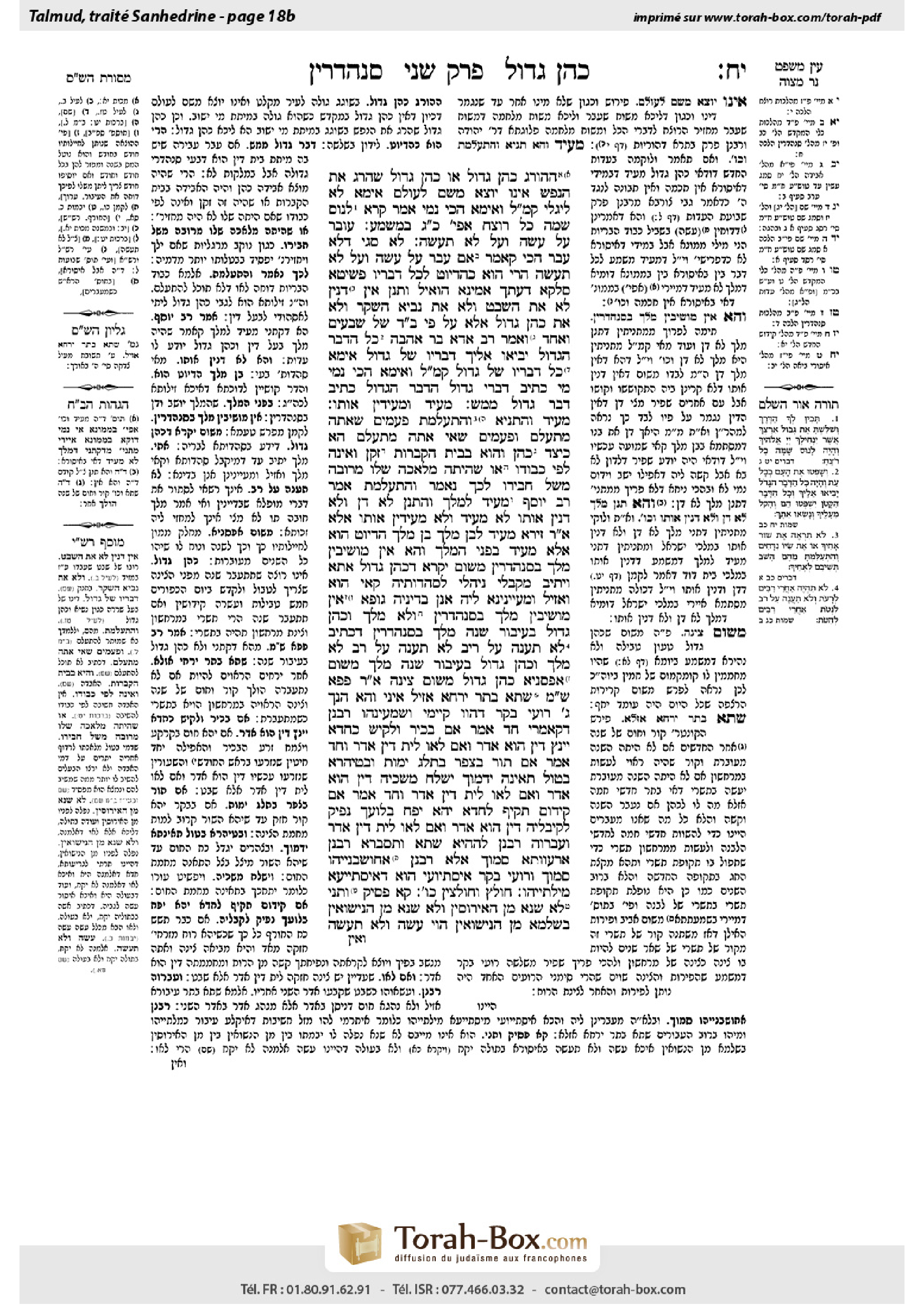
Sanhedrin 18b: Talmud study for Daf Yomi
Daf Yomi is the daily study of one Talmud folio. Explore 37 tractates with scans, Hebrew text, Sefaria English and AI-generated French translations where annotated.
Passage selection and English or AI-generated French translation are available where the scan has annotations. Daf Study is independent of Torah-Box and Sefaria.
Browse Sanhedrin · סנהדרין · All tractatesSanhedrin 18b text and translations
This page of Sanhedrin includes the Aramaic text, an English translation and an AI-generated French translation, alongside the scan above.
סנהדרין י״ח ב · Aramaic and Hebrew text
הַהוֹרֵג כֹּהֵן גָּדוֹל, אוֹ כֹּהֵן גָּדוֹל שֶׁהָרַג אֶת הַנֶּפֶשׁ – אֵינוֹ יוֹצֵא מִשָּׁם לְעוֹלָם; אֵימָא לָא לִיגְלֵי – קָא מַשְׁמַע לַן. וְאֵימָא הָכִי נָמֵי? אָמַר קְרָא ״לָנוּס שָׁמָּה כׇּל רֹצֵחַ״ – אֲפִילּוּ כֹּהֵן גָּדוֹל בַּמַּשְׁמָע.
עוֹבֵר עַל עֲשֵׂה וְעַל לֹא תַעֲשֶׂה. לָא סַגִּי דְּלָא עָבַר? הָכִי קָאָמַר: אִם עָבַר עַל עֲשֵׂה וְעַל לֹא תַעֲשֶׂה, הֲרֵי הוּא כְּהֶדְיוֹט לְכׇל דְּבָרָיו.
פְּשִׁיטָא! סָלְקָא דַּעְתָּךְ אָמֵינָא, הוֹאִיל וּתְנַן: אֵין דָּנִין לֹא אֶת הַשֵּׁבֶט וְלֹא אֶת נְבִיא הַשֶּׁקֶר וְלֹא אֶת כֹּהֵן גָּדוֹל אֶלָּא עַל פִּי בֵּית דִּין שֶׁל שִׁבְעִים וְאֶחָד, וְאָמַר רַב אַדָּא בַּר אַהֲבָה: ״כׇּל הַדָּבָר הַגָּדֹל יָבִיאוּ אֵלֶיךָ״ – דְּבָרָיו שֶׁל גָּדוֹל, אֵימָא כׇּל דְּבָרָיו שֶׁל גָּדוֹל, קָא מַשְׁמַע לַן.
וְאֵימָא הָכִי נָמֵי: מִי כְּתִיב דִּבְרֵי גָדוֹל? ״הַדָּבָר הַגָּדֹל״ כְּתִיב, דָּבָר גָּדוֹל מַמָּשׁ.
מֵעִיד וּמְעִידִין אוֹתוֹ. מֵעִיד? וְהָתַנְיָא: ״וְהִתְעַלַּמְתָּ״ – פְּעָמִים שֶׁאַתָּה מִתְעַלֵּם, וּפְעָמִים שֶׁאִי אַתָּה מִתְעַלֵּם. הָא כֵּיצַד?
כֹּהֵן וְהוּא בְּבֵית הַקְּבָרוֹת, זָקֵן וְאֵינָהּ לְפִי כְּבוֹדוֹ, אוֹ שֶׁהָיְתָה מְלָאכָה שֶׁלּוֹ מְרוּבָּה מִשֶּׁל חֲבֵירוֹ – לְכָךְ נֶאֱמַר ״וְהִתְעַלַּמְתָּ״.
אָמַר רַב יוֹסֵף: מֵעִיד לַמֶּלֶךְ. וְהָתְנַן: לֹא דָּן וְלֹא דָּנִין אוֹתוֹ, לֹא מֵעִיד וְלֹא מְעִידִין אוֹתוֹ? אֶלָּא אָמַר רַבִּי זֵירָא: מֵעִיד לְבֶן מֶלֶךְ. בֶּן מֶלֶךְ הֶדְיוֹט הוּא!
אֶלָּא, מֵעִיד בִּפְנֵי הַמֶּלֶךְ. וְהָא אֵין מוֹשִׁיבִין מֶלֶךְ בְּסַנְהֶדְרִין! מִשּׁוּם יְקָרָא דְּכֹהֵן גָּדוֹל אֲתָא וְיָתֵיב. מְקַבְּלִי נִיהֲלֵיהּ לְסָהֲדוּתֵיהּ, קָאֵי הוּא וְאָזֵיל, וּמְעַיְּינִינָא לֵיהּ אֲנַן בְּדִינֵיהּ.
גּוּפָא: אֵין מוֹשִׁיבִין מֶלֶךְ בַּסַּנְהֶדְרִין, וְלֹא מֶלֶךְ וְכֹהֵן גָּדוֹל בְּעִיבּוּר שָׁנָה. מֶלֶךְ בַּסַּנְהֶדְרִין – דִּכְתִיב: ״לֹא תַעֲנֶה עַל רִב״ – לֹא תַעֲנֶה עַל רַב.
לֹא מֶלֶךְ וְכֹהֵן גָּדוֹל בְּעִיבּוּר שָׁנָה. מֶלֶךְ – מִשּׁוּם אַפְסַנְיָא, כֹּהֵן גָּדוֹל – מִשּׁוּם צִינָּה.
אָמַר רַב פָּפָּא: שְׁמַע מִינַּהּ, שַׁתָּא בָּתַר יַרְחָא אָזֵיל. אִינִי? וְהָא הָנָךְ שְׁלֹשָׁה רוֹעֵי בָקָר דַּהֲווֹ קָיְימִי, וְשַׁמְעִינְהוּ רַבָּנַן דְּקָאָמְרִי:
חַד אָמַר: אִם בַּכִּיר וְלַקִּישׁ כַּחֲדָא יֵינֵץ – דֵּין הוּא אֲדָר, וְאִם לָאו – לֵית דֵּין אֲדָר. וְחַד אָמַר: אִם תּוֹר בִּצְפַר בִּתְלַג יְמוּת, וּבְטִיהֲרָא בְּטוּל תְּאֵינָה יִדְמוֹךְ יַשְׁלַח מַשְׁכֵּיהּ – דֵּין הוּא אֲדָר, וְאִם לָאו – לֵית דֵּין אֲדָר. וְחַד אָמַר: אִם קִידּוּם תַּקִּיף לַחֲדָא יְהֵא, יִפַּח בְּלוֹעָךְ נָפֵיק לְקִיבְלֵיהּ – דֵּין הוּא אֲדָר, וְאִם לָאו – לֵית דֵּין אֲדָר. וְעַבְּרוּהָ רַבָּנַן לְהַהִיא שַׁתָּא.
וְתִסְבְּרָא רַבָּנַן אַרָעֲווֹתָא סְמוּךְ? אֶלָּא, רַבָּנַן אַחוּשְׁבָּנַיְיהוּ סְמוּךְ, וְרוֹעֵי בָקָר אִיסְתַּיּוֹעֵי הוּא דְּאִיסְתַּיַּיעָא מִילְּתַיְיהוּ.
חוֹלֵץ וְחוֹלְצִין כּוּ׳. קָא פָּסֵיק וְתָנֵי, לָא שְׁנָא מִן הָאֵירוּסִין וְלָא שְׁנָא מִן הַנִּישּׂוּאִין. בִּשְׁלָמָא מִן הַנִּישּׂוּאִין, הָוֵי עֲשֵׂה וְלֹא תַעֲשֶׂה -
Sanhedrin 18b · English translation
With regard to one who kills a High Priest or a High Priest who killed a person, he never departs from the city of refuge. Therefore, I will say that a High Priest is not exiled at all. For that reason, the baraita above teaches us that he is exiled. The Gemara suggests: Why not say that the halakha is indeed that the High Priest would not be exiled, since he would not be able to return home? The Gemara responds: The verse states concerning the city of refuge: “That every manslayer may flee there” (Deuteronomy 19:3), and even a High Priest is indicated by the inclusive term “every.”
The baraita teaches that a High Priest transgresses a positive mitzva and a prohibition. The Gemara understands the baraita as an independent statement asserting that the High Priest must transgress a positive mitzva and a prohibition, and asks: Is it not possible that he doesn’t transgress a positive mitzva and prohibition; i.e., must the High Priest transgress a positive mitzva and a prohibition? The Gemara responds: This is what the baraita is saying: This is not an independent statement asserting that the High Priest must transgress a positive mitzva and a prohibition; rather, the baraita teaches that if he transgressed a positive mitzva and a prohibition, then he is considered to be like an ordinary person concerning all of his halakhot, judged just as anyone else for common transgressions.
The Gemara asks: Isn’t that obvious? The Gemara responds: No, as it could enter your mind to say that since we learned in the mishna (2a): The court judges cases involving an entire tribe that sinned, or a false prophet, or a High Priest, only on the basis of a court of seventy-one judges, i.e., the Great Sanhedrin, and since Rav Adda bar Ahava says that the phrase “every great matter they shall bring unto you” (Exodus 18:22), refers to the matters of a great person, the High Priest, who is judged in a court of seventy-one, therefore, one might say that this means all the matters of a great person, including non-capital transgressions, are judged in a court of seventy-one. Therefore, the baraita teaches us that for non-capital transgressions, he is treated like an ordinary person, and judged even by a court of three.
The Gemara suggests: But why not say that indeed, the halakha is that all cases involving the High Priest must be adjudicated in a court of seventy-one? The Gemara rejects this. Is it written: The matters of a great person? “Every great matter” is written, meaning actually a great matter, one involving a capital transgression, not only one related to a great person.
§ The mishna teaches that the High Priest testifies before the court and others testify concerning him. The Gemara expresses surprise: He testifies? But isn’t it taught in a baraita that in the verse: “You shall not see your brother’s ox or his sheep wandering and ignore them; you shall return them to your brother” (Deuteronomy 22:1), the use of the unusual term “and ignore them,” as opposed to the more direct: Do not ignore them, indicates that there are times when you ignore lost items and there are times when you do not ignore them. How so?
The baraita answers: If the one who found the item was a priest, and the lost item is in the cemetery, where priests are prohibited from entering; or if he was an elderly person and it is not in keeping with his dignity to tend to a lost item of that kind; or if his work, which he would need to suspend in order to tend to and return the item, is of greater value than the lost item of the other, one might think that he must nonetheless return it. Therefore, with regard to those cases, it is stated: “And ignore them.” Since a distinguished individual may ignore a mitzva that is incumbent on others if it is not in keeping with his dignity, perhaps the High Priest would be allowed to ignore the obligation to testify, due to his honor.
Rav Yosef said: A High Priest testifies only about a king, since such testimony would not compromise his dignity. The Gemara objects: But didn’t we learn in the mishna above that the king does not judge and is not judged, and he does not testify and others do not testify concerning him? Rather, Rabbi Zeira said: The meaning of Rav Yosef’s statement is that a High Priest testifies about a son of a king. The Gemara objects: The son of a king is an ordinary person, without special status in halakha, so it is not in keeping with the High Priest’s dignity to testify concerning him.
Rather, the meaning of Rav Yosef’s statement is that he testifies before the king, and it is not in keeping with the dignity of the High Priest to testify if the king is a presiding judge. The Gemara objects: But didn’t we learn in a baraita (Tosefta 2:8) that a king is not seated on the Sanhedrin? The Gemara explains: Rav Yosef is referring to a special arrangement: Due to the honor of the High Priest, the king comes and sits as one of the judges, they receive his testimony, he rises and goes, and we deliberate about the case.
§ Having mentioned this baraita, the Gemara turns its attention to the matter itself: A king is not seated on the Sanhedrin, nor is a king or a High Priest seated on a court for intercalating the year. The Gemara explains: With regard to a king on the Sanhedrin, the source is as it is written: “Do not answer in a cause [riv]” (Exodus 23:2), which is explained to mean: Do not answer to a great person [rav]. Therefore, one whose stature will make the other judges afraid to contradict him may not be appointed to the Sanhedrin.
The Gemara continues its explanation of the baraita: Nor is a king or a High Priest seated on a court for intercalating the year. A king does not serve as a judge concerning this matter due to the sustenance of soldiers. A High Priest does not serve as a judge concerning this matter due to the cold. If a month is added to the calendar and the High Priest must perform his Yom Kippur immersions and walk barefoot on the floor of the Temple deeper into the cold autumn, he too will have a vested interest in not adding a month.
Rav Pappa says: Learn from the ruling concerning the High Priest that the weather of the year follows the months, meaning that changes in the seasons are in accordance with the sequence of the months in the standard, non-intercalated calendar. The High Priest would not want the year to be intercalated, because then the colder weather of Marḥeshvan would occur during Tishrei. The Gemara asks: Is that so? But isn’t that contradicted by the incident of those three cattle herders that were standing around, and the Sages heard them saying various statements about annual weather signs?
One of them said: If the first grains and the late-ripening grains sprout at the same time, that is Adar, but if not, that is not Adar but still Shevat. And one of them said: If an ox dies in the morning in the snow, indicating that it is still very cold, and at noon in the shade of a fig tree it sleeps, rubbing against it to strip off its skin because of the heat, that is Adar, but if not, that is not Adar. And one of them said: If there is a very strong east wind, which is cold, yet the warm air that you blow with your jaw goes out and toward it and overcomes its effect, that is Adar, but if not, that is not Adar. And since those signs had not yet come to pass, the Sages intercalated the calendar that year.
The Gemara rejects this: And can you understand that the Sages relied on cattle herders to determine halakha? Rather, the Sages relied on their own calculations, and those cattle herders were supported inasmuch as their statements were supported by the Sages’ independent conclusion.
§ The mishna teaches that the High Priest performs ḥalitza with his brother’s widow and his brother performs ḥalitza with his wife, but in any case he does not consummate levirate marriage with his brother’s wife. The Gemara comments: The mishna categorically teaches that the High Priest does not consummate levirate marriage, and there is no difference whether his brother’s wife was a widow from betrothal alone and no difference whether she was a widow from a marriage that had been consummated. Granted, it is understood that he does not consummate levirate marriage with a widow from marriage, since there is both a positive mitzva: “And he shall take a wife in her virginity” (Leviticus 21:13), and also a prohibition: “A widow, or one divorced, or a ḥalala, or a zona, these shall he not take” (Leviticus 21:14),
Sanhedrin 18b · Traduction française (IA)
À propos de celui qui tue un grand prêtre, ou du grand prêtre qui a tué quelqu’un, il ne quitte jamais la ville de refuge. On pourrait donc dire qu’un grand prêtre n’est jamais exilé. C’est pourquoi la baraïta précédente nous enseigne qu’il est exilé. La Guemara suggère : pourquoi ne pas dire que la halakha est effectivement qu’un grand prêtre n’est pas exilé, puisqu’il ne pourrait pas rentrer chez lui ? La Guemara répond : le verset dit, au sujet de la ville de refuge : « afin que tout meurtrier puisse s’y réfugier » (Deutéronome 19,3), et le terme inclusif « tout » englobe également un grand prêtre.
La baraïta enseigne qu’un grand prêtre transgresse une mitsva positive et une interdiction. La Guemara comprend que la baraïta affirme de manière autonome que le grand prêtre doit transgresser une mitsva positive et une interdiction, et demande : Ne pourrait-il pas ne pas transgresser une mitsva positive et une interdiction ? Autrement dit, le grand prêtre doit-il nécessairement transgresser une mitsva positive et une interdiction ? La Guemara répond : voici ce que dit la baraïta : elle n’affirme pas de manière autonome que le grand prêtre doit transgresser une mitsva positive et une interdiction ; elle enseigne plutôt que, s’il a transgressé une mitsva positive et une interdiction, il est considéré, pour toutes ses halakhot, comme un homme ordinaire et est jugé comme n’importe qui pour les transgressions ordinaires.
La Guemara demande : Cela n’est-il pas évident ? La Guemara répond : Non, car on pourrait penser que, puisque nous avons appris dans la Michna (2a) que le tribunal ne juge les affaires impliquant une tribu entière qui a péché, un faux prophète ou un grand prêtre qu’avec un tribunal de soixante et onze juges, c’est-à-dire le Grand Sanhédrin, et puisque Rav Adda bar Ahava dit que l’expression « toute grande affaire, ils vous la présenteront » (Exode 18,22) désigne les affaires d’un grand personnage, le grand prêtre, qui est jugé par un tribunal de soixante et onze juges, il pourrait sembler que toutes les affaires d’un grand personnage, y compris les transgressions non passibles de la peine capitale, doivent être jugées par un tribunal de soixante et onze juges. La baraïta nous enseigne donc que, pour les transgressions non passibles de la peine capitale, il est traité comme un homme ordinaire et peut être jugé même par un tribunal de trois juges.
La Guemara suggère : Mais pourquoi ne pas dire qu’en effet, la halakha est que toutes les affaires impliquant le grand prêtre doivent être jugées par un tribunal de soixante et onze juges ? La Guemara rejette cette possibilité : Est-il écrit « les affaires d’un grand personnage » ? Il est écrit « toute grande affaire », ce qui signifie une affaire véritablement importante, impliquant une transgression passible de la peine capitale, et non simplement une affaire concernant un grand personnage.
§ La Michna enseigne que le grand prêtre témoigne devant le tribunal et que d’autres témoignent à son sujet. La Guemara s’étonne : Il témoigne ? Mais n’est-il pas enseigné dans une baraïta que, dans le verset « Tu ne verras pas l’âne ou le mouton de ton frère égaré et ne les ignoreras pas ; tu les ramèneras à ton frère » (Deutéronome 22,1), l’emploi de l’expression inhabituelle « et ne les ignoreras pas », au lieu de la formulation plus directe « ne les ignore pas », indique qu’il y a des cas où l’on ignore les objets perdus et d’autres où on ne les ignore pas ? Lesquels ?
La baraïta répond : si celui qui a trouvé l’objet est un prêtre et que l’objet perdu se trouve dans un cimetière, où les prêtres n’ont pas le droit d’entrer ; ou s’il s’agit d’une personne âgée et qu’il ne sied pas à sa dignité de s’occuper d’un objet perdu de cette sorte ; ou si le travail qu’il devrait interrompre pour s’occuper de l’objet et le restituer a plus de valeur que l’objet perdu d’autrui, on pourrait penser qu’il doit néanmoins le restituer. C’est pourquoi, à propos de ces cas, il est dit : « et ignore-les ». Puisqu’une personne éminente peut ignorer une mitsva qui incombe aux autres si son accomplissement ne sied pas à sa dignité, peut-être le grand prêtre serait-il autorisé à ignorer l’obligation de témoigner, par égard pour son honneur.
Rav Yosef a dit : un grand prêtre ne témoigne qu’au sujet d’un roi, car un tel témoignage ne porterait pas atteinte à sa dignité. La Guemara objecte : Mais n’avons-nous pas appris dans la Michna précédente que le roi ne juge pas et n’est pas jugé, qu’il ne témoigne pas et que d’autres ne témoignent pas à son sujet ? Rabbi Zeira a plutôt dit que Rav Yosef voulait dire qu’un grand prêtre témoigne au sujet du fils d’un roi. La Guemara objecte : Le fils d’un roi est un homme ordinaire, sans statut particulier en halakha ; il ne sied donc pas à la dignité du grand prêtre de témoigner à son sujet.
Il faut plutôt comprendre que, selon Rav Yosef, le grand prêtre témoigne devant le roi, et qu’il ne sied pas à sa dignité de témoigner si le roi préside le tribunal. La Guemara objecte : Mais n’avons-nous pas appris dans une baraïta (Tosefta 2:8) qu’un roi ne siège pas au Sanhédrin ? La Guemara explique : Rav Yosef fait référence à un dispositif exceptionnel : par égard pour le grand prêtre, le roi vient siéger parmi les juges ; ils recueillent son témoignage, le roi se lève et s’en va, puis les juges délibèrent sur l’affaire.
§ Ayant mentionné cette baraïta, la Guemara revient au sujet lui-même : un roi ne siège pas au Sanhédrin, et ni un roi ni un grand prêtre ne siègent dans un tribunal chargé d’intercaler l’année. La Guemara explique que, pour le roi au Sanhédrin, la source est le verset : « Ne prends pas parti dans une affaire [riv] » (Exode 23,2), interprété ainsi : « Ne prends pas parti en faveur d’un grand personnage [rav]. » Par conséquent, une personne dont le rang ferait craindre aux autres juges de la contredire ne peut pas être nommée au Sanhédrin.
La Guemara poursuit son explication de la baraïta : ni un roi ni un grand prêtre ne siègent dans un tribunal chargé d’intercaler l’année. Un roi ne siège pas comme juge dans cette affaire en raison de la subsistance des soldats. Un grand prêtre ne siège pas comme juge dans cette affaire en raison du froid. Si l’on ajoute un mois au calendrier et que le grand prêtre doit accomplir ses immersions de Yom Kippour et marcher pieds nus sur le sol du Temple alors que l’automne avance vers une période plus froide, lui aussi aura intérêt à ce qu’on n’ajoute pas de mois.
Rav Pappa dit : apprends de la règle concernant le grand prêtre que le climat de l’année suit les mois, c’est-à-dire que les changements de saison correspondent à l’ordre des mois dans le calendrier ordinaire, non intercalé. Le grand prêtre ne voudrait pas que l’année soit intercalée, car le froid de Marḥeshvan surviendrait alors pendant Tishrei. La Guemara demande : Est-ce bien le cas ? Mais cela n’est-il pas contredit par l’histoire de ces trois bergers qui se tenaient là et dont les Sages entendirent diverses déclarations sur les signes météorologiques de l’année ?
L’un d’eux dit : si les céréales précoces et les céréales tardives poussent en même temps, c’est Adar ; sinon, ce n’est pas Adar, mais encore Shevat. Un autre dit : si un bœuf meurt le matin dans la neige, signe qu’il fait encore très froid, puis qu’à midi, à l’ombre d’un figuier, il dort en se frottant contre l’arbre pour s’écorcher à cause de la chaleur, c’est Adar ; sinon, ce n’est pas Adar. Un autre dit : si un vent d’est très puissant, qui est froid, souffle, mais que l’air chaud que l’on expire par la bouche se dirige vers lui et en surmonte l’effet, c’est Adar ; sinon, ce n’est pas Adar. Et puisque ces signes ne s’étaient pas encore manifestés, les Sages intercalèrent le calendrier cette année-là.
La Guemara rejette cette explication : Peut-on comprendre que les Sages se soient appuyés sur des bergers pour déterminer la halakha ? Les Sages se sont plutôt fiés à leurs propres calculs, et les déclarations des bergers ont été corroborées dans la mesure où elles concordaient avec la conclusion indépendante des Sages.
§ La Michna enseigne que le grand prêtre accomplit la ḥalitza avec la veuve de son frère, et que son frère accomplit la ḥalitza avec sa femme ; en tout état de cause, le grand prêtre ne consomme pas le mariage léviratique avec la femme de son frère. La Guemara remarque que la Michna enseigne catégoriquement que le grand prêtre ne consomme pas le mariage léviratique, sans faire de différence entre le cas où la femme de son frère est devenue veuve après de simples fiançailles et celui où elle est devenue veuve après un mariage consommé. Il est compréhensible qu’il ne consomme pas le mariage léviratique avec une veuve dont le mariage a été consommé, puisqu’il y a à la fois une mitsva positive : « Il prendra une femme dans sa virginité » (Lévitique 21,13), et une interdiction : « Une veuve, une femme divorcée, une profanée ou une prostituée, il ne les prendra pas » (Lévitique 21,14),
Traduction française générée par IA à partir de l’édition anglaise de Sefaria. Vérifie toujours un passage avec le texte source.
Text from Sefaria: William Davidson Edition - Vocalized Aramaic (CC BY NC); William Davidson Edition - English (CC BY NC).